Global Good Practice Analysis on LEDS, NAMAs and MRV
www.mitigationpartnership.net/gpa
Mexico
Building a comprehensive national MRV framework
Development and implementation of a comprehensive national MRV institutional framework in Mexico
Mexico
Industry; Energy; Transport; Waste
2004 to present
Mexico has shown international leadership in developing legislation, policy and programmes to support
its transition to a low carbon economy. A general law on climate change was recently approved and a long
term climate change strategy is under implementation, together with a multi-stakeholder approach to
develop an institutional MRV framework to support NAMAs and LEDS.
The institutional MRV framework being implemented aims to go beyond simply tracking emission reduc-
tions and includes a set of measures, systems and registries to perform policy evaluation, institutional
strengthening and ultimately support decision-making. Currently the MRV framework in Mexico con-
sists of several mechanisms, including laws, reporting rules, estimation methodologies, and coordination
among different institutions of the public and private sector.
These mechanisms continue to be developed and continuously improved and currently serve as a good
example of progress towards a comprehensive national MRV framework.
Activity
Country
Sector(s) involved
Time frame
Case summary
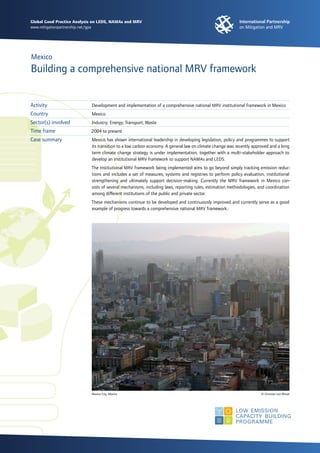
Mexico City, Mexico 	 © Christian von Wissel
2
Mexico
Building a comprehensive national MRV framework
Global Good Practice Analysis on LEDS, NAMAs and MRV2
In 2000 Mexico launched its first National Climate Action Strategy (updated in 2013 after the completion
of an innovative federal Climate Change Special Programme 2009–2012), followed by a national pledge
to reduce greenhouse gas emissions by 30 % by 2020, and 50 % by 2050. This pledge was announced in
2010 by President Calderon at UNFCCC-COP16 in Cancun, and triggered action and policy-making not
only at the federal level, but also at the state and municipal level.
The first milestone towards building an institutional MRV framework in Mexico was the introduction of
the voluntary GHG reporting programme from the private sector in 2004, using the World Resources
Institute’s GHG Protocol. This programme and the data and information it generated then helped to com-
moditise GHG emissions through Mexico’s engagement with the Clean Development Mechanism (CDM).
In 2007 the National Development Plan included a set of objectives related to climate change, which
were further developed in the national strategy on climate change. A more comprehensive approach was
taken with the Climate Change Special Programme 2009–2012 (PECC), which required federal entities
to use indicators to assess progress, not only in terms of emission reductions, but also in how policy, pro-
grammes and projects were implemented. The main impact of including a set of indicators as a milestone
of the MRV institutional framework is that this allowed the Ministry of Environment (SEMARNAT) to
assess progress, and more importantly, correct and improve policy to re-align goals with activities under
this programme.
Climate policy has resulted in the development of several NAMA proposals, and an updated National
Climate Change Strategy with a long-term view to the next ten, twenty and forty years. Together with this
strategy, Mexico has built on the experience and capacity created under the Clean Development Mech-
anism (CDM) to introduce the concept of NAMAs in different sectors, accompanied by an evolving MRV
institutional framework.
»» General Law on Climate Change (GLCC): The 2012 General Law gave a mandate to federal government
to develop long-term climate change policy using impact and effectiveness indicators to facilitate eval-
uation and focus on results. Indicators had already been developed for the Crosscutting Agenda Infor-
mation System (SIAT-PECC) supporting the PECC (2009–12), a web-based tool that tracks progress of
activities under this programme. This progress is not only reviewed by SEMARNAT, but it is reported
to the President’s Office every other month, resulting in several ministries enacting programmes and
projects to comply with top-level official mandates, and ultimately PECC’s objectives.
»» Establishing an institutional framework: As a relatively new area of activity with little international ex-
perience to draw on, Mexico and its international partners are undertaking a rapid learning-by-doing
process that aims to establish a long-term MRV institutional framework according to domestic needs
and capacities (see figure below). The current focus is on tracking policy and emissions (quantification
of co-benefits to follow) with focussing on the establishment and implementation of the following:
»» Climate Change National Strategy: Mandated by the Climate Change General Law, this is the long-
term vision published in 2013. One of its 6 pillars requires the development of tools for Measurement,
Reporting and Verification, and Monitoring and Evaluation to ensure environmental integrity, compa-
rability, consistency, transparency and accuracy of data to support the achievement of the national
adaptation and mitigation policy objectives.
»» Climate Change Special Programme 2013–2018: This programme includes objectives, strategies, ac-
tions and goals for the federal government in tackling climate change. This is the 2nd
edition, and it
has been improved in the use of indicators and parameters that support the SIAT-PECC, a tracking
progress system of this plan, not only in terms of emissions, but also in terms of institutional activities.
It was published in April 2014.
Background
Activities
Mexico
Building a comprehensive national MRV framework
www.mitigationpartnership.net/gpa 3
»» National Emissions Registry (NER): This registry will consider all industrial and mobile sources, ac-
cording to reporting thresholds and other parameters currently under discussion. A first take around
volume is that installations with emissions higher than 25,000 tons of CO2
e/a will need to report
emissions to the NER. It will be hosted at the INECC, and it is expected to be fully functional in 2015,
with verification every 3 years.
Inter-Ministerial Commission on Climate Change (CICC); Ministry of Environment and Natural Resources
(SEMARNAT); National Institute of Ecology and Climate Change (INECC); Commission on Private Sector
Studies for Sustainable Development (CESPEDES).
Global Environment Facility (GEF), Deutsche Gesellschaft für Internationale Zusammenarbeit (GIZ), Inter-­
American Development Bank (IADB), United Nations Development Programme (UNDP) and USAID.
The MRV institutional framework has long been financed through the Mexican Federal Government. How-
ever, several of the estimation methodologies, instruments, processes and policy design, particularly as
they are related to LEDS and NAMAs, are funded with resources from international sources. Donors in-
clude the Dutch Ministry of Infrastructure and the Environment, the European Union, the German Federal
Ministry for the Environment, Nature Conservation, Building and Nuclear Safety (BMUB) through its
International Climate Initiative (IKI), IADB, KfW, UNDP, USAID, and World Bank. Several donors are keen
to work with the country, as Mexico’s development of an MRV framework makes it easier to track impact,
making technical cooperation financing relatively more attractive than in other countries.
Institutions involved
Cooperation with
Finance
General
Climate
Change
Law
(2012)
Inter-ministerial Commission
on Climate Change
Climate Change Council
National Institute for Ecology
and Climate Change
States and Municipalities
Congress
EmissionsReductions
Reporting
National Communications and BURs
National Emissions Registry
Local Climate Change Programs
Website of National Information System
PECC’s electronic monitoring system
National Emissions Registry
(voluntary report of reductions)
Domestic and international NAMA registry
Verification
International Assessment
National Verification Entities
Evaluation Committee*
National Verification Entities
Measurement
National Emissions Inventory
National Emissions Registry
Local Inventories
National Information System
Monitoring system of the Special
Climate Change Program (PECC)
National Emissions Registry
(voluntary report of reductions)
Domestic NAMA registry
REDD+ National Strategy with
MRV scheme
* Policy Evaluation: Adaption policy reviewed and updated at least every 6 years. Mitigation policy reviewed and updated at least every 10 years.
Source: Semarnat (2014) Mexican Climate Change Law and Policy. March 2014. Presentation by Mónica Echegoyen López, Director for Global
Environmental Policy.
Policy InstitutionsPolicy Instruments
Mexican MRV Framework
National
National Climate Change Strategy
(10-20-40 years route)
Federal
Special Climate Change Program
(every 6 year presidential term)
Local
Local Climate Change Programs
(every 6 year local administrations)
National
Climate
Change
System
4
Mexico
Building a comprehensive national MRV framework
Global Good Practice Analysis on LEDS, NAMAs and MRV4
»» Enhanced institutional capacity: The main impact of developing an MRV institutional framework is
that decision-making is being backed up by data that confirms policy effectiveness. In turn, this has
attracted resources from international donors, as they can better track impact and progress. These
additional resources have resulted in the enhancement of institutional capacity, within and outside
the government.
»» Reduced burden to regulated entities: An MRV system is a key component of climate policy, and as
such, Mexico, particularly working together with the private sector, has introduced MRV right from
the beginning of policy design, with the aim of reducing negative impacts and burdens to regulated
entities.
»» Low-carbon supply chain: Nowadays, several participants in the GHG Programme, according to their
internal voluntary commitments, use the MRV institutional framework to reduce emissions and extend
this voluntary participation to their supply chain, using the GHG Programme guidelines. The GHG Pro-
gramme is now advocating simplified reporting, to include GHG emissions and other environmental and
social responsibility commitments, so to minimise compliance costs and burdens, as well as the need to
file multiple reports, including those associated with financing low carbon and clean energy projects.
»» Long-term framework: MRV is developing broader utility not only for tracking emissions, but also
helping inform policy design and evaluation across the board. It is being used as a tool to evaluate
the Climate Change Special Programme (PECC), and to better define measures and methodologies to
assess the impact of emission reductions and policy development
»» The case is good practice as the country recognised the need of a set of coordinating mechanisms to
comply with the high-level goal of fighting climate change. At the same time, defining and imple-
menting an MRV institutional framework has changed the policy-making process, as now it requires
the use of indicators and tracking systems that allow continuous follow-up, as well as the possibility of
verifying achievement of expected results and making corrections when diversions occur. Furthermore,
the MRV framework provides additional transparency and quantification of impacts on how money is
being used from both domestic and international resources.
»» The institutional framework is also good practice, as it was backed and mandated by the President’s
office to track progress. This is particularly important, as climate change is still a contentious issue and
focusing on results is key in developing effective climate policy.
»» Further, the MRV case of Mexico is good practice as the country has managed to build the pillars of a
long-term transformational way to implement policy, mainstreaming the need for performance indica-
tors, evaluation methods, and compliance with the GLCC.
»» Climate change general law: The most important factors for success in developing the MRV framework
are two-fold. First, the Climate Change General Law requires that MRV be part of any policy or pro-
gramme that relates to climate change policy. Second, NAMAs are the climate strategy of choice in
Mexico, and conceptually, they require that MRV be fully integrated right from the beginning of the
policy consultation.
»» High-level political support: As a high political priority for the country, climate change activity is sup-
ported by a strong mandate and effective coordinating mechanisms among a number of key ministries.
»» Greenhouse Gas (GHG) Programme: This programme is to some extent a legacy of the CDM in Mex-
ico, and it was the first programme to start reporting emissions on a voluntary basis. The programme
is quite effective because it is voluntary, free, and recognised by government. This programme has
Impact of activities
Why is it good practice
Success factors
Mexico
Building a comprehensive national MRV framework
www.mitigationpartnership.net/gpa 5
evolved from reporting, to the identification of emission reduction opportunities, to its current status
of verification of emission reductions within the private sector, while creating synergies and reducing
reporting costs. To see this in context, the first expected period for verification in Mexico is in 2015.
Thus, no other single installation, under other programmes, neither public nor private, has been veri-
fied, except from the CDM context.
What were the main barriers/challenges to delivery?
How were these barriers/challenges overcome?
Resources are too limited to reach the whole country, and are concentrated in the larger cities.
Key players are considering using remote systems to perform training relevant to the local context.
There is a need for additional capacity on MRV at all levels, including federal organizations, ministries,
states and municipalities, as well as the private sector and civil society.
A first approach to address this challenge has been through the free GHG Programme, where capacities
are being outsourced. However stakeholders agree that this approach is not sustainable in the long-run.
Regarding the public sector, there is a challenge in increasing domestic and internal capacity related to
climate change. An alternative is to outsource the implementation of different elements of the MRV insti-
tutional framework, particularly in the verification process, similarly to the CDM validation and verification
process.
The country lacks the financial resources needed to comply with the high international expectations of
an MRV framework.
Voluntary programmes are being funded by the private sector and the international community. However,
there is a tremendous challenge on using a voluntary programme to address an issue that creates addi-
tional burdens and costs to regulated entities. There is a need to inform the private sector how MRV can
be used for their own benefit.
Reporting methods have relied on independent, isolated and non-verifiable information systems.
Mexico is taking steps to improve reporting through electronic platforms and available GHG estimation
methodologies in Spanish, whilst also introducing verification and auditable processes.
Information across ministries, public and private sector, and civil society organisations does not flow naturally.
SEMARNAT, together with its partners, have helped in communicating the benefits of using MRV, and
particularly how MRV can be used for better decision-making by other ministries.
Despite the growth of international support, domestic institutions have not been able to cope with the
technical and administrative challenges of an MRV framework at the national level.
Several efforts have been accomplished by creating temporary outsourced capacities, funded by donors.
However, these capacities are temporary and end up diluted due to limited continuity in processes, and
outsourcing tends to be expensive. With the approval of the GLCC, it is expected that institutional capac-
ities will be enhanced within the public and private sectors.
Timing has not been considered fully in policy development and regulation design when it comes to policy
implementation. Many elements of the national strategy take longer than expected due to institutional
limitations and financial barriers (most GLCC secondary legislation was due within a year). This has result-
ed in institutions collapsing due to the enormous amount of work set for a simultaneous deadline.
As the GLCC is new, limited resources were used to determine the required technical capacities to assure
proper and timely implementation. The coordinating mechanisms of the Climate Change Commission
(CICC) have been challenged to working better together, in order to perform tasks faster, and to comply
with the timing of the GLCC.
Overcoming barriers/
challenges
Capacity
Financial
Information
Institutional
6
Mexico
Building a comprehensive national MRV framework
Global Good Practice Analysis on LEDS, NAMAs and MRV6
Despite international technical and financial support the lack of a model or blueprint from developed or
developing countries on how to implement an MRV institutional framework, has created the need for a
rapid learning-by-doing process.
Mexico has managed to create and adapt MRV to the local context, capacities and financial resources.
However, there is a challenge to create systematic and comparable reports that are consistent with the
technical discussions at the UNFCCC, while keeping them affordable and relevant domestically.
From the policy perspective, the main challenge associated with developing an MRV institutional frame-
work is in ensuring that it is envisaged as a complete system.
Stakeholders consider that a more incremental approach should be followed. This way, improvements can
be made according to the existing and evolving capacities of the country. As there is no blueprint on how
to develop an MRV framework, there is a challenge and opportunity to learn from developed countries
on how their own MRV frameworks were put in place. Today, SEMARNAT and INECC are setting standards
for monitoring and reporting within the MRV institutional framework. However, there is a need to provide
further incentives to support verification.
There is a CDM culture associated with climate policy that has created discussions on how the MRV should
be, and how it is useful.
SEMARNAT is focusing discussions on how the MRV could be of use, and how it differs from the CDM, so
that it is useful in the context of NAMAs and LEDS, rather than only focusing on access to carbon markets.
CESPEDES is assembling databases, documents, methodologies, among other inputs to facilitate report-
ing, and use it as a tool for improving GHG performance of all installations under the GHG Programme.
Planning and coordination: It is very difficult to implement an MRV framework that has no blueprint, so
investing in planning and coordinating mechanisms for how the MRV will work is key in order to avoid
duplication of reporting, improve comparability, and assure data quality. No less important, is that with an
MRV framework, it is easier for stakeholders (including donors) to track impacts.
»» Methodologies and approaches were not agreed at the beginning of policy development and imple-
mentation: This resulted in data and models that now use different approaches (top-down vs. bot-
tom-up), that rely on different information, and ultimately create more uncertainty about the results
of climate change policy, and the identification of opportunities for emission reductions.
»» Blending of national and international resources: This is required in a way that these can be partially
absorbed into the national institutional framework, to make MRV a continuous process.
»» Evaluate and revise existing MRV approaches and technical capacity: For example, technical capacities
developed to support CDM delivery, which many stakeholders saw as the prevailing MRV framework
in Mexico.
»» Creating and enhancing coordinating mechanisms: Helps to avoid duplication right from the beginning
of policy design, and improve it through development and implementation. These coordinating mech-
anisms will be key for policy evaluation.
»» Legislative mandate: The Climate Change General Law eliminated or reduced several barriers for the
implementation of a more robust and comprehensive framework. Having a general law creates institu-
tional frameworks that help in reaching consensus, and assure better policy-making.
Lessons learned
How to replicate
this practice
Mexico
Building a comprehensive national MRV framework
www.mitigationpartnership.net/gpa 7
»» Provide reporting and estimation methodologies in appropriate, local language: Using a simplified
language that facilitates reporting through tools, and available web-based support documents. Assure
that regulated entities fully understand how their information will be used, and what quality assurance
process it will follow before verification.
»» Internalise MRV capacities into existing institutions: In order to become part of ministries and create
a continuous process of improvement, of both the MRV as a system, and policy-making in general.
Start incrementally, in small strides, as the MRV framework is for the long run. Prioritise sectors, and
use existing capacities.
»» Show from the start how MRV is useful, and how institutions and regulated entities could benefit from
it: MRV can be used as a tool to calculate carbon footprint and emission reduction opportunities, as
well as costs and savings, that can later be monetised in future carbon market mechanisms. MRV can
be seen as a tool to improve a more integrated approach to policy evaluation, rather than meeting only
climate policy criteria.
»» Monica Echegoyen, Climate Change Director, Ministry of Environment and Natural Resources, Mexico,
monica.echegoyen@semarnat.gob.mx
»» Presidencia de la República. (2012). Desarrollo Sustentable. Accessed on March 7, 2014.
Available at: http://calderon.presidencia.gob.mx/informe/sexto/sustentabilidad_ambiental.html
»» SEMARNAT. (2009). Programa Especial de Cambio Climático. Accessed on February 14, 2014.
Available at: http://gia.imta.mx/geoportal/docs/PECC.pdf
»» CÁMARA DE DIPUTADOS. (2012). Ley General de Cambio Climático. México. Accessed on
February 14, 2014. Available at: www.diputados.gob.mx/LeyesBiblio/pdf/LGCC.pdf
»» SEMARNAT. (2013). Estrategia Nacional de Cambio Climático. Accessed on February 14, 2014.
Available at: www.dof.gob.mx/nota_detalle_popup.php?codigo=5301093
»» GIZ. (2013). Evaluación del Programa Especial de Cambio Climático. Accessed on February 14, 2014.
Available at: http://imco.org.mx/wp-content/uploads/2013/2/studie_2_pecc_web_ok4.pdf
»» COMISIÓN INTERSECRETARIAL DE CAMBIO CLIMÁTICO, (2012), Informe de Avances del Programa
Especial de Cambio Climático 2009–2012. Accessed on February 14, 2014. Available at:
www.conagua.gob.mx/conagua07/contenido/documentos/pecc12.pdf
»» CESPEDES GHG Voluntary Programme website: www.geimexico.org/
»» Instituto Nacional de Ecología y Cambio Climático. www.inecc.gob.mx/
Enrique Rebolledo (Bajo Carbono)
Edited by: Nicholas Harrison (Ecofys)
Editorial support: Ana María Majano and María José Gutiérrez (INCAE); Frauke Röser, Thomas Day,
Daniel Lafond, Niklas Höhne and Katja Eisbrenner (Ecofys).
Coordination by: Ecofys www.ecofys.com and CLACDS, INCAE Business School
»» Jakob Graichen, Principal advisor on mitigation, MRV and transport, GIZ
»» Luisa Manzanares, GHG Voluntary Programme Manager, CESPEDES
»» Monica Echegoyen, Climate Change Director, Ministry of Environment and Natural Resources, Mexico.
»» Enrique Rebolledo, Senior Economist, Bajo Carbono Inc
Contact for enquiries
Further key resources
Website(s)
Case study author(s)
Case study contributor(s)
Global Good Practice Analysis on LEDS, NAMAs and MRV www.mitigationpartnership.net/gpa
Mexico
Building a comprehensive national MRV framework
©Layout:webersupiran.berlin
8
»» SEMARNAT. (2009). Programa Especial de Cambio Climático. Available at:
http://gia.imta.mx/geoportal/docs/PECC.pdf
»» CÁMARA DE DIPUTADOS. (2012). Ley General de Cambio Climático. México. Accessed on
February 14, 2014. Available at: www.diputados.gob.mx/LeyesBiblio/pdf/LGCC.pdf
»» SEMARNAT. (2013). Estrategia Nacional de Cambio Climático. Accessed on February 14, 2014.
Available at: www.dof.gob.mx/nota_detalle_popup.php?codigo=5301093
»» GIZ. (2013). Evaluación del Programa Especial de Cambio Climático. Available at:
http://imco.org.mx/wp-content/uploads/2013/2/studie_2_pecc_web_ok4.pdf
»» COMISIÓN INTERSECRETARIAL DE CAMBIO CLIMÁTICO, (2012), Informe de Avances del
Programa Especial de Cambio Climático 2009–2012. Available at:
www.conagua.gob.mx/conagua07/contenido/documentos/pecc12.pdf	
References

Development and implementation of a comprehensive national MRV institutional framework in Mexico

  • 1.
    Global Good PracticeAnalysis on LEDS, NAMAs and MRV www.mitigationpartnership.net/gpa Mexico Building a comprehensive national MRV framework Development and implementation of a comprehensive national MRV institutional framework in Mexico Mexico Industry; Energy; Transport; Waste 2004 to present Mexico has shown international leadership in developing legislation, policy and programmes to support its transition to a low carbon economy. A general law on climate change was recently approved and a long term climate change strategy is under implementation, together with a multi-stakeholder approach to develop an institutional MRV framework to support NAMAs and LEDS. The institutional MRV framework being implemented aims to go beyond simply tracking emission reduc- tions and includes a set of measures, systems and registries to perform policy evaluation, institutional strengthening and ultimately support decision-making. Currently the MRV framework in Mexico con- sists of several mechanisms, including laws, reporting rules, estimation methodologies, and coordination among different institutions of the public and private sector. These mechanisms continue to be developed and continuously improved and currently serve as a good example of progress towards a comprehensive national MRV framework. Activity Country Sector(s) involved Time frame Case summary Mexico City, Mexico © Christian von Wissel
  • 2.
    2 Mexico Building a comprehensivenational MRV framework Global Good Practice Analysis on LEDS, NAMAs and MRV2 In 2000 Mexico launched its first National Climate Action Strategy (updated in 2013 after the completion of an innovative federal Climate Change Special Programme 2009–2012), followed by a national pledge to reduce greenhouse gas emissions by 30 % by 2020, and 50 % by 2050. This pledge was announced in 2010 by President Calderon at UNFCCC-COP16 in Cancun, and triggered action and policy-making not only at the federal level, but also at the state and municipal level. The first milestone towards building an institutional MRV framework in Mexico was the introduction of the voluntary GHG reporting programme from the private sector in 2004, using the World Resources Institute’s GHG Protocol. This programme and the data and information it generated then helped to com- moditise GHG emissions through Mexico’s engagement with the Clean Development Mechanism (CDM). In 2007 the National Development Plan included a set of objectives related to climate change, which were further developed in the national strategy on climate change. A more comprehensive approach was taken with the Climate Change Special Programme 2009–2012 (PECC), which required federal entities to use indicators to assess progress, not only in terms of emission reductions, but also in how policy, pro- grammes and projects were implemented. The main impact of including a set of indicators as a milestone of the MRV institutional framework is that this allowed the Ministry of Environment (SEMARNAT) to assess progress, and more importantly, correct and improve policy to re-align goals with activities under this programme. Climate policy has resulted in the development of several NAMA proposals, and an updated National Climate Change Strategy with a long-term view to the next ten, twenty and forty years. Together with this strategy, Mexico has built on the experience and capacity created under the Clean Development Mech- anism (CDM) to introduce the concept of NAMAs in different sectors, accompanied by an evolving MRV institutional framework. »» General Law on Climate Change (GLCC): The 2012 General Law gave a mandate to federal government to develop long-term climate change policy using impact and effectiveness indicators to facilitate eval- uation and focus on results. Indicators had already been developed for the Crosscutting Agenda Infor- mation System (SIAT-PECC) supporting the PECC (2009–12), a web-based tool that tracks progress of activities under this programme. This progress is not only reviewed by SEMARNAT, but it is reported to the President’s Office every other month, resulting in several ministries enacting programmes and projects to comply with top-level official mandates, and ultimately PECC’s objectives. »» Establishing an institutional framework: As a relatively new area of activity with little international ex- perience to draw on, Mexico and its international partners are undertaking a rapid learning-by-doing process that aims to establish a long-term MRV institutional framework according to domestic needs and capacities (see figure below). The current focus is on tracking policy and emissions (quantification of co-benefits to follow) with focussing on the establishment and implementation of the following: »» Climate Change National Strategy: Mandated by the Climate Change General Law, this is the long- term vision published in 2013. One of its 6 pillars requires the development of tools for Measurement, Reporting and Verification, and Monitoring and Evaluation to ensure environmental integrity, compa- rability, consistency, transparency and accuracy of data to support the achievement of the national adaptation and mitigation policy objectives. »» Climate Change Special Programme 2013–2018: This programme includes objectives, strategies, ac- tions and goals for the federal government in tackling climate change. This is the 2nd edition, and it has been improved in the use of indicators and parameters that support the SIAT-PECC, a tracking progress system of this plan, not only in terms of emissions, but also in terms of institutional activities. It was published in April 2014. Background Activities
  • 3.
    Mexico Building a comprehensivenational MRV framework www.mitigationpartnership.net/gpa 3 »» National Emissions Registry (NER): This registry will consider all industrial and mobile sources, ac- cording to reporting thresholds and other parameters currently under discussion. A first take around volume is that installations with emissions higher than 25,000 tons of CO2 e/a will need to report emissions to the NER. It will be hosted at the INECC, and it is expected to be fully functional in 2015, with verification every 3 years. Inter-Ministerial Commission on Climate Change (CICC); Ministry of Environment and Natural Resources (SEMARNAT); National Institute of Ecology and Climate Change (INECC); Commission on Private Sector Studies for Sustainable Development (CESPEDES). Global Environment Facility (GEF), Deutsche Gesellschaft für Internationale Zusammenarbeit (GIZ), Inter-­ American Development Bank (IADB), United Nations Development Programme (UNDP) and USAID. The MRV institutional framework has long been financed through the Mexican Federal Government. How- ever, several of the estimation methodologies, instruments, processes and policy design, particularly as they are related to LEDS and NAMAs, are funded with resources from international sources. Donors in- clude the Dutch Ministry of Infrastructure and the Environment, the European Union, the German Federal Ministry for the Environment, Nature Conservation, Building and Nuclear Safety (BMUB) through its International Climate Initiative (IKI), IADB, KfW, UNDP, USAID, and World Bank. Several donors are keen to work with the country, as Mexico’s development of an MRV framework makes it easier to track impact, making technical cooperation financing relatively more attractive than in other countries. Institutions involved Cooperation with Finance General Climate Change Law (2012) Inter-ministerial Commission on Climate Change Climate Change Council National Institute for Ecology and Climate Change States and Municipalities Congress EmissionsReductions Reporting National Communications and BURs National Emissions Registry Local Climate Change Programs Website of National Information System PECC’s electronic monitoring system National Emissions Registry (voluntary report of reductions) Domestic and international NAMA registry Verification International Assessment National Verification Entities Evaluation Committee* National Verification Entities Measurement National Emissions Inventory National Emissions Registry Local Inventories National Information System Monitoring system of the Special Climate Change Program (PECC) National Emissions Registry (voluntary report of reductions) Domestic NAMA registry REDD+ National Strategy with MRV scheme * Policy Evaluation: Adaption policy reviewed and updated at least every 6 years. Mitigation policy reviewed and updated at least every 10 years. Source: Semarnat (2014) Mexican Climate Change Law and Policy. March 2014. Presentation by Mónica Echegoyen López, Director for Global Environmental Policy. Policy InstitutionsPolicy Instruments Mexican MRV Framework National National Climate Change Strategy (10-20-40 years route) Federal Special Climate Change Program (every 6 year presidential term) Local Local Climate Change Programs (every 6 year local administrations) National Climate Change System
  • 4.
    4 Mexico Building a comprehensivenational MRV framework Global Good Practice Analysis on LEDS, NAMAs and MRV4 »» Enhanced institutional capacity: The main impact of developing an MRV institutional framework is that decision-making is being backed up by data that confirms policy effectiveness. In turn, this has attracted resources from international donors, as they can better track impact and progress. These additional resources have resulted in the enhancement of institutional capacity, within and outside the government. »» Reduced burden to regulated entities: An MRV system is a key component of climate policy, and as such, Mexico, particularly working together with the private sector, has introduced MRV right from the beginning of policy design, with the aim of reducing negative impacts and burdens to regulated entities. »» Low-carbon supply chain: Nowadays, several participants in the GHG Programme, according to their internal voluntary commitments, use the MRV institutional framework to reduce emissions and extend this voluntary participation to their supply chain, using the GHG Programme guidelines. The GHG Pro- gramme is now advocating simplified reporting, to include GHG emissions and other environmental and social responsibility commitments, so to minimise compliance costs and burdens, as well as the need to file multiple reports, including those associated with financing low carbon and clean energy projects. »» Long-term framework: MRV is developing broader utility not only for tracking emissions, but also helping inform policy design and evaluation across the board. It is being used as a tool to evaluate the Climate Change Special Programme (PECC), and to better define measures and methodologies to assess the impact of emission reductions and policy development »» The case is good practice as the country recognised the need of a set of coordinating mechanisms to comply with the high-level goal of fighting climate change. At the same time, defining and imple- menting an MRV institutional framework has changed the policy-making process, as now it requires the use of indicators and tracking systems that allow continuous follow-up, as well as the possibility of verifying achievement of expected results and making corrections when diversions occur. Furthermore, the MRV framework provides additional transparency and quantification of impacts on how money is being used from both domestic and international resources. »» The institutional framework is also good practice, as it was backed and mandated by the President’s office to track progress. This is particularly important, as climate change is still a contentious issue and focusing on results is key in developing effective climate policy. »» Further, the MRV case of Mexico is good practice as the country has managed to build the pillars of a long-term transformational way to implement policy, mainstreaming the need for performance indica- tors, evaluation methods, and compliance with the GLCC. »» Climate change general law: The most important factors for success in developing the MRV framework are two-fold. First, the Climate Change General Law requires that MRV be part of any policy or pro- gramme that relates to climate change policy. Second, NAMAs are the climate strategy of choice in Mexico, and conceptually, they require that MRV be fully integrated right from the beginning of the policy consultation. »» High-level political support: As a high political priority for the country, climate change activity is sup- ported by a strong mandate and effective coordinating mechanisms among a number of key ministries. »» Greenhouse Gas (GHG) Programme: This programme is to some extent a legacy of the CDM in Mex- ico, and it was the first programme to start reporting emissions on a voluntary basis. The programme is quite effective because it is voluntary, free, and recognised by government. This programme has Impact of activities Why is it good practice Success factors
  • 5.
    Mexico Building a comprehensivenational MRV framework www.mitigationpartnership.net/gpa 5 evolved from reporting, to the identification of emission reduction opportunities, to its current status of verification of emission reductions within the private sector, while creating synergies and reducing reporting costs. To see this in context, the first expected period for verification in Mexico is in 2015. Thus, no other single installation, under other programmes, neither public nor private, has been veri- fied, except from the CDM context. What were the main barriers/challenges to delivery? How were these barriers/challenges overcome? Resources are too limited to reach the whole country, and are concentrated in the larger cities. Key players are considering using remote systems to perform training relevant to the local context. There is a need for additional capacity on MRV at all levels, including federal organizations, ministries, states and municipalities, as well as the private sector and civil society. A first approach to address this challenge has been through the free GHG Programme, where capacities are being outsourced. However stakeholders agree that this approach is not sustainable in the long-run. Regarding the public sector, there is a challenge in increasing domestic and internal capacity related to climate change. An alternative is to outsource the implementation of different elements of the MRV insti- tutional framework, particularly in the verification process, similarly to the CDM validation and verification process. The country lacks the financial resources needed to comply with the high international expectations of an MRV framework. Voluntary programmes are being funded by the private sector and the international community. However, there is a tremendous challenge on using a voluntary programme to address an issue that creates addi- tional burdens and costs to regulated entities. There is a need to inform the private sector how MRV can be used for their own benefit. Reporting methods have relied on independent, isolated and non-verifiable information systems. Mexico is taking steps to improve reporting through electronic platforms and available GHG estimation methodologies in Spanish, whilst also introducing verification and auditable processes. Information across ministries, public and private sector, and civil society organisations does not flow naturally. SEMARNAT, together with its partners, have helped in communicating the benefits of using MRV, and particularly how MRV can be used for better decision-making by other ministries. Despite the growth of international support, domestic institutions have not been able to cope with the technical and administrative challenges of an MRV framework at the national level. Several efforts have been accomplished by creating temporary outsourced capacities, funded by donors. However, these capacities are temporary and end up diluted due to limited continuity in processes, and outsourcing tends to be expensive. With the approval of the GLCC, it is expected that institutional capac- ities will be enhanced within the public and private sectors. Timing has not been considered fully in policy development and regulation design when it comes to policy implementation. Many elements of the national strategy take longer than expected due to institutional limitations and financial barriers (most GLCC secondary legislation was due within a year). This has result- ed in institutions collapsing due to the enormous amount of work set for a simultaneous deadline. As the GLCC is new, limited resources were used to determine the required technical capacities to assure proper and timely implementation. The coordinating mechanisms of the Climate Change Commission (CICC) have been challenged to working better together, in order to perform tasks faster, and to comply with the timing of the GLCC. Overcoming barriers/ challenges Capacity Financial Information Institutional
  • 6.
    6 Mexico Building a comprehensivenational MRV framework Global Good Practice Analysis on LEDS, NAMAs and MRV6 Despite international technical and financial support the lack of a model or blueprint from developed or developing countries on how to implement an MRV institutional framework, has created the need for a rapid learning-by-doing process. Mexico has managed to create and adapt MRV to the local context, capacities and financial resources. However, there is a challenge to create systematic and comparable reports that are consistent with the technical discussions at the UNFCCC, while keeping them affordable and relevant domestically. From the policy perspective, the main challenge associated with developing an MRV institutional frame- work is in ensuring that it is envisaged as a complete system. Stakeholders consider that a more incremental approach should be followed. This way, improvements can be made according to the existing and evolving capacities of the country. As there is no blueprint on how to develop an MRV framework, there is a challenge and opportunity to learn from developed countries on how their own MRV frameworks were put in place. Today, SEMARNAT and INECC are setting standards for monitoring and reporting within the MRV institutional framework. However, there is a need to provide further incentives to support verification. There is a CDM culture associated with climate policy that has created discussions on how the MRV should be, and how it is useful. SEMARNAT is focusing discussions on how the MRV could be of use, and how it differs from the CDM, so that it is useful in the context of NAMAs and LEDS, rather than only focusing on access to carbon markets. CESPEDES is assembling databases, documents, methodologies, among other inputs to facilitate report- ing, and use it as a tool for improving GHG performance of all installations under the GHG Programme. Planning and coordination: It is very difficult to implement an MRV framework that has no blueprint, so investing in planning and coordinating mechanisms for how the MRV will work is key in order to avoid duplication of reporting, improve comparability, and assure data quality. No less important, is that with an MRV framework, it is easier for stakeholders (including donors) to track impacts. »» Methodologies and approaches were not agreed at the beginning of policy development and imple- mentation: This resulted in data and models that now use different approaches (top-down vs. bot- tom-up), that rely on different information, and ultimately create more uncertainty about the results of climate change policy, and the identification of opportunities for emission reductions. »» Blending of national and international resources: This is required in a way that these can be partially absorbed into the national institutional framework, to make MRV a continuous process. »» Evaluate and revise existing MRV approaches and technical capacity: For example, technical capacities developed to support CDM delivery, which many stakeholders saw as the prevailing MRV framework in Mexico. »» Creating and enhancing coordinating mechanisms: Helps to avoid duplication right from the beginning of policy design, and improve it through development and implementation. These coordinating mech- anisms will be key for policy evaluation. »» Legislative mandate: The Climate Change General Law eliminated or reduced several barriers for the implementation of a more robust and comprehensive framework. Having a general law creates institu- tional frameworks that help in reaching consensus, and assure better policy-making. Lessons learned How to replicate this practice
  • 7.
    Mexico Building a comprehensivenational MRV framework www.mitigationpartnership.net/gpa 7 »» Provide reporting and estimation methodologies in appropriate, local language: Using a simplified language that facilitates reporting through tools, and available web-based support documents. Assure that regulated entities fully understand how their information will be used, and what quality assurance process it will follow before verification. »» Internalise MRV capacities into existing institutions: In order to become part of ministries and create a continuous process of improvement, of both the MRV as a system, and policy-making in general. Start incrementally, in small strides, as the MRV framework is for the long run. Prioritise sectors, and use existing capacities. »» Show from the start how MRV is useful, and how institutions and regulated entities could benefit from it: MRV can be used as a tool to calculate carbon footprint and emission reduction opportunities, as well as costs and savings, that can later be monetised in future carbon market mechanisms. MRV can be seen as a tool to improve a more integrated approach to policy evaluation, rather than meeting only climate policy criteria. »» Monica Echegoyen, Climate Change Director, Ministry of Environment and Natural Resources, Mexico, monica.echegoyen@semarnat.gob.mx »» Presidencia de la República. (2012). Desarrollo Sustentable. Accessed on March 7, 2014. Available at: http://calderon.presidencia.gob.mx/informe/sexto/sustentabilidad_ambiental.html »» SEMARNAT. (2009). Programa Especial de Cambio Climático. Accessed on February 14, 2014. Available at: http://gia.imta.mx/geoportal/docs/PECC.pdf »» CÁMARA DE DIPUTADOS. (2012). Ley General de Cambio Climático. México. Accessed on February 14, 2014. Available at: www.diputados.gob.mx/LeyesBiblio/pdf/LGCC.pdf »» SEMARNAT. (2013). Estrategia Nacional de Cambio Climático. Accessed on February 14, 2014. Available at: www.dof.gob.mx/nota_detalle_popup.php?codigo=5301093 »» GIZ. (2013). Evaluación del Programa Especial de Cambio Climático. Accessed on February 14, 2014. Available at: http://imco.org.mx/wp-content/uploads/2013/2/studie_2_pecc_web_ok4.pdf »» COMISIÓN INTERSECRETARIAL DE CAMBIO CLIMÁTICO, (2012), Informe de Avances del Programa Especial de Cambio Climático 2009–2012. Accessed on February 14, 2014. Available at: www.conagua.gob.mx/conagua07/contenido/documentos/pecc12.pdf »» CESPEDES GHG Voluntary Programme website: www.geimexico.org/ »» Instituto Nacional de Ecología y Cambio Climático. www.inecc.gob.mx/ Enrique Rebolledo (Bajo Carbono) Edited by: Nicholas Harrison (Ecofys) Editorial support: Ana María Majano and María José Gutiérrez (INCAE); Frauke Röser, Thomas Day, Daniel Lafond, Niklas Höhne and Katja Eisbrenner (Ecofys). Coordination by: Ecofys www.ecofys.com and CLACDS, INCAE Business School »» Jakob Graichen, Principal advisor on mitigation, MRV and transport, GIZ »» Luisa Manzanares, GHG Voluntary Programme Manager, CESPEDES »» Monica Echegoyen, Climate Change Director, Ministry of Environment and Natural Resources, Mexico. »» Enrique Rebolledo, Senior Economist, Bajo Carbono Inc Contact for enquiries Further key resources Website(s) Case study author(s) Case study contributor(s)
  • 8.
    Global Good PracticeAnalysis on LEDS, NAMAs and MRV www.mitigationpartnership.net/gpa Mexico Building a comprehensive national MRV framework ©Layout:webersupiran.berlin 8 »» SEMARNAT. (2009). Programa Especial de Cambio Climático. Available at: http://gia.imta.mx/geoportal/docs/PECC.pdf »» CÁMARA DE DIPUTADOS. (2012). Ley General de Cambio Climático. México. Accessed on February 14, 2014. Available at: www.diputados.gob.mx/LeyesBiblio/pdf/LGCC.pdf »» SEMARNAT. (2013). Estrategia Nacional de Cambio Climático. Accessed on February 14, 2014. Available at: www.dof.gob.mx/nota_detalle_popup.php?codigo=5301093 »» GIZ. (2013). Evaluación del Programa Especial de Cambio Climático. Available at: http://imco.org.mx/wp-content/uploads/2013/2/studie_2_pecc_web_ok4.pdf »» COMISIÓN INTERSECRETARIAL DE CAMBIO CLIMÁTICO, (2012), Informe de Avances del Programa Especial de Cambio Climático 2009–2012. Available at: www.conagua.gob.mx/conagua07/contenido/documentos/pecc12.pdf References