
MCQs on General
Biochemistry
BIOCHEMISTRY
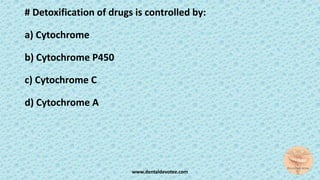
# Detoxification of drugs is controlled by:
a) Cytochrome
b) Cytochrome P450
c) Cytochrome C
d) Cytochrome A
www.dentaldevotee.com
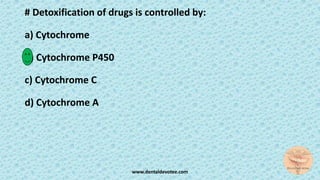
# Detoxification of drugs is controlled by:
a) Cytochrome
b) Cytochrome P450
c) Cytochrome C
d) Cytochrome A
www.dentaldevotee.com
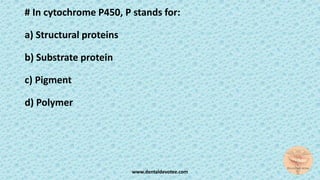
# In cytochrome P450, P stands for:
a) Structural proteins
b) Substrate protein
c) Pigment
d) Polymer
www.dentaldevotee.com
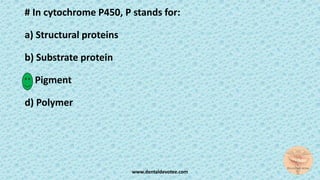
# In cytochrome P450, P stands for:
a) Structural proteins
b) Substrate protein
c) Pigment
d) Polymer
www.dentaldevotee.com
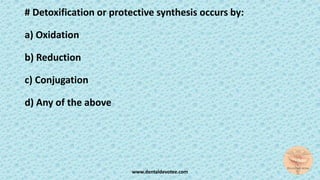
# Detoxification or protective synthesis occurs by:
a) Oxidation
b) Reduction
c) Conjugation
d) Any of the above
www.dentaldevotee.com
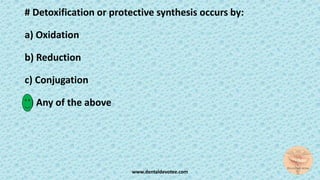
# Detoxification or protective synthesis occurs by:
a) Oxidation
b) Reduction
c) Conjugation
d) Any of the above
www.dentaldevotee.com
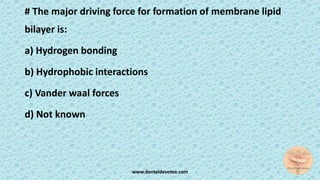
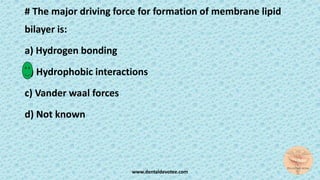
# The major driving force for formation of membrane lipid
bilayer is:
a) Hydrogen bonding
b) Hydrophobic interactions
c) Vander waal forces
d) Not known
www.dentaldevotee.com
# The major driving force for formation of membrane lipid
bilayer is:
a) Hydrogen bonding
b) Hydrophobic interactions
c) Vander waal forces
d) Not known
www.dentaldevotee.com
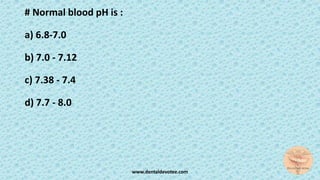
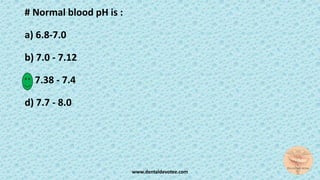
# Normal blood pH is :
a) 6.8-7.0
b) 7.0 - 7.12
c) 7.38 - 7.4
d) 7.7 - 8.0
www.dentaldevotee.com
# Normal blood pH is :
a) 6.8-7.0
b) 7.0 - 7.12
c) 7.38 - 7.4
d) 7.7 - 8.0
www.dentaldevotee.com
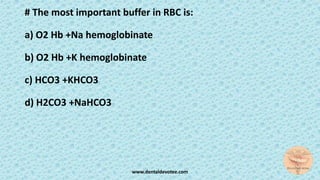
# The most important buffer in RBC is:
a) O2 Hb +Na hemoglobinate
b) O2 Hb +K hemoglobinate
c) HCO3 +KHCO3
d) H2CO3 +NaHCO3
www.dentaldevotee.com
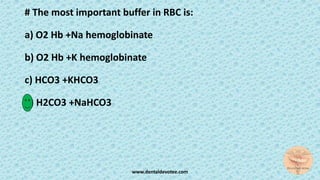
# The most important buffer in RBC is:
a) O2 Hb +Na hemoglobinate
b) O2 Hb +K hemoglobinate
c) HCO3 +KHCO3
d) H2CO3 +NaHCO3
www.dentaldevotee.com
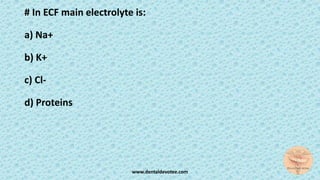
# In ECF main electrolyte is:
a) Na+
b) K+
c) Cl-
d) Proteins
www.dentaldevotee.com
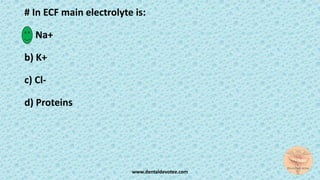
# In ECF main electrolyte is:
a) Na+
b) K+
c) Cl-
d) Proteins
www.dentaldevotee.com
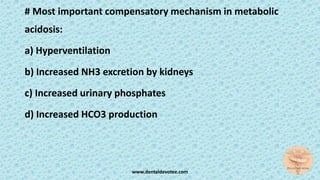
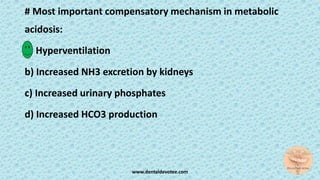
# Most important compensatory mechanism in metabolic
acidosis:
a) Hyperventilation
b) Increased NH3 excretion by kidneys
c) Increased urinary phosphates
d) Increased HCO3 production
www.dentaldevotee.com
# Most important compensatory mechanism in metabolic
acidosis:
a) Hyperventilation
b) Increased NH3 excretion by kidneys
c) Increased urinary phosphates
d) Increased HCO3 production
www.dentaldevotee.com
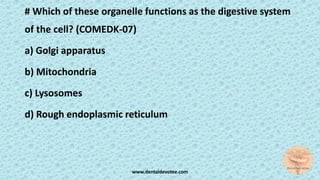
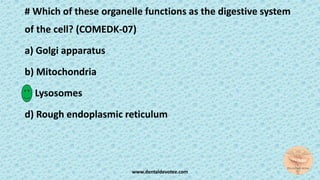
# Which of these organelle functions as the digestive system
of the cell? (COMEDK-07)
a) Golgi apparatus
b) Mitochondria
c) Lysosomes
d) Rough endoplasmic reticulum
www.dentaldevotee.com
# Which of these organelle functions as the digestive system
of the cell? (COMEDK-07)
a) Golgi apparatus
b) Mitochondria
c) Lysosomes
d) Rough endoplasmic reticulum
www.dentaldevotee.com
Our YouTube
Channel
Contact:
dentosphere.worldofdentistry@gmail.com
www.facebook.com/DentCareNepal
www.dentaldevotee.com
www.youtube.com/DentCareNepal
This is only a portion of the MCQs. For viewing
the complete list of MCQs, please visit:
bit.ly/dentistrymcqs

MCQs on General Biochemistry - Dentosphere

  • 1.
  • 2.
    # Detoxification ofdrugs is controlled by: a) Cytochrome b) Cytochrome P450 c) Cytochrome C d) Cytochrome A www.dentaldevotee.com
  • 3.
    # Detoxification ofdrugs is controlled by: a) Cytochrome b) Cytochrome P450 c) Cytochrome C d) Cytochrome A www.dentaldevotee.com
  • 4.
    # In cytochromeP450, P stands for: a) Structural proteins b) Substrate protein c) Pigment d) Polymer www.dentaldevotee.com
  • 5.
    # In cytochromeP450, P stands for: a) Structural proteins b) Substrate protein c) Pigment d) Polymer www.dentaldevotee.com
  • 6.
    # Detoxification orprotective synthesis occurs by: a) Oxidation b) Reduction c) Conjugation d) Any of the above www.dentaldevotee.com
  • 7.
    # Detoxification orprotective synthesis occurs by: a) Oxidation b) Reduction c) Conjugation d) Any of the above www.dentaldevotee.com
  • 8.
    # The majordriving force for formation of membrane lipid bilayer is: a) Hydrogen bonding b) Hydrophobic interactions c) Vander waal forces d) Not known www.dentaldevotee.com
  • 9.
    # The majordriving force for formation of membrane lipid bilayer is: a) Hydrogen bonding b) Hydrophobic interactions c) Vander waal forces d) Not known www.dentaldevotee.com
  • 10.
    # Normal bloodpH is : a) 6.8-7.0 b) 7.0 - 7.12 c) 7.38 - 7.4 d) 7.7 - 8.0 www.dentaldevotee.com
  • 11.
    # Normal bloodpH is : a) 6.8-7.0 b) 7.0 - 7.12 c) 7.38 - 7.4 d) 7.7 - 8.0 www.dentaldevotee.com
  • 12.
    # The mostimportant buffer in RBC is: a) O2 Hb +Na hemoglobinate b) O2 Hb +K hemoglobinate c) HCO3 +KHCO3 d) H2CO3 +NaHCO3 www.dentaldevotee.com
  • 13.
    # The mostimportant buffer in RBC is: a) O2 Hb +Na hemoglobinate b) O2 Hb +K hemoglobinate c) HCO3 +KHCO3 d) H2CO3 +NaHCO3 www.dentaldevotee.com
  • 14.
    # In ECFmain electrolyte is: a) Na+ b) K+ c) Cl- d) Proteins www.dentaldevotee.com
  • 15.
    # In ECFmain electrolyte is: a) Na+ b) K+ c) Cl- d) Proteins www.dentaldevotee.com
  • 16.
    # Most importantcompensatory mechanism in metabolic acidosis: a) Hyperventilation b) Increased NH3 excretion by kidneys c) Increased urinary phosphates d) Increased HCO3 production www.dentaldevotee.com
  • 17.
    # Most importantcompensatory mechanism in metabolic acidosis: a) Hyperventilation b) Increased NH3 excretion by kidneys c) Increased urinary phosphates d) Increased HCO3 production www.dentaldevotee.com
  • 18.
    # Which ofthese organelle functions as the digestive system of the cell? (COMEDK-07) a) Golgi apparatus b) Mitochondria c) Lysosomes d) Rough endoplasmic reticulum www.dentaldevotee.com
  • 19.
    # Which ofthese organelle functions as the digestive system of the cell? (COMEDK-07) a) Golgi apparatus b) Mitochondria c) Lysosomes d) Rough endoplasmic reticulum www.dentaldevotee.com
  • 20.