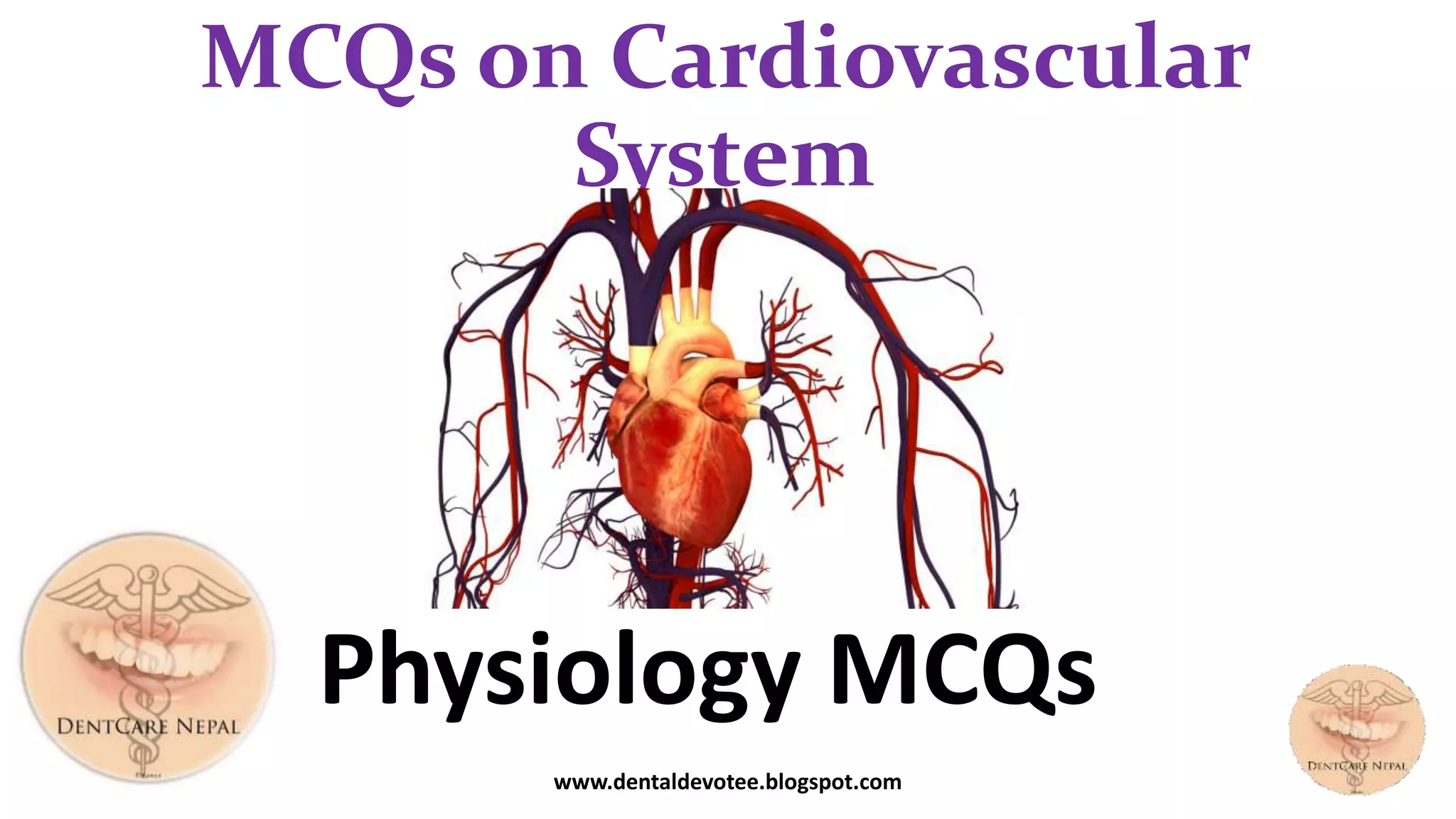
MCQs on Cardiovascular
System
Physiology MCQs
www.dentaldevotee.blogspot.com
नेपालका
डरलाग्दा सवारी
दुर्घटनाहरू
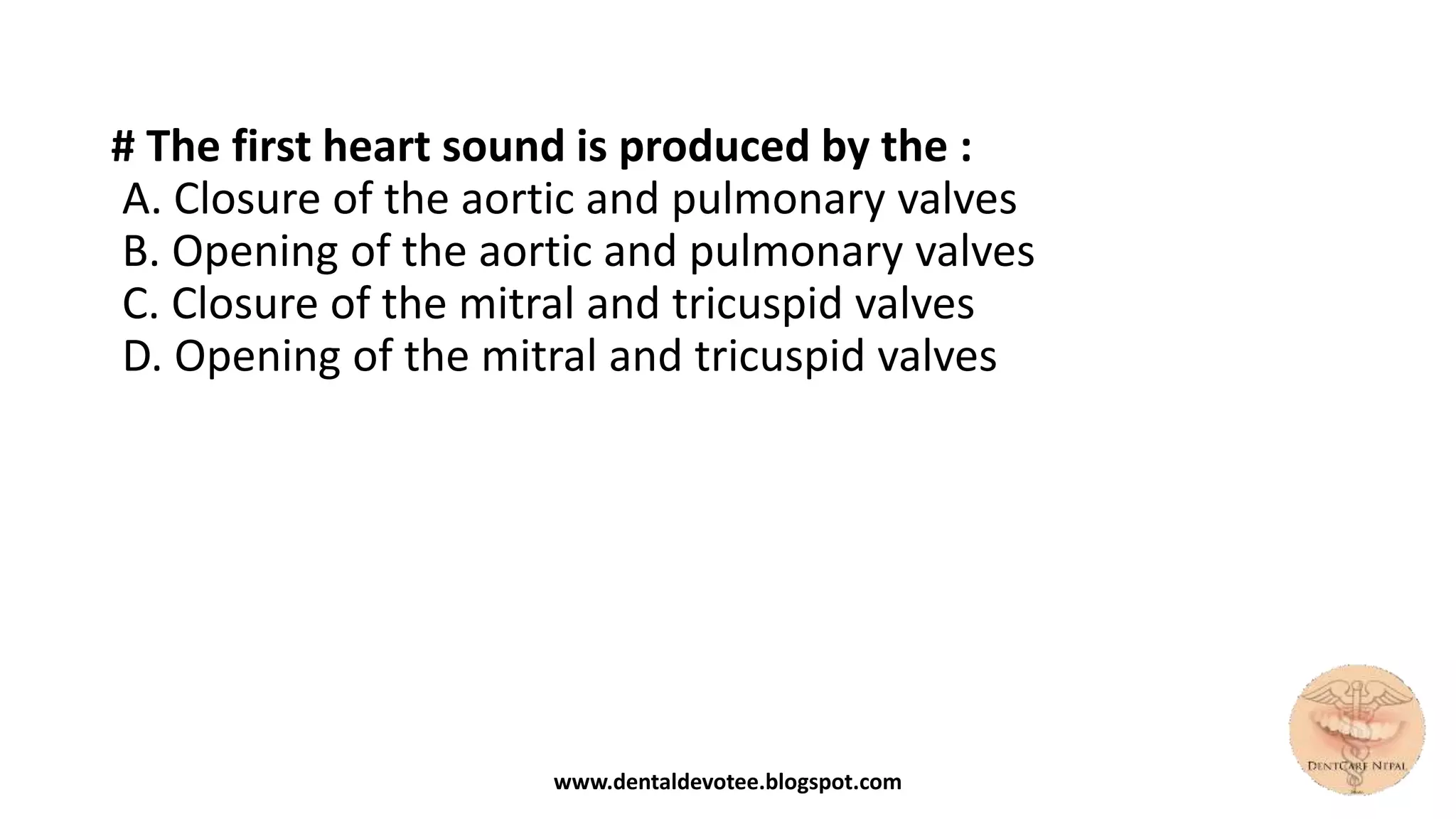
# The first heart sound is produced by the :
A. Closure of the aortic and pulmonary valves
B. Opening of the aortic and pulmonary valves
C. Closure of the mitral and tricuspid valves
D. Opening of the mitral and tricuspid valves

www.dentaldevotee.blogspot.com
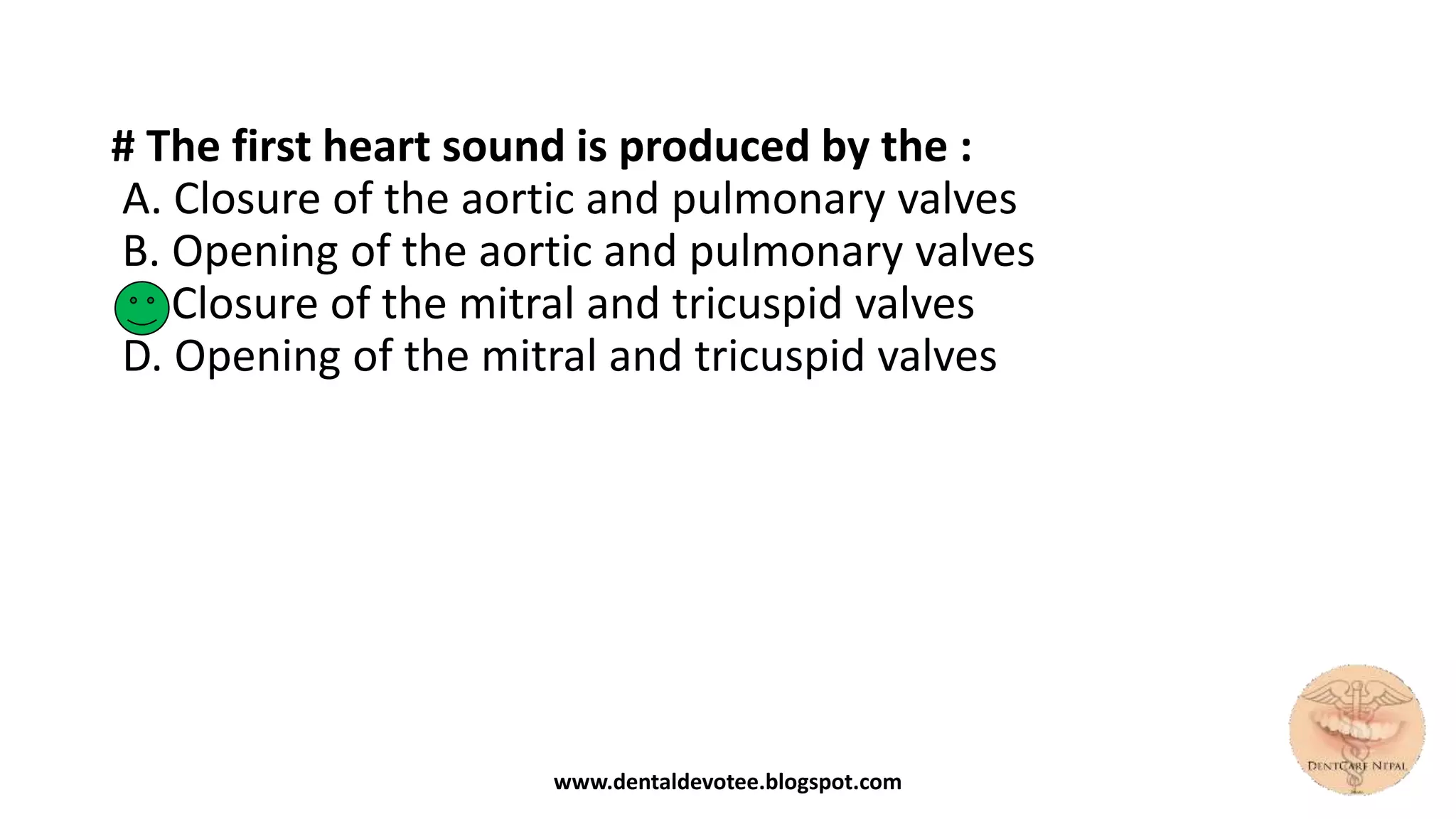
# The first heart sound is produced by the :
A. Closure of the aortic and pulmonary valves
B. Opening of the aortic and pulmonary valves
C. Closure of the mitral and tricuspid valves
D. Opening of the mitral and tricuspid valves
www.dentaldevotee.blogspot.com
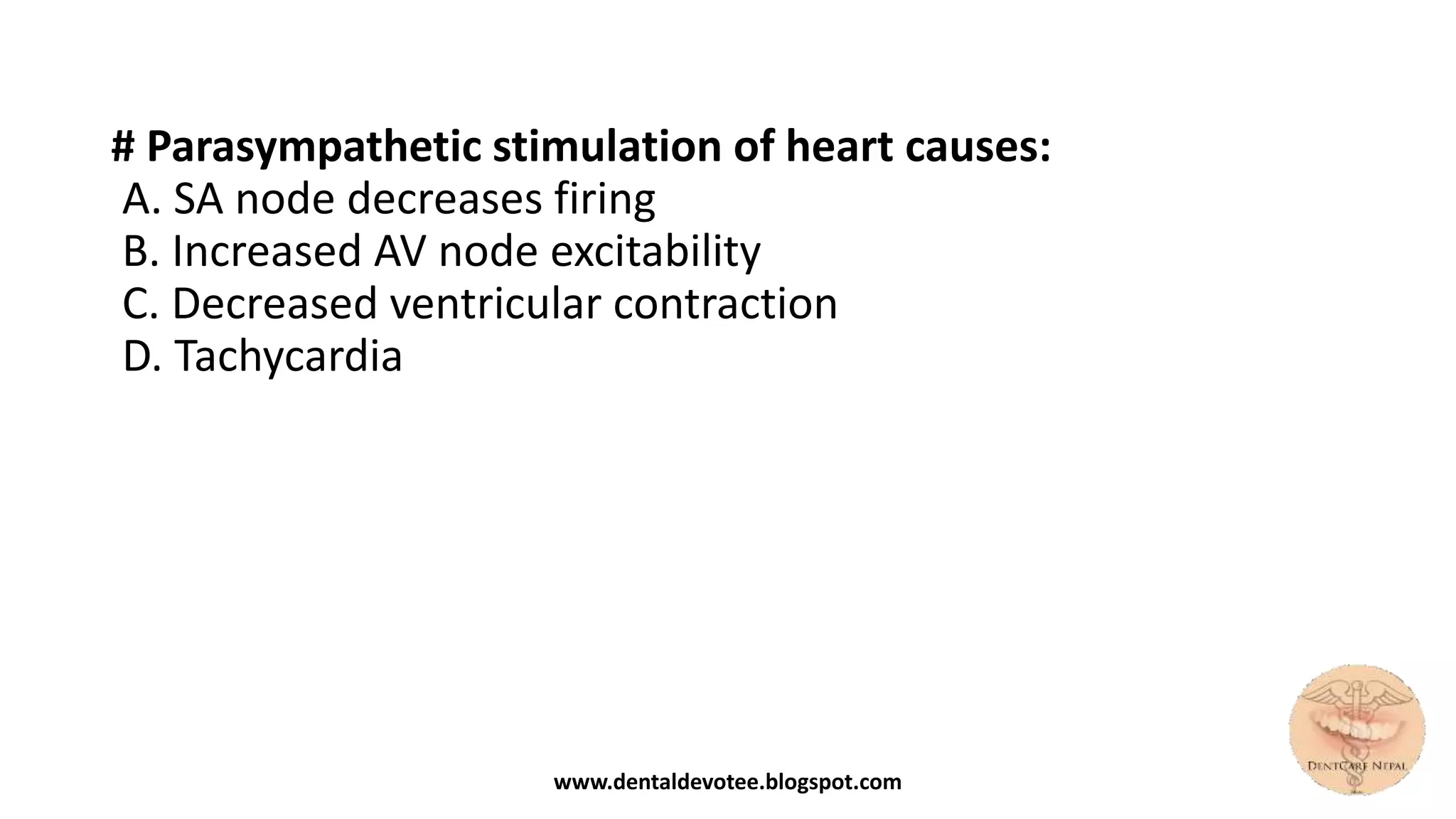
# Parasympathetic stimulation of heart causes:
A. SA node decreases firing
B. Increased AV node excitability
C. Decreased ventricular contraction
D. Tachycardia
www.dentaldevotee.blogspot.com
# Parasympathetic stimulation of heart causes:
A. SA node decreases firing
B. Increased AV node excitability
C. Decreased ventricular contraction
D. Tachycardia
www.dentaldevotee.blogspot.com
# Normally, the rate of the heart beat in a human is
determined by:
A. Bundle of His
B. all cardiac muscles
C. the SA node
D. the cervical ganglion
www.dentaldevotee.blogspot.com
# Normally, the rate of the heart beat in a human is
determined by:
A. Bundle of His
B. all cardiac muscles
C. the SA node
D. the cervical ganglion
www.dentaldevotee.blogspot.com
# The ventricular repolarisation in ECG is best seen in:
A. "P" wave
B. "Q" wave
C. "R" wave
D. "T" wave
www.dentaldevotee.blogspot.com
# The ventricular repolarisation in ECG is best seen in:
A. "P" wave
B. "Q" wave
C. "R" wave
D. "T" wave
www.dentaldevotee.blogspot.com
# Stroke output of each ventricle in normal adult is :
A. 30 ml
B. 130 ml
C. 70 ml
D. 5 liters
www.dentaldevotee.blogspot.com
# Stroke output of each ventricle in normal adult is :
A. 30 ml
B. 130 ml
C. 70 ml
D. 5 liters
www.dentaldevotee.blogspot.com
# Cardiac output is a measure of :
A. Peripheral resistance * tissue fluid
B. Peripheral resistance * cardiac rate
C. Blood pressure * Cardiac rate
D. Heart rate * Stroke volume
www.dentaldevotee.blogspot.com
# Cardiac output is a measure of :
A. Peripheral resistance * tissue fluid
B. Peripheral resistance * cardiac rate
C. Blood pressure * Cardiac rate
D. Heart rate * Stroke volume
www.dentaldevotee.blogspot.com
# Cardiac output is not affected by :
A. Heart rate
B. Peripheral resistance
C. Systolic blod pressure
D. Venous return
www.dentaldevotee.blogspot.com
# Cardiac output is not affected by :
A. Heart rate
B. Peripheral resistance
C. Systolic blod pressure
D. Venous return
www.dentaldevotee.blogspot.com
# The largest function of the total peripheral resistance is
due to:
A. Venules
B. Arterioles
C. Capillaries
D. Precapillary sphincters
www.dentaldevotee.blogspot.com
# The largest function of the total peripheral resistance is
due to:
A. Venules
B. Arterioles
C. Capillaries
D. Precapillary sphincters
www.dentaldevotee.blogspot.com
# All the heart valves are open during which stage of cardiac
cycle?
A. Systolic ejection
B. Isovolumetric relaxation
C. Isovolumetric contraction
D. None of the above
www.dentaldevotee.blogspot.com
# All the heart valves are open during which stage of cardiac
cycle?
A. Systolic ejection
B. Isovolumetric relaxation
C. Isovolumetric contraction
D. None of the above
www.dentaldevotee.blogspot.com
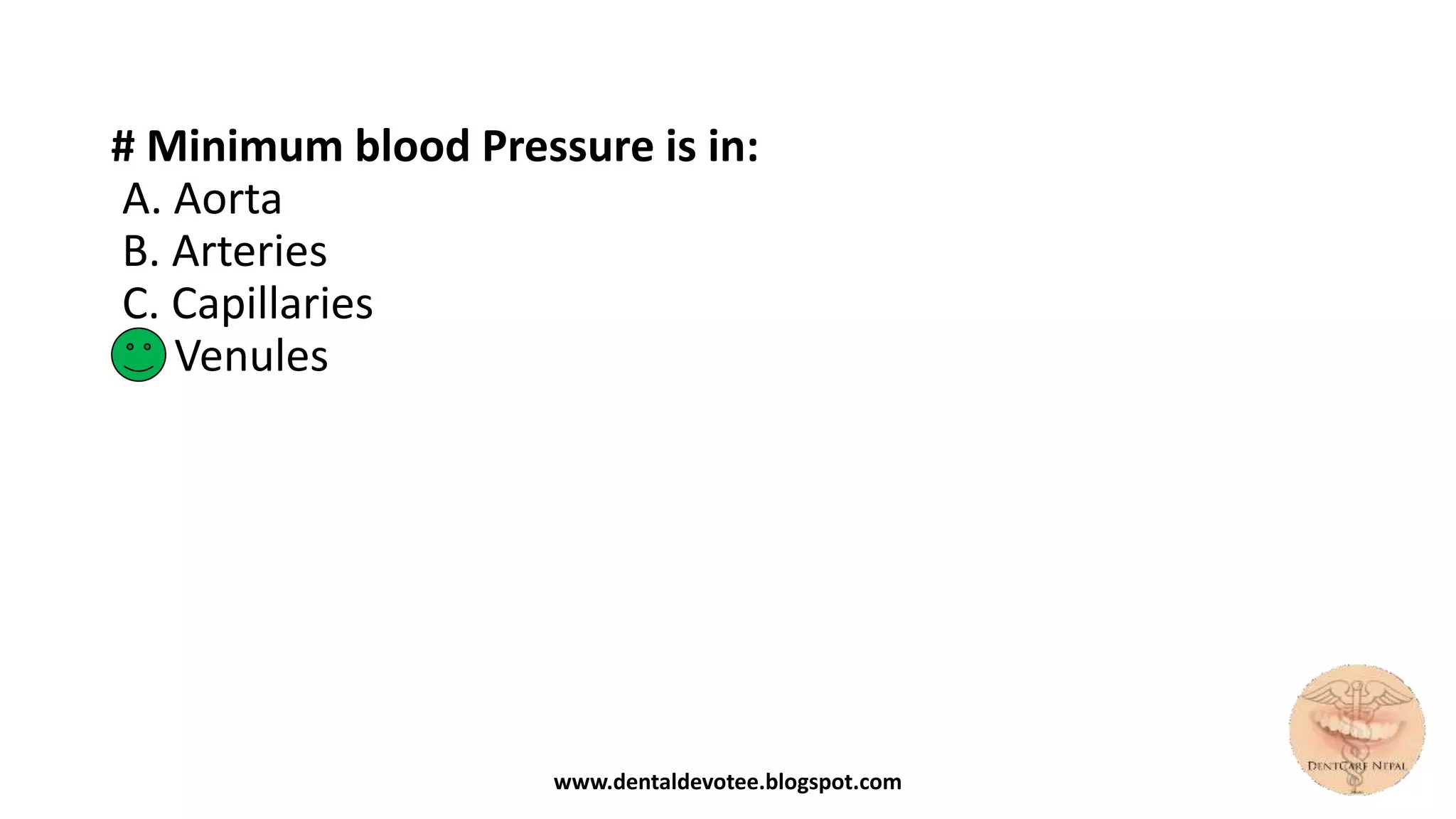
# Minimum blood Pressure is in:
A. Aorta
B. Arteries
C. Capillaries
D. Venules
www.dentaldevotee.blogspot.com
# Minimum blood Pressure is in:
A. Aorta
B. Arteries
C. Capillaries
D. Venules
www.dentaldevotee.blogspot.com
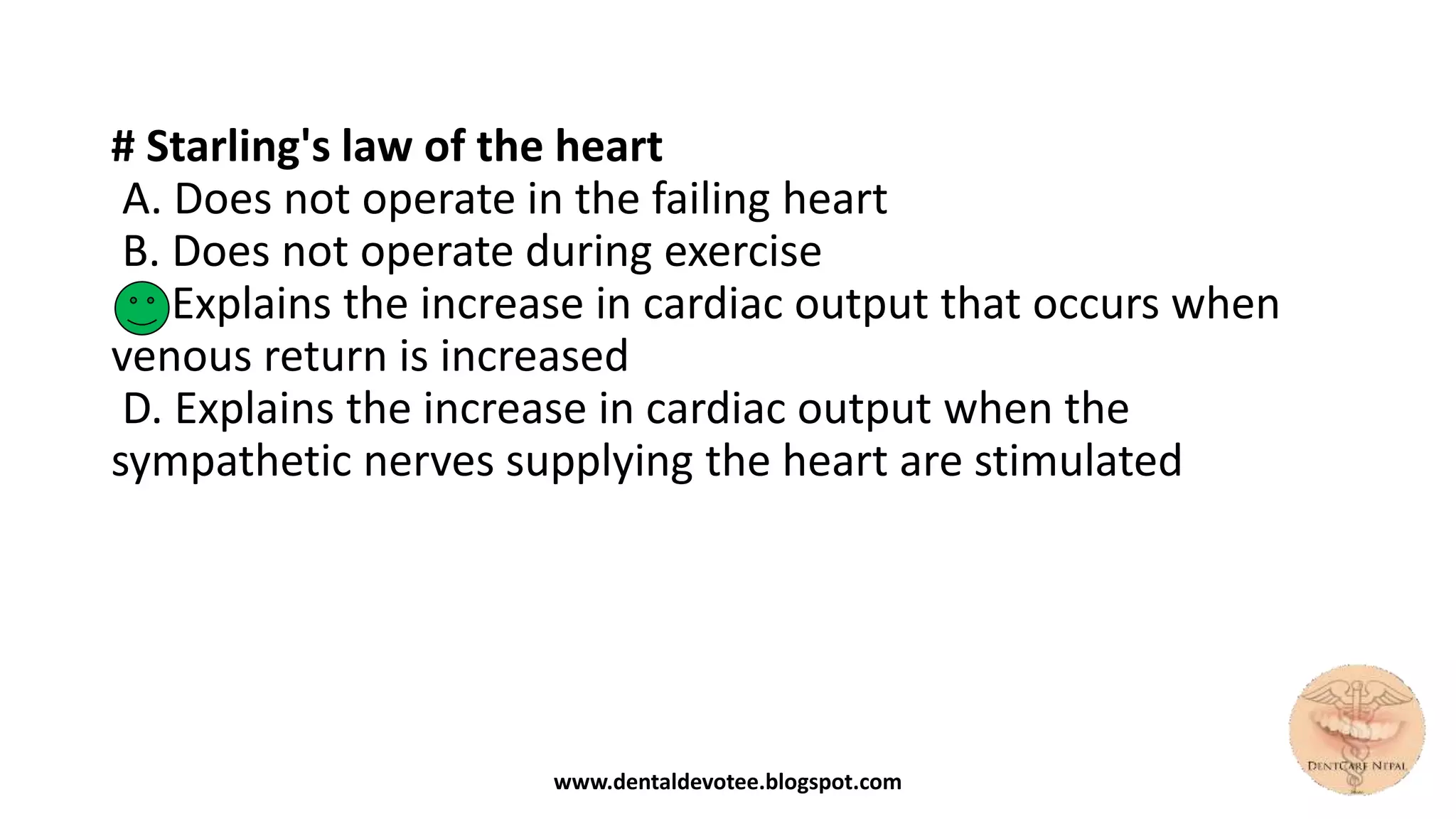
# Starling's law of the heart
A. Does not operate in the failing heart
B. Does not operate during exercise
C. Explains the increase in cardiac output that occurs when
venous return is increased
D. Explains the increase in cardiac output when the
sympathetic nerves supplying the heart are stimulated
www.dentaldevotee.blogspot.com
# Starling's law of the heart
A. Does not operate in the failing heart
B. Does not operate during exercise
C. Explains the increase in cardiac output that occurs when
venous return is increased
D. Explains the increase in cardiac output when the
sympathetic nerves supplying the heart are stimulated
www.dentaldevotee.blogspot.com
# Which of the followings is true ?
A. Starling's law of heart states that increase in force of
contraction is directly related to cardiac output
B. Starling's law of heart states that the force of ventricular
contraction is directly related to the end diastolic volume
C. Both A and B
D. None of the above
www.dentaldevotee.blogspot.com
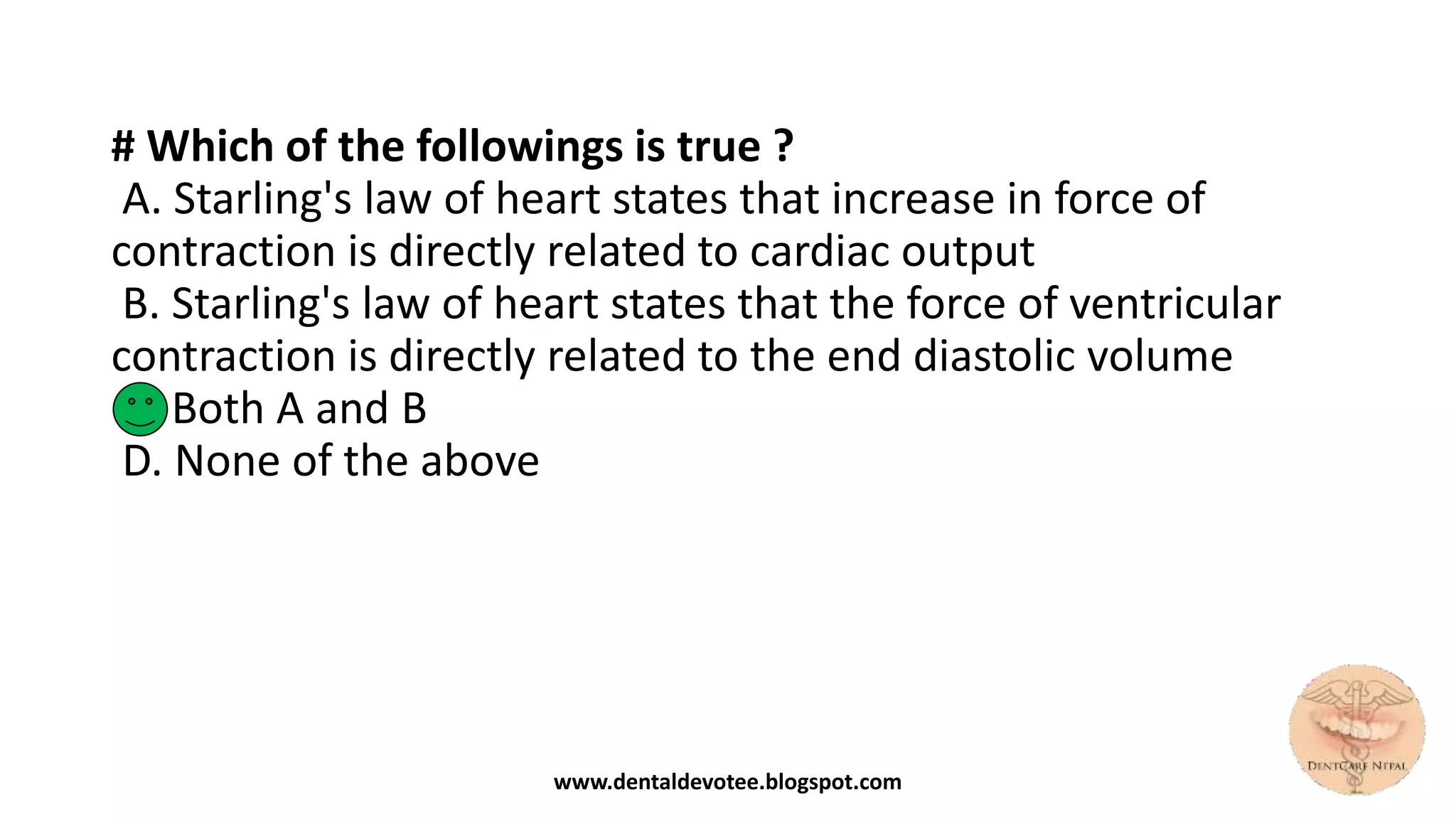
# Which of the followings is true ?
A. Starling's law of heart states that increase in force of
contraction is directly related to cardiac output
B. Starling's law of heart states that the force of ventricular
contraction is directly related to the end diastolic volume
C. Both A and B
D. None of the above
www.dentaldevotee.blogspot.com
# Peripheral resistance is maximum in:
A. Aorta
B. Artery
C. Arteriole
D. Vein
www.dentaldevotee.blogspot.com
# Peripheral resistance is maximum in:
A. Aorta
B. Artery
C. Arteriole
D. Vein
www.dentaldevotee.blogspot.com
# Stimulatuion of baroreceptor leads to :
A. Increased blood pressure, Increased heart rate
B. Decreased BP, decreased heart rate
C. Increased BP, decreased heart rate
D. Decreased BP, Increased heart rate
www.dentaldevotee.blogspot.com
# Stimulatuion of baroreceptor leads to :
A. Increased blood pressure, Increased heart rate
B. Decreased BP, decreased heart rate
C. Increased BP, decreased heart rate
D. Decreased BP, Increased heart rate
www.dentaldevotee.blogspot.com
# Increased functional demand on the heart produces
increased size of the myocardium by:
A. Hyperplasia
B. Hypertrophy
C. Fatty infiltration
D. Increased amounts of fibrous connective tissue
www.dentaldevotee.blogspot.com
# Increased functional demand on the heart produces
increased size of the myocardium by:
A. Hyperplasia
B. Hypertrophy
C. Fatty infiltration
D. Increased amounts of fibrous connective tissue
www.dentaldevotee.blogspot.com
# Cardiac index is related to :
A. Cardiac output and body weight
B. Cardiac output and body surface area
C. Cardiac output and work of the heart
D. Stroke volume and pulse rate
www.dentaldevotee.blogspot.com
# Cardiac index is related to :
A. Cardiac output and body weight
B. Cardiac output and body surface area
C. Cardiac output and work of the heart
D. Stroke volume and pulse rate
www.dentaldevotee.blogspot.com
# Absolute refractory period in heart :
A. Lasts till cardiac contraction
B. Longer than refractory period in skeletal muscle
C. A phase of cardiac cycle in which heart cannot be
stimulated by any amount of stimulus
D. Corresponds with duration of action potential
E. All of the above
www.dentaldevotee.blogspot.com
# Absolute refractory period in heart :
A. Lasts till cardiac contraction
B. Longer than refractory period in skeletal muscle
C. A phase of cardiac cycle in which heart cannot be
stimulated by any amount of stimulus
D. Corresponds with duration of action potential
E. All of the above
www.dentaldevotee.blogspot.com
# Closure of the aortic valve occurs before the following
event:
A. Isovolumetric contraction
B. Isovolumetric relaxation
C. Prediastole
D. Presystole
www.dentaldevotee.blogspot.com
# Closure of the aortic valve occurs before the following
event:
A. Isovolumetric contraction
B. Isovolumetric relaxation
C. Prediastole
D. Presystole
www.dentaldevotee.blogspot.com
# Conduction velocity is least in:
A. AV node
B. SA Node
C. Purkinje fibers
D. Budele of His
www.dentaldevotee.blogspot.com
# Conduction velocity is least in:
A. AV node
B. SA Node
C. Purkinje fibers
D. Budele of His
www.dentaldevotee.blogspot.com
# Fastest conducting tissue in human heart:
A. AV node
B. SA node
C. Bundle of His
D. Purkinje fibers
www.dentaldevotee.blogspot.com
# Fastest conducting tissue in human heart:
A. AV node
B. SA node
C. Bundle of His
D. Purkinje fibers
www.dentaldevotee.blogspot.com
# Under resting condition, the cardiac output is ____ L/min:
A. 2.5
B. 4.25
C. 5.25
D. 9.5
www.dentaldevotee.blogspot.com
# Under resting condition, the cardiac output is ____ L/min:
A. 2.5
B. 4.25
C. 5.25
D. 9.5
www.dentaldevotee.blogspot.com
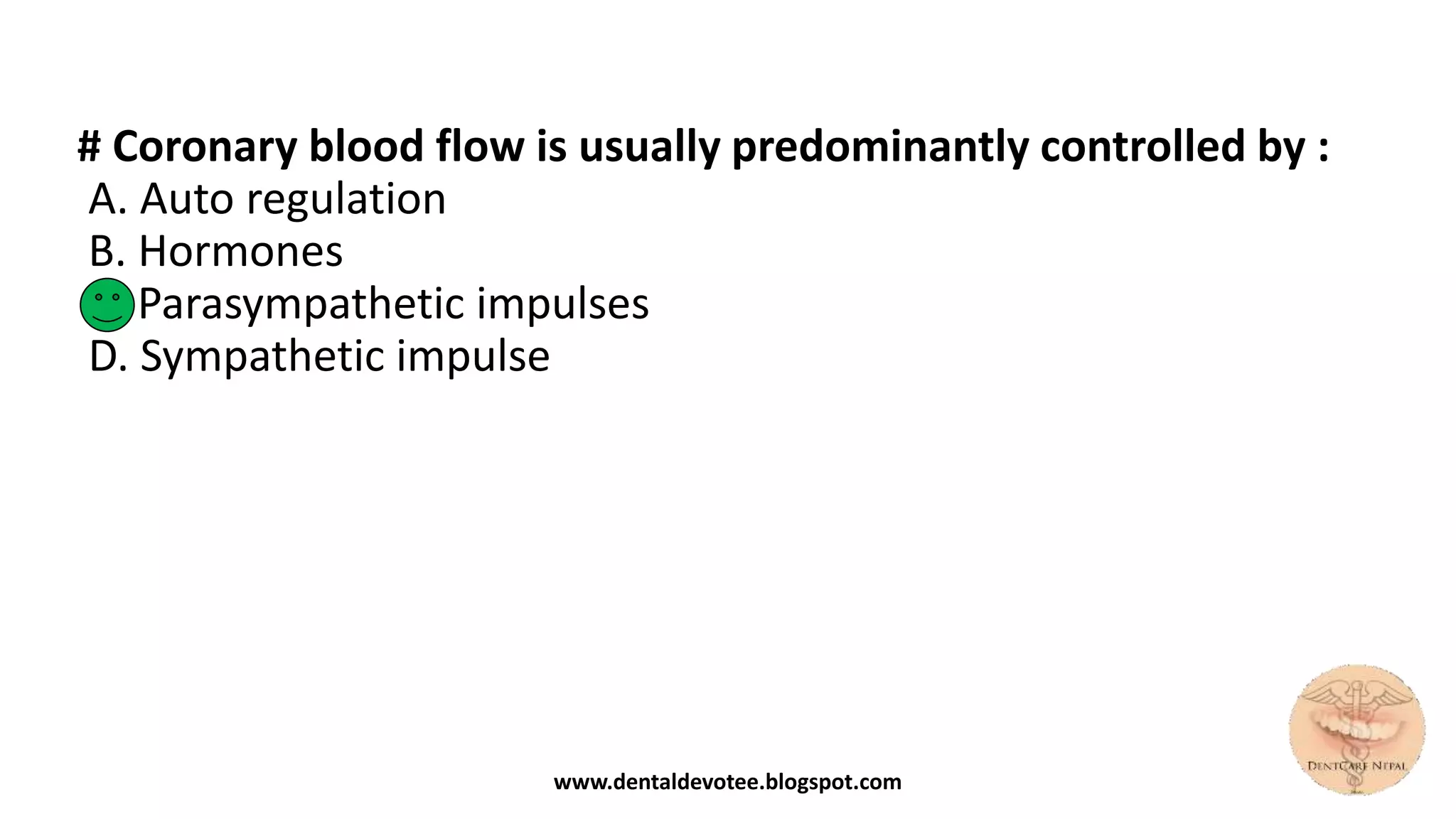
# Coronary blood flow is usually predominantly controlled by :
A. Auto regulation
B. Hormones
C. Parasympathetic impulses
D. Sympathetic impulse
www.dentaldevotee.blogspot.com
# Coronary blood flow is usually predominantly controlled by :
A. Auto regulation
B. Hormones
C. Parasympathetic impulses
D. Sympathetic impulse
www.dentaldevotee.blogspot.com
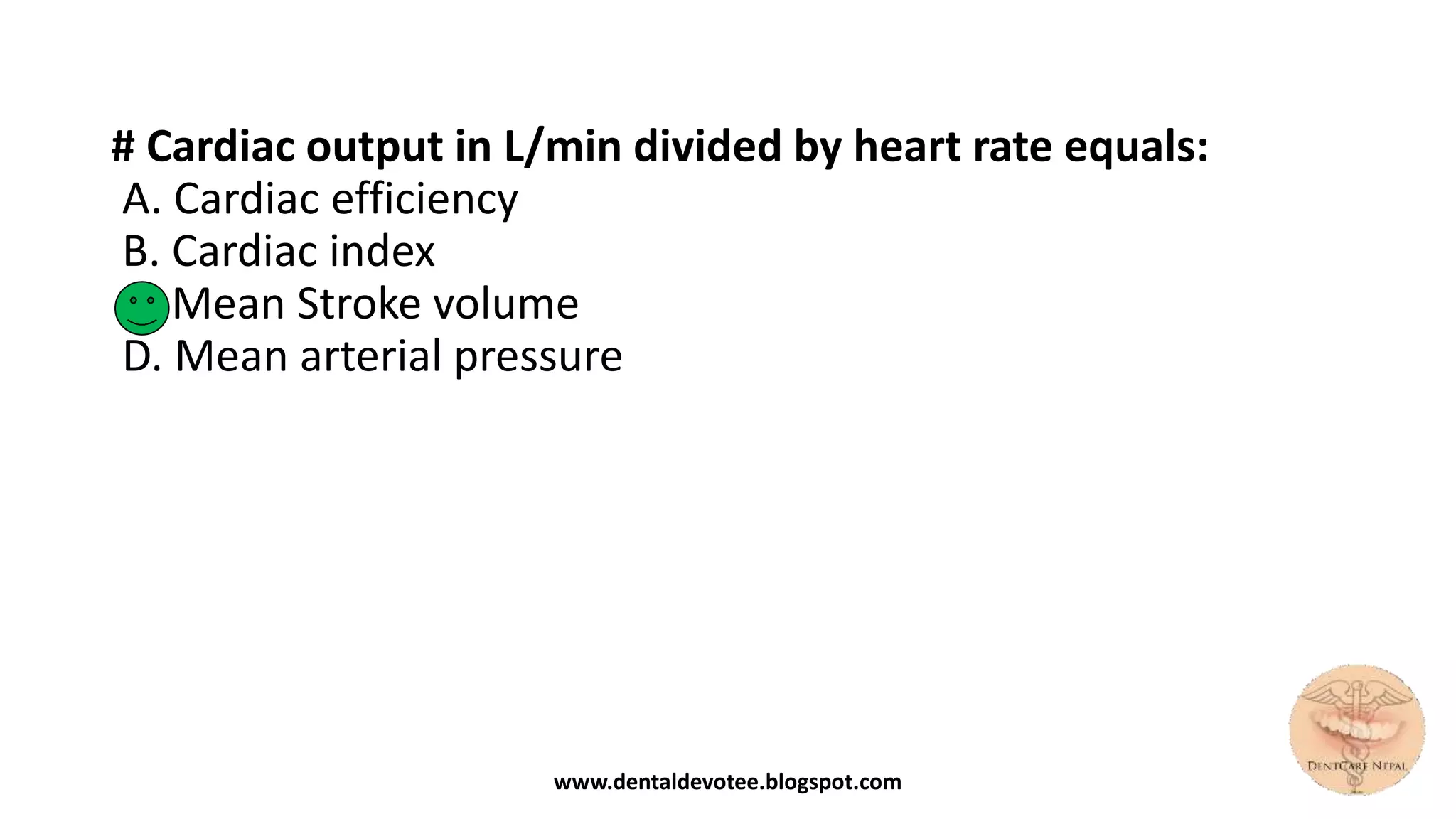
# Cardiac output in L/min divided by heart rate equals:
A. Cardiac efficiency
B. Cardiac index
C. Mean Stroke volume
D. Mean arterial pressure
www.dentaldevotee.blogspot.com
# Cardiac output in L/min divided by heart rate equals:
A. Cardiac efficiency
B. Cardiac index
C. Mean Stroke volume
D. Mean arterial pressure
www.dentaldevotee.blogspot.com
# Cardiac cycle duration in man is:
A. 0.4 sec
B. 0.8 sec
C. 1.2 sec
D. 1.6 sec
www.dentaldevotee.blogspot.com
# Cardiac cycle duration in man is:
A. 0.4 sec
B. 0.8 sec
C. 1.2 sec
D. 1.6 sec
www.dentaldevotee.blogspot.com
# First heart sound occurs during the period of:
A. Isotonic relaxation
B. Isovolumetric relaxation
C. Isovolumetric contraction
D. Isotonic contraction
www.dentaldevotee.blogspot.com
# First heart sound occurs during the period of:
A. Isotonic relaxation
B. Isovolumetric relaxation
C. Isovolumetric contraction
D. Isotonic contraction
www.dentaldevotee.blogspot.com
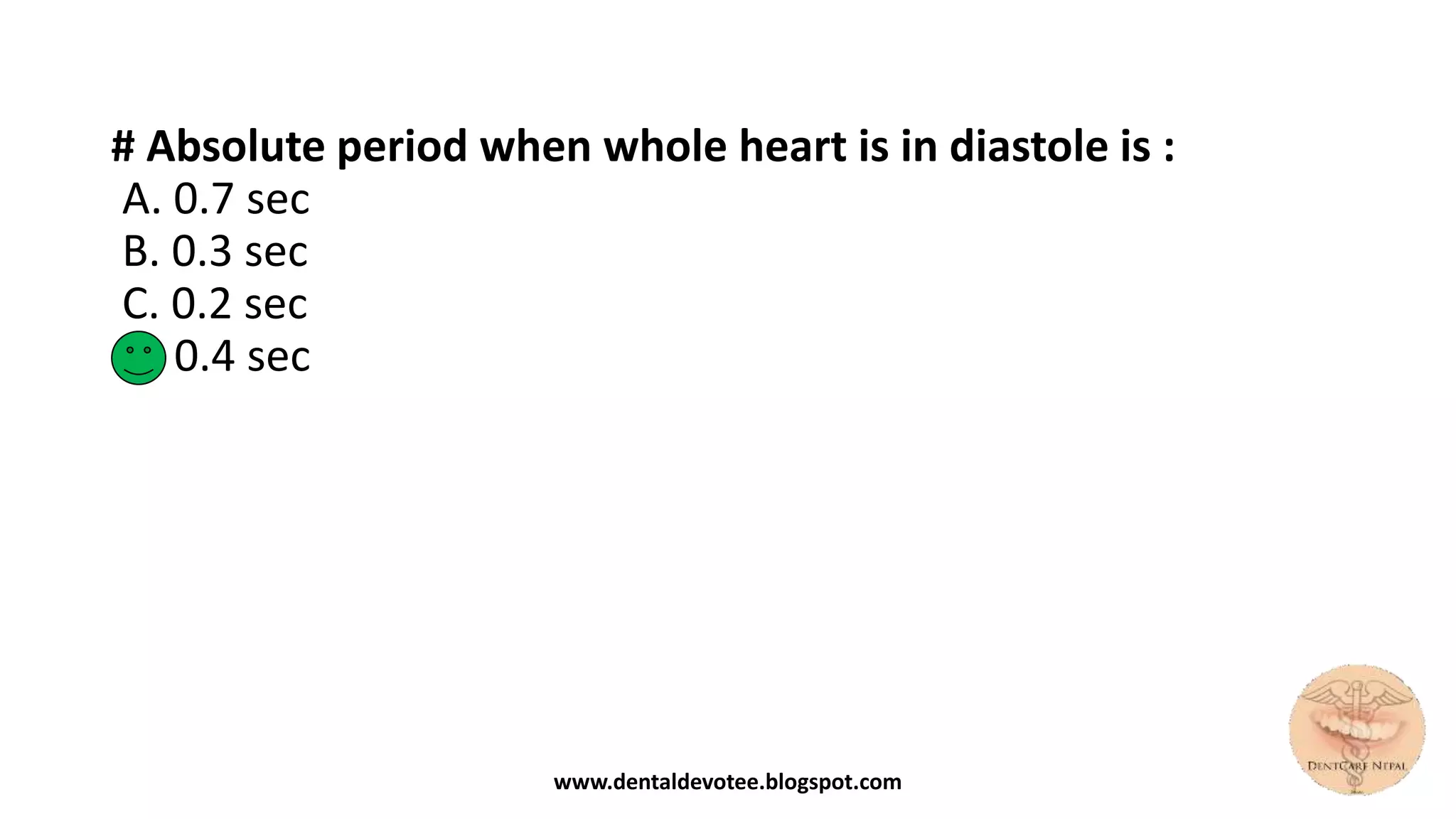
# Absolute period when whole heart is in diastole is :
A. 0.7 sec
B. 0.3 sec
C. 0.2 sec
D. 0.4 sec
www.dentaldevotee.blogspot.com
# Absolute period when whole heart is in diastole is :
A. 0.7 sec
B. 0.3 sec
C. 0.2 sec
D. 0.4 sec
www.dentaldevotee.blogspot.com
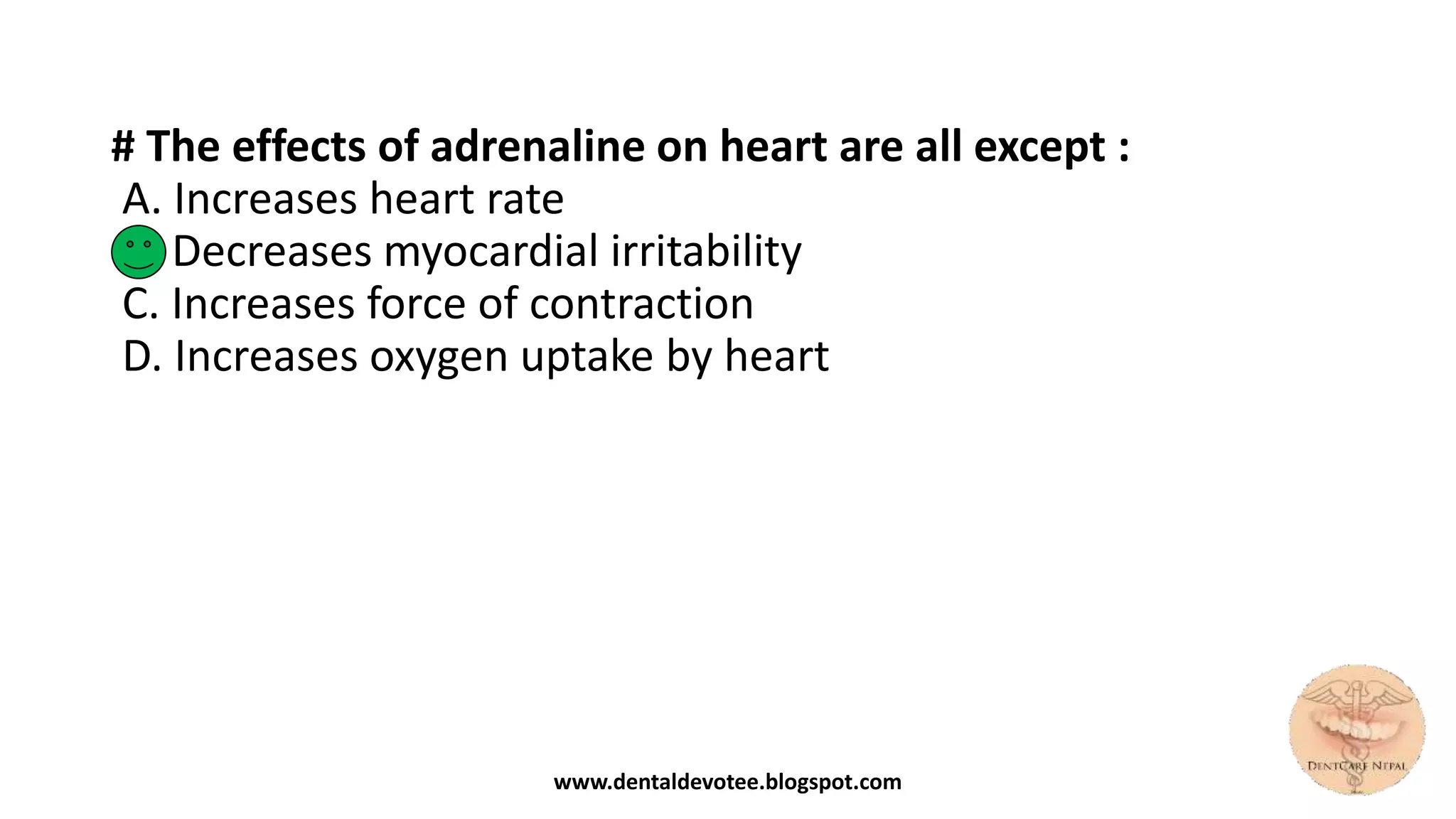
# The effects of adrenaline on heart are all except :
A. Increases heart rate
B. Decreases myocardial irritability
C. Increases force of contraction
D. Increases oxygen uptake by heart
www.dentaldevotee.blogspot.com
# The effects of adrenaline on heart are all except :
A. Increases heart rate
B. Decreases myocardial irritability
C. Increases force of contraction
D. Increases oxygen uptake by heart
www.dentaldevotee.blogspot.com
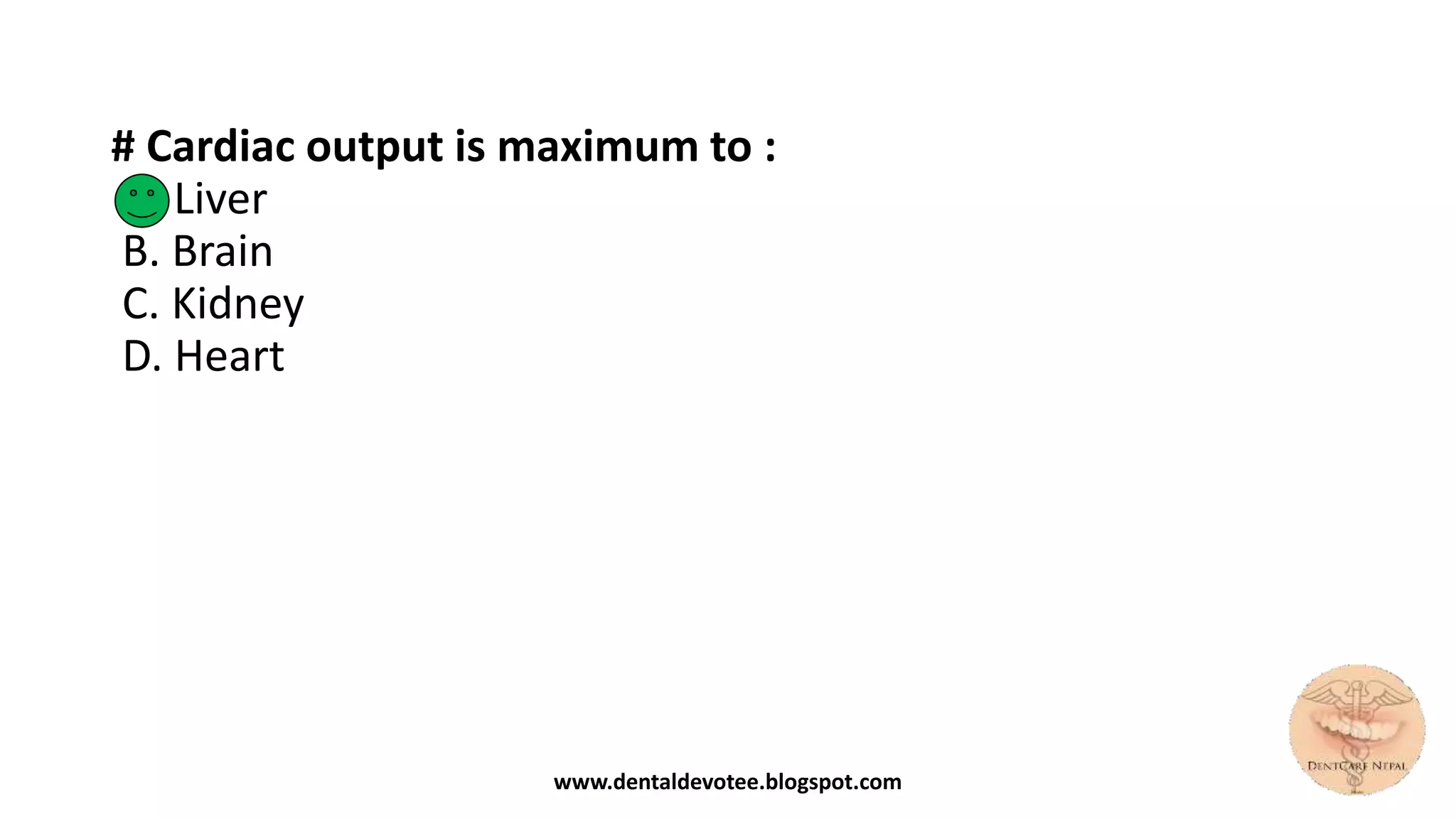
# Cardiac output is maximum to :
A. Liver
B. Brain
C. Kidney
D. Heart
www.dentaldevotee.blogspot.com
# Cardiac output is maximum to :
A. Liver
B. Brain
C. Kidney
D. Heart
www.dentaldevotee.blogspot.com
# Increase in carotid sinus pressure produces:
A. Reflex hyperpnea
B. Reflex bradycardia
C. Reflex tachycardia
D. Reflex hypercapnia
www.dentaldevotee.blogspot.com
# Increase in carotid sinus pressure produces:
A. Reflex hyperpnea
B. Reflex bradycardia
C. Reflex tachycardia
D. Reflex hypercapnia
www.dentaldevotee.blogspot.com
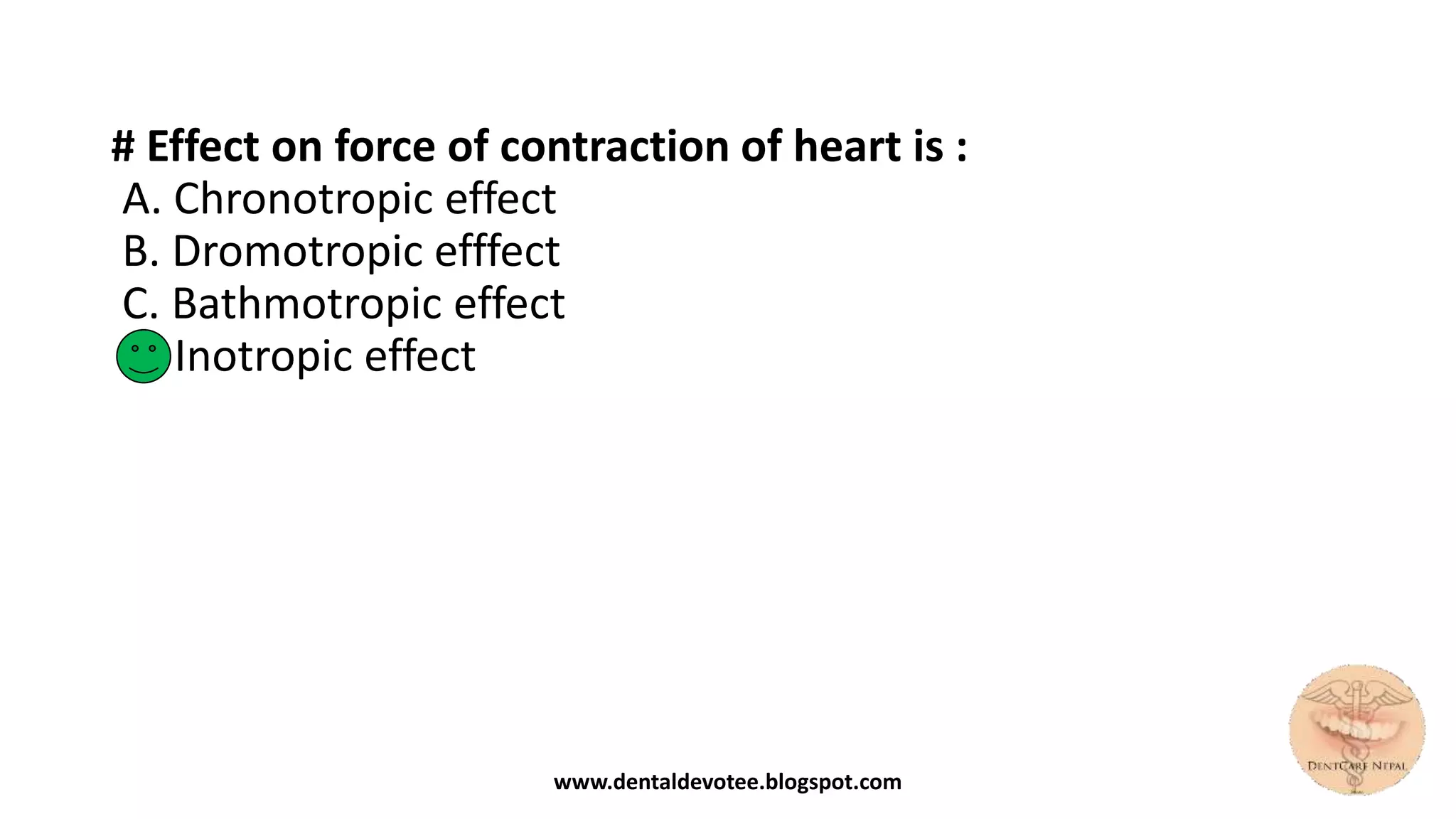
# Effect on force of contraction of heart is :
A. Chronotropic effect
B. Dromotropic efffect
C. Bathmotropic effect
D. Inotropic effect
www.dentaldevotee.blogspot.com
# Effect on force of contraction of heart is :
A. Chronotropic effect
B. Dromotropic efffect
C. Bathmotropic effect
D. Inotropic effect
www.dentaldevotee.blogspot.com
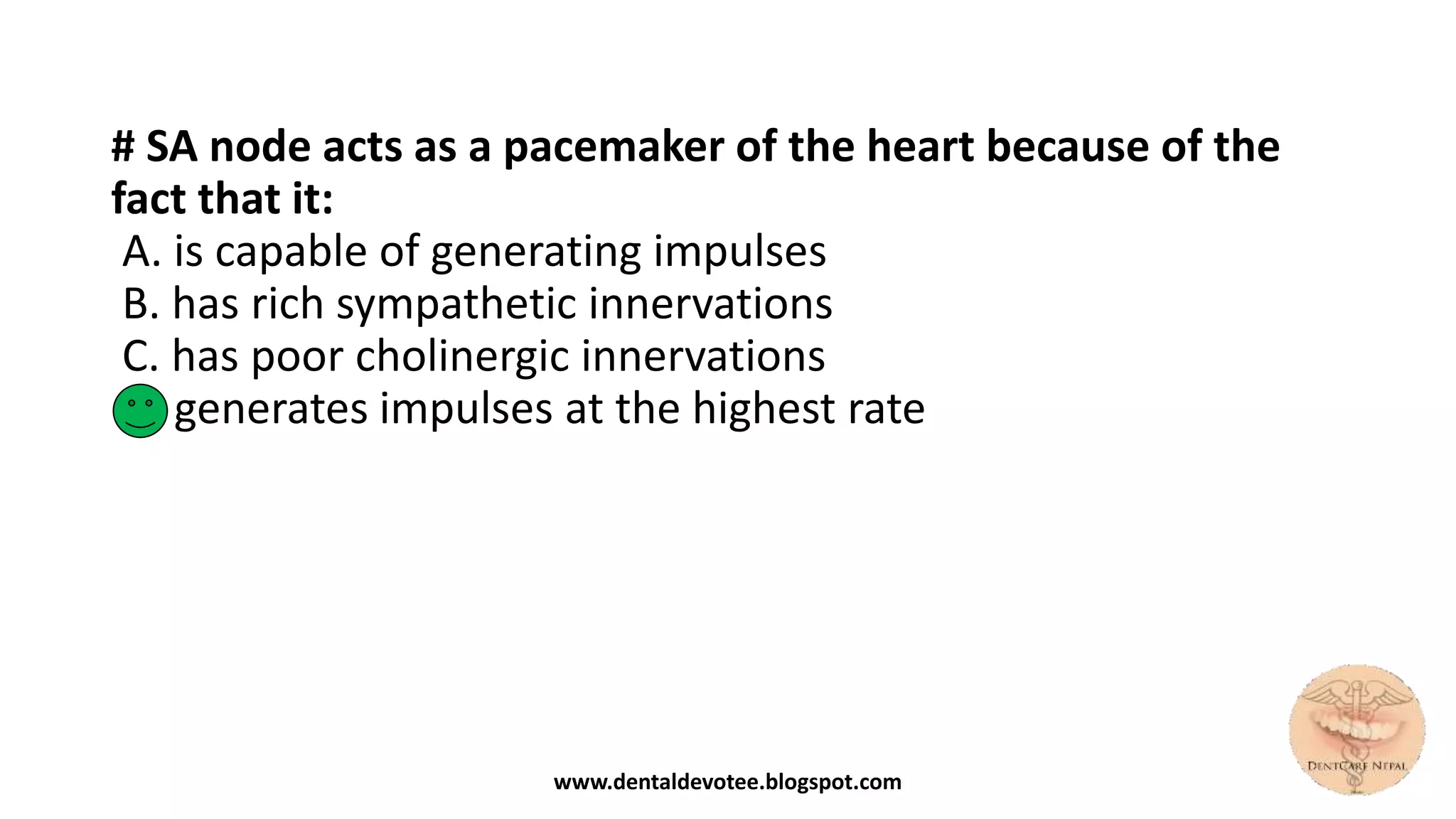
# SA node acts as a pacemaker of the heart because of the
fact that it:
A. is capable of generating impulses
B. has rich sympathetic innervations
C. has poor cholinergic innervations
D. generates impulses at the highest rate
www.dentaldevotee.blogspot.com
# SA node acts as a pacemaker of the heart because of the
fact that it:
A. is capable of generating impulses
B. has rich sympathetic innervations
C. has poor cholinergic innervations
D. generates impulses at the highest rate
www.dentaldevotee.blogspot.com
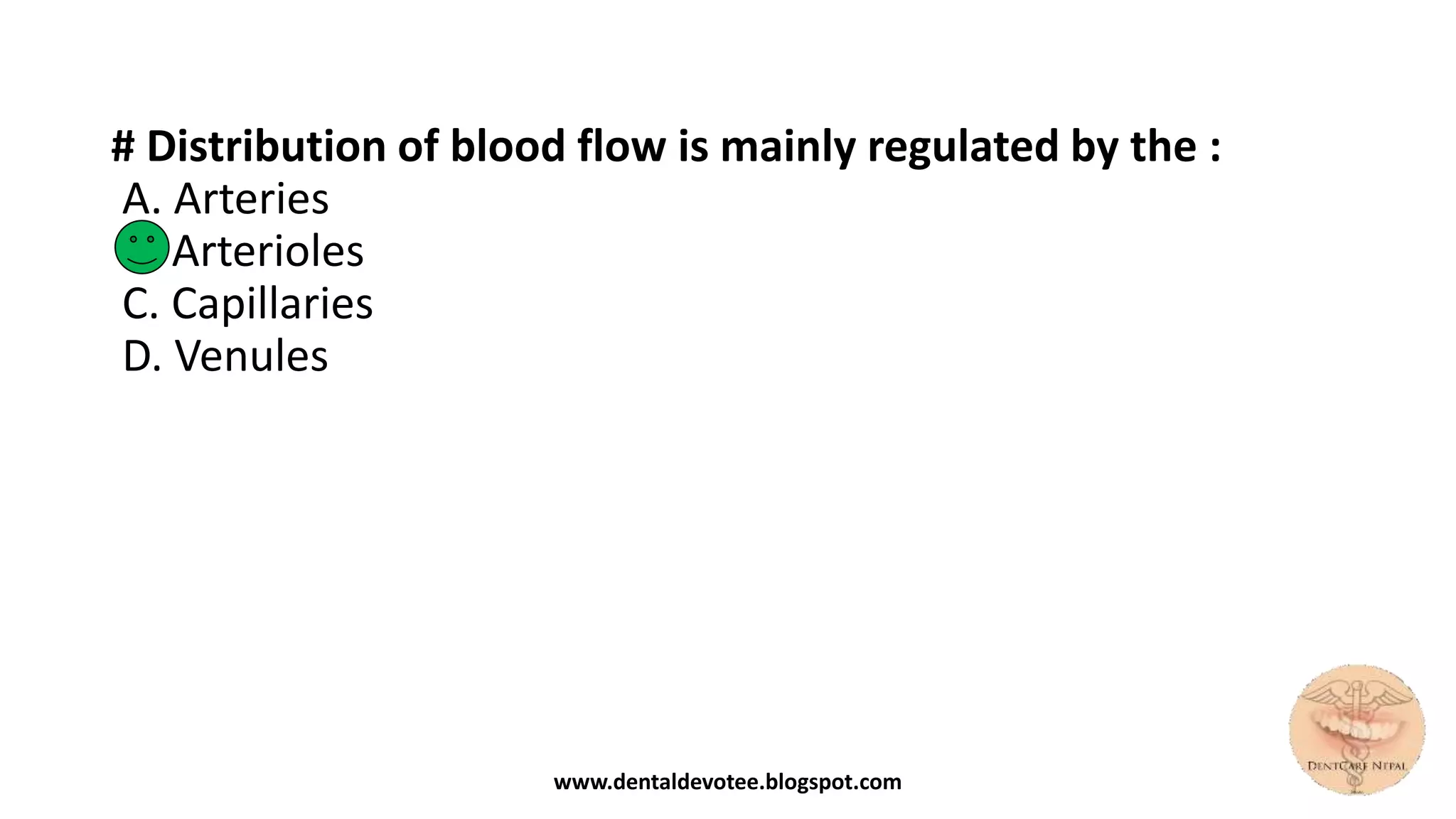
# Distribution of blood flow is mainly regulated by the :
A. Arteries
B. Arterioles
C. Capillaries
D. Venules
www.dentaldevotee.blogspot.com
# Distribution of blood flow is mainly regulated by the :
A. Arteries
B. Arterioles
C. Capillaries
D. Venules
www.dentaldevotee.blogspot.com
# The following factors increase the cardiac output except:
A. Preload
B. Afterload
C. Heart rate
D. Myocardial contractility
www.dentaldevotee.blogspot.com
# The following factors increase the cardiac output except:
A. Preload
B. Afterload
C. Heart rate
D. Myocardial contractility
www.dentaldevotee.blogspot.com
# Ventricular muscle receives impulses directly from the:
A. Purkinje system
B. Bundle of His
C. Right and left bundle branches
D. AV node
www.dentaldevotee.blogspot.com
# Ventricular muscle receives impulses directly from the:
A. Purkinje system
B. Bundle of His
C. Right and left bundle branches
D. AV node
www.dentaldevotee.blogspot.com
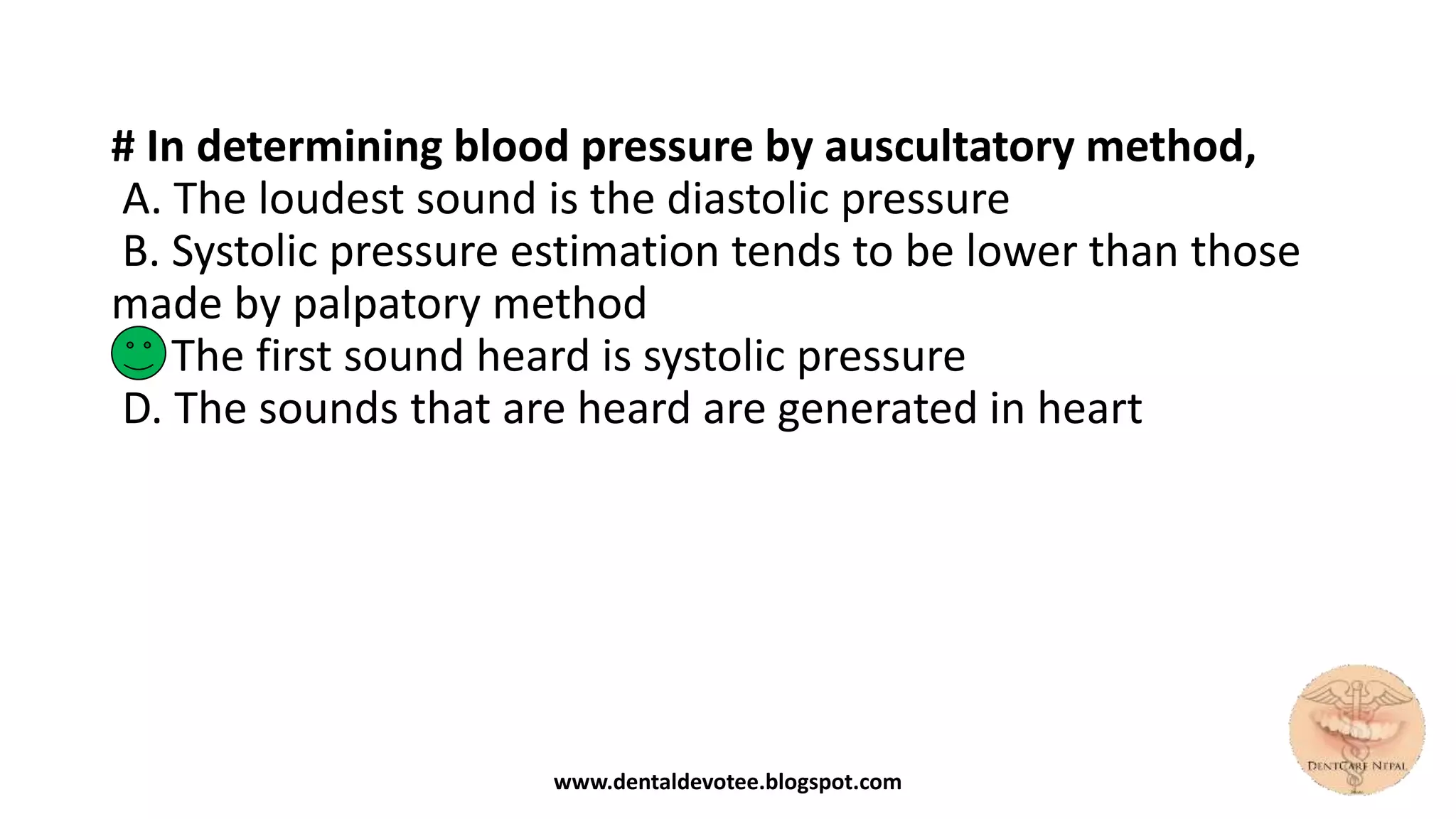
# In determining blood pressure by auscultatory method,
A. The loudest sound is the diastolic pressure
B. Systolic pressure estimation tends to be lower than those
made by palpatory method
C. The first sound heard is systolic pressure
D. The sounds that are heard are generated in heart
www.dentaldevotee.blogspot.com
# In determining blood pressure by auscultatory method,
A. The loudest sound is the diastolic pressure
B. Systolic pressure estimation tends to be lower than those
made by palpatory method
C. The first sound heard is systolic pressure
D. The sounds that are heard are generated in heart
www.dentaldevotee.blogspot.com
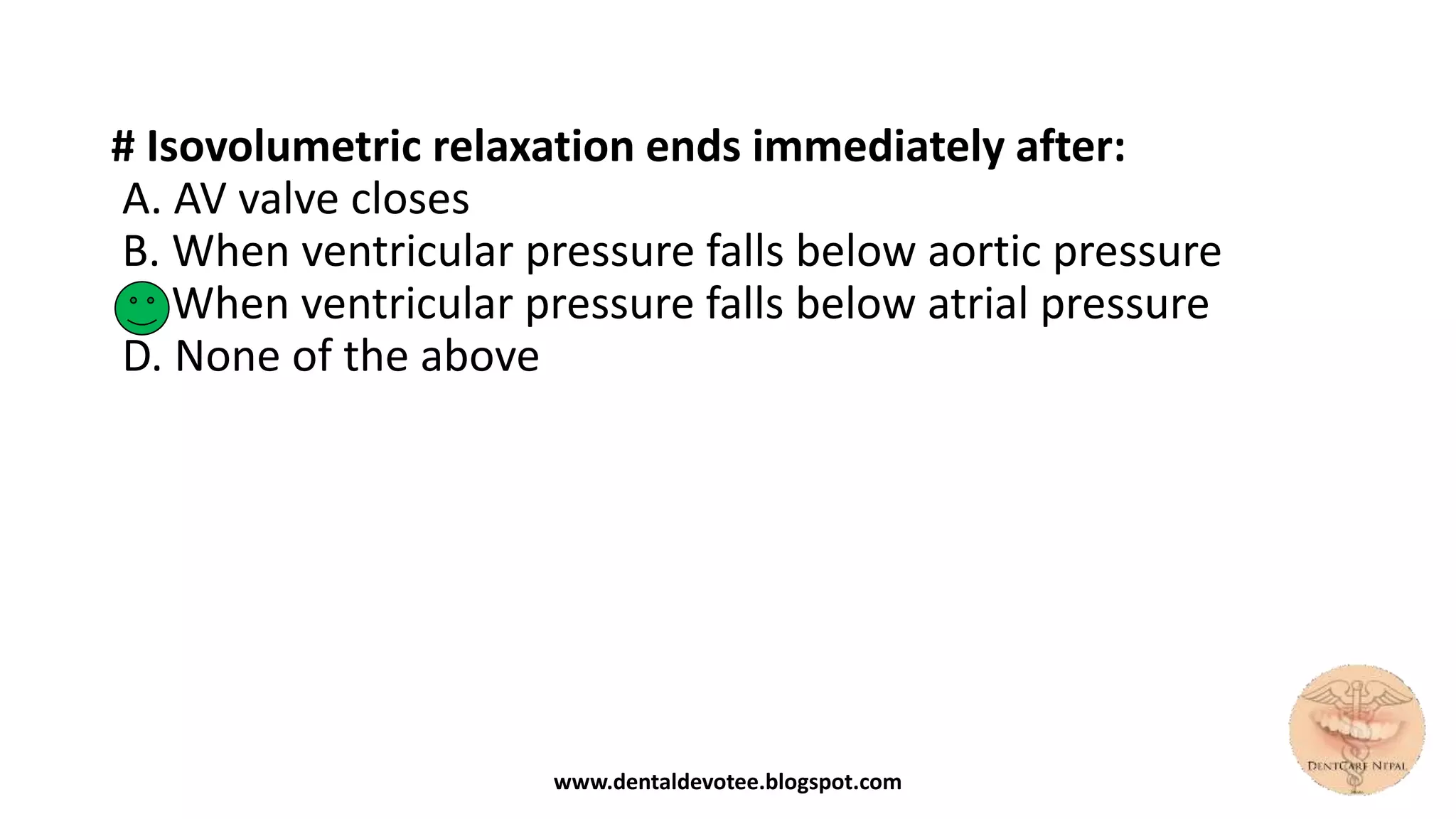
# Isovolumetric relaxation ends immediately after:
A. AV valve closes
B. When ventricular pressure falls below aortic pressure
C. When ventricular pressure falls below atrial pressure
D. None of the above
www.dentaldevotee.blogspot.com
# Isovolumetric relaxation ends immediately after:
A. AV valve closes
B. When ventricular pressure falls below aortic pressure
C. When ventricular pressure falls below atrial pressure
D. None of the above
www.dentaldevotee.blogspot.com
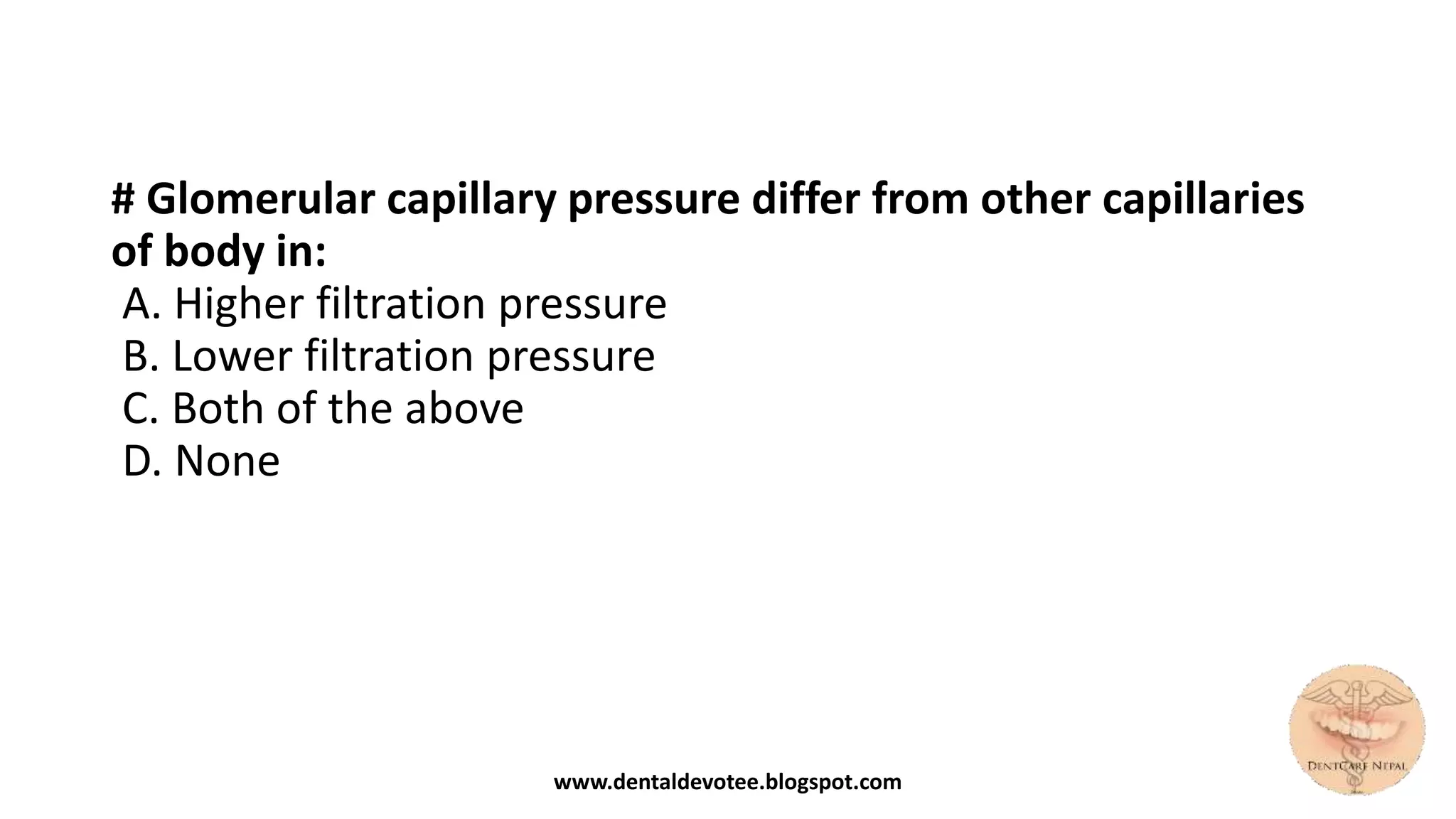
# Glomerular capillary pressure differ from other capillaries
of body in:
A. Higher filtration pressure
B. Lower filtration pressure
C. Both of the above
D. None
www.dentaldevotee.blogspot.com
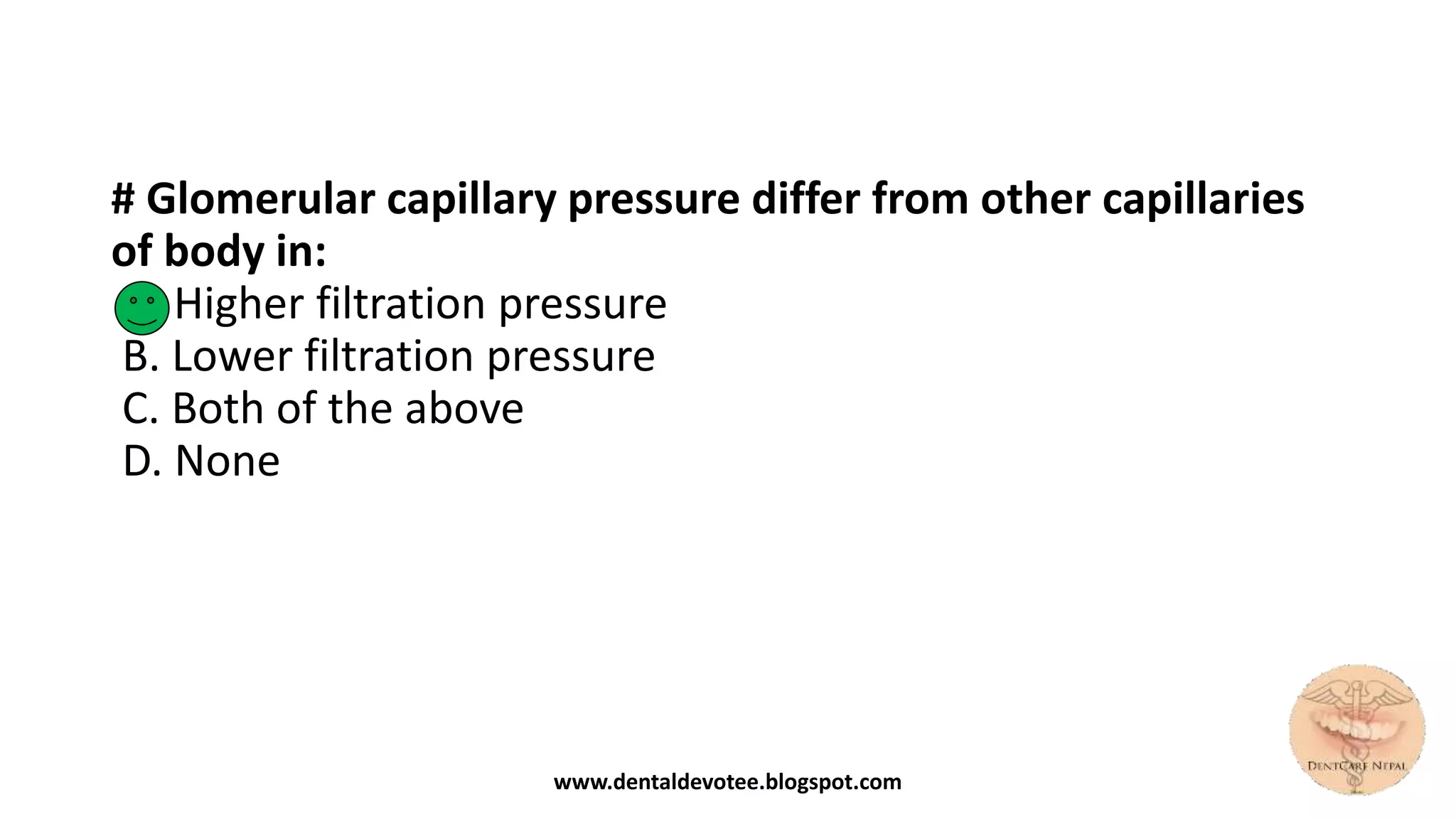
# Glomerular capillary pressure differ from other capillaries
of body in:
A. Higher filtration pressure
B. Lower filtration pressure
C. Both of the above
D. None
www.dentaldevotee.blogspot.com
# The hemoglobin oxygen saturation of blood entering the
right ventricle is approximately:
A. 97 percent
B. 85 percent
C. 75 percent
D. 53 percent
www.dentaldevotee.blogspot.com
# The hemoglobin oxygen saturation of blood entering the
right ventricle is approximately:
A. 97 percent
B. 85 percent
C. 75 percent
D. 53 percent
www.dentaldevotee.blogspot.com
# Which of the following increases turbulence in blood flow ?
A. Reynolds number <2000
B. Decrease in viscosity of blood
C. Decrease in density of blood
D. Increase in diameter of blood vessel
www.dentaldevotee.blogspot.com
# Which of the following increases turbulence in blood flow ?
A. Reynolds number <2000
B. Decrease in viscosity of blood
C. Decrease in density of blood
D. Increase in diameter of blood vessel
www.dentaldevotee.blogspot.com
# In the case of heart muscle , all are true except:
A. Acts as syncytium
B. Has multiple nuclei
C. has gap junctions
D. has branching
www.dentaldevotee.blogspot.com
# In the case of heart muscle , all are true except:
A. Acts as syncytium
B. Has multiple nuclei
C. has gap junctions
D. has branching
www.dentaldevotee.blogspot.com
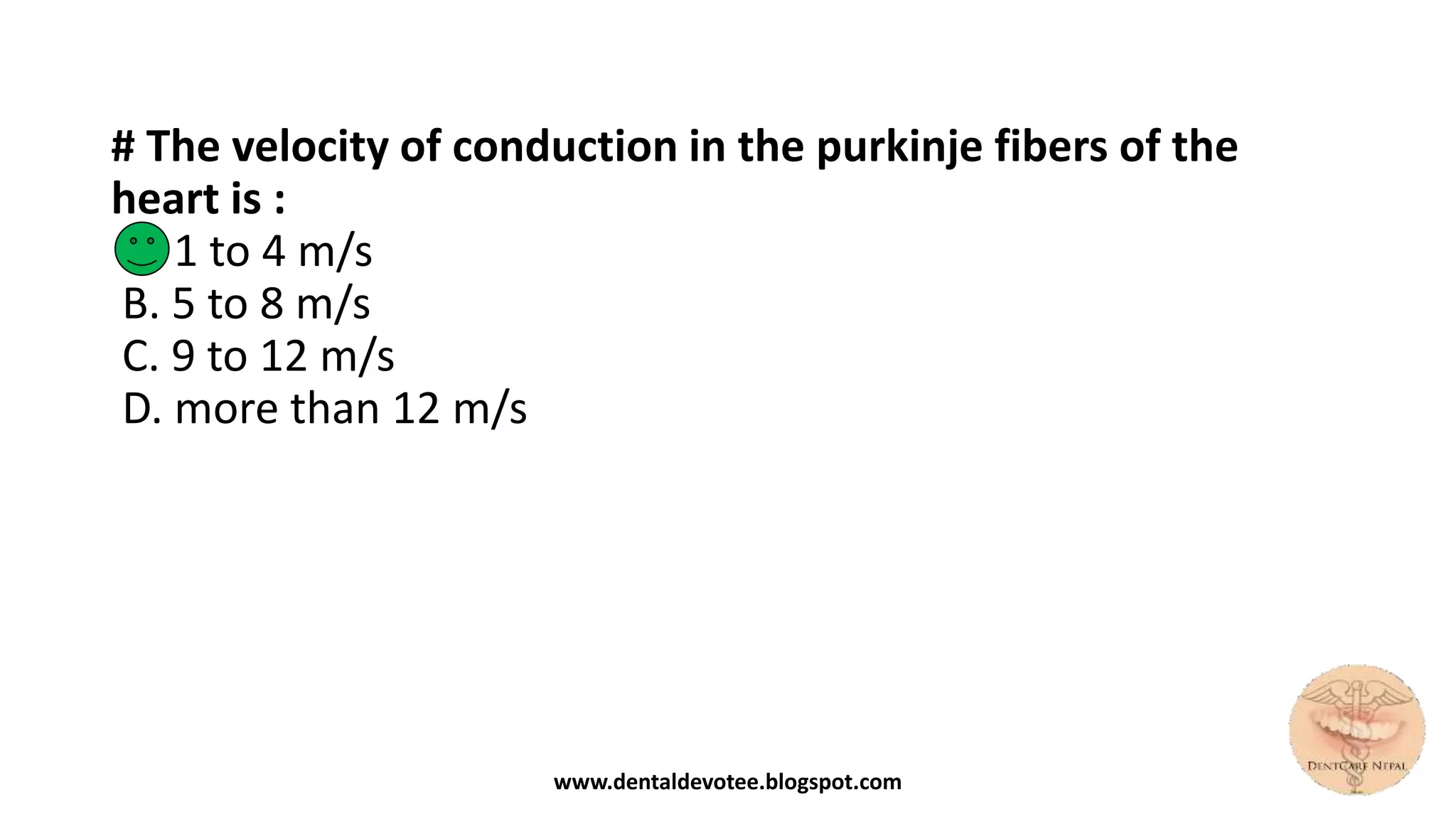
# The velocity of conduction in the purkinje fibers of the
heart is :
A. 1 to 4 m/s
B. 5 to 8 m/s
C. 9 to 12 m/s
D. more than 12 m/s
www.dentaldevotee.blogspot.com
# The velocity of conduction in the purkinje fibers of the
heart is :
A. 1 to 4 m/s
B. 5 to 8 m/s
C. 9 to 12 m/s
D. more than 12 m/s
www.dentaldevotee.blogspot.com
# Second heart sound is characterized by all except:
A. due to closure of semilunar valves
B. is occasionally split
C. has longer duration than first heart sound
D. marks the onset of diastole
www.dentaldevotee.blogspot.com
# Second heart sound is characterized by all except:
A. due to closure of semilunar valves
B. is occasionally split
C. has longer duration than first heart sound
D. marks the onset of diastole
www.dentaldevotee.blogspot.com
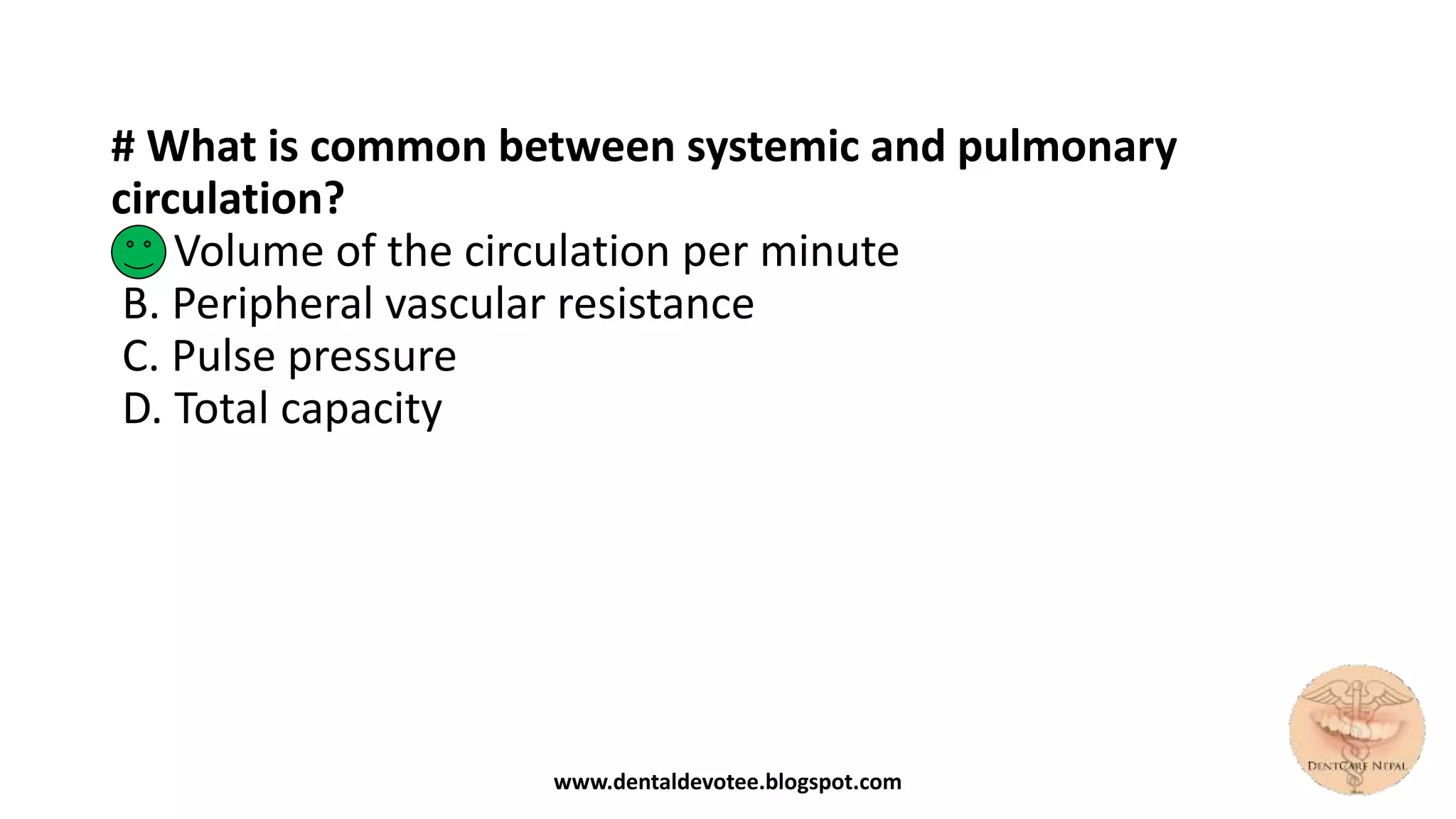
# What is common between systemic and pulmonary
circulation?
A. Volume of the circulation per minute
B. Peripheral vascular resistance
C. Pulse pressure
D. Total capacity
www.dentaldevotee.blogspot.com
# What is common between systemic and pulmonary
circulation?
A. Volume of the circulation per minute
B. Peripheral vascular resistance
C. Pulse pressure
D. Total capacity
www.dentaldevotee.blogspot.com
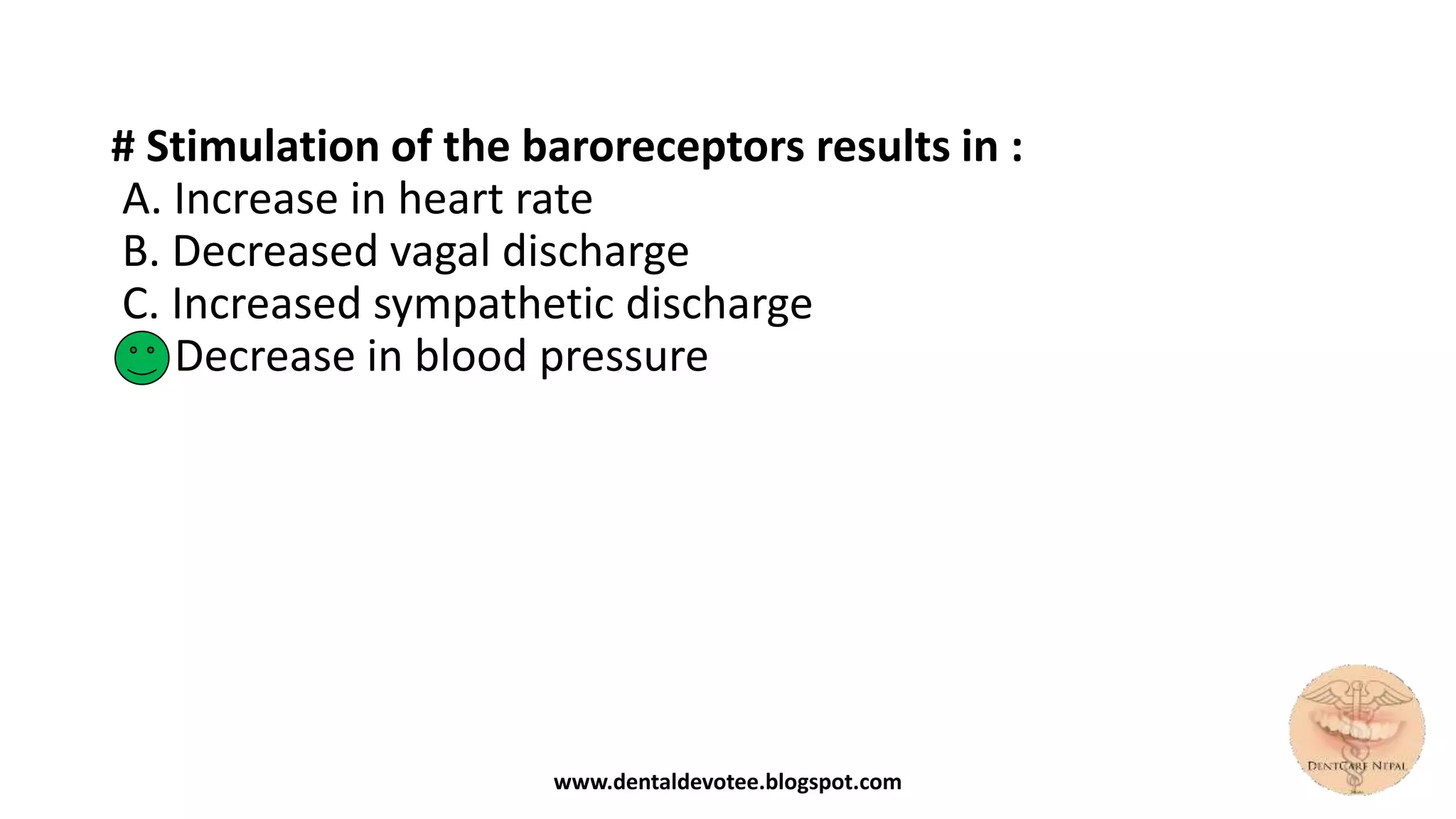
# Stimulation of the baroreceptors results in :
A. Increase in heart rate
B. Decreased vagal discharge
C. Increased sympathetic discharge
D. Decrease in blood pressure
www.dentaldevotee.blogspot.com
# Stimulation of the baroreceptors results in :
A. Increase in heart rate
B. Decreased vagal discharge
C. Increased sympathetic discharge
D. Decrease in blood pressure
www.dentaldevotee.blogspot.com
# The function of carotid body is :
A. Measures the change in pO2 in arterial blood
B. Measures pO2 in venous blood
C. Measures the change in CO2 in arterial blood
D. Measures the change in CO2 in venous blood
www.dentaldevotee.blogspot.com
# The function of carotid body is :
A. Measures the change in pO2 in arterial blood
B. Measures pO2 in venous blood
C. Measures the change in CO2 in arterial blood
D. Measures the change in CO2 in venous blood
www.dentaldevotee.blogspot.com
# The dicrotic notch on the aortic pressure curve is caused by :
A. Closure of the pulmonary valve
B. Rapid filling of the left ventricle
C. Closure of the aortic valve
D. Contraction of the aorta
www.dentaldevotee.blogspot.com
# The dicrotic notch on the aortic pressure curve is caused by :
A. Closure of the pulmonary valve
B. Rapid filling of the left ventricle
C. Closure of the aortic valve
D. Contraction of the aorta
www.dentaldevotee.blogspot.com
# Peripheral vascular resistance is best given by :
A. Mean arterial pressure responsible for blood flow to organ
B. Diastolic blood pressure as it decreases till mid-thoracic
aorta
C. Pulse pressure as it relates to stroke volume and aortic
compliance
D. Systolic pressure as it increase in descending aorta
www.dentaldevotee.blogspot.com
# Peripheral vascular resistance is best given by :
A. Mean arterial pressure responsible for blood flow to organ
B. Diastolic blood pressure as it decreases till mid-thoracic
aorta
C. Pulse pressure as it relates to stroke volume and aortic
compliance
D. Systolic pressure as it increase in descending aorta
www.dentaldevotee.blogspot.com
Share and
Subscribe for
More MCQs
Contact: raman.dhungel@gmail.com
www.facebook.com/DentCareNepal
www.dentaldevotee.blogspot.com
www.youtube.com/DentCareNepal
www.dentaldevotee.blogspot.com

MCQs on Cardiovascular system physiology

  • 1.
    MCQs on Cardiovascular System PhysiologyMCQs www.dentaldevotee.blogspot.com
  • 4.
  • 5.
    # The firstheart sound is produced by the : A. Closure of the aortic and pulmonary valves B. Opening of the aortic and pulmonary valves C. Closure of the mitral and tricuspid valves D. Opening of the mitral and tricuspid valves www.dentaldevotee.blogspot.com
  • 6.
    # The firstheart sound is produced by the : A. Closure of the aortic and pulmonary valves B. Opening of the aortic and pulmonary valves C. Closure of the mitral and tricuspid valves D. Opening of the mitral and tricuspid valves www.dentaldevotee.blogspot.com
  • 7.
    # Parasympathetic stimulationof heart causes: A. SA node decreases firing B. Increased AV node excitability C. Decreased ventricular contraction D. Tachycardia www.dentaldevotee.blogspot.com
  • 8.
    # Parasympathetic stimulationof heart causes: A. SA node decreases firing B. Increased AV node excitability C. Decreased ventricular contraction D. Tachycardia www.dentaldevotee.blogspot.com
  • 9.
    # Normally, therate of the heart beat in a human is determined by: A. Bundle of His B. all cardiac muscles C. the SA node D. the cervical ganglion www.dentaldevotee.blogspot.com
  • 10.
    # Normally, therate of the heart beat in a human is determined by: A. Bundle of His B. all cardiac muscles C. the SA node D. the cervical ganglion www.dentaldevotee.blogspot.com
  • 11.
    # The ventricularrepolarisation in ECG is best seen in: A. "P" wave B. "Q" wave C. "R" wave D. "T" wave www.dentaldevotee.blogspot.com
  • 12.
    # The ventricularrepolarisation in ECG is best seen in: A. "P" wave B. "Q" wave C. "R" wave D. "T" wave www.dentaldevotee.blogspot.com
  • 13.
    # Stroke outputof each ventricle in normal adult is : A. 30 ml B. 130 ml C. 70 ml D. 5 liters www.dentaldevotee.blogspot.com
  • 14.
    # Stroke outputof each ventricle in normal adult is : A. 30 ml B. 130 ml C. 70 ml D. 5 liters www.dentaldevotee.blogspot.com
  • 15.
    # Cardiac outputis a measure of : A. Peripheral resistance * tissue fluid B. Peripheral resistance * cardiac rate C. Blood pressure * Cardiac rate D. Heart rate * Stroke volume www.dentaldevotee.blogspot.com
  • 16.
    # Cardiac outputis a measure of : A. Peripheral resistance * tissue fluid B. Peripheral resistance * cardiac rate C. Blood pressure * Cardiac rate D. Heart rate * Stroke volume www.dentaldevotee.blogspot.com
  • 17.
    # Cardiac outputis not affected by : A. Heart rate B. Peripheral resistance C. Systolic blod pressure D. Venous return www.dentaldevotee.blogspot.com
  • 18.
    # Cardiac outputis not affected by : A. Heart rate B. Peripheral resistance C. Systolic blod pressure D. Venous return www.dentaldevotee.blogspot.com
  • 19.
    # The largestfunction of the total peripheral resistance is due to: A. Venules B. Arterioles C. Capillaries D. Precapillary sphincters www.dentaldevotee.blogspot.com
  • 20.
    # The largestfunction of the total peripheral resistance is due to: A. Venules B. Arterioles C. Capillaries D. Precapillary sphincters www.dentaldevotee.blogspot.com
  • 21.
    # All theheart valves are open during which stage of cardiac cycle? A. Systolic ejection B. Isovolumetric relaxation C. Isovolumetric contraction D. None of the above www.dentaldevotee.blogspot.com
  • 22.
    # All theheart valves are open during which stage of cardiac cycle? A. Systolic ejection B. Isovolumetric relaxation C. Isovolumetric contraction D. None of the above www.dentaldevotee.blogspot.com
  • 23.
    # Minimum bloodPressure is in: A. Aorta B. Arteries C. Capillaries D. Venules www.dentaldevotee.blogspot.com
  • 24.
    # Minimum bloodPressure is in: A. Aorta B. Arteries C. Capillaries D. Venules www.dentaldevotee.blogspot.com
  • 25.
    # Starling's lawof the heart A. Does not operate in the failing heart B. Does not operate during exercise C. Explains the increase in cardiac output that occurs when venous return is increased D. Explains the increase in cardiac output when the sympathetic nerves supplying the heart are stimulated www.dentaldevotee.blogspot.com
  • 26.
    # Starling's lawof the heart A. Does not operate in the failing heart B. Does not operate during exercise C. Explains the increase in cardiac output that occurs when venous return is increased D. Explains the increase in cardiac output when the sympathetic nerves supplying the heart are stimulated www.dentaldevotee.blogspot.com
  • 27.
    # Which ofthe followings is true ? A. Starling's law of heart states that increase in force of contraction is directly related to cardiac output B. Starling's law of heart states that the force of ventricular contraction is directly related to the end diastolic volume C. Both A and B D. None of the above www.dentaldevotee.blogspot.com
  • 28.
    # Which ofthe followings is true ? A. Starling's law of heart states that increase in force of contraction is directly related to cardiac output B. Starling's law of heart states that the force of ventricular contraction is directly related to the end diastolic volume C. Both A and B D. None of the above www.dentaldevotee.blogspot.com
  • 29.
    # Peripheral resistanceis maximum in: A. Aorta B. Artery C. Arteriole D. Vein www.dentaldevotee.blogspot.com
  • 30.
    # Peripheral resistanceis maximum in: A. Aorta B. Artery C. Arteriole D. Vein www.dentaldevotee.blogspot.com
  • 31.
    # Stimulatuion ofbaroreceptor leads to : A. Increased blood pressure, Increased heart rate B. Decreased BP, decreased heart rate C. Increased BP, decreased heart rate D. Decreased BP, Increased heart rate www.dentaldevotee.blogspot.com
  • 32.
    # Stimulatuion ofbaroreceptor leads to : A. Increased blood pressure, Increased heart rate B. Decreased BP, decreased heart rate C. Increased BP, decreased heart rate D. Decreased BP, Increased heart rate www.dentaldevotee.blogspot.com
  • 33.
    # Increased functionaldemand on the heart produces increased size of the myocardium by: A. Hyperplasia B. Hypertrophy C. Fatty infiltration D. Increased amounts of fibrous connective tissue www.dentaldevotee.blogspot.com
  • 34.
    # Increased functionaldemand on the heart produces increased size of the myocardium by: A. Hyperplasia B. Hypertrophy C. Fatty infiltration D. Increased amounts of fibrous connective tissue www.dentaldevotee.blogspot.com
  • 35.
    # Cardiac indexis related to : A. Cardiac output and body weight B. Cardiac output and body surface area C. Cardiac output and work of the heart D. Stroke volume and pulse rate www.dentaldevotee.blogspot.com
  • 36.
    # Cardiac indexis related to : A. Cardiac output and body weight B. Cardiac output and body surface area C. Cardiac output and work of the heart D. Stroke volume and pulse rate www.dentaldevotee.blogspot.com
  • 37.
    # Absolute refractoryperiod in heart : A. Lasts till cardiac contraction B. Longer than refractory period in skeletal muscle C. A phase of cardiac cycle in which heart cannot be stimulated by any amount of stimulus D. Corresponds with duration of action potential E. All of the above www.dentaldevotee.blogspot.com
  • 38.
    # Absolute refractoryperiod in heart : A. Lasts till cardiac contraction B. Longer than refractory period in skeletal muscle C. A phase of cardiac cycle in which heart cannot be stimulated by any amount of stimulus D. Corresponds with duration of action potential E. All of the above www.dentaldevotee.blogspot.com
  • 39.
    # Closure ofthe aortic valve occurs before the following event: A. Isovolumetric contraction B. Isovolumetric relaxation C. Prediastole D. Presystole www.dentaldevotee.blogspot.com
  • 40.
    # Closure ofthe aortic valve occurs before the following event: A. Isovolumetric contraction B. Isovolumetric relaxation C. Prediastole D. Presystole www.dentaldevotee.blogspot.com
  • 41.
    # Conduction velocityis least in: A. AV node B. SA Node C. Purkinje fibers D. Budele of His www.dentaldevotee.blogspot.com
  • 42.
    # Conduction velocityis least in: A. AV node B. SA Node C. Purkinje fibers D. Budele of His www.dentaldevotee.blogspot.com
  • 43.
    # Fastest conductingtissue in human heart: A. AV node B. SA node C. Bundle of His D. Purkinje fibers www.dentaldevotee.blogspot.com
  • 44.
    # Fastest conductingtissue in human heart: A. AV node B. SA node C. Bundle of His D. Purkinje fibers www.dentaldevotee.blogspot.com
  • 45.
    # Under restingcondition, the cardiac output is ____ L/min: A. 2.5 B. 4.25 C. 5.25 D. 9.5 www.dentaldevotee.blogspot.com
  • 46.
    # Under restingcondition, the cardiac output is ____ L/min: A. 2.5 B. 4.25 C. 5.25 D. 9.5 www.dentaldevotee.blogspot.com
  • 47.
    # Coronary bloodflow is usually predominantly controlled by : A. Auto regulation B. Hormones C. Parasympathetic impulses D. Sympathetic impulse www.dentaldevotee.blogspot.com
  • 48.
    # Coronary bloodflow is usually predominantly controlled by : A. Auto regulation B. Hormones C. Parasympathetic impulses D. Sympathetic impulse www.dentaldevotee.blogspot.com
  • 49.
    # Cardiac outputin L/min divided by heart rate equals: A. Cardiac efficiency B. Cardiac index C. Mean Stroke volume D. Mean arterial pressure www.dentaldevotee.blogspot.com
  • 50.
    # Cardiac outputin L/min divided by heart rate equals: A. Cardiac efficiency B. Cardiac index C. Mean Stroke volume D. Mean arterial pressure www.dentaldevotee.blogspot.com
  • 51.
    # Cardiac cycleduration in man is: A. 0.4 sec B. 0.8 sec C. 1.2 sec D. 1.6 sec www.dentaldevotee.blogspot.com
  • 52.
    # Cardiac cycleduration in man is: A. 0.4 sec B. 0.8 sec C. 1.2 sec D. 1.6 sec www.dentaldevotee.blogspot.com
  • 53.
    # First heartsound occurs during the period of: A. Isotonic relaxation B. Isovolumetric relaxation C. Isovolumetric contraction D. Isotonic contraction www.dentaldevotee.blogspot.com
  • 54.
    # First heartsound occurs during the period of: A. Isotonic relaxation B. Isovolumetric relaxation C. Isovolumetric contraction D. Isotonic contraction www.dentaldevotee.blogspot.com
  • 55.
    # Absolute periodwhen whole heart is in diastole is : A. 0.7 sec B. 0.3 sec C. 0.2 sec D. 0.4 sec www.dentaldevotee.blogspot.com
  • 56.
    # Absolute periodwhen whole heart is in diastole is : A. 0.7 sec B. 0.3 sec C. 0.2 sec D. 0.4 sec www.dentaldevotee.blogspot.com
  • 57.
    # The effectsof adrenaline on heart are all except : A. Increases heart rate B. Decreases myocardial irritability C. Increases force of contraction D. Increases oxygen uptake by heart www.dentaldevotee.blogspot.com
  • 58.
    # The effectsof adrenaline on heart are all except : A. Increases heart rate B. Decreases myocardial irritability C. Increases force of contraction D. Increases oxygen uptake by heart www.dentaldevotee.blogspot.com
  • 59.
    # Cardiac outputis maximum to : A. Liver B. Brain C. Kidney D. Heart www.dentaldevotee.blogspot.com
  • 60.
    # Cardiac outputis maximum to : A. Liver B. Brain C. Kidney D. Heart www.dentaldevotee.blogspot.com
  • 61.
    # Increase incarotid sinus pressure produces: A. Reflex hyperpnea B. Reflex bradycardia C. Reflex tachycardia D. Reflex hypercapnia www.dentaldevotee.blogspot.com
  • 62.
    # Increase incarotid sinus pressure produces: A. Reflex hyperpnea B. Reflex bradycardia C. Reflex tachycardia D. Reflex hypercapnia www.dentaldevotee.blogspot.com
  • 63.
    # Effect onforce of contraction of heart is : A. Chronotropic effect B. Dromotropic efffect C. Bathmotropic effect D. Inotropic effect www.dentaldevotee.blogspot.com
  • 64.
    # Effect onforce of contraction of heart is : A. Chronotropic effect B. Dromotropic efffect C. Bathmotropic effect D. Inotropic effect www.dentaldevotee.blogspot.com
  • 65.
    # SA nodeacts as a pacemaker of the heart because of the fact that it: A. is capable of generating impulses B. has rich sympathetic innervations C. has poor cholinergic innervations D. generates impulses at the highest rate www.dentaldevotee.blogspot.com
  • 66.
    # SA nodeacts as a pacemaker of the heart because of the fact that it: A. is capable of generating impulses B. has rich sympathetic innervations C. has poor cholinergic innervations D. generates impulses at the highest rate www.dentaldevotee.blogspot.com
  • 67.
    # Distribution ofblood flow is mainly regulated by the : A. Arteries B. Arterioles C. Capillaries D. Venules www.dentaldevotee.blogspot.com
  • 68.
    # Distribution ofblood flow is mainly regulated by the : A. Arteries B. Arterioles C. Capillaries D. Venules www.dentaldevotee.blogspot.com
  • 69.
    # The followingfactors increase the cardiac output except: A. Preload B. Afterload C. Heart rate D. Myocardial contractility www.dentaldevotee.blogspot.com
  • 70.
    # The followingfactors increase the cardiac output except: A. Preload B. Afterload C. Heart rate D. Myocardial contractility www.dentaldevotee.blogspot.com
  • 71.
    # Ventricular musclereceives impulses directly from the: A. Purkinje system B. Bundle of His C. Right and left bundle branches D. AV node www.dentaldevotee.blogspot.com
  • 72.
    # Ventricular musclereceives impulses directly from the: A. Purkinje system B. Bundle of His C. Right and left bundle branches D. AV node www.dentaldevotee.blogspot.com
  • 73.
    # In determiningblood pressure by auscultatory method, A. The loudest sound is the diastolic pressure B. Systolic pressure estimation tends to be lower than those made by palpatory method C. The first sound heard is systolic pressure D. The sounds that are heard are generated in heart www.dentaldevotee.blogspot.com
  • 74.
    # In determiningblood pressure by auscultatory method, A. The loudest sound is the diastolic pressure B. Systolic pressure estimation tends to be lower than those made by palpatory method C. The first sound heard is systolic pressure D. The sounds that are heard are generated in heart www.dentaldevotee.blogspot.com
  • 75.
    # Isovolumetric relaxationends immediately after: A. AV valve closes B. When ventricular pressure falls below aortic pressure C. When ventricular pressure falls below atrial pressure D. None of the above www.dentaldevotee.blogspot.com
  • 76.
    # Isovolumetric relaxationends immediately after: A. AV valve closes B. When ventricular pressure falls below aortic pressure C. When ventricular pressure falls below atrial pressure D. None of the above www.dentaldevotee.blogspot.com
  • 77.
    # Glomerular capillarypressure differ from other capillaries of body in: A. Higher filtration pressure B. Lower filtration pressure C. Both of the above D. None www.dentaldevotee.blogspot.com
  • 78.
    # Glomerular capillarypressure differ from other capillaries of body in: A. Higher filtration pressure B. Lower filtration pressure C. Both of the above D. None www.dentaldevotee.blogspot.com
  • 79.
    # The hemoglobinoxygen saturation of blood entering the right ventricle is approximately: A. 97 percent B. 85 percent C. 75 percent D. 53 percent www.dentaldevotee.blogspot.com
  • 80.
    # The hemoglobinoxygen saturation of blood entering the right ventricle is approximately: A. 97 percent B. 85 percent C. 75 percent D. 53 percent www.dentaldevotee.blogspot.com
  • 81.
    # Which ofthe following increases turbulence in blood flow ? A. Reynolds number <2000 B. Decrease in viscosity of blood C. Decrease in density of blood D. Increase in diameter of blood vessel www.dentaldevotee.blogspot.com
  • 82.
    # Which ofthe following increases turbulence in blood flow ? A. Reynolds number <2000 B. Decrease in viscosity of blood C. Decrease in density of blood D. Increase in diameter of blood vessel www.dentaldevotee.blogspot.com
  • 83.
    # In thecase of heart muscle , all are true except: A. Acts as syncytium B. Has multiple nuclei C. has gap junctions D. has branching www.dentaldevotee.blogspot.com
  • 84.
    # In thecase of heart muscle , all are true except: A. Acts as syncytium B. Has multiple nuclei C. has gap junctions D. has branching www.dentaldevotee.blogspot.com
  • 85.
    # The velocityof conduction in the purkinje fibers of the heart is : A. 1 to 4 m/s B. 5 to 8 m/s C. 9 to 12 m/s D. more than 12 m/s www.dentaldevotee.blogspot.com
  • 86.
    # The velocityof conduction in the purkinje fibers of the heart is : A. 1 to 4 m/s B. 5 to 8 m/s C. 9 to 12 m/s D. more than 12 m/s www.dentaldevotee.blogspot.com
  • 87.
    # Second heartsound is characterized by all except: A. due to closure of semilunar valves B. is occasionally split C. has longer duration than first heart sound D. marks the onset of diastole www.dentaldevotee.blogspot.com
  • 88.
    # Second heartsound is characterized by all except: A. due to closure of semilunar valves B. is occasionally split C. has longer duration than first heart sound D. marks the onset of diastole www.dentaldevotee.blogspot.com
  • 89.
    # What iscommon between systemic and pulmonary circulation? A. Volume of the circulation per minute B. Peripheral vascular resistance C. Pulse pressure D. Total capacity www.dentaldevotee.blogspot.com
  • 90.
    # What iscommon between systemic and pulmonary circulation? A. Volume of the circulation per minute B. Peripheral vascular resistance C. Pulse pressure D. Total capacity www.dentaldevotee.blogspot.com
  • 91.
    # Stimulation ofthe baroreceptors results in : A. Increase in heart rate B. Decreased vagal discharge C. Increased sympathetic discharge D. Decrease in blood pressure www.dentaldevotee.blogspot.com
  • 92.
    # Stimulation ofthe baroreceptors results in : A. Increase in heart rate B. Decreased vagal discharge C. Increased sympathetic discharge D. Decrease in blood pressure www.dentaldevotee.blogspot.com
  • 93.
    # The functionof carotid body is : A. Measures the change in pO2 in arterial blood B. Measures pO2 in venous blood C. Measures the change in CO2 in arterial blood D. Measures the change in CO2 in venous blood www.dentaldevotee.blogspot.com
  • 94.
    # The functionof carotid body is : A. Measures the change in pO2 in arterial blood B. Measures pO2 in venous blood C. Measures the change in CO2 in arterial blood D. Measures the change in CO2 in venous blood www.dentaldevotee.blogspot.com
  • 95.
    # The dicroticnotch on the aortic pressure curve is caused by : A. Closure of the pulmonary valve B. Rapid filling of the left ventricle C. Closure of the aortic valve D. Contraction of the aorta www.dentaldevotee.blogspot.com
  • 96.
    # The dicroticnotch on the aortic pressure curve is caused by : A. Closure of the pulmonary valve B. Rapid filling of the left ventricle C. Closure of the aortic valve D. Contraction of the aorta www.dentaldevotee.blogspot.com
  • 97.
    # Peripheral vascularresistance is best given by : A. Mean arterial pressure responsible for blood flow to organ B. Diastolic blood pressure as it decreases till mid-thoracic aorta C. Pulse pressure as it relates to stroke volume and aortic compliance D. Systolic pressure as it increase in descending aorta www.dentaldevotee.blogspot.com
  • 98.
    # Peripheral vascularresistance is best given by : A. Mean arterial pressure responsible for blood flow to organ B. Diastolic blood pressure as it decreases till mid-thoracic aorta C. Pulse pressure as it relates to stroke volume and aortic compliance D. Systolic pressure as it increase in descending aorta www.dentaldevotee.blogspot.com
  • 99.
    Share and Subscribe for MoreMCQs Contact: raman.dhungel@gmail.com www.facebook.com/DentCareNepal www.dentaldevotee.blogspot.com www.youtube.com/DentCareNepal www.dentaldevotee.blogspot.com