Dr Gauri Kapila
MDS Student
Department of Periodontology and Oral
Implantology
 Portion of maxilla and mandible that forms, supports
& protects the teeth
 Parts – alveolar bone proper, compact bone,
cancellous bone
FUNCTIONS
 Support to teeth
 Attachment to muscles
 Framework for bone marrow
 Reservoir of ions
Water (15%)
Organic component (25%)
-Collagen І (90%)
-Proteins (osteocalcin, osteonectin, osteopontin, proteoglycans)
-Cells (osteoprogenitor cells, osteoblasts, osteoclasts, osteocytes, bone
lining cells)
Inorganic component (60%)
-Hydroxyapatite
- Ions
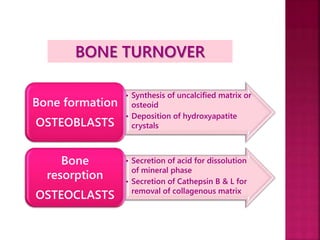
• Synthesis of uncalcified matrix or
osteoid
• Deposition of hydroxyapatite
crystals
Bone formation
OSTEOBLASTS
• Secretion of acid for dissolution
of mineral phase
• Secretion of Cathepsin B & L for
removal of collagenous matrix
Bone
resorption
OSTEOCLASTS
BONE TURNOVER
 Osteo-progenitor cells
 Osteoblasts
 Osteoclasts
 Osteocytes
 Bone lining cells
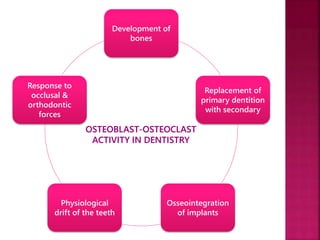
Development of
bones
Replacement of
primary dentition
with secondary
Osseointegration
of implants
Physiological
drift of the teeth
Response to
occlusal &
orthodontic
forces
• Osteoblasts
• Cytokines
• RANKL
• M-CSF
• Osteoclast differentiation
Kobayashi and Udagawa
2007
• Stimulated osteoblasts >
Procollagenase
• Removal of collagenous
part of bone
• Osteoclasts > resorption of
mineralized part of bone
INTERRELATIONSHIP
Systemic
hormones
-Parathyroid hormone
-Vitamin D3
-Calcitonin
Local produced
factors
-PGE2
-Leukotrines
-Cytokines : IL2 IL3 & IL6
-Growth factors : TNFα
TNFβ TGFβ PDGF
Multipotent stromal stem cells
Plating and attachment
Express Col І, II, III and alkaline phosphatase & osteopontin
Increased synthesis of ColІ and alkaline phosphatase
Diminishing of Col II & Col III synthesis
Formation of collagen substratum
Declining of bone osteopontin
Pre-osteoblast > osteoblast through interaction with α2β1 receptor
Condensation of mesenchymal cells
Emergence of osteoblasts
Expression of bone sialoprotein
Initiation of mineralization
Increased osteocalcin synthesis
Osteoblasts > osteocytes and bone lining cells
Xiao G, Wang D, Benson MD, Karsenty G, Franceschi RT
Role of the alpha2-integrin in osteoblast-specific gene expression
and activation of the Osf2 transcription factor. J
Biol Chem 1998: 273: 32988–32994
Homeobox
genes
hoxa2, hoxa13,
hoxd13, dlx5,
msx1, msx2
Regulatory
genes
Runx2
Cbfa1- Master
gene for
osteogenic
differentiation
Transcription
factors
•Ducy P, Zhang R, Geoffroy V, Ridall AL, Karsenty G (1997).
Osf2/Cbfa1: a transcriptional activator of osteoblast differentiation.
Cell 1997: 89: 747–754
•Rodan GA, Harada S. The missing bone. Cell 1997: 89:
677–680.
 Why runx2/cbfa1 is considered to be the master gene for
osteogenic differentiation?
 Functional role in the differentiation of all mineralizing
tissue cells
 Deletion of cbfa1 results in absence of ossified tissues
 Heterozygous mutations of gene causes cleidocranial
dysplasia in humans
•Jiang H, Sodek J, Karsenty G, Thomas H, Ranly D, Chen J. Expression of
core binding factor Osf2/Cbfa-1 and bone sialoprotein in tooth
development. Mech Dev 1999: 81:169–173.
 Studies in vitro have shown bone morphogenetic
protein-2 treatment of the myogenic cell line
C2C12 transiently upregulates cbfa1 and Msx-2
 While TGF-β can also increase cbfa1 and
suppresses myogenic differentiation in these cells,
osteogenic differentiation does not occur,
indicating that other factors induced by BMP’s are
necessary for complete expression of the
osteoblastic phenotype
Lee M-H, Javed A, Kim H-J, Shin H-I et al. Transient upregulation of
CBFA1 in response to bone morphogenetic protein-2 and transforming
growth factor b1 in C2C12 myogenic cells coincides with suppression
of the myogenic phenotype but is not sufficient for osteoblastic
differentiation. J Cell Biochem 1999: 73:114–125.
 A potential factor homeobox-containing gene
dlx5 regulates
osteoblast differentiation which is induced by BMP-4
 Treatment of undifferentiated cells with BMP-7/OP-1, signal
through Smad 5, has also identified BMP/OP-1 responsive
gene and a transcription factor, AJ-18 as immediate targets of
BMP-7, in osteogenic systems
Tamaki K, Souchelnytskyi S, Itoh S, Nakao A et al. Intracellular signaling
of osteogenic protein-1 through Smad5 activation. J Cell Physiol
1998: 177: 355–363.
 Recent studies indicate that the transcriptional activities of
Smads and core binding factor a1 may be linked by the
formation of regulatory complexes which may include other
transcription factors.
Hanai J, Chen LF, Kanno T, Ohtani-Fujita N, Kim WY, Guo
WH, Imamura T et al. Interaction and function cooperation of
PEBP2/CBF with Smads. Synergistic induction of the immunoglobulin
germline Ca promoter. Biol Chem 1999: 274: 31577–31582.
REGULATION OF BONE FORMATION
Calcium
metabolism
hormones
CALCITONIN
PARATHYROID
HORMONE
VITAMIN-D
TGF-β
Insulin like
growth factor
Glucocorticoids
Thyroid
hormones
FGF
PDGF
Bone
morphogenetic
proteins
Estrogen
Production of osteoblastic cells
Activity of osteoblastic cells
Bone resorption, directly or indirectly
PARATHYROID HORMONE
Anabolic effect
Stimulates bone
formation through
TGF-β & insulin like
growth factor
Catabolic effect
Stimulates bone
resorption indirectly
(coupling)
Increased serum Ca
Canalis E, Hock JM, Raisz LG. Parathyroid hormone: Anabolic and
catabolis effects on bone and interactions with growth factors. In:
Bilezikian JP, Marcus R, Levine MA, ed.
The parathyroids. New York: Raven Press, 1994: 65–82.
VITAMIN D3
Anabolic effect
Primary function in Ca
absorption from
intestine
Stimulates synthesis of
osteocalcin &
osteopontin
Catabolic effect
Stimulates bone
resorption
Suppresses collagen
production
DeLuca HF. Vitamin D revisited. Clin Endocrinol Metab 1980: 9: 1–26.
GLUCOCORTICOIDS
Anabolic
effect
Promotes
differentiation of
osteoblastic cells
Stimulates bone
matrix formation
Catabolic
effect
Prolonged t/t with GC
causes bone loss due
to inc PTH in
response to
inhibitory effect on
Ca absorption
TGF-β
Anabolic effect
Induces osteogenic
differentiation of
mesenchymal cells
Decrease in matrix
degradative activity
through inhibtion of
MMP’s
Catabolic effect
Inhibits osteogenic
induction by BMP’s
Reddi AH. BMPs: actions in flesh and bone. Nat Med 1997:
3: 837–839.
INSULIN
Anabolic effect
Directly targets osteoblasts
Stimulates bone matrix formation and
mineralization
Stimulates insulin like GF produced in liver
THYROID HORMONE
Anabolic effect
Affects endochondral bone formation by its
action on cartilage formation
BONE MORPHOGENETIC PROTEINS
Anabolic effect
Most profound effect on bone formation
INSULIN LIKE GROWTH FACTOR
Anabolic effect
Stimulates proliferation of osteoblast
precursors
Inhibits MMP’s
Hock JM, Centrella M, Canalis E. Insulin-like growth factor I (IGF-I) has
independent effects on bone matrix formation and cell replication.
Endocrinology 1988: 122:254–260.
PDGF AND FGF
Anabolic effect
Increases proliferation of osteoprogenitor cells
Promote osteogenic differentiation
Influence expression of other cytokines
Help in wound and fracture healing
Hock JM, Canalis E. Platelet-derived growth factor enhances
bone cell replication but not differentiated function
of osteoblasts. Endocrinology 1994: 134: 1423–1428.
 Requires recruitment of a specialized cell, produced
by the monocyte/macrophage lineage of
hematopoietic cells derived from bone marrow
 develop from a pluripotential mononuclear
precursor CFU-GM which is stimulated to proliferate
and differentiate
under the influence of M-CSF
STAGES IN THE LIFE CYCLE OF AN OSTEOCLAST
 Recent molecular studies have identified transcription
factors, such as c-Fos and PU.1, that are required for
osteoclast differentiation
 Studies stating that if there is impaired production of
colony-stimulating factor-1 (CSF-1), osteoclasts fail to form
leading to osteopetrosis
 Studies showing osteopetrotic phenotype resulting from
ablation of c-Fos gene, revealing the importance of these
genes in the early development of osteoclasts
Studies on transcription factors required for osteoclast
differentiation
Boyce BF, Hughes DE, Wright KR, Xing L, Dai A. Recent advances in
bone biology provide insight into the pathogenesis of bone diseases.
Lab Invest 1999: 79: 83–94
 The identification of a novel receptor, termed OPG has
recently uncovered a key regulatory mechanism in
osteoclast differentiation and activity
 OPGL-the putative osteoclast differentiation factor-
expressed on the surface of stromal/bone cells-causes
differentiation-through TNFR or ODAR or RANK
 Decoy receptor that binds ligand but is incapable of
signaling
 Ablation-osteoporosis
 Increased expression-osteopetrosis
Simonet WS, Lacey DL, Dunstan CR, Kelley M, Chang MS,
Osteoprotegerin: a novel secreted protein involved in the
regulation of bone density. Cell 1997: 89: 309–319.
 Osteocytic osteolysis
 Osteoclastic resorption
 Formation of osteoclasts involves fusion of
monocytic precursors which occurs at the site of
bone resorption
 CD44 (hyaluronan receptor), the aγb3 integrin is
highly expressed in osteoclasts; both receptors-
primary target for the bone matrix protein
osteopontin in signaling, cell attachment and
migration
PHASES OF RESORPTION
Ten cate’s description of sequence of events
 On the bone surface, osteoclasts attach & become
polarized, form a ruffled border beneath which bone
resorption takes place
 Acidic environment- adenosine triphosphatase,
pumps protons generated by carbonic anhydrase
activity
 Demineralization exposes organic matrix
DEMINERALISATION PHASE
 Lysosomal enzymes can degrade collagen matrix
macromolecules into its constituent amino acids- by
phagocytic degradation & release of enzymes- acid
phosphatase & cathepsin
 Matrix metalloproteinases-activated under the acidic
conditions-resorption lacunae & contribute to matrix
degradation
MATRIX DEGRADATION
Sodek J, Overall CM. Matrix metalloproteinases in periodontal tissue
remodelling. Matrix 1992: 1(suppl): 352–362.
 Sequestration of mineral ions & amino acids takes
place inside osteoclast
 Osteoclasts undergo apoptosis-mechanism for
limiting resorptive activity
APOPTOSIS OF OSTEOCLASTS
Stimulating factors
PTH
Vit-D3
IL-1
IL-6
TNF-α
Inhibiting factors
Calcitonin
TGF-β
Estrogen
Interferon-γ
Parathyroid
hormone
Affects indirectly by acting on
the receptors present on pre-
osteoblasts, osteoblasts & lining
cells
Vitamin D3
Mediated by bone matrix protein
osteopontin by its ligation to αγβ3
receptor in pre-osteoclasts & osteoclasts
modulating development of osteoclasts
through OPG/OPGL/RANK pathway
IL-1 & TNF-α
Pro inflammatory cytokine
that upregulates osteoclastic
activity
IL-6
Produced by osteoblasts in
response to PTH & VitD3
Related to estrogen deficiency
related bone resorption
Horwood NJ, Elliott J, Martin TJ, Gillespie MT. Osteotropic
agents regulate the expression of osteoclast differentiation
factor and osteoprotegerin in osteoblastic stromal
cells. Endocrinology 1998: 139: 4743–4746.
Calcitonin
Inhibits osteoclastic activity-causes
cytoplasmic contraction of cell
membrane resulting in dissociation
into monocytic cells
Estrogen
Suppresses production of bone
resorbing cytokines IL-1 and IL-6
Interferon γ & TNF-β
Downregulates the differentiation
of osteoclasts
Takahashi S, Goldring S, Katz M, Hilsenbeck S, Williams R, Roodman GD.
Down regulation of calcitonin during human osteoclast-like cell
differentiation. J Clin Invest1995: 95: 167–171.
Decrease in blood
Ca
Receptors on PT
glands release PTH
PTH stimulates
osteoblasts
Osteoblasts
release IL-1 & IL-6
Stimulates
monocytes to
migrate to bone
area
LIF coalsces
monocytes into
multinucleated
osteoclasts
Osteoclasts resorb
bone
Release of Ca ions
from
hydroxyapatite
into blood
Blood Ca is
normalised
Breakdown of collagen releases osteogenic
substrates
Stimulates differentiation of osteoblasts
Osteoblasts deposit bone
INHIBITION OF RANKL-RANK INTERACTION
 Development of OPG-fc fusion protein and Denosumab-
fully human monoclonal antibody with high affinity for
RANKL
 A peptide WP9QY shown to inhibit RANKL
INHIBITION OF SIGNALING MOLECULES IN OSTEOCLASTIC
PRECURSORS
 A peptide inhibitor of IkB kinase inhibiting nFkB activation
 Blocking of Ca signaling resulting in blocking of NFATc1
expression
 Diphenylhydantoin (phenytoin) & other Ca channel
blockers block NFATc1 expression
INHIBITION OF OSTEOCLASTIC FUNCTION
 Bisphosphonates cause apoptosis of osteoclasts (oral)
 Calcitonin & Cathepsin inhibitors
1. Xiao G, Wang D, Benson MD, Karsenty G, Franceschi RT
Role of the alpha2-integrin in osteoblast-specific gene expression
and activation of the Osf2 transcription factor. J
Biol Chem 1998: 273: 32988–32994
2. Yoshida H, Hayashi S, Kunisada T, Ogawa M et al The murine
mutation osteopetrosis is in the coding region of the macrophage
colony stimulating factor gene. Nature 1990:345: 442–444
•3. Ducy P, Zhang R, Geoffroy V, Ridall AL, Karsenty G (1997).
Osf2/Cbfa1: a transcriptional activator of osteoblast differentiation.
Cell 1997: 89: 747–754
•Rodan GA, Harada S. The missing bone. Cell 1997: 89:
677–680.
4. Jiang H, Sodek J, Karsenty G, Thomas H, Ranly D, Chen J. Expression
of core binding factor Osf2/Cbfa-1 and bone sialoprotein in tooth
development. Mech Dev 1999: 81:169–173
5. Komori T, Yagi H, Nomura S, Yamaguchi A et al. Targeted disruption
of Cbfa1 results in a complete lack of bone formation owing to
maturational arrest of osteoblasts. Cell 1997: 89: 755–764.
6. Mundlos S, Otto F, Munlos C, Mulliken JB et al. Mutations
involving the transcription factor CBFA1 cause cleidocranial
dysplasia. Cell 1997: 89: 773–779
7. Lee M-H, Javed A, Kim H-J, Shin H-I et al. Transient upregulation of
CBFA1 in response to bone morphogenetic protein-2 and transforming
growth factor b1 in C2C12 myogenic cells coincides with suppression
of the myogenic phenotype but is not sufficient for osteoblastic
differentiation. J Cell Biochem 1999: 73:114–125.
8. Miller SC, Jee WSS. The bone lining cell: a distinct phenotype?
Calcified Tissue Int 1987: 41: 1–5.
9. Takeda K, Ichijo H, Fujii M, Mochida Y et al. Identification of a novel
bone morphogenetic protein-responsive gene that may and a novel
zinc finger transcription factor: AJ-18(110), as immediate targets of
bone morphogenetic protein function as a noncoding RNA. J Biol Chem
1998 273:17079–85
10. Canalis E, Hock JM, Raisz LG. Parathyroid hormone: Anabolic and
catabolis effects on bone and interactions with growth factors. In:
Bilezikian JP, Marcus R, Levine MA, ed.
The parathyroids. New York: Raven Press, 1994: 65–82.
11. DeLuca HF. Vitamin D revisited. Clin Endocrinol Metab 1980: 9: 1–
26.
12. Reddi AH. BMPs: actions in flesh and bone. Nat Med 1997:
3: 837–839
13. Hock JM, Centrella M, Canalis E. Insulin-like growth factor I (IGF-I)
has independent effects on bone matrix formation and cell
replication. Endocrinology 1988: 122:254–260.
14. Hock JM, Canalis E. Platelet-derived growth factor enhances
bone cell replication but not differentiated function
of osteoblasts. Endocrinology 1994: 134: 1423–1428.
15. Hock JM, Canalis E. Platelet-derived growth factor enhances
bone cell replication but not differentiated function
of osteoblasts. Endocrinology 1994: 134: 1423–1428.
16. Simonet WS, Lacey DL, Dunstan CR, Kelley M, Chang MS,
Osteoprotegerin: a novel secreted protein involved in the
regulation of bone density. Cell 1997: 89: 309–319.
17. Sodek J, Overall CM. Matrix metalloproteinases in periodontal
tissue remodelling. Matrix 1992: 1(suppl): 352–362.
18. Horwood NJ, Elliott J, Martin TJ, Gillespie MT. Osteotropic
agents regulate the expression of osteoclast differentiation
factor and osteoprotegerin in osteoblastic stromal
cells. Endocrinology 1998: 139: 4743–4746.
19. Takahashi S, Goldring S, Katz M, Hilsenbeck S, Williams R,
Roodman GD. Down regulation of calcitonin during human
osteoclast-like cell differentiation. J Clin Invest1995: 95: 167–171.
 Clinical Periodontology by Michael G. Newman, DDS,
Henry Takei, DDS, MS, Perry R. Klokkevold, DDS, MS and
Fermin A. Carranza 11th edition
 Periodontics by Barry M. Elly and Julius David Manson
 Periodontology 2000 Vol. 24,2000, 99-126
Molecular and Cellular biology of alveolar bone
 Periodontology 2000, Vol. 54, 2010, 235–246 Osteoclastic
bone resorption induced by innate responses
THANK YOU

Osteoblast-Osteoclast activity

  • 1.
    Dr Gauri Kapila MDSStudent Department of Periodontology and Oral Implantology
  • 3.
     Portion ofmaxilla and mandible that forms, supports & protects the teeth  Parts – alveolar bone proper, compact bone, cancellous bone FUNCTIONS  Support to teeth  Attachment to muscles  Framework for bone marrow  Reservoir of ions
  • 4.
    Water (15%) Organic component(25%) -Collagen І (90%) -Proteins (osteocalcin, osteonectin, osteopontin, proteoglycans) -Cells (osteoprogenitor cells, osteoblasts, osteoclasts, osteocytes, bone lining cells) Inorganic component (60%) -Hydroxyapatite - Ions
  • 5.
    • Synthesis ofuncalcified matrix or osteoid • Deposition of hydroxyapatite crystals Bone formation OSTEOBLASTS • Secretion of acid for dissolution of mineral phase • Secretion of Cathepsin B & L for removal of collagenous matrix Bone resorption OSTEOCLASTS BONE TURNOVER
  • 6.
     Osteo-progenitor cells Osteoblasts  Osteoclasts  Osteocytes  Bone lining cells
  • 7.
    Development of bones Replacement of primarydentition with secondary Osseointegration of implants Physiological drift of the teeth Response to occlusal & orthodontic forces
  • 8.
    • Osteoblasts • Cytokines •RANKL • M-CSF • Osteoclast differentiation Kobayashi and Udagawa 2007 • Stimulated osteoblasts > Procollagenase • Removal of collagenous part of bone • Osteoclasts > resorption of mineralized part of bone INTERRELATIONSHIP
  • 10.
    Systemic hormones -Parathyroid hormone -Vitamin D3 -Calcitonin Localproduced factors -PGE2 -Leukotrines -Cytokines : IL2 IL3 & IL6 -Growth factors : TNFα TNFβ TGFβ PDGF
  • 11.
    Multipotent stromal stemcells Plating and attachment Express Col І, II, III and alkaline phosphatase & osteopontin Increased synthesis of ColІ and alkaline phosphatase Diminishing of Col II & Col III synthesis Formation of collagen substratum
  • 12.
    Declining of boneosteopontin Pre-osteoblast > osteoblast through interaction with α2β1 receptor Condensation of mesenchymal cells Emergence of osteoblasts Expression of bone sialoprotein Initiation of mineralization
  • 13.
    Increased osteocalcin synthesis Osteoblasts> osteocytes and bone lining cells Xiao G, Wang D, Benson MD, Karsenty G, Franceschi RT Role of the alpha2-integrin in osteoblast-specific gene expression and activation of the Osf2 transcription factor. J Biol Chem 1998: 273: 32988–32994
  • 15.
    Homeobox genes hoxa2, hoxa13, hoxd13, dlx5, msx1,msx2 Regulatory genes Runx2 Cbfa1- Master gene for osteogenic differentiation Transcription factors •Ducy P, Zhang R, Geoffroy V, Ridall AL, Karsenty G (1997). Osf2/Cbfa1: a transcriptional activator of osteoblast differentiation. Cell 1997: 89: 747–754 •Rodan GA, Harada S. The missing bone. Cell 1997: 89: 677–680.
  • 16.
     Why runx2/cbfa1is considered to be the master gene for osteogenic differentiation?  Functional role in the differentiation of all mineralizing tissue cells  Deletion of cbfa1 results in absence of ossified tissues  Heterozygous mutations of gene causes cleidocranial dysplasia in humans •Jiang H, Sodek J, Karsenty G, Thomas H, Ranly D, Chen J. Expression of core binding factor Osf2/Cbfa-1 and bone sialoprotein in tooth development. Mech Dev 1999: 81:169–173.
  • 17.
     Studies invitro have shown bone morphogenetic protein-2 treatment of the myogenic cell line C2C12 transiently upregulates cbfa1 and Msx-2  While TGF-β can also increase cbfa1 and suppresses myogenic differentiation in these cells, osteogenic differentiation does not occur, indicating that other factors induced by BMP’s are necessary for complete expression of the osteoblastic phenotype Lee M-H, Javed A, Kim H-J, Shin H-I et al. Transient upregulation of CBFA1 in response to bone morphogenetic protein-2 and transforming growth factor b1 in C2C12 myogenic cells coincides with suppression of the myogenic phenotype but is not sufficient for osteoblastic differentiation. J Cell Biochem 1999: 73:114–125.
  • 18.
     A potentialfactor homeobox-containing gene dlx5 regulates osteoblast differentiation which is induced by BMP-4  Treatment of undifferentiated cells with BMP-7/OP-1, signal through Smad 5, has also identified BMP/OP-1 responsive gene and a transcription factor, AJ-18 as immediate targets of BMP-7, in osteogenic systems Tamaki K, Souchelnytskyi S, Itoh S, Nakao A et al. Intracellular signaling of osteogenic protein-1 through Smad5 activation. J Cell Physiol 1998: 177: 355–363.
  • 19.
     Recent studiesindicate that the transcriptional activities of Smads and core binding factor a1 may be linked by the formation of regulatory complexes which may include other transcription factors. Hanai J, Chen LF, Kanno T, Ohtani-Fujita N, Kim WY, Guo WH, Imamura T et al. Interaction and function cooperation of PEBP2/CBF with Smads. Synergistic induction of the immunoglobulin germline Ca promoter. Biol Chem 1999: 274: 31577–31582.
  • 20.
    REGULATION OF BONEFORMATION Calcium metabolism hormones CALCITONIN PARATHYROID HORMONE VITAMIN-D TGF-β Insulin like growth factor Glucocorticoids Thyroid hormones FGF PDGF Bone morphogenetic proteins Estrogen
  • 21.
    Production of osteoblasticcells Activity of osteoblastic cells Bone resorption, directly or indirectly
  • 22.
    PARATHYROID HORMONE Anabolic effect Stimulatesbone formation through TGF-β & insulin like growth factor Catabolic effect Stimulates bone resorption indirectly (coupling) Increased serum Ca Canalis E, Hock JM, Raisz LG. Parathyroid hormone: Anabolic and catabolis effects on bone and interactions with growth factors. In: Bilezikian JP, Marcus R, Levine MA, ed. The parathyroids. New York: Raven Press, 1994: 65–82.
  • 23.
    VITAMIN D3 Anabolic effect Primaryfunction in Ca absorption from intestine Stimulates synthesis of osteocalcin & osteopontin Catabolic effect Stimulates bone resorption Suppresses collagen production DeLuca HF. Vitamin D revisited. Clin Endocrinol Metab 1980: 9: 1–26.
  • 24.
    GLUCOCORTICOIDS Anabolic effect Promotes differentiation of osteoblastic cells Stimulatesbone matrix formation Catabolic effect Prolonged t/t with GC causes bone loss due to inc PTH in response to inhibitory effect on Ca absorption
  • 25.
    TGF-β Anabolic effect Induces osteogenic differentiationof mesenchymal cells Decrease in matrix degradative activity through inhibtion of MMP’s Catabolic effect Inhibits osteogenic induction by BMP’s Reddi AH. BMPs: actions in flesh and bone. Nat Med 1997: 3: 837–839.
  • 26.
    INSULIN Anabolic effect Directly targetsosteoblasts Stimulates bone matrix formation and mineralization Stimulates insulin like GF produced in liver
  • 27.
    THYROID HORMONE Anabolic effect Affectsendochondral bone formation by its action on cartilage formation
  • 28.
    BONE MORPHOGENETIC PROTEINS Anaboliceffect Most profound effect on bone formation
  • 29.
    INSULIN LIKE GROWTHFACTOR Anabolic effect Stimulates proliferation of osteoblast precursors Inhibits MMP’s Hock JM, Centrella M, Canalis E. Insulin-like growth factor I (IGF-I) has independent effects on bone matrix formation and cell replication. Endocrinology 1988: 122:254–260.
  • 30.
    PDGF AND FGF Anaboliceffect Increases proliferation of osteoprogenitor cells Promote osteogenic differentiation Influence expression of other cytokines Help in wound and fracture healing Hock JM, Canalis E. Platelet-derived growth factor enhances bone cell replication but not differentiated function of osteoblasts. Endocrinology 1994: 134: 1423–1428.
  • 31.
     Requires recruitmentof a specialized cell, produced by the monocyte/macrophage lineage of hematopoietic cells derived from bone marrow  develop from a pluripotential mononuclear precursor CFU-GM which is stimulated to proliferate and differentiate under the influence of M-CSF
  • 32.
    STAGES IN THELIFE CYCLE OF AN OSTEOCLAST
  • 35.
     Recent molecularstudies have identified transcription factors, such as c-Fos and PU.1, that are required for osteoclast differentiation  Studies stating that if there is impaired production of colony-stimulating factor-1 (CSF-1), osteoclasts fail to form leading to osteopetrosis  Studies showing osteopetrotic phenotype resulting from ablation of c-Fos gene, revealing the importance of these genes in the early development of osteoclasts Studies on transcription factors required for osteoclast differentiation Boyce BF, Hughes DE, Wright KR, Xing L, Dai A. Recent advances in bone biology provide insight into the pathogenesis of bone diseases. Lab Invest 1999: 79: 83–94
  • 36.
     The identificationof a novel receptor, termed OPG has recently uncovered a key regulatory mechanism in osteoclast differentiation and activity  OPGL-the putative osteoclast differentiation factor- expressed on the surface of stromal/bone cells-causes differentiation-through TNFR or ODAR or RANK  Decoy receptor that binds ligand but is incapable of signaling  Ablation-osteoporosis  Increased expression-osteopetrosis Simonet WS, Lacey DL, Dunstan CR, Kelley M, Chang MS, Osteoprotegerin: a novel secreted protein involved in the regulation of bone density. Cell 1997: 89: 309–319.
  • 37.
     Osteocytic osteolysis Osteoclastic resorption
  • 38.
     Formation ofosteoclasts involves fusion of monocytic precursors which occurs at the site of bone resorption  CD44 (hyaluronan receptor), the aγb3 integrin is highly expressed in osteoclasts; both receptors- primary target for the bone matrix protein osteopontin in signaling, cell attachment and migration
  • 39.
    PHASES OF RESORPTION Tencate’s description of sequence of events
  • 40.
     On thebone surface, osteoclasts attach & become polarized, form a ruffled border beneath which bone resorption takes place  Acidic environment- adenosine triphosphatase, pumps protons generated by carbonic anhydrase activity  Demineralization exposes organic matrix DEMINERALISATION PHASE
  • 41.
     Lysosomal enzymescan degrade collagen matrix macromolecules into its constituent amino acids- by phagocytic degradation & release of enzymes- acid phosphatase & cathepsin  Matrix metalloproteinases-activated under the acidic conditions-resorption lacunae & contribute to matrix degradation MATRIX DEGRADATION Sodek J, Overall CM. Matrix metalloproteinases in periodontal tissue remodelling. Matrix 1992: 1(suppl): 352–362.
  • 42.
     Sequestration ofmineral ions & amino acids takes place inside osteoclast  Osteoclasts undergo apoptosis-mechanism for limiting resorptive activity APOPTOSIS OF OSTEOCLASTS
  • 43.
  • 44.
    Parathyroid hormone Affects indirectly byacting on the receptors present on pre- osteoblasts, osteoblasts & lining cells Vitamin D3 Mediated by bone matrix protein osteopontin by its ligation to αγβ3 receptor in pre-osteoclasts & osteoclasts modulating development of osteoclasts through OPG/OPGL/RANK pathway IL-1 & TNF-α Pro inflammatory cytokine that upregulates osteoclastic activity IL-6 Produced by osteoblasts in response to PTH & VitD3 Related to estrogen deficiency related bone resorption Horwood NJ, Elliott J, Martin TJ, Gillespie MT. Osteotropic agents regulate the expression of osteoclast differentiation factor and osteoprotegerin in osteoblastic stromal cells. Endocrinology 1998: 139: 4743–4746.
  • 45.
    Calcitonin Inhibits osteoclastic activity-causes cytoplasmiccontraction of cell membrane resulting in dissociation into monocytic cells Estrogen Suppresses production of bone resorbing cytokines IL-1 and IL-6 Interferon γ & TNF-β Downregulates the differentiation of osteoclasts Takahashi S, Goldring S, Katz M, Hilsenbeck S, Williams R, Roodman GD. Down regulation of calcitonin during human osteoclast-like cell differentiation. J Clin Invest1995: 95: 167–171.
  • 46.
    Decrease in blood Ca Receptorson PT glands release PTH PTH stimulates osteoblasts Osteoblasts release IL-1 & IL-6 Stimulates monocytes to migrate to bone area LIF coalsces monocytes into multinucleated osteoclasts Osteoclasts resorb bone Release of Ca ions from hydroxyapatite into blood Blood Ca is normalised
  • 47.
    Breakdown of collagenreleases osteogenic substrates Stimulates differentiation of osteoblasts Osteoblasts deposit bone
  • 50.
    INHIBITION OF RANKL-RANKINTERACTION  Development of OPG-fc fusion protein and Denosumab- fully human monoclonal antibody with high affinity for RANKL  A peptide WP9QY shown to inhibit RANKL INHIBITION OF SIGNALING MOLECULES IN OSTEOCLASTIC PRECURSORS  A peptide inhibitor of IkB kinase inhibiting nFkB activation  Blocking of Ca signaling resulting in blocking of NFATc1 expression  Diphenylhydantoin (phenytoin) & other Ca channel blockers block NFATc1 expression INHIBITION OF OSTEOCLASTIC FUNCTION  Bisphosphonates cause apoptosis of osteoclasts (oral)  Calcitonin & Cathepsin inhibitors
  • 51.
    1. Xiao G,Wang D, Benson MD, Karsenty G, Franceschi RT Role of the alpha2-integrin in osteoblast-specific gene expression and activation of the Osf2 transcription factor. J Biol Chem 1998: 273: 32988–32994 2. Yoshida H, Hayashi S, Kunisada T, Ogawa M et al The murine mutation osteopetrosis is in the coding region of the macrophage colony stimulating factor gene. Nature 1990:345: 442–444 •3. Ducy P, Zhang R, Geoffroy V, Ridall AL, Karsenty G (1997). Osf2/Cbfa1: a transcriptional activator of osteoblast differentiation. Cell 1997: 89: 747–754 •Rodan GA, Harada S. The missing bone. Cell 1997: 89: 677–680. 4. Jiang H, Sodek J, Karsenty G, Thomas H, Ranly D, Chen J. Expression of core binding factor Osf2/Cbfa-1 and bone sialoprotein in tooth development. Mech Dev 1999: 81:169–173 5. Komori T, Yagi H, Nomura S, Yamaguchi A et al. Targeted disruption of Cbfa1 results in a complete lack of bone formation owing to maturational arrest of osteoblasts. Cell 1997: 89: 755–764.
  • 52.
    6. Mundlos S,Otto F, Munlos C, Mulliken JB et al. Mutations involving the transcription factor CBFA1 cause cleidocranial dysplasia. Cell 1997: 89: 773–779 7. Lee M-H, Javed A, Kim H-J, Shin H-I et al. Transient upregulation of CBFA1 in response to bone morphogenetic protein-2 and transforming growth factor b1 in C2C12 myogenic cells coincides with suppression of the myogenic phenotype but is not sufficient for osteoblastic differentiation. J Cell Biochem 1999: 73:114–125. 8. Miller SC, Jee WSS. The bone lining cell: a distinct phenotype? Calcified Tissue Int 1987: 41: 1–5. 9. Takeda K, Ichijo H, Fujii M, Mochida Y et al. Identification of a novel bone morphogenetic protein-responsive gene that may and a novel zinc finger transcription factor: AJ-18(110), as immediate targets of bone morphogenetic protein function as a noncoding RNA. J Biol Chem 1998 273:17079–85 10. Canalis E, Hock JM, Raisz LG. Parathyroid hormone: Anabolic and catabolis effects on bone and interactions with growth factors. In: Bilezikian JP, Marcus R, Levine MA, ed. The parathyroids. New York: Raven Press, 1994: 65–82.
  • 53.
    11. DeLuca HF.Vitamin D revisited. Clin Endocrinol Metab 1980: 9: 1– 26. 12. Reddi AH. BMPs: actions in flesh and bone. Nat Med 1997: 3: 837–839 13. Hock JM, Centrella M, Canalis E. Insulin-like growth factor I (IGF-I) has independent effects on bone matrix formation and cell replication. Endocrinology 1988: 122:254–260. 14. Hock JM, Canalis E. Platelet-derived growth factor enhances bone cell replication but not differentiated function of osteoblasts. Endocrinology 1994: 134: 1423–1428. 15. Hock JM, Canalis E. Platelet-derived growth factor enhances bone cell replication but not differentiated function of osteoblasts. Endocrinology 1994: 134: 1423–1428. 16. Simonet WS, Lacey DL, Dunstan CR, Kelley M, Chang MS, Osteoprotegerin: a novel secreted protein involved in the regulation of bone density. Cell 1997: 89: 309–319. 17. Sodek J, Overall CM. Matrix metalloproteinases in periodontal tissue remodelling. Matrix 1992: 1(suppl): 352–362.
  • 54.
    18. Horwood NJ,Elliott J, Martin TJ, Gillespie MT. Osteotropic agents regulate the expression of osteoclast differentiation factor and osteoprotegerin in osteoblastic stromal cells. Endocrinology 1998: 139: 4743–4746. 19. Takahashi S, Goldring S, Katz M, Hilsenbeck S, Williams R, Roodman GD. Down regulation of calcitonin during human osteoclast-like cell differentiation. J Clin Invest1995: 95: 167–171.
  • 55.
     Clinical Periodontologyby Michael G. Newman, DDS, Henry Takei, DDS, MS, Perry R. Klokkevold, DDS, MS and Fermin A. Carranza 11th edition  Periodontics by Barry M. Elly and Julius David Manson  Periodontology 2000 Vol. 24,2000, 99-126 Molecular and Cellular biology of alveolar bone  Periodontology 2000, Vol. 54, 2010, 235–246 Osteoclastic bone resorption induced by innate responses
  • 56.

Editor's Notes

  • #12 Stromal cells are small agranular cells present in the osteogenic tissues Alk P and osteopontin – characteristic of osteogenic lineage
  • #13 Stromal cells are small agranular cells present in the osteogenic tissues Alk P and osteopontin – characteristic of osteogenic lineage
  • #14 Stromal cells are small agranular cells present in the osteogenic tissues Alk P and osteopontin – characteristic of osteogenic lineage
  • #19 The SMAD proteins are homologs of both the Drosophila protein, mothers against decapentaplegic (MAD[12]) and theCaenorhabditis elegans protein SMA (from gene sma for small body size[13]). The name is a portmanteau of the two. MAD mutations can be placed in an allelic series based on the relative severity of the maternal effect enhancement of weak dpp alleles, thus explaining the name Mothers against dpp.[14] During Drosophila research, it was found that a mutation in the gene, MAD, in the mother, repressed the genedecapentaplegic in the embryo.
  • #37 Tumor necrosis factor receptor Osteoclast differentiation receptor Receptor activator of nuclear factor kB
  • #38 Does not merely extract calcium, it destroys entire matrix of bone and diminishes bone mass.
  • #51 Denosumab has more half life and decreased administration is required