“
”
CASE STUDY
BY:-
SACHIN
MAU14AR016
MELBOURNE CRICKET GROUND
CASE STUDY
(MCG, AUSTRALIA)
 The Melbourne Cricket Club (MCC) also known as “THE G” is a sports club based
in Melbourne, Australia. It was founded in 1838 and is one of the oldest sports clubs in
Australia.
 This also guarantees the club's occupation of about 20 per cent of the stadium for its
members reserve.
 As well as cricket, the MCC is also an umbrella organisation for other sports, such
as Australian football, baseball, bowls, field hockey, golf, lacrosse, netball, target
shooting, squash and real tennis.
 The total capacity of the MCG is 100,018.
 This includes 95,000 seats and approximately 5000 standing room spaces.
A Brief Layout:-
 Other Name: The G
 Location: Yarra Park,
Melbourne, Australia
 Capacity: 100,018 seats
 Field Size: 171 m x 146 m
 Used for : Cricket Test, Twenty
20’s & ODIs
 Construction Time: Developed
periodically. (1838 – 1956)
 Cost: 150 million USD $ (2008 –
2012)
 Architecture: Cox Architecture
(2012)
 Contractor: Mr. Warren Bonello
 Structural Engineers:
Construction Engineering
Australia Pvt. Ltd. (2012)
A Unique Structure
Transparent walls engage approaching
patrons as they arrive Gates 1, 2 & 3. (Three
Atrium Entrances)
Underground car parking.
Sightlines from all seats are uninterrupted.
Structural Challenges
To construct and increase the space.
To re innovate the interiors.
Increase the brightness in the seating
areas.
Solutions
Implementing underground space.
Green construction and structure.
Capping the new stand is a hybrid roof,
part metal and part glass.
Spectator
Facilities:
 This marvelous structure,
accommodating 44,500 people and
covering 45 per cent of the stadium’s
perimeter.
 Facilities and finishes are superior
throughout. The male/female toilet ratio
has been significantly improved.
 Spectators are also closer to the action.
 Seats are approximately 30% bigger than
the previous northern stand and about
80% of seats are under roof cover.
 Extensive landscaping and a new access
road enhance the sense of arrival for
visitors.
DIMENSIONS:-
 The MCG arena has a total of
approximately 20,000 square
metres in area and measures
171 x 146 metres in length, from
fence to fence.
 The boundary line measures five
metres from the fence.
 The volume of the MCG is
1,700,000 cubic metres, or 1.7
million cubic metres.
 The goal posts for AFL matches
are 15 metres in height (point
posts are 10 metres high)
 Length of the cricket pitch is 22
yards, which in metric terms is
20.12 metres.
Arena Grow Lights:
As a result, the MCC procured
a product called Stadium Grow
Lighting, a mobile
supplementary lighting unit
The shipment, comprising 11
lighting rigs each measuring
12m x 2.5m x 2.5m and two
smaller rigs.
The lighting rigs are placed
above the grass to provide light
and heat, which stimulates turf
growth.
This will enable to achieve
year-round quality turf in all
weather conditions.
LIGHT TOWERS:
The light tower system comprises of six
light towers which stand approximately 75
metres high (equivalent to a 24 story
building) with the head frame a further 10
metres higher (85 metres overall).
The foundations for the towers consist
of four reinforced concrete piers which
are set down in depth from seven to 12
metres depending on the sub surface
structure.
Each of the hollow tubular steel towers
contains about 130 tonnes of steel.
The diameter reduces from 4.2 metres
at the base to two metres at the top.
There are between 12 and 14 landings
connecting ladders inside each tower. The
head frames of the towers are angled in
at 15 Degrees in order to provide
optimum levels of light.
Waste
Management:
The MCC adheres to five key
guiding principles to continually
improve its performance in waste
management.
• Reduce unrecyclable waste
• Reuse materials where possible
• Promote recycling by providing
appropriate infrastructure
• Educate employees, patrons
and contractors
• Use landfill as a last resort.
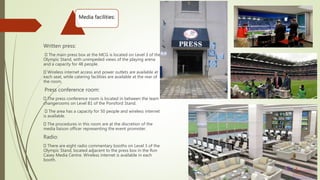
Media facilities:
Written press:
The main press box at the MCG is located on Level 3 of the
Olympic Stand, with unimpeded views of the playing arena
and a capacity for 48 people.
Wireless internet access and power outlets are available at
each seat, while catering facilities are available at the rear of
the room.
Press conference room:
The press conference room is located in between the team
changerooms on Level B1 of the Ponsford Stand.
The area has a capacity for 50 people and wireless internet
is available.
The procedures in this room are at the discretion of the
media liaison officer representing the event promoter.
Radio:
There are eight radio commentary booths on Level 3 of the
Olympic Stand, located adjacent to the press box in the Ron
Casey Media Centre. Wireless internet is available in each
booth.
Orientation:
• Now a day’s main axis is usually north-east to south west.
• Playing field is oriented north-south to protect from the
direct glare to the players.
• The access gate is mostly situated to the east.
• The angle of the playing field should be done in relation to
the sum and the prevailing weather condition.
• The match participants, spectators and media representatives
must be protected as much as possible form the glare of the
sun.
Safety requirements :
• Safety should be considered as the prime task.
• All parts of the stadium, including entrance,
exits, stairways, doors, escape routes, roofs and
all public and private areas and rooms must
conform safety standards.
• Exit doors and gates in the stadium and all
gates leading from the spectator areas into -
the playing are must open outwards, away
from the spectators.
• Well-planning good zoning, good structural
• The zoning should be done considering the
four safety zones. Activity area (Temporary
safety zone), Viewing zone (Spectator zone),
Circulation area (Temporary safety zone) and
• Outside Stadium (Final safety zone).
1. For a stadium with a capacity of
60,000, parking places should be
provided for 10,000 Cars and
approximately 500 buses.
2. Where sufficient on-site public
parking is not possible, parking
should be provided no further than
1,500 meters from the stadium.
3. There should be sufficient parking
space for the buses and cars of VIP’S.
Preferably, these vehicles should be
parked inside the stadium.
4. Parking space for at least 2 buses and
8 cars should be available for teams,
match officials and stadium staff.
5. At least 10 parking spots including
large vehicles should be provided to
the media.
Straight Parking
• Suitable two ways traffic
and large no of vehicles.
• Parking bays are
perpendicular to
circulation road
Angled Parking
• Suitable for one way traffic which has
separate entrance/exit.
• It reduces the width of the parking lots as
the vehicles are placed in angle.
• The parking bays are inclined in 30*, 45*,
60*, 90*.
Oblique Parking
• Suitable for two way traffic and separate entrance/exit
Playing field
 No fixed
dimensions for the
field but its
diameter usually
varies between 450
feet (137 m) and
500 feet (150 m).
 A cricket pitch is 22
yards long.
 The pitch measures 10 × 66 feet (3.05 × 20.12 m).Lines drawn or painted on the pitch are known as creases.
Pitches are generally classified as:
• Green Pitch: They contain fair amount of grass and are conducive to bounce and swing.
• Dry Pitch: They contain no grass and are conducive to spin.
• Concrete Pitch: These are made of concrete and generally used for practice facilities.
• Mats: These are used for practice facilities as well and laid over the pitch.
Advertising Boards
around Playing Area
 It’s minimum size should be
24m2.
 It should have clothes hanging
facilities or lockers for 4 people
 Advertising boards normally have a
height of 90-100cm
 The minimum distances between the
boundary lines of the playing field and
the advertising boards should be: 4-5m
Access from Team Areas
to Playing Field
 The tunnel should be 4m-6m
wide and a minimum of 2.3m
high.
First Aid and Treatment Room
 This room is used by players, match
officials, the media, VIPs and security
Personnel .
 Minimum sized 50m2
Umpires’ Area
Doping Control
Area(NARCOTICS)
 Minimum size is 36m
ENTRY
`
 Seating and standing areas must be separated by fences.
 For every 750 seats an escape route (stairway, ramp, flat surface)
with a minimum width of 1.00 must be provided.
 Provision of emergency exit gates unlocked for all time.
 Stairway themselves should act as emergency exit.
 Staircase width(m)=
number of spectator
/ (Emptying time(s)X 1.25)
 Lecture hall
a. Room size: 26' X 30’ for 35.
b. Separate tablet armchairs for 35 students
c. The seven seats spacing of 3' 6” laterally and 4' 6" between the end
seat and side walls
d. This arrangement requires about 22 square feet of space per student
ACADEMIC AND OTHER
FACILITIES
 Size of Bed/Bedrooms
Single Rooms
a. Minimum recommended area - 90 sqft
b. Optimum recommended area - 110 sq.ft
c. Generous recommended area - 120 sq. Ft.
Double rooms with
bunked beds
Minimum
recommended
area - 140 sqft
Optimum
recommended
area - 160 sqft
Generous
recommended
area - 180 sqft
Double rooms
without bunked beds
Minimum
recommended
area - 180 sqft
Optimum
recommended
area - 220 sqft
Generous
recommended
area - 240 sqft
Kitchen
Dining
number of square feet per
person seated times the
number of persons seated
at one time.
• Dining room: 60% of total
area u Kitchen (cooking,
storage, preparation): 40-
50% of total area
• Seating requirements
• Small children: 8 sq ft
• Adult seating: 12 sqft
• Banquet seating: 10 sqft
• Deluxe seating: 30 sqft
• Place seating for adults: 24
inch
• Place seating for child: 20
inch
Gym hall
• No of users – 40-50
• Room size – at least 200m²
• Height – 3m
• Width of room for double row arrangement of
machine – at least 6m
• The length of room to allow clear supervision of all
trainers – 15m or less
• For 12 users minimum room size is – 40m
Storage
RECCOMENDATION FOR
POSSIBLE ZONING
THANK
YOU

Mcg, australia

  • 1.
  • 2.
    CASE STUDY (MCG, AUSTRALIA) The Melbourne Cricket Club (MCC) also known as “THE G” is a sports club based in Melbourne, Australia. It was founded in 1838 and is one of the oldest sports clubs in Australia.  This also guarantees the club's occupation of about 20 per cent of the stadium for its members reserve.  As well as cricket, the MCC is also an umbrella organisation for other sports, such as Australian football, baseball, bowls, field hockey, golf, lacrosse, netball, target shooting, squash and real tennis.  The total capacity of the MCG is 100,018.  This includes 95,000 seats and approximately 5000 standing room spaces.
  • 3.
    A Brief Layout:- Other Name: The G  Location: Yarra Park, Melbourne, Australia  Capacity: 100,018 seats  Field Size: 171 m x 146 m  Used for : Cricket Test, Twenty 20’s & ODIs  Construction Time: Developed periodically. (1838 – 1956)  Cost: 150 million USD $ (2008 – 2012)  Architecture: Cox Architecture (2012)  Contractor: Mr. Warren Bonello  Structural Engineers: Construction Engineering Australia Pvt. Ltd. (2012)
  • 4.
    A Unique Structure Transparentwalls engage approaching patrons as they arrive Gates 1, 2 & 3. (Three Atrium Entrances) Underground car parking. Sightlines from all seats are uninterrupted. Structural Challenges To construct and increase the space. To re innovate the interiors. Increase the brightness in the seating areas. Solutions Implementing underground space. Green construction and structure. Capping the new stand is a hybrid roof, part metal and part glass.
  • 7.
    Spectator Facilities:  This marvelousstructure, accommodating 44,500 people and covering 45 per cent of the stadium’s perimeter.  Facilities and finishes are superior throughout. The male/female toilet ratio has been significantly improved.  Spectators are also closer to the action.  Seats are approximately 30% bigger than the previous northern stand and about 80% of seats are under roof cover.  Extensive landscaping and a new access road enhance the sense of arrival for visitors.
  • 9.
    DIMENSIONS:-  The MCGarena has a total of approximately 20,000 square metres in area and measures 171 x 146 metres in length, from fence to fence.  The boundary line measures five metres from the fence.  The volume of the MCG is 1,700,000 cubic metres, or 1.7 million cubic metres.  The goal posts for AFL matches are 15 metres in height (point posts are 10 metres high)  Length of the cricket pitch is 22 yards, which in metric terms is 20.12 metres.
  • 10.
    Arena Grow Lights: Asa result, the MCC procured a product called Stadium Grow Lighting, a mobile supplementary lighting unit The shipment, comprising 11 lighting rigs each measuring 12m x 2.5m x 2.5m and two smaller rigs. The lighting rigs are placed above the grass to provide light and heat, which stimulates turf growth. This will enable to achieve year-round quality turf in all weather conditions.
  • 11.
    LIGHT TOWERS: The lighttower system comprises of six light towers which stand approximately 75 metres high (equivalent to a 24 story building) with the head frame a further 10 metres higher (85 metres overall). The foundations for the towers consist of four reinforced concrete piers which are set down in depth from seven to 12 metres depending on the sub surface structure. Each of the hollow tubular steel towers contains about 130 tonnes of steel. The diameter reduces from 4.2 metres at the base to two metres at the top. There are between 12 and 14 landings connecting ladders inside each tower. The head frames of the towers are angled in at 15 Degrees in order to provide optimum levels of light.
  • 12.
    Waste Management: The MCC adheresto five key guiding principles to continually improve its performance in waste management. • Reduce unrecyclable waste • Reuse materials where possible • Promote recycling by providing appropriate infrastructure • Educate employees, patrons and contractors • Use landfill as a last resort.
  • 13.
    Media facilities: Written press: Themain press box at the MCG is located on Level 3 of the Olympic Stand, with unimpeded views of the playing arena and a capacity for 48 people. Wireless internet access and power outlets are available at each seat, while catering facilities are available at the rear of the room. Press conference room: The press conference room is located in between the team changerooms on Level B1 of the Ponsford Stand. The area has a capacity for 50 people and wireless internet is available. The procedures in this room are at the discretion of the media liaison officer representing the event promoter. Radio: There are eight radio commentary booths on Level 3 of the Olympic Stand, located adjacent to the press box in the Ron Casey Media Centre. Wireless internet is available in each booth.
  • 14.
    Orientation: • Now aday’s main axis is usually north-east to south west. • Playing field is oriented north-south to protect from the direct glare to the players. • The access gate is mostly situated to the east. • The angle of the playing field should be done in relation to the sum and the prevailing weather condition. • The match participants, spectators and media representatives must be protected as much as possible form the glare of the sun.
  • 15.
    Safety requirements : •Safety should be considered as the prime task. • All parts of the stadium, including entrance, exits, stairways, doors, escape routes, roofs and all public and private areas and rooms must conform safety standards. • Exit doors and gates in the stadium and all gates leading from the spectator areas into - the playing are must open outwards, away from the spectators. • Well-planning good zoning, good structural • The zoning should be done considering the four safety zones. Activity area (Temporary safety zone), Viewing zone (Spectator zone), Circulation area (Temporary safety zone) and • Outside Stadium (Final safety zone).
  • 16.
    1. For astadium with a capacity of 60,000, parking places should be provided for 10,000 Cars and approximately 500 buses. 2. Where sufficient on-site public parking is not possible, parking should be provided no further than 1,500 meters from the stadium. 3. There should be sufficient parking space for the buses and cars of VIP’S. Preferably, these vehicles should be parked inside the stadium. 4. Parking space for at least 2 buses and 8 cars should be available for teams, match officials and stadium staff. 5. At least 10 parking spots including large vehicles should be provided to the media.
  • 17.
    Straight Parking • Suitabletwo ways traffic and large no of vehicles. • Parking bays are perpendicular to circulation road Angled Parking • Suitable for one way traffic which has separate entrance/exit. • It reduces the width of the parking lots as the vehicles are placed in angle. • The parking bays are inclined in 30*, 45*, 60*, 90*.
  • 18.
    Oblique Parking • Suitablefor two way traffic and separate entrance/exit
  • 20.
    Playing field  Nofixed dimensions for the field but its diameter usually varies between 450 feet (137 m) and 500 feet (150 m).  A cricket pitch is 22 yards long.
  • 21.
     The pitchmeasures 10 × 66 feet (3.05 × 20.12 m).Lines drawn or painted on the pitch are known as creases. Pitches are generally classified as: • Green Pitch: They contain fair amount of grass and are conducive to bounce and swing. • Dry Pitch: They contain no grass and are conducive to spin. • Concrete Pitch: These are made of concrete and generally used for practice facilities. • Mats: These are used for practice facilities as well and laid over the pitch.
  • 22.
    Advertising Boards around PlayingArea  It’s minimum size should be 24m2.  It should have clothes hanging facilities or lockers for 4 people  Advertising boards normally have a height of 90-100cm  The minimum distances between the boundary lines of the playing field and the advertising boards should be: 4-5m Access from Team Areas to Playing Field  The tunnel should be 4m-6m wide and a minimum of 2.3m high. First Aid and Treatment Room  This room is used by players, match officials, the media, VIPs and security Personnel .  Minimum sized 50m2 Umpires’ Area Doping Control Area(NARCOTICS)  Minimum size is 36m
  • 23.
  • 24.
     Seating andstanding areas must be separated by fences.  For every 750 seats an escape route (stairway, ramp, flat surface) with a minimum width of 1.00 must be provided.  Provision of emergency exit gates unlocked for all time.  Stairway themselves should act as emergency exit.  Staircase width(m)= number of spectator / (Emptying time(s)X 1.25)
  • 25.
     Lecture hall a.Room size: 26' X 30’ for 35. b. Separate tablet armchairs for 35 students c. The seven seats spacing of 3' 6” laterally and 4' 6" between the end seat and side walls d. This arrangement requires about 22 square feet of space per student ACADEMIC AND OTHER FACILITIES  Size of Bed/Bedrooms Single Rooms a. Minimum recommended area - 90 sqft b. Optimum recommended area - 110 sq.ft c. Generous recommended area - 120 sq. Ft.
  • 26.
    Double rooms with bunkedbeds Minimum recommended area - 140 sqft Optimum recommended area - 160 sqft Generous recommended area - 180 sqft Double rooms without bunked beds Minimum recommended area - 180 sqft Optimum recommended area - 220 sqft Generous recommended area - 240 sqft
  • 27.
    Kitchen Dining number of squarefeet per person seated times the number of persons seated at one time. • Dining room: 60% of total area u Kitchen (cooking, storage, preparation): 40- 50% of total area • Seating requirements • Small children: 8 sq ft • Adult seating: 12 sqft • Banquet seating: 10 sqft • Deluxe seating: 30 sqft • Place seating for adults: 24 inch • Place seating for child: 20 inch
  • 29.
    Gym hall • Noof users – 40-50 • Room size – at least 200m² • Height – 3m • Width of room for double row arrangement of machine – at least 6m • The length of room to allow clear supervision of all trainers – 15m or less • For 12 users minimum room size is – 40m Storage
  • 30.
  • 31.