MEDIA PLANNING ANDMANAGEMENT
Keywords of the Lesson
Media, Communication Channel, Mass Communication, Media
planning, Consumer Buying Decision, Media Planner,
Organization Structure of Media Company, Legal Aspects in
Media Planning, Media Research.
Overview of Media and Media Planning:
 Meaning of Media & Features of Media, Meaning of Media Planning , Scope of Media planning
, Media Planning Elements, Role of Media in Business, Media Planning Process, Impact of
Marketing Objectives on Media Planning, Factors Influencing Media Planning Decisions, Role
and Importance of Media in Consumer Buying Decision, Role of Media Planner, Challenges of
Media Planning, Organization Structure of Media Company, Regulatory Framework and Legal
Aspects in Media Planning
 b) Media Research: Meaning, Role and Importance Sources of Media Research : Audit Bureau
of Circulation, Press Audits, National Readership Survey/IRS, Businessmen’s Readership
Survey, TRP, National Television Study, ADMAR Satellite Cable Network Study, Reach and
Coverage Study, ClB Listenership Survey
What is Media?
Media is communication channels through which
news,entertainment,education,data or promotional messages are
disseminated.
Media includes every broadcasting and narrowcasting medium such as
newspapers,magazines,TV, radio,billboards,telephone,fax and internet
Features of Mass Communication
 Large number ofAudience
 ScatteredAudience
 No Direct Feedback
 Outward Flow
 Use of Technology
 Persuasion
Media Planning
It is the process of deciding how to most effectively get your
marketing communications seen by your target audience.
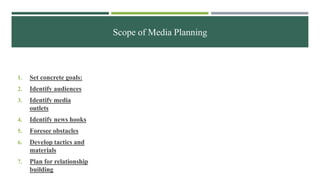
Scope of Media Planning
1. Set concrete goals:
2. Identify audiences
3. Identify media
outlets
4. Identify news hooks
5. Foresee obstacles
6. Develop tactics and
materials
7. Plan for relationship
building
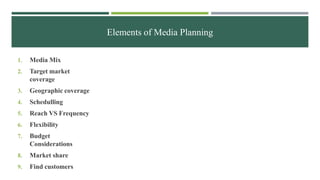
Elements of Media Planning
1. Media Mix
2. Target market
coverage
3. Geographic coverage
4. Schedulling
5. Reach VS Frequency
6. Flexibility
7. Budget
Considerations
8. Market share
9. Find customers
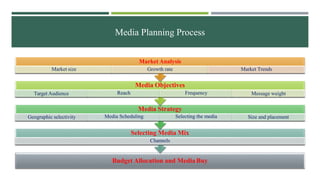
Media Planning Process
Selecting Media Mix
Channels
Budget Allocation and MediaBuy
Market Analysis
Market size Growth rate Market Trends
Target Audience
Media Objectives
Reach Frequency Message weight
Geographic selectivity
Media Strategy
Media Scheduling Selecting the media Size and placement
Impact of Marketing Objectives on Media Planning
 Increase sales
 Build brand awareness
 Grow market share
 Example: “meetha hai khana aaj pehli taarikh hai” Cadbury Dairy Milk advertisement is
advertisement to associate people getting their salary and those small moments to celebrate.
This was intended to increase sales and market share.
Factors Influencing Media Planning Decision
 Media
 Objectives of the campaign
 Budget available
 Research concerning the clientele
 Media classified by audience
 Media audience measurement
 Product
 Type of message or selling appeal
 Relative cost
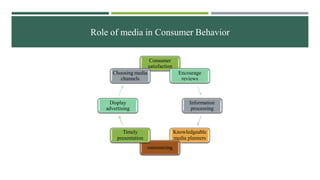
Role of media in Consumer Behavior
Consumer
satisfaction
Encourage
reviews
Information
processing
Knowledgeable
media planners
outsourcing
Timely
presentation
Display
advertising
Choosing media
channels
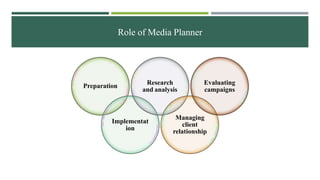
Role of Media Planner
Preparation
Implementat
ion
Research
and analysis
Managing
client
relationship
Evaluating
campaigns
Challenges of Media Planning
Insufficient information: lack of data
Inconsistent Terminologies: standards of measurements are not always
consistent
Time pressures: Competitors strategy or sense of urgency
Difficulty measuring effectiveness: difficult to determine relative
effectiveness of various media or media vehicals
Organisation Structure of Media Company
 An Editor in Chief: leads editorial team, assign stories and represent the editorial team in important and
controversial matters.
 Writers: writers and reporters who report on news and provide opinion and commentary.
 Junior Editors: Help edit stories and do administrative tasks for co-editors.
 Accounting and Finance Department: Decide the sources of finance and selection of which projects to
invest in.
 Public Relations Department: Maintain cordial relationship with all stakeholders.
 Art Department: Advertising agency uses the power of creativity and to make the content more
presentable and agreeable.
 Production Department: the production department in consultation with the clients sends the
communication to print media like magazines,newspapaers etc.
 Research department: carry out research and obtain necessary information.
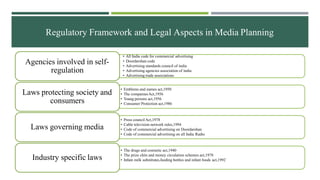
Regulatory Framework and Legal Aspects in Media Planning
• All India code for commercial advertising
• Doordarshan code
• Advertising standards council of india
• Advertising agencies association of india
• Advertising trade associations
Agencies involved in self-
regulation
• Emblems and names act,1950
• The companiesAct,1956
• Young persons act,1956
• Consumer Protection act,1986
Laws protecting society and
consumers
• Press councilAct,1978
• Cable television network rules,1994
• Code of commercial advertising on Doordarshan
• Code of commercial advertising on all India Radio
Laws governing media
• The drugs and cosmetic act,1940
• The prize chits and money circulation schemes act,1978
• Infant milk substitutes,feeding bottles and infant foods act,1992
Industry specific laws
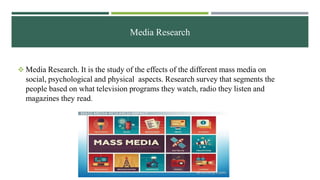
Media Research
 Media Research. It is the study of the effects of the different mass media on
social, psychological and physical aspects. Research survey that segments the
people based on what television programs they watch, radio they listen and
magazines they read.
Role of Media Research
 Consumer insights:what content is being consumed and how consumers are
reacting to an alteration to the content.Eg:movie krish got insights in kids
mindsand found a need for Krish Merchandise.
 Medium choice: helps to choose media depending on vehical
distribution,vehical exposure,advertising exposure.
 Contributes to new avenues:it keeps the professional researcher abrest with
latest in their discipline.
 Motivation for further inquiry:helps dispels the myths and antiquated
practices by examining them scientifically.
Impotance of Media Research
 Readers data
 Rating of tv serials
 Availability of information
 Beneficial to media research
organisation
 Useful to media planners
 Evaluation of various media
 Planning media
Sources of Media research
1. Audit bureau of Circulations: The Audit Bureau of Circulations (ABC) of India is a non-profit circulation-
auditing organisation. It certifies and audits the circulations of major publications, including newspapers and
magazines in India
 ABC is a voluntary organisation initiated in 1948 that operates in different parts of the world. Until 1948, the concept of
circulation audit was yet to be made in India and the publishers had no means to verify the actual circulation number of
publications that they used for advertising and had to depend more on their own judgement.
 Publishers also found it difficult to convince advertisers of the relative values of their publication for the purpose of advertising.
It is with this background that eminent representatives of the advertising profession and publishing industry came together to
establish an organisation which could serve the common interest.
 Since then the benefit of ABC certificates of circulation have been availed by advertisers, advertising agencies, publishers and
organisations connected with print media advertising
2. Media Audit Press: Media Press Audit benchmarks all regional and national publications, supplements
and magazines. This helps to identify how efficient a client schedule is by target audience and region. Our
audit will then advise on the best strategy to optimise your campaigns potential.
 Encourages the clients to tell what they want from an audit rather than giving them a standard set of
numbers
 Clients will ask questions like:
 1.what effect does changing my strategy have on my pricing?
2. Competitors strategy?
 3. How many pages did they run and through which publications?
1. National Readership Survey:-The National Readership Survey is a joint
venture company in the UK between the Institute of Practitioners in
Advertising (IPA), the Newspaper Publishers Association (NPA) and the
Periodical Publishers Association (PPA). It provides audience research for
print advertising trading in the UK. The survey covers over 250 of Britain's
major newspapers and magazines, showing the size and nature of the
audiences they achieve.
4. Indian Readership Survey:- The Indian Readership Survey (IRS) is the largest continuous
readership research study in the world with an annual sample size exceeding 2.56 lakh
(256,000) respondents. IRS collects a comprehensive range of demographic information and
provides extensive coverage of consumer and product categories, including cars, household
appliances, household durables, household care and personal care products, food and
beverages, finance and holidays.[1] IRS is not restricted to survey of readership alone but is
synonymous with both readership & consumption across various FMCG (Fast- Moving
Consumer Goods) products throughout India.[2] IRS covers information on over 100 product
categories. IRS is conducted by MRUC (Media Research Users Council) and RSCI
(Readership Studies Council of India).[3]
5. Businessmen’s readership survey: a specialised survey to measure the readership of publications among
business and professionals in private,government and public sections.
 It provides the estimates of:
a) primary and secondary readerships
b) Place of reading
c) Profile of readers
d) The extent of business travel and use of business services.
6.Television rating point: A target rating point (TRP) is a metric used in marketing and advertising to indicate the
percentage of the target audience reached by a campaign or advertisement through a communication medium. In the particular
case of television, a device is attached to the TV set in a few thousand viewers' houses to measure impressions. These numbers
are treated as a sample from the overall TV owners in different geographical and demographic sectors. Using a device, a
special code is telecasted during the programme, which records the time and the programme that a viewer watches on a
particular day. The average is taken for a 30-day period, which gives the viewership status for the particular channel.
7. Satellite television: Satellite TV is a type of television programming that is wirelessly delivered to TV sets across the world
via a network of radio signals, communications satellites, broadcast centers and outdoor antennas.
 Satellite television is a service that delivers television programming to viewers by relaying it from a communications
satellite orbiting the Earth directly to the viewer's location.[1] The signals are received via an outdoor parabolic
antenna commonly referred to as a satellite dish and a [[low-noise block downconve

A satellite receiver then decodes the desired television programme for viewing on a television set. Receivers can be external set-
top boxes, or a built-in television tuner. Satellite television provides a wide range of channels and services. It is usually the only
television available in many remote geographic areas without terrestrial television or cable television service.
8. National television study:It considers such factors as whether the violence is rewarded or punished; whether the portrayal
includes the consequences of violence; the realism, extent, and graphicness of the violence; use of weapons; and the involvement
of humor
 Studies of how program ratings and advisories are used on television and the role they play in the viewing decisions of children
+ Profiles of potential target audiences for future antiviolence campaigns and a content analysis of current anti-violence public
service announcements
 . It contributes new data on the effectiveness of various kinds of violence ratings and advisories for children and young
adolescent audiences. It also presents a fresh analysis of a national survey of adolescents that sheds light on the most appropriate
audiences for anti-violence public service announcements.
 Finally, it provides novel analyses of "high risk" presentations of violence most likely to adversely affect younger audiences.
This groundbreaking report will be of great value to students and researchers in media studies, popular culture, sociology,
communication, and violence prevention.
9. Reach and coverage study: Media monitoring and analysis service- a firm that aggregates information gathered by
traditional and social media content providers,using its software to complile and analyse the information.
 The resulting media inteligence is packed according to client specifications and delivered to those clients in real time.
 It can help organisations track publicity campaigns,discover the nature and extent of various social trends,and obtain insight on
how media and other opinion leasders are responding to their products and messages.
10.Listenership Survey Study:
 Profile of the listenership
 Listening habits profile
 Gather feedback from listeners
 Feedback into marketing plans and strategies

Media planning and management unit 1 2021

  • 1.
  • 2.
    Keywords of theLesson Media, Communication Channel, Mass Communication, Media planning, Consumer Buying Decision, Media Planner, Organization Structure of Media Company, Legal Aspects in Media Planning, Media Research.
  • 3.
    Overview of Mediaand Media Planning:  Meaning of Media & Features of Media, Meaning of Media Planning , Scope of Media planning , Media Planning Elements, Role of Media in Business, Media Planning Process, Impact of Marketing Objectives on Media Planning, Factors Influencing Media Planning Decisions, Role and Importance of Media in Consumer Buying Decision, Role of Media Planner, Challenges of Media Planning, Organization Structure of Media Company, Regulatory Framework and Legal Aspects in Media Planning  b) Media Research: Meaning, Role and Importance Sources of Media Research : Audit Bureau of Circulation, Press Audits, National Readership Survey/IRS, Businessmen’s Readership Survey, TRP, National Television Study, ADMAR Satellite Cable Network Study, Reach and Coverage Study, ClB Listenership Survey
  • 4.
    What is Media? Mediais communication channels through which news,entertainment,education,data or promotional messages are disseminated. Media includes every broadcasting and narrowcasting medium such as newspapers,magazines,TV, radio,billboards,telephone,fax and internet
  • 5.
    Features of MassCommunication  Large number ofAudience  ScatteredAudience  No Direct Feedback  Outward Flow  Use of Technology  Persuasion
  • 6.
    Media Planning It isthe process of deciding how to most effectively get your marketing communications seen by your target audience.
  • 7.
    Scope of MediaPlanning 1. Set concrete goals: 2. Identify audiences 3. Identify media outlets 4. Identify news hooks 5. Foresee obstacles 6. Develop tactics and materials 7. Plan for relationship building
  • 8.
    Elements of MediaPlanning 1. Media Mix 2. Target market coverage 3. Geographic coverage 4. Schedulling 5. Reach VS Frequency 6. Flexibility 7. Budget Considerations 8. Market share 9. Find customers
  • 9.
    Media Planning Process SelectingMedia Mix Channels Budget Allocation and MediaBuy Market Analysis Market size Growth rate Market Trends Target Audience Media Objectives Reach Frequency Message weight Geographic selectivity Media Strategy Media Scheduling Selecting the media Size and placement
  • 10.
    Impact of MarketingObjectives on Media Planning  Increase sales  Build brand awareness  Grow market share  Example: “meetha hai khana aaj pehli taarikh hai” Cadbury Dairy Milk advertisement is advertisement to associate people getting their salary and those small moments to celebrate. This was intended to increase sales and market share.
  • 11.
    Factors Influencing MediaPlanning Decision  Media  Objectives of the campaign  Budget available  Research concerning the clientele  Media classified by audience  Media audience measurement  Product  Type of message or selling appeal  Relative cost
  • 12.
    Role of mediain Consumer Behavior Consumer satisfaction Encourage reviews Information processing Knowledgeable media planners outsourcing Timely presentation Display advertising Choosing media channels
  • 13.
    Role of MediaPlanner Preparation Implementat ion Research and analysis Managing client relationship Evaluating campaigns
  • 14.
    Challenges of MediaPlanning Insufficient information: lack of data Inconsistent Terminologies: standards of measurements are not always consistent Time pressures: Competitors strategy or sense of urgency Difficulty measuring effectiveness: difficult to determine relative effectiveness of various media or media vehicals
  • 15.
    Organisation Structure ofMedia Company  An Editor in Chief: leads editorial team, assign stories and represent the editorial team in important and controversial matters.  Writers: writers and reporters who report on news and provide opinion and commentary.  Junior Editors: Help edit stories and do administrative tasks for co-editors.  Accounting and Finance Department: Decide the sources of finance and selection of which projects to invest in.  Public Relations Department: Maintain cordial relationship with all stakeholders.  Art Department: Advertising agency uses the power of creativity and to make the content more presentable and agreeable.  Production Department: the production department in consultation with the clients sends the communication to print media like magazines,newspapaers etc.  Research department: carry out research and obtain necessary information.
  • 16.
    Regulatory Framework andLegal Aspects in Media Planning • All India code for commercial advertising • Doordarshan code • Advertising standards council of india • Advertising agencies association of india • Advertising trade associations Agencies involved in self- regulation • Emblems and names act,1950 • The companiesAct,1956 • Young persons act,1956 • Consumer Protection act,1986 Laws protecting society and consumers • Press councilAct,1978 • Cable television network rules,1994 • Code of commercial advertising on Doordarshan • Code of commercial advertising on all India Radio Laws governing media • The drugs and cosmetic act,1940 • The prize chits and money circulation schemes act,1978 • Infant milk substitutes,feeding bottles and infant foods act,1992 Industry specific laws
  • 17.
    Media Research  MediaResearch. It is the study of the effects of the different mass media on social, psychological and physical aspects. Research survey that segments the people based on what television programs they watch, radio they listen and magazines they read.
  • 18.
    Role of MediaResearch  Consumer insights:what content is being consumed and how consumers are reacting to an alteration to the content.Eg:movie krish got insights in kids mindsand found a need for Krish Merchandise.  Medium choice: helps to choose media depending on vehical distribution,vehical exposure,advertising exposure.  Contributes to new avenues:it keeps the professional researcher abrest with latest in their discipline.  Motivation for further inquiry:helps dispels the myths and antiquated practices by examining them scientifically.
  • 19.
    Impotance of MediaResearch  Readers data  Rating of tv serials  Availability of information  Beneficial to media research organisation  Useful to media planners  Evaluation of various media  Planning media
  • 20.
    Sources of Mediaresearch 1. Audit bureau of Circulations: The Audit Bureau of Circulations (ABC) of India is a non-profit circulation- auditing organisation. It certifies and audits the circulations of major publications, including newspapers and magazines in India  ABC is a voluntary organisation initiated in 1948 that operates in different parts of the world. Until 1948, the concept of circulation audit was yet to be made in India and the publishers had no means to verify the actual circulation number of publications that they used for advertising and had to depend more on their own judgement.  Publishers also found it difficult to convince advertisers of the relative values of their publication for the purpose of advertising. It is with this background that eminent representatives of the advertising profession and publishing industry came together to establish an organisation which could serve the common interest.  Since then the benefit of ABC certificates of circulation have been availed by advertisers, advertising agencies, publishers and organisations connected with print media advertising
  • 21.
    2. Media AuditPress: Media Press Audit benchmarks all regional and national publications, supplements and magazines. This helps to identify how efficient a client schedule is by target audience and region. Our audit will then advise on the best strategy to optimise your campaigns potential.  Encourages the clients to tell what they want from an audit rather than giving them a standard set of numbers  Clients will ask questions like:  1.what effect does changing my strategy have on my pricing? 2. Competitors strategy?  3. How many pages did they run and through which publications?
  • 22.
    1. National ReadershipSurvey:-The National Readership Survey is a joint venture company in the UK between the Institute of Practitioners in Advertising (IPA), the Newspaper Publishers Association (NPA) and the Periodical Publishers Association (PPA). It provides audience research for print advertising trading in the UK. The survey covers over 250 of Britain's major newspapers and magazines, showing the size and nature of the audiences they achieve.
  • 23.
    4. Indian ReadershipSurvey:- The Indian Readership Survey (IRS) is the largest continuous readership research study in the world with an annual sample size exceeding 2.56 lakh (256,000) respondents. IRS collects a comprehensive range of demographic information and provides extensive coverage of consumer and product categories, including cars, household appliances, household durables, household care and personal care products, food and beverages, finance and holidays.[1] IRS is not restricted to survey of readership alone but is synonymous with both readership & consumption across various FMCG (Fast- Moving Consumer Goods) products throughout India.[2] IRS covers information on over 100 product categories. IRS is conducted by MRUC (Media Research Users Council) and RSCI (Readership Studies Council of India).[3]
  • 24.
    5. Businessmen’s readershipsurvey: a specialised survey to measure the readership of publications among business and professionals in private,government and public sections.  It provides the estimates of: a) primary and secondary readerships b) Place of reading c) Profile of readers d) The extent of business travel and use of business services.
  • 25.
    6.Television rating point:A target rating point (TRP) is a metric used in marketing and advertising to indicate the percentage of the target audience reached by a campaign or advertisement through a communication medium. In the particular case of television, a device is attached to the TV set in a few thousand viewers' houses to measure impressions. These numbers are treated as a sample from the overall TV owners in different geographical and demographic sectors. Using a device, a special code is telecasted during the programme, which records the time and the programme that a viewer watches on a particular day. The average is taken for a 30-day period, which gives the viewership status for the particular channel.
  • 26.
    7. Satellite television:Satellite TV is a type of television programming that is wirelessly delivered to TV sets across the world via a network of radio signals, communications satellites, broadcast centers and outdoor antennas.  Satellite television is a service that delivers television programming to viewers by relaying it from a communications satellite orbiting the Earth directly to the viewer's location.[1] The signals are received via an outdoor parabolic antenna commonly referred to as a satellite dish and a [[low-noise block downconve  A satellite receiver then decodes the desired television programme for viewing on a television set. Receivers can be external set- top boxes, or a built-in television tuner. Satellite television provides a wide range of channels and services. It is usually the only television available in many remote geographic areas without terrestrial television or cable television service.
  • 27.
    8. National televisionstudy:It considers such factors as whether the violence is rewarded or punished; whether the portrayal includes the consequences of violence; the realism, extent, and graphicness of the violence; use of weapons; and the involvement of humor  Studies of how program ratings and advisories are used on television and the role they play in the viewing decisions of children + Profiles of potential target audiences for future antiviolence campaigns and a content analysis of current anti-violence public service announcements  . It contributes new data on the effectiveness of various kinds of violence ratings and advisories for children and young adolescent audiences. It also presents a fresh analysis of a national survey of adolescents that sheds light on the most appropriate audiences for anti-violence public service announcements.  Finally, it provides novel analyses of "high risk" presentations of violence most likely to adversely affect younger audiences. This groundbreaking report will be of great value to students and researchers in media studies, popular culture, sociology, communication, and violence prevention.
  • 28.
    9. Reach andcoverage study: Media monitoring and analysis service- a firm that aggregates information gathered by traditional and social media content providers,using its software to complile and analyse the information.  The resulting media inteligence is packed according to client specifications and delivered to those clients in real time.  It can help organisations track publicity campaigns,discover the nature and extent of various social trends,and obtain insight on how media and other opinion leasders are responding to their products and messages.
  • 29.
    10.Listenership Survey Study: Profile of the listenership  Listening habits profile  Gather feedback from listeners  Feedback into marketing plans and strategies