MC Kinsey
7S Model
MUSKAN ARORA
ASSISTANT PROFESSOR
MUSKAN ARORA (ASSISTANT PROFESSOR)
7-S MODEL
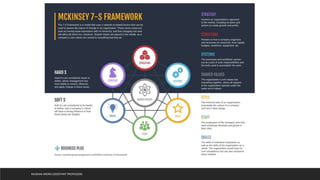
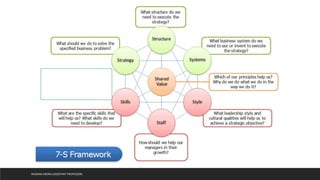
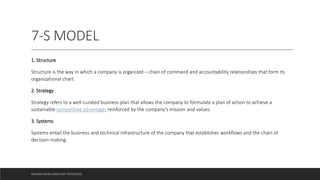
1. Structure
Structure is the way in which a company is organized – chain of command and accountability relationships that form its
organizational chart.
2. Strategy
Strategy refers to a well-curated business plan that allows the company to formulate a plan of action to achieve a
sustainable competitive advantage, reinforced by the company’s mission and values.
3. Systems
Systems entail the business and technical infrastructure of the company that establishes workflows and the chain of
decision-making.
MUSKAN ARORA (ASSISTANT PROFESSOR)
7-S MODEL
4. Skills
Skills form the capabilities and competencies of a company that enables its employees to achieve its objectives.
5. Style
The attitude of senior employees in a company establishes a code of conduct through their ways of interactions and
symbolic decision-making, which forms the management style of its leaders.
6. Staff
Staff involves talent management and all human resources related to company decisions, such as training, recruiting, and
rewards systems
7. Shared Values
The mission, objectives, and values form the foundation of every organization and play an important role in aligning all key
key elements to maintain an effective organizational design.
MUSKAN ARORA (ASSISTANT PROFESSOR)
Application of McKinsey 7-S Model
Step 1: Identify the areas that are not effectively aligned
Is there consistency in the values, strategy, structure, and systems? Look for gaps and
inconsistencies in the relationship of elements. What needs to change?
Step 2: Determine the optimal organization design
It is important to consolidate the opinions of top management and create a generic optimal
organizational design that will allow the company to set realistic goals and achievable objectives.
The step requires a tremendous amount of research and analysis since there are no
“organizational industry templates” to follow.
MUSKAN ARORA (ASSISTANT PROFESSOR)
Application of McKinsey 7-S Model
Step 3: Decide where and what changes should be made
Once the outliers are identified, the plan of action can be created, which will involve making
concrete changes to the chain of hierarchy, the flow of communication, and reporting
relationships. It will allow the company to achieve an efficient organizational design.
Step 4: Make the necessary changes
Implementation of the decision strategy is a make-or-break situation for the company in
realistically achieving what they set out to do. Several hurdles in the process of implementation
arise, which are best dealt with a well-thought-out implementation plan.
MUSKAN ARORA (ASSISTANT PROFESSOR)
Advantages
•It enables different parts of a company to act in a coherent
and “synced” manner.
•It allows for the effective tracking of the impact of the
changes in key elements.
•It is considered a longstanding theory, with numerous
organizations adopting the model over time.
MUSKAN ARORA (ASSISTANT PROFESSOR)
Disadvantages
•It is considered a long-term model.
•With the changing nature of businesses, it remains to be
seen how the model will adapt.
•It seems to rely on internal factors and processes and may
be disadvantageous in situations where external
circumstances influence an organization.
MUSKAN ARORA (ASSISTANT PROFESSOR)
Example
The McKinsey 7S model can be applied in circumstances where changes are being brought into
the organization that may affect one or more of the shared values. Suppose a company is
planning to undertake a merger. It will affect how the company is organized since new staff will
be coming in. It will also affect the structure of the company, along with strategic decision-
making, as new ideas flow in through synergy.
In such a case, the McKinsey 7s model can be used to first identify the inconsistent areas – here,
it would primarily be the structure, staff, and strategy. After identifying the relevant areas, the
company can make effective decisions to optimally re-organize and incorporate the changes in a
way that streamlines the merger process – after conducting extensive research and analysis of
the consequences that the changes bring to the company.
MUSKAN ARORA (ASSISTANT PROFESSOR)

MC Kinsey 7S Model.pptx

  • 1.
    MC Kinsey 7S Model MUSKANARORA ASSISTANT PROFESSOR MUSKAN ARORA (ASSISTANT PROFESSOR)
  • 2.
  • 3.
  • 4.
    7-S MODEL 1. Structure Structureis the way in which a company is organized – chain of command and accountability relationships that form its organizational chart. 2. Strategy Strategy refers to a well-curated business plan that allows the company to formulate a plan of action to achieve a sustainable competitive advantage, reinforced by the company’s mission and values. 3. Systems Systems entail the business and technical infrastructure of the company that establishes workflows and the chain of decision-making. MUSKAN ARORA (ASSISTANT PROFESSOR)
  • 5.
    7-S MODEL 4. Skills Skillsform the capabilities and competencies of a company that enables its employees to achieve its objectives. 5. Style The attitude of senior employees in a company establishes a code of conduct through their ways of interactions and symbolic decision-making, which forms the management style of its leaders. 6. Staff Staff involves talent management and all human resources related to company decisions, such as training, recruiting, and rewards systems 7. Shared Values The mission, objectives, and values form the foundation of every organization and play an important role in aligning all key key elements to maintain an effective organizational design. MUSKAN ARORA (ASSISTANT PROFESSOR)
  • 6.
    Application of McKinsey7-S Model Step 1: Identify the areas that are not effectively aligned Is there consistency in the values, strategy, structure, and systems? Look for gaps and inconsistencies in the relationship of elements. What needs to change? Step 2: Determine the optimal organization design It is important to consolidate the opinions of top management and create a generic optimal organizational design that will allow the company to set realistic goals and achievable objectives. The step requires a tremendous amount of research and analysis since there are no “organizational industry templates” to follow. MUSKAN ARORA (ASSISTANT PROFESSOR)
  • 7.
    Application of McKinsey7-S Model Step 3: Decide where and what changes should be made Once the outliers are identified, the plan of action can be created, which will involve making concrete changes to the chain of hierarchy, the flow of communication, and reporting relationships. It will allow the company to achieve an efficient organizational design. Step 4: Make the necessary changes Implementation of the decision strategy is a make-or-break situation for the company in realistically achieving what they set out to do. Several hurdles in the process of implementation arise, which are best dealt with a well-thought-out implementation plan. MUSKAN ARORA (ASSISTANT PROFESSOR)
  • 8.
    Advantages •It enables differentparts of a company to act in a coherent and “synced” manner. •It allows for the effective tracking of the impact of the changes in key elements. •It is considered a longstanding theory, with numerous organizations adopting the model over time. MUSKAN ARORA (ASSISTANT PROFESSOR)
  • 9.
    Disadvantages •It is considereda long-term model. •With the changing nature of businesses, it remains to be seen how the model will adapt. •It seems to rely on internal factors and processes and may be disadvantageous in situations where external circumstances influence an organization. MUSKAN ARORA (ASSISTANT PROFESSOR)
  • 10.
    Example The McKinsey 7Smodel can be applied in circumstances where changes are being brought into the organization that may affect one or more of the shared values. Suppose a company is planning to undertake a merger. It will affect how the company is organized since new staff will be coming in. It will also affect the structure of the company, along with strategic decision- making, as new ideas flow in through synergy. In such a case, the McKinsey 7s model can be used to first identify the inconsistent areas – here, it would primarily be the structure, staff, and strategy. After identifying the relevant areas, the company can make effective decisions to optimally re-organize and incorporate the changes in a way that streamlines the merger process – after conducting extensive research and analysis of the consequences that the changes bring to the company. MUSKAN ARORA (ASSISTANT PROFESSOR)