1
You might think only dorks ‐ aka those boring academics care about research. But if even 
Brad Pitt made a movie about the value of research, perhaps it’s not so nerdy at all! The 
movie Moneyball which premiered 9/23/2011 is about how the manager of a losing 
baseball team was able to turn things around by using the right kinds of statistical models.


                                                                                               2
We discussed the concept of research and its philosophical implications last class. Today, 
we will discuss the process of literature review, with the important goal of developing 
hypotheses or theory. 

This lecture is an adaptation of workshop materials developed by Center for Academic 
Achievement, Carlow University


                                                                                              3
4
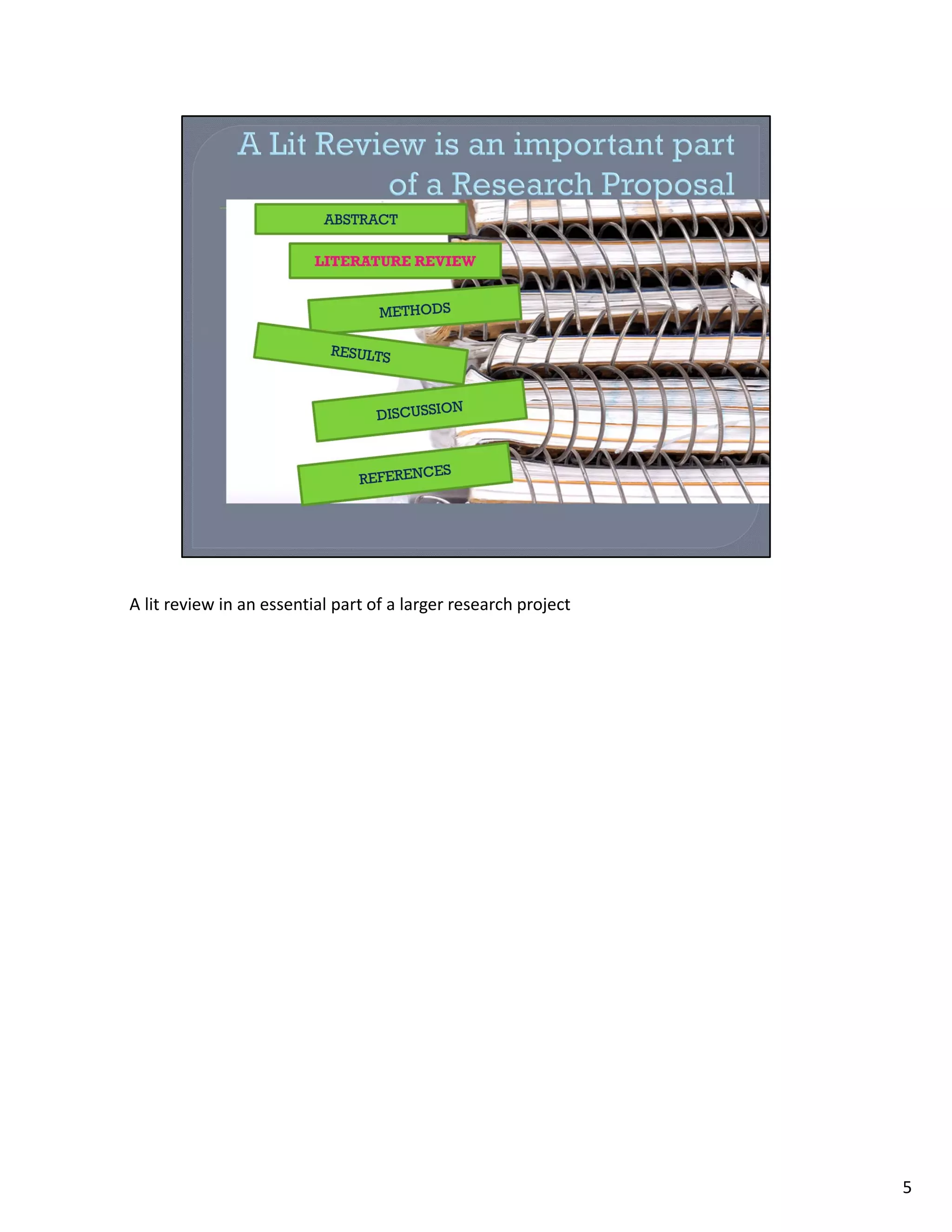
A lit review in an essential part of a larger research project


                                                                 5
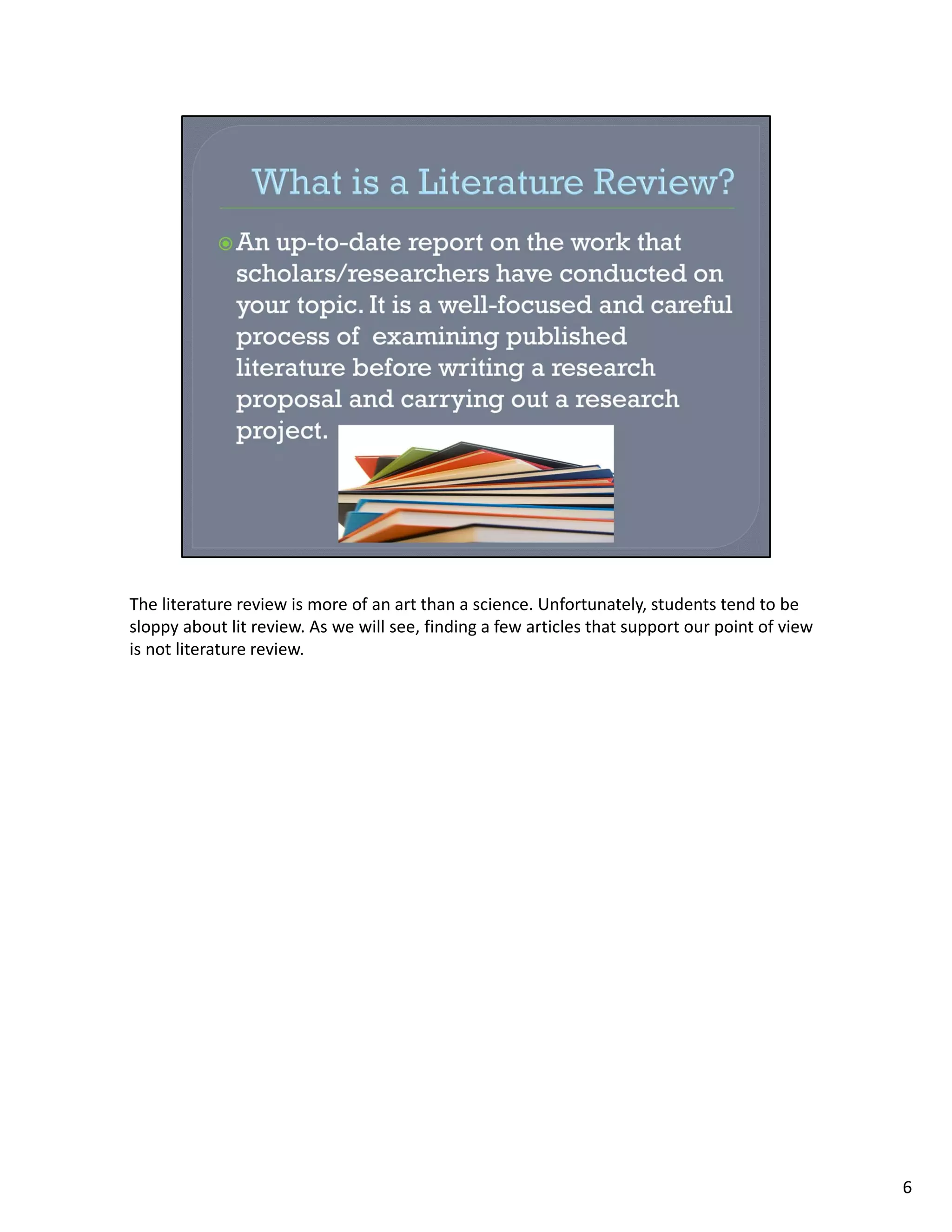
The literature review is more of an art than a science. Unfortunately, students tend to be 
sloppy about lit review. As we will see, finding a few articles that support our point of view 
is not literature review.


                                                                                                  6
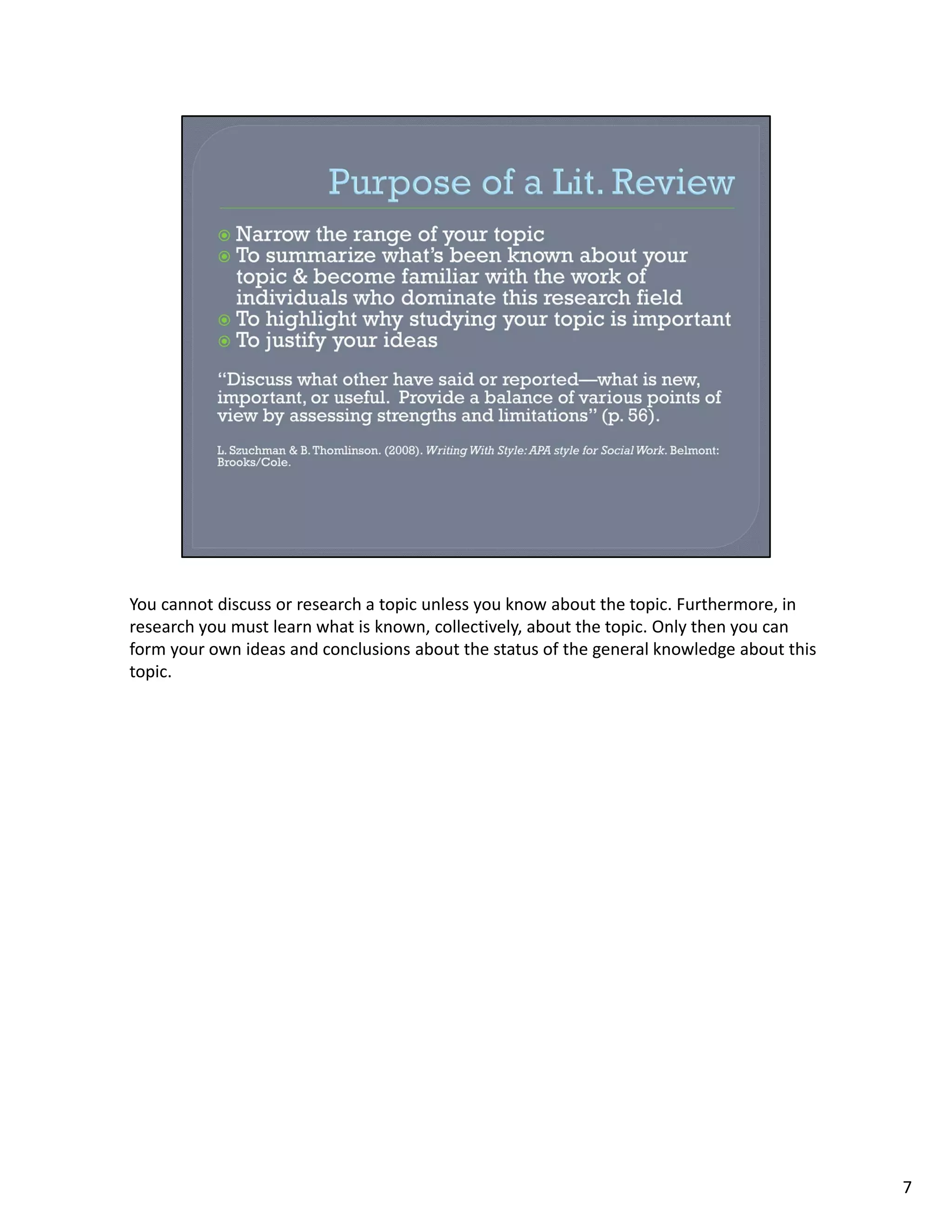
You cannot discuss or research a topic unless you know about the topic. Furthermore, in 
research you must learn what is known, collectively, about the topic. Only then you can 
form your own ideas and conclusions about the status of the general knowledge about this 
topic. 


                                                                                            7
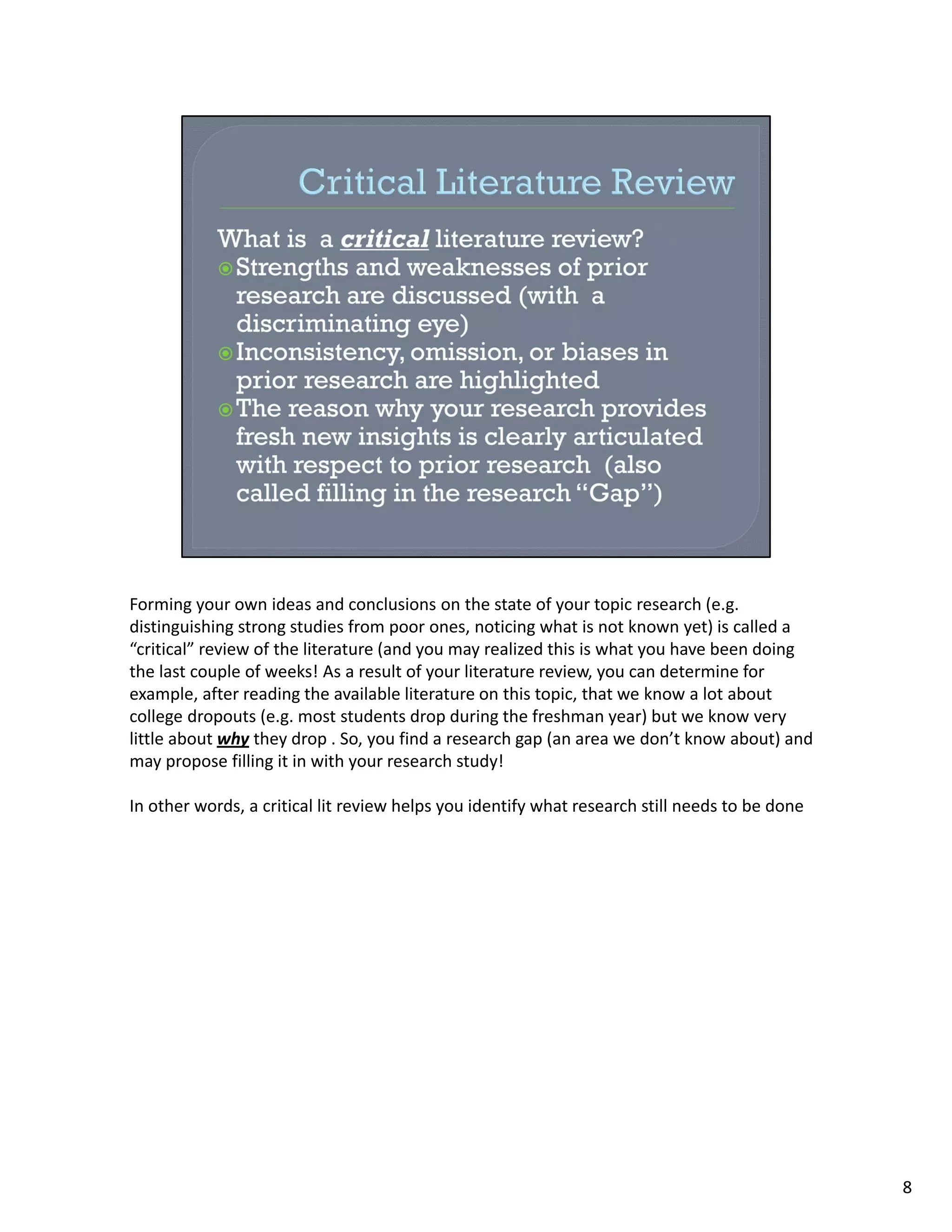
Forming your own ideas and conclusions on the state of your topic research (e.g. 
distinguishing strong studies from poor ones, noticing what is not known yet) is called a 
“critical” review of the literature (and you may realized this is what you have been doing 
the last couple of weeks! As a result of your literature review, you can determine for 
example, after reading the available literature on this topic, that we know a lot about 
college dropouts (e.g. most students drop during the freshman year) but we know very 
little about why they drop . So, you find a research gap (an area we don’t know about) and 
may propose filling it in with your research study!

In other words, a critical lit review helps you identify what research still needs to be done


                                                                                                8
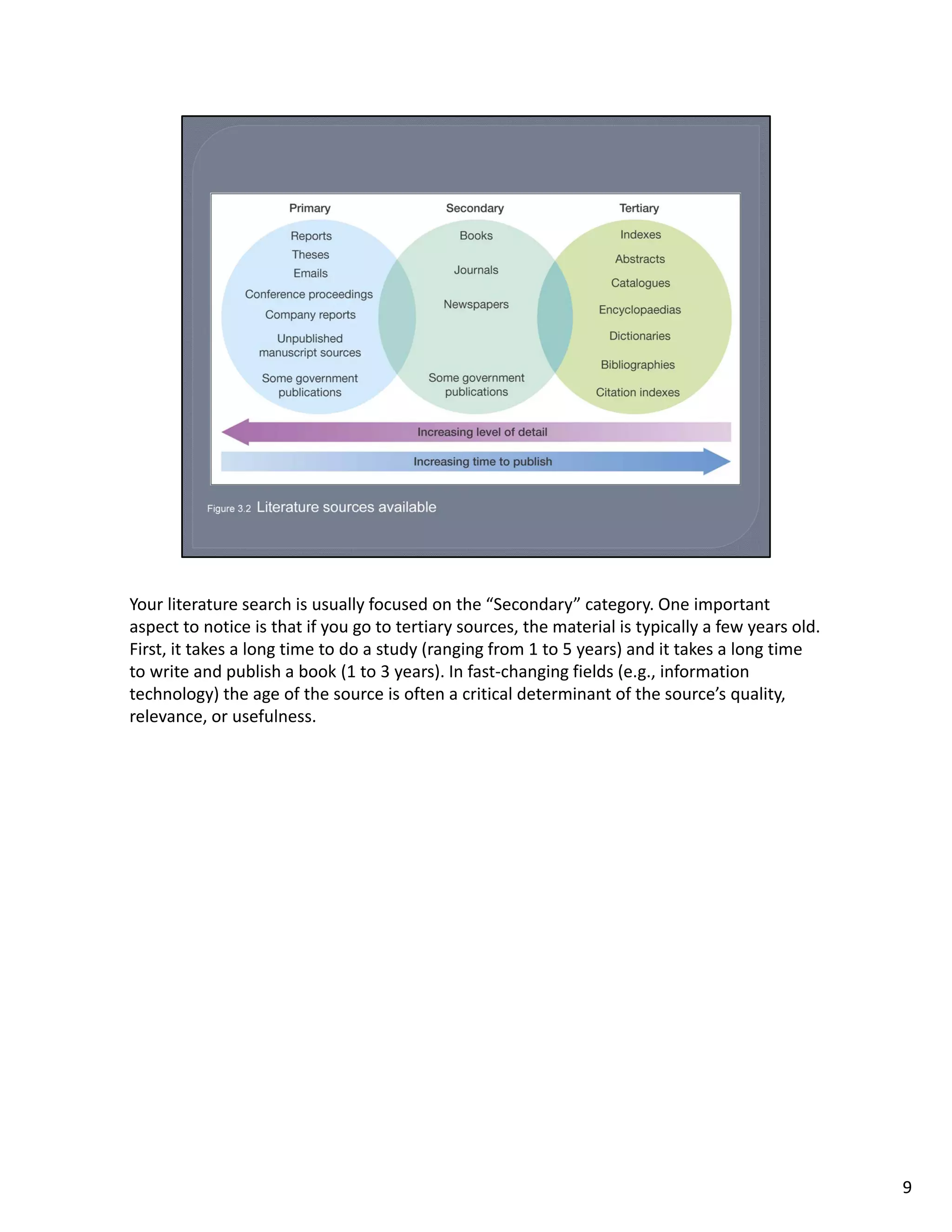
Your literature search is usually focused on the “Secondary” category. One important 
aspect to notice is that if you go to tertiary sources, the material is typically a few years old. 
First, it takes a long time to do a study (ranging from 1 to 5 years) and it takes a long time 
to write and publish a book (1 to 3 years). In fast‐changing fields (e.g., information 
technology) the age of the source is often a critical determinant of the source’s quality, 
relevance, or usefulness.


                                                                                                      9
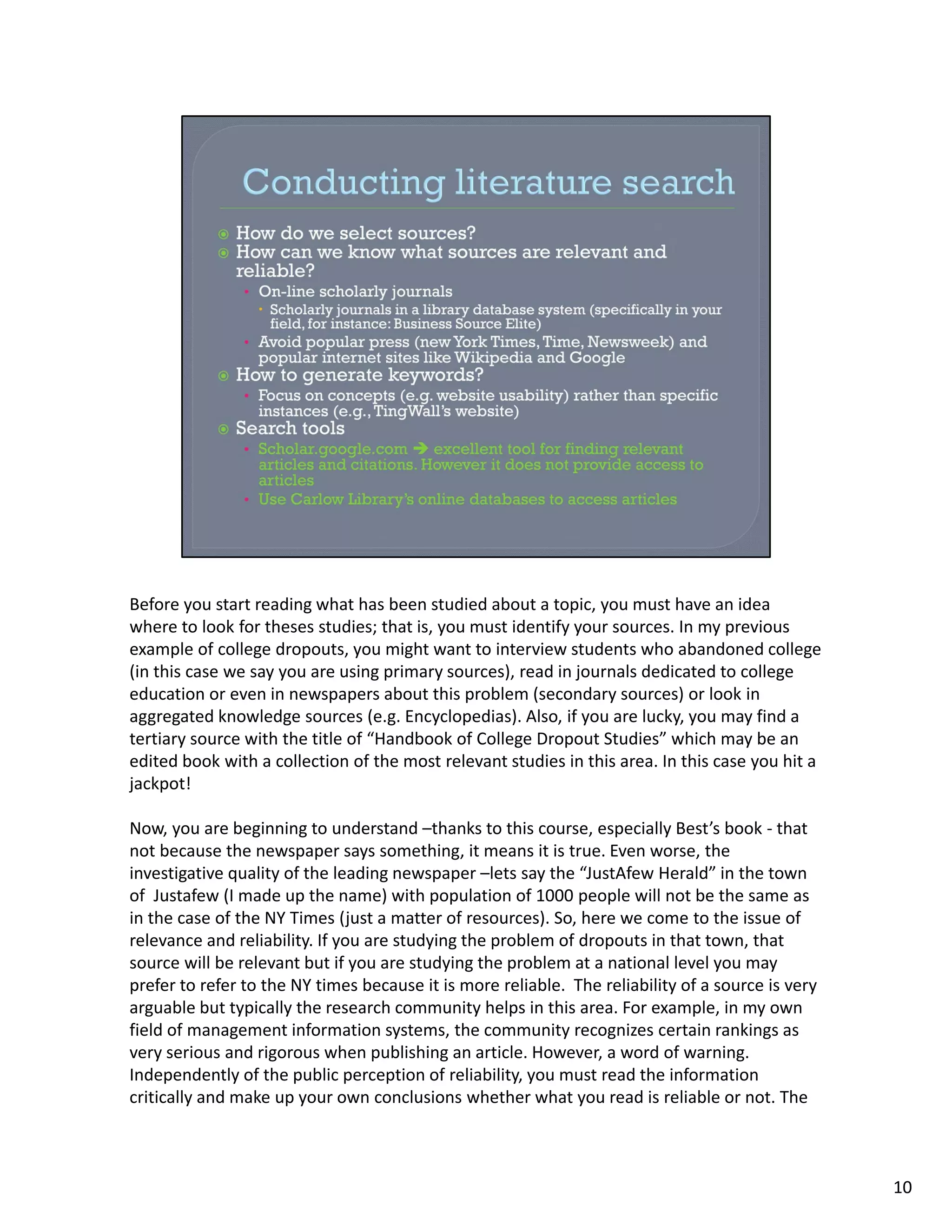
Before you start reading what has been studied about a topic, you must have an idea 
where to look for theses studies; that is, you must identify your sources. In my previous 
example of college dropouts, you might want to interview students who abandoned college 
(in this case we say you are using primary sources), read in journals dedicated to college 
education or even in newspapers about this problem (secondary sources) or look in 
aggregated knowledge sources (e.g. Encyclopedias). Also, if you are lucky, you may find a 
tertiary source with the title of “Handbook of College Dropout Studies” which may be an 
edited book with a collection of the most relevant studies in this area. In this case you hit a 
jackpot!

Now, you are beginning to understand –thanks to this course, especially Best’s book ‐ that 
not because the newspaper says something, it means it is true. Even worse, the 
investigative quality of the leading newspaper –lets say the “JustAfew Herald” in the town 
of  Justafew (I made up the name) with population of 1000 people will not be the same as 
in the case of the NY Times (just a matter of resources). So, here we come to the issue of 
relevance and reliability. If you are studying the problem of dropouts in that town, that 
source will be relevant but if you are studying the problem at a national level you may 
prefer to refer to the NY times because it is more reliable.  The reliability of a source is very 
arguable but typically the research community helps in this area. For example, in my own 
field of management information systems, the community recognizes certain rankings as 
very serious and rigorous when publishing an article. However, a word of warning. 
Independently of the public perception of reliability, you must read the information 
critically and make up your own conclusions whether what you read is reliable or not. The 


                                                                                                     10
main “take away” of this course is probably your ability to read research critically!

Finally, notice that if we use the term “college dropouts” to search for articles on this topic, I 
might not get all the relevant articles or a comprehensive list. Why?... The problem of the 
keywords. Perhaps the most important study on this subject had the title: “Why students fail 
to complete their college education?” This means that you must generate a list of keywords 
of what to look for (make sure to include “college education”). This is really more of an art –
in particular at the beginning‐ but little by little you will start noticing that certain terms 
appear over and over (people love to give “names” to social problems or problems in general 
(e.g. “restless leg syndrome”). So, the bottom line here is that your must generate keywords 
using word associations, brainstorming, and try to be creative and open‐minded!

With respect to what search to use, it used to be that people would go to the library and use 
their search tools to look for articles and books. We still do it but now we also have the 
advantage of the web and search engines such as Google, which –by the way‐ has a 
specialized academic search engine ( http://scholar.google.com/ ). What is the difference? All 
the reference links provided are academic sources. So, this is a good search tool to use for 
academic research. Unfortunately, it will provide the references in many cases but you will 
still have to go to the library to read the book or article.


                                                                                                      10
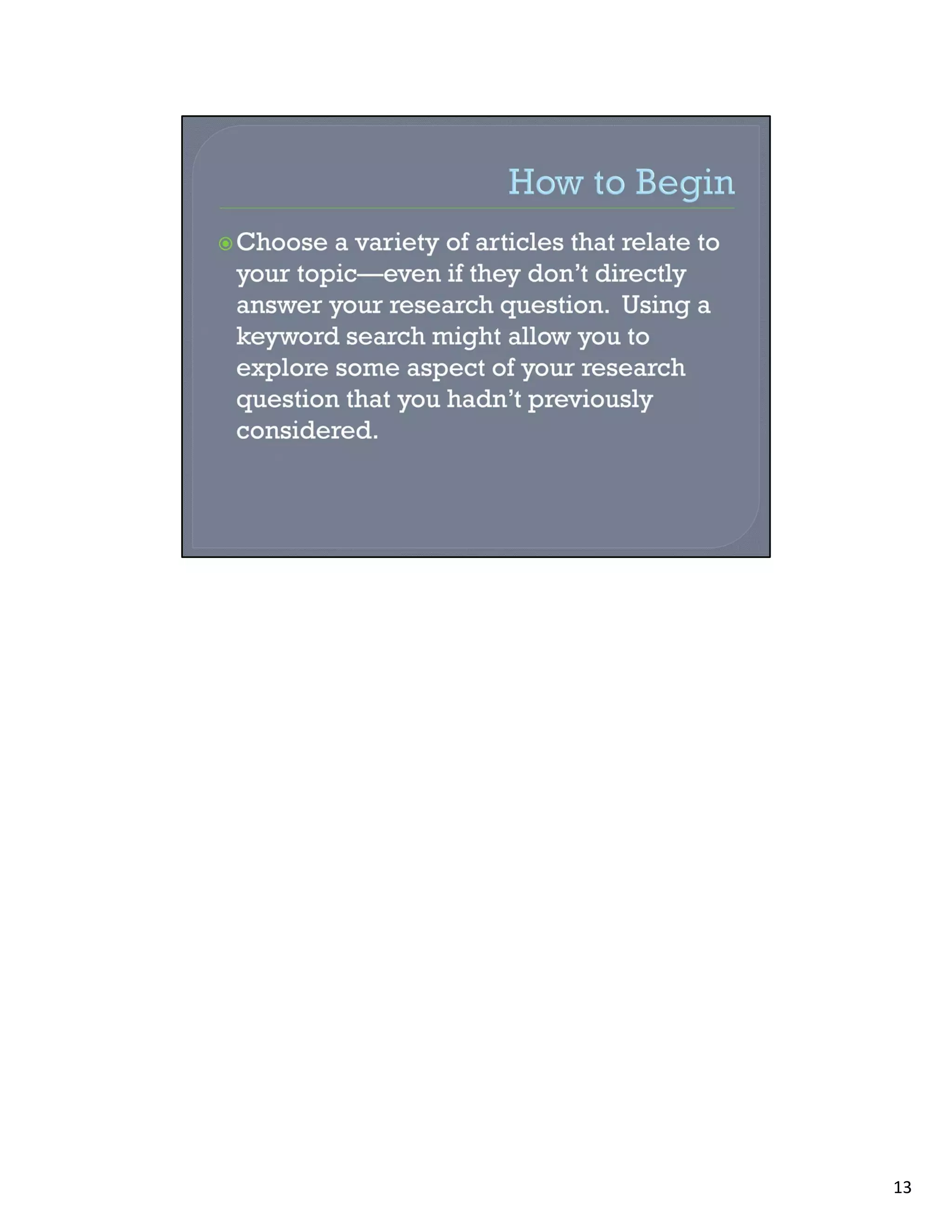
11
12
13
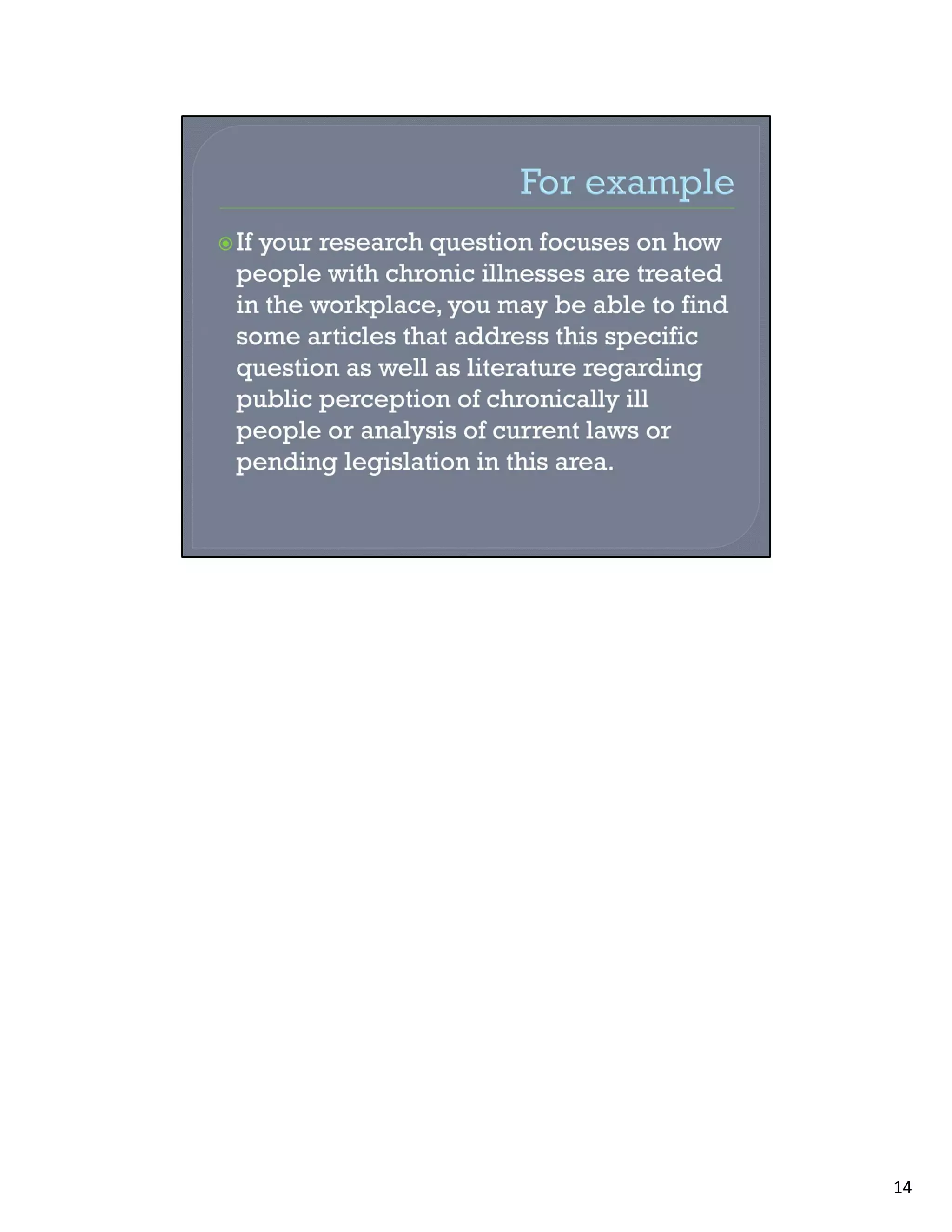
14
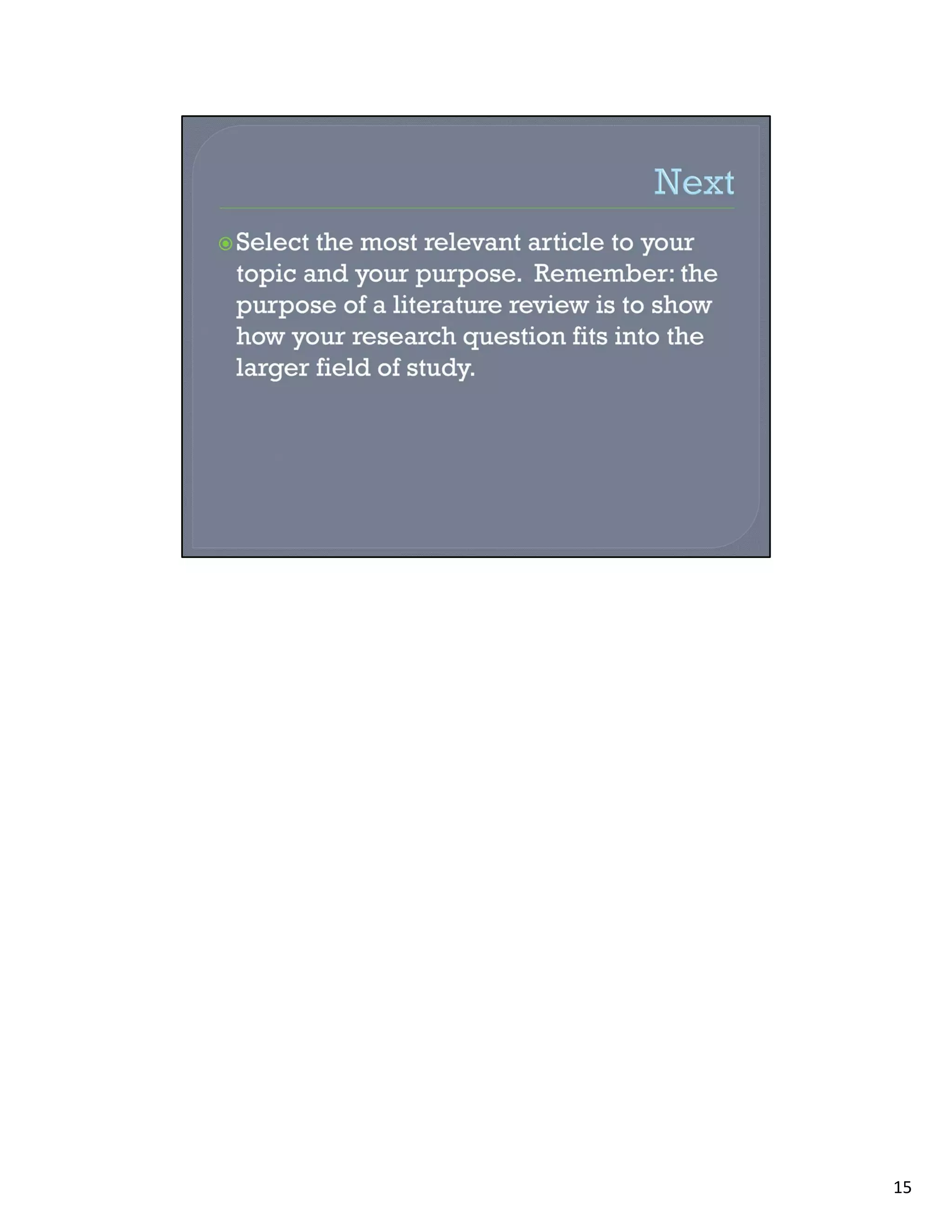
15
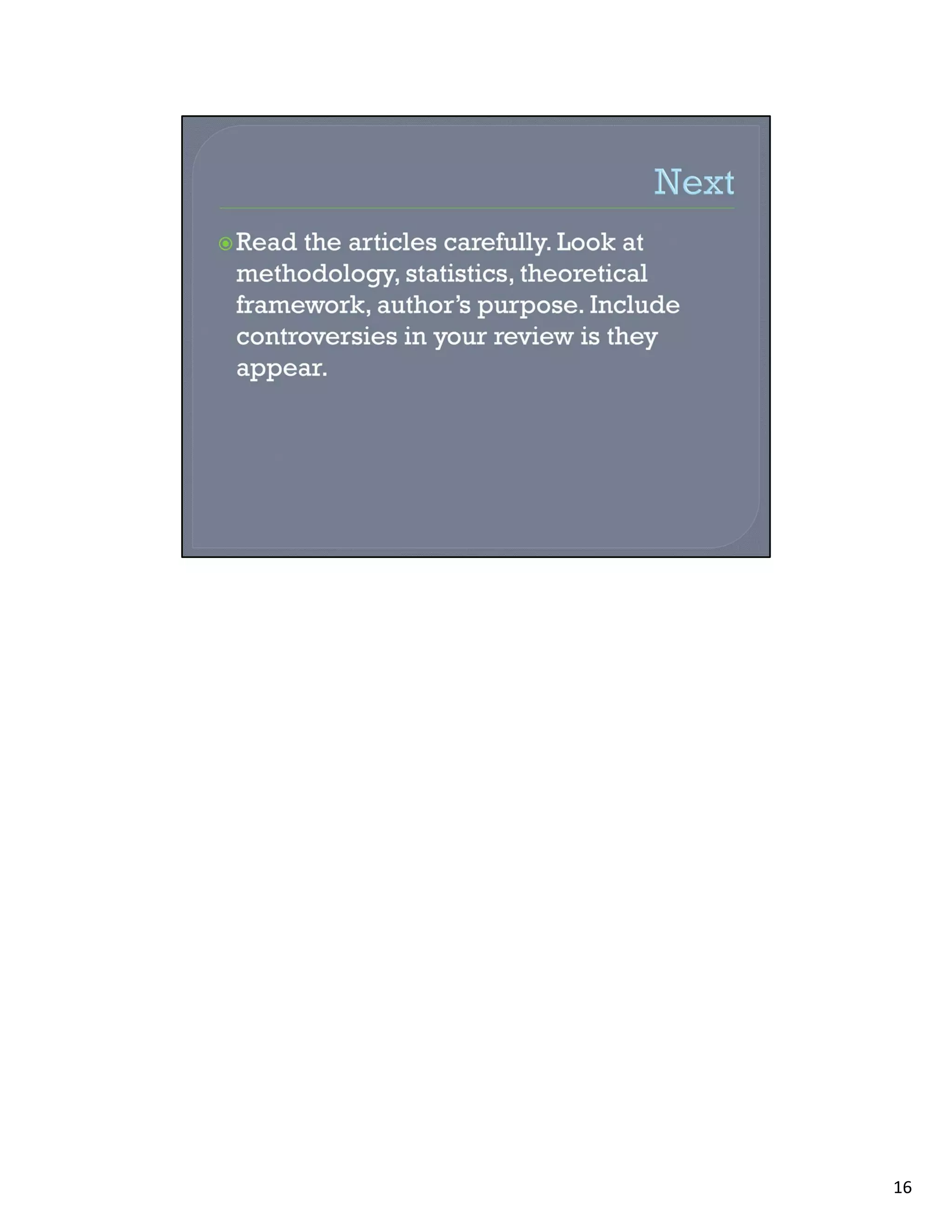
16
You must also be able to find some sort of a classification structure for what you are 
reading. 


                                                                                          17
18
19
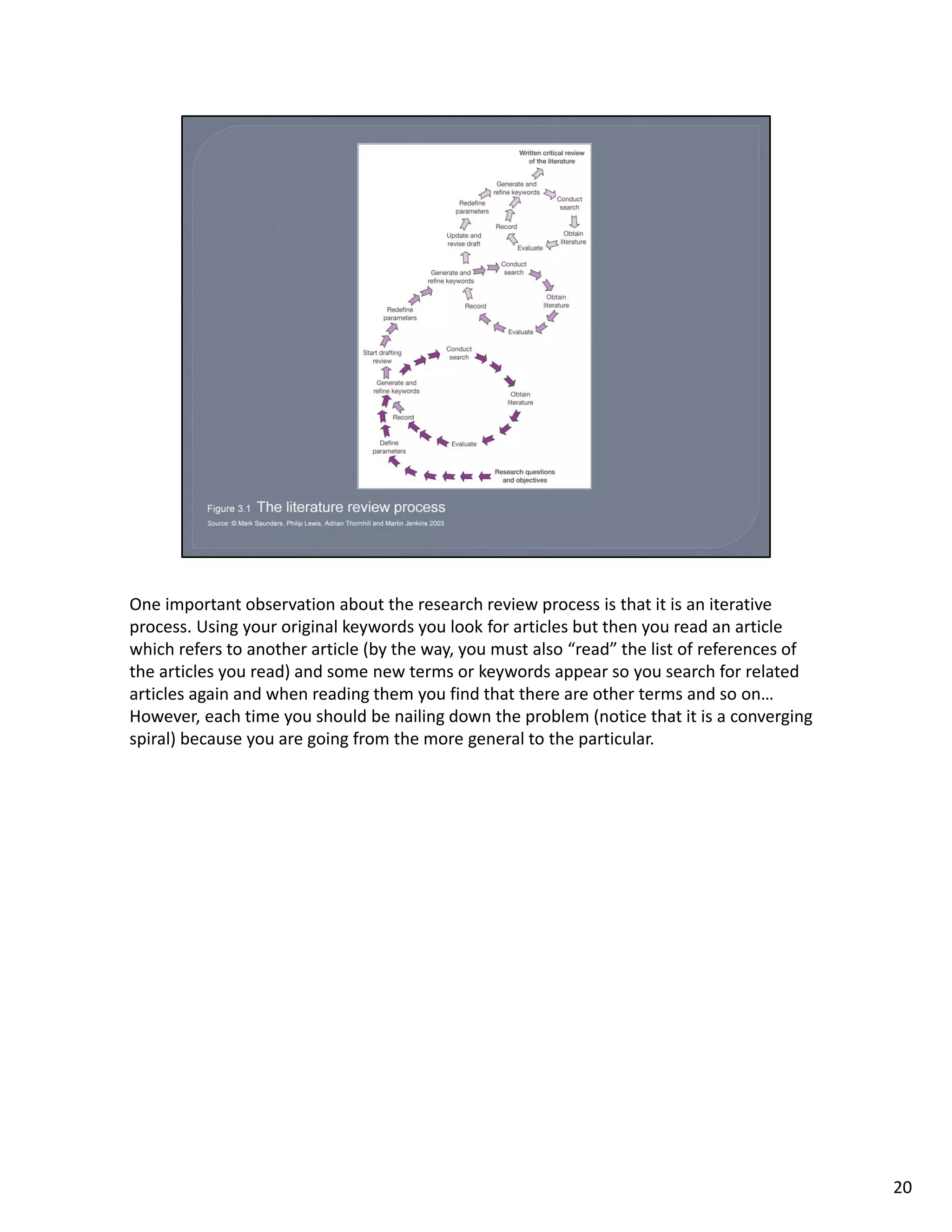
One important observation about the research review process is that it is an iterative 
process. Using your original keywords you look for articles but then you read an article 
which refers to another article (by the way, you must also “read” the list of references of 
the articles you read) and some new terms or keywords appear so you search for related 
articles again and when reading them you find that there are other terms and so on… 
However, each time you should be nailing down the problem (notice that it is a converging 
spiral) because you are going from the more general to the particular.


                                                                                               20
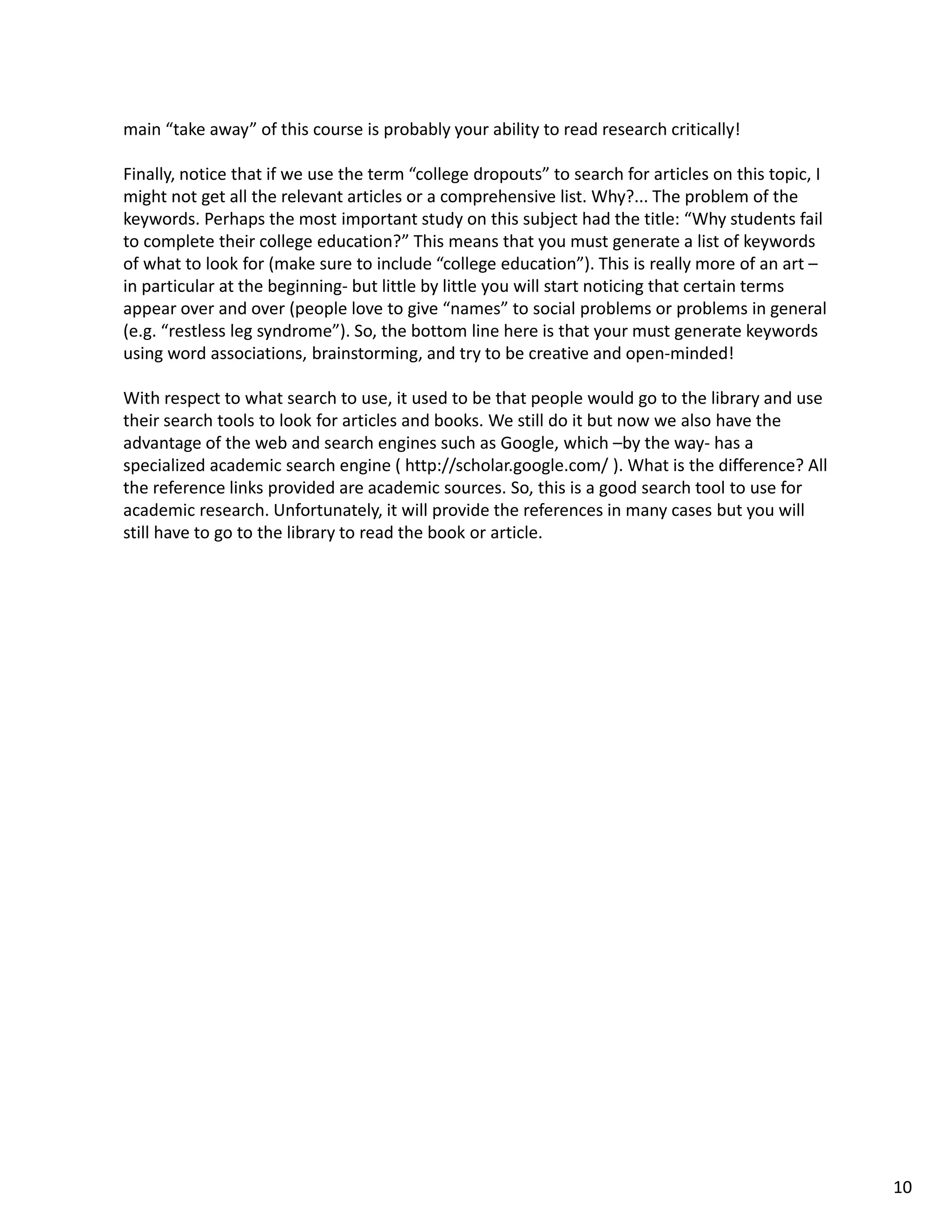
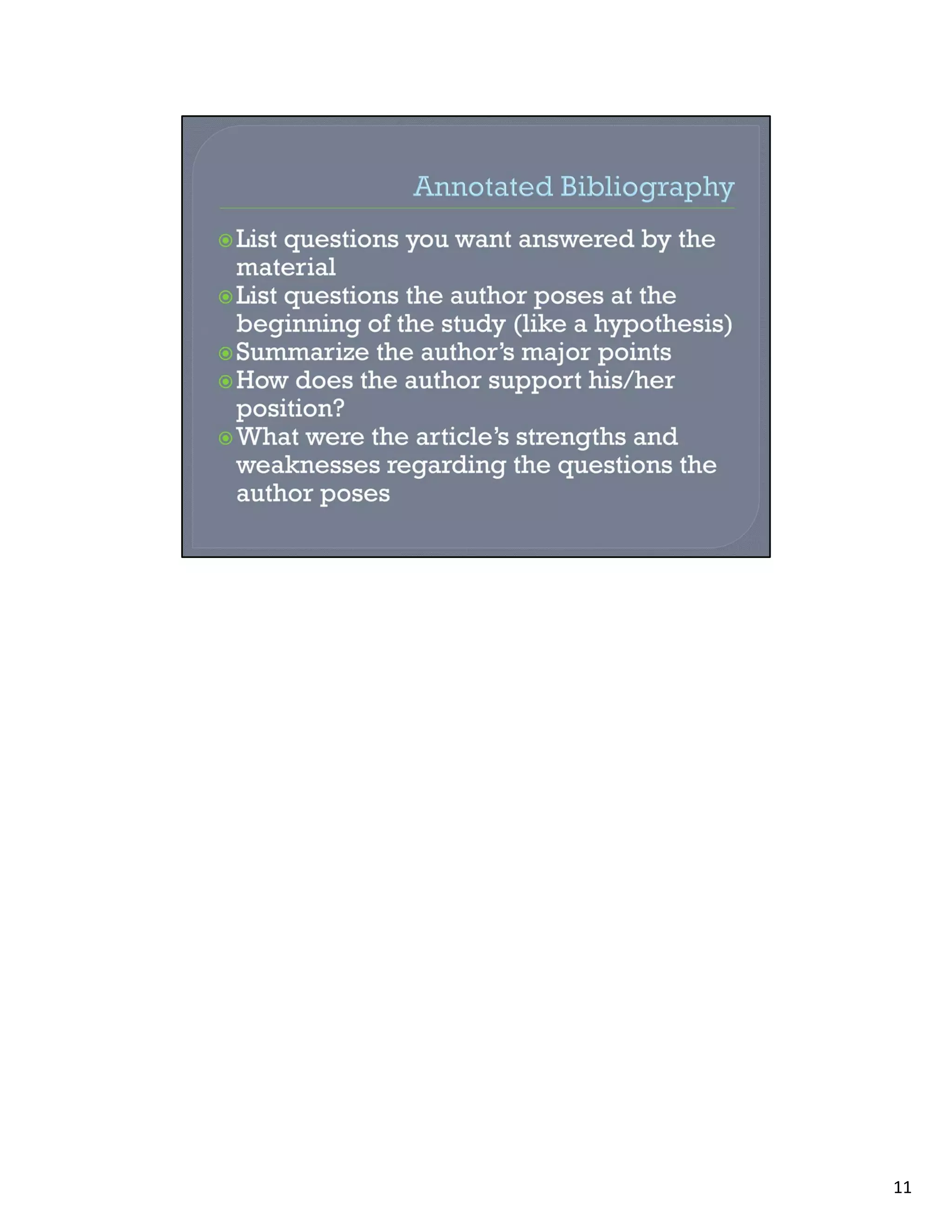
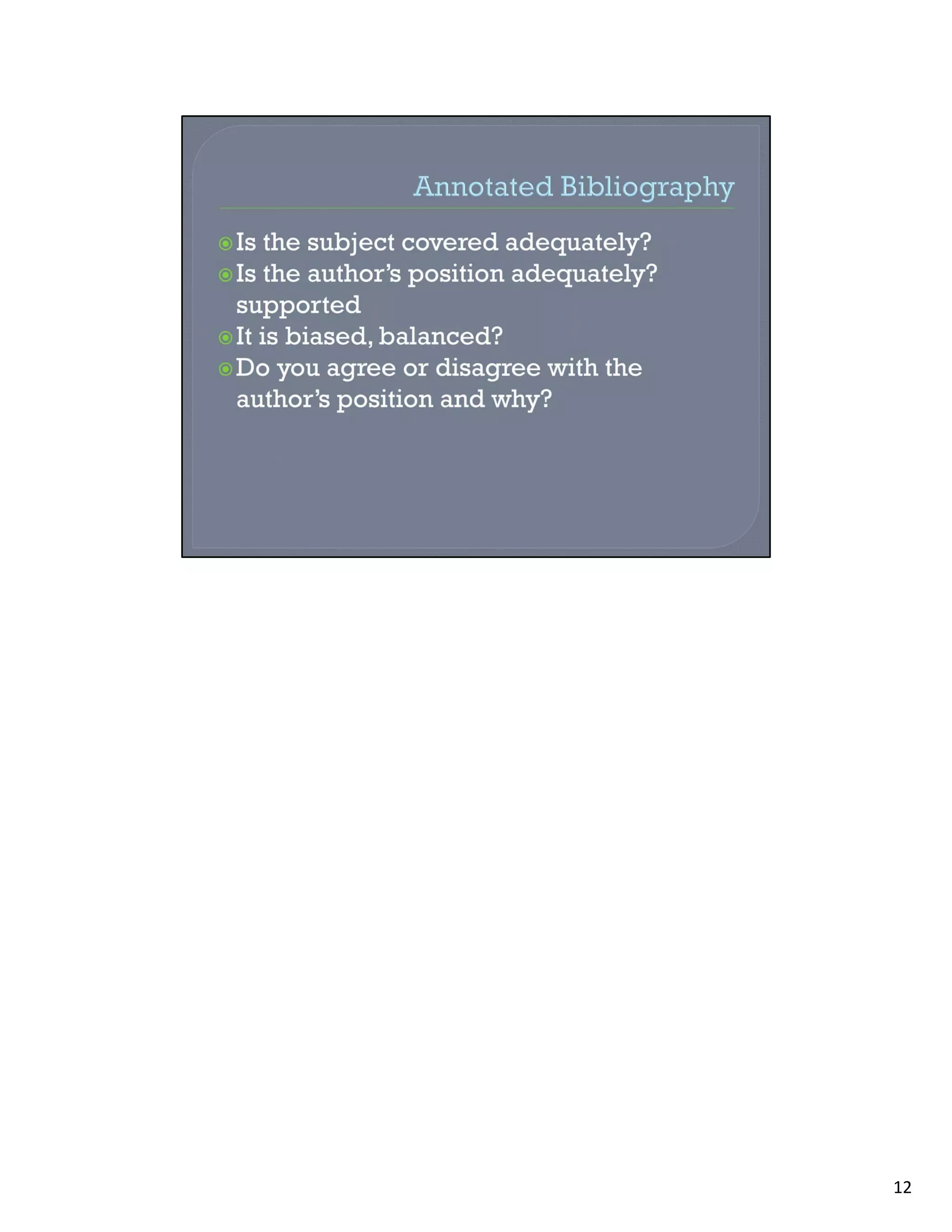
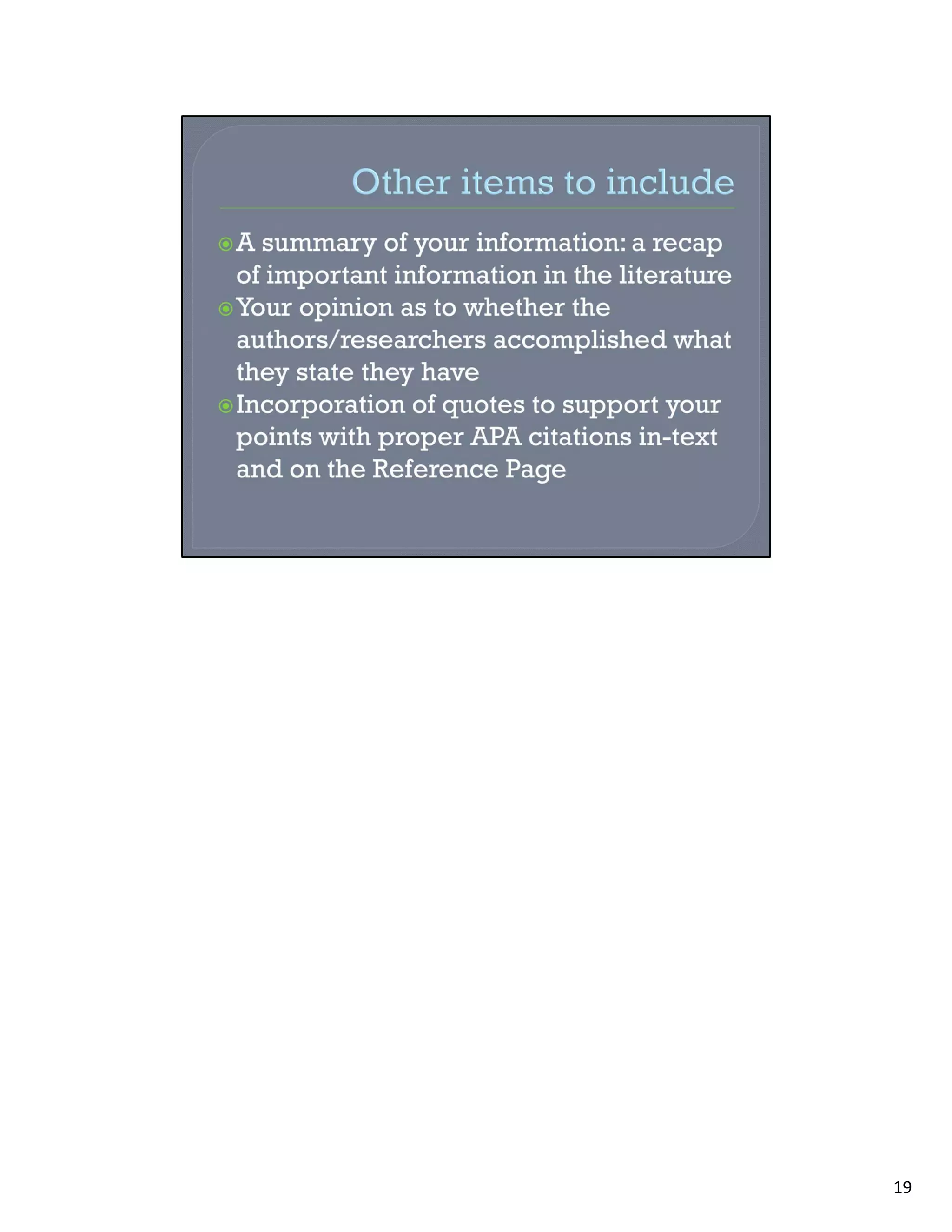
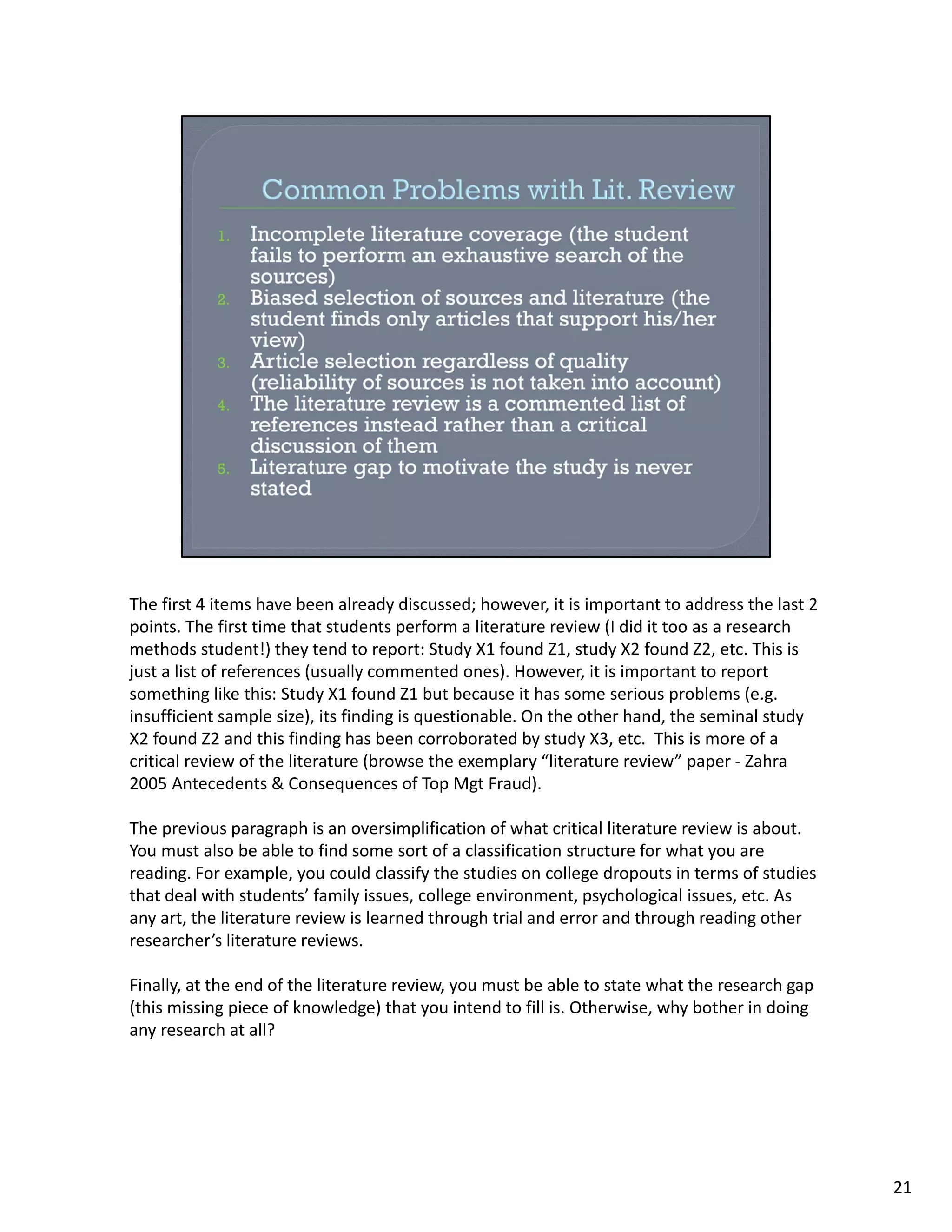
The first 4 items have been already discussed; however, it is important to address the last 2 
points. The first time that students perform a literature review (I did it too as a research 
methods student!) they tend to report: Study X1 found Z1, study X2 found Z2, etc. This is 
just a list of references (usually commented ones). However, it is important to report 
something like this: Study X1 found Z1 but because it has some serious problems (e.g. 
insufficient sample size), its finding is questionable. On the other hand, the seminal study 
X2 found Z2 and this finding has been corroborated by study X3, etc.  This is more of a 
critical review of the literature (browse the exemplary “literature review” paper ‐ Zahra 
2005 Antecedents & Consequences of Top Mgt Fraud).

The previous paragraph is an oversimplification of what critical literature review is about. 
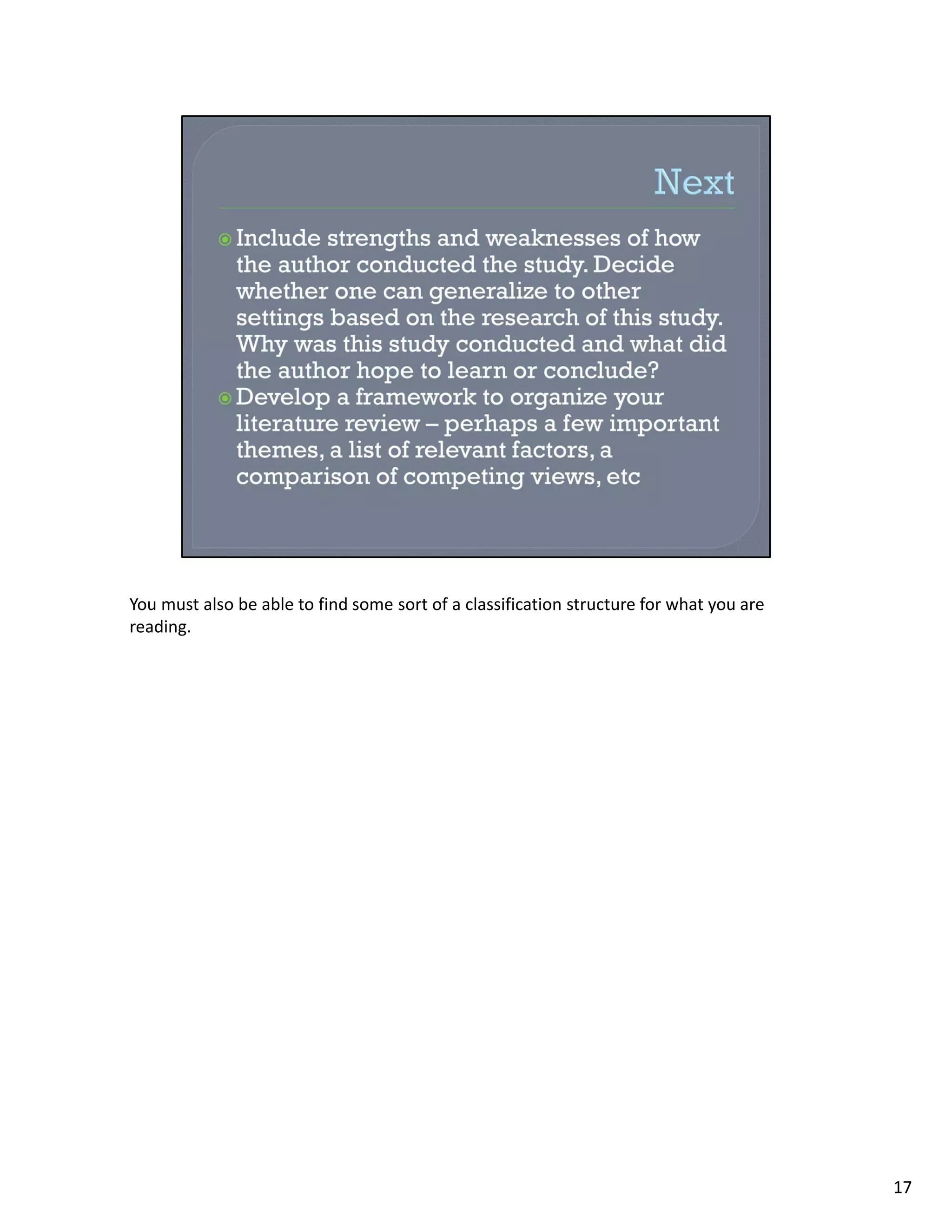
You must also be able to find some sort of a classification structure for what you are 
reading. For example, you could classify the studies on college dropouts in terms of studies 
that deal with students’ family issues, college environment, psychological issues, etc. As 
any art, the literature review is learned through trial and error and through reading other 
researcher’s literature reviews.

Finally, at the end of the literature review, you must be able to state what the research gap 
(this missing piece of knowledge) that you intend to fill is. Otherwise, why bother in doing 
any research at all?


                                                                                                 21
This workshop was prepared with help from

Columbia University Work Writing Center/School of Social Work web page
University of North Carolina at Chapel Hill Writing Center web page
Purdue On‐line Writing Lab


                                                                         22

Mba724 s3 1 writing a lit review (based on caa workshop)