General
Pick Topic (maybe write the thesis)
Find sources
(Read sources…maybe)
OR
Go quote-mining
Write paper
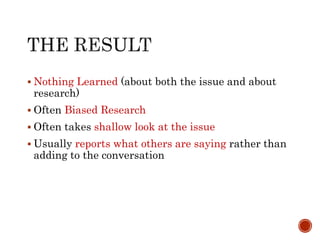
 Nothing Learned (about both the issue and about
research)
 Often Biased Research
 Often takes shallow look at the issue
 Usually reports what others are saying rather than
adding to the conversation
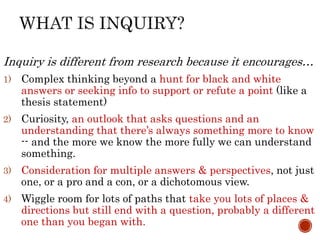
Inquiry is different from research because it encourages…
1) Complex thinking beyond a hunt for black and white
answers or seeking info to support or refute a point (like a
thesis statement)
2) Curiosity, an outlook that asks questions and an
understanding that there’s always something more to know
-- and the more we know the more fully we can understand
something.
3) Consideration for multiple answers & perspectives, not just
one, or a pro and a con, or a dichotomous view.
4) Wiggle room for lots of paths that take you lots of places &
directions but still end with a question, probably a different
one than you began with.
General
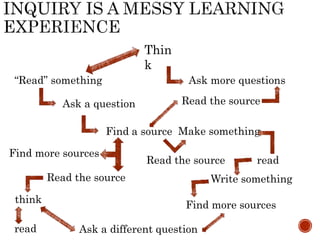
“Read” something
Find a source
Read the source
Ask a question
Write somethingRead the source
Read the source
Make something
Ask a different question
Find more sources
Find more sources
Ask more questions
Thin
k
think
read
read
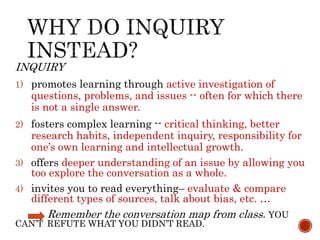
INQUIRY
1) promotes learning through active investigation of
questions, problems, and issues -- often for which there
is not a single answer.
2) fosters complex learning -- critical thinking, better
research habits, independent inquiry, responsibility for
one’s own learning and intellectual growth.
3) offers deeper understanding of an issue by allowing you
too explore the conversation as a whole.
4) invites you to read everything– evaluate & compare
different types of sources, talk about bias, etc. …
Remember the conversation map from class. YOU
CAN’T REFUTE WHAT YOU DIDN’T READ.
Starts now…
1.Good inquiry doesn’t appear out of thin air or a
vacuum.
Real inquiry often starts from a “source” (news report, an article, a
song, a documentary, a blog) to establish and clarify the idea--
• Read something
• Watch something
• Listen to something
• Talk about something
2.Good inquiry stems from natural curiosity-
from wondering…
• whether or not something is true
• why so many people believe or do something
• how/why something happens
Abracadabr
a… Inquiry
 Am I truly interested in this topic? If you aren’t interested, your audience
won’t either.
 Is it answerable through research? --Which religion is better? Why do
people prefer this type of music?
 Is there a substantial human element to the topic? This must be
meaningful for you and your audience, something that matters and makes
a difference
 You should be able to identify who would most benefit and explain why people
should care
 Is it something debatable and/or complex enough to dig below the surface
and explore multiple opinions? You don’t want to be on a fact hunt or
merely looking at the issue through an oversimplified, dichotomous view.
 Is the subject current and relevant? Don’t bore readers with something they already
know everything about.
 Can I really say something new or contribute something here (academic
writing should say something new)? NO REPORTS!!!
 Examples to avoid: abortion, legalizing marijuana, steroids in sports, whether or not
global warming is real… you get the idea.
 Issues that have been “over talked about” & “over researched.” If you Googled them, you’d
get 50,000 results, and they’d all say basically the same thing.
 Is the subject limited and clear enough in focus? Is there a specific enough focus
to end up with sources that are connected and speak to each other in some key way?
Example of something too big or vague—
 What is beauty? (Huh?)
 What’s wrong with the public education system? (Get ready for a looooong semester.)
 Why do people get tattoos? (They have personal or cultural value & it varies
widely… no one wants a lesson on the global history of tattoos.)
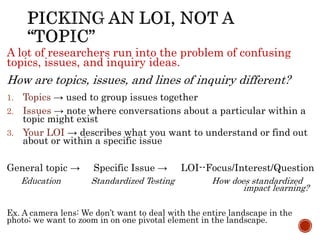
A lot of researchers run into the problem of confusing
topics, issues, and inquiry ideas.
How are topics, issues, and lines of inquiry different?
1. Topics → used to group issues together
2. Issues → note where conversations about a particular within a
topic might exist
3. Your LOI → describes what you want to understand or find out
about or within a specific issue
General topic → Specific Issue → LOI--Focus/Interest/Question
Education Standardized Testing How does standardized
impact learning?
Ex. A camera lens: We don’t want to deal with the entire landscape in the
photo; we want to zoom in on one pivotal element in the landscape.
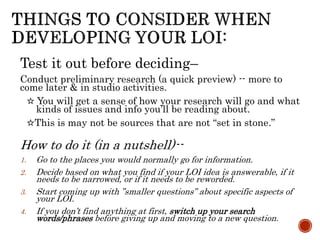
Test it out before deciding–
Conduct preliminary research (a quick preview) -- more to
come later & in studio activities.
☆ You will get a sense of how your research will go and what
kinds of issues and info you’ll be reading about.
☆This is may not be sources that are not “set in stone.”
How to do it (in a nutshell)--
1. Go to the places you would normally go for information.
2. Decide based on what you find if your LOI idea is answerable, if it
needs to be narrowed, or if it needs to be reworded.
3. Start coming up with ”smaller questions” about specific aspects of
your LOI.
4. If you don’t find anything at first, switch up your search
words/phrases before giving up and moving to a new question.
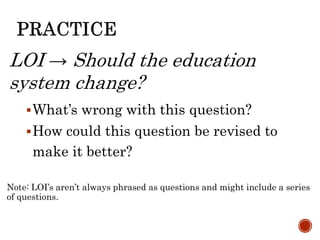
LOI → Should the education
system change?
What’s wrong with this question?
How could this question be revised to
make it better?
Note: LOI’s aren’t always phrased as questions and might include a series
of questions.
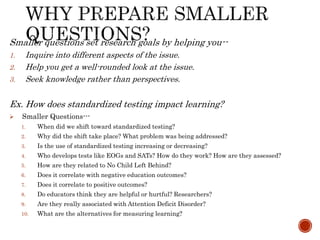
Smaller questions set research goals by helping you--
1. Inquire into different aspects of the issue.
2. Help you get a well-rounded look at the issue.
3. Seek knowledge rather than perspectives.
Ex. How does standardized testing impact learning?
 Smaller Questions---
1. When did we shift toward standardized testing?
2. Why did the shift take place? What problem was being addressed?
3. Is the use of standardized testing increasing or decreasing?
4. Who develops tests like EOGs and SATs? How do they work? How are they assessed?
5. How are they related to No Child Left Behind?
6. Does it correlate with negative education outcomes?
7. Does it correlate to positive outcomes?
8. Do educators think they are helpful or hurtful? Researchers?
9. Are they really associated with Attention Deficit Disorder?
10. What are the alternatives for measuring learning?
These 6 steps help you get a range of terms to group together and
work with. They help you tell the search engine what you want to
find.
 Step 1: Write out your line of inquiry (LOI). Include any smaller
questions that go along with it.
 Step 2: Pull out and list the major key search terms you see.
 You can also brainstorm these on your own or pull them from an overview
source like Wikipedia.
 Step 3: List as many synonyms for those words as you can think of.
 Step 4: List as many specific terms that correlate to your LOI as you
can think of.
 Step 5: List as many general terms that correlate to your LOI as you
can think of.
 Step 6: Think of different ways you can group these words together
to create different search results.
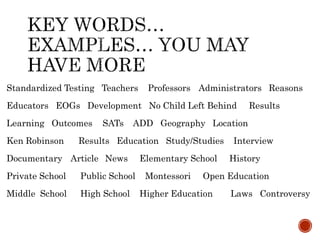
Standardized Testing Teachers Professors Administrators Reasons
Educators EOGs Development No Child Left Behind Results
Learning Outcomes SATs ADD Geography Location
Ken Robinson Results Education Study/Studies Interview
Documentary Article News Elementary School History
Private School Public School Montessori Open Education
Middle School High School Higher Education Laws Controversy
 Don’t stop with the background information or with only one opinion
or set of results.
 Remember, if you quickly find an “answer” without having to struggle, it
wasn’t inquiry.
 Leave some wiggle room.
 Genuine research happens through our own curiosity about something
 The path can shift during the process.
 There’s no way to know what you are going to find before you do the
research or how it will go.
YOUR LOI CAN SHIFT AS YOU GO.
1) Reporting information without adding anything new– connections to
your own experiences & observations and connections to other texts
& information
2) Research you compile to a question you already know the answer to
3) Research that only skims the surface-- doesn’t show engagement or
nuanced knowledge to the issue from multiple angles
4) Research that follows a straight line and stops at the first sign of an
answer– This happens if you’ve gotten some basic info or a
perspective that looks good and you think, “I found everything I
need. I don’t need to go anywhere else.”
5) Research that doesn’t produce new questions and knowledge- Good
inquiry should take you somewhere new and open new doors.
6) Planning an argument – Usually this leads to one-sided research.
7) Fact or answer hunting- You should find facts and possible answers
along the way, but this isn’t the end goal and likely causes
frustration when you don’t find exactly what you’re looking for

Inquiry1104

  • 1.
    General Pick Topic (maybewrite the thesis) Find sources (Read sources…maybe) OR Go quote-mining Write paper
  • 2.
     Nothing Learned(about both the issue and about research)  Often Biased Research  Often takes shallow look at the issue  Usually reports what others are saying rather than adding to the conversation
  • 3.
    Inquiry is differentfrom research because it encourages… 1) Complex thinking beyond a hunt for black and white answers or seeking info to support or refute a point (like a thesis statement) 2) Curiosity, an outlook that asks questions and an understanding that there’s always something more to know -- and the more we know the more fully we can understand something. 3) Consideration for multiple answers & perspectives, not just one, or a pro and a con, or a dichotomous view. 4) Wiggle room for lots of paths that take you lots of places & directions but still end with a question, probably a different one than you began with.
  • 4.
    General “Read” something Find asource Read the source Ask a question Write somethingRead the source Read the source Make something Ask a different question Find more sources Find more sources Ask more questions Thin k think read read
  • 5.
    INQUIRY 1) promotes learningthrough active investigation of questions, problems, and issues -- often for which there is not a single answer. 2) fosters complex learning -- critical thinking, better research habits, independent inquiry, responsibility for one’s own learning and intellectual growth. 3) offers deeper understanding of an issue by allowing you too explore the conversation as a whole. 4) invites you to read everything– evaluate & compare different types of sources, talk about bias, etc. … Remember the conversation map from class. YOU CAN’T REFUTE WHAT YOU DIDN’T READ.
  • 6.
  • 7.
    1.Good inquiry doesn’tappear out of thin air or a vacuum. Real inquiry often starts from a “source” (news report, an article, a song, a documentary, a blog) to establish and clarify the idea-- • Read something • Watch something • Listen to something • Talk about something 2.Good inquiry stems from natural curiosity- from wondering… • whether or not something is true • why so many people believe or do something • how/why something happens Abracadabr a… Inquiry
  • 8.
     Am Itruly interested in this topic? If you aren’t interested, your audience won’t either.  Is it answerable through research? --Which religion is better? Why do people prefer this type of music?  Is there a substantial human element to the topic? This must be meaningful for you and your audience, something that matters and makes a difference  You should be able to identify who would most benefit and explain why people should care  Is it something debatable and/or complex enough to dig below the surface and explore multiple opinions? You don’t want to be on a fact hunt or merely looking at the issue through an oversimplified, dichotomous view.
  • 9.
     Is thesubject current and relevant? Don’t bore readers with something they already know everything about.  Can I really say something new or contribute something here (academic writing should say something new)? NO REPORTS!!!  Examples to avoid: abortion, legalizing marijuana, steroids in sports, whether or not global warming is real… you get the idea.  Issues that have been “over talked about” & “over researched.” If you Googled them, you’d get 50,000 results, and they’d all say basically the same thing.  Is the subject limited and clear enough in focus? Is there a specific enough focus to end up with sources that are connected and speak to each other in some key way? Example of something too big or vague—  What is beauty? (Huh?)  What’s wrong with the public education system? (Get ready for a looooong semester.)  Why do people get tattoos? (They have personal or cultural value & it varies widely… no one wants a lesson on the global history of tattoos.)
  • 10.
    A lot ofresearchers run into the problem of confusing topics, issues, and inquiry ideas. How are topics, issues, and lines of inquiry different? 1. Topics → used to group issues together 2. Issues → note where conversations about a particular within a topic might exist 3. Your LOI → describes what you want to understand or find out about or within a specific issue General topic → Specific Issue → LOI--Focus/Interest/Question Education Standardized Testing How does standardized impact learning? Ex. A camera lens: We don’t want to deal with the entire landscape in the photo; we want to zoom in on one pivotal element in the landscape.
  • 11.
    Test it outbefore deciding– Conduct preliminary research (a quick preview) -- more to come later & in studio activities. ☆ You will get a sense of how your research will go and what kinds of issues and info you’ll be reading about. ☆This is may not be sources that are not “set in stone.” How to do it (in a nutshell)-- 1. Go to the places you would normally go for information. 2. Decide based on what you find if your LOI idea is answerable, if it needs to be narrowed, or if it needs to be reworded. 3. Start coming up with ”smaller questions” about specific aspects of your LOI. 4. If you don’t find anything at first, switch up your search words/phrases before giving up and moving to a new question.
  • 12.
    LOI → Shouldthe education system change? What’s wrong with this question? How could this question be revised to make it better? Note: LOI’s aren’t always phrased as questions and might include a series of questions.
  • 13.
    Smaller questions setresearch goals by helping you-- 1. Inquire into different aspects of the issue. 2. Help you get a well-rounded look at the issue. 3. Seek knowledge rather than perspectives. Ex. How does standardized testing impact learning?  Smaller Questions--- 1. When did we shift toward standardized testing? 2. Why did the shift take place? What problem was being addressed? 3. Is the use of standardized testing increasing or decreasing? 4. Who develops tests like EOGs and SATs? How do they work? How are they assessed? 5. How are they related to No Child Left Behind? 6. Does it correlate with negative education outcomes? 7. Does it correlate to positive outcomes? 8. Do educators think they are helpful or hurtful? Researchers? 9. Are they really associated with Attention Deficit Disorder? 10. What are the alternatives for measuring learning?
  • 14.
    These 6 stepshelp you get a range of terms to group together and work with. They help you tell the search engine what you want to find.  Step 1: Write out your line of inquiry (LOI). Include any smaller questions that go along with it.  Step 2: Pull out and list the major key search terms you see.  You can also brainstorm these on your own or pull them from an overview source like Wikipedia.  Step 3: List as many synonyms for those words as you can think of.  Step 4: List as many specific terms that correlate to your LOI as you can think of.  Step 5: List as many general terms that correlate to your LOI as you can think of.  Step 6: Think of different ways you can group these words together to create different search results.
  • 15.
    Standardized Testing TeachersProfessors Administrators Reasons Educators EOGs Development No Child Left Behind Results Learning Outcomes SATs ADD Geography Location Ken Robinson Results Education Study/Studies Interview Documentary Article News Elementary School History Private School Public School Montessori Open Education Middle School High School Higher Education Laws Controversy
  • 16.
     Don’t stopwith the background information or with only one opinion or set of results.  Remember, if you quickly find an “answer” without having to struggle, it wasn’t inquiry.  Leave some wiggle room.  Genuine research happens through our own curiosity about something  The path can shift during the process.  There’s no way to know what you are going to find before you do the research or how it will go. YOUR LOI CAN SHIFT AS YOU GO.
  • 17.
    1) Reporting informationwithout adding anything new– connections to your own experiences & observations and connections to other texts & information 2) Research you compile to a question you already know the answer to 3) Research that only skims the surface-- doesn’t show engagement or nuanced knowledge to the issue from multiple angles 4) Research that follows a straight line and stops at the first sign of an answer– This happens if you’ve gotten some basic info or a perspective that looks good and you think, “I found everything I need. I don’t need to go anywhere else.” 5) Research that doesn’t produce new questions and knowledge- Good inquiry should take you somewhere new and open new doors. 6) Planning an argument – Usually this leads to one-sided research. 7) Fact or answer hunting- You should find facts and possible answers along the way, but this isn’t the end goal and likely causes frustration when you don’t find exactly what you’re looking for