BUSINESS BUYING BEHAVIOUR
  -   Sometimes described as Business to Business buyer or industrial buyer.
  -   Organizations that buy goods and services for further production of other goods and services,
      reselling, renting or supplying to others( Kotler and Amstrong,2008)
  -   4 main categories of a Business buyers :
  -   1. Producers
          Purchase goods and services to produce other products.
          Examples: manufacturers, construction builders
      2. Resellers
           Wholesalers or retailers that purchase finished goods and resell them for a profit.
      3. Government
          Federal, state and local bodies which purchase goods to provide benefits to the public at
          large.
      4. Institutions
          College, Universities, schools, hospitals

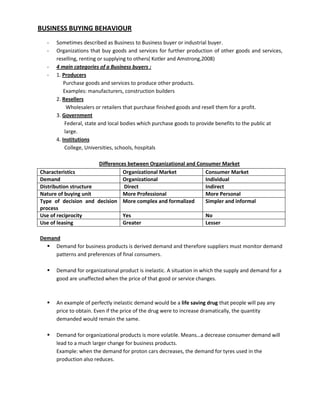
                       Differences between Organizational and Consumer Market
Characteristics                  Organizational Market           Consumer Market
Demand                           Organizational                  Individual
Distribution structure           Direct                          Indirect
Nature of buying unit            More Professional               More Personal
Type of decision and decision More complex and formalized        Simpler and informal
process
Use of reciprocity               Yes                             No
Use of leasing                   Greater                         Lesser

Demand
   Demand for business products is derived demand and therefore suppliers must monitor demand
     patterns and preferences of final consumers.

     Demand for organizational product is inelastic. A situation in which the supply and demand for a
      good are unaffected when the price of that good or service changes.


     An example of perfectly inelastic demand would be a life saving drug that people will pay any
      price to obtain. Even if the price of the drug were to increase dramatically, the quantity
      demanded would remain the same.

     Demand for organizational products is more volatile. Means…a decrease consumer demand will
      lead to a much larger change for business products.
      Example: when the demand for proton cars decreases, the demand for tyres used in the
      production also reduces.
Distribution Structure

        More common in organization market because products are often sold in larger quantities.

 Nature of Buying Unit
     Organiszational buyers involves many people and also professional approach.
     Some organization hires purchasers who concentrate on making better purchaser for the
        organization.

Type of Decisions and Decision process

       The purchase decision for organization is more complex as it involves price negotiations,
        payment terms, deliver date and so on.
       It takes months and also involved lots of money and technical interactions in an organization.
       The decision process is more formal where details on products and suppliers are searched
        thoroughly.

Use of Reciprocity
Apa maksud Reciprocity – mutual or cooperative exchange of things with others for mutual benefit)

       Business buyer purchase from their own customer.
       Example: Manufacturer of plastic container may buy chemicals used in the production from the
        customer a chemical manufacturer

Use of Leasing
Apa maksud leasing –( sewa) contract of renting land, bulding

       Business tend to lease products for use as is uses less capital, better services are the advantages
        business gain.
       Example: Machines, equipment, land, building

Buying centres

       The decision making unit in an organization.
       Includes all members in the organization in purchase decisions.
       Example : Purchasing Department or Purchasing Officer and he or she plays the role of a buying
        centre.
       The role of a gatekeeper only exits in the buying centre.

                                     ROLES IN THE PURCHASING PROCESS
        DOMINANT PEOPLE                                         ROLES
        Users                      People in the organization who uses the product
        Gatekeepers                Members who control the information flow in relation to
                                   purchasers. Example: Secretary to Manager maybe the ‘Gate’ as
                                   she controls the request from others in the department
        Influencers                People who influence the buying decision
        Deciders                   The person who have formal and informal powers to choose the
                                   final vendors or brands.
        Buyers                     Members who have formal authority to select vendors and
                                   negotiate the purchases.
BUSINESS BUYING DECISION-MAKING PROCESS


There are 3 main stages in the business buying decision making process:

1. NEED RECOGNITION AND SPRCIFICATION PHASE.
   a) Problem Recognition
         o Someone sees that specific product or services can solve a problem or fulfill the need in
             the organization.
         o Maybe internal stimuli – Organization may need to replace an old computer
         o Maybe external stimuli- Manager sees machine at a trade exhibition.

    b) General Need Description
         o Describe the characteristics and quantity of the needed item.
         o At this stage, the buying centre may need to discuss with technical people to define the
              type of products needed to complete the task.
         o Defining the product will require ranking according to its importance.

    c) Product Specification
       Purchasing department will need to develop the technical spec for the product required.

2. SUPPLIER IDENTIFICATION PHASE
   a) Supplier Search
      Search for the qualified supplier and starts with the available list of suppliers from the
      company’s record.

    b) Proposal Solicitation
          o People at the buying centre will request for proposals or bids from [potential suppliers.
          o If it’s a complex buying then a written proposal may be requested from the suppliers.

    c) Suppler Selection
          o Buying centre analyze the choice of proposal and select a supplier.
          o Normally a rating system is developed in which the rating may include: Honesty,
               competitive process, customer service, reputation, location and performance history.

3. ORDER PLACEMENT AND PERFORMANCE REVIREW PHASE

       a) Order Placement
             o Once the supplier has been selected, the purchasing agent will place the order and
                  determine on the delivery instructions.
             o This may include the DO, information on the product, quantity, methods of
                  payment, price, mode of delivery, payment terms in which all are detailed out.
       b) Performance Review
             o Purchaser’s and users may need to monitor the performance of the supplier
             o This review will determine whether to continue, change or stop the arrangement.
FACTORS AFFECTING BUSINESS BUYER BEHAVIOUR

1. ENVIRONMENTAL FACTORS
     o Business buyer need to pay attention to the economic climate, political,
         technological and also competitive factors.
     o Example : During recession, companies may defer investments or purchase new
         equipment until the economic situations improves.
     o Cultural also affects on the buying decision process across the globe.
     o Demand and Supply conditions ( labor and raw material) is another factor that
         need to be consider as an increase in the price of raw materials may force
         organization to look for domestic alternatives.

2. ORGANIZATIONAL FACTORS
     o Business buying decisions are affected by the organizations goals and objectives,
        policies and procedures, structures and purchasing system.
     o This is because organizations objectives and goals may differ in the criteria use
        to make buying decisions.
     o Example: If a firm wants to be a cost leader in an industry then the materials
        purchased are at reasonable quality at lowest possible.

3. INTERPERSONAL FACTORS
      o There are many people in the buying centre and they influence other in the
          organization.
      o Individuals in an organization may influence the buying decision process maybe
          because of the authority, status, expertise and relationship with other buying
          centre members.
      o Buying decisions may also be affected by personal, social, cultural and
          psychological factors.
      o Power, conflicts may also complicate buying process as we need to remember
          that individuals in the buying centre may have different experiences and skills
          and also personality.

Business buying behaviour

  • 1.
    BUSINESS BUYING BEHAVIOUR - Sometimes described as Business to Business buyer or industrial buyer. - Organizations that buy goods and services for further production of other goods and services, reselling, renting or supplying to others( Kotler and Amstrong,2008) - 4 main categories of a Business buyers : - 1. Producers Purchase goods and services to produce other products. Examples: manufacturers, construction builders 2. Resellers Wholesalers or retailers that purchase finished goods and resell them for a profit. 3. Government Federal, state and local bodies which purchase goods to provide benefits to the public at large. 4. Institutions College, Universities, schools, hospitals Differences between Organizational and Consumer Market Characteristics Organizational Market Consumer Market Demand Organizational Individual Distribution structure Direct Indirect Nature of buying unit More Professional More Personal Type of decision and decision More complex and formalized Simpler and informal process Use of reciprocity Yes No Use of leasing Greater Lesser Demand  Demand for business products is derived demand and therefore suppliers must monitor demand patterns and preferences of final consumers.  Demand for organizational product is inelastic. A situation in which the supply and demand for a good are unaffected when the price of that good or service changes.  An example of perfectly inelastic demand would be a life saving drug that people will pay any price to obtain. Even if the price of the drug were to increase dramatically, the quantity demanded would remain the same.  Demand for organizational products is more volatile. Means…a decrease consumer demand will lead to a much larger change for business products. Example: when the demand for proton cars decreases, the demand for tyres used in the production also reduces.
  • 2.
    Distribution Structure  More common in organization market because products are often sold in larger quantities. Nature of Buying Unit  Organiszational buyers involves many people and also professional approach.  Some organization hires purchasers who concentrate on making better purchaser for the organization. Type of Decisions and Decision process  The purchase decision for organization is more complex as it involves price negotiations, payment terms, deliver date and so on.  It takes months and also involved lots of money and technical interactions in an organization.  The decision process is more formal where details on products and suppliers are searched thoroughly. Use of Reciprocity Apa maksud Reciprocity – mutual or cooperative exchange of things with others for mutual benefit)  Business buyer purchase from their own customer.  Example: Manufacturer of plastic container may buy chemicals used in the production from the customer a chemical manufacturer Use of Leasing Apa maksud leasing –( sewa) contract of renting land, bulding  Business tend to lease products for use as is uses less capital, better services are the advantages business gain.  Example: Machines, equipment, land, building Buying centres  The decision making unit in an organization.  Includes all members in the organization in purchase decisions.  Example : Purchasing Department or Purchasing Officer and he or she plays the role of a buying centre.  The role of a gatekeeper only exits in the buying centre. ROLES IN THE PURCHASING PROCESS DOMINANT PEOPLE ROLES Users People in the organization who uses the product Gatekeepers Members who control the information flow in relation to purchasers. Example: Secretary to Manager maybe the ‘Gate’ as she controls the request from others in the department Influencers People who influence the buying decision Deciders The person who have formal and informal powers to choose the final vendors or brands. Buyers Members who have formal authority to select vendors and negotiate the purchases.
  • 3.
    BUSINESS BUYING DECISION-MAKINGPROCESS There are 3 main stages in the business buying decision making process: 1. NEED RECOGNITION AND SPRCIFICATION PHASE. a) Problem Recognition o Someone sees that specific product or services can solve a problem or fulfill the need in the organization. o Maybe internal stimuli – Organization may need to replace an old computer o Maybe external stimuli- Manager sees machine at a trade exhibition. b) General Need Description o Describe the characteristics and quantity of the needed item. o At this stage, the buying centre may need to discuss with technical people to define the type of products needed to complete the task. o Defining the product will require ranking according to its importance. c) Product Specification Purchasing department will need to develop the technical spec for the product required. 2. SUPPLIER IDENTIFICATION PHASE a) Supplier Search Search for the qualified supplier and starts with the available list of suppliers from the company’s record. b) Proposal Solicitation o People at the buying centre will request for proposals or bids from [potential suppliers. o If it’s a complex buying then a written proposal may be requested from the suppliers. c) Suppler Selection o Buying centre analyze the choice of proposal and select a supplier. o Normally a rating system is developed in which the rating may include: Honesty, competitive process, customer service, reputation, location and performance history. 3. ORDER PLACEMENT AND PERFORMANCE REVIREW PHASE a) Order Placement o Once the supplier has been selected, the purchasing agent will place the order and determine on the delivery instructions. o This may include the DO, information on the product, quantity, methods of payment, price, mode of delivery, payment terms in which all are detailed out. b) Performance Review o Purchaser’s and users may need to monitor the performance of the supplier o This review will determine whether to continue, change or stop the arrangement.
  • 4.
    FACTORS AFFECTING BUSINESSBUYER BEHAVIOUR 1. ENVIRONMENTAL FACTORS o Business buyer need to pay attention to the economic climate, political, technological and also competitive factors. o Example : During recession, companies may defer investments or purchase new equipment until the economic situations improves. o Cultural also affects on the buying decision process across the globe. o Demand and Supply conditions ( labor and raw material) is another factor that need to be consider as an increase in the price of raw materials may force organization to look for domestic alternatives. 2. ORGANIZATIONAL FACTORS o Business buying decisions are affected by the organizations goals and objectives, policies and procedures, structures and purchasing system. o This is because organizations objectives and goals may differ in the criteria use to make buying decisions. o Example: If a firm wants to be a cost leader in an industry then the materials purchased are at reasonable quality at lowest possible. 3. INTERPERSONAL FACTORS o There are many people in the buying centre and they influence other in the organization. o Individuals in an organization may influence the buying decision process maybe because of the authority, status, expertise and relationship with other buying centre members. o Buying decisions may also be affected by personal, social, cultural and psychological factors. o Power, conflicts may also complicate buying process as we need to remember that individuals in the buying centre may have different experiences and skills and also personality.