Chapter One

           Creating and Capturing Customer
                        Value

Copyright © 2009 Pearson Education, Inc.
                                           Chapter 1- slide 1
Publishing as Prentice Hall
What Is Marketing?
   Marketing is a process by which
    companies create value for customers and
    build strong customer relationships to
    capture value
   from customers in
   return


Copyright © 2010 Pearson Education, Inc.
                                             Chapter 1- slide 2
Publishing as Prentice Hall
What Is Marketing?
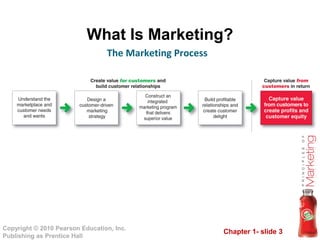
                                 The Marketing Process


Copyright © 2010 Pearson Education, Inc.
                                                         Chapter 1- slide 3
Publishing as Prentice Hall
Understanding the Marketplace
                and Customer Needs
                        Customer Needs, Wants, and Demands


Copyright © 2010 Pearson Education, Inc.
                                                       Chapter 1- slide 4
Publishing as Prentice Hall
Understanding the Marketplace
                and Customer Needs

     • Market offerings are some
       combination of products,
       services, information, or
       experiences offered to a
       market to satisfy a need or
       want
     • Marketing myopia is
       focusing only on existing
       wants and losing sight of
       underlying consumer
       needs


Copyright © 2010 Pearson Education, Inc.
                                           Chapter 1- slide 5
Publishing as Prentice Hall
Understanding the Marketplace
                and Customer Needs
                      Customer Value and Satisfaction
                              Expectations


Copyright © 2010 Pearson Education, Inc.
                                                 Chapter 1- slide 6
Publishing as Prentice Hall
Understanding the Marketplace
                and Customer Needs
           Exchange is the act of obtaining a desired
           object from someone by offering
           something in return


Copyright © 2010 Pearson Education, Inc.
                                           Chapter 1- slide 7
Publishing as Prentice Hall
Understanding the Marketplace
                  and Customer Needs
             Markets are the set of actual and
              potential buyers of a product


Copyright © 2010 Pearson Education, Inc.
                                           Chapter 1- slide 8
Publishing as Prentice Hall
Designing a Customer-Driven
                   Marketing Strategy
                         Selecting Customers to Serve


       Demarketing is marketing to reduce demand
        temporarily or permanently; the aim is not
        to destroy demand but to reduce or shift it


Copyright © 2010 Pearson Education, Inc.
                                                   Chapter 1- slide 9
Publishing as Prentice Hall
Designing a Customer-Driven
                   Marketing Strategy
                 Marketing Management Orientations


Copyright © 2010 Pearson Education, Inc.
                                            Chapter 1- slide 10
Publishing as Prentice Hall
Designing a Customer-Driven
                   Marketing Strategy
                   Marketing Management Orientations

       Production concept is the idea that
         consumers will favor products that are
         available or highly affordable


Copyright © 2010 Pearson Education, Inc.
                                              Chapter 1- slide 11
Publishing as Prentice Hall
Designing a Customer-Driven
                   Marketing Strategy
                   Marketing Management Orientations

       Product concept is the idea that consumers
         will favor products that offer the most
         quality, performance, and features.
         Organization should therefore devote its
         energy to making continuous product
         improvements.

Copyright © 2010 Pearson Education, Inc.
                                              Chapter 1- slide 12
Publishing as Prentice Hall
Designing a Customer-Driven
                   Marketing Strategy
                   Marketing Management Orientations

       Selling concept is the idea that consumers
         will not buy enough of the firm’s products
         unless it undertakes a large scale selling
         and promotion effort


Copyright © 2010 Pearson Education, Inc.
                                              Chapter 1- slide 13
Publishing as Prentice Hall
Designing a Customer-Driven
                    Marketing Strategy
                    Marketing Management Orientations

                                     Marketing concept is the
                                         idea that achieving
                                         organizational goals
                                         depends on knowing the
                                         needs and wants of the
                                         target markets and
                                         delivering the desired
                                         satisfactions better than
Copyright © 2010 Pearson Education, Inc.
                                         competitors doChapter 1- slide 14
Publishing as Prentice Hall
Designing a Customer-Driven
                   Marketing Strategy
                   Marketing Management Orientations
                                           Societal marketing concept
                                           is the idea that a company
                                           should make good marketing
                                           decisions by considering
                                           consumers’ wants, the
                                           company’s requirements,
                                           consumers’ long-term
                                           interests, and society’s long-
                                           run interests
Copyright © 2010 Pearson Education, Inc.
                                                            Chapter 1- slide 15
Publishing as Prentice Hall
Designing a Customer-Driven
                     Marketing Strategy


Copyright © 2010 Pearson Education, Inc.
                                           Chapter 1- slide 16
Publishing as Prentice Hall
Building Customer Relationships
             Customer Relationship Management (CRM)
                              • The overall process of
                                building and maintaining
                                profitable customer
                                relationships by delivering
                                superior customer value
                                and satisfaction


Copyright © 2010 Pearson Education, Inc.
                                               Chapter 1- slide 17
Publishing as Prentice Hall
4 Ps of Marketing


                                           4Pss Provide


    Four Cs of Marketing

       Customer solution (Product)
       Customer cost (Price)
       Convenience (Placement)
       Communication (Promotion)
Copyright © 2010 Pearson Education, Inc.
                                              Chapter 1- slide 18
Publishing as Prentice Hall

Chapter 1

  • 1.
    Chapter One Creating and Capturing Customer Value Copyright © 2009 Pearson Education, Inc. Chapter 1- slide 1 Publishing as Prentice Hall
  • 2.
    What Is Marketing? Marketing is a process by which companies create value for customers and build strong customer relationships to capture value from customers in return Copyright © 2010 Pearson Education, Inc. Chapter 1- slide 2 Publishing as Prentice Hall
  • 3.
    What Is Marketing? The Marketing Process Copyright © 2010 Pearson Education, Inc. Chapter 1- slide 3 Publishing as Prentice Hall
  • 4.
    Understanding the Marketplace and Customer Needs Customer Needs, Wants, and Demands Copyright © 2010 Pearson Education, Inc. Chapter 1- slide 4 Publishing as Prentice Hall
  • 5.
    Understanding the Marketplace and Customer Needs • Market offerings are some combination of products, services, information, or experiences offered to a market to satisfy a need or want • Marketing myopia is focusing only on existing wants and losing sight of underlying consumer needs Copyright © 2010 Pearson Education, Inc. Chapter 1- slide 5 Publishing as Prentice Hall
  • 6.
    Understanding the Marketplace and Customer Needs Customer Value and Satisfaction Expectations Copyright © 2010 Pearson Education, Inc. Chapter 1- slide 6 Publishing as Prentice Hall
  • 7.
    Understanding the Marketplace and Customer Needs Exchange is the act of obtaining a desired object from someone by offering something in return Copyright © 2010 Pearson Education, Inc. Chapter 1- slide 7 Publishing as Prentice Hall
  • 8.
    Understanding the Marketplace and Customer Needs Markets are the set of actual and potential buyers of a product Copyright © 2010 Pearson Education, Inc. Chapter 1- slide 8 Publishing as Prentice Hall
  • 9.
    Designing a Customer-Driven Marketing Strategy Selecting Customers to Serve Demarketing is marketing to reduce demand temporarily or permanently; the aim is not to destroy demand but to reduce or shift it Copyright © 2010 Pearson Education, Inc. Chapter 1- slide 9 Publishing as Prentice Hall
  • 10.
    Designing a Customer-Driven Marketing Strategy Marketing Management Orientations Copyright © 2010 Pearson Education, Inc. Chapter 1- slide 10 Publishing as Prentice Hall
  • 11.
    Designing a Customer-Driven Marketing Strategy Marketing Management Orientations Production concept is the idea that consumers will favor products that are available or highly affordable Copyright © 2010 Pearson Education, Inc. Chapter 1- slide 11 Publishing as Prentice Hall
  • 12.
    Designing a Customer-Driven Marketing Strategy Marketing Management Orientations Product concept is the idea that consumers will favor products that offer the most quality, performance, and features. Organization should therefore devote its energy to making continuous product improvements. Copyright © 2010 Pearson Education, Inc. Chapter 1- slide 12 Publishing as Prentice Hall
  • 13.
    Designing a Customer-Driven Marketing Strategy Marketing Management Orientations Selling concept is the idea that consumers will not buy enough of the firm’s products unless it undertakes a large scale selling and promotion effort Copyright © 2010 Pearson Education, Inc. Chapter 1- slide 13 Publishing as Prentice Hall
  • 14.
    Designing a Customer-Driven Marketing Strategy Marketing Management Orientations Marketing concept is the idea that achieving organizational goals depends on knowing the needs and wants of the target markets and delivering the desired satisfactions better than Copyright © 2010 Pearson Education, Inc. competitors doChapter 1- slide 14 Publishing as Prentice Hall
  • 15.
    Designing a Customer-Driven Marketing Strategy Marketing Management Orientations Societal marketing concept is the idea that a company should make good marketing decisions by considering consumers’ wants, the company’s requirements, consumers’ long-term interests, and society’s long- run interests Copyright © 2010 Pearson Education, Inc. Chapter 1- slide 15 Publishing as Prentice Hall
  • 16.
    Designing a Customer-Driven Marketing Strategy Copyright © 2010 Pearson Education, Inc. Chapter 1- slide 16 Publishing as Prentice Hall
  • 17.
    Building Customer Relationships Customer Relationship Management (CRM) • The overall process of building and maintaining profitable customer relationships by delivering superior customer value and satisfaction Copyright © 2010 Pearson Education, Inc. Chapter 1- slide 17 Publishing as Prentice Hall
  • 18.
    4 Ps ofMarketing 4Pss Provide Four Cs of Marketing  Customer solution (Product)  Customer cost (Price)  Convenience (Placement)  Communication (Promotion) Copyright © 2010 Pearson Education, Inc. Chapter 1- slide 18 Publishing as Prentice Hall

Editor's Notes

  • #3 Note to Instructor: The text gives some excellent examples of companies that are successful in marketing. These examples include: Wal-Mart which has become the world’s largest retailer—and the world’s largest company— by delivering on its promise, “Save money. Live Better.” At Disney theme parks, “imagineers”work wonders in their quest to “make a dream come true today.” Apple fulfills its motto to “Think Different” with dazzling, customer-driven innovation that captures customer imaginations and loyalty. Its wildly successful iPod grabs more than 70 percent of the music player market; its iTunes music store captures nearly 90 percent of the song download business. Discussion Question Ask students for other examples of either national or local companies who are excellent at marketing and ask how they reflect the definition given in this slide.
  • #7 Note to Instructor: This Web link connects to online shoe retailer zappos.com. You can link to the site and see how this retailer creates value for the consumer. Explore features including customer reviews, online LIVE customer service, free shipping (including returns). Ask students what other online retailers deliver exceptional value and satisfaction. Discussion Question Why do marketer’s not always understand customer needs? How can they better identify customer needs? Marketer’s often work in a vacuum and do not consider the customer’s needs as much as they should. Future chapters will talk about market research and marketing information, important tools for understanding customer’s needs. Students might be familiar with survey research or focus groups as techniques for gathering information or they might be asked for their zip code when they purchase in certain retailers
  • #8 Note to Instructor: Marketing consists of actions taken to build and maintain desirable exchange relationships with target audiences involving a product, service, idea, or other object. Beyond simply attracting new customers and creating transactions, the goal is to retain customers and grow their business with the company.
  • #16 Discussion Questions What companies can you identify with social Marketing? What do these companies do that ties to the societal marketing concept? Students might be familiar with many different companies that practice societal marketing through their Corporate Social Responsibility (CSR) initiatives. Students might be familiar with local retailers who are also involved in societal marketing. (Target, TOMS shoes). They will note that these companies donate, contribute, or offer services to charities and not-for-profit organizations.
  • #17 Note to Instructor This slide shows companies should balance three considerations in setting their marketing strategies. Johnson & Johnson does this well. Johnson & Johnson would rather take a big loss than ship a bad batch of one of its products. Consider the tragic tampering case in which eight people died in 1982 from swallowing cyanide-laced capsules of Tylenol, a Johnson & Johnson brand. Although Johnson & Johnson believed that the pills had been altered in only a few stores it recalled all of its product and launched an information campaign to instruct and reassure consumers. The recall cost the company $100 million in earnings. In the long run, however, the company’s swift recall of Tylenol strengthened consumer confidence and loyalty, and today Tylenol remains one of the nation’s leading brands of pain reliever. Discussion Question Ask students about other companies that have had serious problems with their products? How have these companies bounced back?