Porter's
Five
Forces
Model
PRECIOUS GRACE C. BRAVO
PRINCESS KAY A. LIGAD
ZAREN GRACE O. VISAGA
JUNE 30, 2024
Introduction to Porter's Five Forces
Developed by Michael E. Porter in 1979
Framework for analyzing the competitive forces
within an industry
Helps businesses determine industry
attractiveness and inform strategic decisions
Definition of Porter's Five Forces
A tool for analyzing the competitive forces that
shape every industry
Identifies five forces that determine the
intensity of competition and profitability
Purpose of Porter's Five Forces
To understand the dynamics of an industry
To identify the strengths and weaknesses
of an industry position
To inform strategic decisions and gain a
competitive advantage
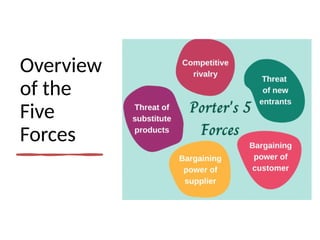
Overview
of the
Five
Forces
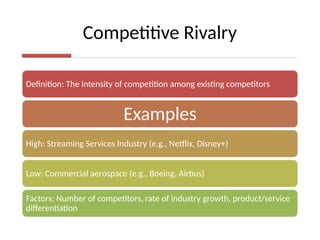
Competitive Rivalry
Definition: The intensity of competition among existing competitors
Examples
High: Streaming Services Industry (e.g., Netflix, Disney+)
Low: Commercial aerospace (e.g., Boeing, Airbus)
Factors: Number of competitors, rate of industry growth, product/service
differentiation
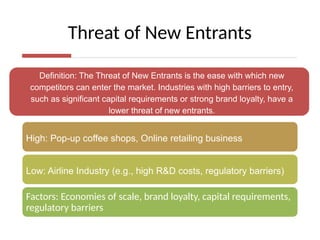
Threat of New Entrants
Definition: The Threat of New Entrants is the ease with which new
competitors can enter the market. Industries with high barriers to entry,
such as significant capital requirements or strong brand loyalty, have a
lower threat of new entrants.
High: Pop-up coffee shops, Online retailing business
Low: Airline Industry (e.g., high R&D costs, regulatory barriers)
Factors: Economies of scale, brand loyalty, capital requirements,
regulatory barriers
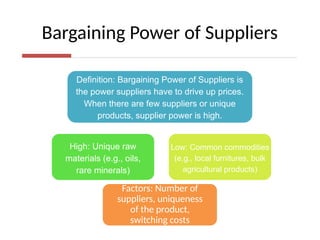
Bargaining Power of Suppliers
Definition: Bargaining Power of Suppliers is
the power suppliers have to drive up prices.
When there are few suppliers or unique
products, supplier power is high.
High: Unique raw
materials (e.g., oils,
rare minerals)
Low: Common commodities
(e.g., local furnitures, bulk
agricultural products)
Factors: Number of
suppliers, uniqueness
of the product,
switching costs
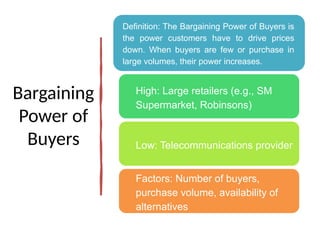
Bargaining
Power of
Buyers
Definition: The Bargaining Power of Buyers is
the power customers have to drive prices
down. When buyers are few or purchase in
large volumes, their power increases.
High: Large retailers (e.g., SM
Supermarket, Robinsons)
Low: Telecommunications provider
Factors: Number of buyers,
purchase volume, availability of
alternatives
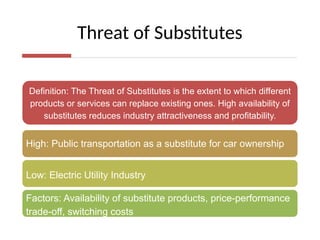
Threat of Substitutes
Definition: The Threat of Substitutes is the extent to which different
products or services can replace existing ones. High availability of
substitutes reduces industry attractiveness and profitability.
High: Public transportation as a substitute for car ownership
Low: Electric Utility Industry
Factors: Availability of substitute products, price-performance
trade-off, switching costs
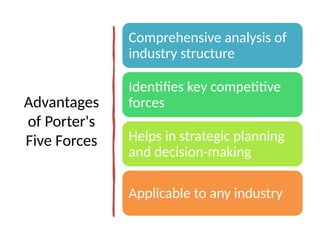
Advantages
of Porter's
Five Forces
Comprehensive analysis of
industry structure
Identifies key competitive
forces
Helps in strategic planning
and decision-making
Applicable to any industry
Disadvantages of Porter's Five Forces
May oversimplify complex industries
Static model; may not account for dynamic changes
Focuses on external factors, neglecting internal
capabilities
May not be applicable to non-traditional industries
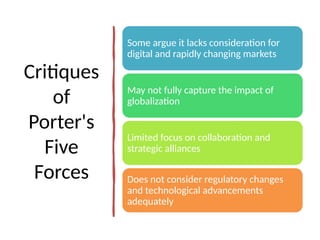
Critiques
of
Porter's
Five
Forces
Some argue it lacks consideration for
digital and rapidly changing markets
May not fully capture the impact of
globalization
Limited focus on collaboration and
strategic alliances
Does not consider regulatory changes
and technological advancements
adequately
When to Use Porter's Five Forces
When entering a new market or industry
For strategic planning and competitive analysis
To assess industry attractiveness and profitability
During mergers and acquisitions to evaluate industry
dynamics
Conclusion
Porter's Five Forces is a valuable tool for
understanding industry competition
Provides insights into strategic positioning
Useful for a wide range of strategic
decisions

Porter's Five Forces Model AND ALL PPT.pptx

  • 1.
    Porter's Five Forces Model PRECIOUS GRACE C.BRAVO PRINCESS KAY A. LIGAD ZAREN GRACE O. VISAGA JUNE 30, 2024
  • 2.
    Introduction to Porter'sFive Forces Developed by Michael E. Porter in 1979 Framework for analyzing the competitive forces within an industry Helps businesses determine industry attractiveness and inform strategic decisions
  • 3.
    Definition of Porter'sFive Forces A tool for analyzing the competitive forces that shape every industry Identifies five forces that determine the intensity of competition and profitability
  • 4.
    Purpose of Porter'sFive Forces To understand the dynamics of an industry To identify the strengths and weaknesses of an industry position To inform strategic decisions and gain a competitive advantage
  • 5.
  • 6.
    Competitive Rivalry Definition: Theintensity of competition among existing competitors Examples High: Streaming Services Industry (e.g., Netflix, Disney+) Low: Commercial aerospace (e.g., Boeing, Airbus) Factors: Number of competitors, rate of industry growth, product/service differentiation
  • 7.
    Threat of NewEntrants Definition: The Threat of New Entrants is the ease with which new competitors can enter the market. Industries with high barriers to entry, such as significant capital requirements or strong brand loyalty, have a lower threat of new entrants. High: Pop-up coffee shops, Online retailing business Low: Airline Industry (e.g., high R&D costs, regulatory barriers) Factors: Economies of scale, brand loyalty, capital requirements, regulatory barriers
  • 8.
    Bargaining Power ofSuppliers Definition: Bargaining Power of Suppliers is the power suppliers have to drive up prices. When there are few suppliers or unique products, supplier power is high. High: Unique raw materials (e.g., oils, rare minerals) Low: Common commodities (e.g., local furnitures, bulk agricultural products) Factors: Number of suppliers, uniqueness of the product, switching costs
  • 9.
    Bargaining Power of Buyers Definition: TheBargaining Power of Buyers is the power customers have to drive prices down. When buyers are few or purchase in large volumes, their power increases. High: Large retailers (e.g., SM Supermarket, Robinsons) Low: Telecommunications provider Factors: Number of buyers, purchase volume, availability of alternatives
  • 10.
    Threat of Substitutes Definition:The Threat of Substitutes is the extent to which different products or services can replace existing ones. High availability of substitutes reduces industry attractiveness and profitability. High: Public transportation as a substitute for car ownership Low: Electric Utility Industry Factors: Availability of substitute products, price-performance trade-off, switching costs
  • 11.
    Advantages of Porter's Five Forces Comprehensiveanalysis of industry structure Identifies key competitive forces Helps in strategic planning and decision-making Applicable to any industry
  • 12.
    Disadvantages of Porter'sFive Forces May oversimplify complex industries Static model; may not account for dynamic changes Focuses on external factors, neglecting internal capabilities May not be applicable to non-traditional industries
  • 13.
    Critiques of Porter's Five Forces Some argue itlacks consideration for digital and rapidly changing markets May not fully capture the impact of globalization Limited focus on collaboration and strategic alliances Does not consider regulatory changes and technological advancements adequately
  • 14.
    When to UsePorter's Five Forces When entering a new market or industry For strategic planning and competitive analysis To assess industry attractiveness and profitability During mergers and acquisitions to evaluate industry dynamics
  • 15.
    Conclusion Porter's Five Forcesis a valuable tool for understanding industry competition Provides insights into strategic positioning Useful for a wide range of strategic decisions