fast and flexible probabilistic modeling in python
jmschreiber91
@jmschrei
@jmschreiber91
Jacob Schreiber
PhD student, Paul G. Allen School of
Computer Science, University of
Washington, Seattle WA
Maxwell Libbrecht
Postdoc, Department of Genome Sciences,
University of Washington, Seattle WA
Assistant Professor, Simon Fraser University,
Vancouver BC
noble.gs.washington.edu/~maxwl/
fast and flexible probabilistic modeling in python
jmschreiber91
@jmschrei
@jmschreiber91
Jacob Schreiber
PhD student, Paul G. Allen School of
Computer Science, University of
Washington, Seattle WA
Maxwell Libbrecht
Postdoc, Department of Genome Sciences,
University of Washington, Seattle WA
Assistant Professor, Simon Fraser University,
Vancouver BC
noble.gs.washington.edu/~maxwl/
Follow along with the Jupyter tutorial
3
goo.gl/cbE7rs
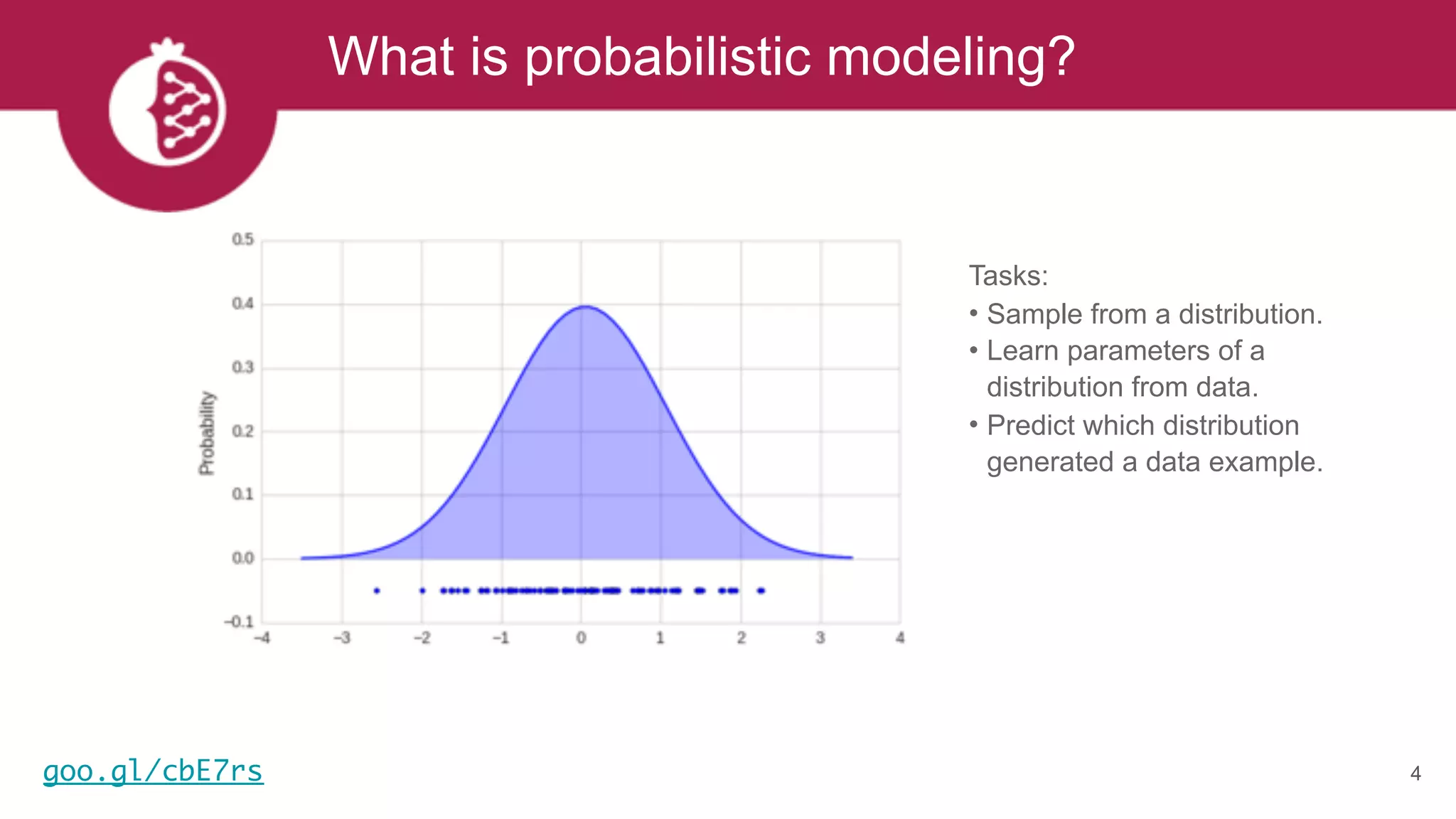
What is probabilistic modeling?
4goo.gl/cbE7rs
Tasks:
• Sample from a distribution.
• Learn parameters of a
distribution from data.
• Predict which distribution
generated a data example.
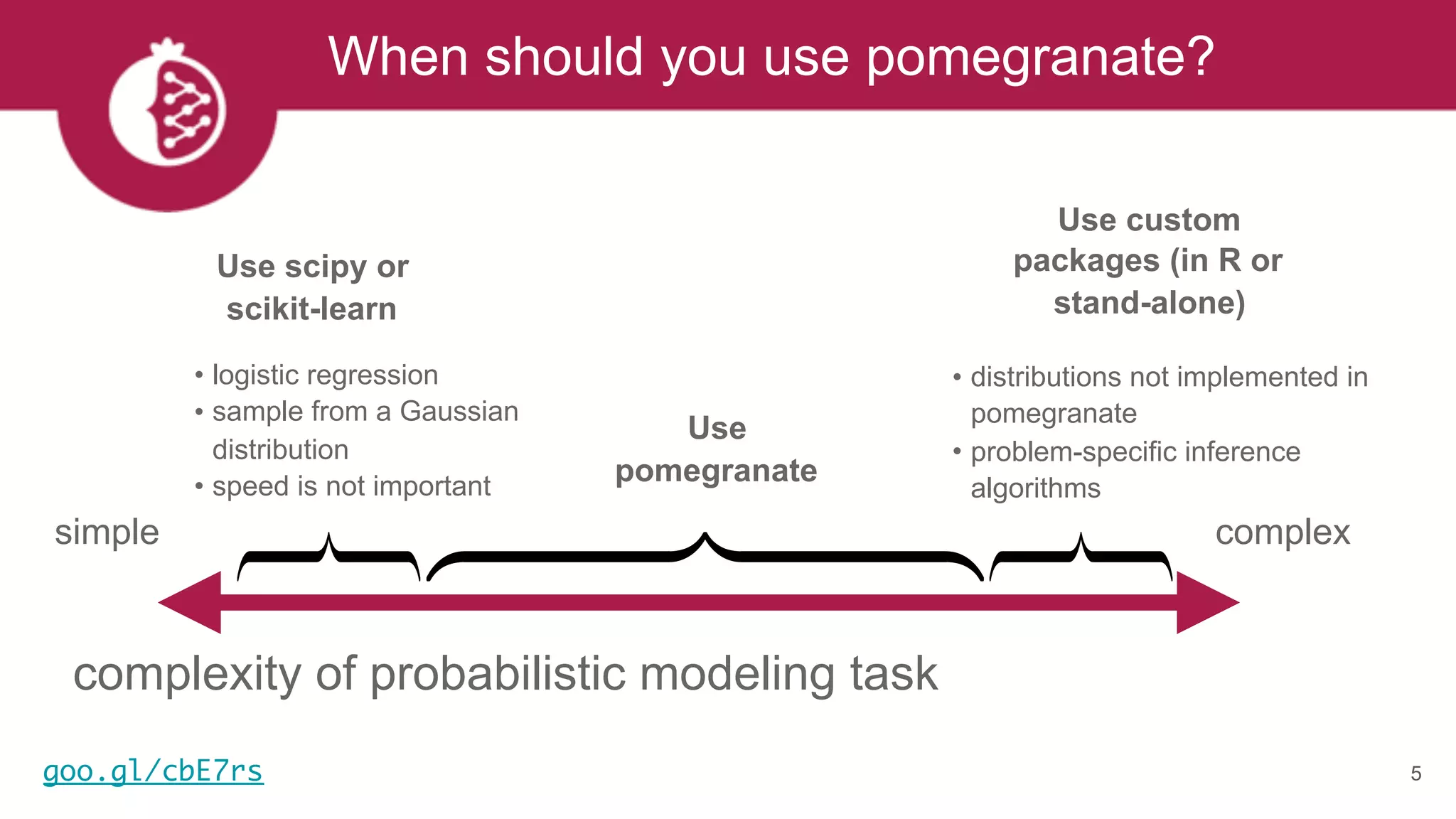
When should you use pomegranate?
5
complexity of probabilistic modeling task
simple complexz }| {
• logistic regression
• sample from a Gaussian
distribution
• speed is not important
Use scipy or
scikit-learn
z }| {
• distributions not implemented in
pomegranate
• problem-specific inference
algorithms
Use custom
packages (in R or
stand-alone)
z }| {
Use
pomegranate
goo.gl/cbE7rs
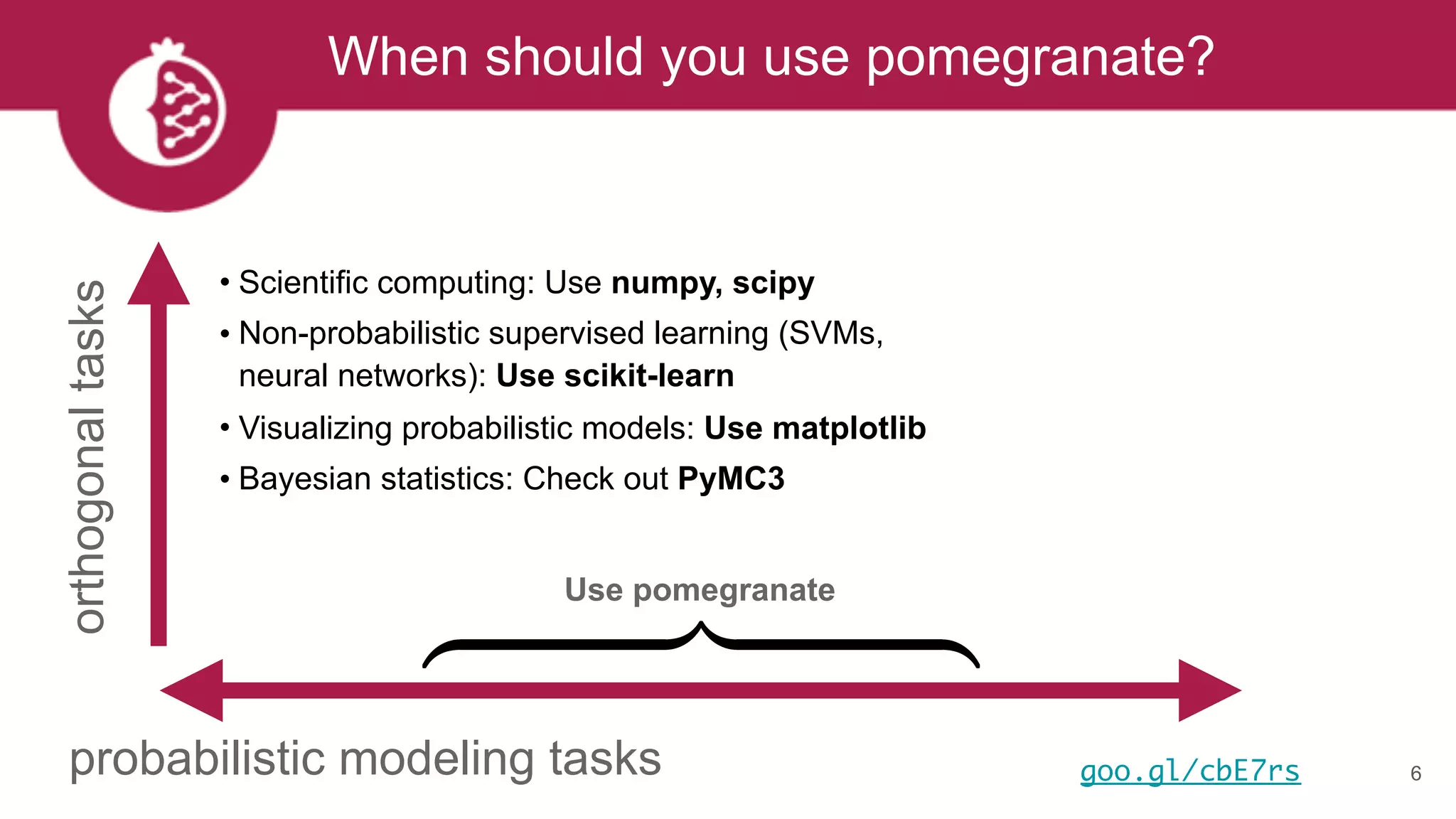
When should you use pomegranate?
6
z }| {
Use pomegranate
probabilistic modeling tasks
orthogonaltasks
• Scientific computing: Use numpy, scipy
• Non-probabilistic supervised learning (SVMs,
neural networks): Use scikit-learn
• Visualizing probabilistic models: Use matplotlib
• Bayesian statistics: Check out PyMC3
goo.gl/cbE7rs
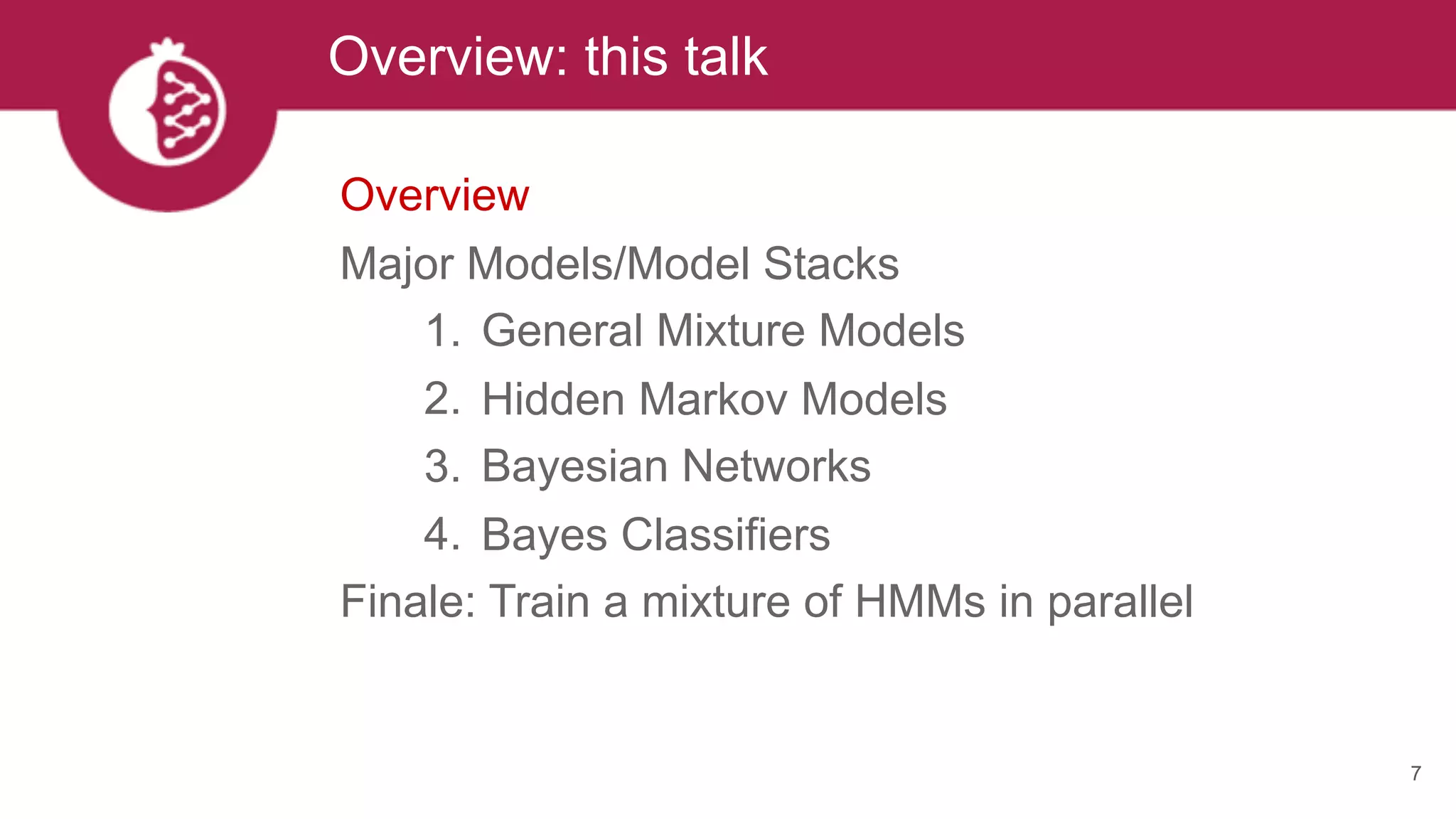
Overview: this talk
7
Overview
Major Models/Model Stacks
1. General Mixture Models
2. Hidden Markov Models
3. Bayesian Networks
4. Bayes Classifiers
Finale: Train a mixture of HMMs in parallel
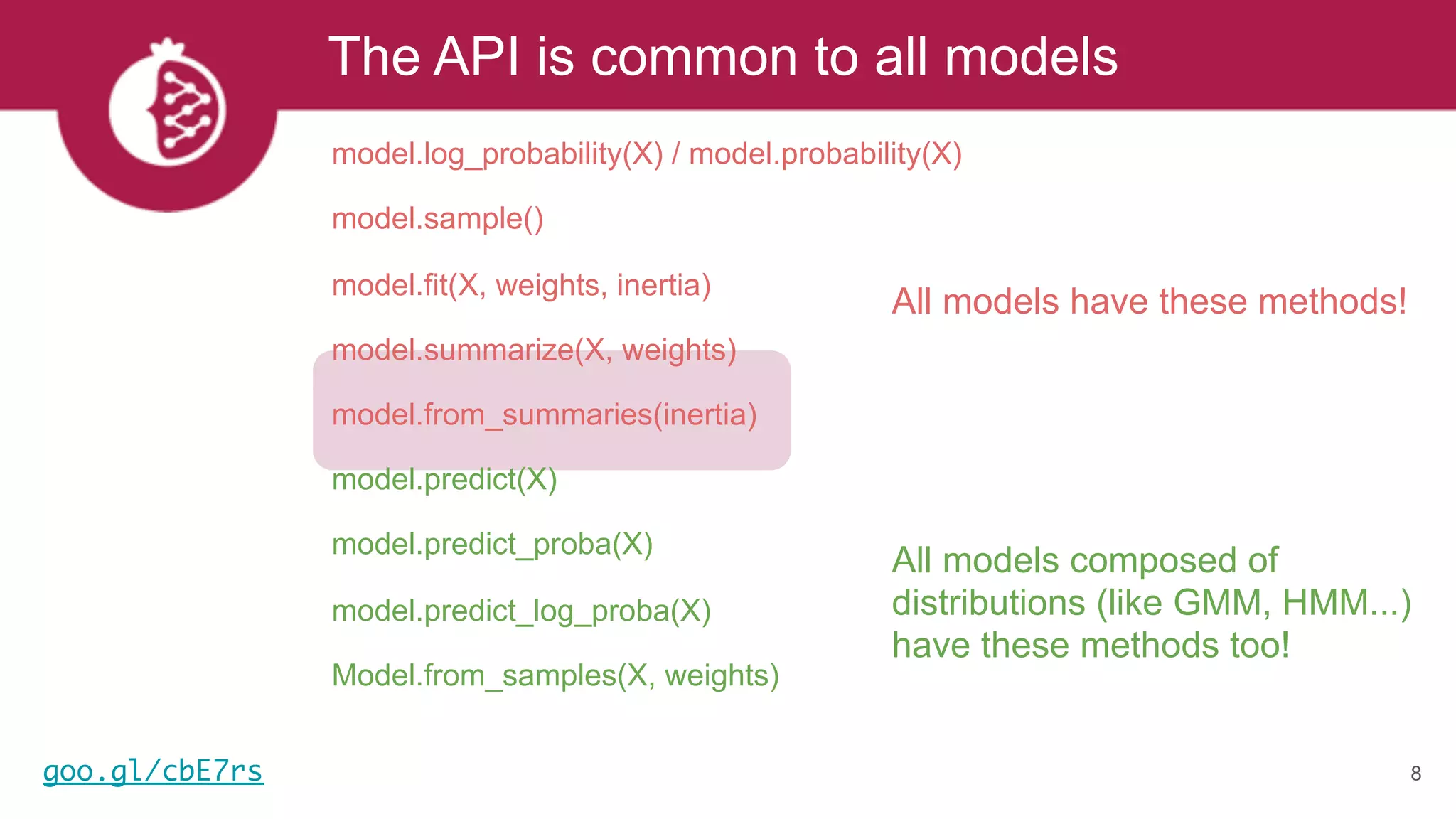
The API is common to all models
8
All models have these methods!
All models composed of
distributions (like GMM, HMM...)
have these methods too!
model.log_probability(X) / model.probability(X)
model.sample()
model.fit(X, weights, inertia)
model.summarize(X, weights)
model.from_summaries(inertia)
model.predict(X)
model.predict_proba(X)
model.predict_log_proba(X)
Model.from_samples(X, weights)
goo.gl/cbE7rs
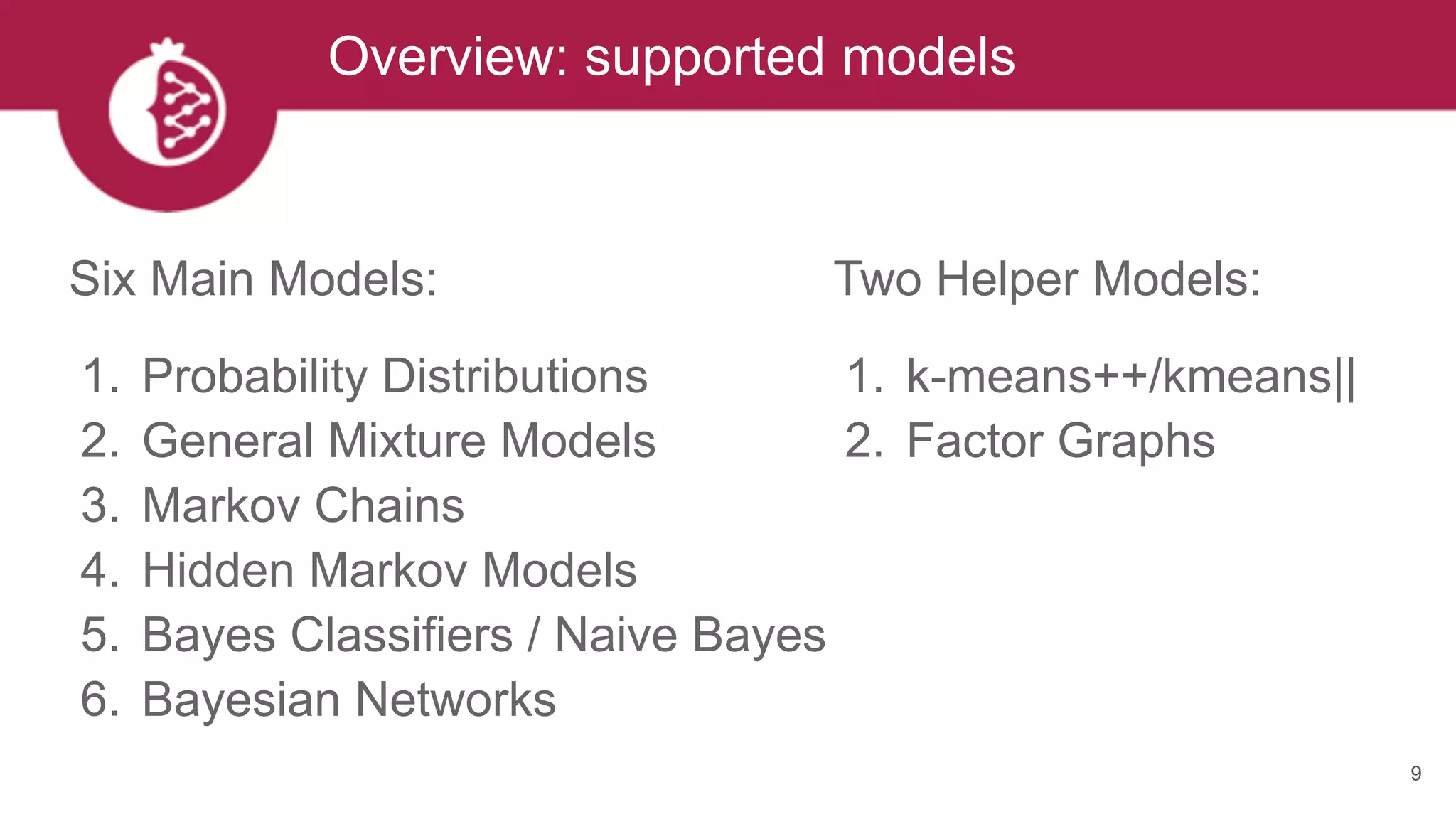
Overview: supported models
Six Main Models:
1. Probability Distributions
2. General Mixture Models
3. Markov Chains
4. Hidden Markov Models
5. Bayes Classifiers / Naive Bayes
6. Bayesian Networks
9
Two Helper Models:
1. k-means++/kmeans||
2. Factor Graphs
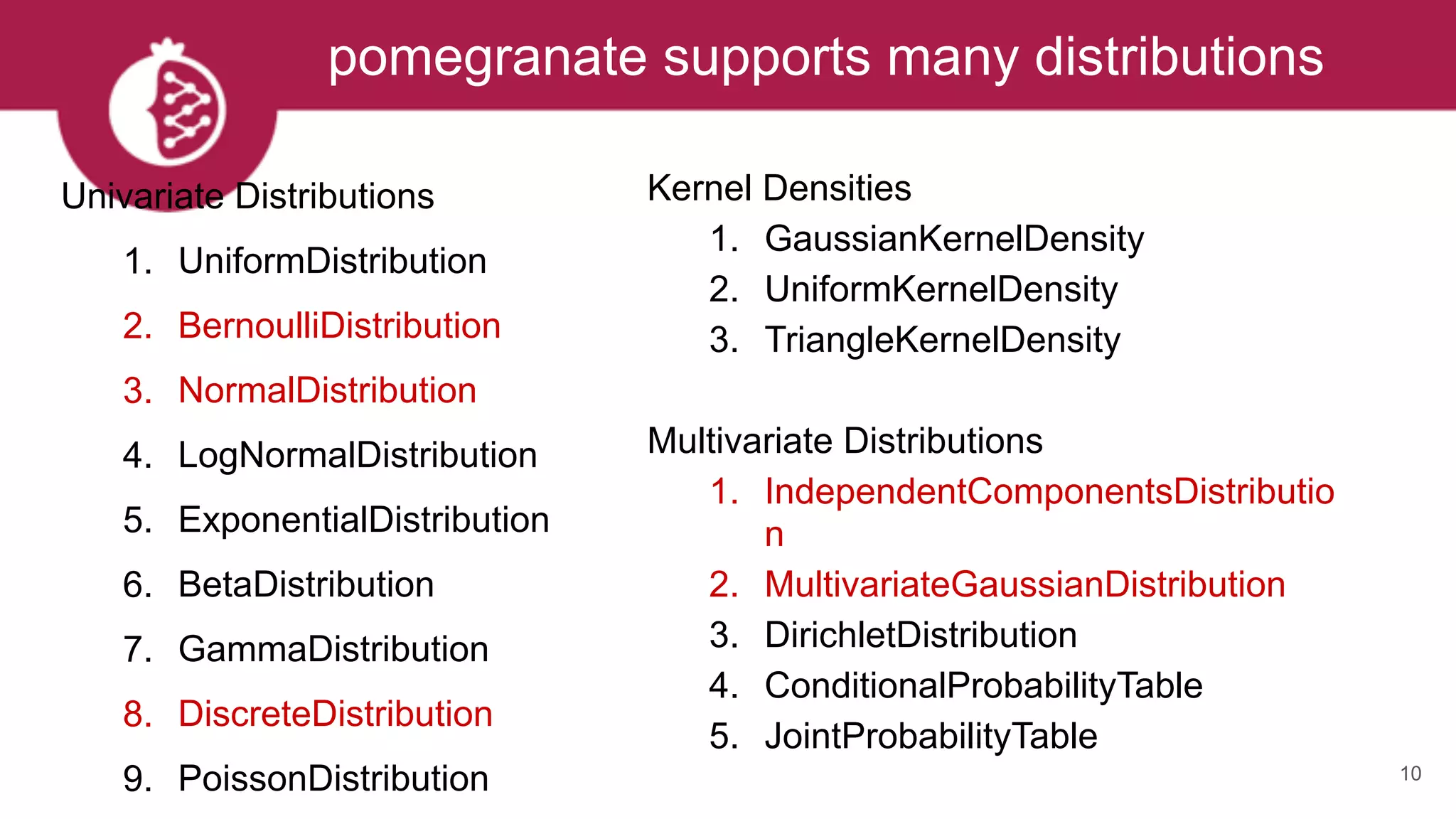
pomegranate supports many distributions
10
Univariate Distributions
1. UniformDistribution
2. BernoulliDistribution
3. NormalDistribution
4. LogNormalDistribution
5. ExponentialDistribution
6. BetaDistribution
7. GammaDistribution
8. DiscreteDistribution
9. PoissonDistribution
Kernel Densities
1. GaussianKernelDensity
2. UniformKernelDensity
3. TriangleKernelDensity
Multivariate Distributions
1. IndependentComponentsDistributio
n
2. MultivariateGaussianDistribution
3. DirichletDistribution
4. ConditionalProbabilityTable
5. JointProbabilityTable
11
mu,	sig	=	0,	2	
a	=	NormalDistribution(mu,	sig)
X	=	[0,	1,	1,	2,	1.5,	6,	7,	8,	7]	
a	=	GaussianKernelDensity(X)
Models can be created from known values
12
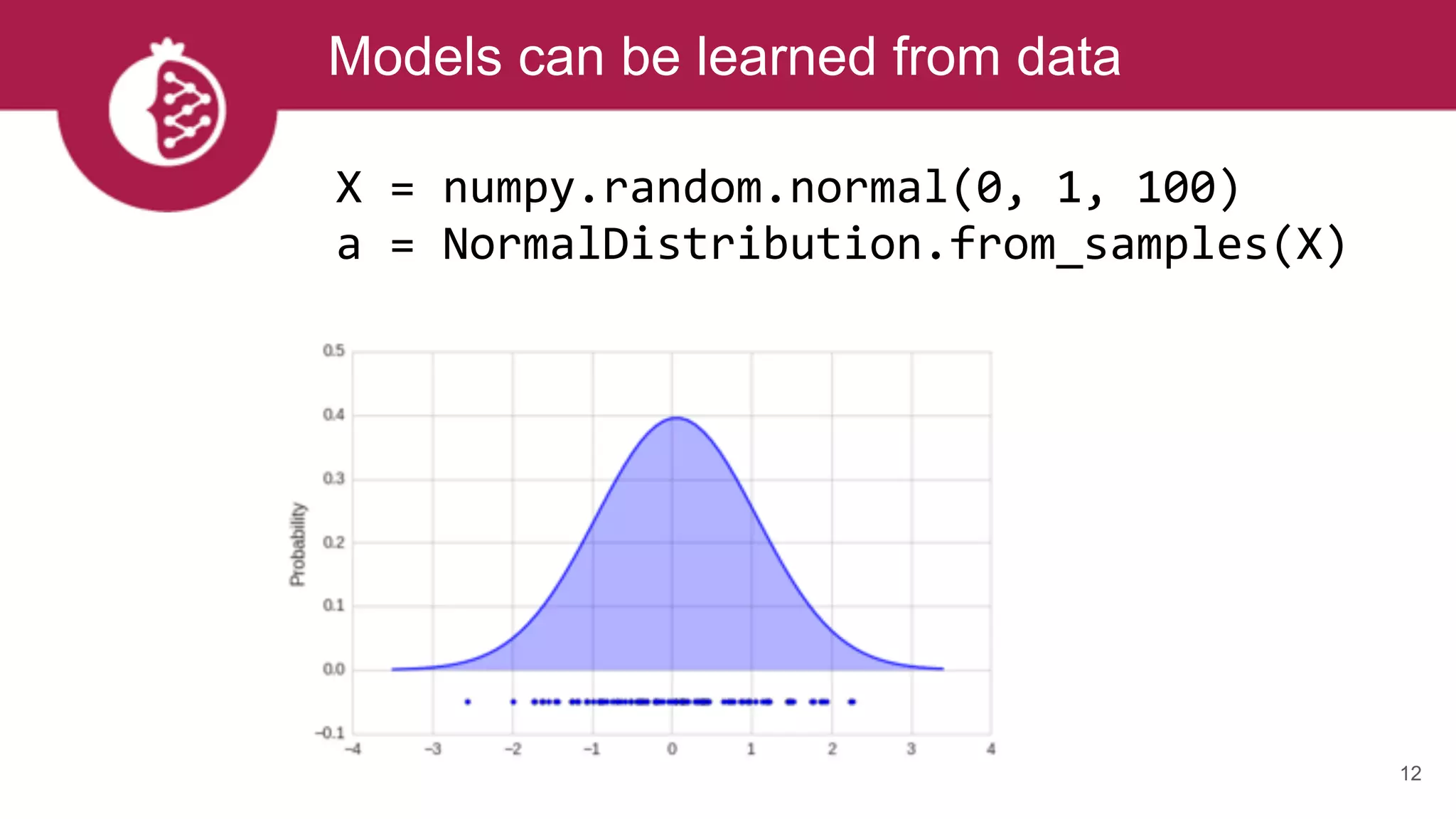
Models can be learned from data
X	=	numpy.random.normal(0,	1,	100)	
a	=	NormalDistribution.from_samples(X)
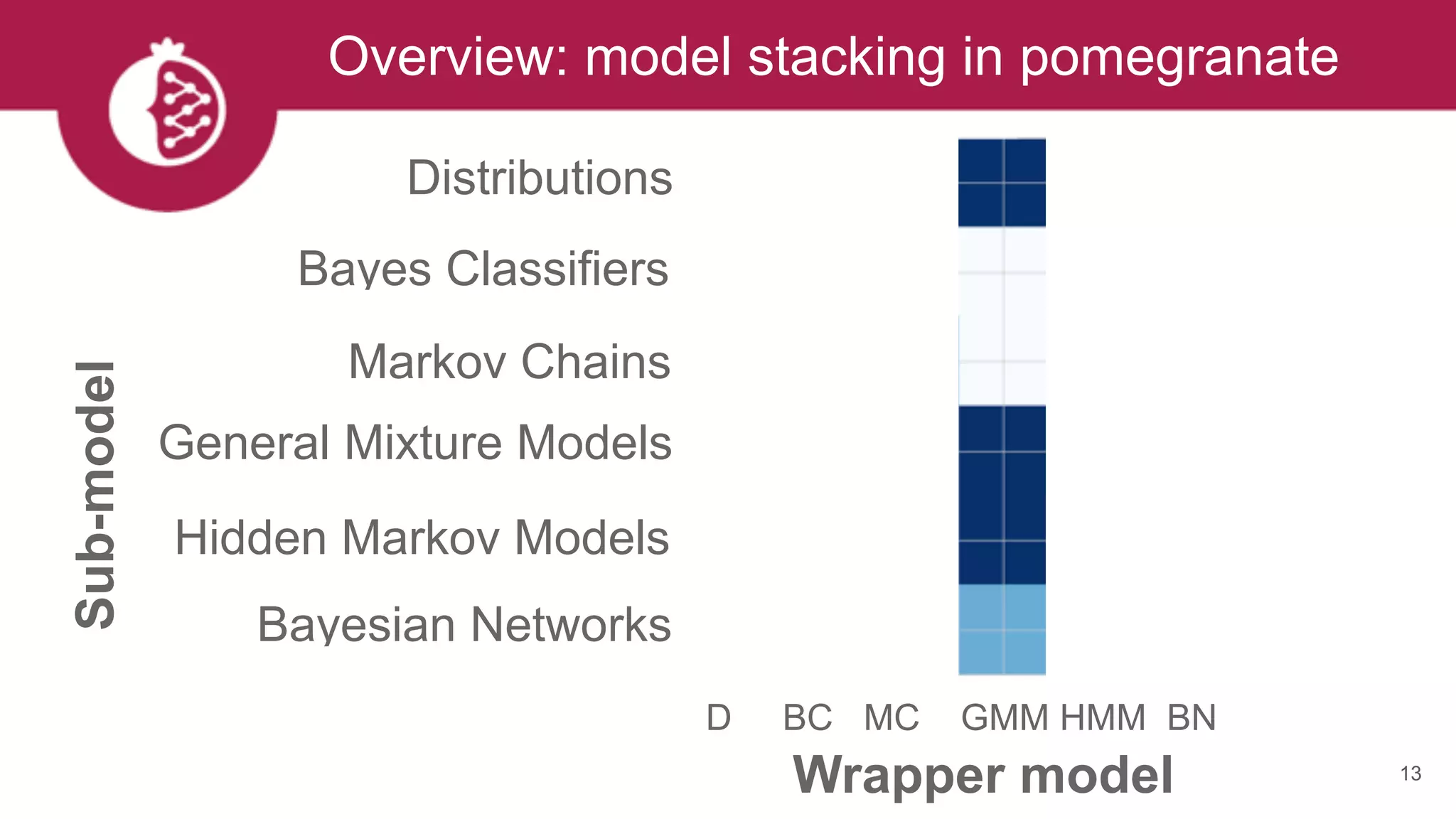
Overview: model stacking in pomegranate
13
Distributions
Bayes Classifiers
Markov Chains
General Mixture Models
Hidden Markov Models
Bayesian Networks
D BC MC GMM HMM BN
Sub-model
Wrapper model
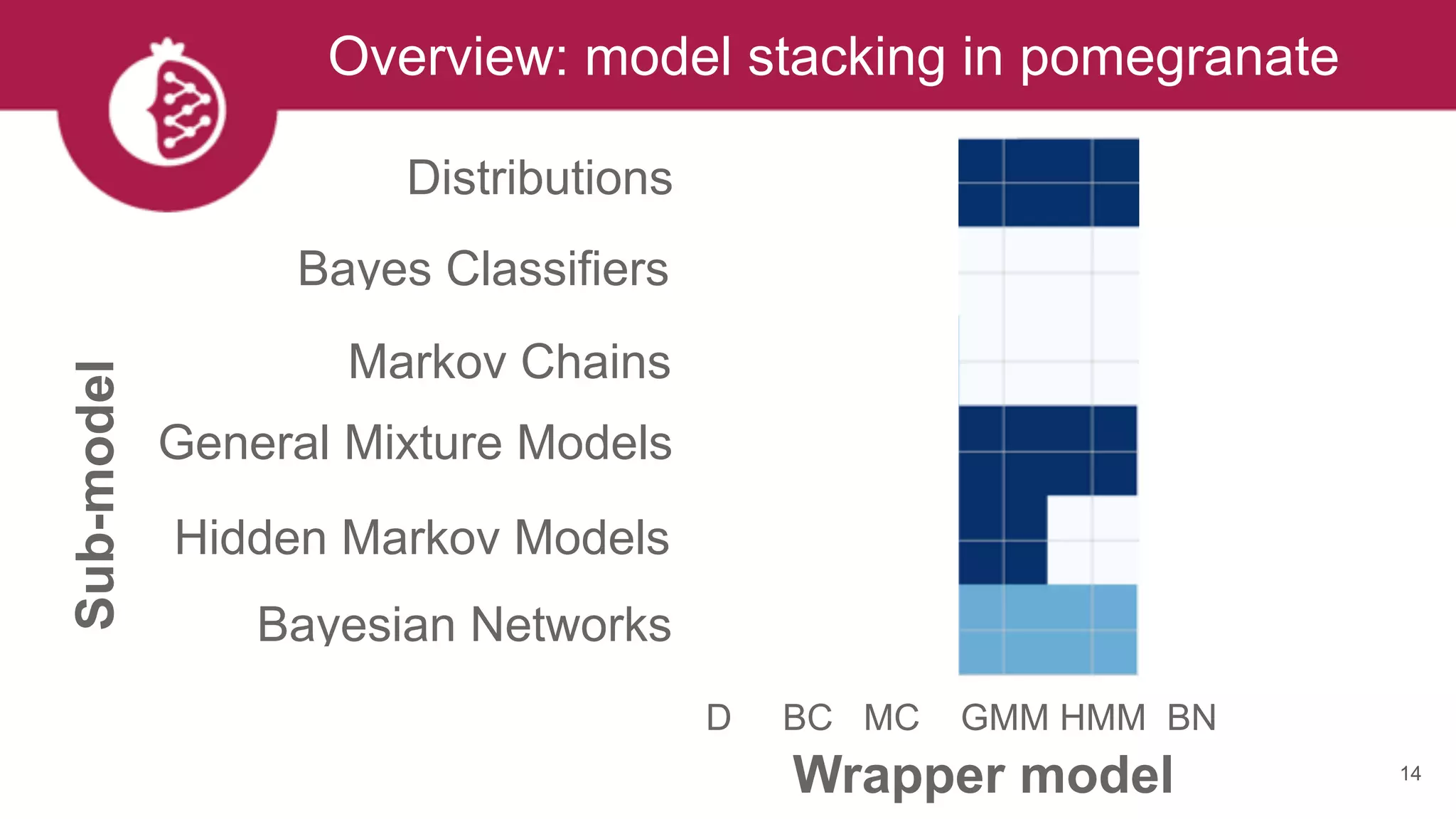
Overview: model stacking in pomegranate
14
Distributions
Bayes Classifiers
Markov Chains
General Mixture Models
Hidden Markov Models
Bayesian Networks
D BC MC GMM HMM BN
Sub-model
Wrapper model
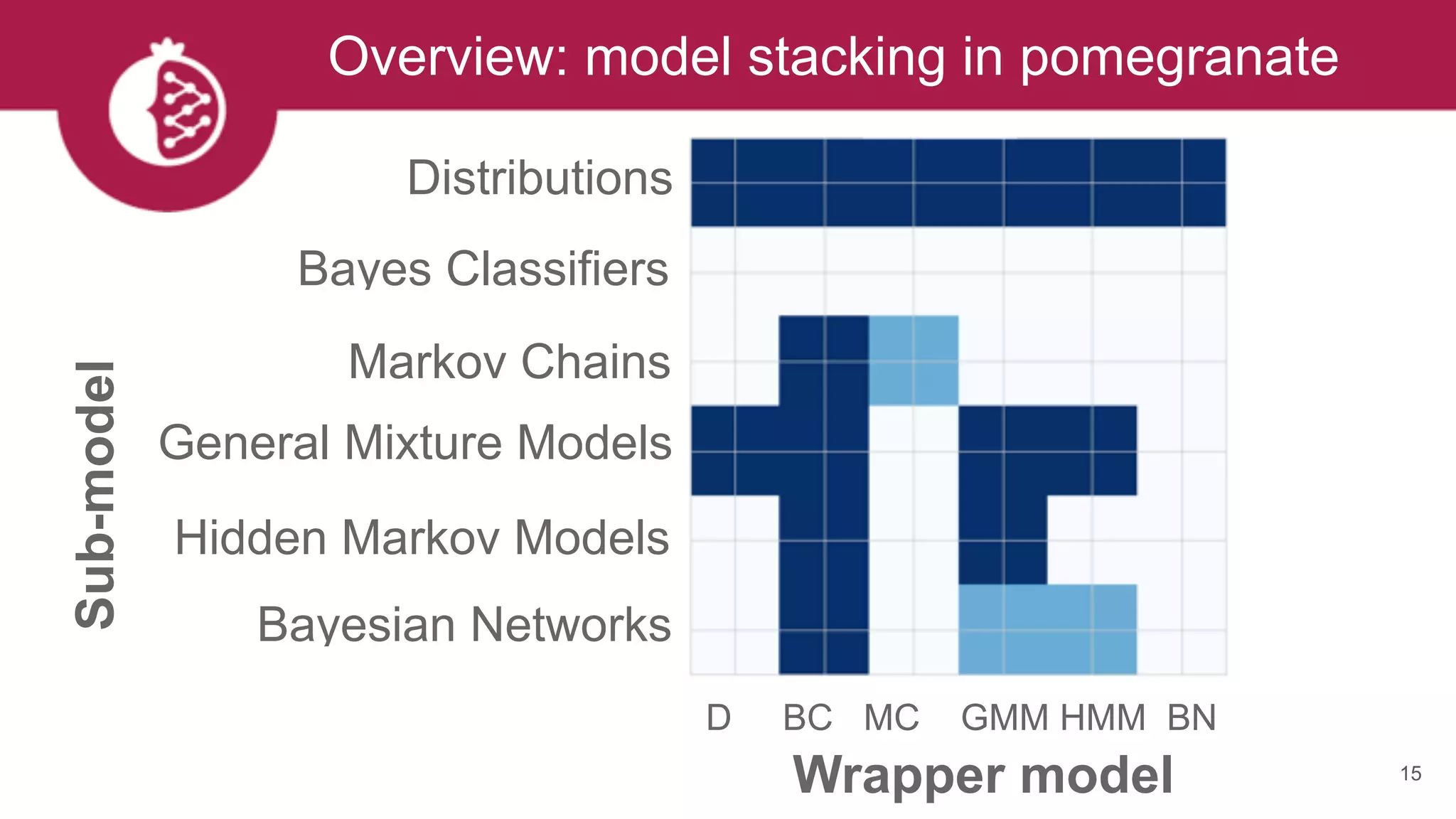
Overview: model stacking in pomegranate
15
Distributions
Bayes Classifiers
Markov Chains
General Mixture Models
Hidden Markov Models
Bayesian Networks
D BC MC GMM HMM BN
Sub-model
Wrapper model
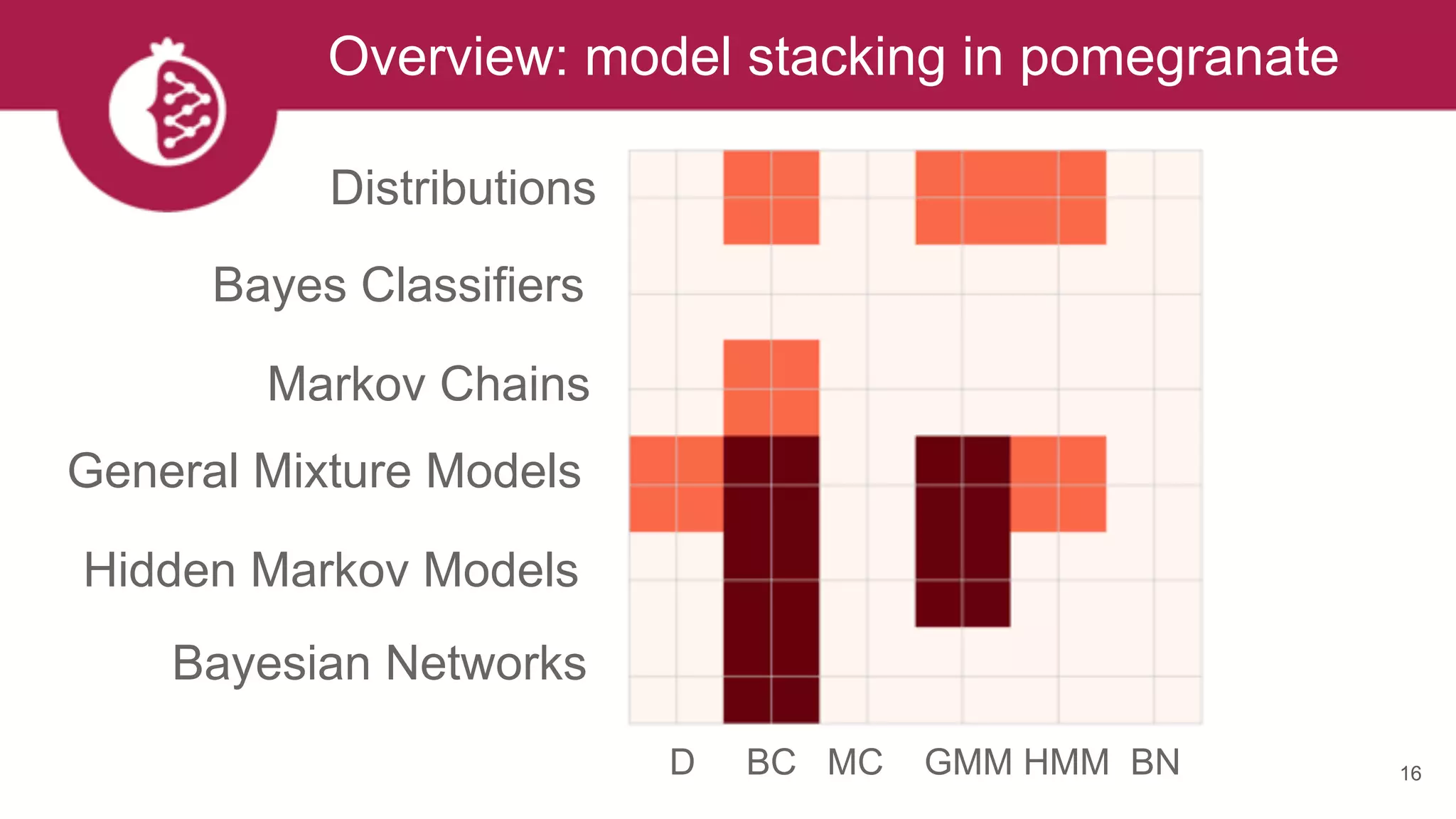
Overview: model stacking in pomegranate
16
Distributions
Bayes Classifiers
Markov Chains
General Mixture Models
Hidden Markov Models
Bayesian Networks
D BC MC GMM HMM BN
17
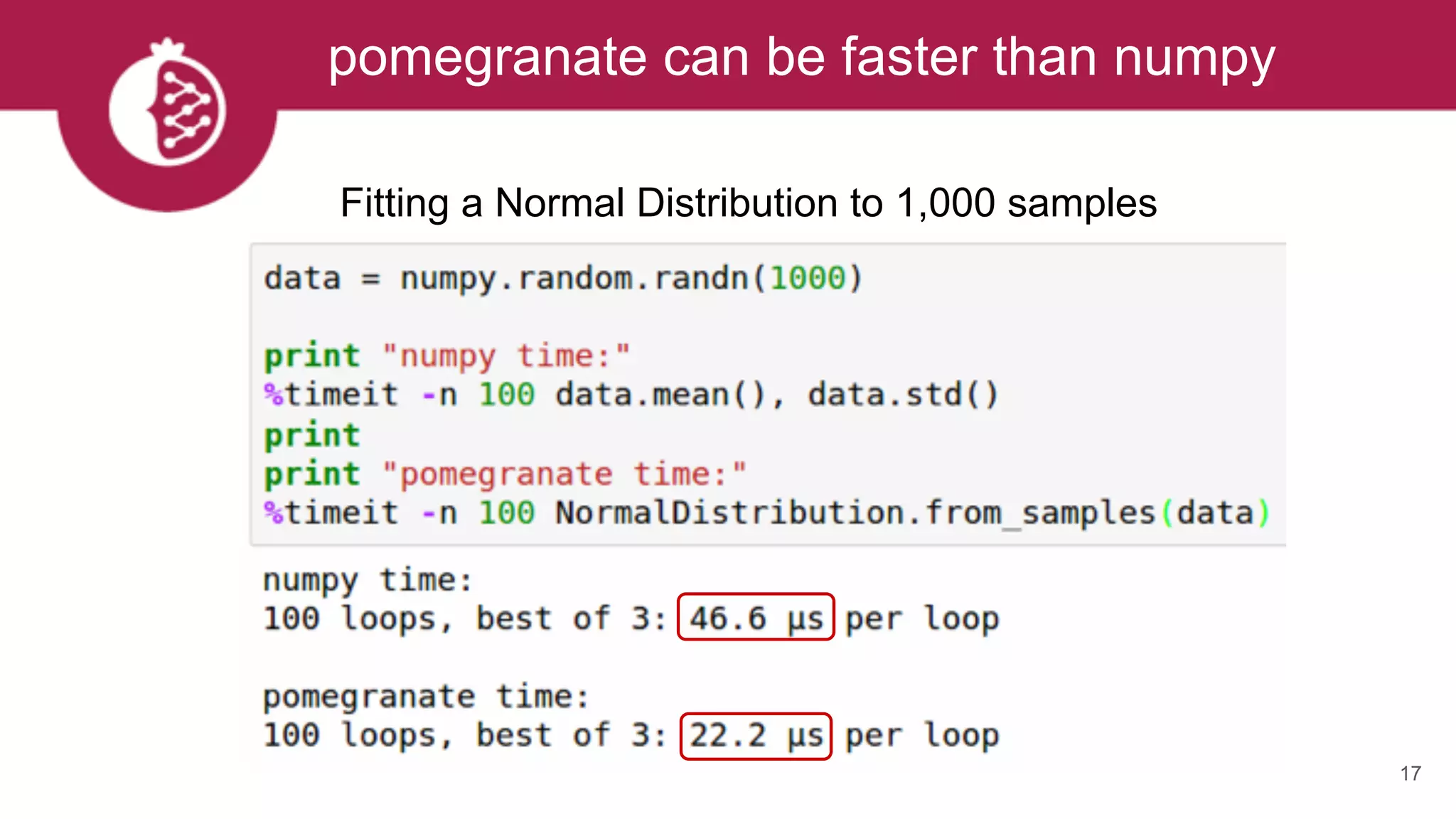
pomegranate can be faster than numpy
Fitting a Normal Distribution to 1,000 samples
18
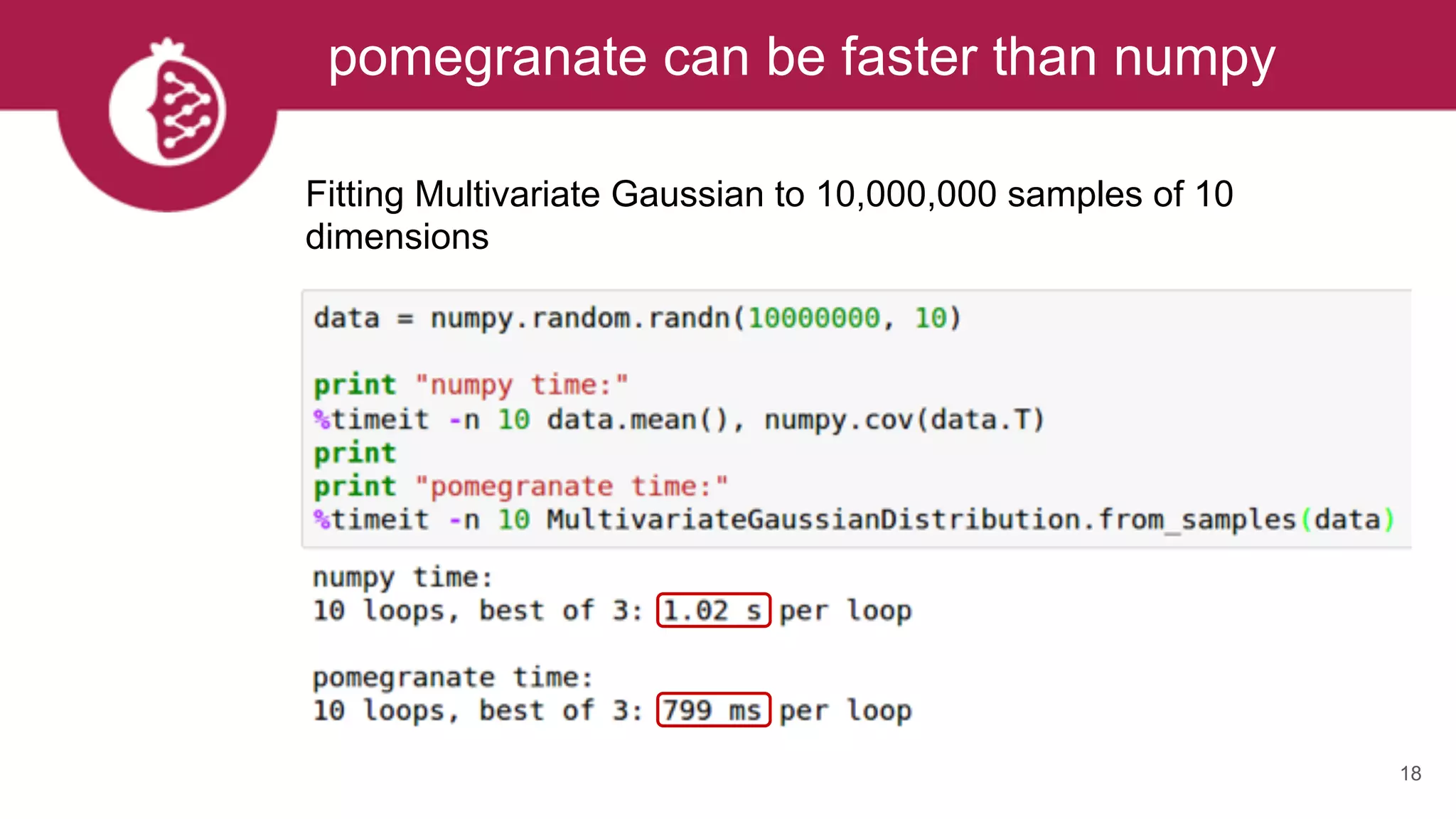
pomegranate can be faster than numpy
Fitting Multivariate Gaussian to 10,000,000 samples of 10
dimensions
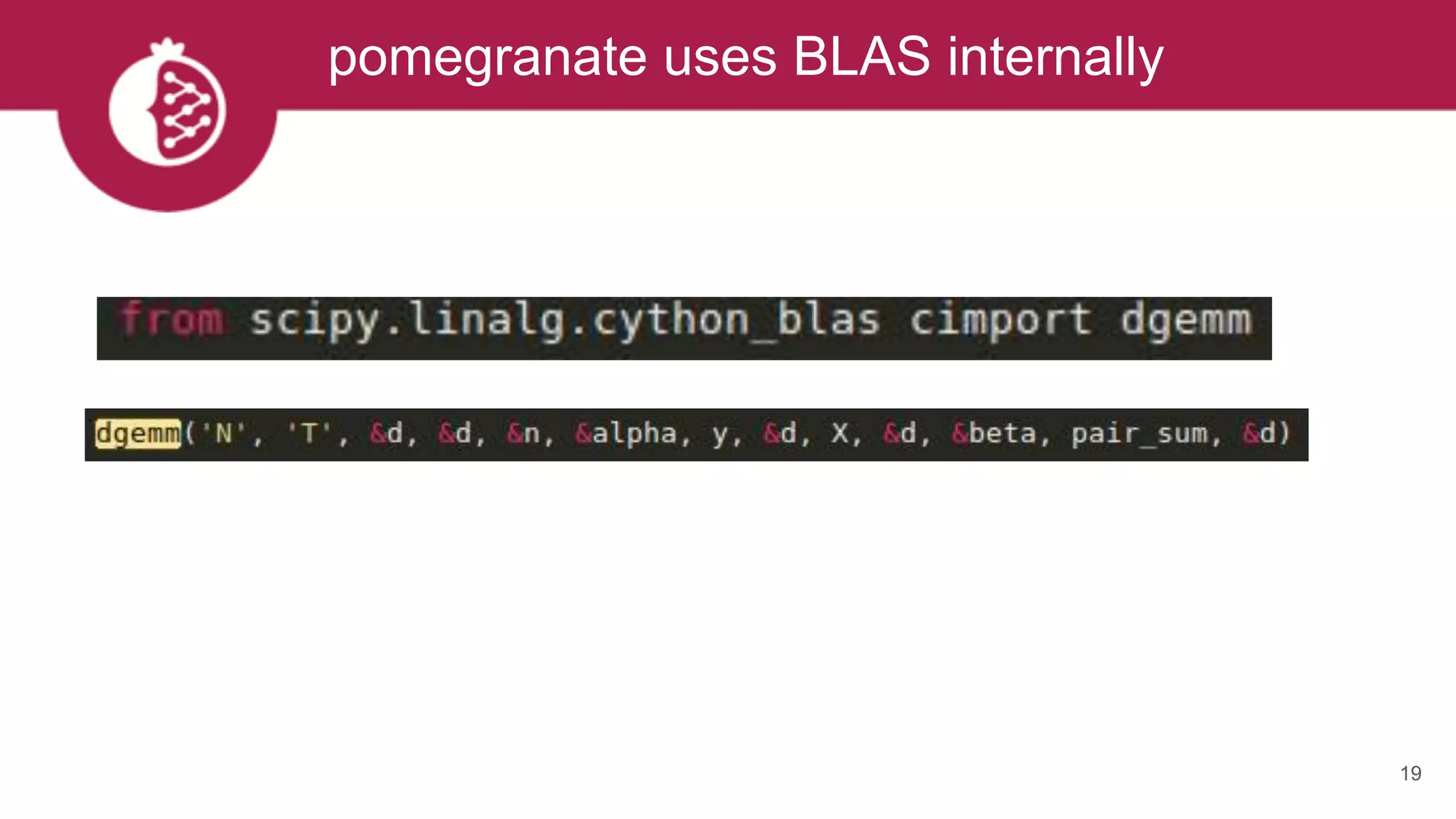
19
pomegranate uses BLAS internally
20
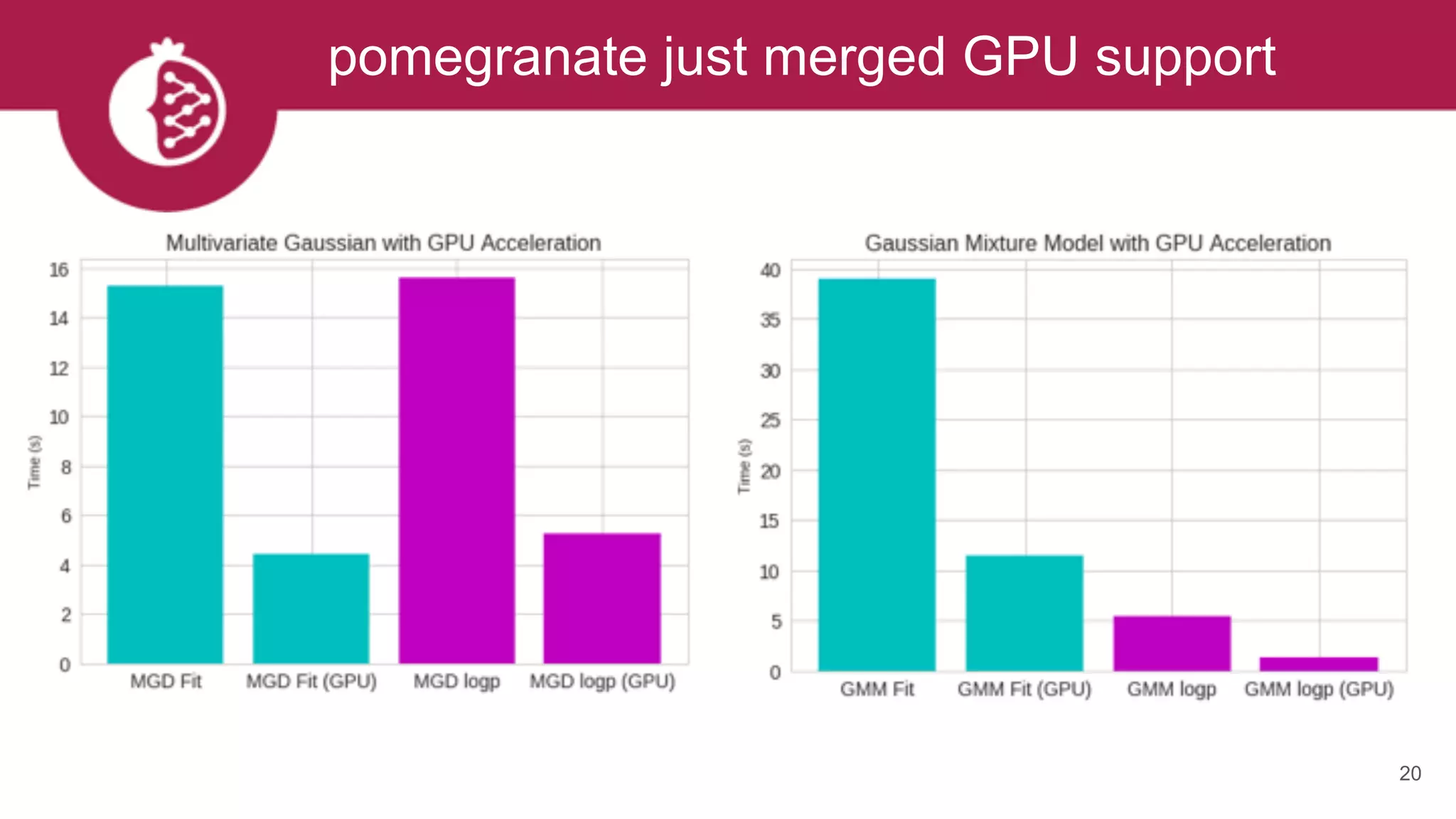
pomegranate just merged GPU support
21
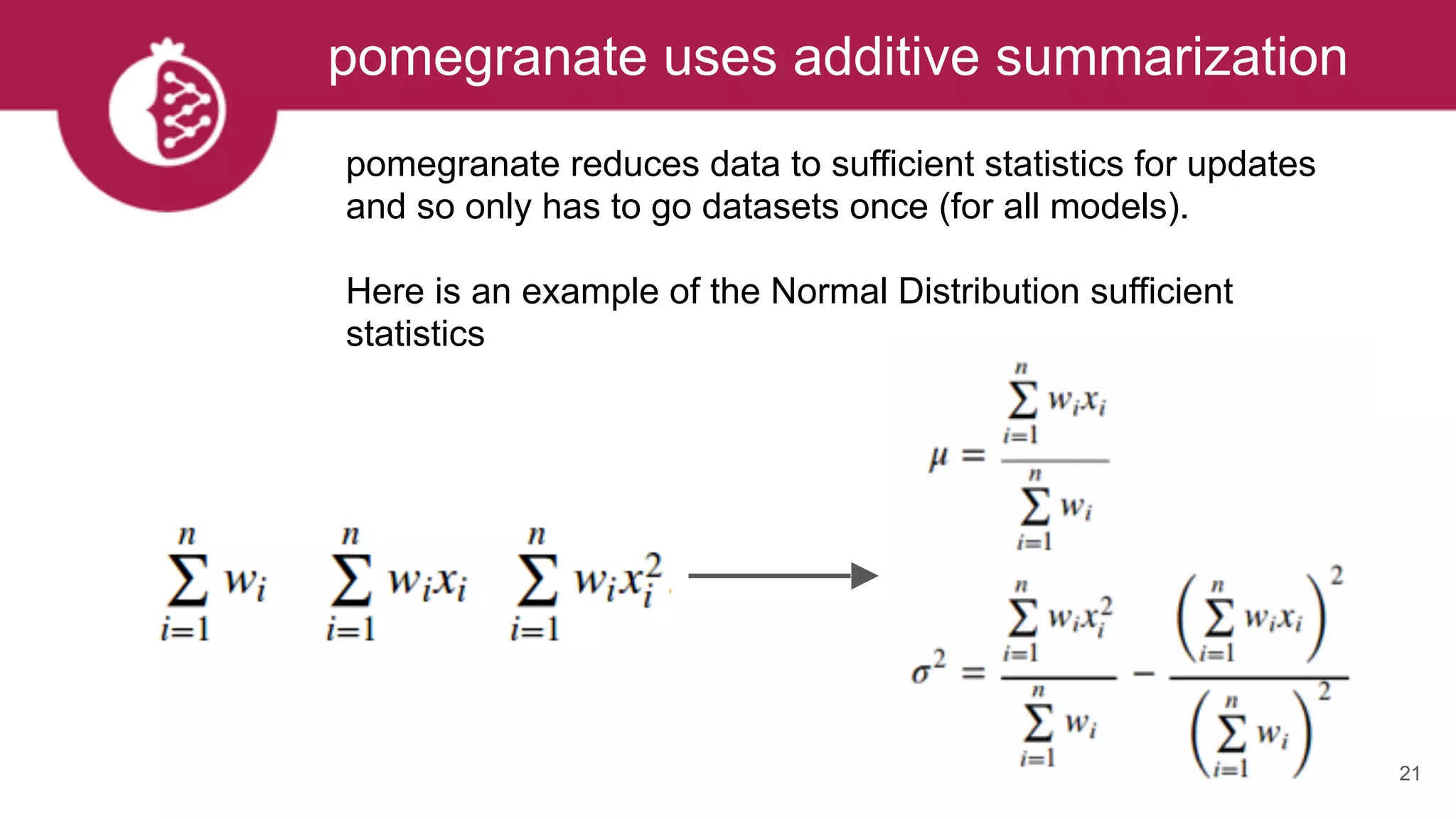
pomegranate uses additive summarization
pomegranate reduces data to sufficient statistics for updates
and so only has to go datasets once (for all models).
Here is an example of the Normal Distribution sufficient
statistics
22
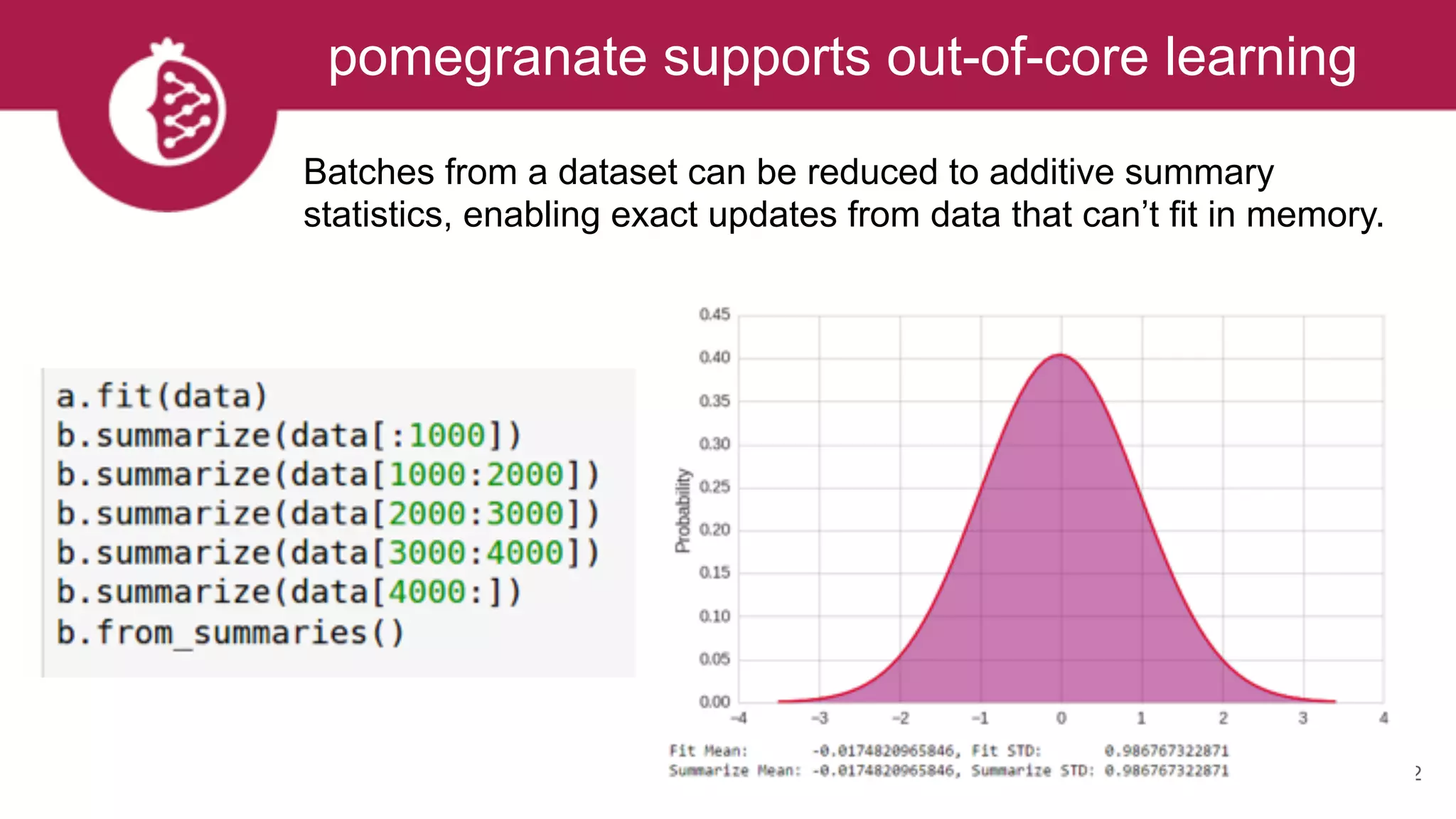
pomegranate supports out-of-core learning
Batches from a dataset can be reduced to additive summary
statistics, enabling exact updates from data that can’t fit in memory.
23
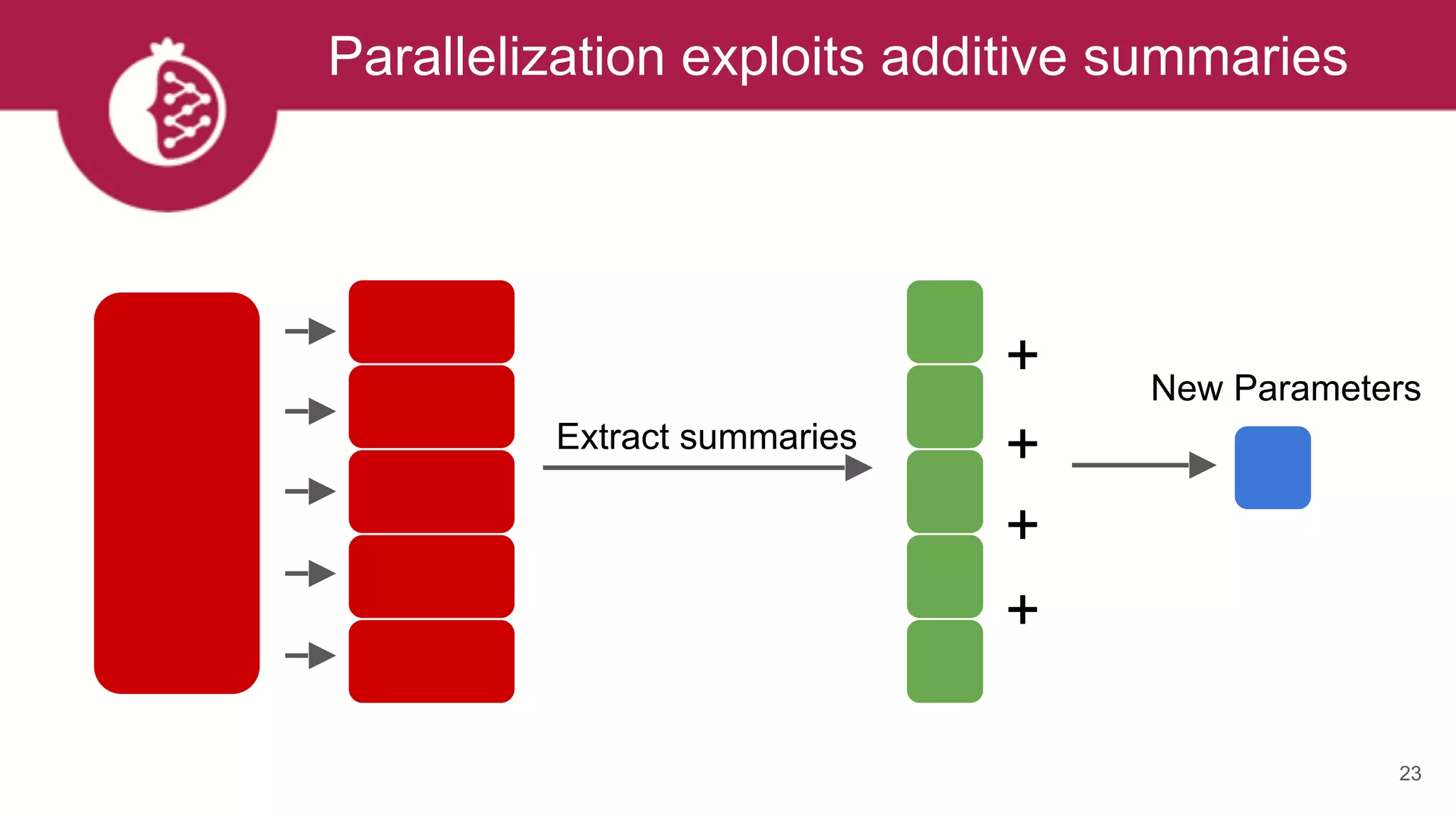
Parallelization exploits additive summaries
Extract summaries
+
+
+
+
New Parameters
24
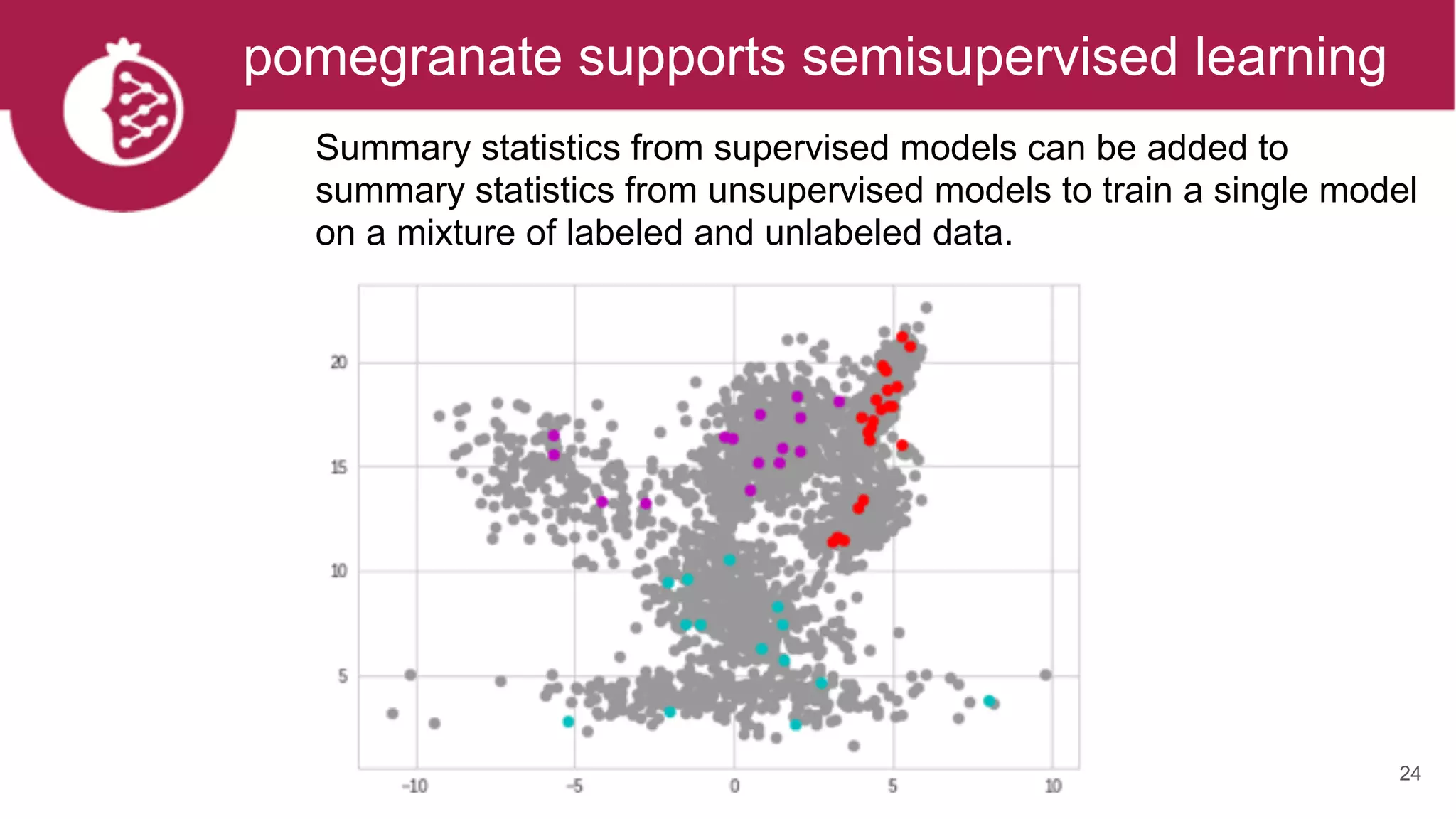
pomegranate supports semisupervised learning
Summary statistics from supervised models can be added to
summary statistics from unsupervised models to train a single model
on a mixture of labeled and unlabeled data.
25
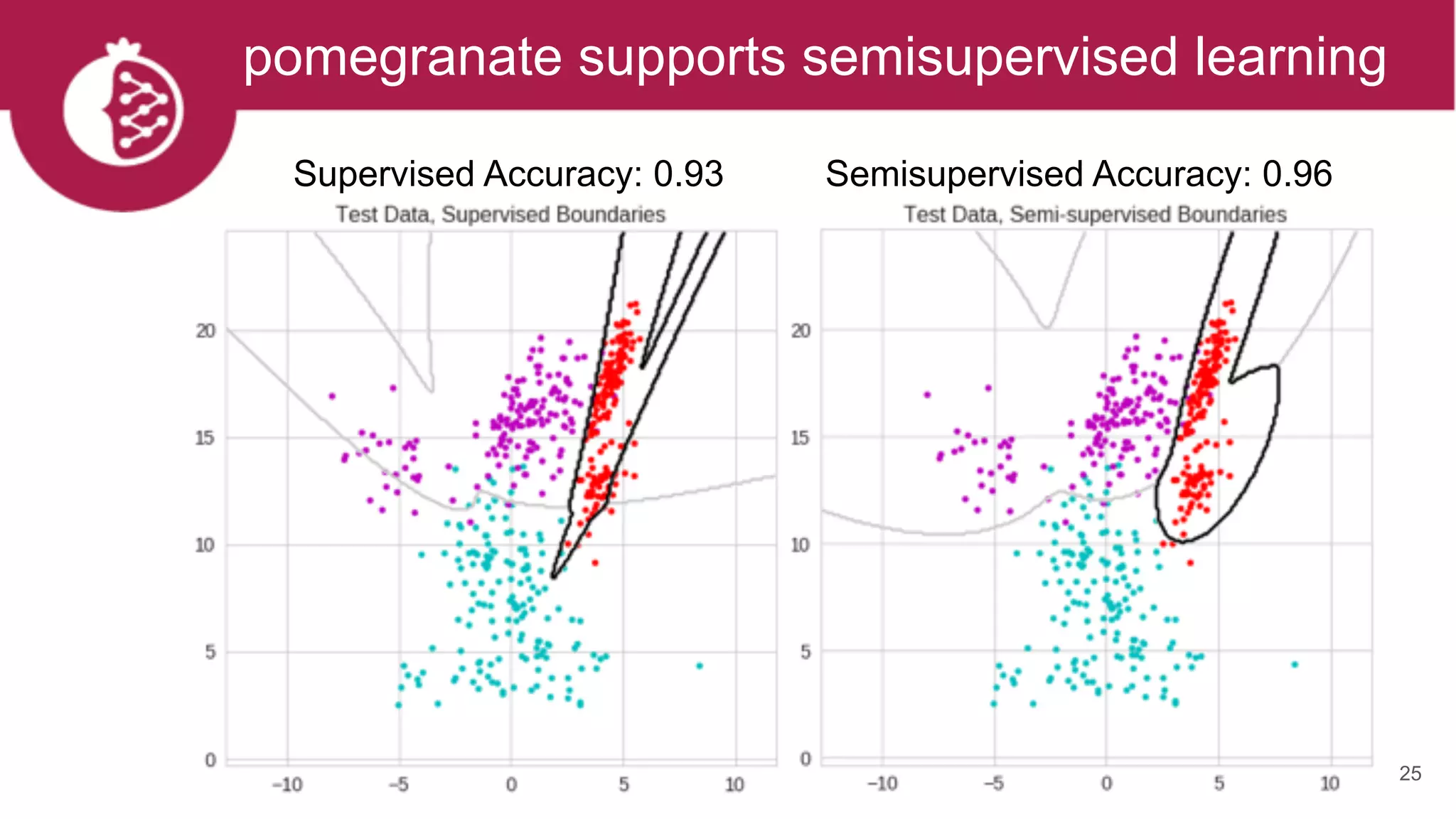
pomegranate supports semisupervised learning
Supervised Accuracy: 0.93 Semisupervised Accuracy: 0.96
26
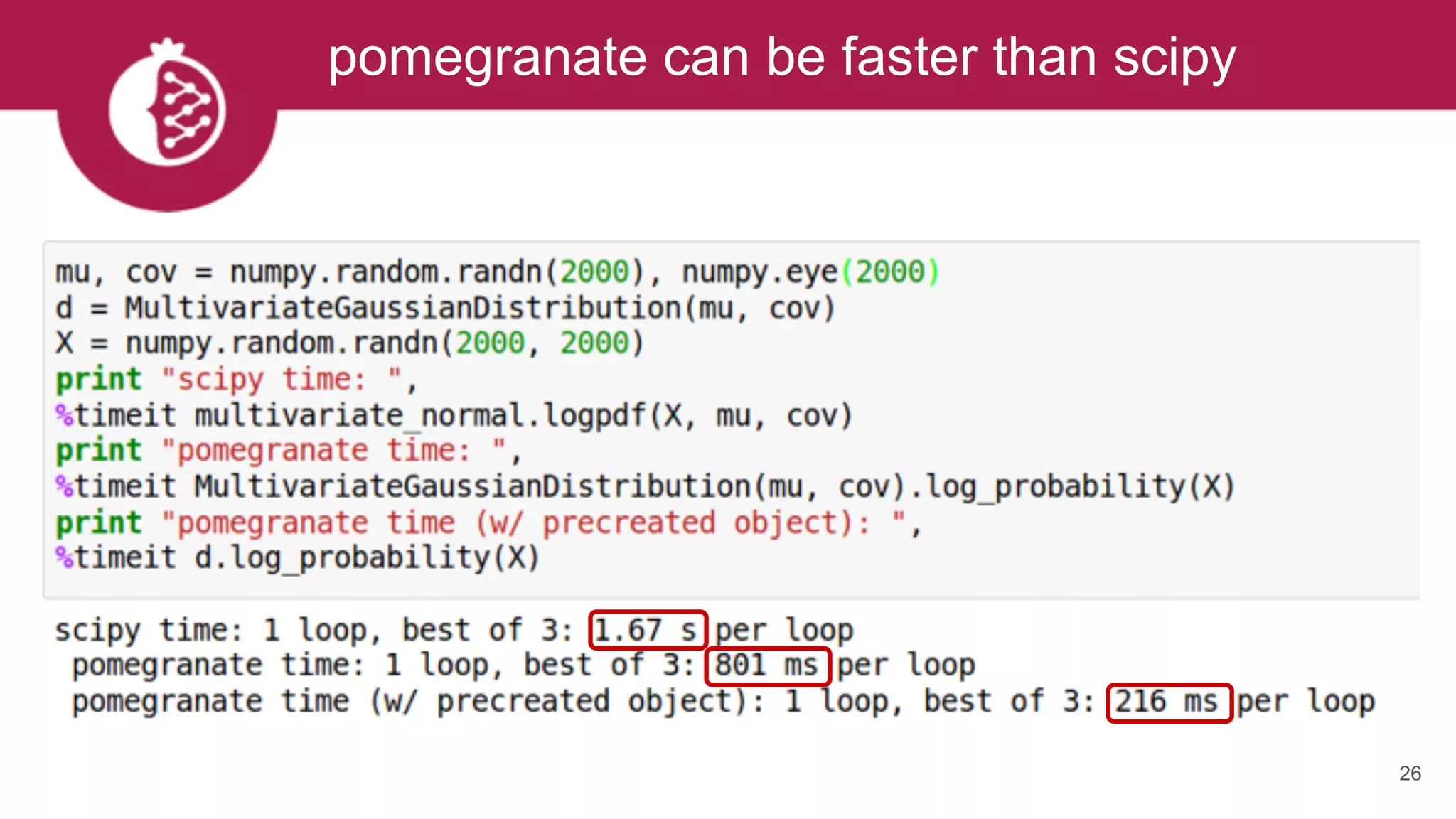
pomegranate can be faster than scipy
27
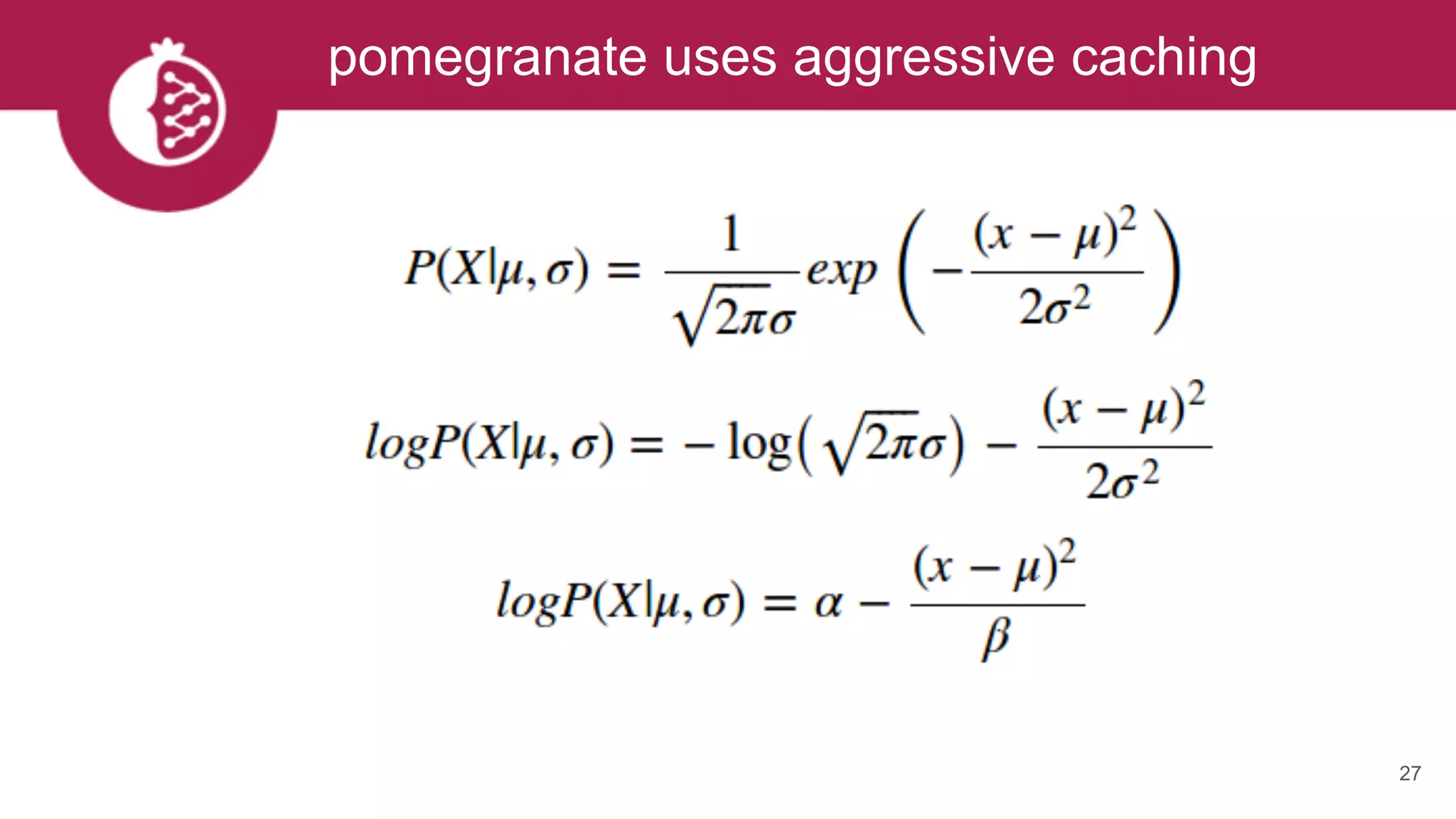
pomegranate uses aggressive caching
29
30
Example ‘blast’ from Gossip Girl
Spotted: Lonely Boy. Can't believe the love of his life has
returned. If only she knew who he was. But everyone knows
Serena. And everyone is talking. Wonder what Blair Waldorf
thinks. Sure, they're BFF's, but we always thought Blair's
boyfriend Nate had a thing for Serena.
31
How do we encode these ‘blasts’?
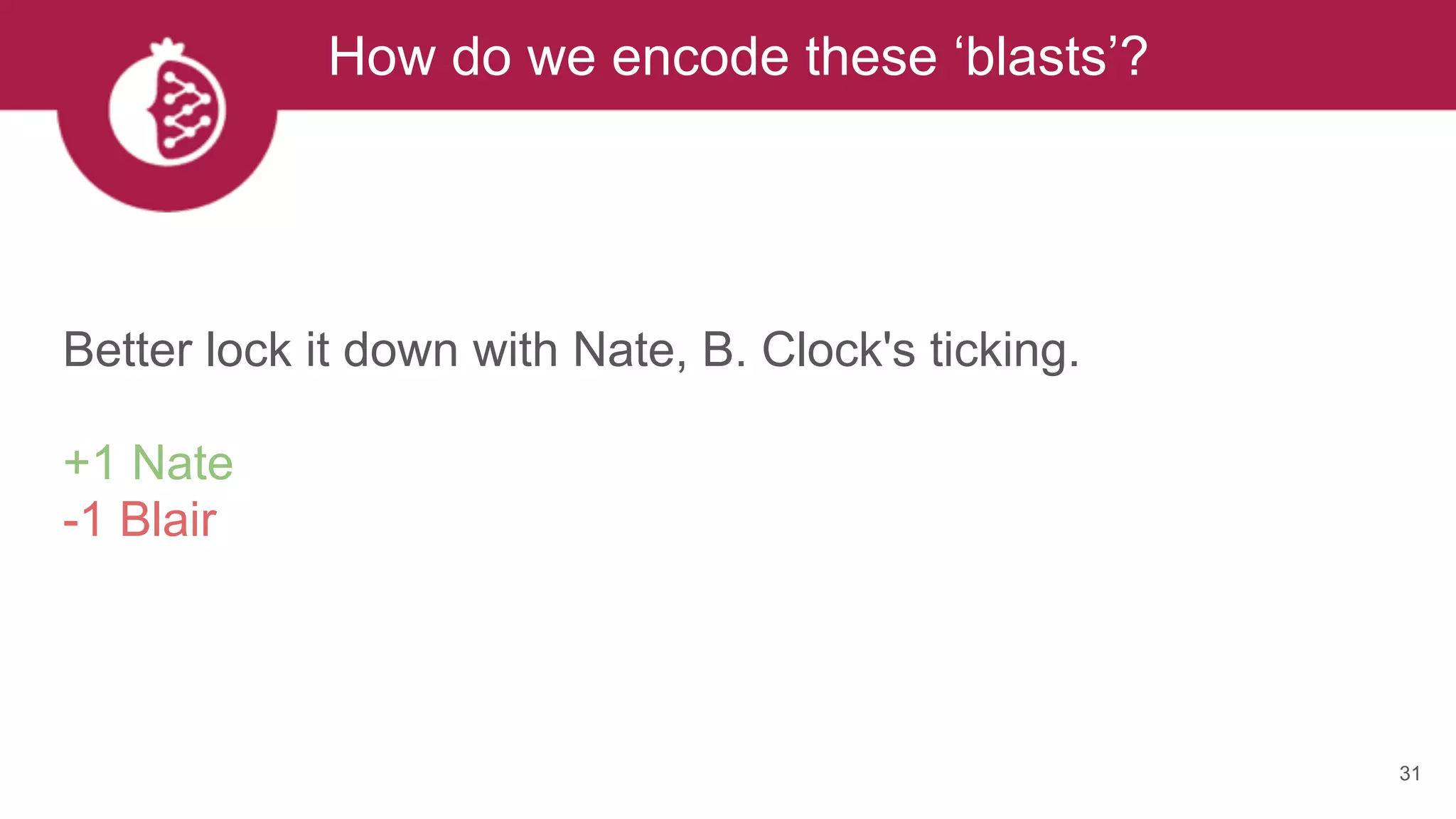
Better lock it down with Nate, B. Clock's ticking.
+1 Nate
-1 Blair
32
How do we encode these ‘blasts’?
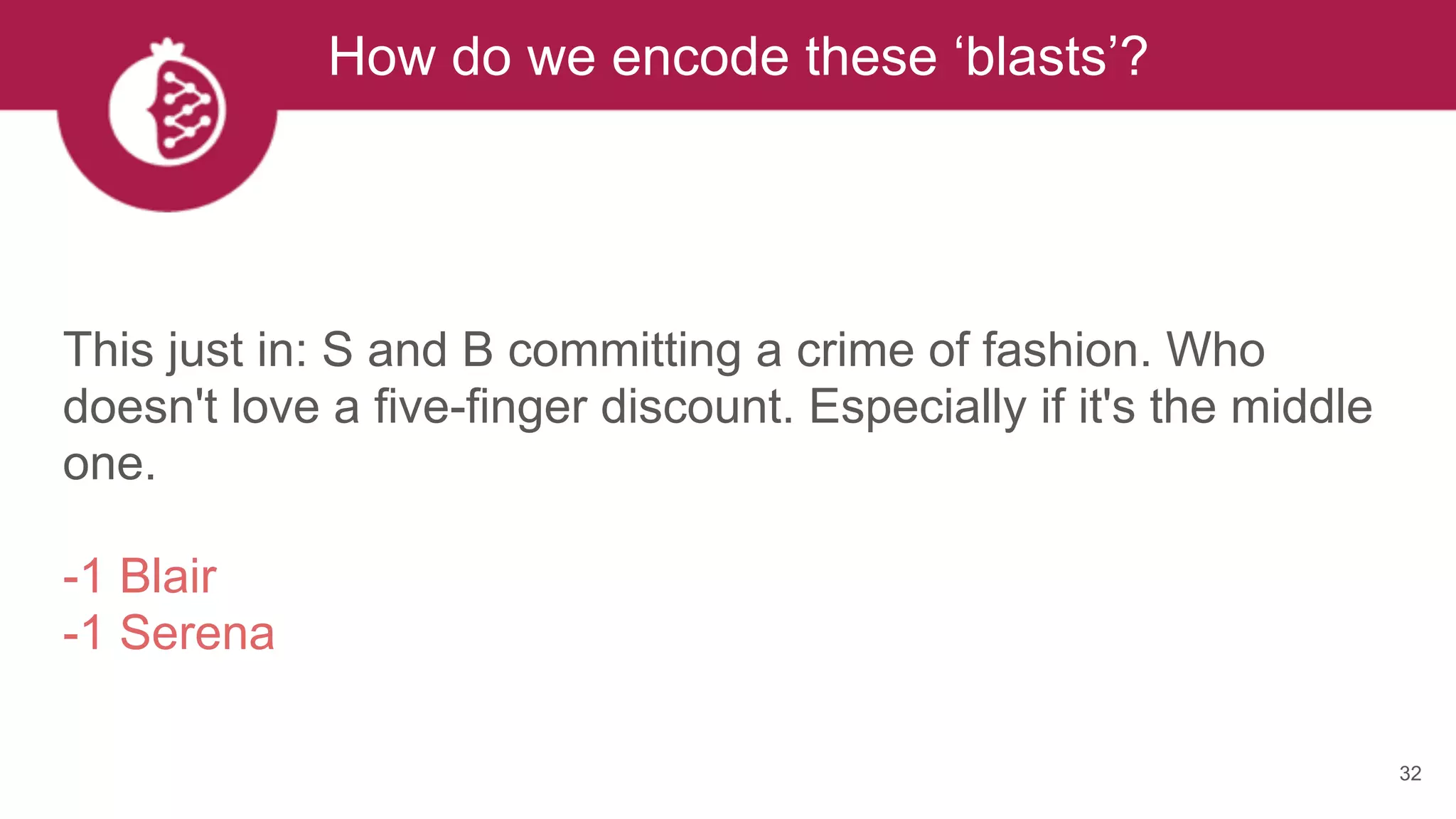
This just in: S and B committing a crime of fashion. Who
doesn't love a five-finger discount. Especially if it's the middle
one.
-1 Blair
-1 Serena
33
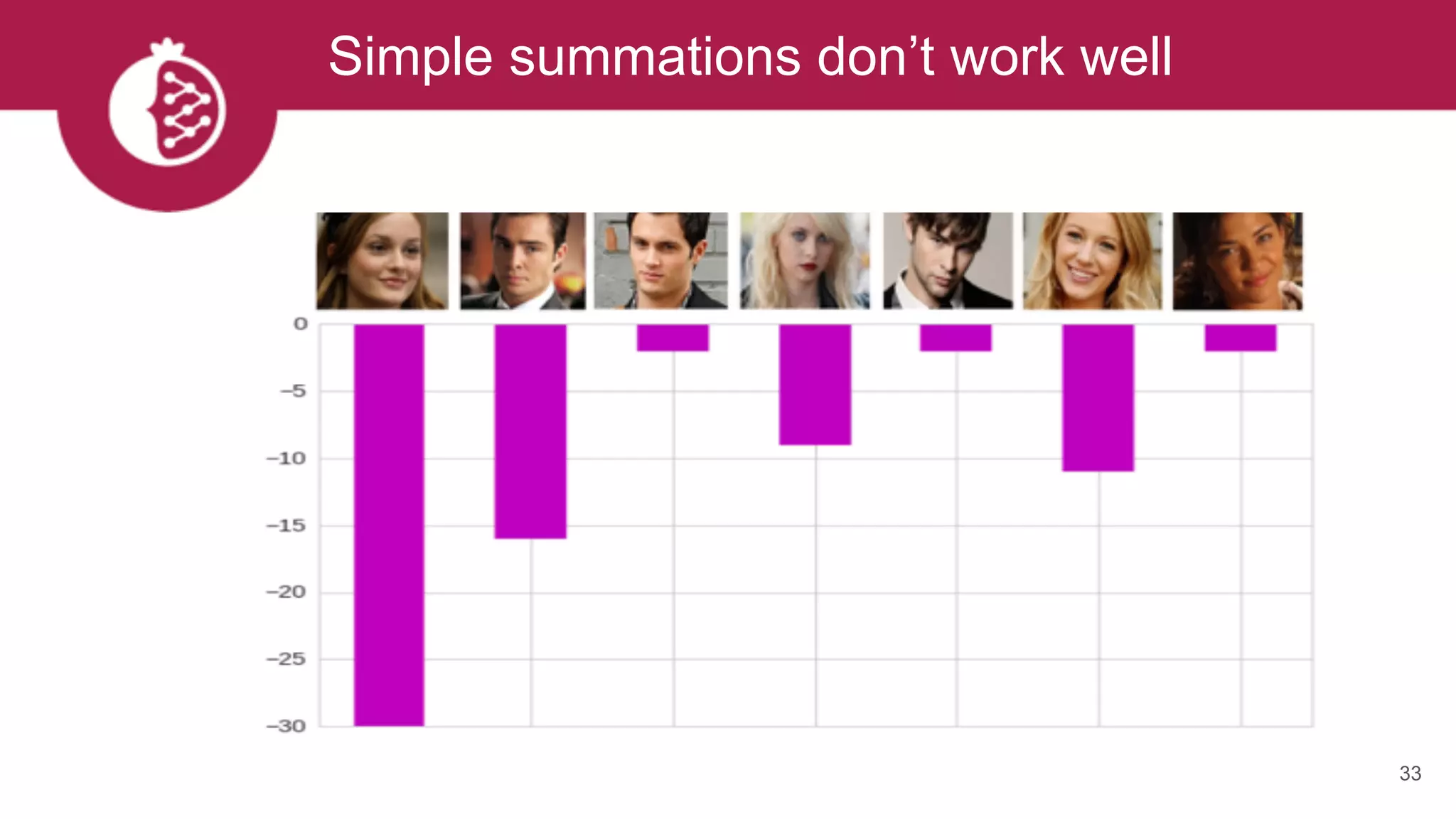
Simple summations don’t work well
34
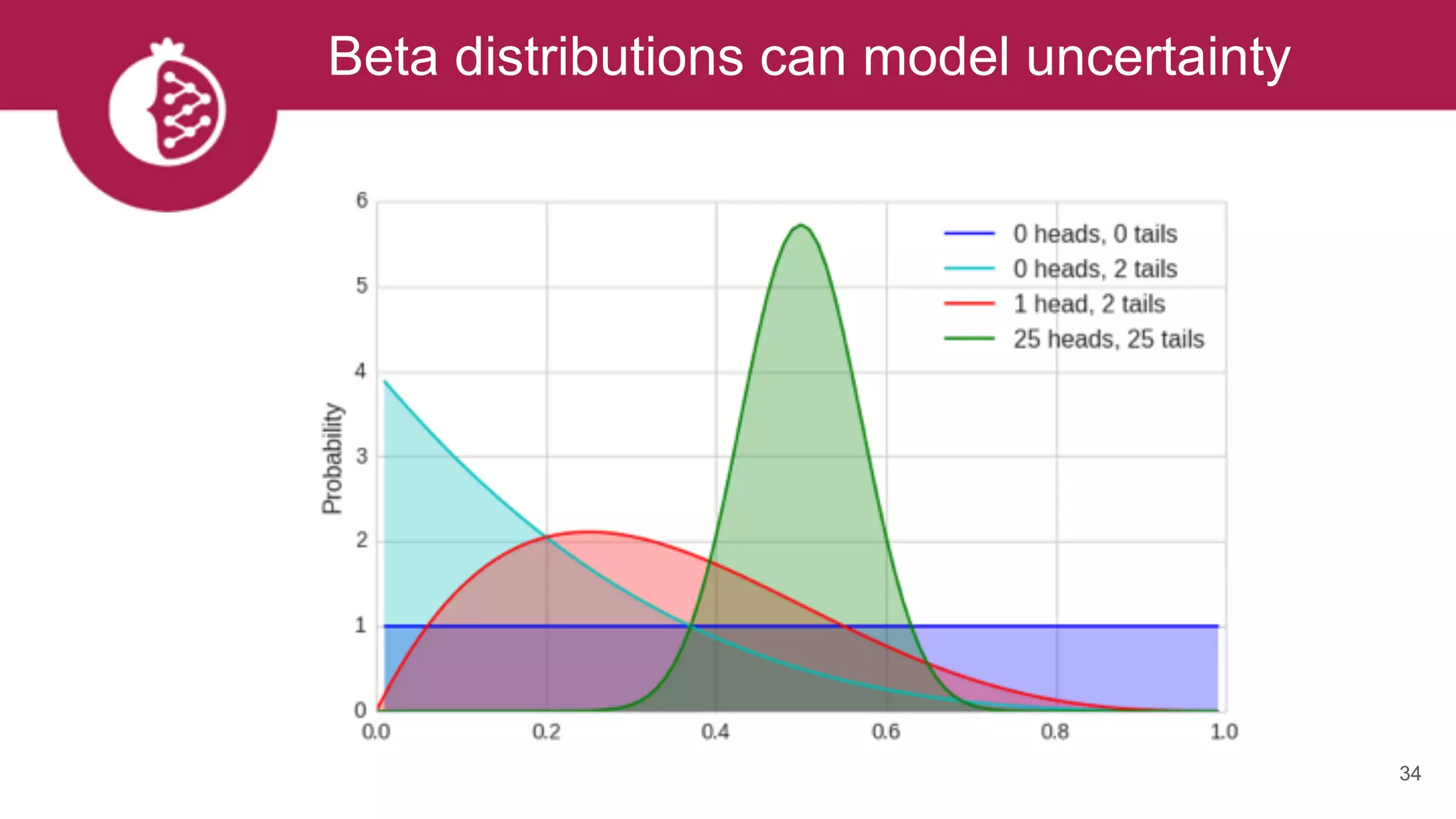
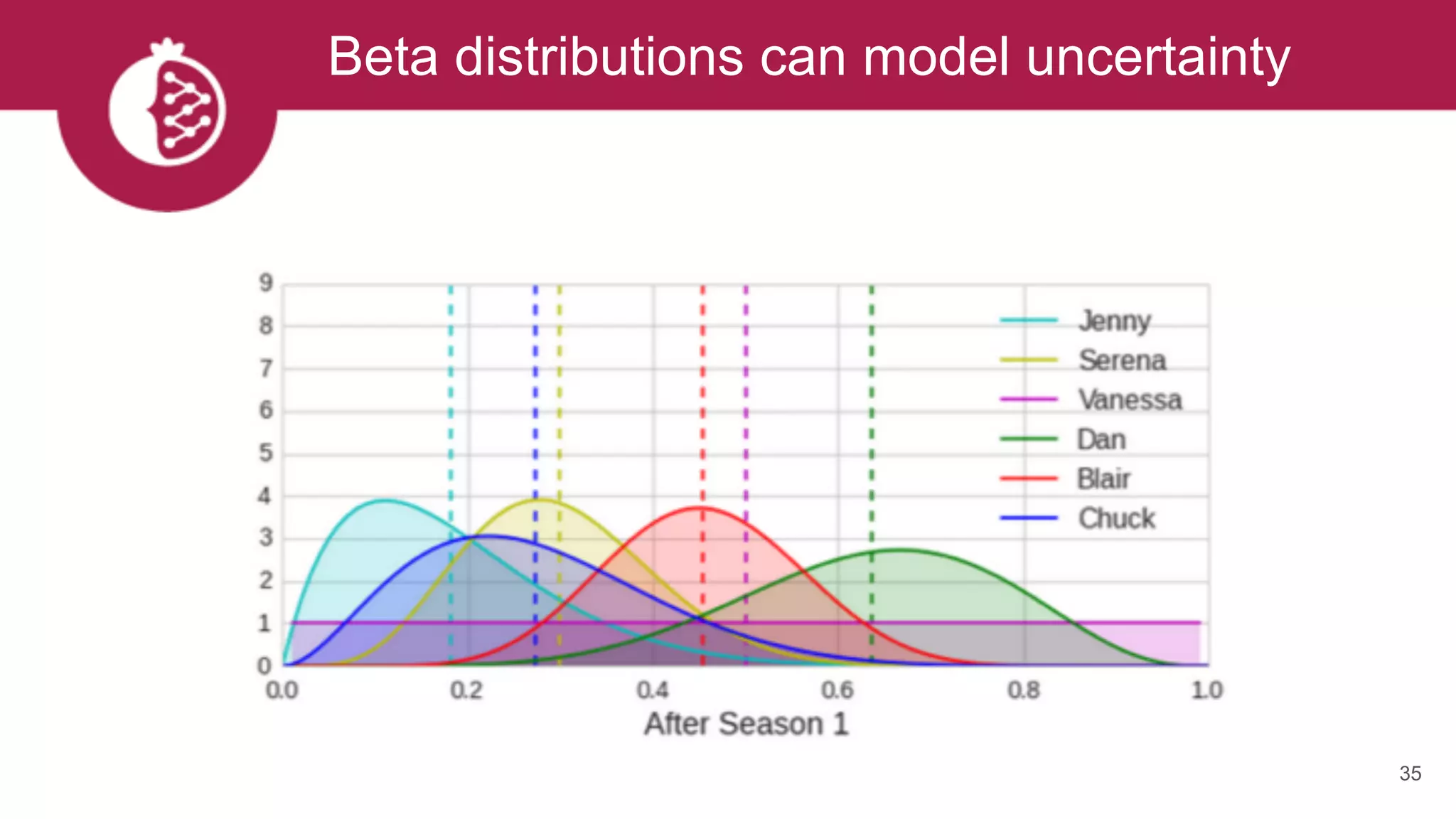
Beta distributions can model uncertainty
35
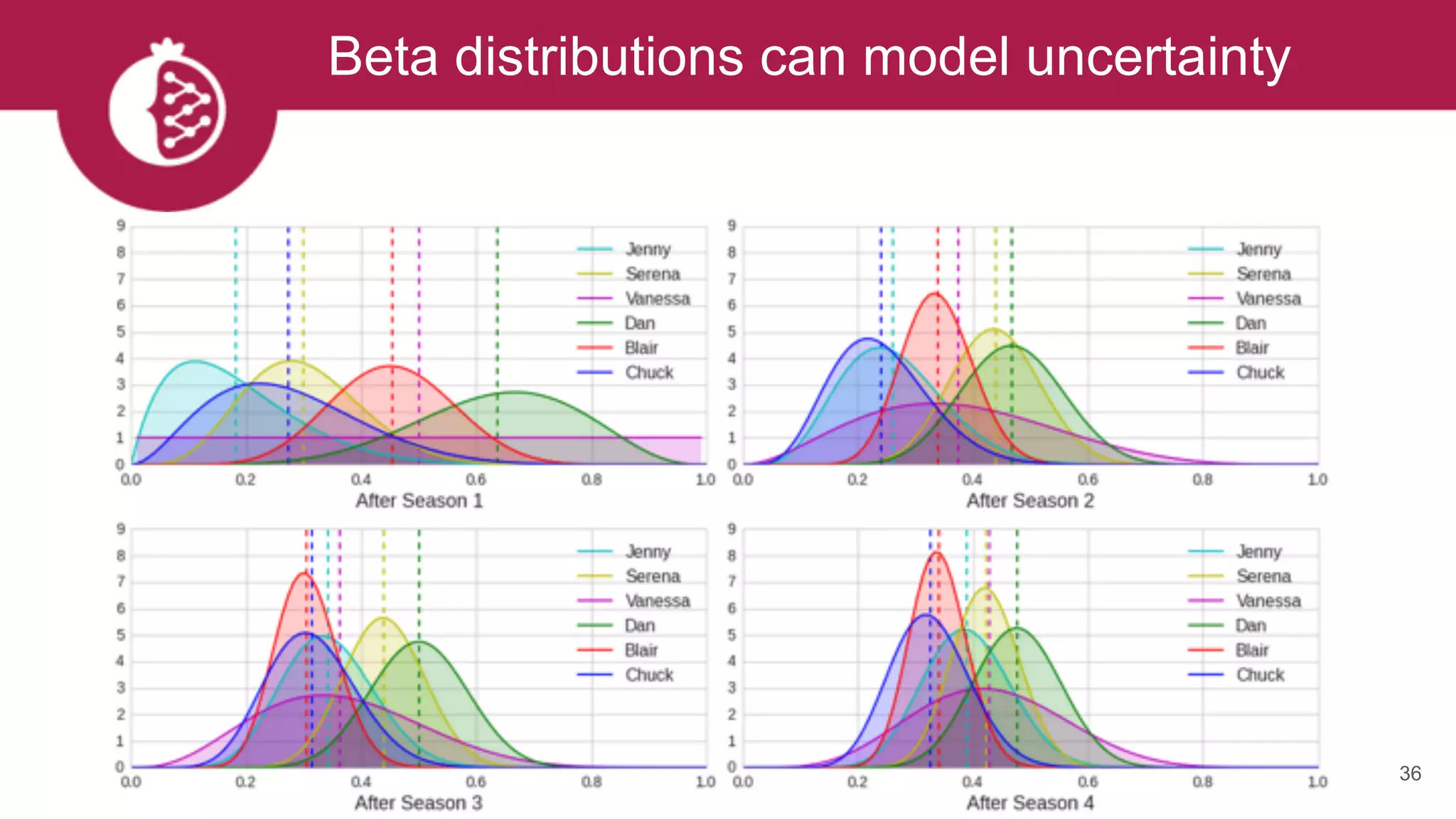
Beta distributions can model uncertainty
36
Beta distributions can model uncertainty
Overview: this talk
37
Overview
Major Models/Model Stacks
1. General Mixture Models
2. Hidden Markov Models
3. Bayesian Networks
4. Bayes Classifiers
Finale: Train a mixture of HMMs in parallel
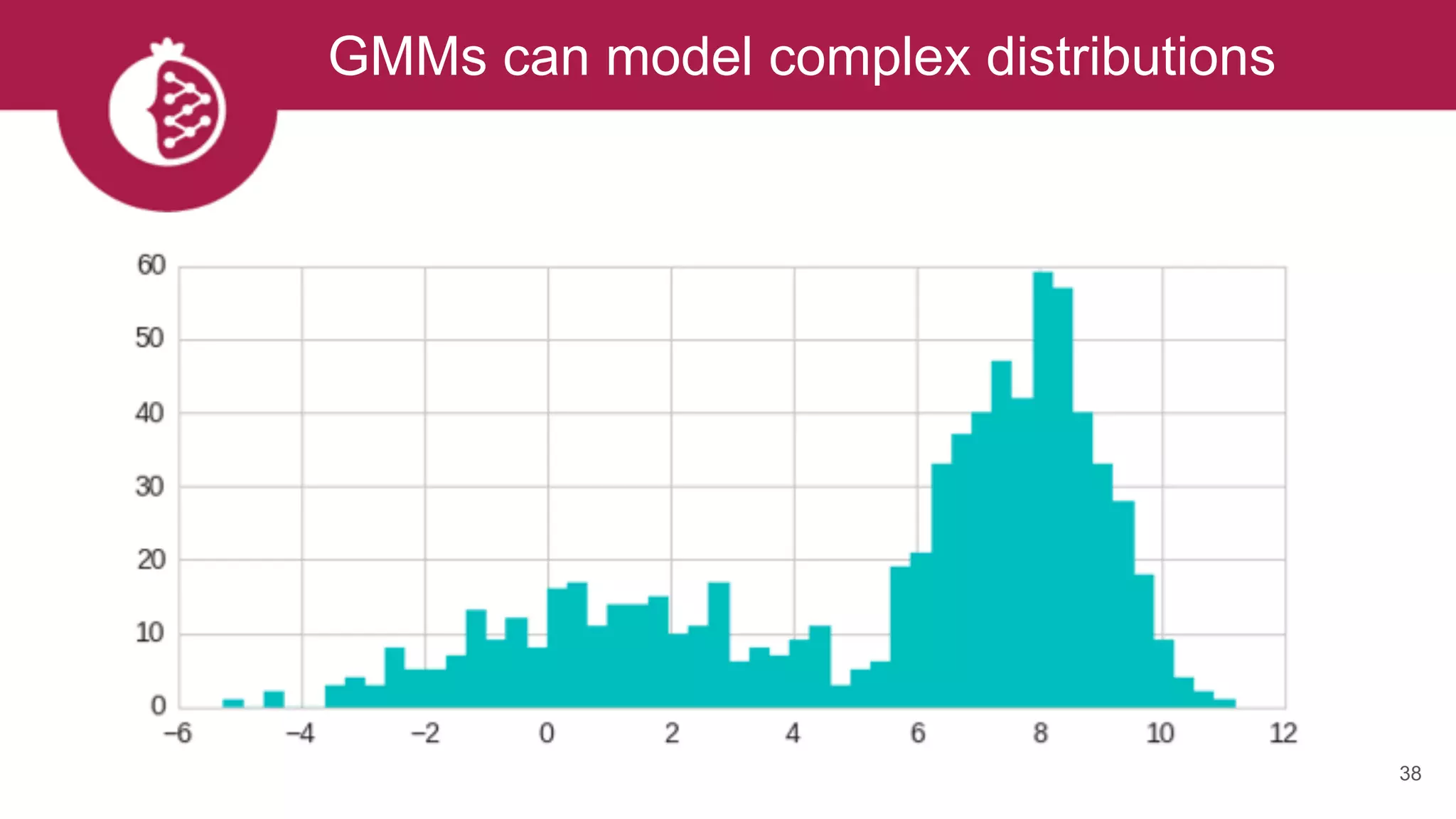
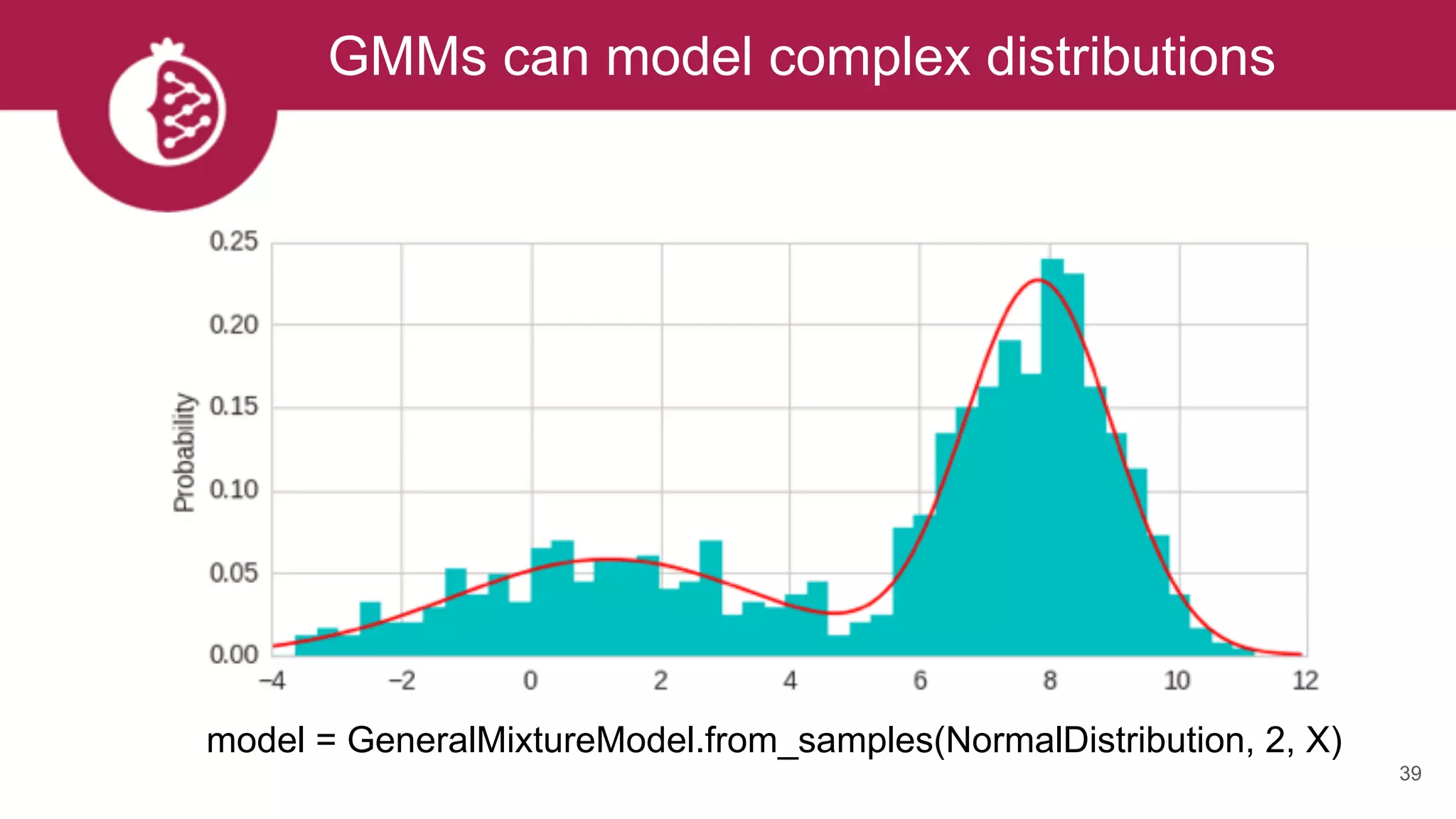
GMMs can model complex distributions
38
GMMs can model complex distributions
39
model = GeneralMixtureModel.from_samples(NormalDistribution, 2, X)
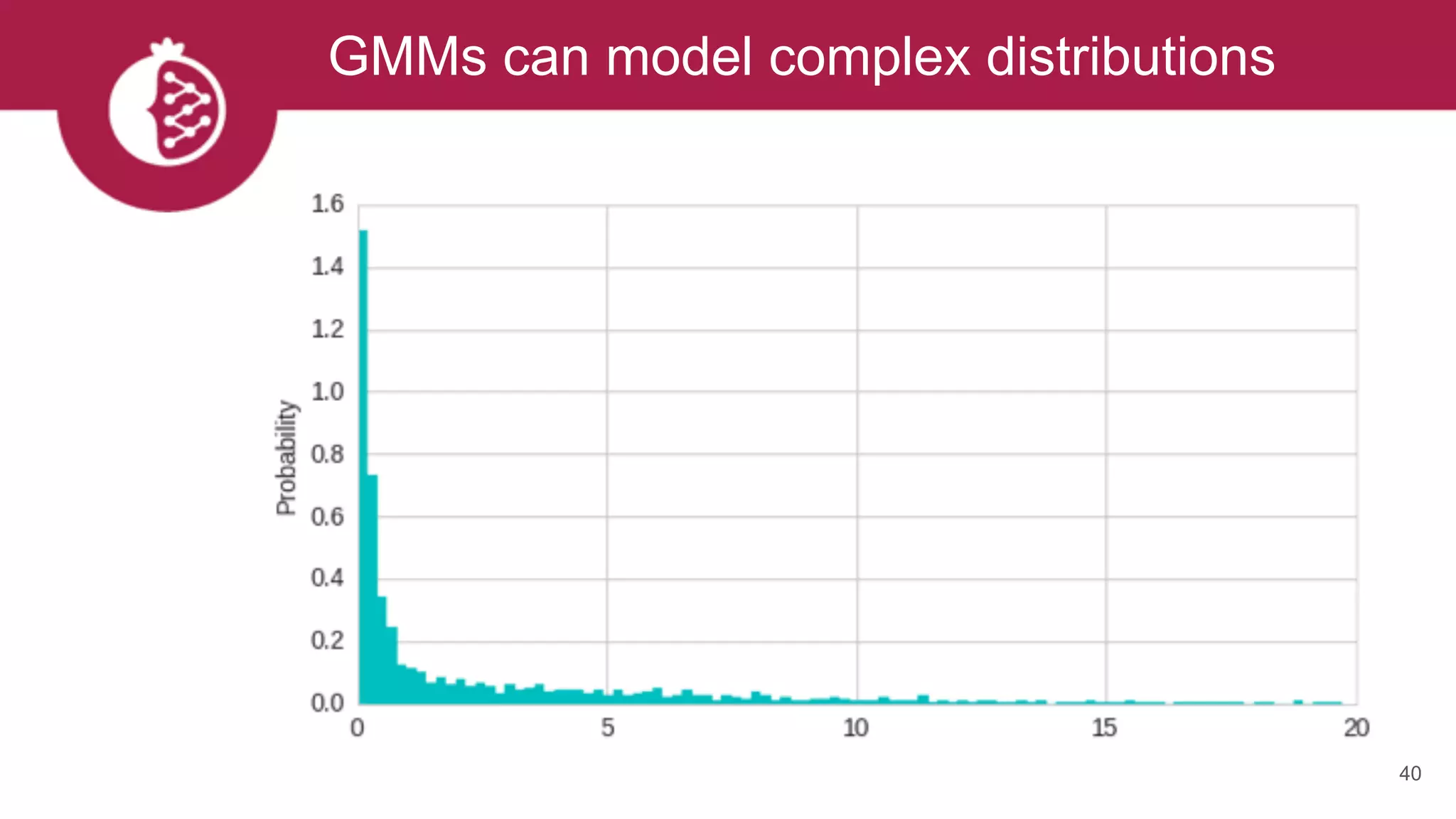
GMMs can model complex distributions
40
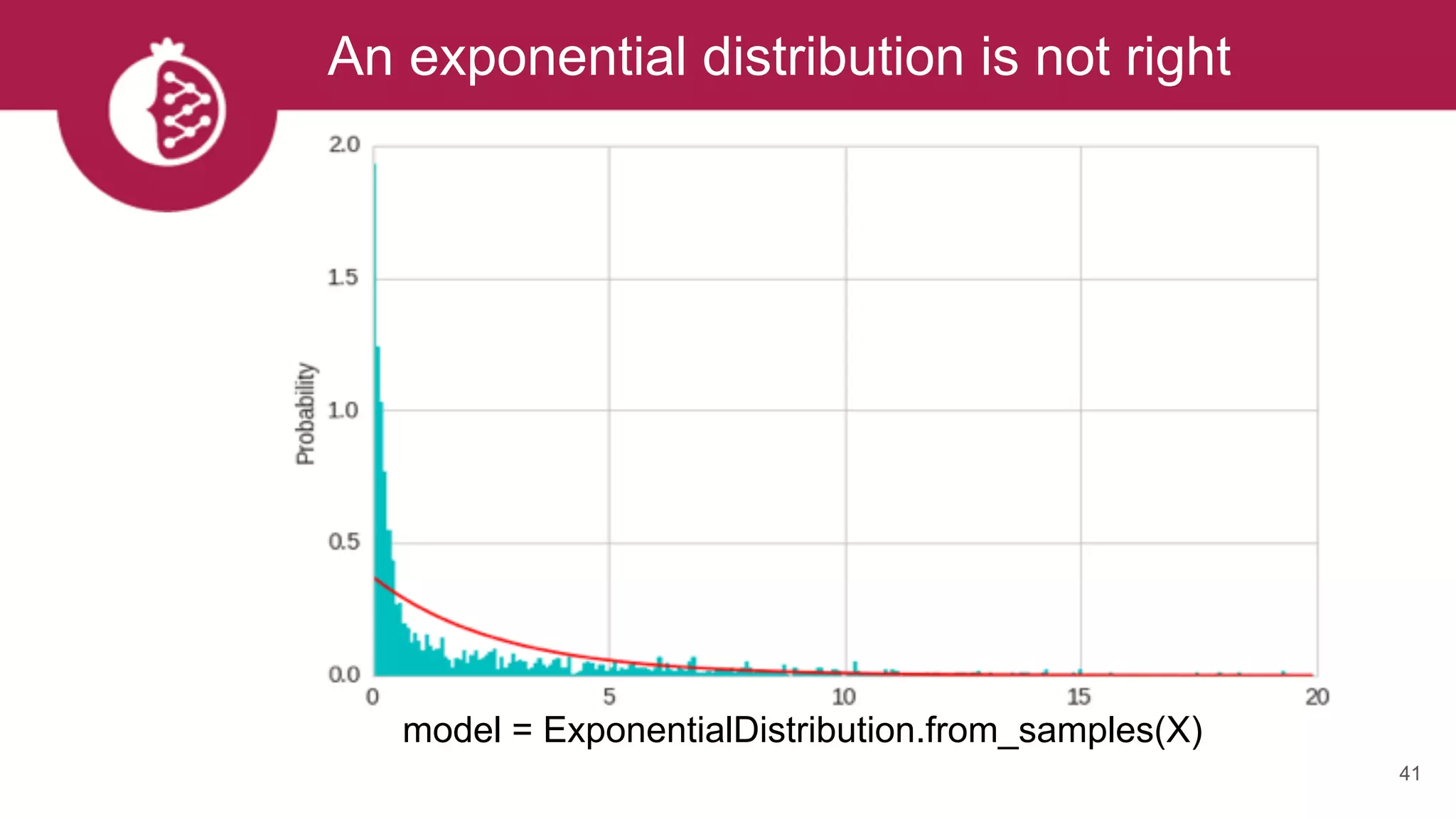
An exponential distribution is not right
41
model = ExponentialDistribution.from_samples(X)
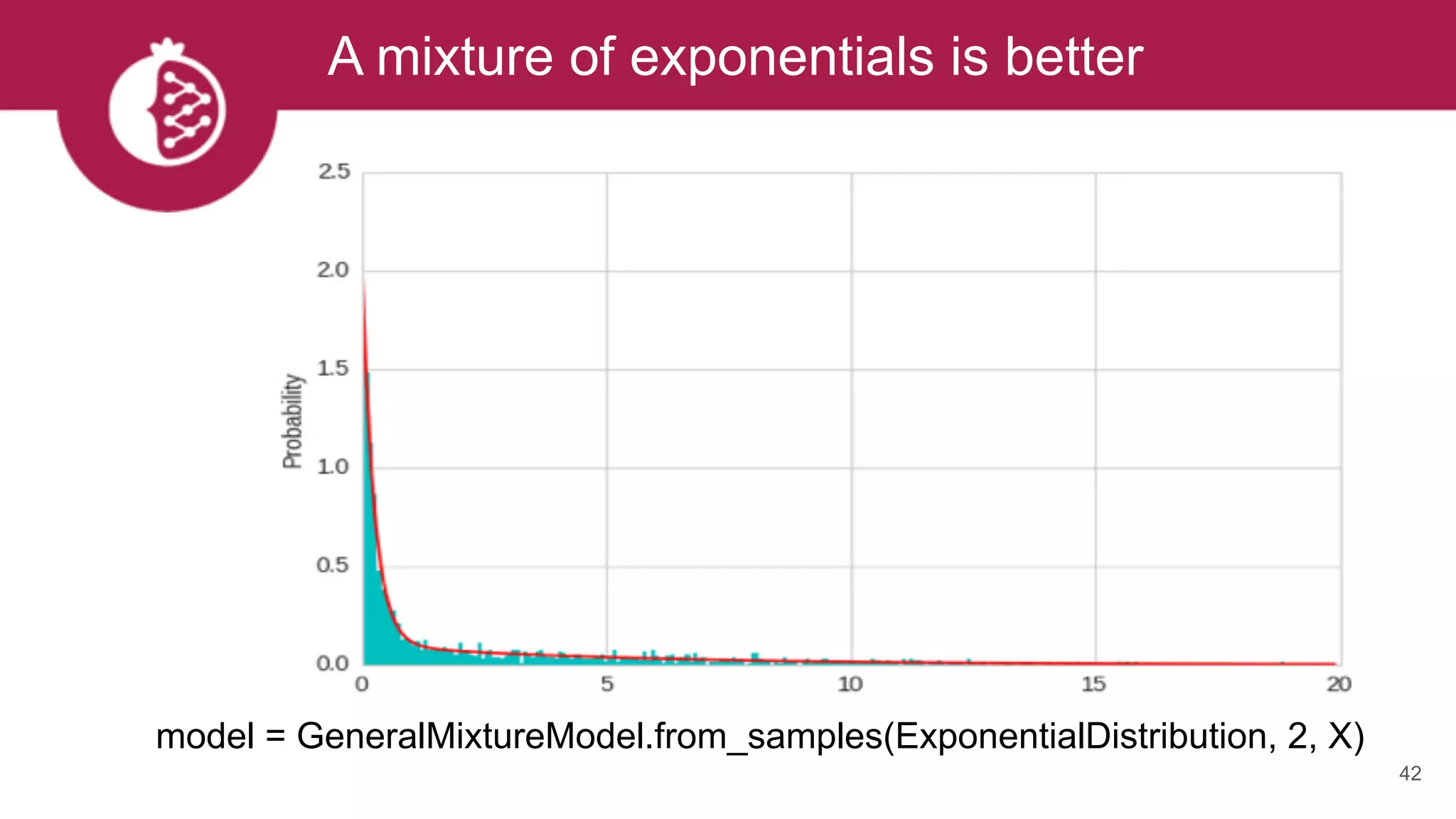
A mixture of exponentials is better
42
model = GeneralMixtureModel.from_samples(ExponentialDistribution, 2, X)
Heterogeneous mixtures natively supported
43
model = GeneralMixtureModel.from_samples([ExponentialDistribution, UniformDistribution], 2, X)
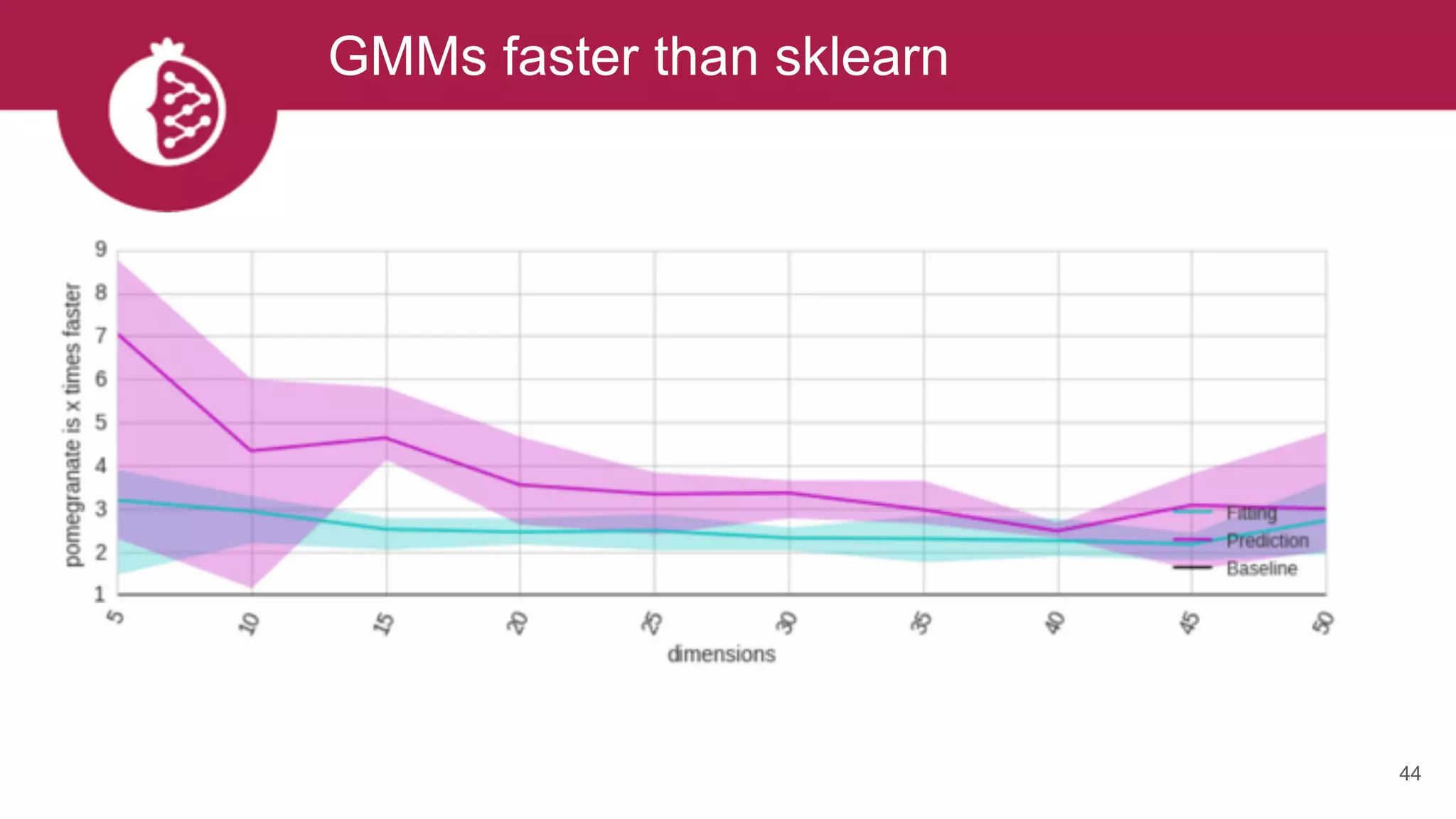
GMMs faster than sklearn
44
Overview: this talk
45
Overview
Major Models/Model Stacks
1. General Mixture Models
2. Hidden Markov Models
3. Bayesian Networks
4. Bayes Classifiers
Finale: Train a mixture of HMMs in parallel
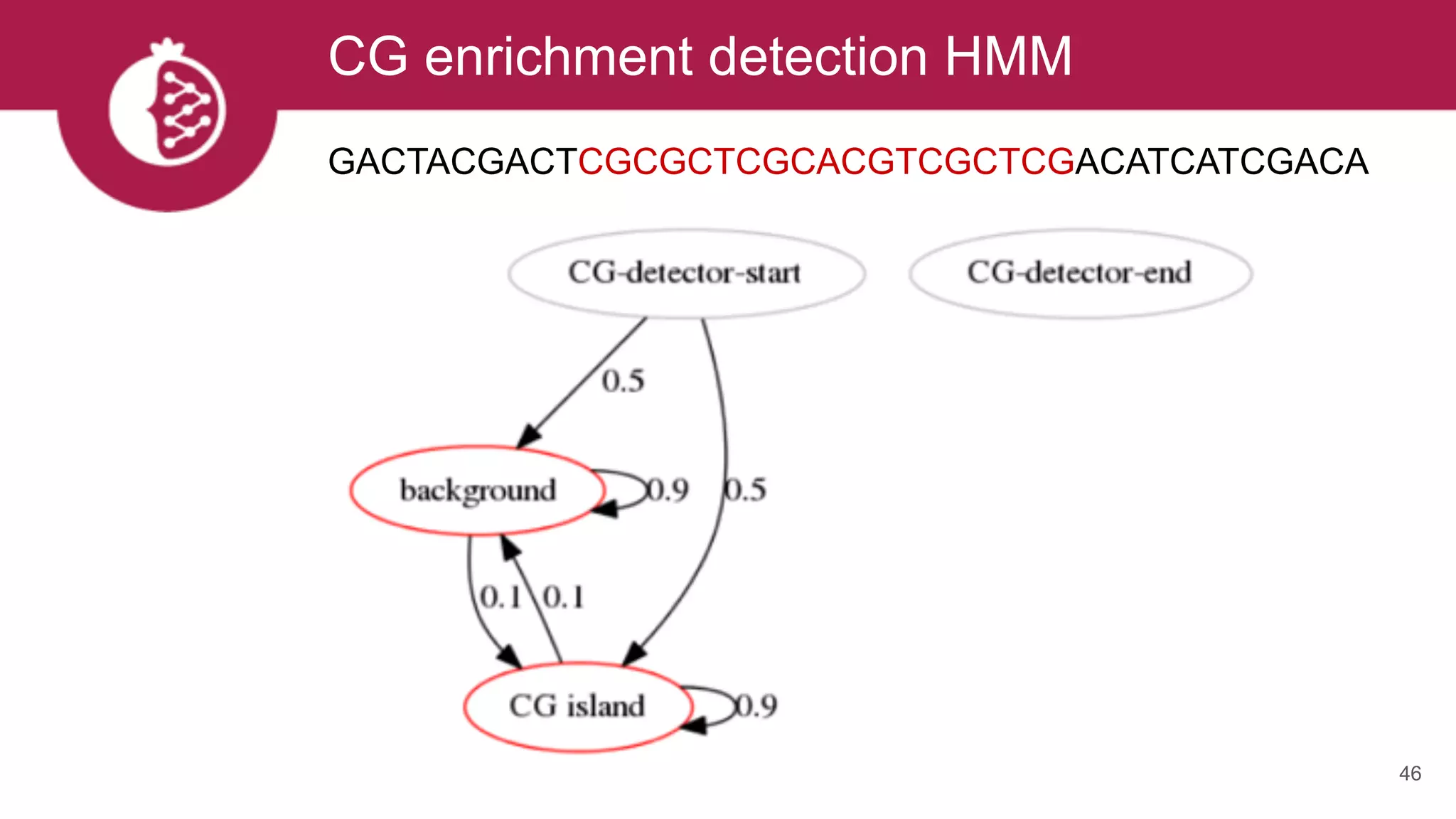
CG enrichment detection HMM
46
GACTACGACTCGCGCTCGCACGTCGCTCGACATCATCGACA
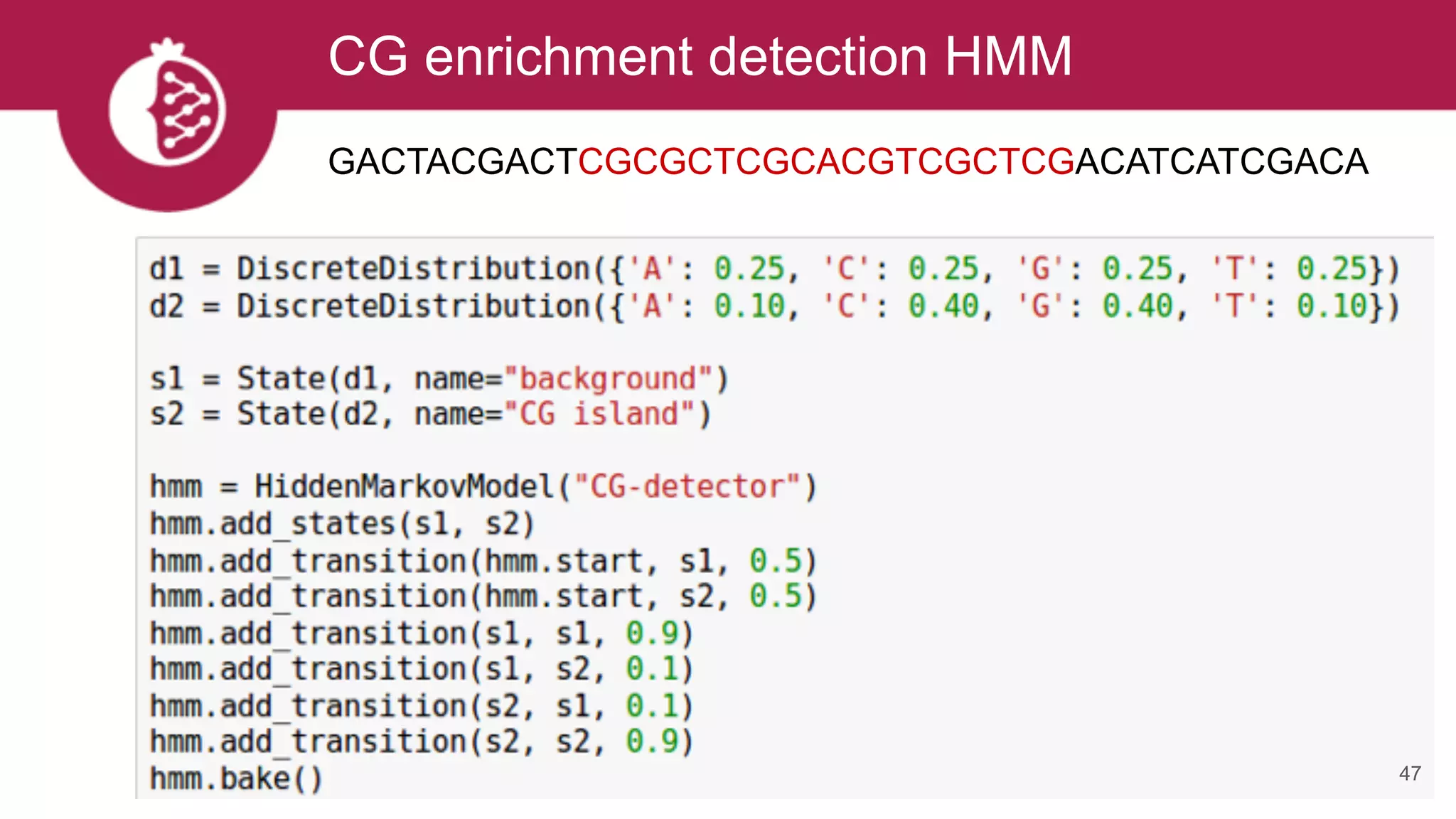
CG enrichment detection HMM
GACTACGACTCGCGCTCGCACGTCGCTCGACATCATCGACA
47
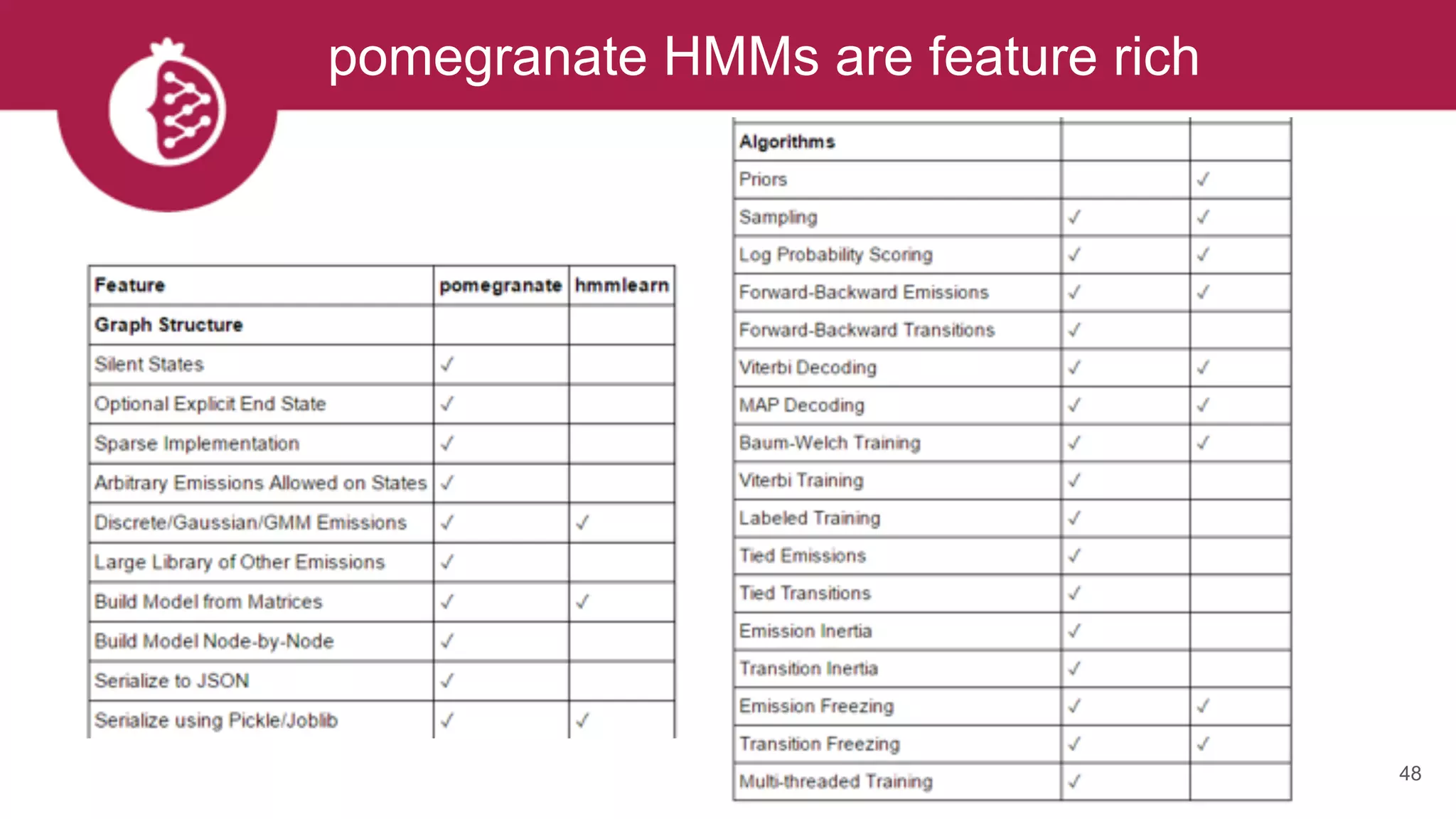
pomegranate HMMs are feature rich
48
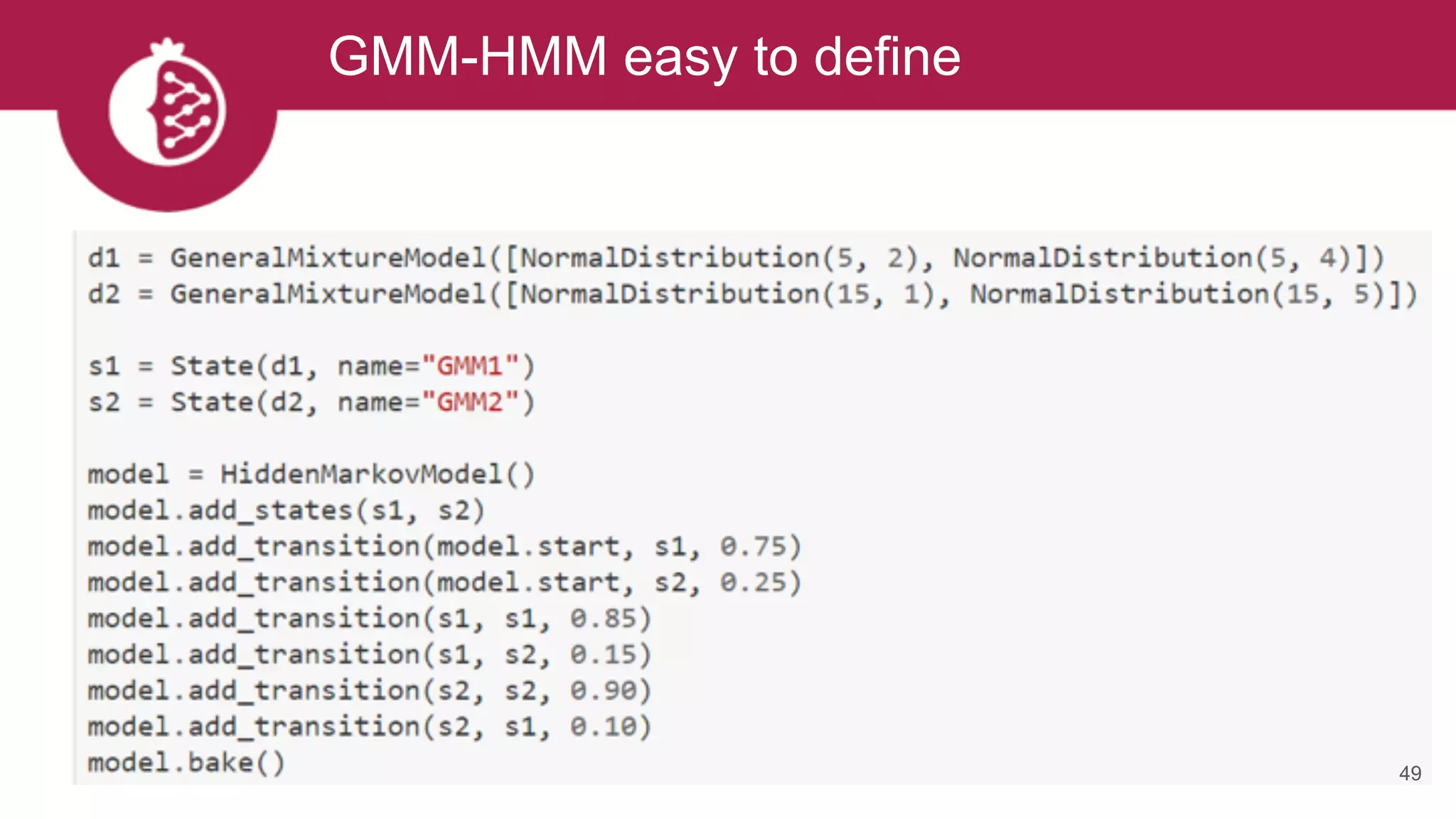
GMM-HMM easy to define
49
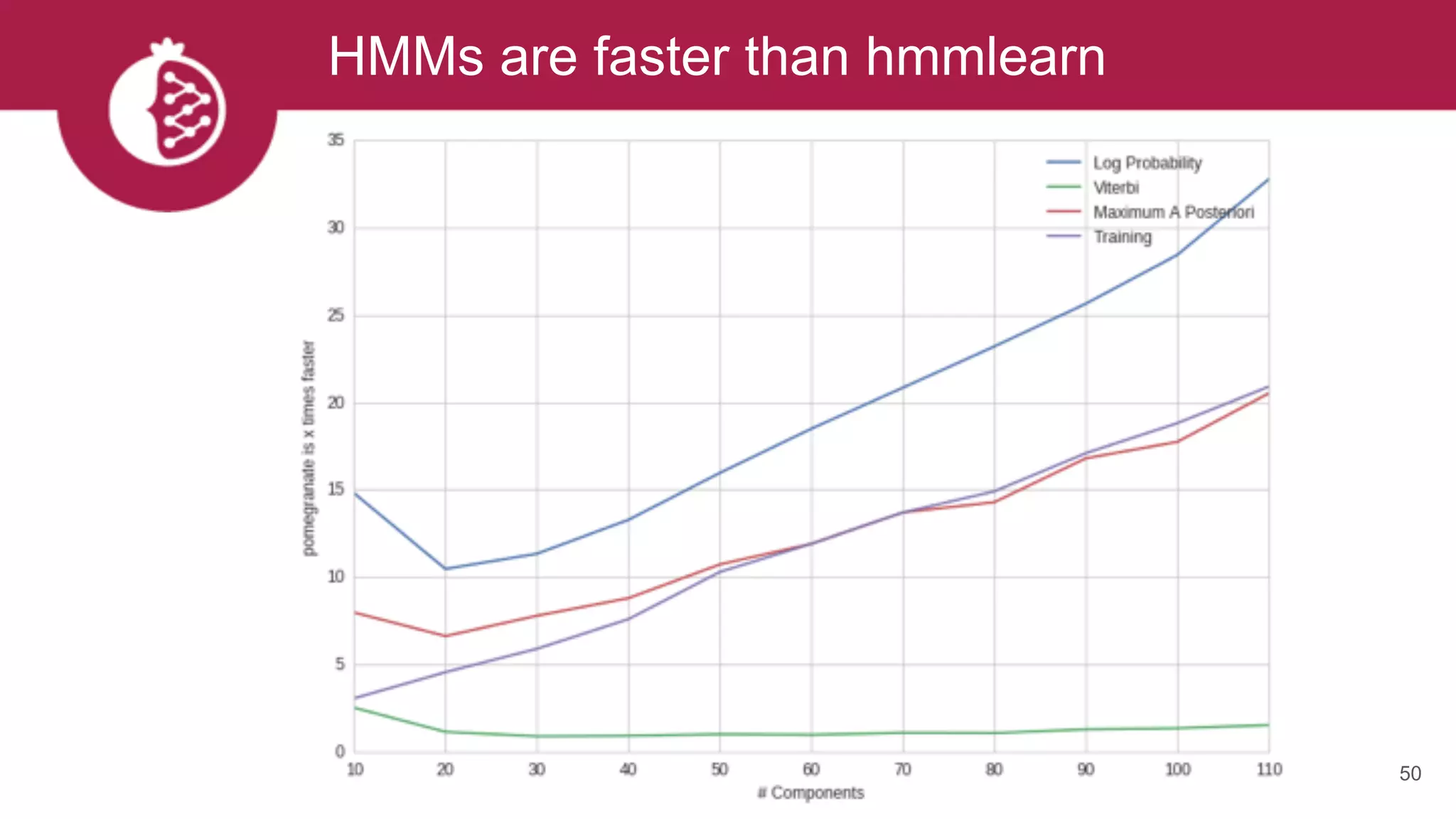
HMMs are faster than hmmlearn
50
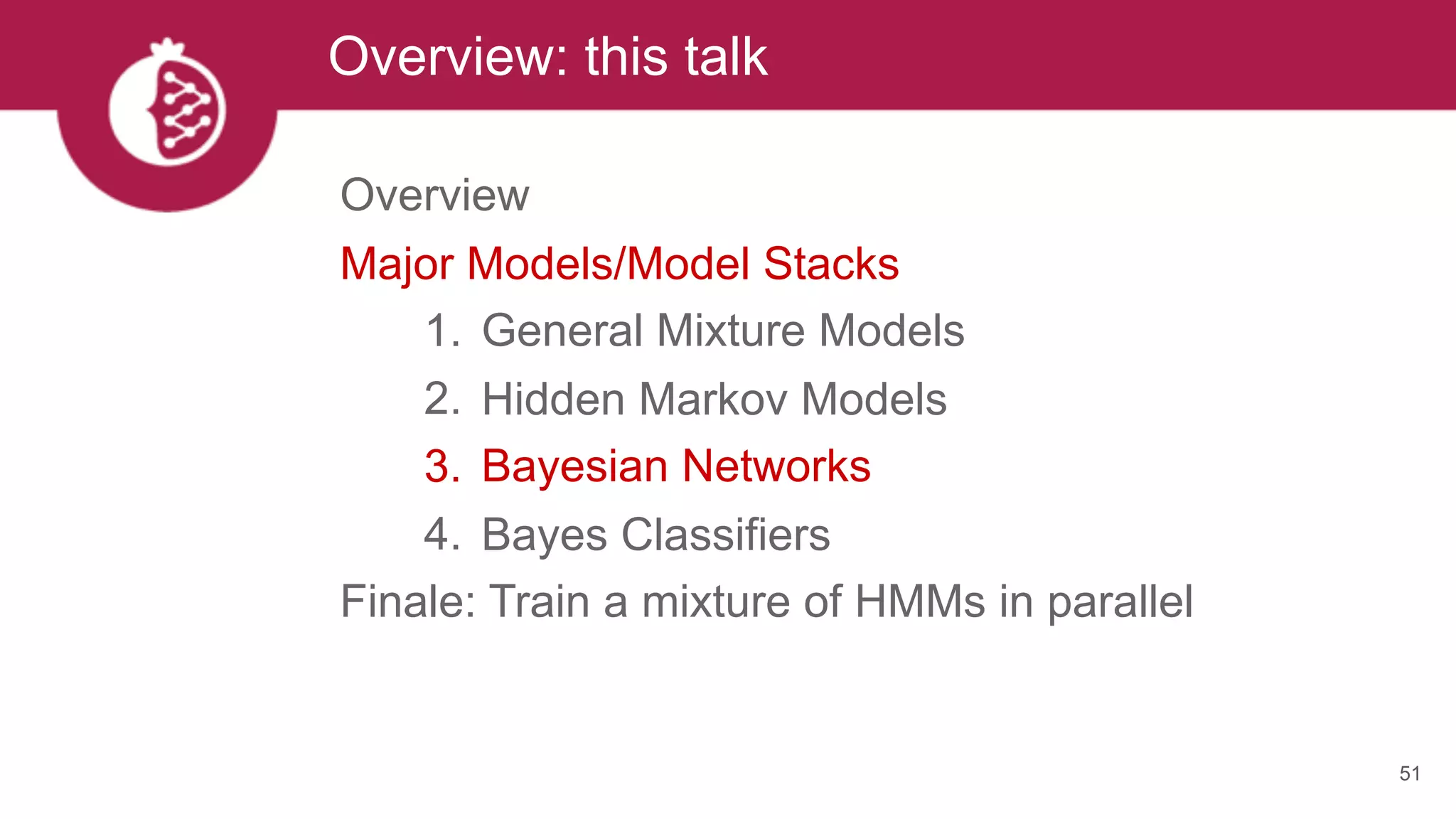
Overview: this talk
51
Overview
Major Models/Model Stacks
1. General Mixture Models
2. Hidden Markov Models
3. Bayesian Networks
4. Bayes Classifiers
Finale: Train a mixture of HMMs in parallel
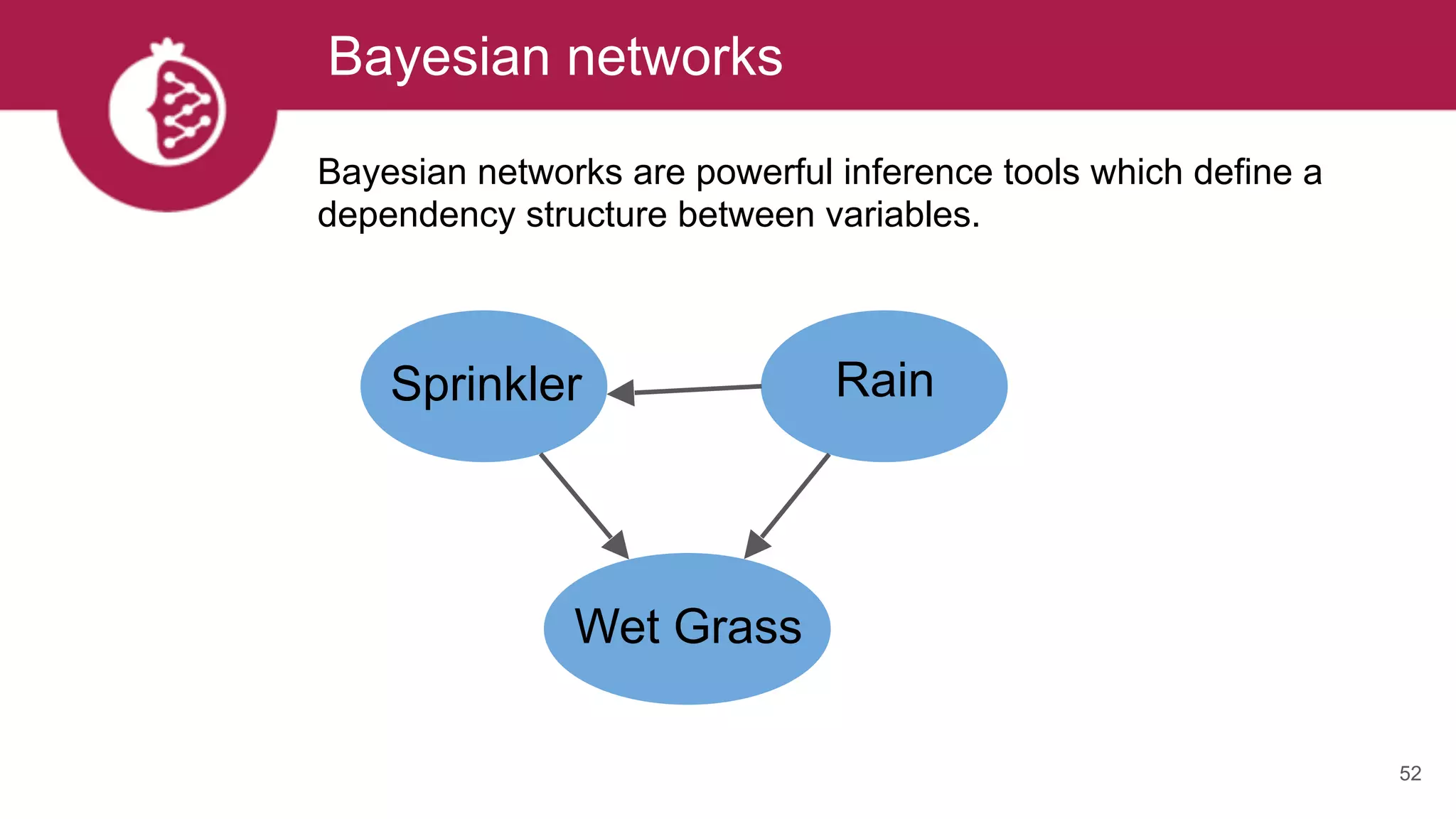
Bayesian networks
52
Bayesian networks are powerful inference tools which define a
dependency structure between variables.
Sprinkler
Wet Grass
Rain
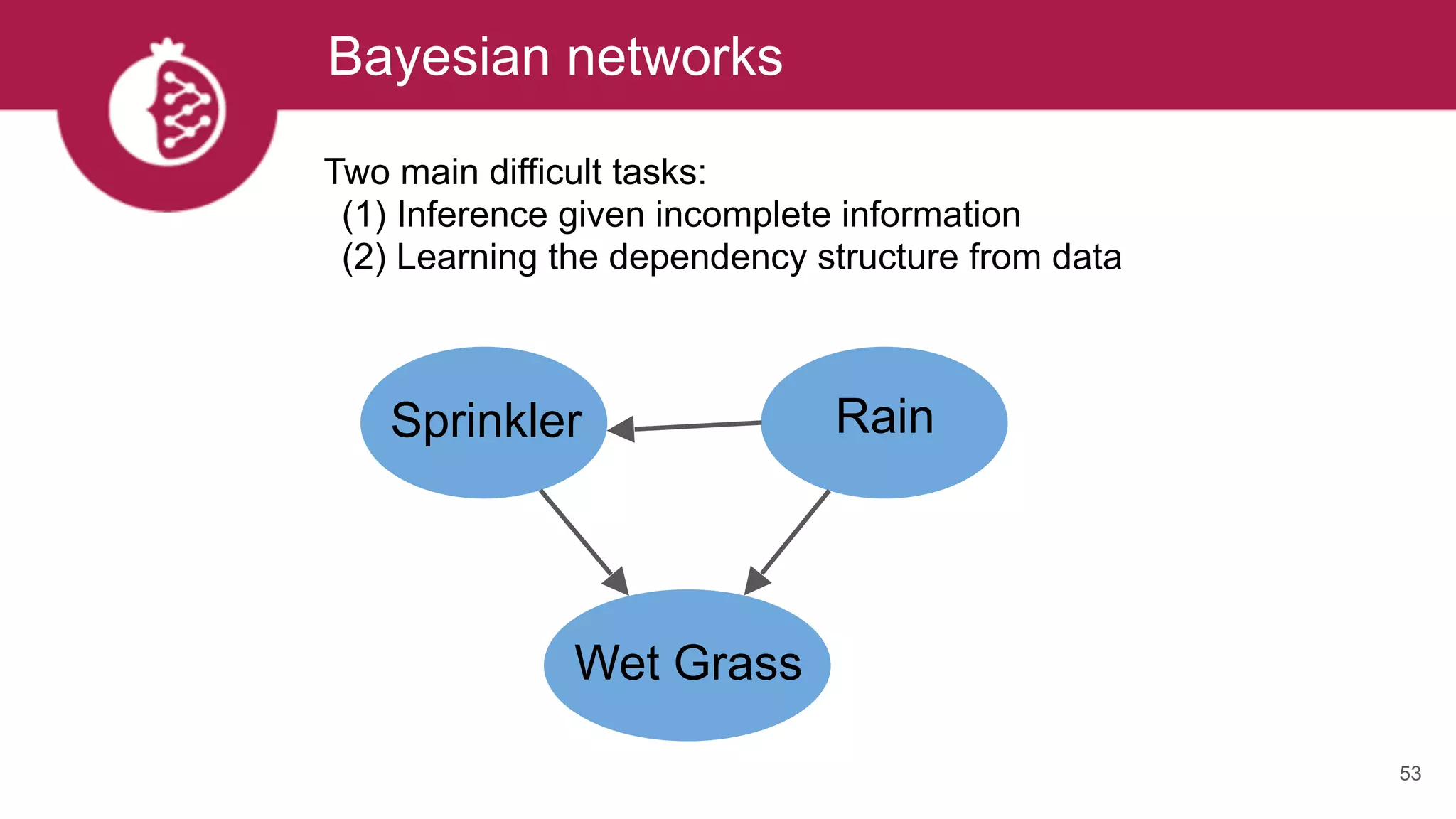
Bayesian networks
53
Sprinkler
Wet Grass
Rain
Two main difficult tasks:
(1) Inference given incomplete information
(2) Learning the dependency structure from data
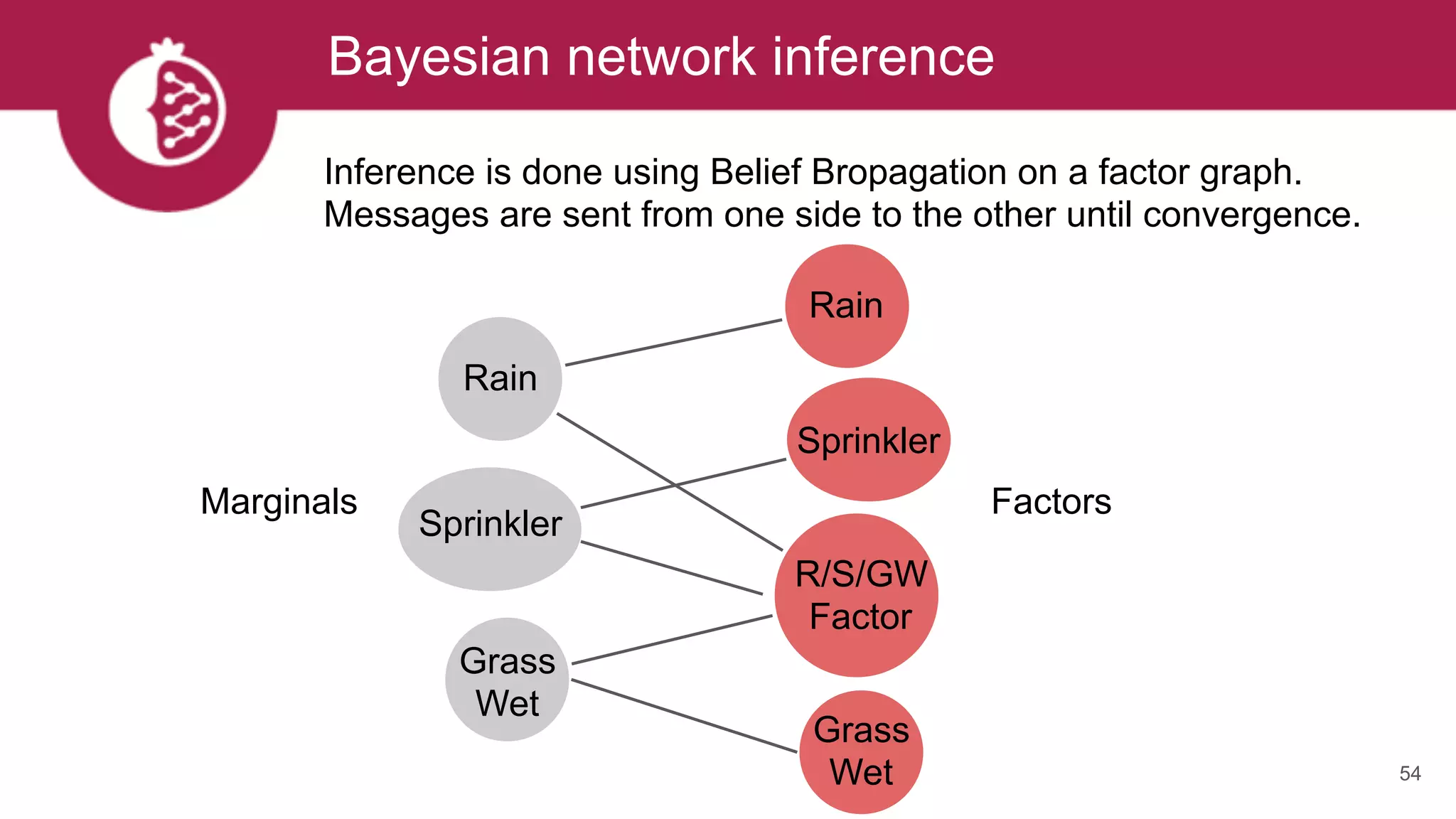
Bayesian network inference
54
Inference is done using Belief Bropagation on a factor graph.
Messages are sent from one side to the other until convergence.
Rain
Sprinkler
Grass
Wet
R/S/GW
Factor
Grass
Wet
Rain
Sprinkler
Marginals Factors
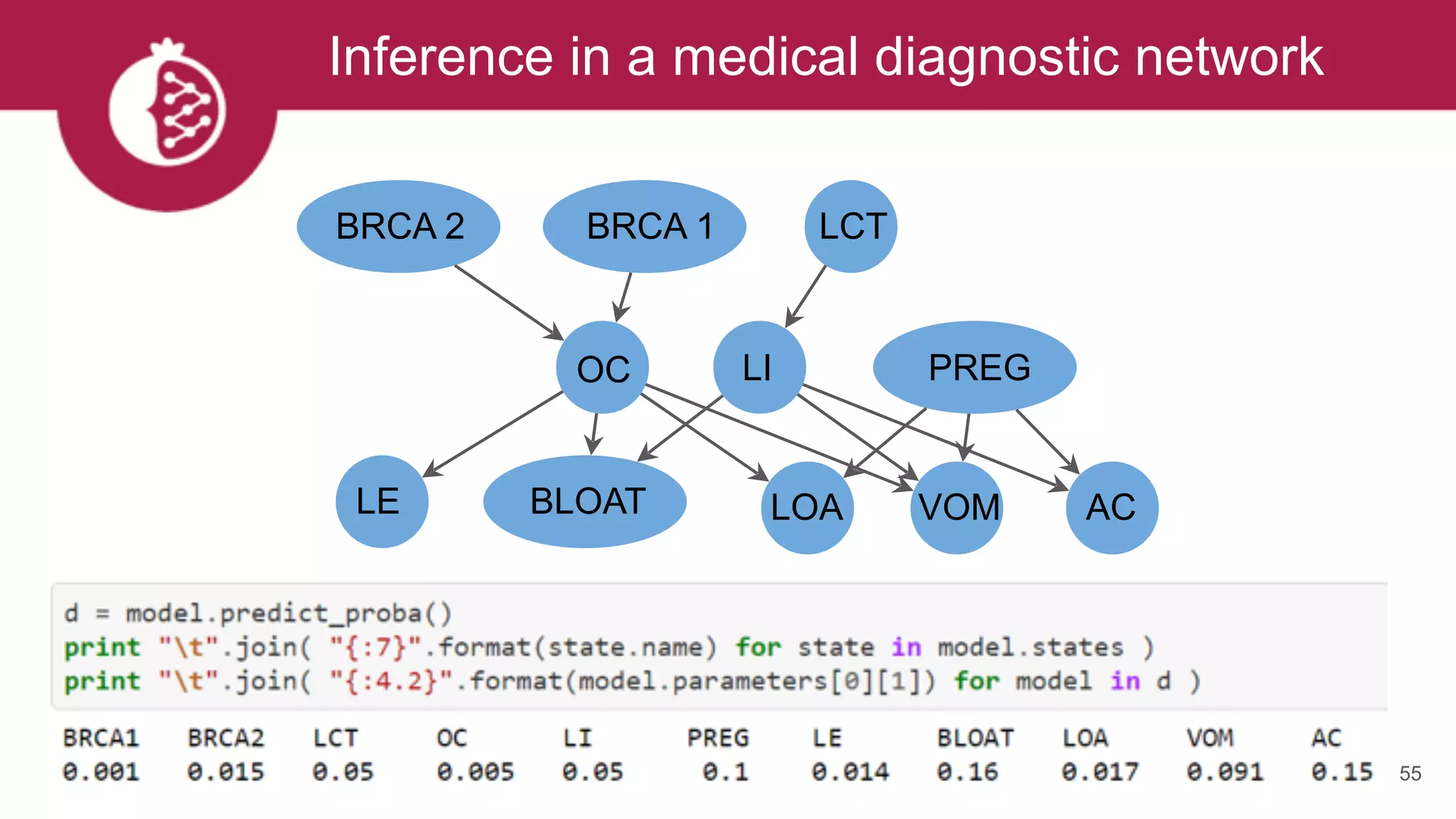
Inference in a medical diagnostic network
55
BRCA 2 BRCA 1 LCT
BLOATLE LOA VOM AC
PREGLIOC
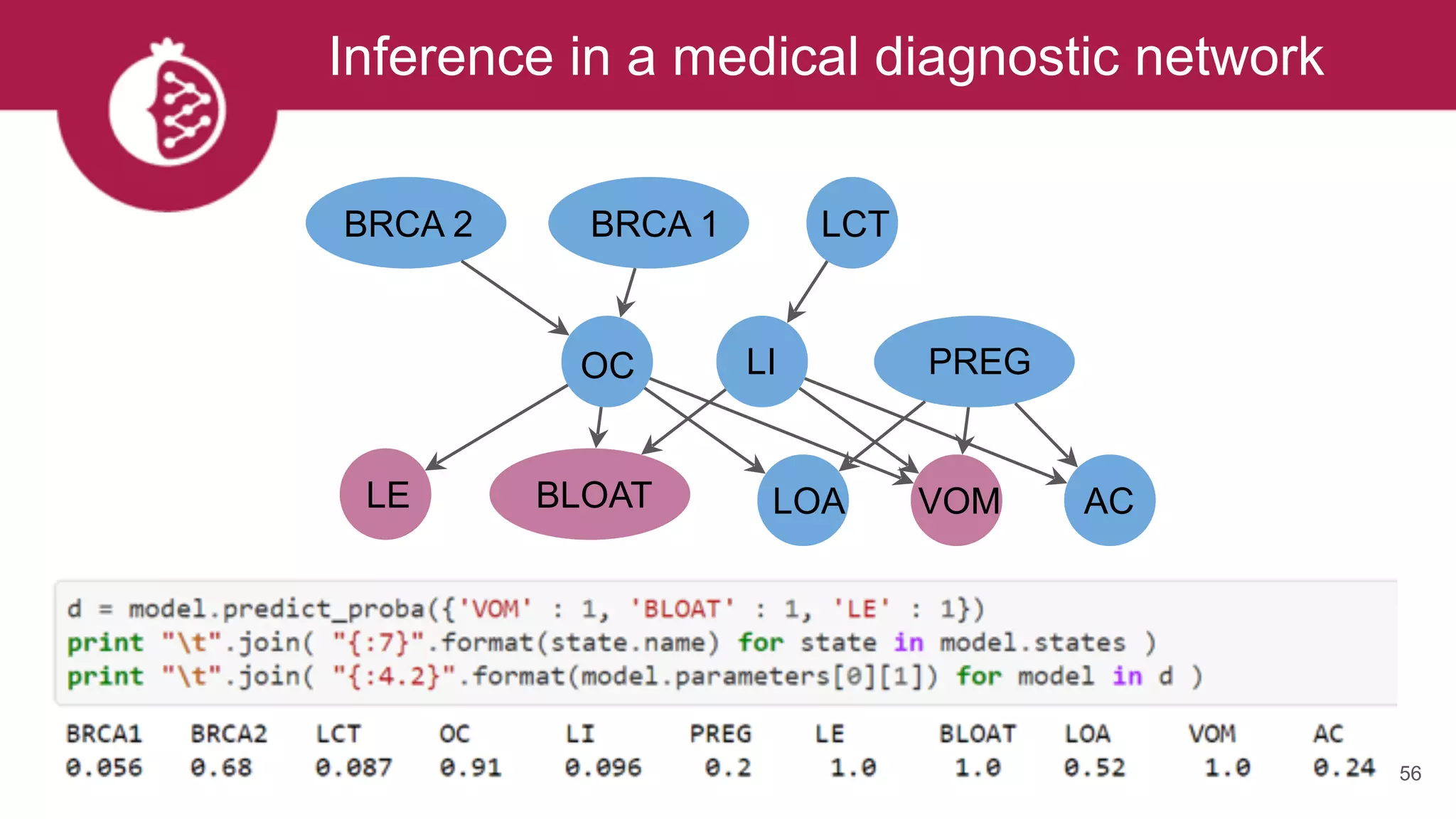
Inference in a medical diagnostic network
56
BRCA 2 BRCA 1 LCT
BLOATLE LOA VOM AC
PREGLIOC
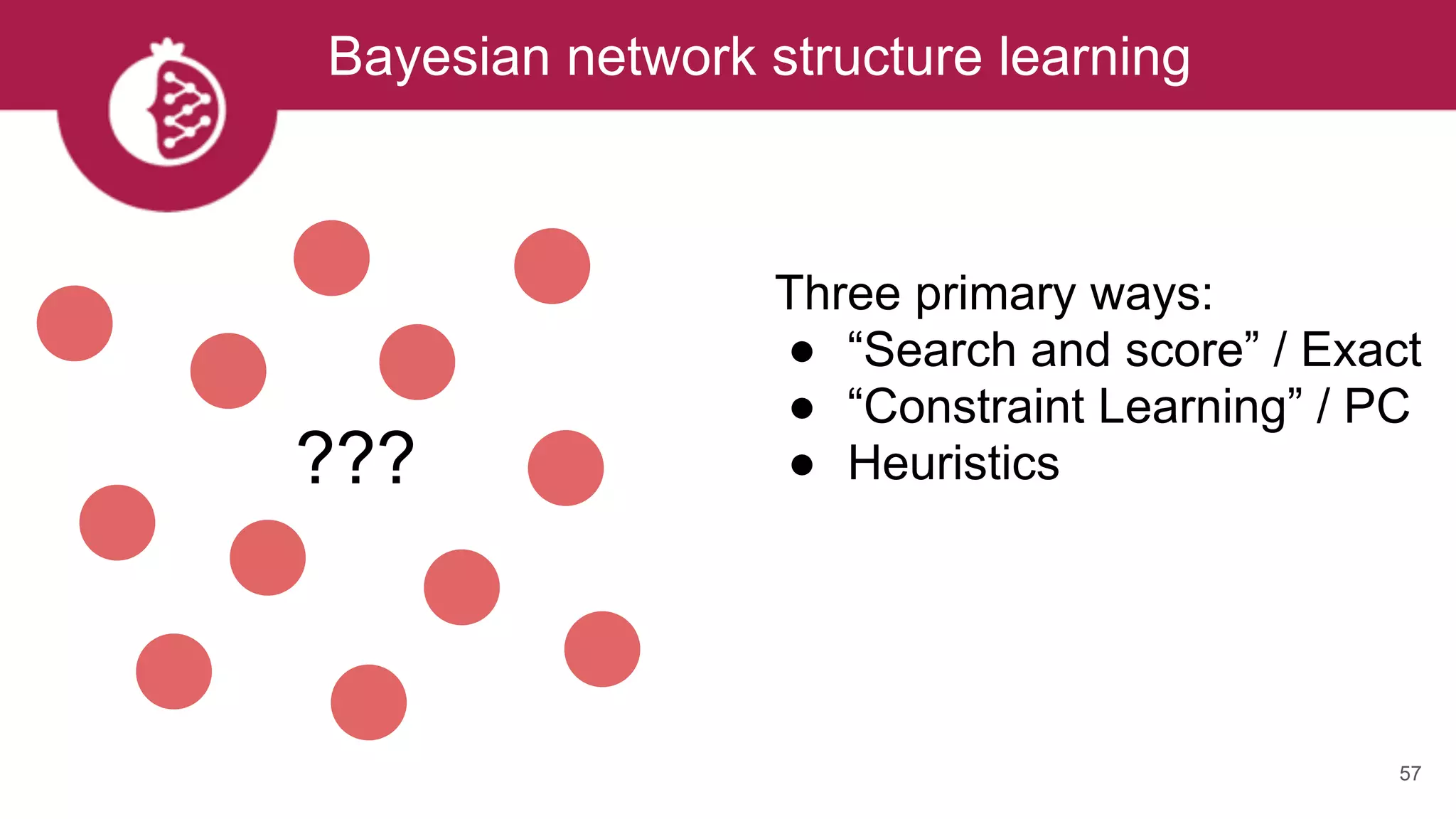
Bayesian network structure learning
57
???
Three primary ways:
● “Search and score” / Exact
● “Constraint Learning” / PC
● Heuristics
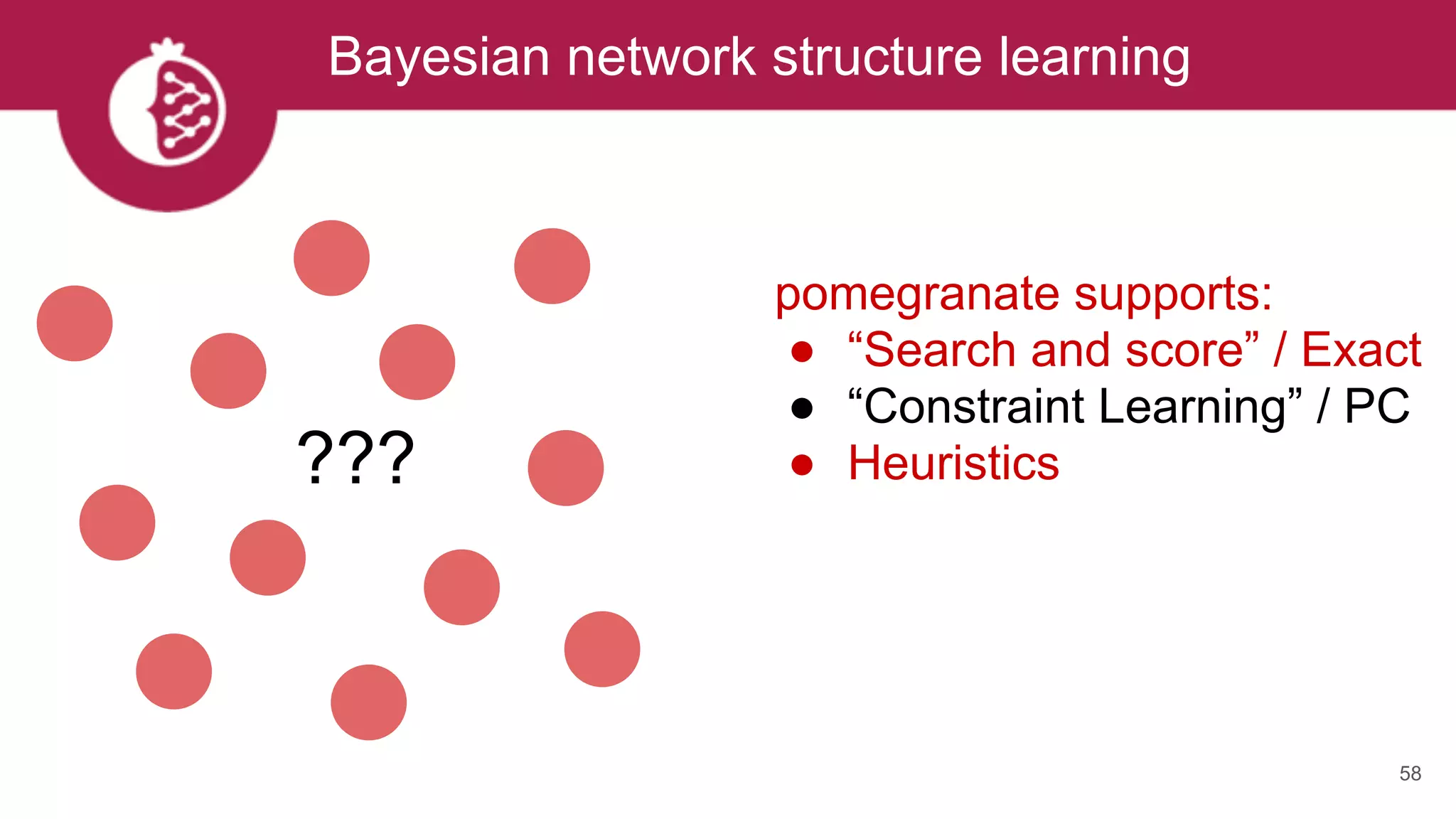
Bayesian network structure learning
58
???
pomegranate supports:
● “Search and score” / Exact
● “Constraint Learning” / PC
● Heuristics
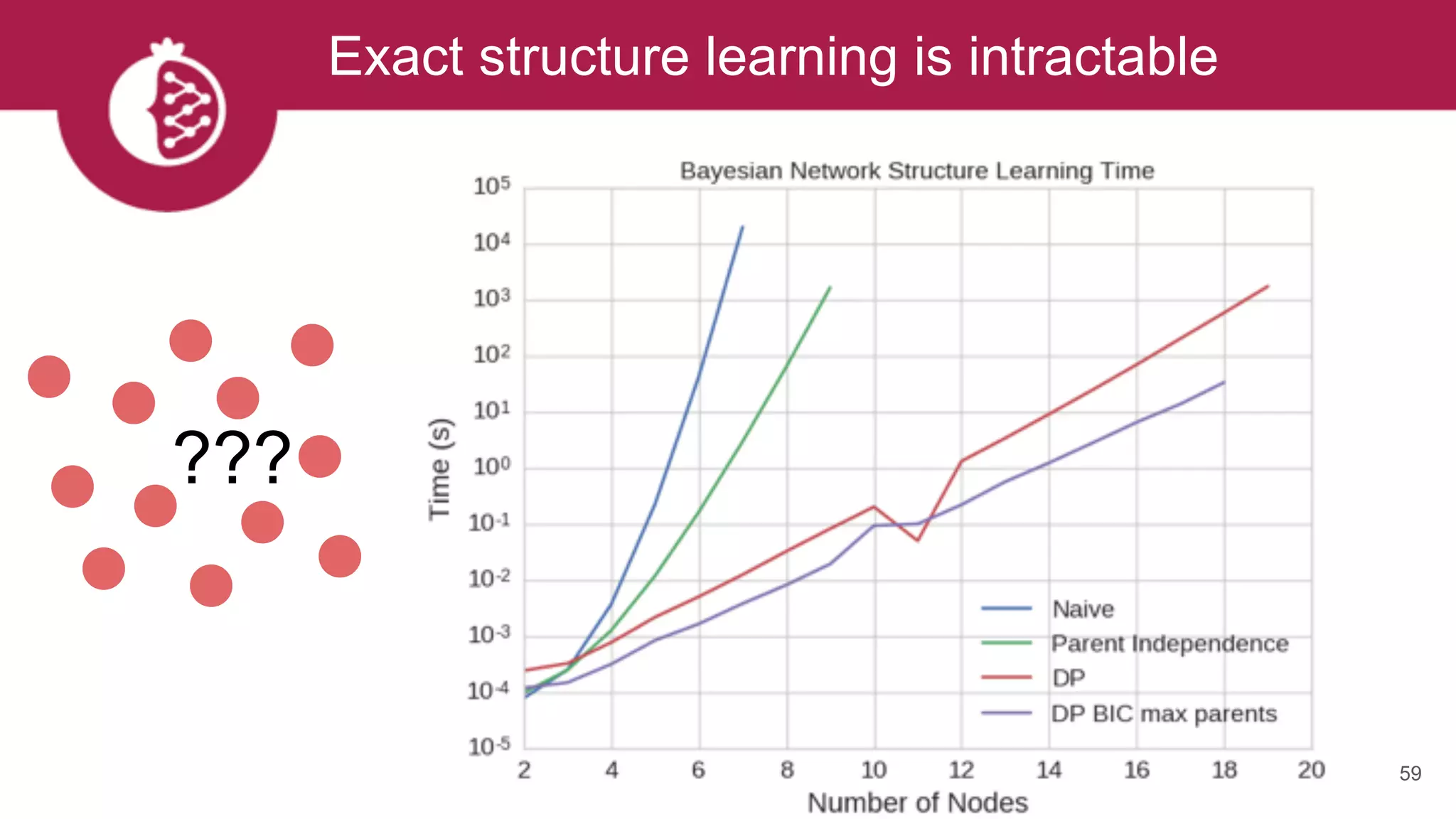
Exact structure learning is intractable
???
59
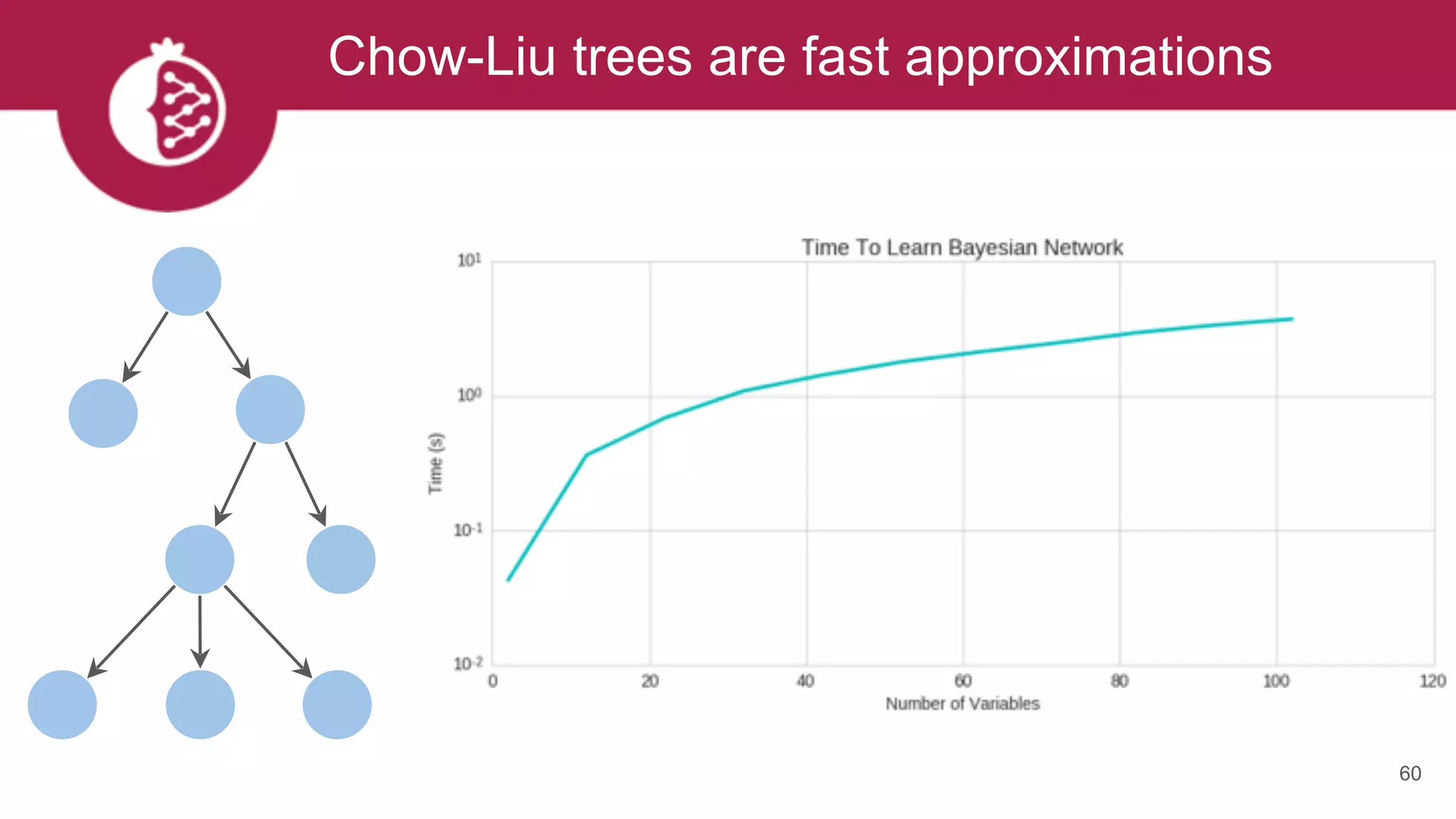
Chow-Liu trees are fast approximations
60
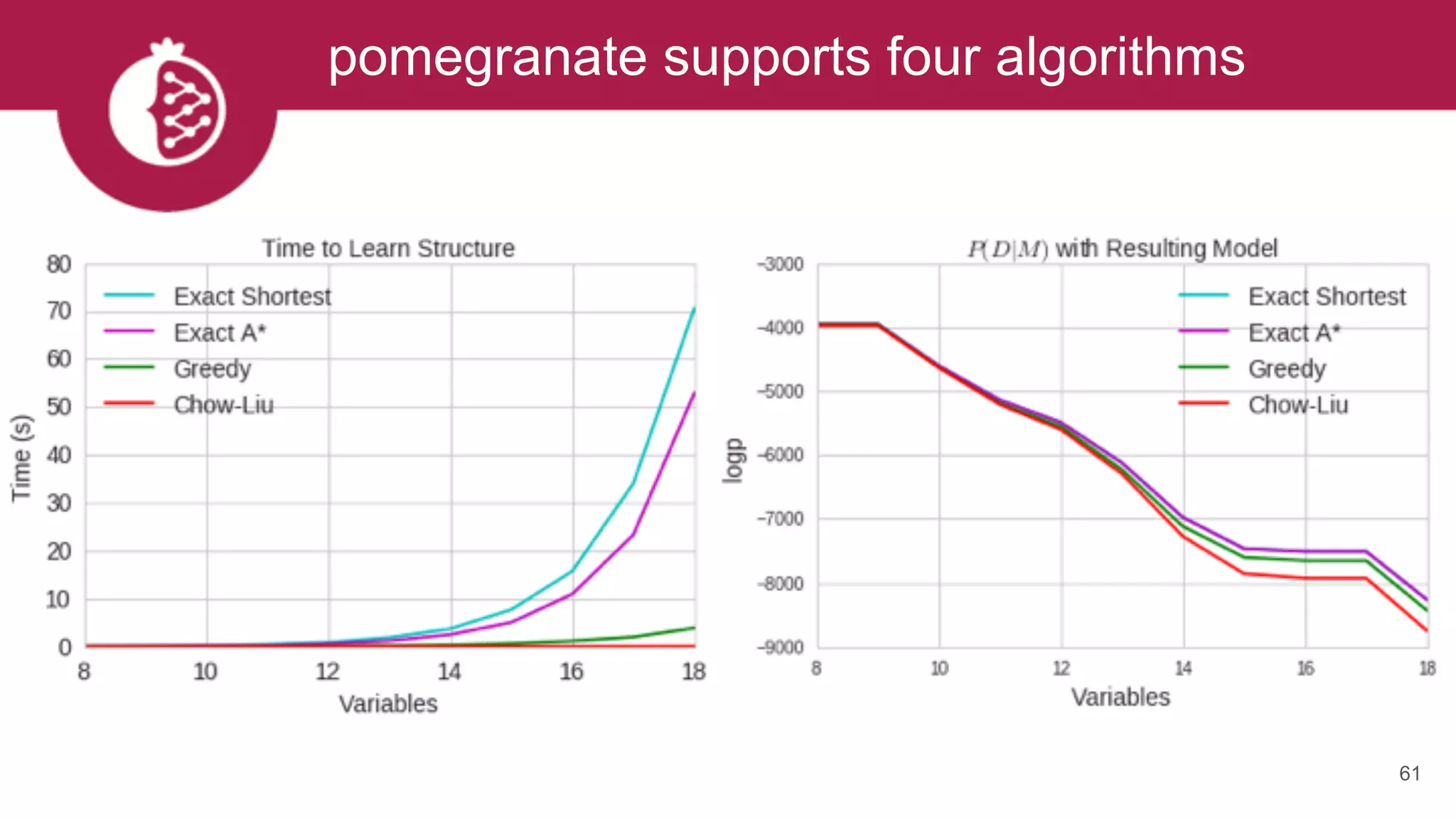
pomegranate supports four algorithms
61
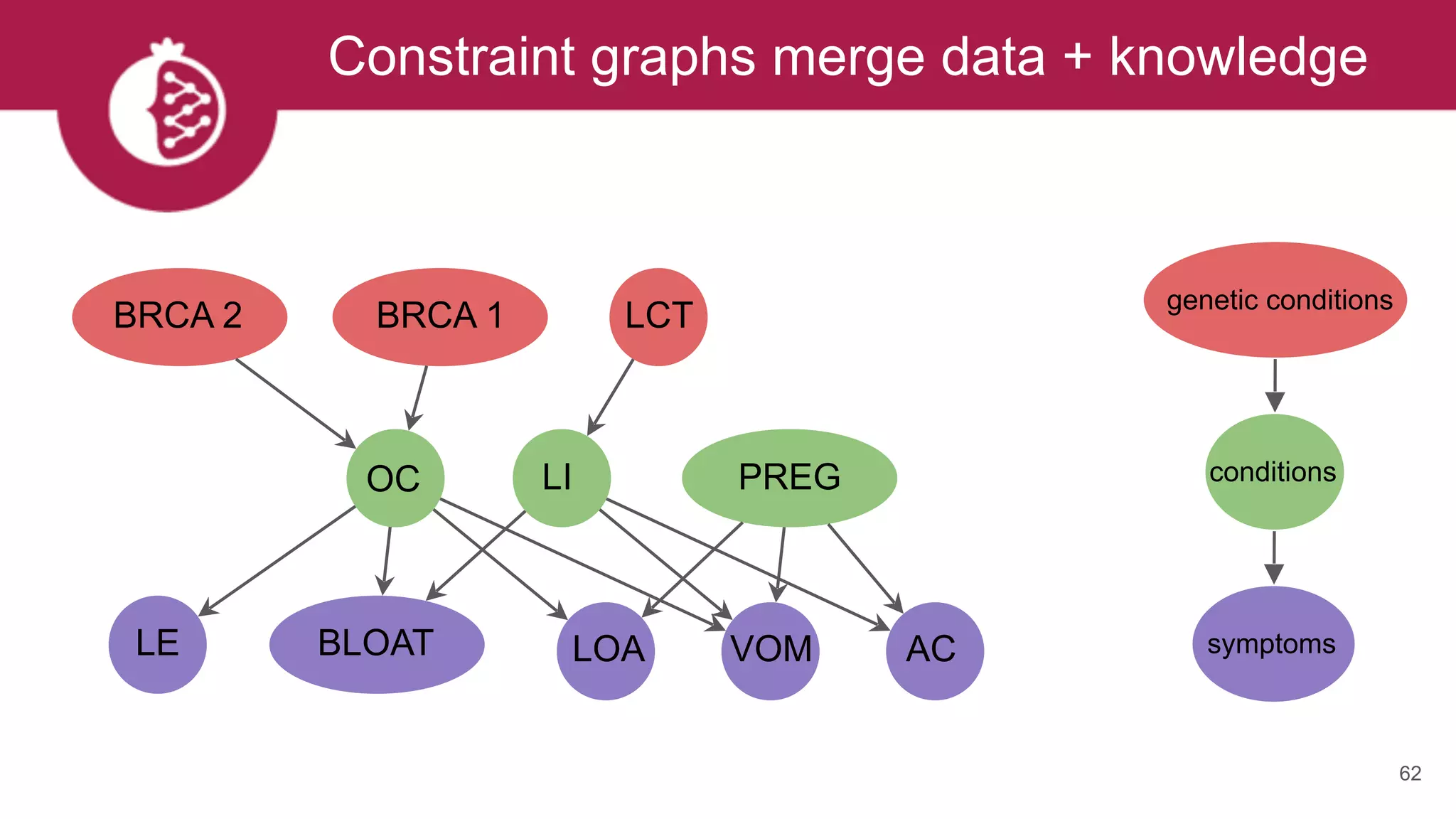
Constraint graphs merge data + knowledge
62
BRCA 2 BRCA 1 LCT
BLOATLE LOA VOM AC
PREGLIOC
genetic conditions
conditions
symptoms
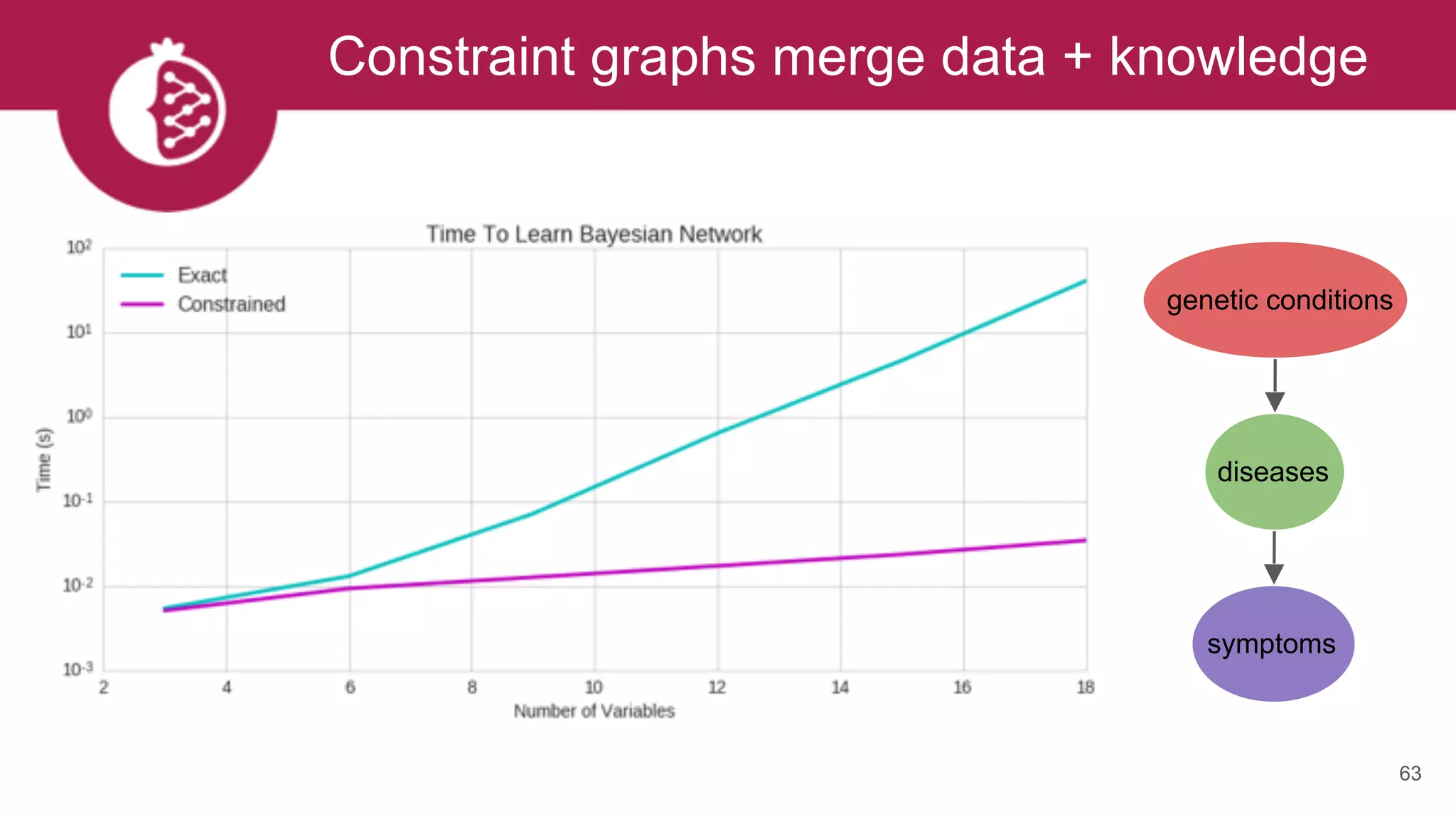
Constraint graphs merge data + knowledge
63
genetic conditions
diseases
symptoms
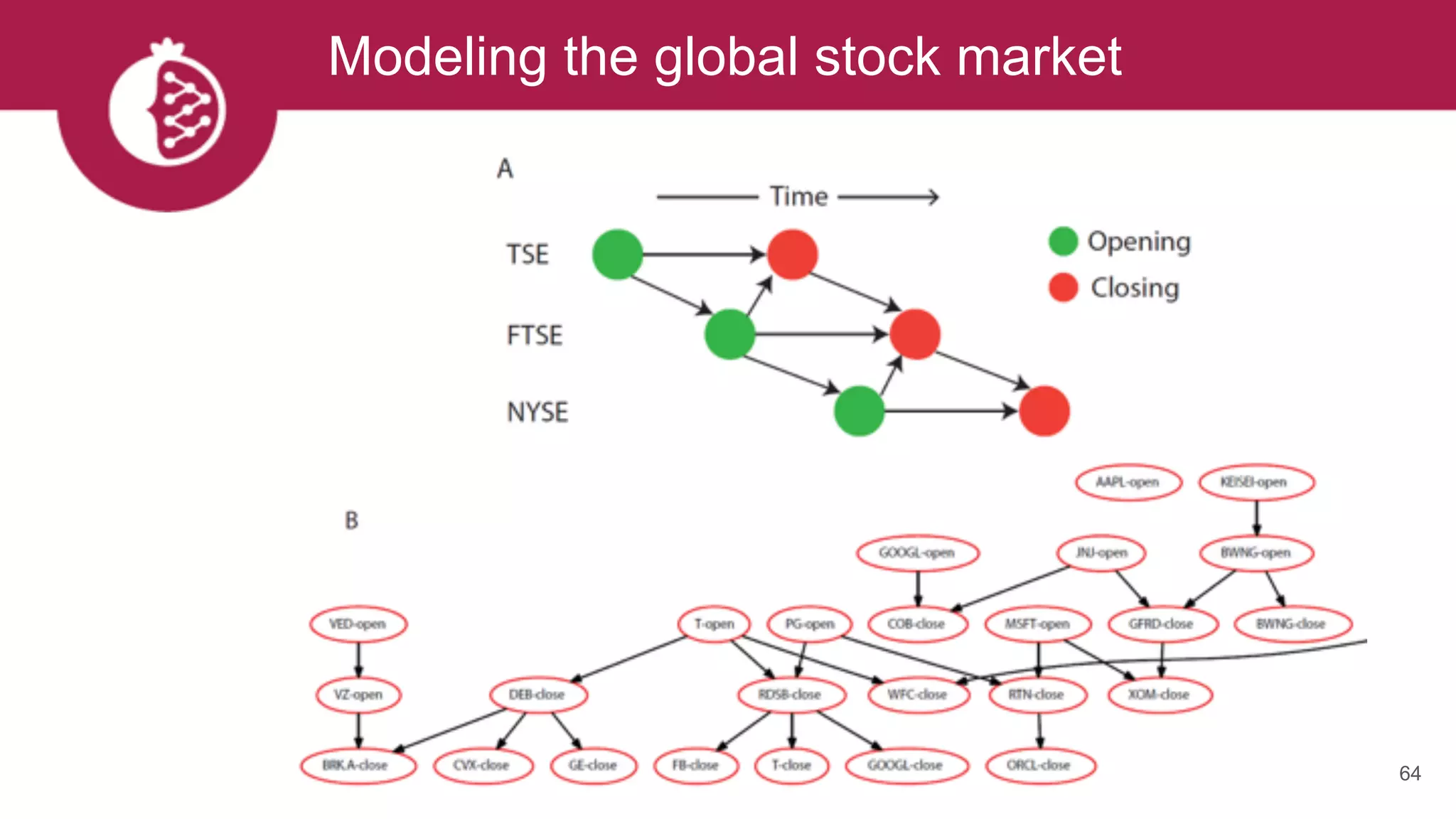
Modeling the global stock market
64
Constraint graph published in PeerJ CS
65
Overview: this talk
66
Overview
Major Models/Model Stacks
1. General Mixture Models
2. Hidden Markov Models
3. Bayesian Networks
4. Bayes Classifiers
Finale: Train a mixture of HMMs in parallel
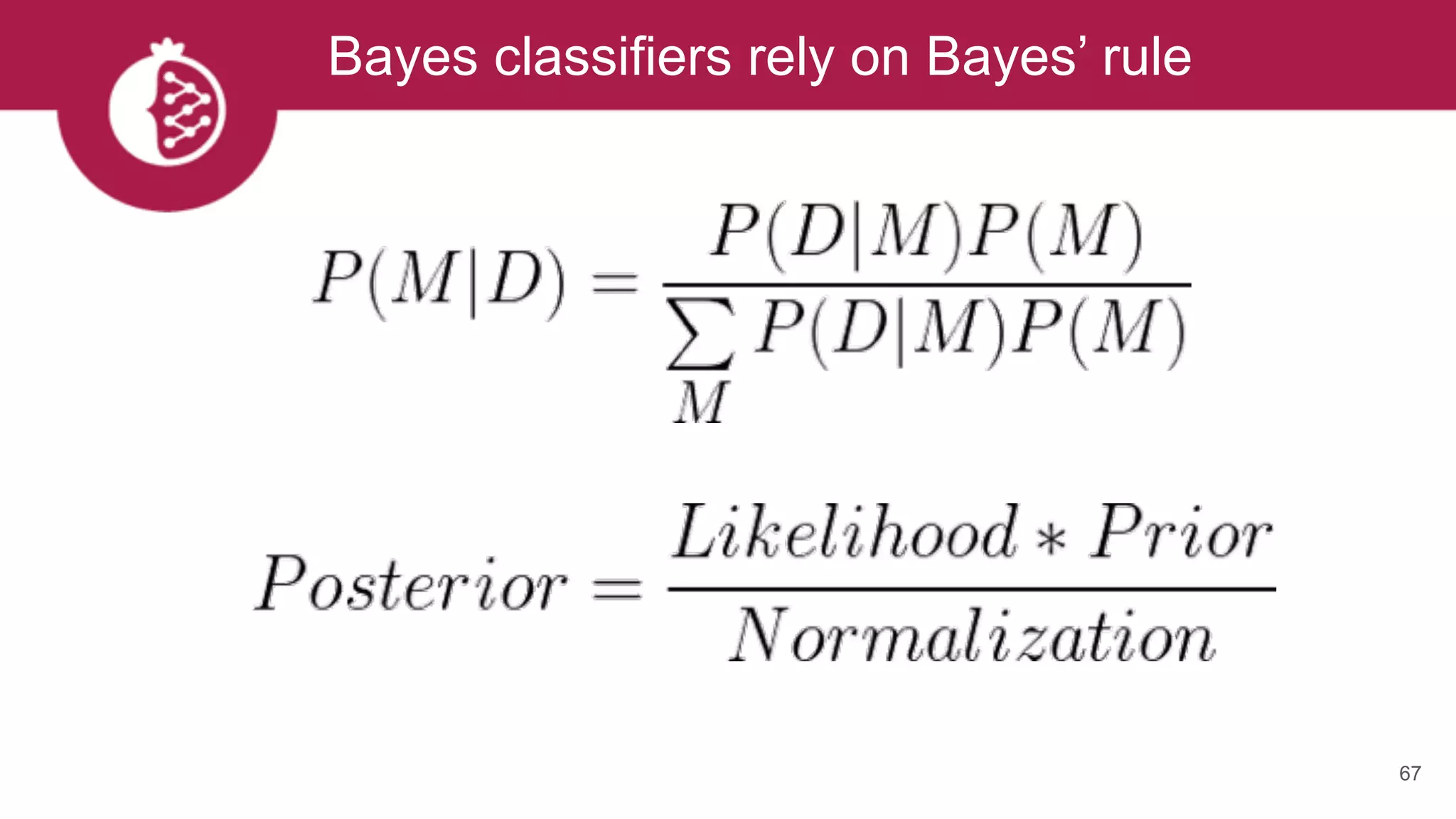
Bayes classifiers rely on Bayes’ rule
67
68
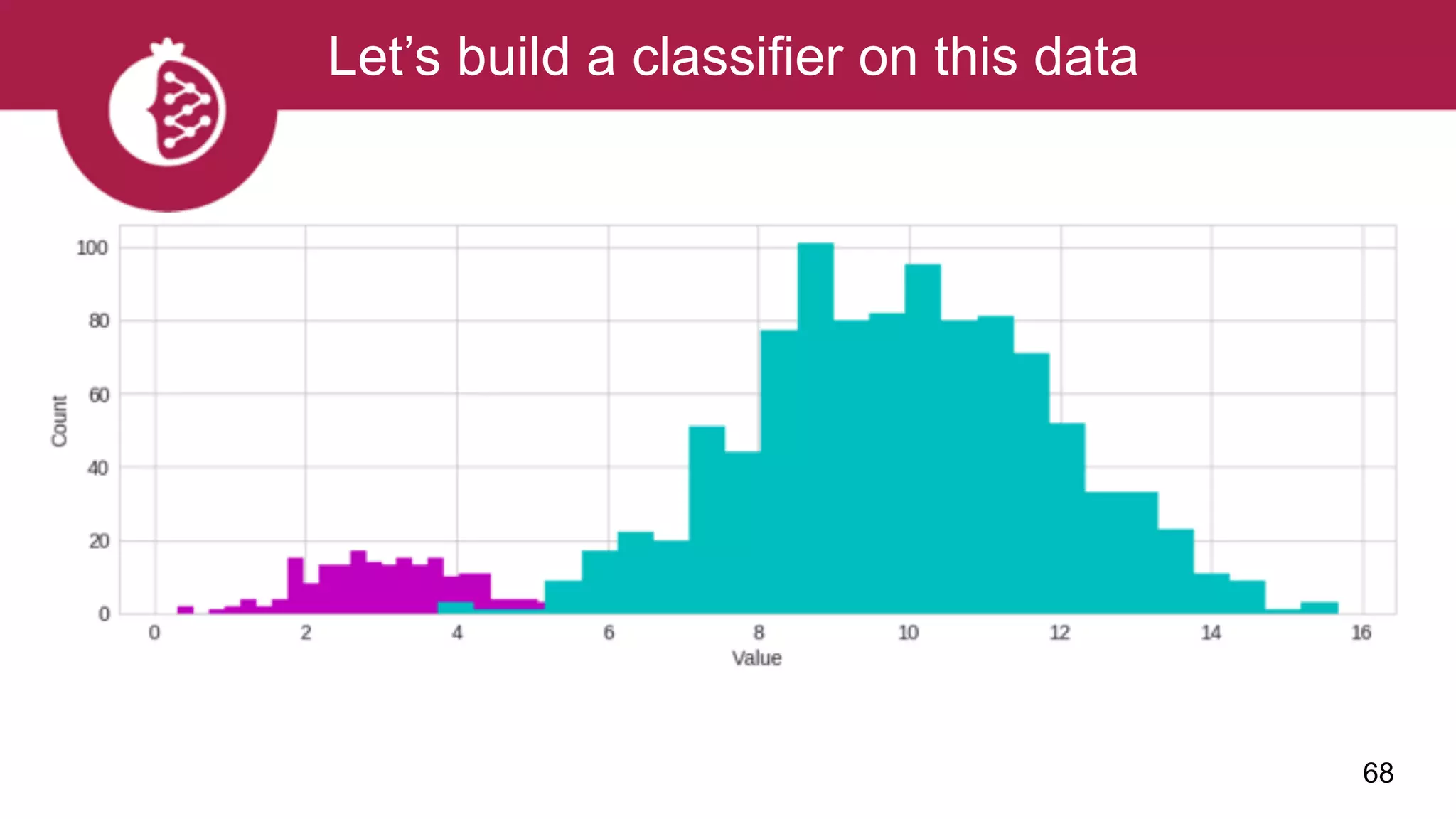
Let’s build a classifier on this data
69
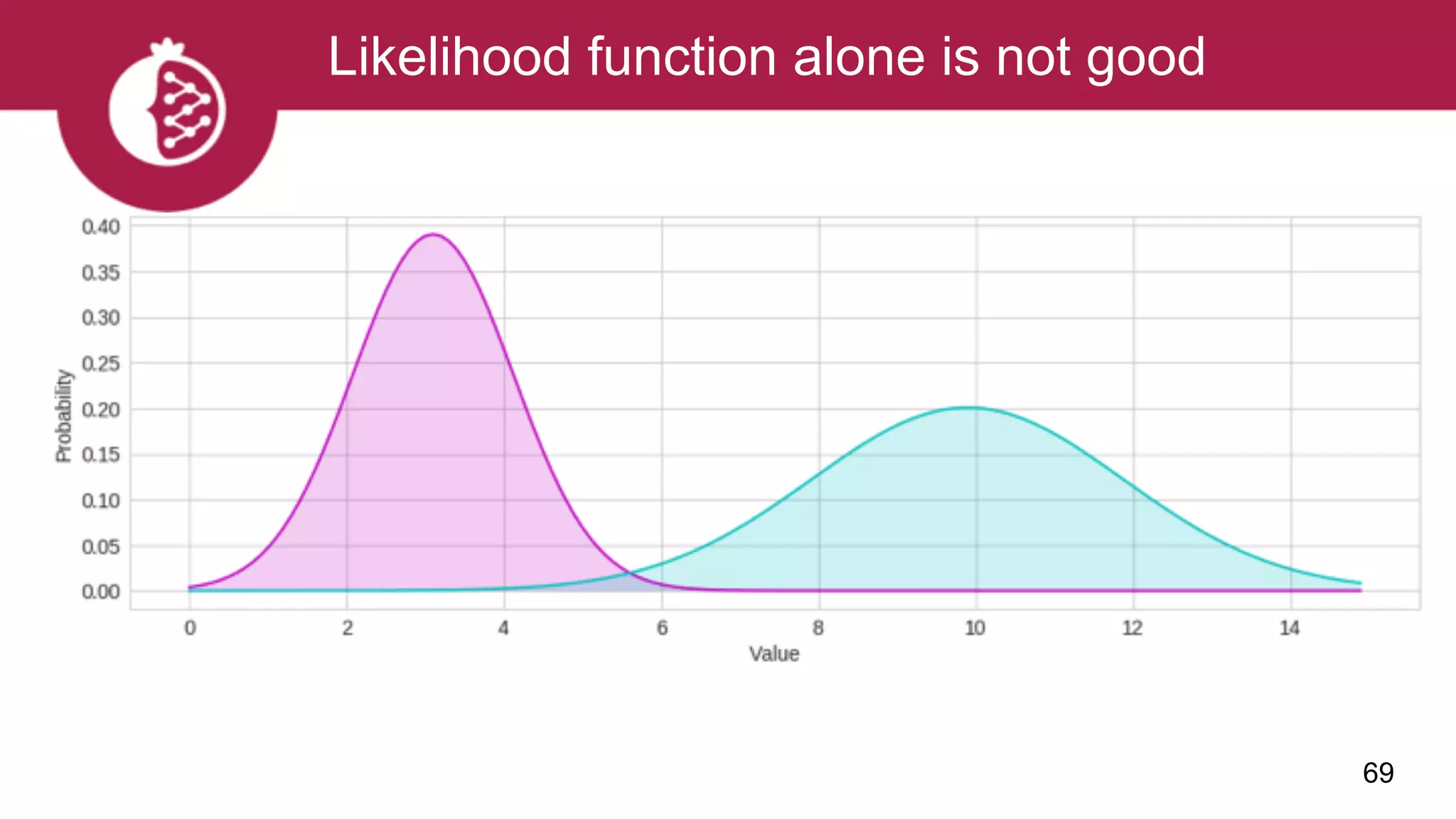
Likelihood function alone is not good
70
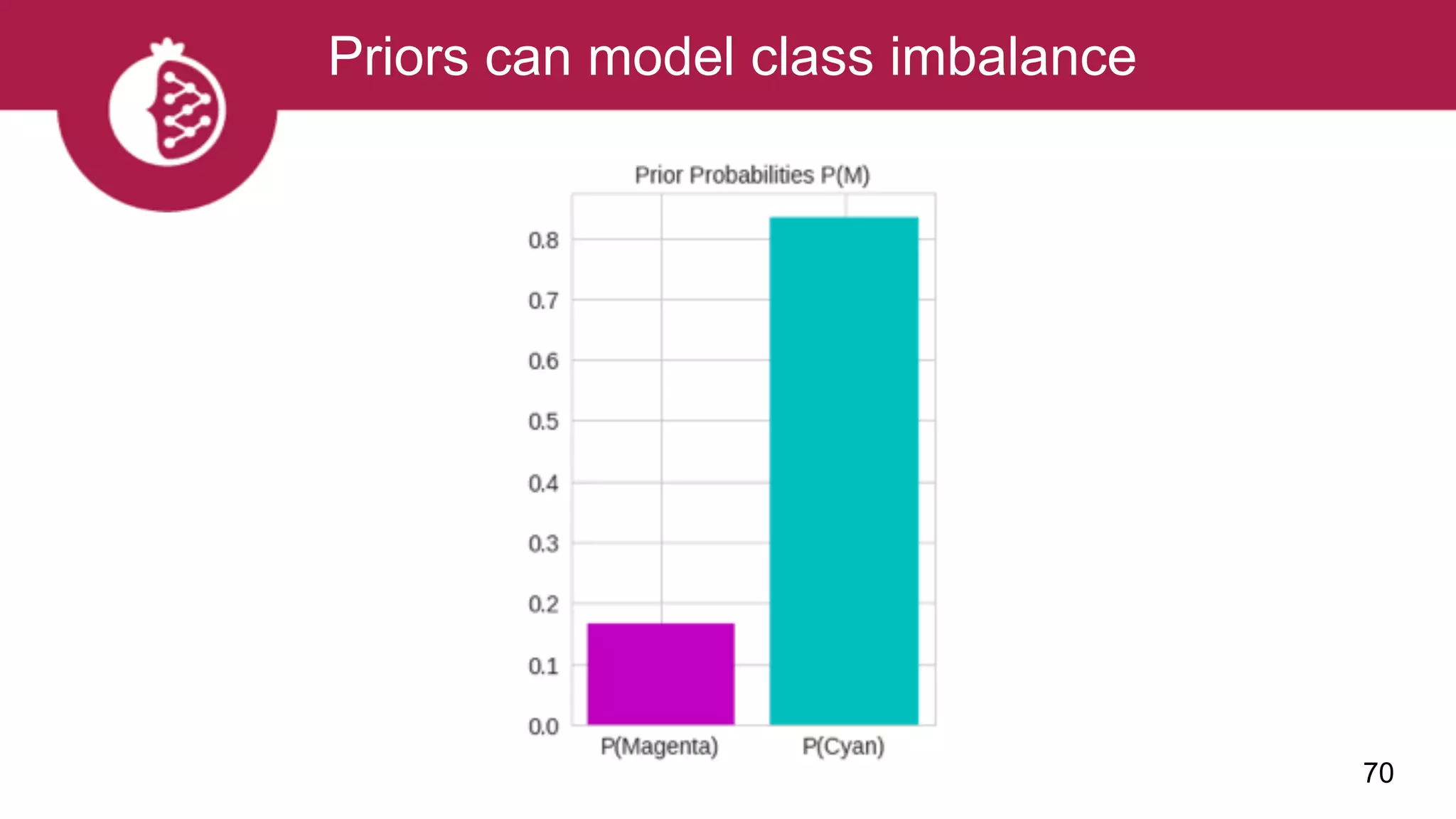
Priors can model class imbalance
71
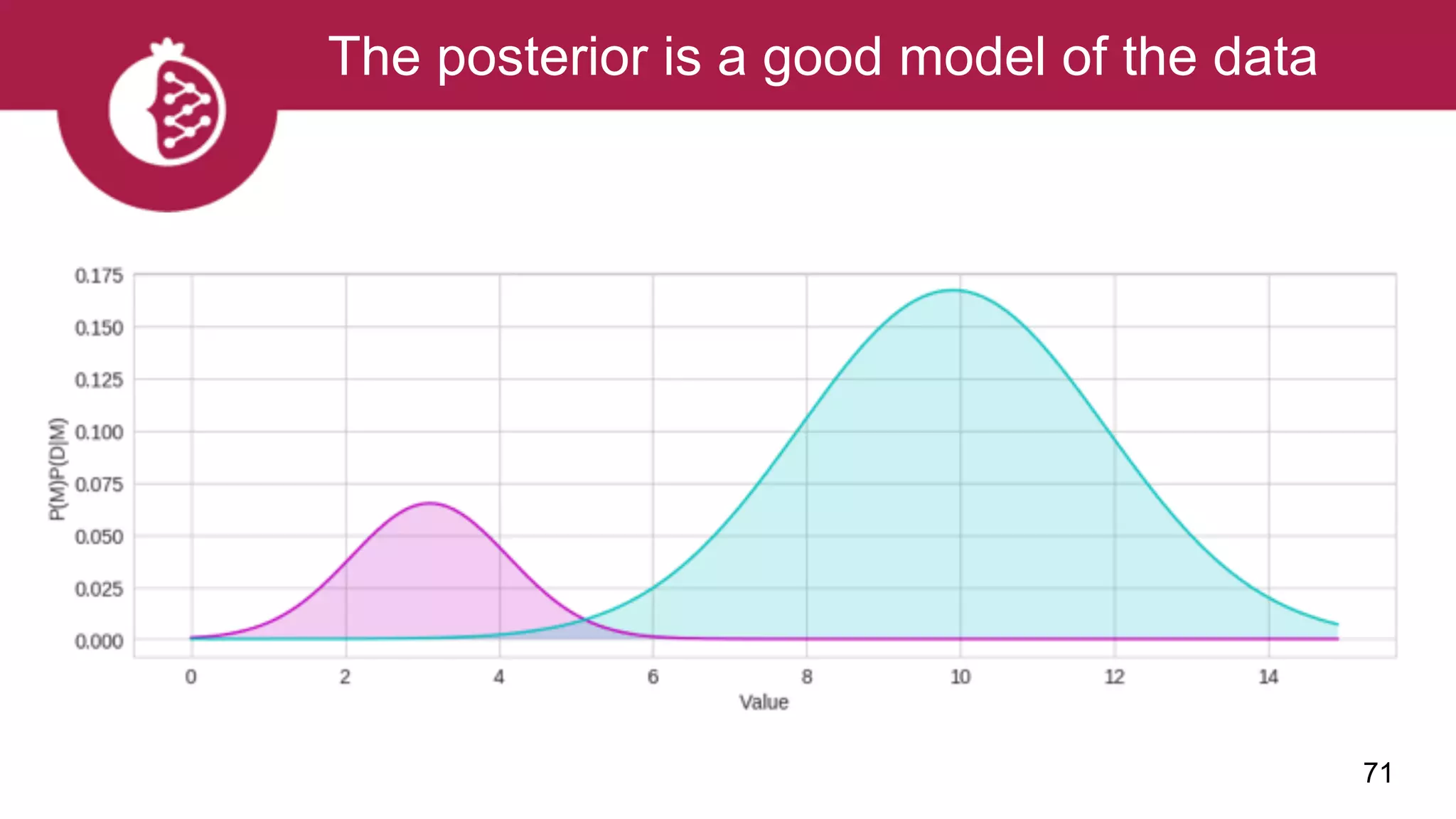
The posterior is a good model of the data
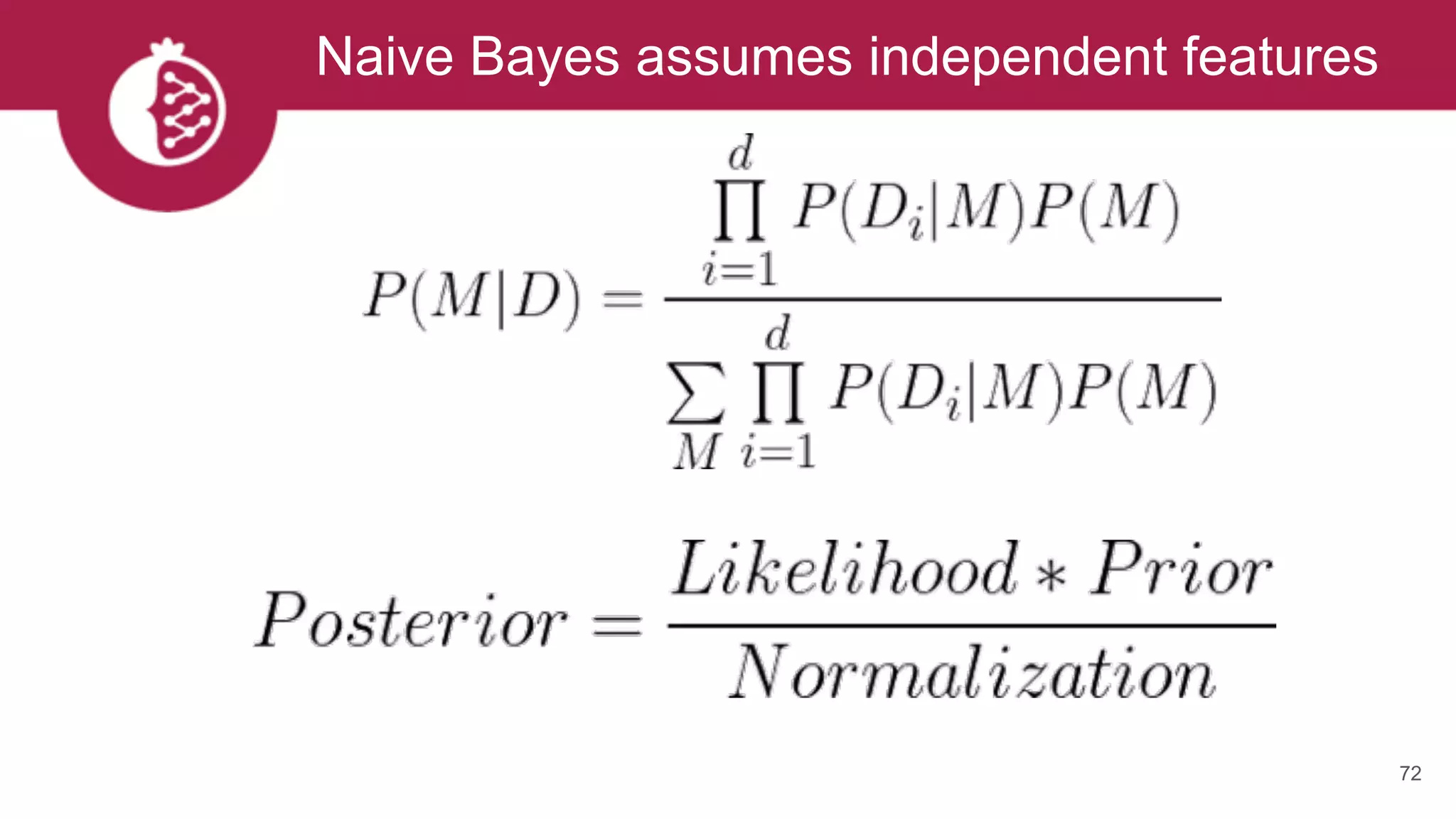
Naive Bayes assumes independent features
72
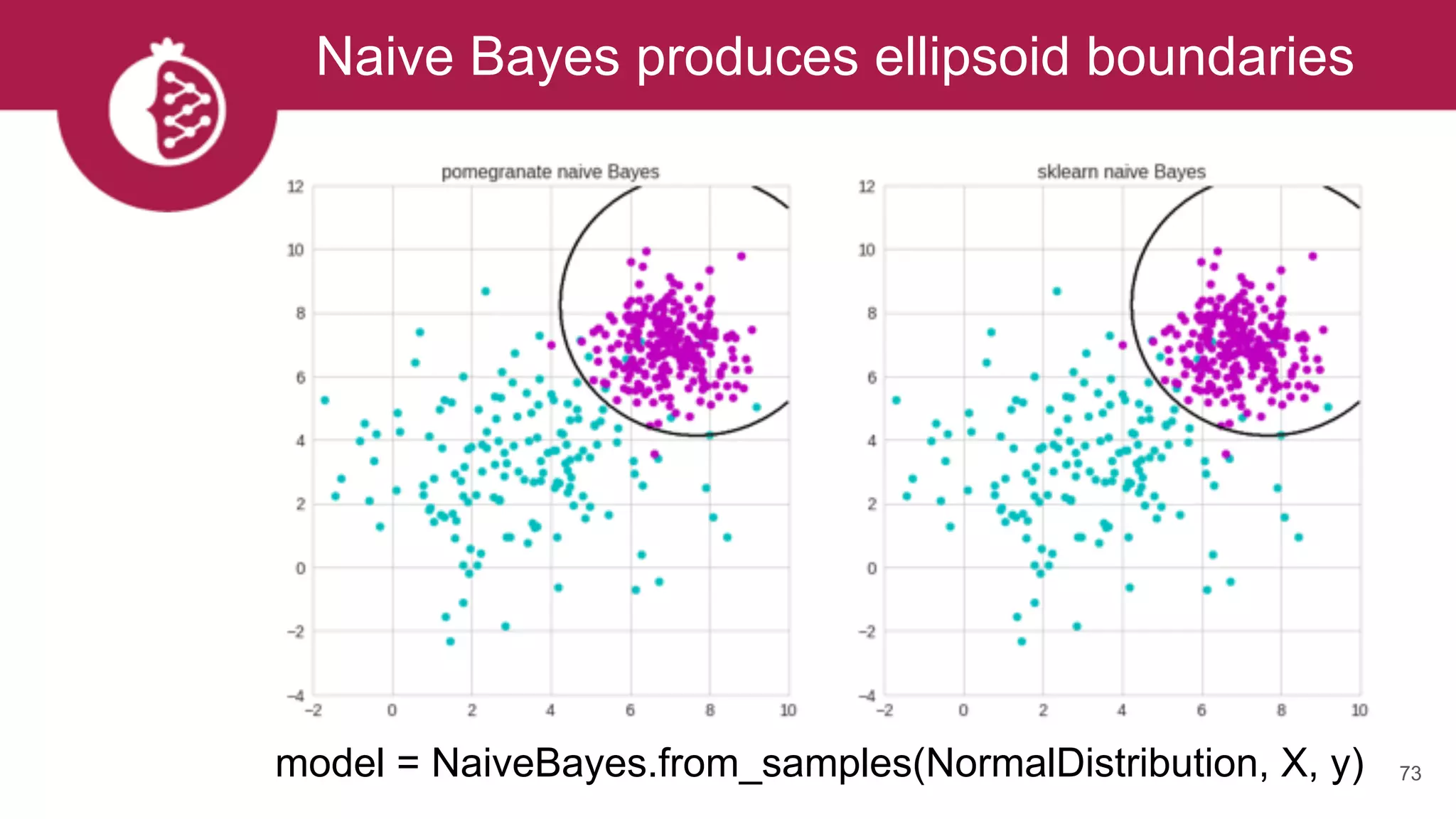
Naive Bayes produces ellipsoid boundaries
73model = NaiveBayes.from_samples(NormalDistribution, X, y)

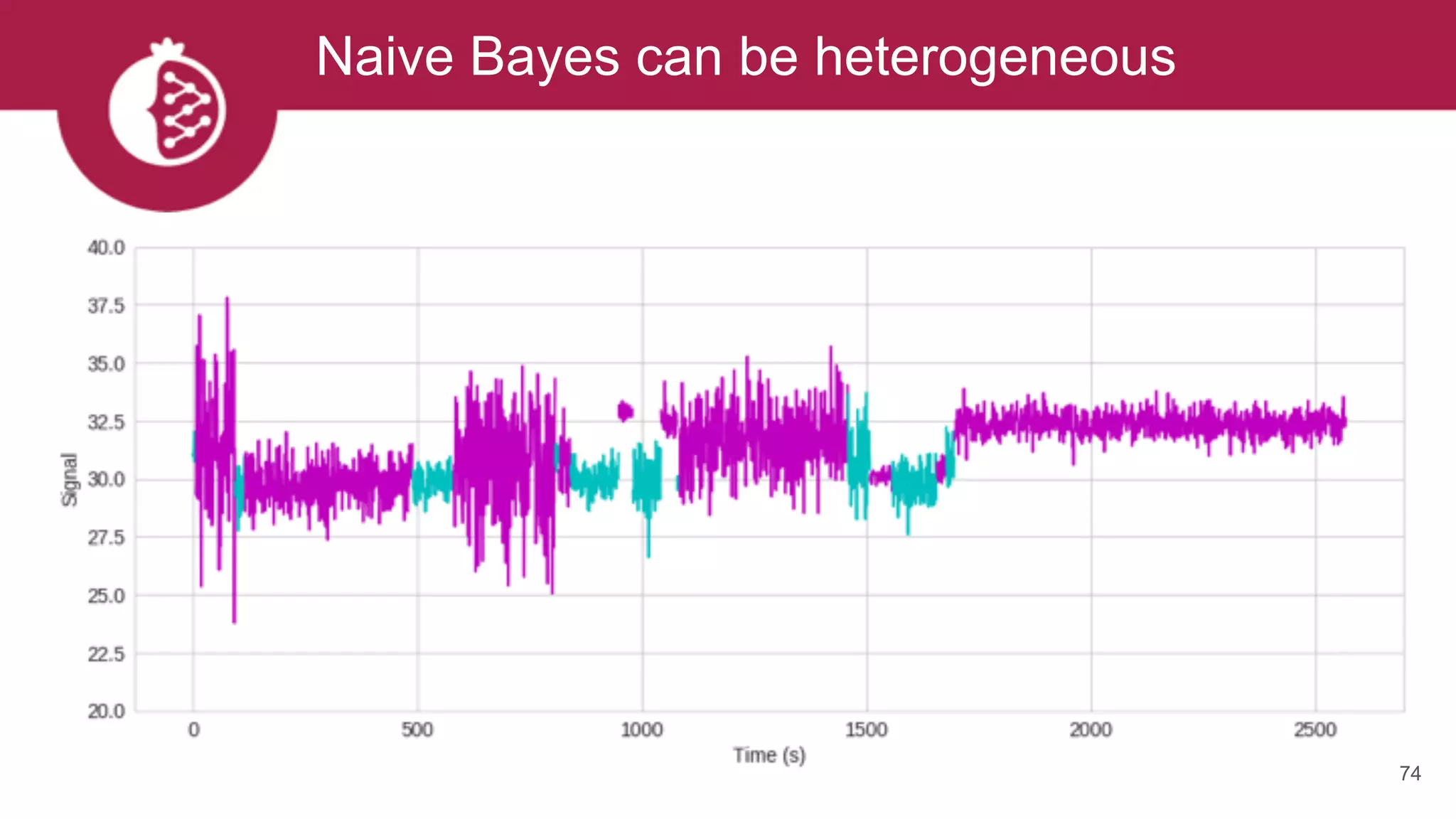
Naive Bayes can be heterogeneous
74
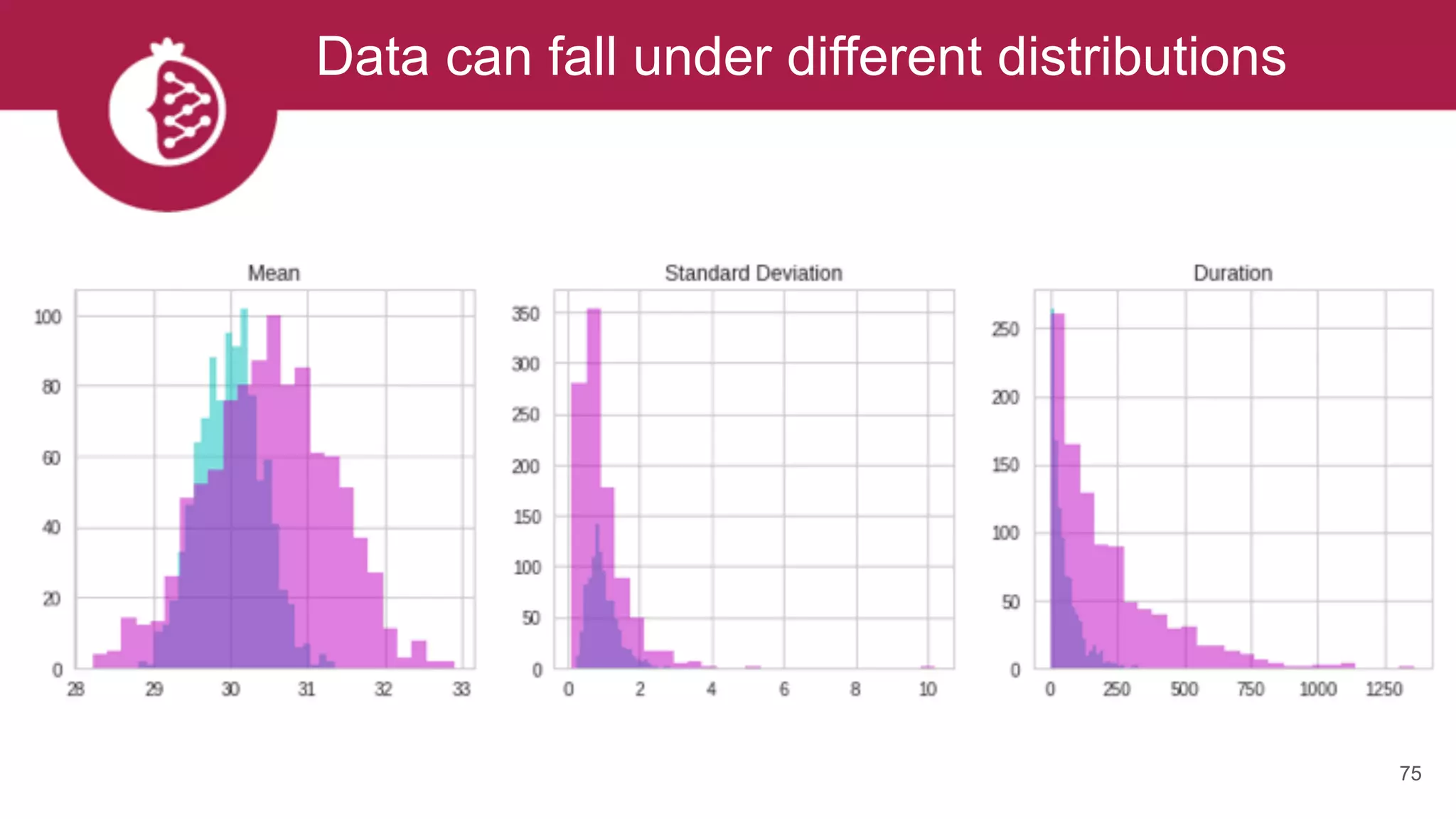
Data can fall under different distributions
75
Using appropriate distributions is better
76
model = NaiveBayes.from_samples(NormalDistribution, X_train, y_train)
print "Gaussian Naive Bayes: ", (model.predict(X_test) == y_test).mean()

clf = GaussianNB().fit(X_train, y_train)

print "sklearn Gaussian Naive Bayes: ", (clf.predict(X_test) == y_test).mean()

model = NaiveBayes.from_samples([NormalDistribution, LogNormalDistribution,
ExponentialDistribution], X_train, y_train

print "Heterogeneous Naive Bayes: ", (model.predict(X_test) == y_test).mean()
Gaussian Naive Bayes: 0.798

sklearn Gaussian Naive Bayes: 0.798

Heterogeneous Naive Bayes: 0.844
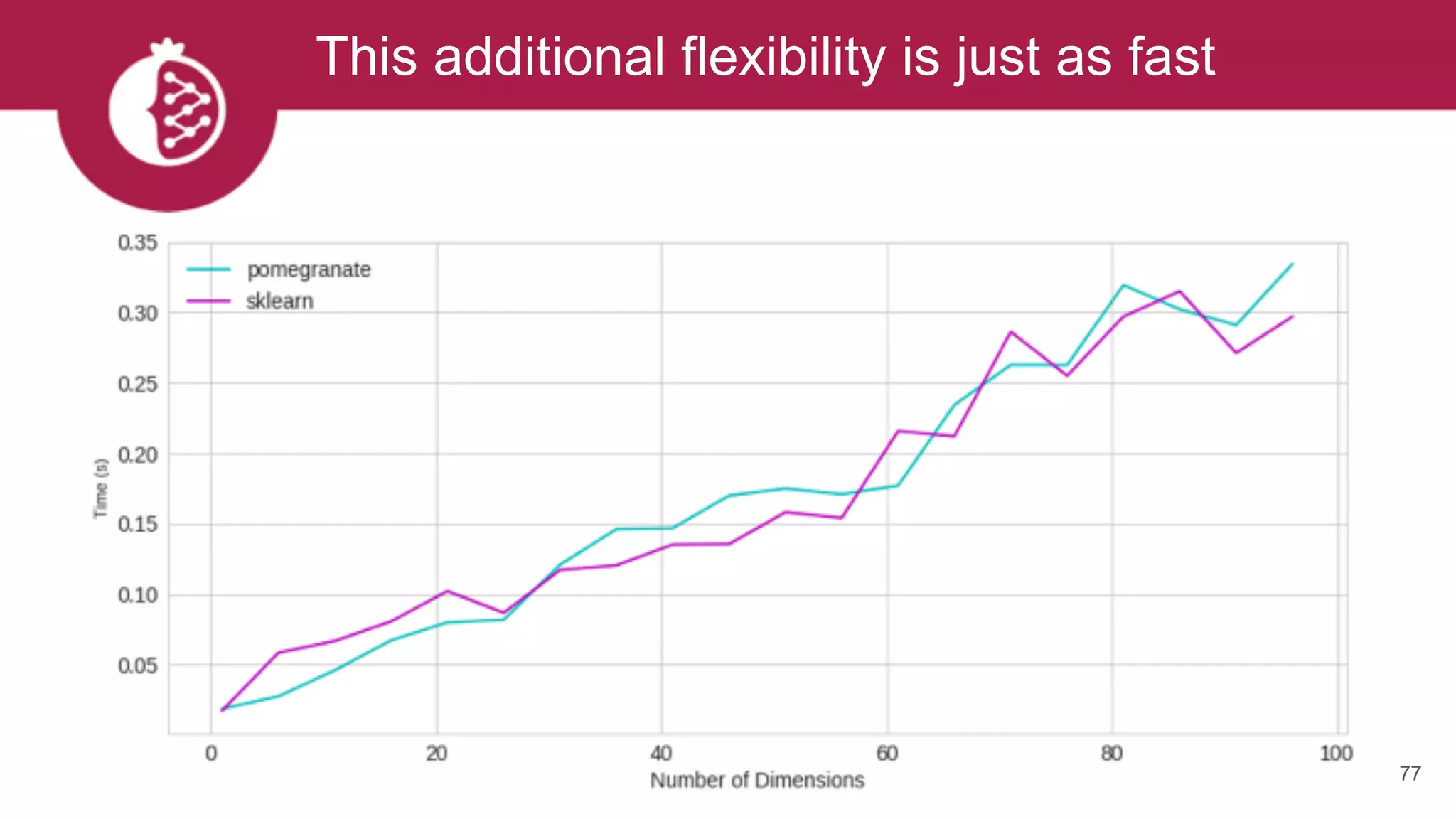
This additional flexibility is just as fast
77
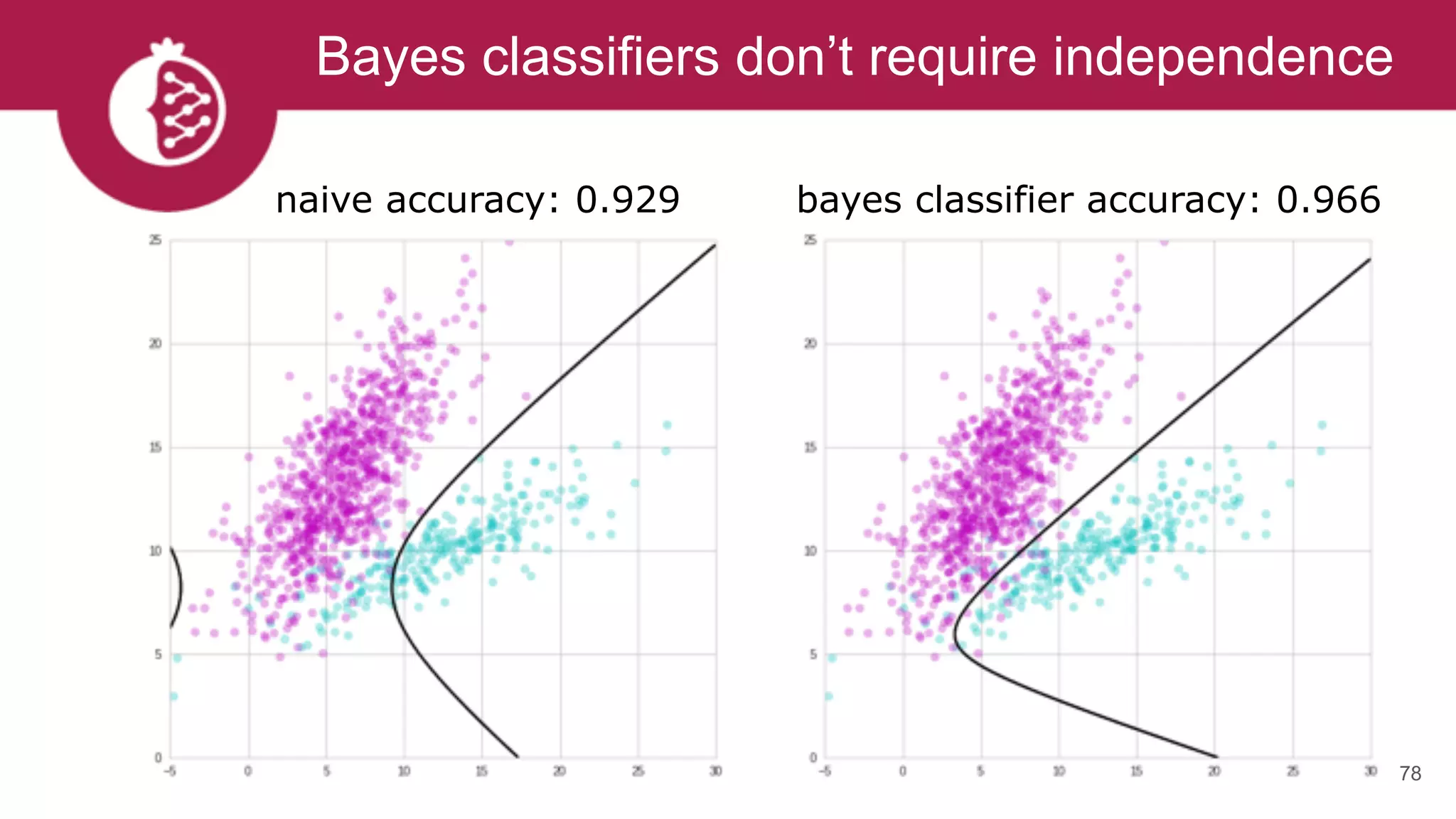
Bayes classifiers don’t require independence
78
naive accuracy: 0.929 bayes classifier accuracy: 0.966
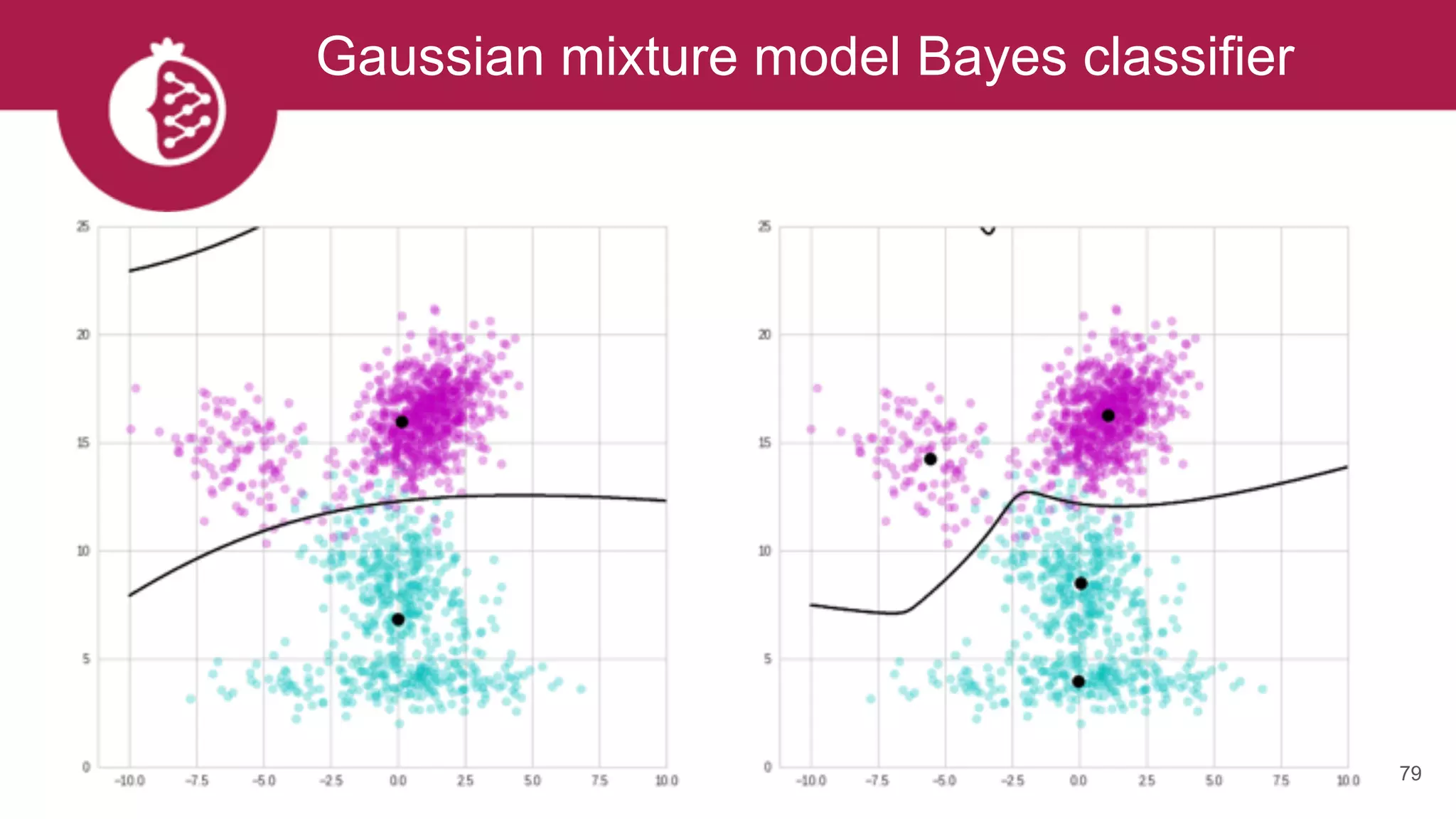
Gaussian mixture model Bayes classifier
79
Creating complex Bayes classifiers is easy
80
gmm_a = GeneralMixtureModel.from_samples(MultivariateGaussianDistribution, 2, X[y == 0])

gmm_b = GeneralMixtureModel.from_samples(MultivariateGaussianDistribution, 2, X[y == 1])

model_b = BayesClassifier([gmm_a, gmm_b], weights=numpy.array([1-y.mean(), y.mean()]))

Creating complex Bayes classifiers is easy
81
mc_a = MarkovChain.from_samples(X[y == 0])
mc_b = MarkovChain.from_samples(X[y == 1])

model_b = BayesClassifier([mc_a, mc_b], weights=numpy.array([1-y.mean(), y.mean()]))
hmm_a = HiddenMarkovModel.from_samples(X[y == 0])
hmm_b = HiddenMarkovModel.from_samples(X[y == 1])

model_b = BayesClassifier([hmm_a, hmm_b], weights=numpy.array([1-y.mean(), y.mean()]))
bn_a = BayesianNetwork.from_samples(X[y == 0])
bn_b = BayesianNetwork.from_samples(X[y == 1])

model_b = BayesClassifier([bn_a, bn_b], weights=numpy.array([1-y.mean(), y.mean()]))


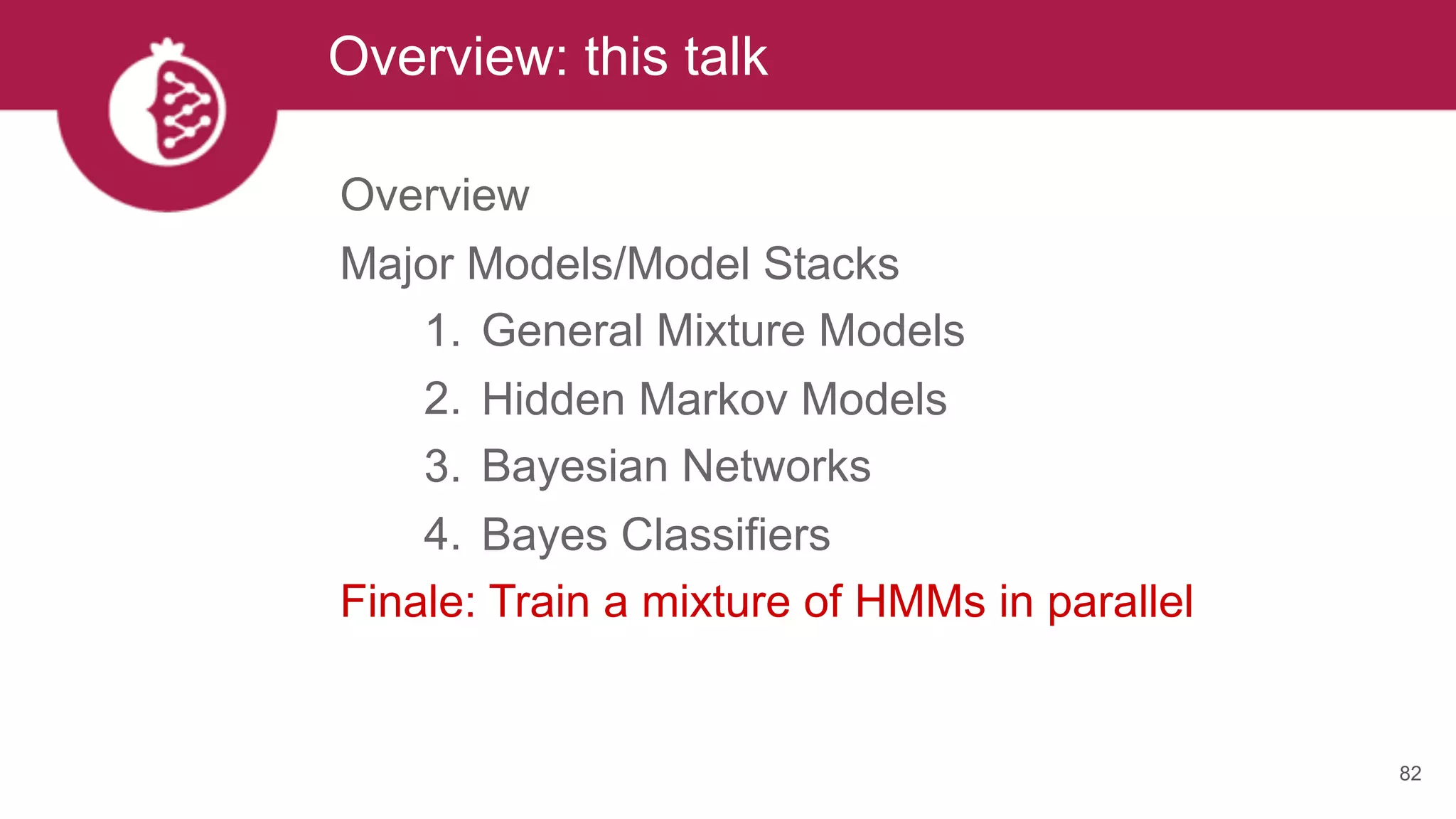
Overview: this talk
82
Overview
Major Models/Model Stacks
1. General Mixture Models
2. Hidden Markov Models
3. Bayesian Networks
4. Bayes Classifiers
Finale: Train a mixture of HMMs in parallel
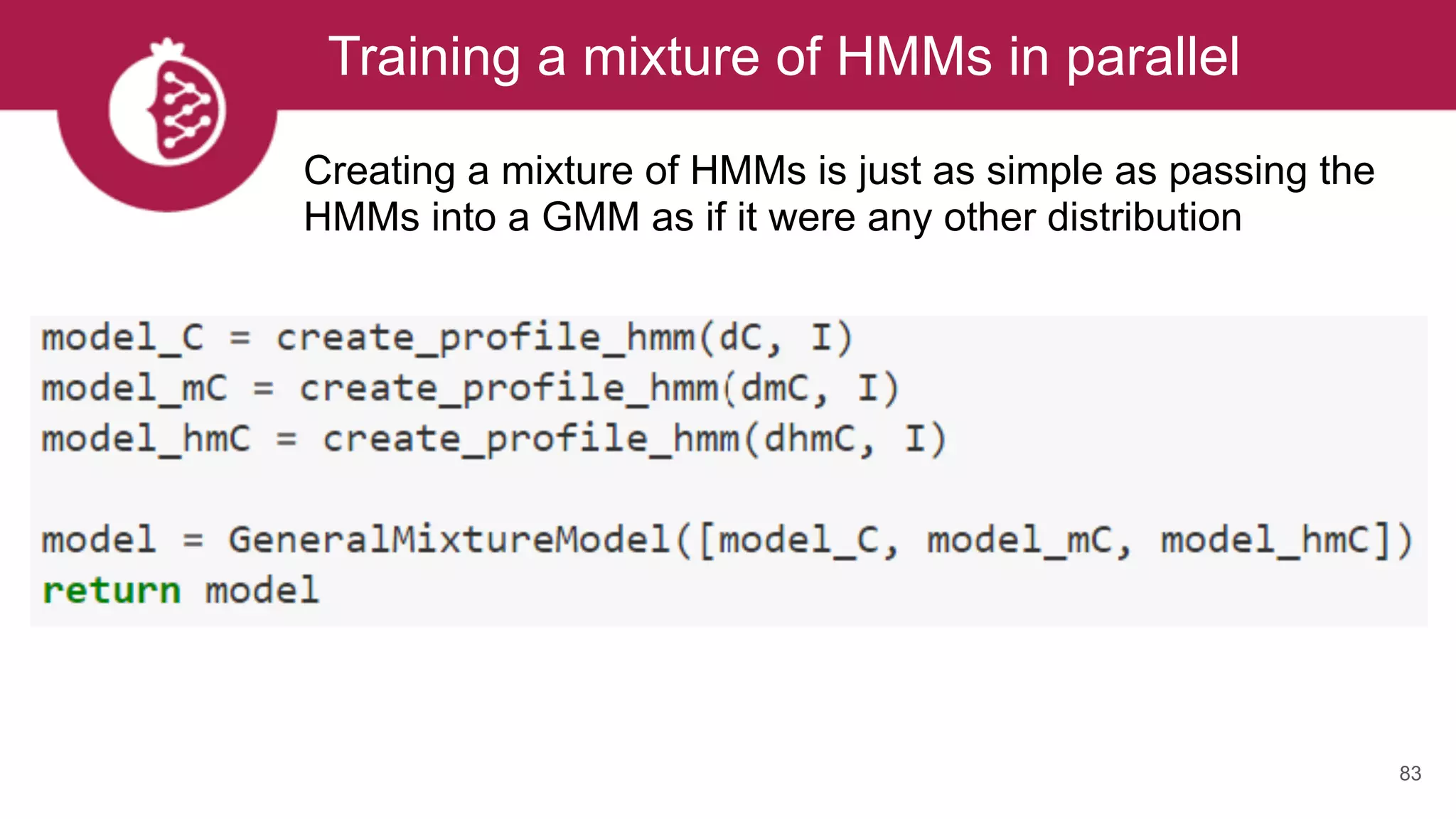
Training a mixture of HMMs in parallel
83
Creating a mixture of HMMs is just as simple as passing the
HMMs into a GMM as if it were any other distribution
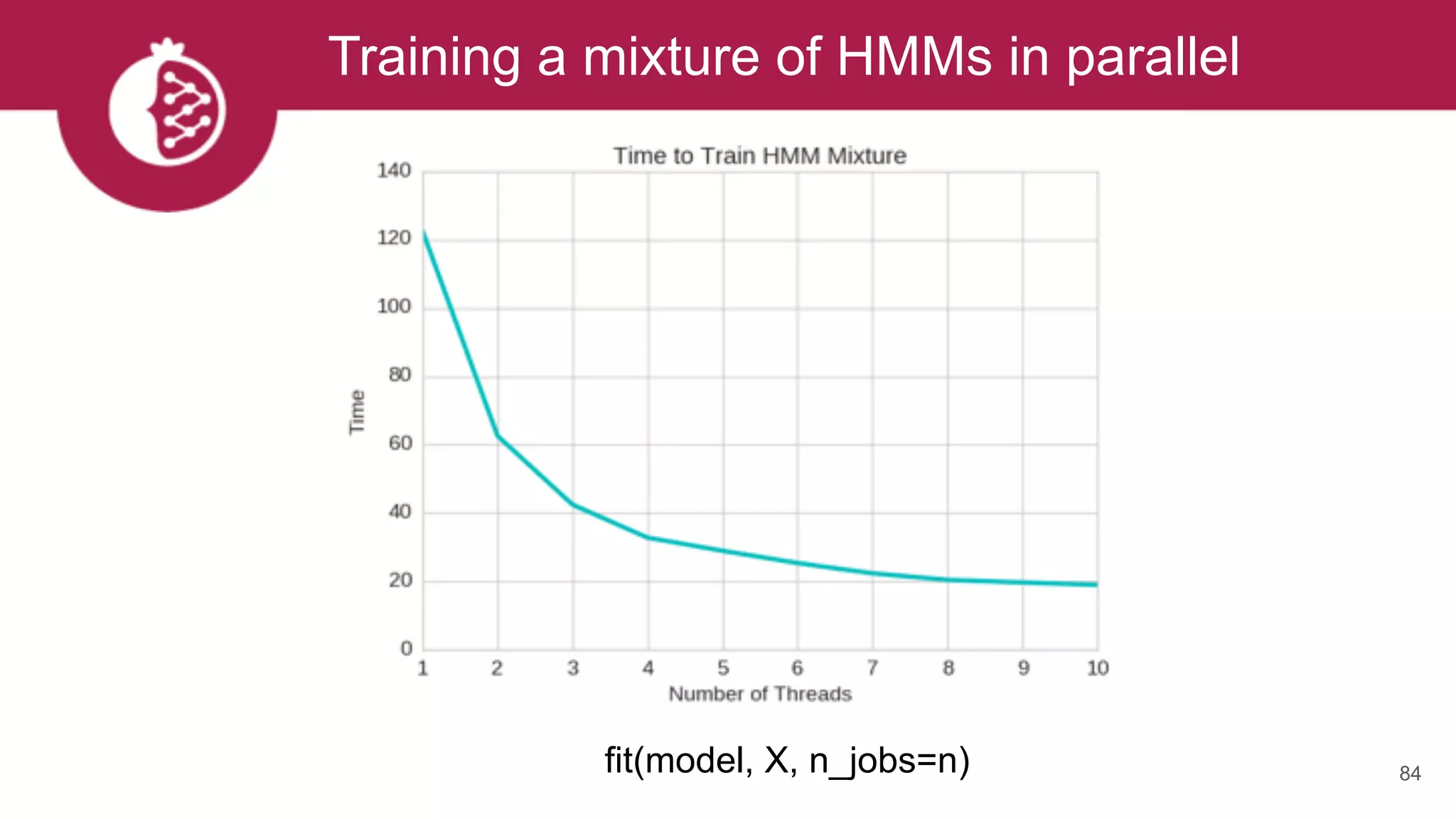
Training a mixture of HMMs in parallel
84fit(model, X, n_jobs=n)
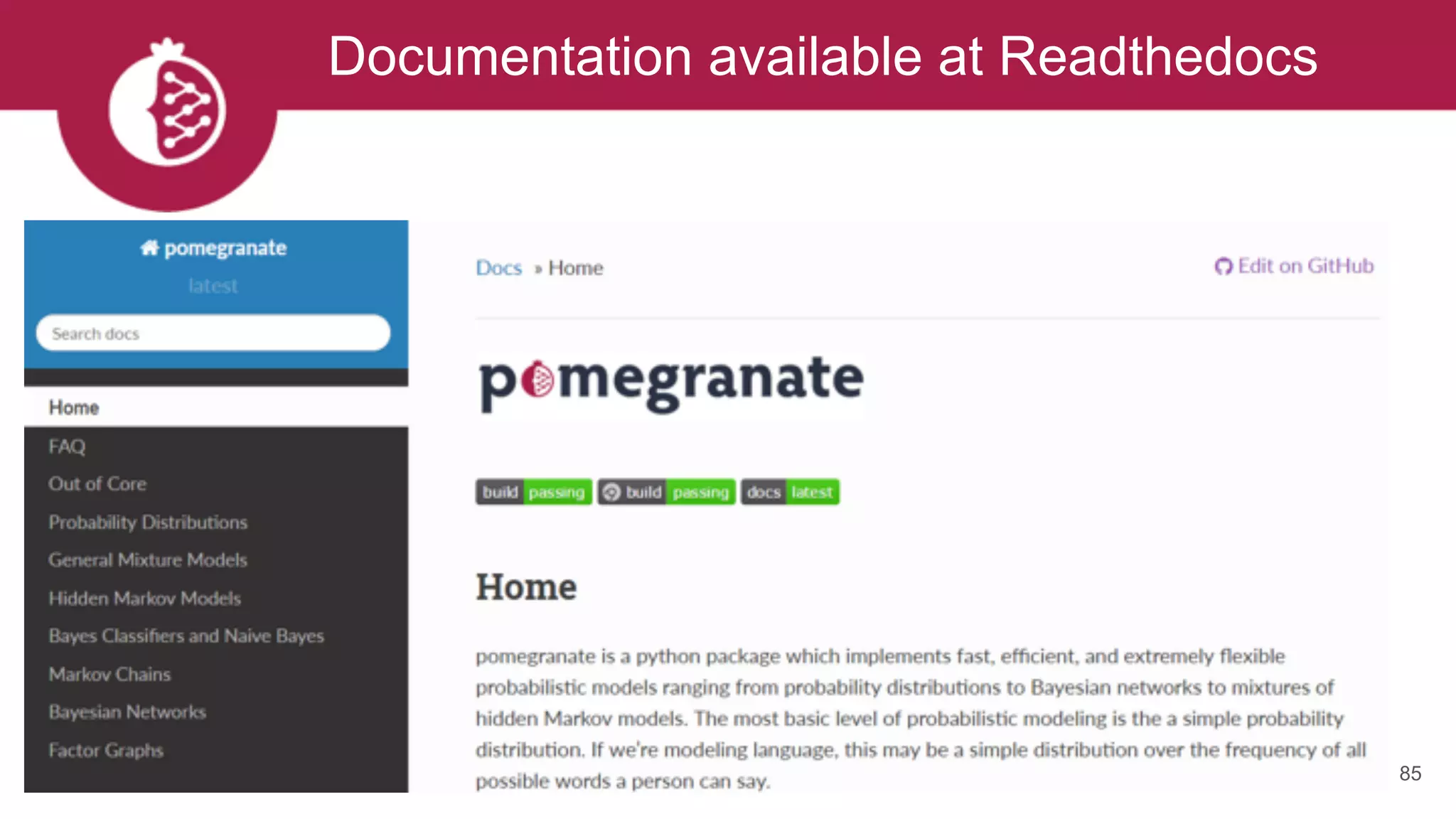
Documentation available at Readthedocs
85
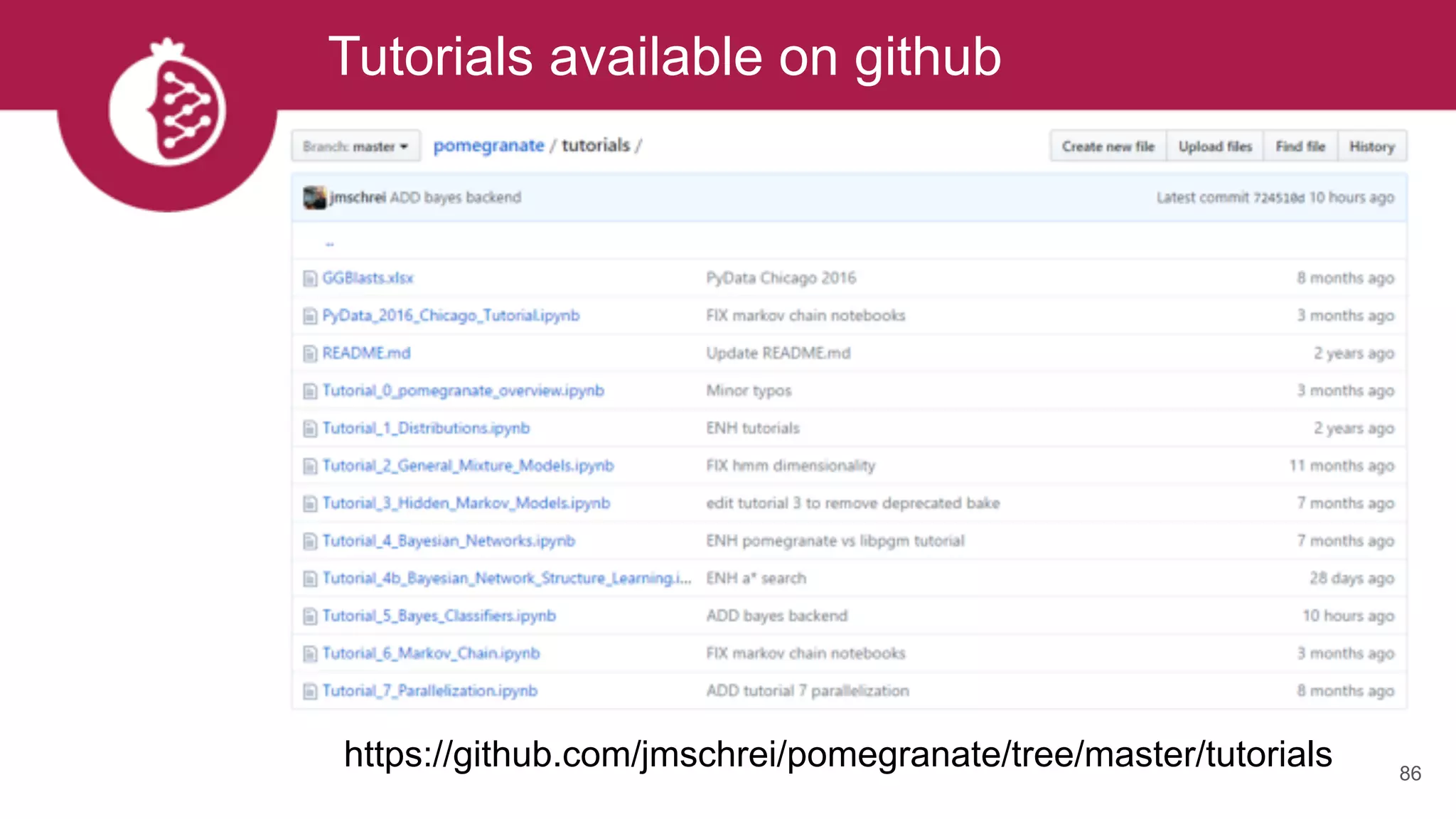
Tutorials available on github
86
https://github.com/jmschrei/pomegranate/tree/master/tutorials
Acknowledgements
87
fast and flexible probabilistic modeling in python
jmschreiber91
@jmschrei
@jmschreiber91
Jacob Schreiber
PhD student, Paul G. Allen School of
Computer Science, University of
Washington, Seattle WA
Maxwell Libbrecht
Postdoc, Department of Genome Sciences,
University of Washington, Seattle WA
Assistant Professor, Simon Fraser University,
Vancouver BC
noble.gs.washington.edu/~maxwl/

Maxwell W Libbrecht - pomegranate: fast and flexible probabilistic modeling in python

  • 1.
    fast and flexibleprobabilistic modeling in python jmschreiber91 @jmschrei @jmschreiber91 Jacob Schreiber PhD student, Paul G. Allen School of Computer Science, University of Washington, Seattle WA Maxwell Libbrecht Postdoc, Department of Genome Sciences, University of Washington, Seattle WA Assistant Professor, Simon Fraser University, Vancouver BC noble.gs.washington.edu/~maxwl/
  • 2.
    fast and flexibleprobabilistic modeling in python jmschreiber91 @jmschrei @jmschreiber91 Jacob Schreiber PhD student, Paul G. Allen School of Computer Science, University of Washington, Seattle WA Maxwell Libbrecht Postdoc, Department of Genome Sciences, University of Washington, Seattle WA Assistant Professor, Simon Fraser University, Vancouver BC noble.gs.washington.edu/~maxwl/
  • 3.
    Follow along withthe Jupyter tutorial 3 goo.gl/cbE7rs
  • 4.
    What is probabilisticmodeling? 4goo.gl/cbE7rs Tasks: • Sample from a distribution. • Learn parameters of a distribution from data. • Predict which distribution generated a data example.
  • 5.
    When should youuse pomegranate? 5 complexity of probabilistic modeling task simple complexz }| { • logistic regression • sample from a Gaussian distribution • speed is not important Use scipy or scikit-learn z }| { • distributions not implemented in pomegranate • problem-specific inference algorithms Use custom packages (in R or stand-alone) z }| { Use pomegranate goo.gl/cbE7rs
  • 6.
    When should youuse pomegranate? 6 z }| { Use pomegranate probabilistic modeling tasks orthogonaltasks • Scientific computing: Use numpy, scipy • Non-probabilistic supervised learning (SVMs, neural networks): Use scikit-learn • Visualizing probabilistic models: Use matplotlib • Bayesian statistics: Check out PyMC3 goo.gl/cbE7rs
  • 7.
    Overview: this talk 7 Overview MajorModels/Model Stacks 1. General Mixture Models 2. Hidden Markov Models 3. Bayesian Networks 4. Bayes Classifiers Finale: Train a mixture of HMMs in parallel
  • 8.
    The API iscommon to all models 8 All models have these methods! All models composed of distributions (like GMM, HMM...) have these methods too! model.log_probability(X) / model.probability(X) model.sample() model.fit(X, weights, inertia) model.summarize(X, weights) model.from_summaries(inertia) model.predict(X) model.predict_proba(X) model.predict_log_proba(X) Model.from_samples(X, weights) goo.gl/cbE7rs
  • 9.
    Overview: supported models SixMain Models: 1. Probability Distributions 2. General Mixture Models 3. Markov Chains 4. Hidden Markov Models 5. Bayes Classifiers / Naive Bayes 6. Bayesian Networks 9 Two Helper Models: 1. k-means++/kmeans|| 2. Factor Graphs
  • 10.
    pomegranate supports manydistributions 10 Univariate Distributions 1. UniformDistribution 2. BernoulliDistribution 3. NormalDistribution 4. LogNormalDistribution 5. ExponentialDistribution 6. BetaDistribution 7. GammaDistribution 8. DiscreteDistribution 9. PoissonDistribution Kernel Densities 1. GaussianKernelDensity 2. UniformKernelDensity 3. TriangleKernelDensity Multivariate Distributions 1. IndependentComponentsDistributio n 2. MultivariateGaussianDistribution 3. DirichletDistribution 4. ConditionalProbabilityTable 5. JointProbabilityTable
  • 11.
  • 12.
    12 Models can belearned from data X = numpy.random.normal(0, 1, 100) a = NormalDistribution.from_samples(X)
  • 13.
    Overview: model stackingin pomegranate 13 Distributions Bayes Classifiers Markov Chains General Mixture Models Hidden Markov Models Bayesian Networks D BC MC GMM HMM BN Sub-model Wrapper model
  • 14.
    Overview: model stackingin pomegranate 14 Distributions Bayes Classifiers Markov Chains General Mixture Models Hidden Markov Models Bayesian Networks D BC MC GMM HMM BN Sub-model Wrapper model
  • 15.
    Overview: model stackingin pomegranate 15 Distributions Bayes Classifiers Markov Chains General Mixture Models Hidden Markov Models Bayesian Networks D BC MC GMM HMM BN Sub-model Wrapper model
  • 16.
    Overview: model stackingin pomegranate 16 Distributions Bayes Classifiers Markov Chains General Mixture Models Hidden Markov Models Bayesian Networks D BC MC GMM HMM BN
  • 17.
    17 pomegranate can befaster than numpy Fitting a Normal Distribution to 1,000 samples
  • 18.
    18 pomegranate can befaster than numpy Fitting Multivariate Gaussian to 10,000,000 samples of 10 dimensions
  • 19.
  • 20.
  • 21.
    21 pomegranate uses additivesummarization pomegranate reduces data to sufficient statistics for updates and so only has to go datasets once (for all models). Here is an example of the Normal Distribution sufficient statistics
  • 22.
    22 pomegranate supports out-of-corelearning Batches from a dataset can be reduced to additive summary statistics, enabling exact updates from data that can’t fit in memory.
  • 23.
    23 Parallelization exploits additivesummaries Extract summaries + + + + New Parameters
  • 24.
    24 pomegranate supports semisupervisedlearning Summary statistics from supervised models can be added to summary statistics from unsupervised models to train a single model on a mixture of labeled and unlabeled data.
  • 25.
    25 pomegranate supports semisupervisedlearning Supervised Accuracy: 0.93 Semisupervised Accuracy: 0.96
  • 26.
    26 pomegranate can befaster than scipy
  • 27.
  • 29.
  • 30.
    30 Example ‘blast’ fromGossip Girl Spotted: Lonely Boy. Can't believe the love of his life has returned. If only she knew who he was. But everyone knows Serena. And everyone is talking. Wonder what Blair Waldorf thinks. Sure, they're BFF's, but we always thought Blair's boyfriend Nate had a thing for Serena.
  • 31.
    31 How do weencode these ‘blasts’? Better lock it down with Nate, B. Clock's ticking. +1 Nate -1 Blair
  • 32.
    32 How do weencode these ‘blasts’? This just in: S and B committing a crime of fashion. Who doesn't love a five-finger discount. Especially if it's the middle one. -1 Blair -1 Serena
  • 33.
  • 34.
    34 Beta distributions canmodel uncertainty
  • 35.
    35 Beta distributions canmodel uncertainty
  • 36.
    36 Beta distributions canmodel uncertainty
  • 37.
    Overview: this talk 37 Overview MajorModels/Model Stacks 1. General Mixture Models 2. Hidden Markov Models 3. Bayesian Networks 4. Bayes Classifiers Finale: Train a mixture of HMMs in parallel
  • 38.
    GMMs can modelcomplex distributions 38
  • 39.
    GMMs can modelcomplex distributions 39 model = GeneralMixtureModel.from_samples(NormalDistribution, 2, X)
  • 40.
    GMMs can modelcomplex distributions 40
  • 41.
    An exponential distributionis not right 41 model = ExponentialDistribution.from_samples(X)
  • 42.
    A mixture ofexponentials is better 42 model = GeneralMixtureModel.from_samples(ExponentialDistribution, 2, X)
  • 43.
    Heterogeneous mixtures nativelysupported 43 model = GeneralMixtureModel.from_samples([ExponentialDistribution, UniformDistribution], 2, X)
  • 44.
    GMMs faster thansklearn 44
  • 45.
    Overview: this talk 45 Overview MajorModels/Model Stacks 1. General Mixture Models 2. Hidden Markov Models 3. Bayesian Networks 4. Bayes Classifiers Finale: Train a mixture of HMMs in parallel
  • 46.
    CG enrichment detectionHMM 46 GACTACGACTCGCGCTCGCACGTCGCTCGACATCATCGACA
  • 47.
    CG enrichment detectionHMM GACTACGACTCGCGCTCGCACGTCGCTCGACATCATCGACA 47
  • 48.
    pomegranate HMMs arefeature rich 48
  • 49.
    GMM-HMM easy todefine 49
  • 50.
    HMMs are fasterthan hmmlearn 50
  • 51.
    Overview: this talk 51 Overview MajorModels/Model Stacks 1. General Mixture Models 2. Hidden Markov Models 3. Bayesian Networks 4. Bayes Classifiers Finale: Train a mixture of HMMs in parallel
  • 52.
    Bayesian networks 52 Bayesian networksare powerful inference tools which define a dependency structure between variables. Sprinkler Wet Grass Rain
  • 53.
    Bayesian networks 53 Sprinkler Wet Grass Rain Twomain difficult tasks: (1) Inference given incomplete information (2) Learning the dependency structure from data
  • 54.
    Bayesian network inference 54 Inferenceis done using Belief Bropagation on a factor graph. Messages are sent from one side to the other until convergence. Rain Sprinkler Grass Wet R/S/GW Factor Grass Wet Rain Sprinkler Marginals Factors
  • 55.
    Inference in amedical diagnostic network 55 BRCA 2 BRCA 1 LCT BLOATLE LOA VOM AC PREGLIOC
  • 56.
    Inference in amedical diagnostic network 56 BRCA 2 BRCA 1 LCT BLOATLE LOA VOM AC PREGLIOC
  • 57.
    Bayesian network structurelearning 57 ??? Three primary ways: ● “Search and score” / Exact ● “Constraint Learning” / PC ● Heuristics
  • 58.
    Bayesian network structurelearning 58 ??? pomegranate supports: ● “Search and score” / Exact ● “Constraint Learning” / PC ● Heuristics
  • 59.
    Exact structure learningis intractable ??? 59
  • 60.
    Chow-Liu trees arefast approximations 60
  • 61.
  • 62.
    Constraint graphs mergedata + knowledge 62 BRCA 2 BRCA 1 LCT BLOATLE LOA VOM AC PREGLIOC genetic conditions conditions symptoms
  • 63.
    Constraint graphs mergedata + knowledge 63 genetic conditions diseases symptoms
  • 64.
    Modeling the globalstock market 64
  • 65.
  • 66.
    Overview: this talk 66 Overview MajorModels/Model Stacks 1. General Mixture Models 2. Hidden Markov Models 3. Bayesian Networks 4. Bayes Classifiers Finale: Train a mixture of HMMs in parallel
  • 67.
    Bayes classifiers relyon Bayes’ rule 67
  • 68.
    68 Let’s build aclassifier on this data
  • 69.
  • 70.
    70 Priors can modelclass imbalance
  • 71.
    71 The posterior isa good model of the data
  • 72.
    Naive Bayes assumesindependent features 72
  • 73.
    Naive Bayes producesellipsoid boundaries 73model = NaiveBayes.from_samples(NormalDistribution, X, y)

  • 74.
    Naive Bayes canbe heterogeneous 74
  • 75.
    Data can fallunder different distributions 75
  • 76.
    Using appropriate distributionsis better 76 model = NaiveBayes.from_samples(NormalDistribution, X_train, y_train) print "Gaussian Naive Bayes: ", (model.predict(X_test) == y_test).mean()
 clf = GaussianNB().fit(X_train, y_train)
 print "sklearn Gaussian Naive Bayes: ", (clf.predict(X_test) == y_test).mean()
 model = NaiveBayes.from_samples([NormalDistribution, LogNormalDistribution, ExponentialDistribution], X_train, y_train
 print "Heterogeneous Naive Bayes: ", (model.predict(X_test) == y_test).mean() Gaussian Naive Bayes: 0.798
 sklearn Gaussian Naive Bayes: 0.798
 Heterogeneous Naive Bayes: 0.844
  • 77.
    This additional flexibilityis just as fast 77
  • 78.
    Bayes classifiers don’trequire independence 78 naive accuracy: 0.929 bayes classifier accuracy: 0.966
  • 79.
    Gaussian mixture modelBayes classifier 79
  • 80.
    Creating complex Bayesclassifiers is easy 80 gmm_a = GeneralMixtureModel.from_samples(MultivariateGaussianDistribution, 2, X[y == 0])
 gmm_b = GeneralMixtureModel.from_samples(MultivariateGaussianDistribution, 2, X[y == 1])
 model_b = BayesClassifier([gmm_a, gmm_b], weights=numpy.array([1-y.mean(), y.mean()]))

  • 81.
    Creating complex Bayesclassifiers is easy 81 mc_a = MarkovChain.from_samples(X[y == 0]) mc_b = MarkovChain.from_samples(X[y == 1])
 model_b = BayesClassifier([mc_a, mc_b], weights=numpy.array([1-y.mean(), y.mean()])) hmm_a = HiddenMarkovModel.from_samples(X[y == 0]) hmm_b = HiddenMarkovModel.from_samples(X[y == 1])
 model_b = BayesClassifier([hmm_a, hmm_b], weights=numpy.array([1-y.mean(), y.mean()])) bn_a = BayesianNetwork.from_samples(X[y == 0]) bn_b = BayesianNetwork.from_samples(X[y == 1])
 model_b = BayesClassifier([bn_a, bn_b], weights=numpy.array([1-y.mean(), y.mean()]))
 

  • 82.
    Overview: this talk 82 Overview MajorModels/Model Stacks 1. General Mixture Models 2. Hidden Markov Models 3. Bayesian Networks 4. Bayes Classifiers Finale: Train a mixture of HMMs in parallel
  • 83.
    Training a mixtureof HMMs in parallel 83 Creating a mixture of HMMs is just as simple as passing the HMMs into a GMM as if it were any other distribution
  • 84.
    Training a mixtureof HMMs in parallel 84fit(model, X, n_jobs=n)
  • 85.
  • 86.
    Tutorials available ongithub 86 https://github.com/jmschrei/pomegranate/tree/master/tutorials
  • 87.
  • 88.
    fast and flexibleprobabilistic modeling in python jmschreiber91 @jmschrei @jmschreiber91 Jacob Schreiber PhD student, Paul G. Allen School of Computer Science, University of Washington, Seattle WA Maxwell Libbrecht Postdoc, Department of Genome Sciences, University of Washington, Seattle WA Assistant Professor, Simon Fraser University, Vancouver BC noble.gs.washington.edu/~maxwl/