MATH 401: LOGIC & PROOF TECHNIQUES Copyright © Nahid Sultana 2014-2015. 
Dr. Nahid Sultana Email: nszakir@ud.edu.sa 
Chapter-4: More on Direct Proof and Proof by Contrapositive 
10/10/2014 
1
Topics 2 
 
Proofs Involving Divisibility of Integers 
 
Proofs Involving Congruence of Integers 
 
Proofs Involving Real Numbers 
 
Proofs Involving sets 
 
Fundamental Properties of Set Operations 
 
Proofs Involving Cartesian Products of Sets 10/10/2014 Copyright © Nahid Sultana 2014-2015.
3 
Definition: For integers a and b with a≠0, we say that 
a divides b or b is divisible by a if there is an integer c such that b=ac, and is written as a|b. 
If a does not divide b, then we write a b. 
Example: 3|6 and -4 |28 ? 
Yes because 6 = 3 . 2 and 28 = (-4) . (-7). 
Proofs Involving Divisibility of Integers 
|/ 
Copyright © Nahid Sultana 2014-2015. 10/10/2014
Proofs Involving Divisibility of Integers (Cont…) 4 
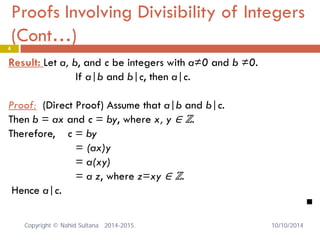
Result: Let a, b, and c be integers with a≠0 and b ≠0. 
If a|b and b|c, then a|c. 
Proof: (Direct Proof) Assume that a|b and b|c. 
Then b = ax and c = by, where x, y ∈ ℤ. 
Therefore, c = by 
= (ax)y 
= a(xy) 
= a z, where z=xy ∈ ℤ. 
Hence a|c. 
 Copyright © Nahid Sultana 2014-2015. 10/10/2014
Proofs Involving Divisibility of Integers (Cont…) 5 
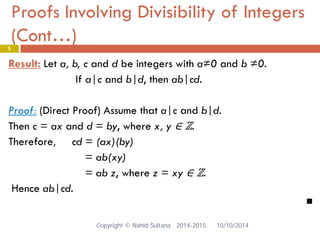
Result: Let a, b, c and d be integers with a≠0 and b ≠0. 
If a|c and b|d, then ab|cd. 
Proof: (Direct Proof) Assume that a|c and b|d. 
Then c = ax and d = by, where x, y ∈ ℤ. 
Therefore, cd = (ax)(by) 
= ab(xy) 
= ab z, where z = xy ∈ ℤ. 
Hence ab|cd. 
 Copyright © Nahid Sultana 2014-2015. 10/10/2014
Proofs Involving Divisibility of Integers (Cont…) 6 
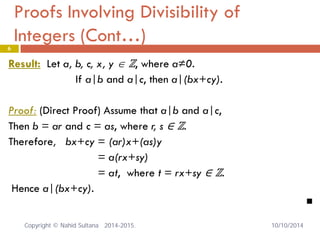
Result: Let a, b, c, x, y ∈ ℤ, where a≠0. 
If a|b and a|c, then a|(bx+cy). 
Proof: (Direct Proof) Assume that a|b and a|c, 
Then b = ar and c = as, where r, s ∈ ℤ. 
Therefore, bx+cy = (ar)x+(as)y 
= a(rx+sy) 
= at, where t = rx+sy ∈ ℤ. 
Hence a|(bx+cy). 
 Copyright © Nahid Sultana 2014-2015. 10/10/2014
Proofs Involving Divisibility of Integers (Cont…) 7 
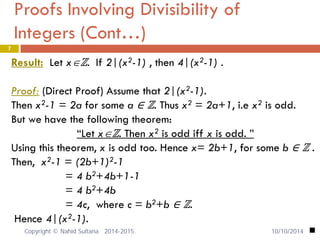
Result: Let x∈ℤ. If 2|(x2-1) , then 4|(x2-1) . 
Proof: (Direct Proof) Assume that 2|(x2-1). 
Then x2-1 = 2a for some a ∈ ℤ. Thus x2 = 2a+1, i.e x2 is odd. 
But we have the following theorem: 
“Let x∈ℤ. Then x2 is odd iff x is odd. ” 
Using this theorem, x is odd too. Hence x= 2b+1, for some b ∈ ℤ . 
Then, x2-1 = (2b+1)2-1 
= 4 b2+4b+1-1 
= 4 b2+4b 
= 4c, where c = b2+b ∈ ℤ. 
Hence 4|(x2-1). 
 10/10/2014 Copyright © Nahid Sultana 2014-2015.
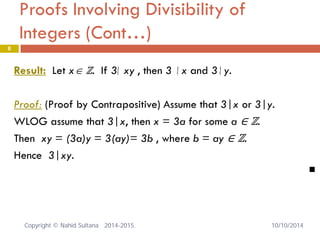
Proofs Involving Divisibility of Integers (Cont…) 8 
Result: Let x∈ ℤ. If 3 xy , then 3 x and 3 y. 
Proof: (Proof by Contrapositive) Assume that 3|x or 3|y. 
WLOG assume that 3|x, then x = 3a for some a ∈ ℤ. 
Then xy = (3a)y = 3(ay)= 3b , where b = ay ∈ ℤ. 
Hence 3|xy. 
 
|/|/|/ 
Copyright © Nahid Sultana 2014-2015. 10/10/2014
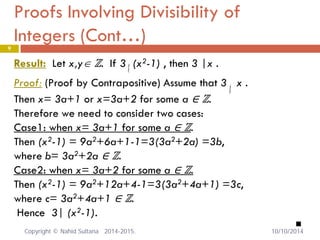
Proofs Involving Divisibility of Integers (Cont…) 9 
Result: Let x,y∈ ℤ. If 3 (x2-1) , then 3 |x . 
Proof: (Proof by Contrapositive) Assume that 3 x . 
Then x= 3a+1 or x=3a+2 for some a ∈ ℤ. 
Therefore we need to consider two cases: 
Case1: when x= 3a+1 for some a ∈ ℤ. 
Then (x2-1) = 9a2+6a+1-1=3(3a2+2a) =3b, 
where b= 3a2+2a ∈ ℤ. 
Case2: when x= 3a+2 for some a ∈ ℤ. 
Then (x2-1) = 9a2+12a+4-1=3(3a2+4a+1) =3c, 
where c= 3a2+4a+1 ∈ ℤ. 
Hence 3| (x2-1). 
 
|/ |/ 
Copyright © Nahid Sultana 2014-2015. 10/10/2014
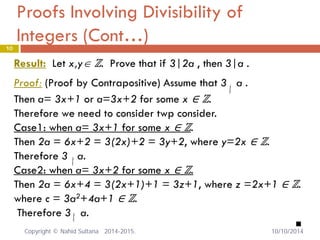
Proofs Involving Divisibility of Integers (Cont…) 10 
Result: Let x,y∈ ℤ. Prove that if 3|2a , then 3|a . 
Proof: (Proof by Contrapositive) Assume that 3 a . 
Then a= 3x+1 or a=3x+2 for some x ∈ ℤ. 
Therefore we need to consider twp consider. 
Case1: when a= 3x+1 for some x ∈ ℤ. 
Then 2a = 6x+2 = 3(2x)+2 = 3y+2, where y=2x ∈ ℤ. 
Therefore 3 a. 
Case2: when a= 3x+2 for some x ∈ ℤ. 
Then 2a = 6x+4 = 3(2x+1)+1 = 3z+1, where z =2x+1 ∈ ℤ. 
where c = 3a2+4a+1 ∈ ℤ. 
Therefore 3 a. 
 
|/ |/ |/ 
Copyright © Nahid Sultana 2014-2015. 10/10/2014
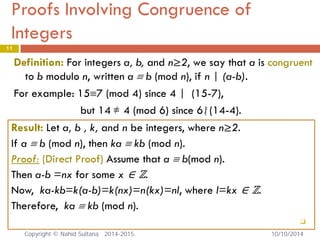
Proofs Involving Congruence of Integers 11 
Definition: For integers a, b, and n≥2, we say that a is congruent to b modulo n, written a ≡ b (mod n), if n | (a-b). 
For example: 15≡7 (mod 4) since 4 | (15-7), 
but 14 4 (mod 6) since 6 (14-4). 
≡/|/ 
Result: Let a, b , k, and n be integers, where n≥2. If a ≡ b (mod n), then ka ≡ kb (mod n). Proof: (Direct Proof) Assume that a ≡ b(mod n). Then a-b =nx for some x ∈ ℤ. Now, ka-kb=k(a-b)=k(nx)=n(kx)=nl, where l=kx ∈ ℤ. Therefore, ka ≡ kb (mod n). 
 
10/10/2014 Copyright © Nahid Sultana 2014-2015.
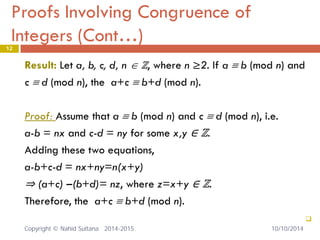
Proofs Involving Congruence of Integers (Cont…) 12 
Result: Let a, b, c, d, n ∈ ℤ, where n ≥2. If a ≡ b (mod n) and 
c ≡ d (mod n), the a+c ≡ b+d (mod n). 
Proof: Assume that a ≡ b (mod n) and c ≡ d (mod n), i.e. 
a-b = nx and c-d = ny for some x,y ∈ ℤ. 
Adding these two equations, 
a-b+c-d = nx+ny=n(x+y) 
⇒ (a+c) –(b+d)= nz, where z=x+y ∈ ℤ. 
Therefore, the a+c ≡ b+d (mod n). 
 
10/10/2014 Copyright © Nahid Sultana 2014-2015.
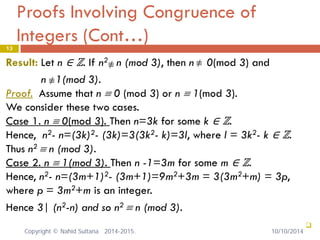
Proofs Involving Congruence of Integers (Cont…) 13 
Result: Let n ∈ ℤ. If n2 n (mod 3), then n 0(mod 3) and 
n 1(mod 3). 
Proof. Assume that n ≡ 0 (mod 3) or n ≡ 1(mod 3). 
We consider these two cases. 
Case 1. n ≡ 0(mod 3). Then n=3k for some k ∈ ℤ. 
Hence, n2- n=(3k)2- (3k)=3(3k2- k)=3l, where l = 3k2- k ∈ ℤ. 
Thus n2 ≡ n (mod 3). 
Case 2. n ≡ 1(mod 3). Then n -1=3m for some m ∈ ℤ. 
Hence, n2- n=(3m+1)2- (3m+1)=9m2+3m = 3(3m2+m) = 3p, 
where p = 3m2+m is an integer. 
Hence 3| (n2-n) and so n2 ≡ n (mod 3). 
 
≡/≡/ ≡/ 
Copyright © Nahid Sultana 2014-2015. 10/10/2014
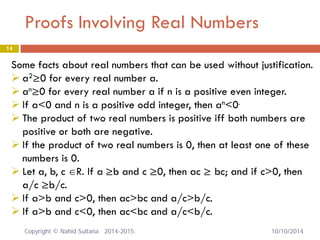
Proofs Involving Real Numbers 14 
Some facts about real numbers that can be used without justification. 
 
a2≥0 for every real number a. 
 
an≥0 for every real number a if n is a positive even integer. 
 
If a<0 and n is a positive odd integer, then an<0. 
 
The product of two real numbers is positive iff both numbers are positive or both are negative. 
 
If the product of two real numbers is 0, then at least one of these numbers is 0. 
 
Let a, b, c ∈R. If a ≥b and c ≥0, then ac ≥ bc; and if c>0, then a/c ≥b/c. 
 
If a>b and c>0, then ac>bc and a/c>b/c. 
 
If a>b and c<0, then ac<bc and a/c<b/c. Copyright © Nahid Sultana 2014-2015. 10/10/2014
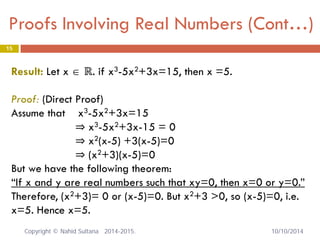
Proofs Involving Real Numbers (Cont…) 15 
Result: Let x ∈ ℝ. if x3-5x2+3x=15, then x =5. Proof: (Direct Proof) Assume that x3-5x2+3x=15 ⇒ x3-5x2+3x-15 = 0 ⇒ x2(x-5) +3(x-5)=0 ⇒ (x2+3)(x-5)=0 But we have the following theorem: “If x and y are real numbers such that xy=0, then x=0 or y=0.” Therefore, (x2+3)= 0 or (x-5)=0. But x2+3 >0, so (x-5)=0, i.e. x=5. Hence x=5. Copyright © Nahid Sultana 2014-2015. 10/10/2014
Proofs Involving Real Numbers (Cont…) 16 
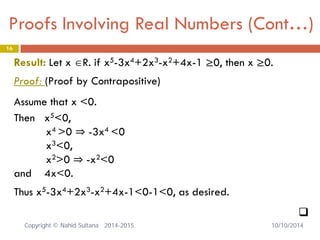
Result: Let x ∈R. if x5-3x4+2x3-x2+4x-1 ≥0, then x ≥0. Proof: (Proof by Contrapositive) Assume that x <0. Then x5<0, x4 >0 ⇒ -3x4 <0 x3<0, x2>0 ⇒ -x2<0 and 4x<0. Thus x5-3x4+2x3-x2+4x-1<0-1<0, as desired. 
 
Copyright © Nahid Sultana 2014-2015. 10/10/2014
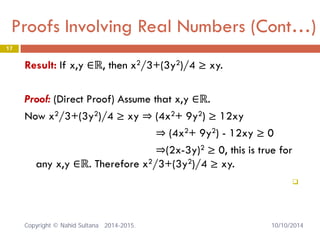
Result: If x,y ∈ℝ, then x2/3+(3y2)/4 ≥ xy. 
Proof: (Direct Proof) Assume that x,y ∈ℝ. 
Now x2/3+(3y2)/4 ≥ xy ⇒ (4x2+ 9y2) ≥ 12xy 
⇒ (4x2+ 9y2) - 12xy ≥ 0 
⇒(2x-3y)2 ≥ 0, this is true for any x,y ∈ℝ. Therefore x2/3+(3y2)/4 ≥ xy. 
 
17 
Proofs Involving Real Numbers (Cont…) Copyright © Nahid Sultana 2014-2015. 10/10/2014
Proofs Involving sets 18 
 
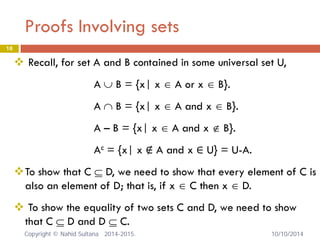
Recall, for set A and B contained in some universal set U, A ∪ B = {x| x ∈ A or x ∈ B}. A ∩ B = {x| x ∈ A and x ∈ B}. A – B = {x| x ∈ A and x ∉ B}. Ac = {x| x ∉ A and x ∈ U} = U-A. 
 
To show that C ⊆ D, we need to show that every element of C is also an element of D; that is, if x ∈ C then x ∈ D. 
 
To show the equality of two sets C and D, we need to show that C ⊆ D and D ⊆ C. Copyright © Nahid Sultana 2014-2015. 10/10/2014
Proofs Involving sets (Cont…) 19 
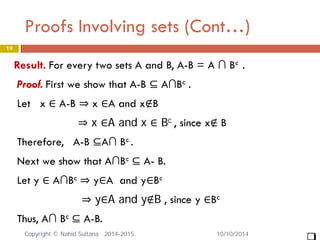
Result. For every two sets A and B, A-B = A ∩ Bc . Proof. First we show that A-B ⊆ A∩Bc . Let x ∈ A-B ⇒ x ∈A and x∉B ⇒ x ∈A and x ∈ Bc , since x∉ B Therefore, A-B ⊆A∩ Bc . Next we show that A∩Bc ⊆ A- B. Let y ∈ A∩Bc ⇒ y∈A and y∈Bc ⇒ y∈A and y∉B , since y ∈Bc Thus, A∩ Bc ⊆ A-B. 
 
10/10/2014 Copyright © Nahid Sultana 2014-2015.
20 
Result. Let A and B be sets. Then A∪B= A if and only if B ⊆ A. Proof. First we prove that if A∪B= A, then B ⊆ A. (proof by contrapositive) Assume that B ⊈ A ⇒ x ∈ B and x ∉ A ⇒ x∈ A∪B, Since x ∈ B and A∪B ={x| x∈A or x∈B}. But x ∉ A i.e. A ∪ B ≠ A. Next we prove the converse, i.e. if B ⊆ A, then A∪B=A. (direct proof) Assume that B ⊆ A. To show A∪B= A, we need to show that A ⊆ A∪B and A ∪ B ⊆ A . But by the definition of union A ⊆ A∪B. To prove A ∪ B ⊆A, assume that y∈ A ∪ B ⇒ y∈A or y∈B. Case 1: If y∈A, then A ∪ B ⊆ A as also y ∈ A ∪ B by assumption. Case2: If y∈ B then A ∪ B ⊆ B ⇒ A ∪ B ⊆ A as B⊆ A. Thus A∪B= A. 
 
Proofs Involving sets (Cont…) Copyright © Nahid Sultana 2014-2015. 10/10/2014
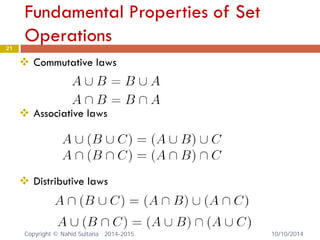
Fundamental Properties of Set Operations 21 
 
Commutative laws 
 Associative laws 
 Distributive laws 
Copyright © Nahid Sultana 2014-2015. 10/10/2014
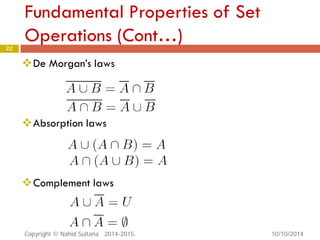
Fundamental Properties of Set Operations (Cont…) 22 
 
De Morgan’s laws 
 
Absorption laws 
Complement laws 
Copyright © Nahid Sultana 2014-2015. 10/10/2014
23 
DeMorgan’s Law: For any sets A and B, (A ∪ B)c = Ac ∩ B c 
Proof. Assume that x∈(A ∪ B)c ⇒ x ∉ A ∪ B 
⇒ x∉ A and x∉ B 
⇒x∈Ac and x∈Bc 
⇒ x∈ Ac ∩ Bc . 
Therefore, (A ∪ B)c ⊆ Ac ∩ Bc 
Next assume that x∈ Ac ∩ Bc ⇒ x∈Ac and x∈Bc 
⇒x∉ A and x∉B 
⇒ x ∉ A ∪ B 
⇒x∈(A ∪ B)c 
Therefore, Ac ∩ Bc ⊆(A ∪ B)c. Hence (A ∪B)c = Ac ∩ Bc. 
 
Fundamental Properties of Set Operations (Cont…) Copyright © Nahid Sultana 2014-2015. 10/10/2014
Proofs involving Cartesian products of sets 24 
Definition: The Cartesian product of two sets A and B is the set of all ordered pairs (a, b) with a∈ A and b∈ B, i.e. A×B = {(a,b)|a∈A and b∈B}. 
Theorem: If A= Φ or B= Φ, then A×B =Φ. 
Theorem: If A, B, C, and D are sets such that A ⊆ C and B ⊆ D, then A × B ⊆ C × D. Proof: Assume that A ⊆ c and B ⊆ D. Now let (x,y)∈ A × B ⇒ x∈A and y∈B ⇒ x∈C and y∈D, as A⊆ C and B ⊆ D. Therefore A×B⊆ C×D. 
 
10/10/2014 Copyright © Nahid Sultana 2014-2015.
Proofs involving Cartesian products of sets (Cont…) 25 
Theorem: For sets A, B and C, A×(B∪C) = (A×B) ∪ (A×C). 
Proof: Assume that (x,y)∈A×(B∪C) ⇒ x∈ A and {y∈ B or y∈C} ⇒ {x∈A and y∈B} or {x∈A and y∈C} ⇒(x,y)∈A×B or (x,y)∈A×C ⇒(x,y)∈(A×B) ∪ (A×C). Therefore, A×(B∪C) ⊆ (A×B) ∪ (A×C). Assume that (x,y)∈ (A×B) ∪ (A×C) ⇒(x,y)∈A×B or (x,y)∈A×C ⇒ {x∈A and y∈B} or {x∈A and y∈C} ⇒x∈ A and {y∈ B or y∈C} ⇒ (x,y)∈A×(B∪C). Therefore, (A×B) ∪ (A×C) ⊆ A×(B∪C) . Hence A×(B∪C) = (A×B) ∪ (A×C). 
 
10/10/2014 Copyright © Nahid Sultana 2014-2015.
Proofs involving Cartesian products of sets (Cont…) 26 
Result: For sets A, B and C, A×(B-C) = (A×B) - (A×C). Proof: Assume that (x,y)∈A×(B-C) ⇒ x∈A and y∈ B-C ⇒ x∈ A and {y∈ B and y∉C} ⇒ {x∈A and y∈B} and {x∈A and y∉C} ⇒(x,y)∈A×B and (x,y)∉A×C, as y∉C ⇒(x,y)∈(A×B) - (A×C). Therefore A×(B-C) ⊆ (A×B) - (A×C). Now Assume that (x,y)∈ (A×B)-(A×C) ⇒(x,y)∈A×B and (x,y)∉A×C ⇒ {x∈A and y∈B} and {x∈A and y∉C} as x∈ A ⇒x∈ A and {y∈ B and y∉C} ⇒ x∈A and y∈ B-C ⇒ (x,y)∈A×(B-C). Therefore (A×B) - (A×C )⊆ A×(B-C). Hence A×(B-C) = (A×B) - (A×C). 
 
10/10/2014 Copyright © Nahid Sultana 2014-2015.

Chapter-4: More on Direct Proof and Proof by Contrapositive

  • 1.
    MATH 401: LOGIC& PROOF TECHNIQUES Copyright © Nahid Sultana 2014-2015. Dr. Nahid Sultana Email: nszakir@ud.edu.sa Chapter-4: More on Direct Proof and Proof by Contrapositive 10/10/2014 1
  • 2.
    Topics 2  Proofs Involving Divisibility of Integers  Proofs Involving Congruence of Integers  Proofs Involving Real Numbers  Proofs Involving sets  Fundamental Properties of Set Operations  Proofs Involving Cartesian Products of Sets 10/10/2014 Copyright © Nahid Sultana 2014-2015.
  • 3.
    3 Definition: Forintegers a and b with a≠0, we say that a divides b or b is divisible by a if there is an integer c such that b=ac, and is written as a|b. If a does not divide b, then we write a b. Example: 3|6 and -4 |28 ? Yes because 6 = 3 . 2 and 28 = (-4) . (-7). Proofs Involving Divisibility of Integers |/ Copyright © Nahid Sultana 2014-2015. 10/10/2014
  • 4.
    Proofs Involving Divisibilityof Integers (Cont…) 4 Result: Let a, b, and c be integers with a≠0 and b ≠0. If a|b and b|c, then a|c. Proof: (Direct Proof) Assume that a|b and b|c. Then b = ax and c = by, where x, y ∈ ℤ. Therefore, c = by = (ax)y = a(xy) = a z, where z=xy ∈ ℤ. Hence a|c.  Copyright © Nahid Sultana 2014-2015. 10/10/2014
  • 5.
    Proofs Involving Divisibilityof Integers (Cont…) 5 Result: Let a, b, c and d be integers with a≠0 and b ≠0. If a|c and b|d, then ab|cd. Proof: (Direct Proof) Assume that a|c and b|d. Then c = ax and d = by, where x, y ∈ ℤ. Therefore, cd = (ax)(by) = ab(xy) = ab z, where z = xy ∈ ℤ. Hence ab|cd.  Copyright © Nahid Sultana 2014-2015. 10/10/2014
  • 6.
    Proofs Involving Divisibilityof Integers (Cont…) 6 Result: Let a, b, c, x, y ∈ ℤ, where a≠0. If a|b and a|c, then a|(bx+cy). Proof: (Direct Proof) Assume that a|b and a|c, Then b = ar and c = as, where r, s ∈ ℤ. Therefore, bx+cy = (ar)x+(as)y = a(rx+sy) = at, where t = rx+sy ∈ ℤ. Hence a|(bx+cy).  Copyright © Nahid Sultana 2014-2015. 10/10/2014
  • 7.
    Proofs Involving Divisibilityof Integers (Cont…) 7 Result: Let x∈ℤ. If 2|(x2-1) , then 4|(x2-1) . Proof: (Direct Proof) Assume that 2|(x2-1). Then x2-1 = 2a for some a ∈ ℤ. Thus x2 = 2a+1, i.e x2 is odd. But we have the following theorem: “Let x∈ℤ. Then x2 is odd iff x is odd. ” Using this theorem, x is odd too. Hence x= 2b+1, for some b ∈ ℤ . Then, x2-1 = (2b+1)2-1 = 4 b2+4b+1-1 = 4 b2+4b = 4c, where c = b2+b ∈ ℤ. Hence 4|(x2-1).  10/10/2014 Copyright © Nahid Sultana 2014-2015.
  • 8.
    Proofs Involving Divisibilityof Integers (Cont…) 8 Result: Let x∈ ℤ. If 3 xy , then 3 x and 3 y. Proof: (Proof by Contrapositive) Assume that 3|x or 3|y. WLOG assume that 3|x, then x = 3a for some a ∈ ℤ. Then xy = (3a)y = 3(ay)= 3b , where b = ay ∈ ℤ. Hence 3|xy.  |/|/|/ Copyright © Nahid Sultana 2014-2015. 10/10/2014
  • 9.
    Proofs Involving Divisibilityof Integers (Cont…) 9 Result: Let x,y∈ ℤ. If 3 (x2-1) , then 3 |x . Proof: (Proof by Contrapositive) Assume that 3 x . Then x= 3a+1 or x=3a+2 for some a ∈ ℤ. Therefore we need to consider two cases: Case1: when x= 3a+1 for some a ∈ ℤ. Then (x2-1) = 9a2+6a+1-1=3(3a2+2a) =3b, where b= 3a2+2a ∈ ℤ. Case2: when x= 3a+2 for some a ∈ ℤ. Then (x2-1) = 9a2+12a+4-1=3(3a2+4a+1) =3c, where c= 3a2+4a+1 ∈ ℤ. Hence 3| (x2-1).  |/ |/ Copyright © Nahid Sultana 2014-2015. 10/10/2014
  • 10.
    Proofs Involving Divisibilityof Integers (Cont…) 10 Result: Let x,y∈ ℤ. Prove that if 3|2a , then 3|a . Proof: (Proof by Contrapositive) Assume that 3 a . Then a= 3x+1 or a=3x+2 for some x ∈ ℤ. Therefore we need to consider twp consider. Case1: when a= 3x+1 for some x ∈ ℤ. Then 2a = 6x+2 = 3(2x)+2 = 3y+2, where y=2x ∈ ℤ. Therefore 3 a. Case2: when a= 3x+2 for some x ∈ ℤ. Then 2a = 6x+4 = 3(2x+1)+1 = 3z+1, where z =2x+1 ∈ ℤ. where c = 3a2+4a+1 ∈ ℤ. Therefore 3 a.  |/ |/ |/ Copyright © Nahid Sultana 2014-2015. 10/10/2014
  • 11.
    Proofs Involving Congruenceof Integers 11 Definition: For integers a, b, and n≥2, we say that a is congruent to b modulo n, written a ≡ b (mod n), if n | (a-b). For example: 15≡7 (mod 4) since 4 | (15-7), but 14 4 (mod 6) since 6 (14-4). ≡/|/ Result: Let a, b , k, and n be integers, where n≥2. If a ≡ b (mod n), then ka ≡ kb (mod n). Proof: (Direct Proof) Assume that a ≡ b(mod n). Then a-b =nx for some x ∈ ℤ. Now, ka-kb=k(a-b)=k(nx)=n(kx)=nl, where l=kx ∈ ℤ. Therefore, ka ≡ kb (mod n).  10/10/2014 Copyright © Nahid Sultana 2014-2015.
  • 12.
    Proofs Involving Congruenceof Integers (Cont…) 12 Result: Let a, b, c, d, n ∈ ℤ, where n ≥2. If a ≡ b (mod n) and c ≡ d (mod n), the a+c ≡ b+d (mod n). Proof: Assume that a ≡ b (mod n) and c ≡ d (mod n), i.e. a-b = nx and c-d = ny for some x,y ∈ ℤ. Adding these two equations, a-b+c-d = nx+ny=n(x+y) ⇒ (a+c) –(b+d)= nz, where z=x+y ∈ ℤ. Therefore, the a+c ≡ b+d (mod n).  10/10/2014 Copyright © Nahid Sultana 2014-2015.
  • 13.
    Proofs Involving Congruenceof Integers (Cont…) 13 Result: Let n ∈ ℤ. If n2 n (mod 3), then n 0(mod 3) and n 1(mod 3). Proof. Assume that n ≡ 0 (mod 3) or n ≡ 1(mod 3). We consider these two cases. Case 1. n ≡ 0(mod 3). Then n=3k for some k ∈ ℤ. Hence, n2- n=(3k)2- (3k)=3(3k2- k)=3l, where l = 3k2- k ∈ ℤ. Thus n2 ≡ n (mod 3). Case 2. n ≡ 1(mod 3). Then n -1=3m for some m ∈ ℤ. Hence, n2- n=(3m+1)2- (3m+1)=9m2+3m = 3(3m2+m) = 3p, where p = 3m2+m is an integer. Hence 3| (n2-n) and so n2 ≡ n (mod 3).  ≡/≡/ ≡/ Copyright © Nahid Sultana 2014-2015. 10/10/2014
  • 14.
    Proofs Involving RealNumbers 14 Some facts about real numbers that can be used without justification.  a2≥0 for every real number a.  an≥0 for every real number a if n is a positive even integer.  If a<0 and n is a positive odd integer, then an<0.  The product of two real numbers is positive iff both numbers are positive or both are negative.  If the product of two real numbers is 0, then at least one of these numbers is 0.  Let a, b, c ∈R. If a ≥b and c ≥0, then ac ≥ bc; and if c>0, then a/c ≥b/c.  If a>b and c>0, then ac>bc and a/c>b/c.  If a>b and c<0, then ac<bc and a/c<b/c. Copyright © Nahid Sultana 2014-2015. 10/10/2014
  • 15.
    Proofs Involving RealNumbers (Cont…) 15 Result: Let x ∈ ℝ. if x3-5x2+3x=15, then x =5. Proof: (Direct Proof) Assume that x3-5x2+3x=15 ⇒ x3-5x2+3x-15 = 0 ⇒ x2(x-5) +3(x-5)=0 ⇒ (x2+3)(x-5)=0 But we have the following theorem: “If x and y are real numbers such that xy=0, then x=0 or y=0.” Therefore, (x2+3)= 0 or (x-5)=0. But x2+3 >0, so (x-5)=0, i.e. x=5. Hence x=5. Copyright © Nahid Sultana 2014-2015. 10/10/2014
  • 16.
    Proofs Involving RealNumbers (Cont…) 16 Result: Let x ∈R. if x5-3x4+2x3-x2+4x-1 ≥0, then x ≥0. Proof: (Proof by Contrapositive) Assume that x <0. Then x5<0, x4 >0 ⇒ -3x4 <0 x3<0, x2>0 ⇒ -x2<0 and 4x<0. Thus x5-3x4+2x3-x2+4x-1<0-1<0, as desired.  Copyright © Nahid Sultana 2014-2015. 10/10/2014
  • 17.
    Result: If x,y∈ℝ, then x2/3+(3y2)/4 ≥ xy. Proof: (Direct Proof) Assume that x,y ∈ℝ. Now x2/3+(3y2)/4 ≥ xy ⇒ (4x2+ 9y2) ≥ 12xy ⇒ (4x2+ 9y2) - 12xy ≥ 0 ⇒(2x-3y)2 ≥ 0, this is true for any x,y ∈ℝ. Therefore x2/3+(3y2)/4 ≥ xy.  17 Proofs Involving Real Numbers (Cont…) Copyright © Nahid Sultana 2014-2015. 10/10/2014
  • 18.
    Proofs Involving sets18  Recall, for set A and B contained in some universal set U, A ∪ B = {x| x ∈ A or x ∈ B}. A ∩ B = {x| x ∈ A and x ∈ B}. A – B = {x| x ∈ A and x ∉ B}. Ac = {x| x ∉ A and x ∈ U} = U-A.  To show that C ⊆ D, we need to show that every element of C is also an element of D; that is, if x ∈ C then x ∈ D.  To show the equality of two sets C and D, we need to show that C ⊆ D and D ⊆ C. Copyright © Nahid Sultana 2014-2015. 10/10/2014
  • 19.
    Proofs Involving sets(Cont…) 19 Result. For every two sets A and B, A-B = A ∩ Bc . Proof. First we show that A-B ⊆ A∩Bc . Let x ∈ A-B ⇒ x ∈A and x∉B ⇒ x ∈A and x ∈ Bc , since x∉ B Therefore, A-B ⊆A∩ Bc . Next we show that A∩Bc ⊆ A- B. Let y ∈ A∩Bc ⇒ y∈A and y∈Bc ⇒ y∈A and y∉B , since y ∈Bc Thus, A∩ Bc ⊆ A-B.  10/10/2014 Copyright © Nahid Sultana 2014-2015.
  • 20.
    20 Result. LetA and B be sets. Then A∪B= A if and only if B ⊆ A. Proof. First we prove that if A∪B= A, then B ⊆ A. (proof by contrapositive) Assume that B ⊈ A ⇒ x ∈ B and x ∉ A ⇒ x∈ A∪B, Since x ∈ B and A∪B ={x| x∈A or x∈B}. But x ∉ A i.e. A ∪ B ≠ A. Next we prove the converse, i.e. if B ⊆ A, then A∪B=A. (direct proof) Assume that B ⊆ A. To show A∪B= A, we need to show that A ⊆ A∪B and A ∪ B ⊆ A . But by the definition of union A ⊆ A∪B. To prove A ∪ B ⊆A, assume that y∈ A ∪ B ⇒ y∈A or y∈B. Case 1: If y∈A, then A ∪ B ⊆ A as also y ∈ A ∪ B by assumption. Case2: If y∈ B then A ∪ B ⊆ B ⇒ A ∪ B ⊆ A as B⊆ A. Thus A∪B= A.  Proofs Involving sets (Cont…) Copyright © Nahid Sultana 2014-2015. 10/10/2014
  • 21.
    Fundamental Properties ofSet Operations 21  Commutative laws  Associative laws  Distributive laws Copyright © Nahid Sultana 2014-2015. 10/10/2014
  • 22.
    Fundamental Properties ofSet Operations (Cont…) 22  De Morgan’s laws  Absorption laws Complement laws Copyright © Nahid Sultana 2014-2015. 10/10/2014
  • 23.
    23 DeMorgan’s Law:For any sets A and B, (A ∪ B)c = Ac ∩ B c Proof. Assume that x∈(A ∪ B)c ⇒ x ∉ A ∪ B ⇒ x∉ A and x∉ B ⇒x∈Ac and x∈Bc ⇒ x∈ Ac ∩ Bc . Therefore, (A ∪ B)c ⊆ Ac ∩ Bc Next assume that x∈ Ac ∩ Bc ⇒ x∈Ac and x∈Bc ⇒x∉ A and x∉B ⇒ x ∉ A ∪ B ⇒x∈(A ∪ B)c Therefore, Ac ∩ Bc ⊆(A ∪ B)c. Hence (A ∪B)c = Ac ∩ Bc.  Fundamental Properties of Set Operations (Cont…) Copyright © Nahid Sultana 2014-2015. 10/10/2014
  • 24.
    Proofs involving Cartesianproducts of sets 24 Definition: The Cartesian product of two sets A and B is the set of all ordered pairs (a, b) with a∈ A and b∈ B, i.e. A×B = {(a,b)|a∈A and b∈B}. Theorem: If A= Φ or B= Φ, then A×B =Φ. Theorem: If A, B, C, and D are sets such that A ⊆ C and B ⊆ D, then A × B ⊆ C × D. Proof: Assume that A ⊆ c and B ⊆ D. Now let (x,y)∈ A × B ⇒ x∈A and y∈B ⇒ x∈C and y∈D, as A⊆ C and B ⊆ D. Therefore A×B⊆ C×D.  10/10/2014 Copyright © Nahid Sultana 2014-2015.
  • 25.
    Proofs involving Cartesianproducts of sets (Cont…) 25 Theorem: For sets A, B and C, A×(B∪C) = (A×B) ∪ (A×C). Proof: Assume that (x,y)∈A×(B∪C) ⇒ x∈ A and {y∈ B or y∈C} ⇒ {x∈A and y∈B} or {x∈A and y∈C} ⇒(x,y)∈A×B or (x,y)∈A×C ⇒(x,y)∈(A×B) ∪ (A×C). Therefore, A×(B∪C) ⊆ (A×B) ∪ (A×C). Assume that (x,y)∈ (A×B) ∪ (A×C) ⇒(x,y)∈A×B or (x,y)∈A×C ⇒ {x∈A and y∈B} or {x∈A and y∈C} ⇒x∈ A and {y∈ B or y∈C} ⇒ (x,y)∈A×(B∪C). Therefore, (A×B) ∪ (A×C) ⊆ A×(B∪C) . Hence A×(B∪C) = (A×B) ∪ (A×C).  10/10/2014 Copyright © Nahid Sultana 2014-2015.
  • 26.
    Proofs involving Cartesianproducts of sets (Cont…) 26 Result: For sets A, B and C, A×(B-C) = (A×B) - (A×C). Proof: Assume that (x,y)∈A×(B-C) ⇒ x∈A and y∈ B-C ⇒ x∈ A and {y∈ B and y∉C} ⇒ {x∈A and y∈B} and {x∈A and y∉C} ⇒(x,y)∈A×B and (x,y)∉A×C, as y∉C ⇒(x,y)∈(A×B) - (A×C). Therefore A×(B-C) ⊆ (A×B) - (A×C). Now Assume that (x,y)∈ (A×B)-(A×C) ⇒(x,y)∈A×B and (x,y)∉A×C ⇒ {x∈A and y∈B} and {x∈A and y∉C} as x∈ A ⇒x∈ A and {y∈ B and y∉C} ⇒ x∈A and y∈ B-C ⇒ (x,y)∈A×(B-C). Therefore (A×B) - (A×C )⊆ A×(B-C). Hence A×(B-C) = (A×B) - (A×C).  10/10/2014 Copyright © Nahid Sultana 2014-2015.