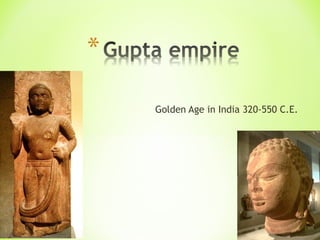
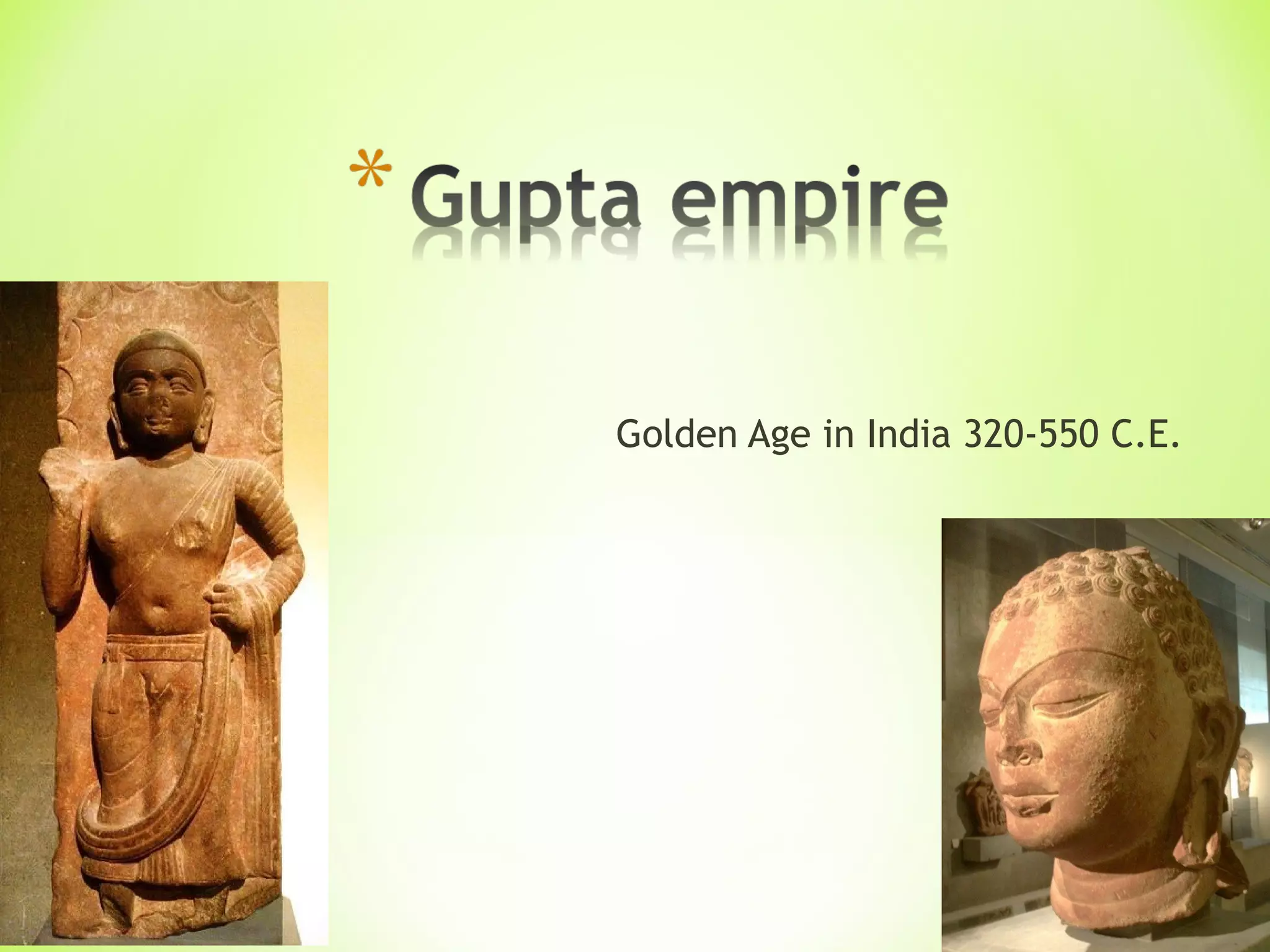

Golden Age in India 320-550 C.E.
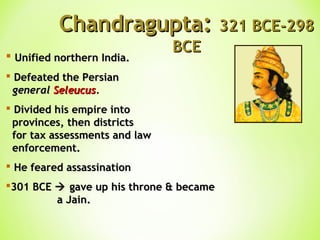
ChandraguptaChandragupta:: 321 BCE-298321 BCE-298
BCEBCE
 Unified northern India.Unified northern India.
 Defeated the PersianDefeated the Persian
generalgeneral SeleucusSeleucus..
 Divided his empire intoDivided his empire into
provinces, then districtsprovinces, then districts
for tax assessments and lawfor tax assessments and law
enforcement.enforcement.
 He feared assassinationHe feared assassination
301 BCE301 BCE  gave up his throne & becamegave up his throne & became
a Jain.a Jain.
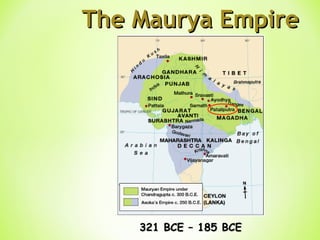
The Maurya EmpireThe Maurya Empire
321 BCE – 185 BCE321 BCE – 185 BCE
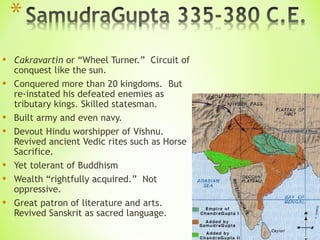
• Cakravartin or “Wheel Turner.” Circuit of
conquest like the sun.
• Conquered more than 20 kingdoms. But
re-instated his defeated enemies as
tributary kings. Skilled statesman.
• Built army and even navy.
• Devout Hindu worshipper of Vishnu.
Revived ancient Vedic rites such as Horse
Sacrifice.
• Yet tolerant of Buddhism
• Wealth “rightfully acquired.” Not
oppressive.
• Great patron of literature and arts.
Revived Sanskrit as sacred language.
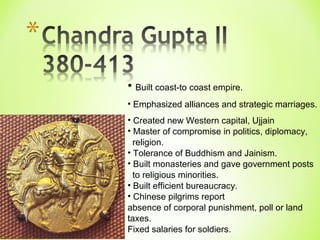
• Built coast-to coast empire.
• Emphasized alliances and strategic marriages.
• Created new Western capital, Ujjain
• Master of compromise in politics, diplomacy,
religion.
• Tolerance of Buddhism and Jainism.
• Built monasteries and gave government posts
to religious minorities.
• Built efficient bureaucracy.
• Chinese pilgrims report
absence of corporal punishment, poll or land
taxes.
Fixed salaries for soldiers.
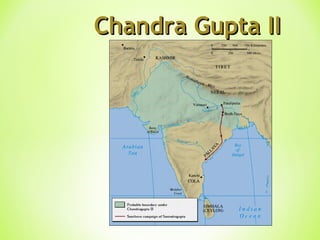
Chandra Gupta IIChandra Gupta II
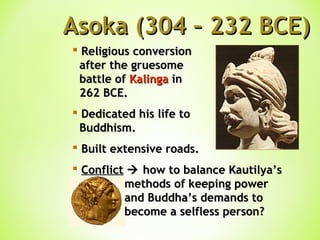
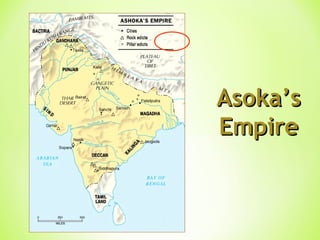
Asoka (304 – 232 BCE)Asoka (304 – 232 BCE)
 Religious conversionReligious conversion
after the gruesomeafter the gruesome
battle ofbattle of KalingaKalinga inin
262 BCE.262 BCE.
 Dedicated his life toDedicated his life to
Buddhism.Buddhism.
 Built extensive roads.Built extensive roads.
 ConflictConflict  how to balance Kautilya’show to balance Kautilya’s
methods of keeping powermethods of keeping power
and Buddha’s demands toand Buddha’s demands to
become a selfless person?become a selfless person?
Asoka’sAsoka’s
EmpireEmpire
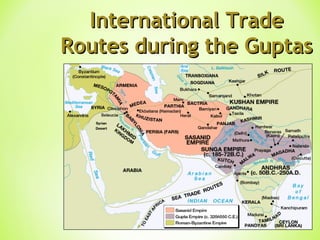
International TradeInternational Trade
Routes during the GuptasRoutes during the Guptas
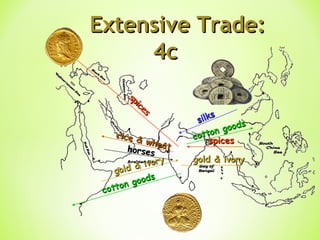
Extensive Trade:Extensive Trade:
4c4c
spices
spices
spicesspices
gold & ivory
gold & ivory gold & ivorygold & ivory
rice & wheat
rice & wheathorseshorses
cotton goods
cotton goods
cotton goods
cotton goodssilks
silks
MedicineMedicineMedicineMedicine LiteratureLiteratureLiteratureLiterature
MathematicsMathematicsMathematicsMathematics
AstronomyAstronomyAstronomyAstronomy
PrintedPrinted
medicinal guidesmedicinal guides
1000 diseases1000 diseases
classifiedclassified
PlasticPlastic
SurgerySurgery
C-sectionsC-sections
performedperformed
InoculationsInoculations
500 healing500 healing
plants identifiedplants identified
DecimalDecimal
SystemSystem
ConceptConcept
of Zeroof Zero
PI = 3.1416PI = 3.1416
KalidasaKalidasa
SolarSolar
CalendarCalendar
The earthThe earth
is roundis round
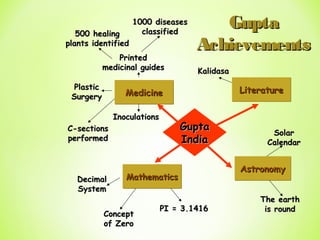
GuptaGupta
IndiaIndia
GuptaGupta
AchievementsAchievements
Gupta kings empower merchant vaisya caste
Elaborate coinage system developed.
Trade expands. Flourishing trade with Rome, China, Arabian
world.
In many cities marketplaces surge.
BUT still essentially an agricultural economy
Feudal pattern begins as kings make land grants to
Brahmins. After Gupta period, these land grants are
increasingly made to Kshatriya or warrior caste.
Advances in agriculture: iron permits clearing of Ganges
River valley for farming.
Translation of works of Greek astronomy into Sanskrit. By 499 past,
future planet locations calculated accurately, solar year measured.
Geography: world longitudes redrawn, beginning in Ujjain instead of
Alexandria.
Math: World’s first effective treatises on square and cubed roots.
Numeral and decimal system developed which spread eventually to
Europe.
Philosophy: Formal logic developed. Use of syllogism.
Medicine: Free hospitals provided. Advances in bone-setting and
pharmacy soon adopted by Arabs and Greeks.
Great universities of Nalanda and Vikramasila established, receive
influx of students from all the world.
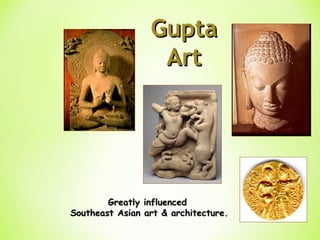
GuptaGupta
ArtArt
Greatly influencedGreatly influenced
Southeast Asian art & architecture.Southeast Asian art & architecture.
• Characterized by “a turning
inward, an ability to
communicate higher
spiritual states…”
• Most famous paintings are
from Ajanta Caves.
Supported by a kingdom
aligned with the Guptas
through marriage, usually
understood as part of Gupta
legacy.
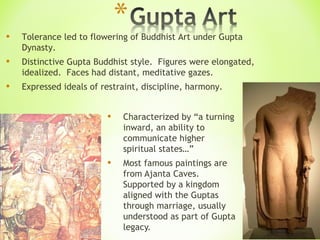
• Tolerance led to flowering of Buddhist Art under Gupta
Dynasty.
• Distinctive Gupta Buddhist style. Figures were elongated,
idealized. Faces had distant, meditative gazes.
• Expressed ideals of restraint, discipline, harmony.
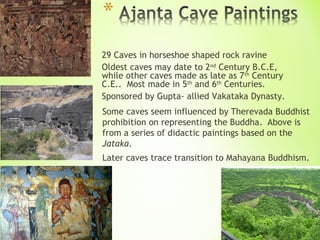
Some caves seem influenced by Therevada Buddhist
prohibition on representing the Buddha. Above is
from a series of didactic paintings based on the
Jataka.
Later caves trace transition to Mahayana Buddhism.
29 Caves in horseshoe shaped rock ravine
Oldest caves may date to 2nd
Century B.C.E,
while other caves made as late as 7th
Century
C.E.. Most made in 5th
and 6th
Centuries.
Sponsored by Gupta- allied Vakataka Dynasty.
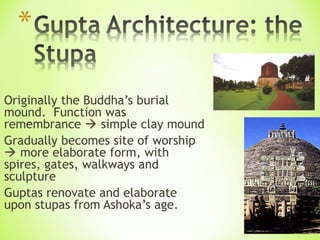
Originally the Buddha’s burial
mound. Function was
remembrance  simple clay mound
Gradually becomes site of worship
 more elaborate form, with
spires, gates, walkways and
sculpture
Guptas renovate and elaborate
upon stupas from Ashoka’s age.
Photo gallery

Maurya gupta empires

  • 1.
    Golden Age inIndia 320-550 C.E.
  • 2.
    ChandraguptaChandragupta:: 321 BCE-298321BCE-298 BCEBCE  Unified northern India.Unified northern India.  Defeated the PersianDefeated the Persian generalgeneral SeleucusSeleucus..  Divided his empire intoDivided his empire into provinces, then districtsprovinces, then districts for tax assessments and lawfor tax assessments and law enforcement.enforcement.  He feared assassinationHe feared assassination 301 BCE301 BCE  gave up his throne & becamegave up his throne & became a Jain.a Jain.
  • 3.
    The Maurya EmpireTheMaurya Empire 321 BCE – 185 BCE321 BCE – 185 BCE
  • 4.
    • Cakravartin or“Wheel Turner.” Circuit of conquest like the sun. • Conquered more than 20 kingdoms. But re-instated his defeated enemies as tributary kings. Skilled statesman. • Built army and even navy. • Devout Hindu worshipper of Vishnu. Revived ancient Vedic rites such as Horse Sacrifice. • Yet tolerant of Buddhism • Wealth “rightfully acquired.” Not oppressive. • Great patron of literature and arts. Revived Sanskrit as sacred language.
  • 5.
    • Built coast-tocoast empire. • Emphasized alliances and strategic marriages. • Created new Western capital, Ujjain • Master of compromise in politics, diplomacy, religion. • Tolerance of Buddhism and Jainism. • Built monasteries and gave government posts to religious minorities. • Built efficient bureaucracy. • Chinese pilgrims report absence of corporal punishment, poll or land taxes. Fixed salaries for soldiers.
  • 6.
  • 7.
    Asoka (304 –232 BCE)Asoka (304 – 232 BCE)  Religious conversionReligious conversion after the gruesomeafter the gruesome battle ofbattle of KalingaKalinga inin 262 BCE.262 BCE.  Dedicated his life toDedicated his life to Buddhism.Buddhism.  Built extensive roads.Built extensive roads.  ConflictConflict  how to balance Kautilya’show to balance Kautilya’s methods of keeping powermethods of keeping power and Buddha’s demands toand Buddha’s demands to become a selfless person?become a selfless person?
  • 8.
  • 9.
    International TradeInternational Trade Routesduring the GuptasRoutes during the Guptas
  • 10.
    Extensive Trade:Extensive Trade: 4c4c spices spices spicesspices gold& ivory gold & ivory gold & ivorygold & ivory rice & wheat rice & wheathorseshorses cotton goods cotton goods cotton goods cotton goodssilks silks
  • 11.
    MedicineMedicineMedicineMedicine LiteratureLiteratureLiteratureLiterature MathematicsMathematicsMathematicsMathematics AstronomyAstronomyAstronomyAstronomy PrintedPrinted medicinal guidesmedicinalguides 1000 diseases1000 diseases classifiedclassified PlasticPlastic SurgerySurgery C-sectionsC-sections performedperformed InoculationsInoculations 500 healing500 healing plants identifiedplants identified DecimalDecimal SystemSystem ConceptConcept of Zeroof Zero PI = 3.1416PI = 3.1416 KalidasaKalidasa SolarSolar CalendarCalendar The earthThe earth is roundis round GuptaGupta IndiaIndia GuptaGupta AchievementsAchievements
  • 12.
    Gupta kings empowermerchant vaisya caste Elaborate coinage system developed. Trade expands. Flourishing trade with Rome, China, Arabian world. In many cities marketplaces surge. BUT still essentially an agricultural economy Feudal pattern begins as kings make land grants to Brahmins. After Gupta period, these land grants are increasingly made to Kshatriya or warrior caste. Advances in agriculture: iron permits clearing of Ganges River valley for farming.
  • 13.
    Translation of worksof Greek astronomy into Sanskrit. By 499 past, future planet locations calculated accurately, solar year measured. Geography: world longitudes redrawn, beginning in Ujjain instead of Alexandria. Math: World’s first effective treatises on square and cubed roots. Numeral and decimal system developed which spread eventually to Europe. Philosophy: Formal logic developed. Use of syllogism. Medicine: Free hospitals provided. Advances in bone-setting and pharmacy soon adopted by Arabs and Greeks. Great universities of Nalanda and Vikramasila established, receive influx of students from all the world.
  • 14.
    GuptaGupta ArtArt Greatly influencedGreatly influenced SoutheastAsian art & architecture.Southeast Asian art & architecture.
  • 15.
    • Characterized by“a turning inward, an ability to communicate higher spiritual states…” • Most famous paintings are from Ajanta Caves. Supported by a kingdom aligned with the Guptas through marriage, usually understood as part of Gupta legacy. • Tolerance led to flowering of Buddhist Art under Gupta Dynasty. • Distinctive Gupta Buddhist style. Figures were elongated, idealized. Faces had distant, meditative gazes. • Expressed ideals of restraint, discipline, harmony.
  • 16.
    Some caves seeminfluenced by Therevada Buddhist prohibition on representing the Buddha. Above is from a series of didactic paintings based on the Jataka. Later caves trace transition to Mahayana Buddhism. 29 Caves in horseshoe shaped rock ravine Oldest caves may date to 2nd Century B.C.E, while other caves made as late as 7th Century C.E.. Most made in 5th and 6th Centuries. Sponsored by Gupta- allied Vakataka Dynasty.
  • 17.
    Originally the Buddha’sburial mound. Function was remembrance  simple clay mound Gradually becomes site of worship  more elaborate form, with spires, gates, walkways and sculpture Guptas renovate and elaborate upon stupas from Ashoka’s age.
  • 18.