INDO-SCYTHIAN/
Sakas Dynasty
(200 BCE to 400 CE)
Sachin Kr. Tiwary
NOMENCLATURE & ORIGIN –
• Saka (by Persian and
India), Scyta (by the ancient
Greek), Hun (by Chinese),
Sakae, Iskuzai, Askuza,
Sistān known in ancient times
as Sakastān "the land of
the Saka", is a historical
& geographical region in
present-day
eastern Iran (Sistān &
Baluchistān Province) &
southern Afghānistān (Nimruz
, Helmand, Kāndhār).
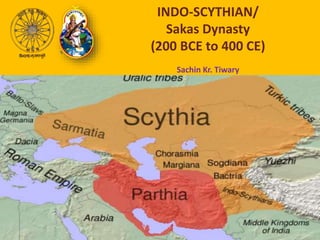
• The Sakās were
a Scythian tribe which from
the 200 BCE to the 100 CE
migrated to the Iranian
Plateau & Indus valley, where
they carved a kingdom known
as the Indo-Scythian
Kingdom.
TODAY’S POLITICAL
EXTEND:
• Western & Northern South Asia
Sogdiana (Today’s
Kazakhstan, Tajikistan &
Uzbekistan),
• Bactria (Today’s
Afghanistan, Tajikistan & Uzbekis
tan),
• Arachosia (Arachosia was
centered on
the Arghandab valley in modern-
day southern Afghanistan,
although its influence extended
east to as far as the Indus
River),
• Gandhara, Sindh, Kashmir, Punj
ab, Rajasthan, Gujarat,
Haryana, Uttar Pradesh, Bihar
& Maharashtra.
SOURCES:
• Literature [Indian-Foreign]
– Religious- Ramayan, Mahabharat, Markandeya Puran, Gargi Samhita (Description about attack on
Mathura by western); Pandit Braj (Minister of king Bhoj, 11th Cen. CE) writings Simhasana;
Dvatrimsika/ Singhasan Battisi/ Vikram Baital (13th Cen. CE); Abhidhan Chintamani (by Hemchandra
Suri a Jain scholar 1089–1172); Milindapanho; Harivansh (by Harivansha 500-600 CE- described
about Tonsure), Pali text Samantapāsādikā (500 CE),
– Secular: Devichandraguptam (500-600 CE., Political Drama of Vishakhadatta- The complete text of
the play is now lost, but its portions survive in form of quotations in the later works. The plot also
survives in form of a Persian language story, which appears to be an adaptation of the play, & is
included in the 11th century text Majmal-ut-Tawarikh. In the play, king Ramagupta decides to
surrender his queen Dhruvadevi ("Devi") to a Shaka enemy when besieged. Ramagupta's younger
brother Chandragupta enters the enemy camp disguised as the queen, & kills the enemy ruler),
Harshacharitam (by Bāṇabhaṭṭa 700 CE), Kavyamimamsa (by Rajashekhara, 880 & 920 CE),
Avashyak Vrihad Vritti, Padliptaprabandha,
– Foreign- Chinese source, Greek Source- Periplus of the Erythraean Sea (100 CE), Geographia of
Claudius Ptolemy (c. 100- 170 CE), Arrian (Indica).
• Archaeological [Epigraphs, Numismatics, Architecture- Art]:
– Epigraphs- Moga Inscriptions of Mathura, Damad Ushawadaat insc. of Nasik & Karle,
Nagarjunikonda; Prayag-Prashasti of Samudra Gupta, Inscriptions of Satvahana rulers, Taxila Copper
Plate, Andhau inc. of Kachchhkhaadi, Junagadh Insc., Junnar Insc. of Nahapaan.
– Coins/ Numismatics,
WHY THEY MOVED TO INDIA?:
The invasion by the Central Asian nomadic tribes
Hiyungunu & Yuezhi in 165 BCE from the Chinese region
was responsible for the migration of the Sakas towards
South-East.
Kapisa in
Afghanistan
Shakas of
Taxila
Shaka-Satrap of
Mathura
Kshaharat of West
(Indus to Maharashtra)
Chashtan/Kardamak of
Upper Deccan
MP, Gujarat
North-Western
Shakas
Northern Shakas
Mathura to Eastern Panjab, Pakistan
Western Shakas
Gujarat, Maharashtra, Rajasthan & Madhya Pradesh
FIVE DIFFERENT BRANCHES OF INDO-SCYTHIAN
DYNASTIES & RULERS:
SAKAS OF KAPISA IN AFGHANISTAN
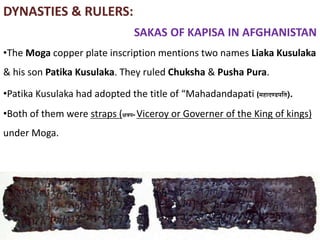
•The Moga copper plate inscription mentions two names Liaka Kusulaka
& his son Patika Kusulaka. They ruled Chuksha & Pusha Pura.
•Patika Kusulaka had adopted the title of “Mahadandapati (महादण्डपति).
•Both of them were straps (क्षत्रप- Viceroy or Governer of the King of kings)
under Moga.
DYNASTIES & RULERS:
SHAKAS OF TAXILA IN PAKISTAN
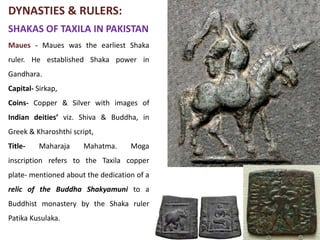
Maues - Maues was the earliest Shaka
ruler. He established Shaka power in
Gandhara.
Capital- Sirkap,
Coins- Copper & Silver with images of
Indian deities’ viz. Shiva & Buddha, in
Greek & Kharoshthi script,
Title- Maharaja Mahatma. Moga
inscription refers to the Taxila copper
plate- mentioned about the dedication of a
relic of the Buddha Shakyamuni to a
Buddhist monastery by the Shaka ruler
Patika Kusulaka.
DYNASTIES & RULERS:
SHAKAS OF TAXILA IN PAKISTAN
Azes-I & Azes II - Maues & his successors were able to conquer
large areas of Gandhara, they were unsuccessful against the Indo-
Greek kings remaining behind the Jhelum river in eastern Punjab.
But it was Azes-I who put an end to the remnant of the Greek
rule in India.
Azes-I annexed the kingdom of the Indo-Greek Hippostratos after a
long resistance.
Azes-I founded the Azes Era, which coincides with the Vikram Era
in India in 57 BCE.
Azes-I was succeeded by Azilises, who was succeeded by Azes II.
There are some coins issued jointly by Azes-I & Azilises & jointly
issued by Azilises & Azes II.
Azes II reigned between the 35 & 12 BCE & he is considered to be
the last Shaka ruler & was lost to Kushanas.
During Azes II the Shakas started decline from the west due to the
Cryotiz & Gondophernes (Indo-Parthian king) rebels.
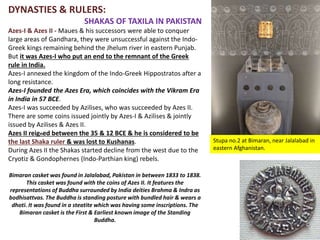
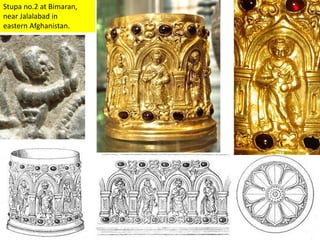
Bimaran casket was found in Jalalabad, Pakistan in between 1833 to 1838.
This casket was found with the coins of Azes II. It features the
representations of Buddha surrounded by India deities Brahma & Indra as
bodhisattvas. The Buddha is standing posture with bundled hair & wears a
dhoti. It was found in a steatite which was having some inscriptions. The
Bimaran casket is the First & Earliest known image of the Standing
Buddha.
Stupa no.2 at Bimaran, near Jalalabad in
eastern Afghanistan.
Stupa no.2 at Bimaran,
near Jalalabad in
eastern Afghanistan.
DYNASTIES & RULERS:
SHAKA-SATRAP OF MATHURA
• First known satraps of Mathura are
Hagana & Hagamasa. One of their
successors named “Rajuvula” has
been mentioned as Mahasatrapa
(महाक्षत्रप- Great Satra) in the Mora
inscription that was found near
Mathura.
• Other satrapas are Sodasha,
Sivadatta, Sivaghosha. Mathura
Satraps issued coins with standing
image resembled Laxami & Three
Elephants.
1. mahaksatrapasa ramjuvulasa putrasa svami ...
2. bhagavatam vrsnina[m] pamcaviranam
pratima[h] sailadevagr[he] ...
3. ya[s] tosayah sailam srimadgrham atulam
udadha samadhara ...
4. arcadesam sailam pamca jvalata iva
paramavapusa ...
– Mora Well Inscription, 1st century CE
DYNASTIES & RULERS:
KSHAHARAT OF WEST
• Bhumaka-First known satrapa in the Western
India was Bhumaka, who ruled in Saurashtra
in Gujarat. Bhumaka’s successor Nahapana
was an important ruler of the Western
satrapas. The coins of Bhumaka mentioned
him as a Kshakarata Kshatrapa (क्षहरात
क्षत्रप). The coins show the symbol of the lion-
capital engraved with Kharoshthi & Brahmi.
These coins were found in Gujarat & rarely in
Malwa which might indicate the area of rule
of the Mathura Kashtrapas. It was Bhumaka,
who has been discussed in the Periplus of
Erythrean Sea.
• It is also known that some of the inscriptions
of the Mathura. Kshatrapas were incised on
a lion capital. These show that the two
families were alike.
DYNASTIES & RULERS:
KSHAHARAT OF WEST
• Nahapana (119-125 CE)- Some
sources says that Nahapana was son
of Bhumaka, yet the actual
relationship between two is not
verified.
• He fought against Satvahana & won
the war, but later on during the
Gautami Putra Shatkarni he was
defeated & killed in the battle.
• His title was Rajan.
A coin of Nahapana restruck by
the Satavahana king Gautamiputra Satakarni.
DYNASTIES & RULERS:
CHASHTAN/KARDAMAK DYNASTY
• Chastana- He has been
mentioned as Tiastenes of Ozene
(Chastana of Ujjain) in Ptolemy’s
Geography.
– Founded by Chastana in 78 CE
(BEGINING OF SHAKA ERA), who
ruled for two or three centuries in
south-western India & gave its
name to the Shakanripakala, or era
of Shaka kings, in Indian history.
– He was the son of Yasmolik. He was
contemporary to Kushans & was
working under their control.
– Chastana territory was up to
Andhras. The wars of these Shakas
with the Andhras continued for
several generations.
Coin of the Western Satrap Chastana (c. 130
CE). Obv: King in profile. The legend typically reads
"PANNIΩ IATPAΠAC CIASTANCA" (corrupted Greek
script), transliteration of the Prakrit Raño
Kshatrapasa Castana: "King and Satrap Castana"
Statue of Chastana,
Inscription "Shastana“
Mathura Museum
DYNASTIES & RULERS:
CHASHTAN/KARDAMAK DYNASTY
• Jayadaman- He was the son of Chastana
called Shatrapa.
• Rudradaman- The first great Shaka ruler
was Rudradaman I, Chastana’s grandson, who
reigned after 130 CE. He was Mahachhatrapa
(महाक्षत्रप).
– Yavanesvara was a Greek writer who translated
the Yavanajataka from Greek to Sanskrit. It had
influenced astrology in India.
– This work was done in the times of Rudradaman.
The Junagadh rock contains inscriptions
by Ashoka (fourteen of the Edicts of Ashoka),
Rudradāman I and Skandagupta.
DECLINE:
• The direct line of Chastana
became extinct in 304–
305 CE with the death of
Vishvasena, son of
Bhartridaman.
• It is doubtful that
the dynasty was important
in the 400 CE, although
one of its members—
probably Rudrasimha III—is
recorded as the “Shaka
king” killed by Chandra
Gupta II when he sacked
the Shakas in 388.
• Emergence of Gupta
dynasty.
• War between Chastan
dynasty & Gupta dynasty,
DECLINE:
• They became a part of
Kushan Empire and
formed Northern
Satraps,
• Regular war between
Scythian & Parthian,
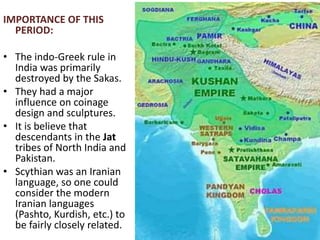
IMPORTANCE OF THIS
PERIOD:
• The indo-Greek rule in
India was primarily
destroyed by the Sakas.
• They had a major
influence on coinage
design and sculptures.
• It is believe that
descendants in the Jat
tribes of North India and
Pakistan.
• Scythian was an Iranian
language, so one could
consider the modern
Iranian languages
(Pashto, Kurdish, etc.) to
be fairly closely related.
Thank you
Any Questions ?

Indo-Scythian

  • 1.
    INDO-SCYTHIAN/ Sakas Dynasty (200 BCEto 400 CE) Sachin Kr. Tiwary
  • 2.
    NOMENCLATURE & ORIGIN– • Saka (by Persian and India), Scyta (by the ancient Greek), Hun (by Chinese), Sakae, Iskuzai, Askuza, Sistān known in ancient times as Sakastān "the land of the Saka", is a historical & geographical region in present-day eastern Iran (Sistān & Baluchistān Province) & southern Afghānistān (Nimruz , Helmand, Kāndhār). • The Sakās were a Scythian tribe which from the 200 BCE to the 100 CE migrated to the Iranian Plateau & Indus valley, where they carved a kingdom known as the Indo-Scythian Kingdom.
  • 3.
    TODAY’S POLITICAL EXTEND: • Western& Northern South Asia Sogdiana (Today’s Kazakhstan, Tajikistan & Uzbekistan), • Bactria (Today’s Afghanistan, Tajikistan & Uzbekis tan), • Arachosia (Arachosia was centered on the Arghandab valley in modern- day southern Afghanistan, although its influence extended east to as far as the Indus River), • Gandhara, Sindh, Kashmir, Punj ab, Rajasthan, Gujarat, Haryana, Uttar Pradesh, Bihar & Maharashtra.
  • 4.
    SOURCES: • Literature [Indian-Foreign] –Religious- Ramayan, Mahabharat, Markandeya Puran, Gargi Samhita (Description about attack on Mathura by western); Pandit Braj (Minister of king Bhoj, 11th Cen. CE) writings Simhasana; Dvatrimsika/ Singhasan Battisi/ Vikram Baital (13th Cen. CE); Abhidhan Chintamani (by Hemchandra Suri a Jain scholar 1089–1172); Milindapanho; Harivansh (by Harivansha 500-600 CE- described about Tonsure), Pali text Samantapāsādikā (500 CE), – Secular: Devichandraguptam (500-600 CE., Political Drama of Vishakhadatta- The complete text of the play is now lost, but its portions survive in form of quotations in the later works. The plot also survives in form of a Persian language story, which appears to be an adaptation of the play, & is included in the 11th century text Majmal-ut-Tawarikh. In the play, king Ramagupta decides to surrender his queen Dhruvadevi ("Devi") to a Shaka enemy when besieged. Ramagupta's younger brother Chandragupta enters the enemy camp disguised as the queen, & kills the enemy ruler), Harshacharitam (by Bāṇabhaṭṭa 700 CE), Kavyamimamsa (by Rajashekhara, 880 & 920 CE), Avashyak Vrihad Vritti, Padliptaprabandha, – Foreign- Chinese source, Greek Source- Periplus of the Erythraean Sea (100 CE), Geographia of Claudius Ptolemy (c. 100- 170 CE), Arrian (Indica). • Archaeological [Epigraphs, Numismatics, Architecture- Art]: – Epigraphs- Moga Inscriptions of Mathura, Damad Ushawadaat insc. of Nasik & Karle, Nagarjunikonda; Prayag-Prashasti of Samudra Gupta, Inscriptions of Satvahana rulers, Taxila Copper Plate, Andhau inc. of Kachchhkhaadi, Junagadh Insc., Junnar Insc. of Nahapaan. – Coins/ Numismatics,
  • 5.
    WHY THEY MOVEDTO INDIA?: The invasion by the Central Asian nomadic tribes Hiyungunu & Yuezhi in 165 BCE from the Chinese region was responsible for the migration of the Sakas towards South-East. Kapisa in Afghanistan Shakas of Taxila Shaka-Satrap of Mathura Kshaharat of West (Indus to Maharashtra) Chashtan/Kardamak of Upper Deccan MP, Gujarat North-Western Shakas Northern Shakas Mathura to Eastern Panjab, Pakistan Western Shakas Gujarat, Maharashtra, Rajasthan & Madhya Pradesh FIVE DIFFERENT BRANCHES OF INDO-SCYTHIAN
  • 6.
    DYNASTIES & RULERS: SAKASOF KAPISA IN AFGHANISTAN •The Moga copper plate inscription mentions two names Liaka Kusulaka & his son Patika Kusulaka. They ruled Chuksha & Pusha Pura. •Patika Kusulaka had adopted the title of “Mahadandapati (महादण्डपति). •Both of them were straps (क्षत्रप- Viceroy or Governer of the King of kings) under Moga.
  • 7.
    DYNASTIES & RULERS: SHAKASOF TAXILA IN PAKISTAN Maues - Maues was the earliest Shaka ruler. He established Shaka power in Gandhara. Capital- Sirkap, Coins- Copper & Silver with images of Indian deities’ viz. Shiva & Buddha, in Greek & Kharoshthi script, Title- Maharaja Mahatma. Moga inscription refers to the Taxila copper plate- mentioned about the dedication of a relic of the Buddha Shakyamuni to a Buddhist monastery by the Shaka ruler Patika Kusulaka.
  • 8.
    DYNASTIES & RULERS: SHAKASOF TAXILA IN PAKISTAN Azes-I & Azes II - Maues & his successors were able to conquer large areas of Gandhara, they were unsuccessful against the Indo- Greek kings remaining behind the Jhelum river in eastern Punjab. But it was Azes-I who put an end to the remnant of the Greek rule in India. Azes-I annexed the kingdom of the Indo-Greek Hippostratos after a long resistance. Azes-I founded the Azes Era, which coincides with the Vikram Era in India in 57 BCE. Azes-I was succeeded by Azilises, who was succeeded by Azes II. There are some coins issued jointly by Azes-I & Azilises & jointly issued by Azilises & Azes II. Azes II reigned between the 35 & 12 BCE & he is considered to be the last Shaka ruler & was lost to Kushanas. During Azes II the Shakas started decline from the west due to the Cryotiz & Gondophernes (Indo-Parthian king) rebels. Bimaran casket was found in Jalalabad, Pakistan in between 1833 to 1838. This casket was found with the coins of Azes II. It features the representations of Buddha surrounded by India deities Brahma & Indra as bodhisattvas. The Buddha is standing posture with bundled hair & wears a dhoti. It was found in a steatite which was having some inscriptions. The Bimaran casket is the First & Earliest known image of the Standing Buddha. Stupa no.2 at Bimaran, near Jalalabad in eastern Afghanistan.
  • 9.
    Stupa no.2 atBimaran, near Jalalabad in eastern Afghanistan.
  • 10.
    DYNASTIES & RULERS: SHAKA-SATRAPOF MATHURA • First known satraps of Mathura are Hagana & Hagamasa. One of their successors named “Rajuvula” has been mentioned as Mahasatrapa (महाक्षत्रप- Great Satra) in the Mora inscription that was found near Mathura. • Other satrapas are Sodasha, Sivadatta, Sivaghosha. Mathura Satraps issued coins with standing image resembled Laxami & Three Elephants. 1. mahaksatrapasa ramjuvulasa putrasa svami ... 2. bhagavatam vrsnina[m] pamcaviranam pratima[h] sailadevagr[he] ... 3. ya[s] tosayah sailam srimadgrham atulam udadha samadhara ... 4. arcadesam sailam pamca jvalata iva paramavapusa ... – Mora Well Inscription, 1st century CE
  • 11.
    DYNASTIES & RULERS: KSHAHARATOF WEST • Bhumaka-First known satrapa in the Western India was Bhumaka, who ruled in Saurashtra in Gujarat. Bhumaka’s successor Nahapana was an important ruler of the Western satrapas. The coins of Bhumaka mentioned him as a Kshakarata Kshatrapa (क्षहरात क्षत्रप). The coins show the symbol of the lion- capital engraved with Kharoshthi & Brahmi. These coins were found in Gujarat & rarely in Malwa which might indicate the area of rule of the Mathura Kashtrapas. It was Bhumaka, who has been discussed in the Periplus of Erythrean Sea. • It is also known that some of the inscriptions of the Mathura. Kshatrapas were incised on a lion capital. These show that the two families were alike.
  • 12.
    DYNASTIES & RULERS: KSHAHARATOF WEST • Nahapana (119-125 CE)- Some sources says that Nahapana was son of Bhumaka, yet the actual relationship between two is not verified. • He fought against Satvahana & won the war, but later on during the Gautami Putra Shatkarni he was defeated & killed in the battle. • His title was Rajan. A coin of Nahapana restruck by the Satavahana king Gautamiputra Satakarni.
  • 13.
    DYNASTIES & RULERS: CHASHTAN/KARDAMAKDYNASTY • Chastana- He has been mentioned as Tiastenes of Ozene (Chastana of Ujjain) in Ptolemy’s Geography. – Founded by Chastana in 78 CE (BEGINING OF SHAKA ERA), who ruled for two or three centuries in south-western India & gave its name to the Shakanripakala, or era of Shaka kings, in Indian history. – He was the son of Yasmolik. He was contemporary to Kushans & was working under their control. – Chastana territory was up to Andhras. The wars of these Shakas with the Andhras continued for several generations. Coin of the Western Satrap Chastana (c. 130 CE). Obv: King in profile. The legend typically reads "PANNIΩ IATPAΠAC CIASTANCA" (corrupted Greek script), transliteration of the Prakrit Raño Kshatrapasa Castana: "King and Satrap Castana" Statue of Chastana, Inscription "Shastana“ Mathura Museum
  • 15.
    DYNASTIES & RULERS: CHASHTAN/KARDAMAKDYNASTY • Jayadaman- He was the son of Chastana called Shatrapa. • Rudradaman- The first great Shaka ruler was Rudradaman I, Chastana’s grandson, who reigned after 130 CE. He was Mahachhatrapa (महाक्षत्रप). – Yavanesvara was a Greek writer who translated the Yavanajataka from Greek to Sanskrit. It had influenced astrology in India. – This work was done in the times of Rudradaman. The Junagadh rock contains inscriptions by Ashoka (fourteen of the Edicts of Ashoka), Rudradāman I and Skandagupta.
  • 16.
    DECLINE: • The directline of Chastana became extinct in 304– 305 CE with the death of Vishvasena, son of Bhartridaman. • It is doubtful that the dynasty was important in the 400 CE, although one of its members— probably Rudrasimha III—is recorded as the “Shaka king” killed by Chandra Gupta II when he sacked the Shakas in 388. • Emergence of Gupta dynasty. • War between Chastan dynasty & Gupta dynasty,
  • 17.
    DECLINE: • They becamea part of Kushan Empire and formed Northern Satraps, • Regular war between Scythian & Parthian,
  • 18.
    IMPORTANCE OF THIS PERIOD: •The indo-Greek rule in India was primarily destroyed by the Sakas. • They had a major influence on coinage design and sculptures. • It is believe that descendants in the Jat tribes of North India and Pakistan. • Scythian was an Iranian language, so one could consider the modern Iranian languages (Pashto, Kurdish, etc.) to be fairly closely related.
  • 19.