
MATTER?
M – What M is created by God in His image and Likeness? Man
A – What A is the invisible mixture of gas? Air
T – What T is an instrument use to measure temperature? Thermometer
T – What T is the part of the mouth use to taste food? Tongue
E – What E is the organ responsible for our sense of sight?
R – What R is the part of a plant that absorbs water from the soil?
Eyes
Roots
OBJECTIVES
•IDENTIFY THE STATES AND CHARACTERISTICS OF MATTER
•CLASSIFY OBJECTS AS SOLID, LIQUID, AND GAS
•DESCRIBE CHANGES IN MATERIALS ON THE EFFECT OF TEMPERATURE
Man Air Thermometer Tongue
Eyes Roots
Examples of Matter
Give your own Examples of Matter
MATTER
•IT IS ANYTHING THAT OCCUPIES SPACE AND HAS MASS
•IT EXISTS EVERYWHERE
•ALL LIVING AND NON-LIVING THINGS ARE MATTER WHETHER YOU
SEE THEM OR NOT
STATES OF MATTER •SOLID
•LIQUID
•GAS
•PLASMA
Matter is made up of molecules which
are arranged according to its state. It
has properties like mass, weight,
volume, and density.
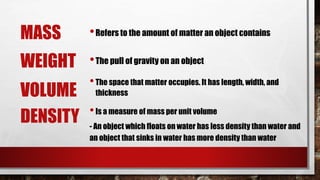
MASS •Refers to the amount of matter an object contains
VOLUME
•The pull of gravity on an objectWEIGHT
•The space that matter occupies. It has length, width, and
thickness
DENSITY •Is a measure of mass per unit volume
- An object which floats on water has less density than water and
an object that sinks in water has more density than water
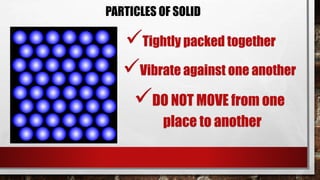
PARTICLES OF SOLID
Tightly packed together
Vibrate against one another
DO NOT MOVE from one
place to another
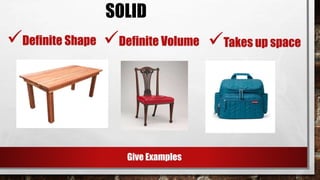
Definite Shape Definite Volume
SOLID
Takes up space
Give Examples
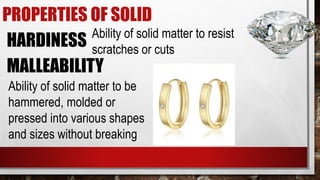
PROPERTIES OF SOLID
HARDINESS Ability of solid matter to resist
scratches or cuts
MALLEABILITY
Ability of solid matter to be
hammered, molded or
pressed into various shapes
and sizes without breaking
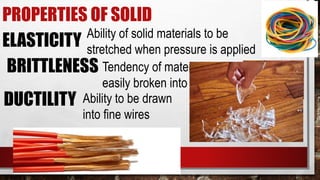
PROPERTIES OF SOLID
ELASTICITY Ability of solid materials to be
stretched when pressure is applied
BRITTLENESS Tendency of materials to be
easily broken into pieces
DUCTILITY Ability to be drawn
into fine wires
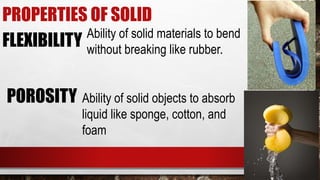
PROPERTIES OF SOLID
FLEXIBILITY Ability of solid materials to bend
without breaking like rubber.
POROSITY Ability of solid objects to absorb
liquid like sponge, cotton, and
foam
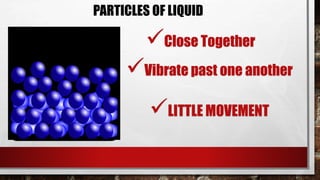
PARTICLES OF LIQUID
Close Together
Vibrate past one another
LITTLE MOVEMENT
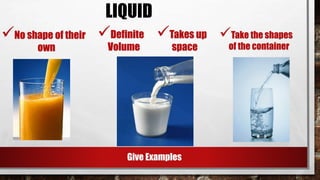
No shape of their
own
Definite
Volume
LIQUID
Takes up
space
Take the shapes
of the container
Give Examples
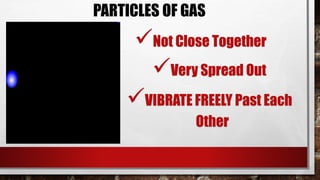
PARTICLES OF GAS
Not Close Together
Very Spread Out
VIBRATE FREELY Past Each
Other
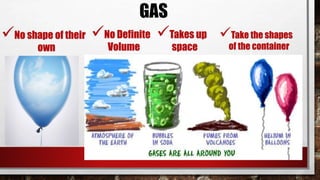
No shape of their
own
No Definite
Volume
GAS
Takes up
space
Take the shapes
of the container
GIVE EXAMPLES OF GASES
•OXYGEN •HELIUM •CARBON DIOXIDE
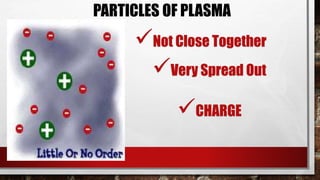
PARTICLES OF PLASMA
Not Close Together
Very Spread Out
CHARGE
No shape of their
own
No Definite
Volume
PLASMA
Less dense
Plasmas are made up of atoms in which some or all of the electrons have been stripped
away and positively charged nuclei, called ions, roam freely.
Blood plasma, by the way, is something completely different. It is the liquid portion of
blood. It is 92 percent water and constitutes 55 percent of blood volume
Being made of charged particles, plasmas can do things gases cannot, like conduct
electricity. And since moving charges make magnetic fields, plasmas also can have
them.
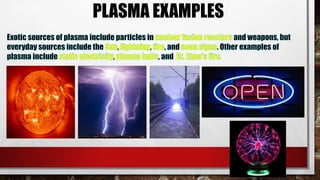
PLASMA EXAMPLES
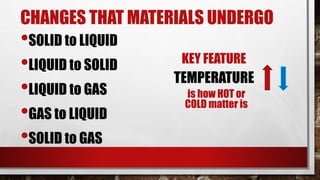
CHANGES THAT MATERIALS UNDERGO
•SOLID to LIQUID
•LIQUID to SOLID
•LIQUID to GAS
•GAS to LIQUID
•SOLID to GAS
KEY FEATURE
TEMPERATURE
is how HOT or
COLD matter is
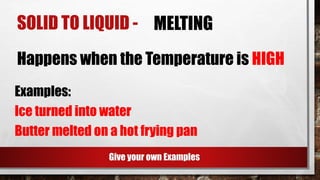
SOLID TO LIQUID - MELTING
Happens when the Temperature is HIGH
Examples:
Ice turned into water
Butter melted on a hot frying pan
Give your own Examples
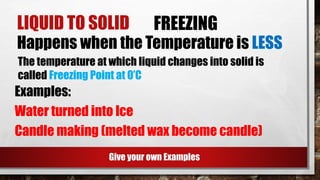
LIQUID TO SOLID FREEZING
Happens when the Temperature is LESS
Examples:
Water turned into Ice
Candle making (melted wax become candle)
Give your own Examples
The temperature at which liquid changes into solid is
called Freezing Point at 0’C
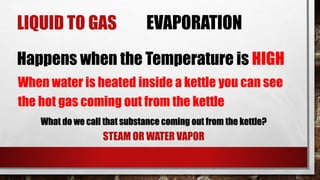
LIQUID TO GAS EVAPORATION
Happens when the Temperature is HIGH
When water is heated inside a kettle you can see
the hot gas coming out from the kettle
What do we call that substance coming out from the kettle?
STEAM OR WATER VAPOR
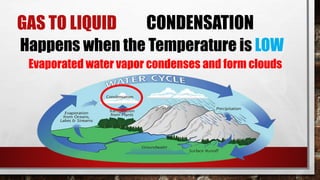
GAS TO LIQUID CONDENSATION
Happens when the Temperature is LOW
Evaporated water vapor condenses and form clouds
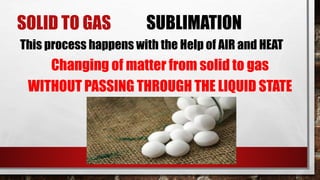
SOLID TO GAS SUBLIMATION
This process happens with the Help of AIR and HEAT
Changing of matter from solid to gas
WITHOUT PASSING THROUGH THE LIQUID STATE
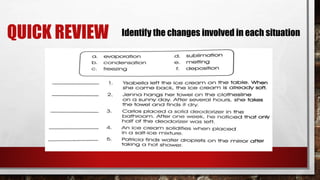
QUICK REVIEW Identify the changes involved in each situation

Matter

  • 2.
    MATTER? M – WhatM is created by God in His image and Likeness? Man A – What A is the invisible mixture of gas? Air T – What T is an instrument use to measure temperature? Thermometer T – What T is the part of the mouth use to taste food? Tongue E – What E is the organ responsible for our sense of sight? R – What R is the part of a plant that absorbs water from the soil? Eyes Roots
  • 3.
    OBJECTIVES •IDENTIFY THE STATESAND CHARACTERISTICS OF MATTER •CLASSIFY OBJECTS AS SOLID, LIQUID, AND GAS •DESCRIBE CHANGES IN MATERIALS ON THE EFFECT OF TEMPERATURE
  • 4.
    Man Air ThermometerTongue Eyes Roots Examples of Matter Give your own Examples of Matter
  • 5.
    MATTER •IT IS ANYTHINGTHAT OCCUPIES SPACE AND HAS MASS •IT EXISTS EVERYWHERE •ALL LIVING AND NON-LIVING THINGS ARE MATTER WHETHER YOU SEE THEM OR NOT
  • 6.
    STATES OF MATTER•SOLID •LIQUID •GAS •PLASMA
  • 7.
    Matter is madeup of molecules which are arranged according to its state. It has properties like mass, weight, volume, and density.
  • 8.
    MASS •Refers tothe amount of matter an object contains VOLUME •The pull of gravity on an objectWEIGHT •The space that matter occupies. It has length, width, and thickness DENSITY •Is a measure of mass per unit volume - An object which floats on water has less density than water and an object that sinks in water has more density than water
  • 9.
    PARTICLES OF SOLID Tightlypacked together Vibrate against one another DO NOT MOVE from one place to another
  • 10.
    Definite Shape DefiniteVolume SOLID Takes up space Give Examples
  • 11.
    PROPERTIES OF SOLID HARDINESSAbility of solid matter to resist scratches or cuts MALLEABILITY Ability of solid matter to be hammered, molded or pressed into various shapes and sizes without breaking
  • 12.
    PROPERTIES OF SOLID ELASTICITYAbility of solid materials to be stretched when pressure is applied BRITTLENESS Tendency of materials to be easily broken into pieces DUCTILITY Ability to be drawn into fine wires
  • 13.
    PROPERTIES OF SOLID FLEXIBILITYAbility of solid materials to bend without breaking like rubber. POROSITY Ability of solid objects to absorb liquid like sponge, cotton, and foam
  • 14.
    PARTICLES OF LIQUID CloseTogether Vibrate past one another LITTLE MOVEMENT
  • 15.
    No shape oftheir own Definite Volume LIQUID Takes up space Take the shapes of the container Give Examples
  • 16.
    PARTICLES OF GAS NotClose Together Very Spread Out VIBRATE FREELY Past Each Other
  • 17.
    No shape oftheir own No Definite Volume GAS Takes up space Take the shapes of the container
  • 18.
    GIVE EXAMPLES OFGASES •OXYGEN •HELIUM •CARBON DIOXIDE
  • 19.
    PARTICLES OF PLASMA NotClose Together Very Spread Out CHARGE
  • 20.
    No shape oftheir own No Definite Volume PLASMA Less dense Plasmas are made up of atoms in which some or all of the electrons have been stripped away and positively charged nuclei, called ions, roam freely. Blood plasma, by the way, is something completely different. It is the liquid portion of blood. It is 92 percent water and constitutes 55 percent of blood volume Being made of charged particles, plasmas can do things gases cannot, like conduct electricity. And since moving charges make magnetic fields, plasmas also can have them.
  • 21.
  • 22.
    CHANGES THAT MATERIALSUNDERGO •SOLID to LIQUID •LIQUID to SOLID •LIQUID to GAS •GAS to LIQUID •SOLID to GAS KEY FEATURE TEMPERATURE is how HOT or COLD matter is
  • 23.
    SOLID TO LIQUID- MELTING Happens when the Temperature is HIGH Examples: Ice turned into water Butter melted on a hot frying pan Give your own Examples
  • 24.
    LIQUID TO SOLIDFREEZING Happens when the Temperature is LESS Examples: Water turned into Ice Candle making (melted wax become candle) Give your own Examples The temperature at which liquid changes into solid is called Freezing Point at 0’C
  • 25.
    LIQUID TO GASEVAPORATION Happens when the Temperature is HIGH When water is heated inside a kettle you can see the hot gas coming out from the kettle What do we call that substance coming out from the kettle? STEAM OR WATER VAPOR
  • 26.
    GAS TO LIQUIDCONDENSATION Happens when the Temperature is LOW Evaporated water vapor condenses and form clouds
  • 27.
    SOLID TO GASSUBLIMATION This process happens with the Help of AIR and HEAT Changing of matter from solid to gas WITHOUT PASSING THROUGH THE LIQUID STATE
  • 28.
    QUICK REVIEW Identifythe changes involved in each situation