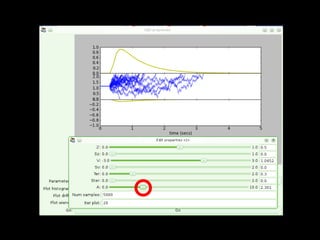
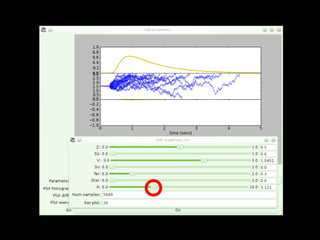
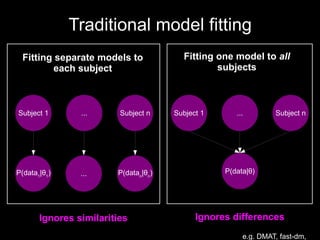
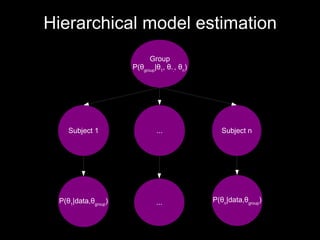
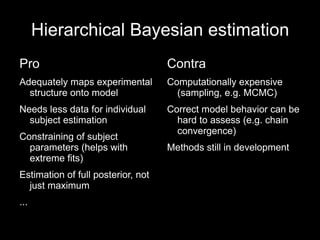
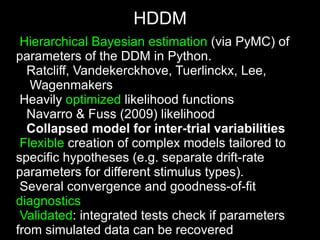
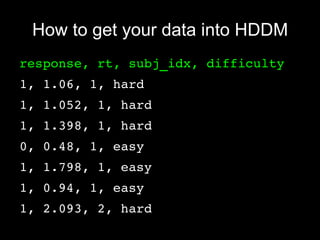
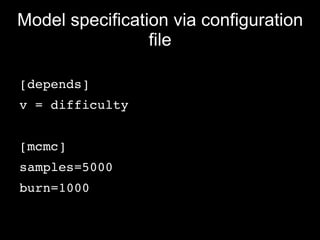
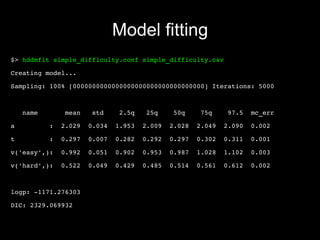
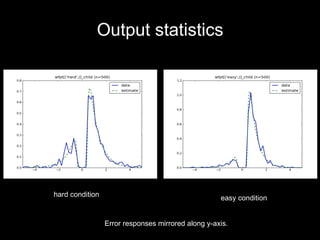
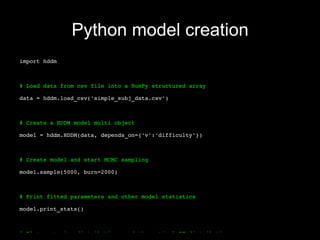
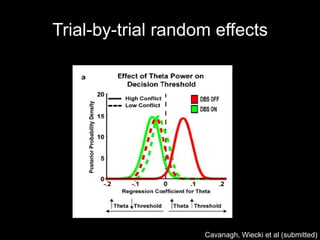
HDDM is a hierarchical Bayesian model that fits drift-diffusion models to behavioral data from multiple subjects. It estimates both group-level and subject-specific parameters, leveraging information across subjects to obtain more reliable estimates. This allows modeling experimental effects like difficulty while accounting for individual differences. HDDM implements efficient Markov chain Monte Carlo sampling in Python to estimate the full posterior distribution. It provides tools to assess model fit and visualize parameter estimates.





![PPT-HEART-DISEASE[1].pptx presentationss](https://cdn.slidesharecdn.com/ss_thumbnails/ppt-heart-disease1-250901140846-bb7a7155-thumbnail.jpg?width=640&height=640&fit=bounds)


