Antiderivatives
5.1
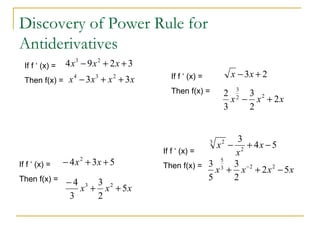
Discovery of Power Rule for
Antiderivatives
If f ‘ (x) =
Then f(x) =
If f ‘ (x) =
Then f(x) =
If f ‘ (x) =
Then f(x) =
If f ‘ (x) =
Then f(x) =
3294 23
++− xxx
xxxx 33 234
++−
23 +− xx
xxx 2
2
3
3
2 22
3
+−
54
3
2
3 2
−+− x
x
x
xxxx 52
2
3
5
3 223
5
−++ −
534 2
++− xx
xxx 5
2
3
3
4 23
++
−
1
oftiveAntideriva
1
+
=
+
n
x
x
n
n
Differentiation
Integration
The process of finding
a derivative The process of finding
the antiderivative
Symbols:
Symbols:
)(',', xfy
dx
dy
∫ dxxf )(
Integral
Integrand
Tells us the
variable of
integration
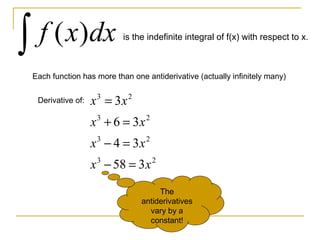
∫ dxxf )( is the indefinite integral of f(x) with respect to x.
Each function has more than one antiderivative (actually infinitely many)
23
23
23
23
358
34
36
3
xx
xx
xx
xx
=−
=−
=+
=Derivative of:
The
antiderivatives
vary by a
constant!
General Solution for an Indefinite Integral
CxFdxxf +=∫ )()(
Where c is a constantYou will lose points if
you forget dx or + C!!!
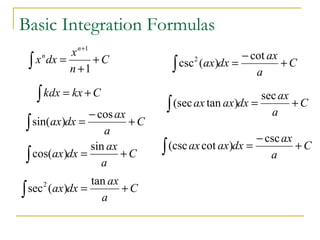
Basic Integration Formulas
C
n
x
dxx
n
n
+
+
=
+
∫ 1
1
Ckxdxk +=∫
C
a
ax
dxax +
−
=∫
cos
)sin(
C
a
ax
dxax +=∫
sin
)cos(
C
a
ax
dxax +=∫
tan
)(sec2
C
a
ax
dxax +
−
=∫
cot
)(csc2
C
a
ax
dxaxax +=∫
sec
)tan(sec
C
a
ax
dxaxax +
−
=∫
csc
)cot(csc
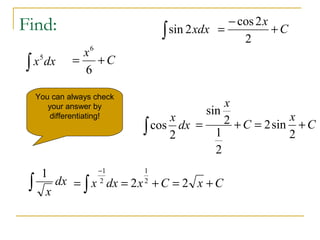
Find:
∫ dxx5
∫ dx
x
1
∫ xdx2sin
∫ dx
x
2
cos
C
x
+=
6
6
CxCxdxx +=+== ∫
−
22 2
1
2
1
C
x
+
−
=
2
2cos
C
x
C
x
+=+=
2
sin2
2
1
2
sin
You can always check
your answer by
differentiating!
Basic Integration Rules
∫∫ = dxxfkdxxkf )()(
( ) ∫∫∫ ±=± dxxgdxxfdxxgxf )()()()(
Evaluate:
( )∫ +−+ dxxxx 465 23
∫ ∫∫∫ +−+= dxdxxdxxdxx 465 23
CxC
x
C
x
C
x
++





+−





++





+= 4
2
6
34
5
234
Cxx
xx
++−+= 43
34
5 2
34
C represents
any constant
Evaluate:
∫ dxx5 3
∫= 5
3
x C
x
+=
5
8
5
8
Cx += 5
8
8
5
Evaluate:
( )∫ − dxxx cos3sin4
∫ ∫−= xdxxdx cos3sin4
CxCx +−+−= sin3cos4
Cxx +−−= sin3cos4
Evaluate:
( )∫ − dxx
22
3
( )∫ +−= dxxx 42
69
C
x
xx ++−=
5
29
5
3
Cxx
x
++−= 92
5
3
5
Evaluate:
∫ dx
x
x
2
cos
sin
∫ ⋅= dx
x
x
x cos
sin
cos
1
Cx += sec
∫ ⋅= xdxx tansec
Particular Solutions
2
1
)('
x
xf = and F(1) = 0
dx
x
xF ∫= 2
1
)(
dxxxF ∫
−
= 2
)(
C
x
xF +
−
=
−
1
)(
1
C
x
xF +−=
1
)(
0
1
1
)1( =+−= CF
1=C
1
1
)( +−=
x
xF

Antiderivatives

  • 1.
  • 2.
    Discovery of PowerRule for Antiderivatives If f ‘ (x) = Then f(x) = If f ‘ (x) = Then f(x) = If f ‘ (x) = Then f(x) = If f ‘ (x) = Then f(x) = 3294 23 ++− xxx xxxx 33 234 ++− 23 +− xx xxx 2 2 3 3 2 22 3 +− 54 3 2 3 2 −+− x x x xxxx 52 2 3 5 3 223 5 −++ − 534 2 ++− xx xxx 5 2 3 3 4 23 ++ −
  • 3.
  • 4.
    Differentiation Integration The process offinding a derivative The process of finding the antiderivative Symbols: Symbols: )(',', xfy dx dy ∫ dxxf )( Integral Integrand Tells us the variable of integration
  • 5.
    ∫ dxxf )(is the indefinite integral of f(x) with respect to x. Each function has more than one antiderivative (actually infinitely many) 23 23 23 23 358 34 36 3 xx xx xx xx =− =− =+ =Derivative of: The antiderivatives vary by a constant!
  • 6.
    General Solution foran Indefinite Integral CxFdxxf +=∫ )()( Where c is a constantYou will lose points if you forget dx or + C!!!
  • 7.
    Basic Integration Formulas C n x dxx n n + + = + ∫1 1 Ckxdxk +=∫ C a ax dxax + − =∫ cos )sin( C a ax dxax +=∫ sin )cos( C a ax dxax +=∫ tan )(sec2 C a ax dxax + − =∫ cot )(csc2 C a ax dxaxax +=∫ sec )tan(sec C a ax dxaxax + − =∫ csc )cot(csc
  • 8.
    Find: ∫ dxx5 ∫ dx x 1 ∫xdx2sin ∫ dx x 2 cos C x += 6 6 CxCxdxx +=+== ∫ − 22 2 1 2 1 C x + − = 2 2cos C x C x +=+= 2 sin2 2 1 2 sin You can always check your answer by differentiating!
  • 9.
    Basic Integration Rules ∫∫= dxxfkdxxkf )()( ( ) ∫∫∫ ±=± dxxgdxxfdxxgxf )()()()(
  • 10.
    Evaluate: ( )∫ +−+dxxxx 465 23 ∫ ∫∫∫ +−+= dxdxxdxxdxx 465 23 ∫ ∫∫∫ +−+= dxdxxdxxdxx 465 23 CxC x C x C x ++      +−      ++      += 4 2 6 34 5 234 Cxx xx ++−+= 43 34 5 2 34 C represents any constant
  • 11.
    Evaluate: ∫ dxx5 3 ∫=5 3 x C x += 5 8 5 8 Cx += 5 8 8 5
  • 12.
    Evaluate: ( )∫ −dxxx cos3sin4 ∫ ∫−= xdxxdx cos3sin4 CxCx +−+−= sin3cos4 Cxx +−−= sin3cos4
  • 13.
    Evaluate: ( )∫ −dxx 22 3 ( )∫ +−= dxxx 42 69 C x xx ++−= 5 29 5 3 Cxx x ++−= 92 5 3 5
  • 14.
    Evaluate: ∫ dx x x 2 cos sin ∫ ⋅=dx x x x cos sin cos 1 Cx += sec ∫ ⋅= xdxx tansec
  • 15.
    Particular Solutions 2 1 )(' x xf =and F(1) = 0 dx x xF ∫= 2 1 )( dxxxF ∫ − = 2 )( C x xF + − = − 1 )( 1 C x xF +−= 1 )( 0 1 1 )1( =+−= CF 1=C 1 1 )( +−= x xF