Tractor Pulling on
  Datawarehouses

Martin Kersten, Volker Markl
Meikel Poess, Kai-Uwe Settler
  Alfons Kemper, Ani Nica,


       DBTest 2011
The good old days
• The early eighties when
  – Oracle appeared on the scene
  – Ingres was a respected innovator on
    RDBMS
  – System R fought the Codasyl battle
  – IMS was still dominating the market


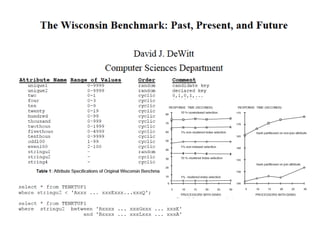
• There was a need for a metric to
  evaluate the solutions
The good old days
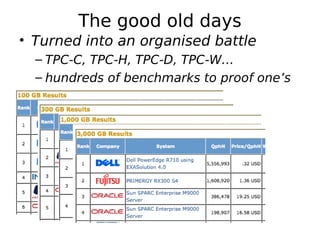
• Turned into an organised battle
  – TPC-C, TPC-H, TPC-D, TPC-W…
  – hundreds of benchmarks to proof one’s
    muscles
• We need tools to assess a solution
  space


• We don’t need weapons to win a
  ‘war’
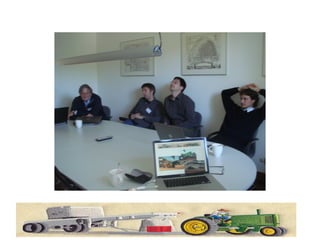
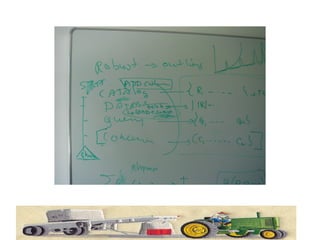
Dagstuhl 2010 Robust Query
        Processing
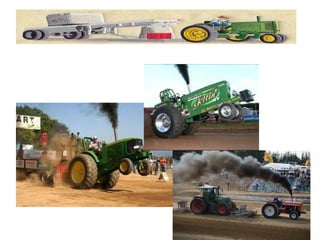
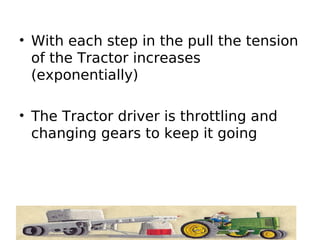
• With each step in the pull the tension
  of the Tractor increases
  (exponentially)

• The Tractor driver is throttling and
  changing gears to keep it going
Ingredients of the DBMS
          Tractor Pull
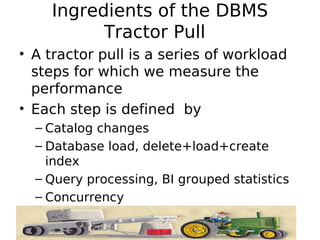
• A tractor pull is a series of workload
  steps for which we measure the
  performance
• Each step is defined by
  – Catalog changes
  – Database load, delete+load+create
    index
  – Query processing, BI grouped statistics
  – Concurrency
  – Act of God operations
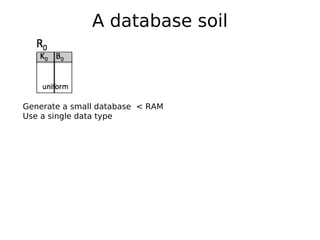
A database soil


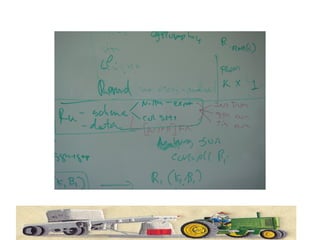
Generate a small database < RAM
Use a single data type
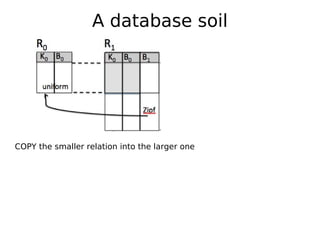
A database soil


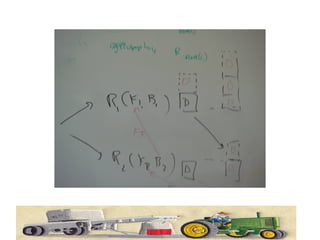
COPY the smaller relation into the larger one


                                 Cop
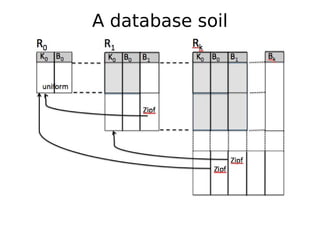
A database soil
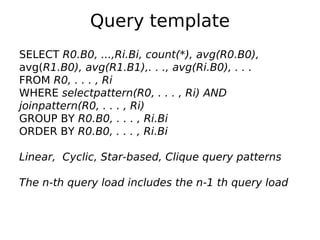
Query template
SELECT R0.B0, ...,Ri.Bi, count(*), avg(R0.B0),
avg(R1.B0), avg(R1.B1),. . ., avg(Ri.B0), . . .
FROM R0, . . . , Ri
WHERE selectpattern(R0, . . . , Ri) AND
joinpattern(R0, . . . , Ri)
GROUP BY R0.B0, . . . , Ri.Bi
ORDER BY R0.B0, . . . , Ri.Bi

Linear, Cyclic, Star-based, Clique query patterns

The n-th query load includes the n-1 th query load
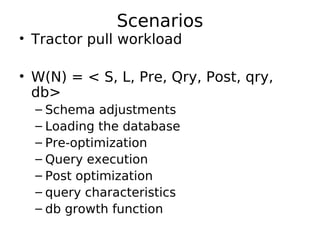
Scenarios
• Tractor pull workload

• W(N) = < S, L, Pre, Qry, Post, qry,
  db>
  – Schema adjustments
  – Loading the database
  – Pre-optimization
  – Query execution
  – Post optimization
  – query characteristics
  – db growth function
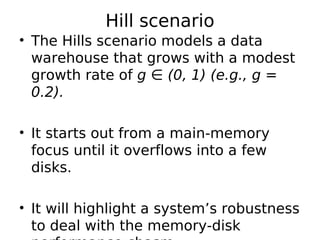
Hill scenario
• The Hills scenario models a data
  warehouse that grows with a modest
  growth rate of g ∈ (0, 1) (e.g., g =
  0.2).

• It starts out from a main-memory
  focus until it overflows into a few
  disks.

• It will highlight a system’s robustness
  to deal with the memory-disk
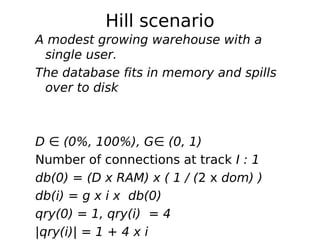
Hill scenario
A modest growing warehouse with a
 single user.
The database fits in memory and spills
 over to disk


D ∈ (0%, 100%), G∈ (0, 1)
Number of connections at track I : 1
db(0) = (D x RAM) x ( 1 / (2 x dom) )
db(i) = g x i x db(0)
qry(0) = 1, qry(i) = 4
|qry(i)| = 1 + 4 x i
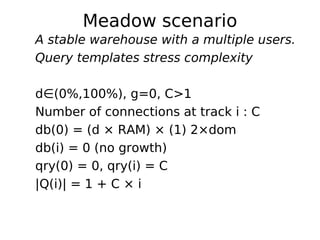
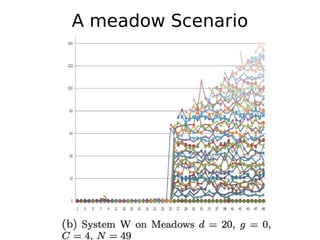
Meadow scenario
A stable warehouse with a multiple users.
Query templates stress complexity

d∈(0%,100%), g=0, C>1
Number of connections at track i : C
db(0) = (d × RAM) × (1) 2×dom
db(i) = 0 (no growth)
qry(0) = 0, qry(i) = C
|Q(i)| = 1 + C × i
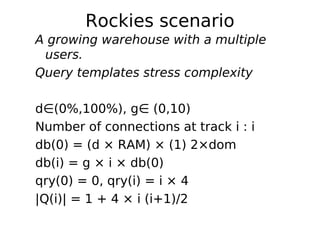
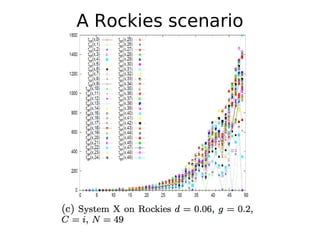
Rockies scenario
A growing warehouse with a multiple
 users.
Query templates stress complexity

d∈(0%,100%), g∈ (0,10)
Number of connections at track i : i
db(0) = (d × RAM) × (1) 2×dom
db(i) = g × i × db(0)
qry(0) = 0, qry(i) = i × 4
|Q(i)| = 1 + 4 × i (i+1)/2
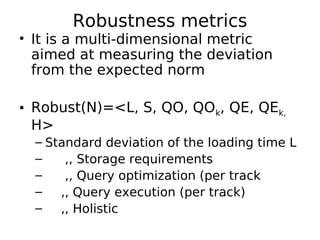
Robustness metrics
• It is a multi-dimensional metric
  aimed at measuring the deviation
  from the expected norm

• Robust(N)=<L, S, QO, QOk, QE, QEk,
  H>
  – Standard deviation of the loading time L
  –    ,, Storage requirements
  –    ,, Query optimization (per track
  –   ,, Query execution (per track)
  –   ,, Holistic
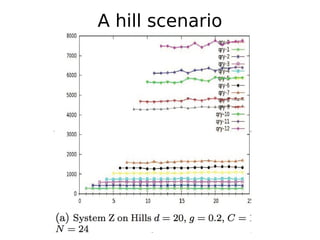
A hill scenario
A meadow Scenario
A Rockies scenario
Take aways
• Robustness is all about comparisons.
  We need methods to quickly
  determine difference in behavior.

• If the system reaches the end of the
  field we are happy. If it blows up or if
  the queries are behaving worse
  along the way it is not robust.
Conclusions
• Tractorpulling is an effective new
  toolkit for robustness testing a DBMS
  in various dimensions

• Refinements for ease of analysis is
  needed (GUIs)

• http://sourceforge.net/projects/tracto
  rpulling
Tractor Pulling on Data Warehouse

Tractor Pulling on Data Warehouse

  • 1.
    Tractor Pulling on Datawarehouses Martin Kersten, Volker Markl Meikel Poess, Kai-Uwe Settler Alfons Kemper, Ani Nica, DBTest 2011
  • 2.
    The good olddays • The early eighties when – Oracle appeared on the scene – Ingres was a respected innovator on RDBMS – System R fought the Codasyl battle – IMS was still dominating the market • There was a need for a metric to evaluate the solutions
  • 4.
    The good olddays • Turned into an organised battle – TPC-C, TPC-H, TPC-D, TPC-W… – hundreds of benchmarks to proof one’s muscles
  • 5.
    • We needtools to assess a solution space • We don’t need weapons to win a ‘war’
  • 6.
    Dagstuhl 2010 RobustQuery Processing
  • 8.
    • With eachstep in the pull the tension of the Tractor increases (exponentially) • The Tractor driver is throttling and changing gears to keep it going
  • 9.
    Ingredients of theDBMS Tractor Pull • A tractor pull is a series of workload steps for which we measure the performance • Each step is defined by – Catalog changes – Database load, delete+load+create index – Query processing, BI grouped statistics – Concurrency – Act of God operations
  • 10.
    A database soil Generatea small database < RAM Use a single data type
  • 11.
    A database soil COPYthe smaller relation into the larger one Cop
  • 12.
  • 13.
    Query template SELECT R0.B0,...,Ri.Bi, count(*), avg(R0.B0), avg(R1.B0), avg(R1.B1),. . ., avg(Ri.B0), . . . FROM R0, . . . , Ri WHERE selectpattern(R0, . . . , Ri) AND joinpattern(R0, . . . , Ri) GROUP BY R0.B0, . . . , Ri.Bi ORDER BY R0.B0, . . . , Ri.Bi Linear, Cyclic, Star-based, Clique query patterns The n-th query load includes the n-1 th query load
  • 14.
    Scenarios • Tractor pullworkload • W(N) = < S, L, Pre, Qry, Post, qry, db> – Schema adjustments – Loading the database – Pre-optimization – Query execution – Post optimization – query characteristics – db growth function
  • 15.
    Hill scenario • TheHills scenario models a data warehouse that grows with a modest growth rate of g ∈ (0, 1) (e.g., g = 0.2). • It starts out from a main-memory focus until it overflows into a few disks. • It will highlight a system’s robustness to deal with the memory-disk
  • 16.
    Hill scenario A modestgrowing warehouse with a single user. The database fits in memory and spills over to disk D ∈ (0%, 100%), G∈ (0, 1) Number of connections at track I : 1 db(0) = (D x RAM) x ( 1 / (2 x dom) ) db(i) = g x i x db(0) qry(0) = 1, qry(i) = 4 |qry(i)| = 1 + 4 x i
  • 17.
    Meadow scenario A stablewarehouse with a multiple users. Query templates stress complexity d∈(0%,100%), g=0, C>1 Number of connections at track i : C db(0) = (d × RAM) × (1) 2×dom db(i) = 0 (no growth) qry(0) = 0, qry(i) = C |Q(i)| = 1 + C × i
  • 18.
    Rockies scenario A growingwarehouse with a multiple users. Query templates stress complexity d∈(0%,100%), g∈ (0,10) Number of connections at track i : i db(0) = (d × RAM) × (1) 2×dom db(i) = g × i × db(0) qry(0) = 0, qry(i) = i × 4 |Q(i)| = 1 + 4 × i (i+1)/2
  • 19.
    Robustness metrics • Itis a multi-dimensional metric aimed at measuring the deviation from the expected norm • Robust(N)=<L, S, QO, QOk, QE, QEk, H> – Standard deviation of the loading time L – ,, Storage requirements – ,, Query optimization (per track – ,, Query execution (per track) – ,, Holistic
  • 20.
  • 21.
  • 22.
  • 23.
    Take aways • Robustnessis all about comparisons. We need methods to quickly determine difference in behavior. • If the system reaches the end of the field we are happy. If it blows up or if the queries are behaving worse along the way it is not robust.
  • 24.
    Conclusions • Tractorpulling isan effective new toolkit for robustness testing a DBMS in various dimensions • Refinements for ease of analysis is needed (GUIs) • http://sourceforge.net/projects/tracto rpulling