Concept Note:
Mathematics Skill
Development
Programme
                 Siddharth Misra
                 This program helps children lose the fear of Mathematics
                 (by introducing them the concept of “Joyful
                 Mathematics”) and let them gain confidence in the
                 subject.


      Saumitra

      Lucknow

    9838073306

      5/2/2010
Concept Note: Mathematics Skill Development Programme

Contents
Mathematics Skill Development Programme ............................................................................................... 3
   What is MatheMatics? .............................................................................................................................. 3
   Importance of Mathematics: .................................................................................................................... 3
   Problem of teaching mathematics at school level .................................................................................... 3
   What is Mathematics Skill Development programme? ............................................................................ 4
   Programme content .................................................................................................................................. 5
   Topics ........................................................................................................................................................ 5
      ALGEBRA ............................................................................................................................................... 5
      GEOMETRY ............................................................................................................................................ 5
      MEASUREMENT .................................................................................................................................... 5
      NUMBER SYSTEM AND ARITHMETIC .................................................................................................... 5
      PROBABILITY AND STATISTICS .............................................................................................................. 6
      MATHEMATICAL REASONING ............................................................................................................... 6
   Methodology ............................................................................................................................................. 6


MSD by Siddharth Misra                                                                                                                                   Page 2
Concept Note: Mathematics Skill Development Programme

Mathematics Skill Development Programme


What is MatheMatics?
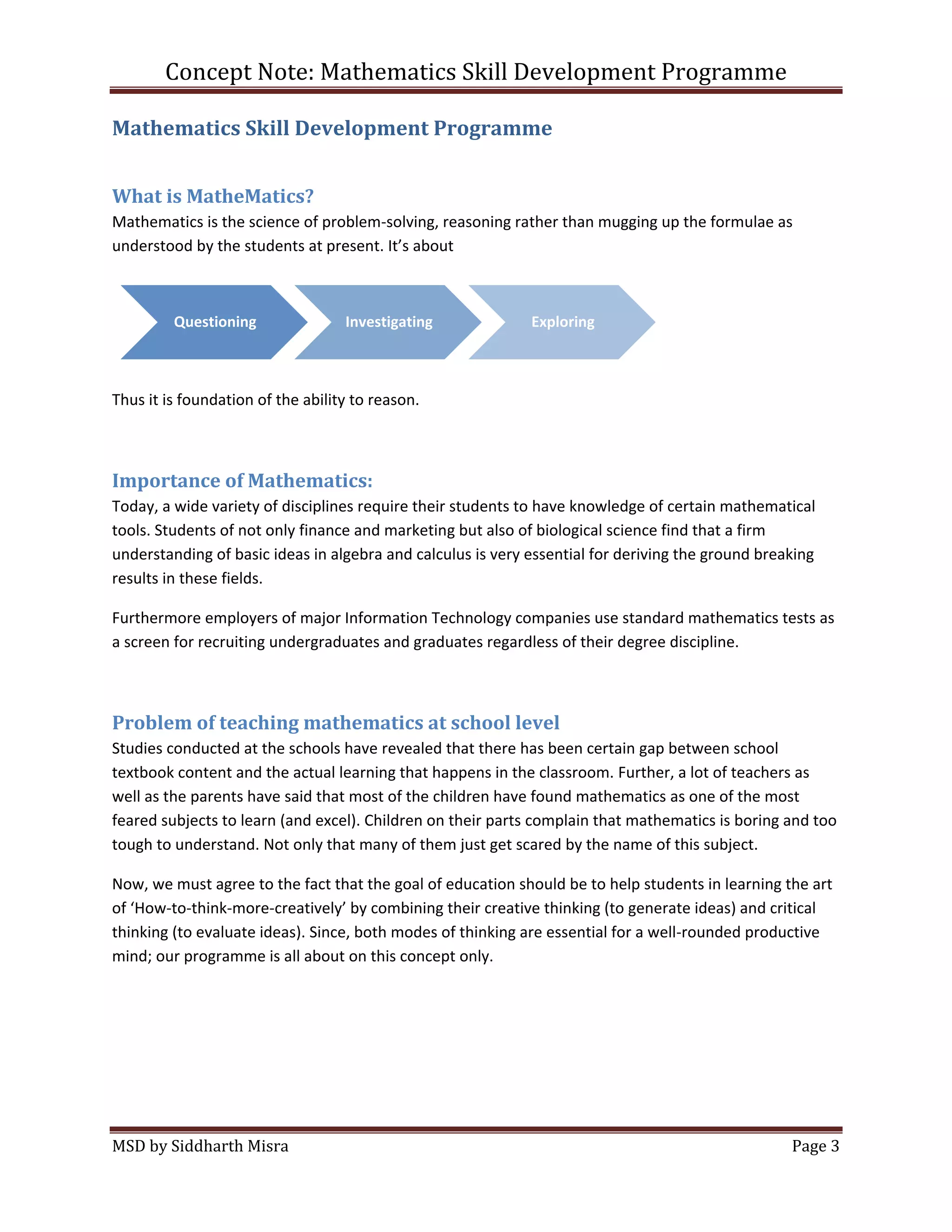
Mathematics is the science of problem-solving, reasoning rather than mugging up the formulae as
understood by the students at present. It’s about


         Questioning               Investigating             Exploring


Thus it is foundation of the ability to reason.


Importance of Mathematics:
Today, a wide variety of disciplines require their students to have knowledge of certain mathematical
tools. Students of not only finance and marketing but also of biological science find that a firm
understanding of basic ideas in algebra and calculus is very essential for deriving the ground breaking
results in these fields.

Furthermore employers of major Information Technology companies use standard mathematics tests as
a screen for recruiting undergraduates and graduates regardless of their degree discipline.


Problem of teaching mathematics at school level
Studies conducted at the schools have revealed that there has been certain gap between school
textbook content and the actual learning that happens in the classroom. Further, a lot of teachers as
well as the parents have said that most of the children have found mathematics as one of the most
feared subjects to learn (and excel). Children on their parts complain that mathematics is boring and too
tough to understand. Not only that many of them just get scared by the name of this subject.

Now, we must agree to the fact that the goal of education should be to help students in learning the art
of ‘How-to-think-more-creatively’ by combining their creative thinking (to generate ideas) and critical
thinking (to evaluate ideas). Since, both modes of thinking are essential for a well-rounded productive
mind; our programme is all about on this concept only.


MSD by Siddharth Misra                                                                             Page 3
Concept Note: Mathematics Skill Development Programme

What is Mathematics Skill Development programme?
MSD Program is aimed at developing the mental mathematics skill of children aged 12 years and above.
This program helps children lose the fear of Mathematics (by introducing them the concept of “Joyful
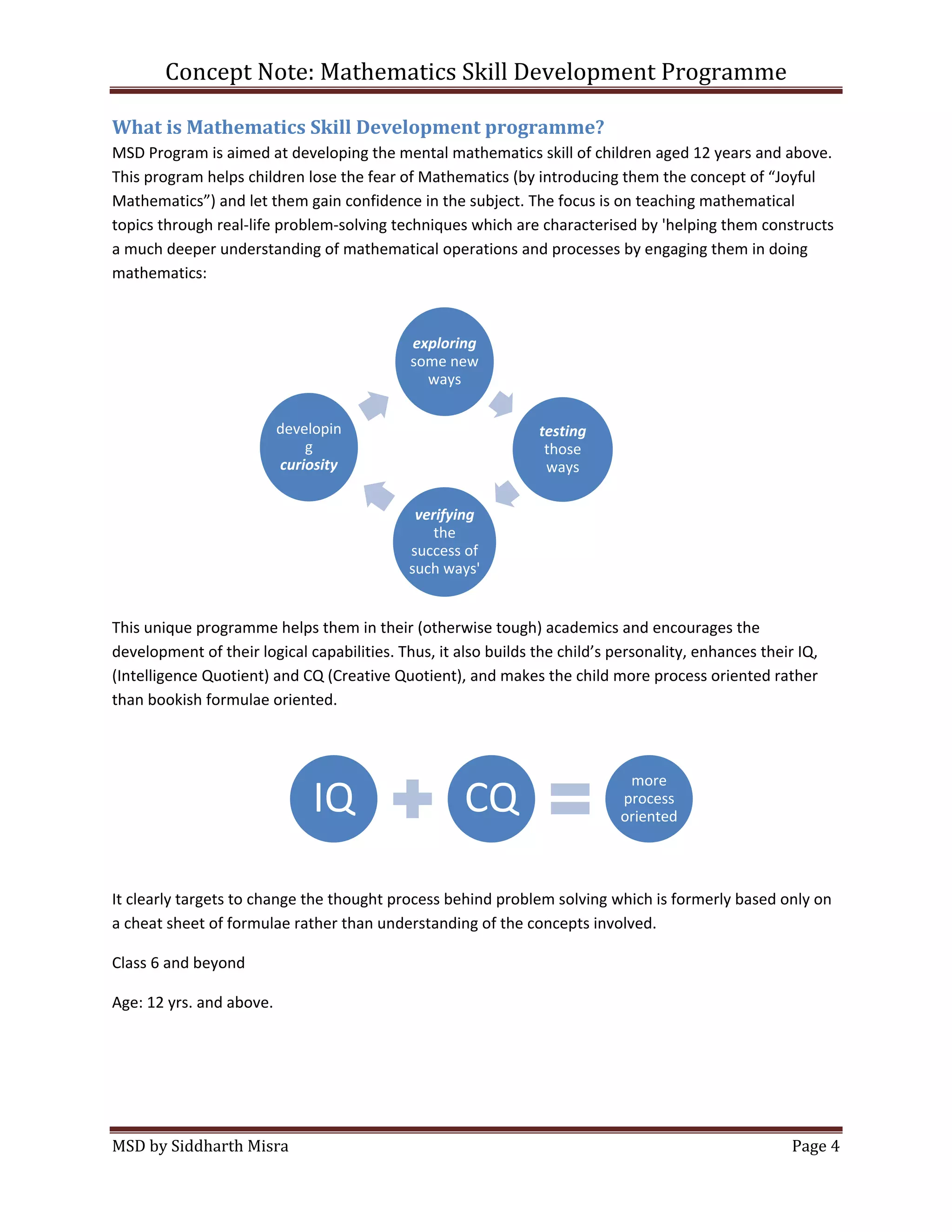
Mathematics”) and let them gain confidence in the subject. The focus is on teaching mathematical
topics through real-life problem-solving techniques which are characterised by 'helping them constructs
a much deeper understanding of mathematical operations and processes by engaging them in doing
mathematics:


                                             exploring
                                             some new
                                               ways


                          developin                             testing
                              g                                  those
                          curiosity                              ways

                                              verifying
                                                 the
                                             success of
                                             such ways'


This unique programme helps them in their (otherwise tough) academics and encourages the
development of their logical capabilities. Thus, it also builds the child’s personality, enhances their IQ,
(Intelligence Quotient) and CQ (Creative Quotient), and makes the child more process oriented rather
than bookish formulae oriented.


                                                                              more
                               IQ                    CQ                      process
                                                                             oriented


It clearly targets to change the thought process behind problem solving which is formerly based only on
a cheat sheet of formulae rather than understanding of the concepts involved.

Class 6 and beyond

Age: 12 yrs. and above.


MSD by Siddharth Misra                                                                                 Page 4
Concept Note: Mathematics Skill Development Programme

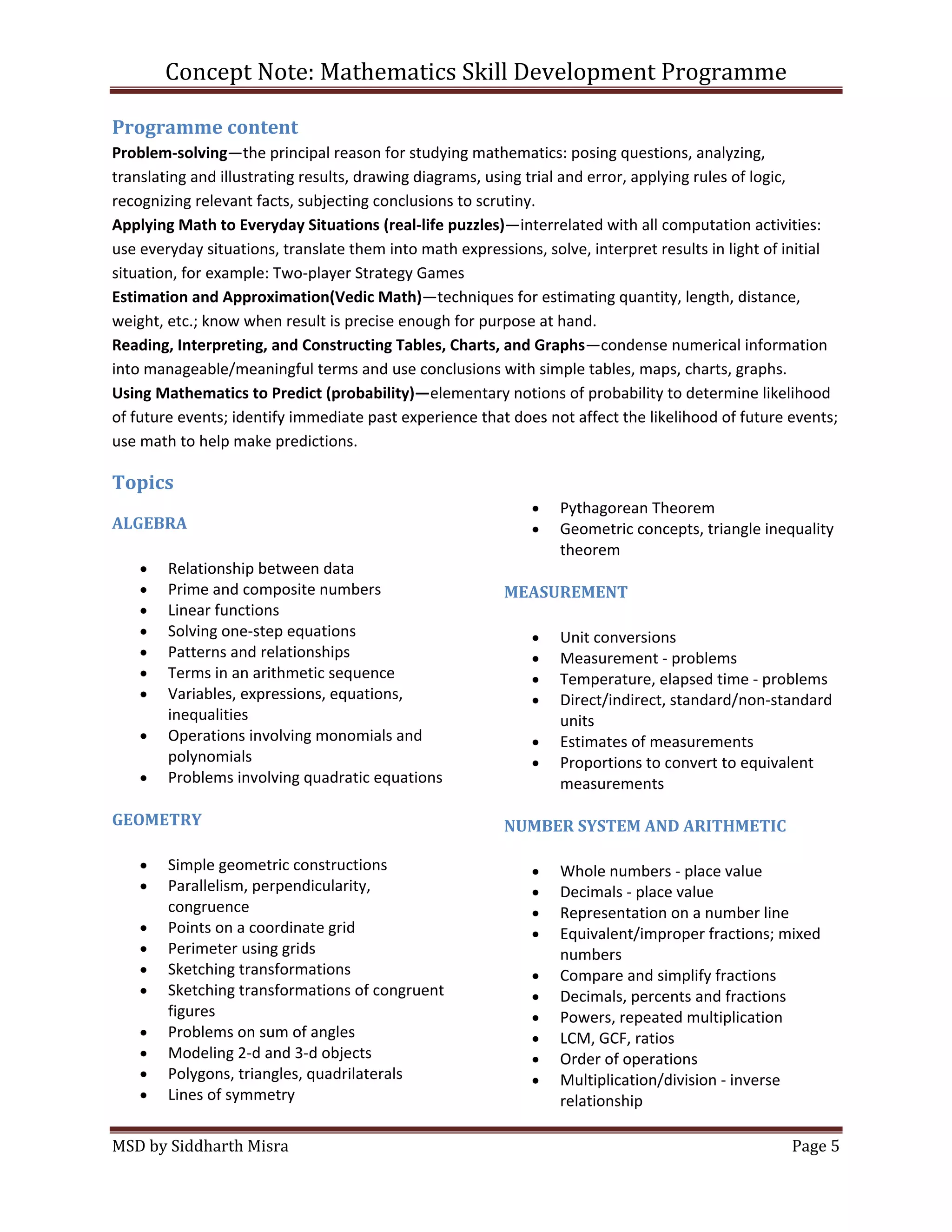
Programme content
Problem-solving—the principal reason for studying mathematics: posing questions, analyzing,
translating and illustrating results, drawing diagrams, using trial and error, applying rules of logic,
recognizing relevant facts, subjecting conclusions to scrutiny.
Applying Math to Everyday Situations (real-life puzzles)—interrelated with all computation activities:
use everyday situations, translate them into math expressions, solve, interpret results in light of initial
situation, for example: Two-player Strategy Games
Estimation and Approximation(Vedic Math)—techniques for estimating quantity, length, distance,
weight, etc.; know when result is precise enough for purpose at hand.
Reading, Interpreting, and Constructing Tables, Charts, and Graphs—condense numerical information
into manageable/meaningful terms and use conclusions with simple tables, maps, charts, graphs.
Using Mathematics to Predict (probability)—elementary notions of probability to determine likelihood
of future events; identify immediate past experience that does not affect the likelihood of future events;
use math to help make predictions.

Topics
                                                                  Pythagorean Theorem
ALGEBRA                                                           Geometric concepts, triangle inequality
                                                                  theorem
        Relationship between data
        Prime and composite numbers                      MEASUREMENT
        Linear functions
        Solving one-step equations                                Unit conversions
        Patterns and relationships                                Measurement - problems
        Terms in an arithmetic sequence                           Temperature, elapsed time - problems
        Variables, expressions, equations,                        Direct/indirect, standard/non-standard
        inequalities                                              units
        Operations involving monomials and                        Estimates of measurements
        polynomials                                               Proportions to convert to equivalent
        Problems involving quadratic equations                    measurements

GEOMETRY                                                 NUMBER SYSTEM AND ARITHMETIC

        Simple geometric constructions                            Whole numbers - place value
        Parallelism, perpendicularity,                            Decimals - place value
        congruence                                                Representation on a number line
        Points on a coordinate grid                               Equivalent/improper fractions; mixed
        Perimeter using grids                                     numbers
        Sketching transformations                                 Compare and simplify fractions
        Sketching transformations of congruent                    Decimals, percents and fractions
        figures                                                   Powers, repeated multiplication
        Problems on sum of angles                                 LCM, GCF, ratios
        Modeling 2-d and 3-d objects                              Order of operations
        Polygons, triangles, quadrilaterals                       Multiplication/division - inverse
        Lines of symmetry                                         relationship

MSD by Siddharth Misra                                                                              Page 5
Concept Note: Mathematics Skill Development Programme

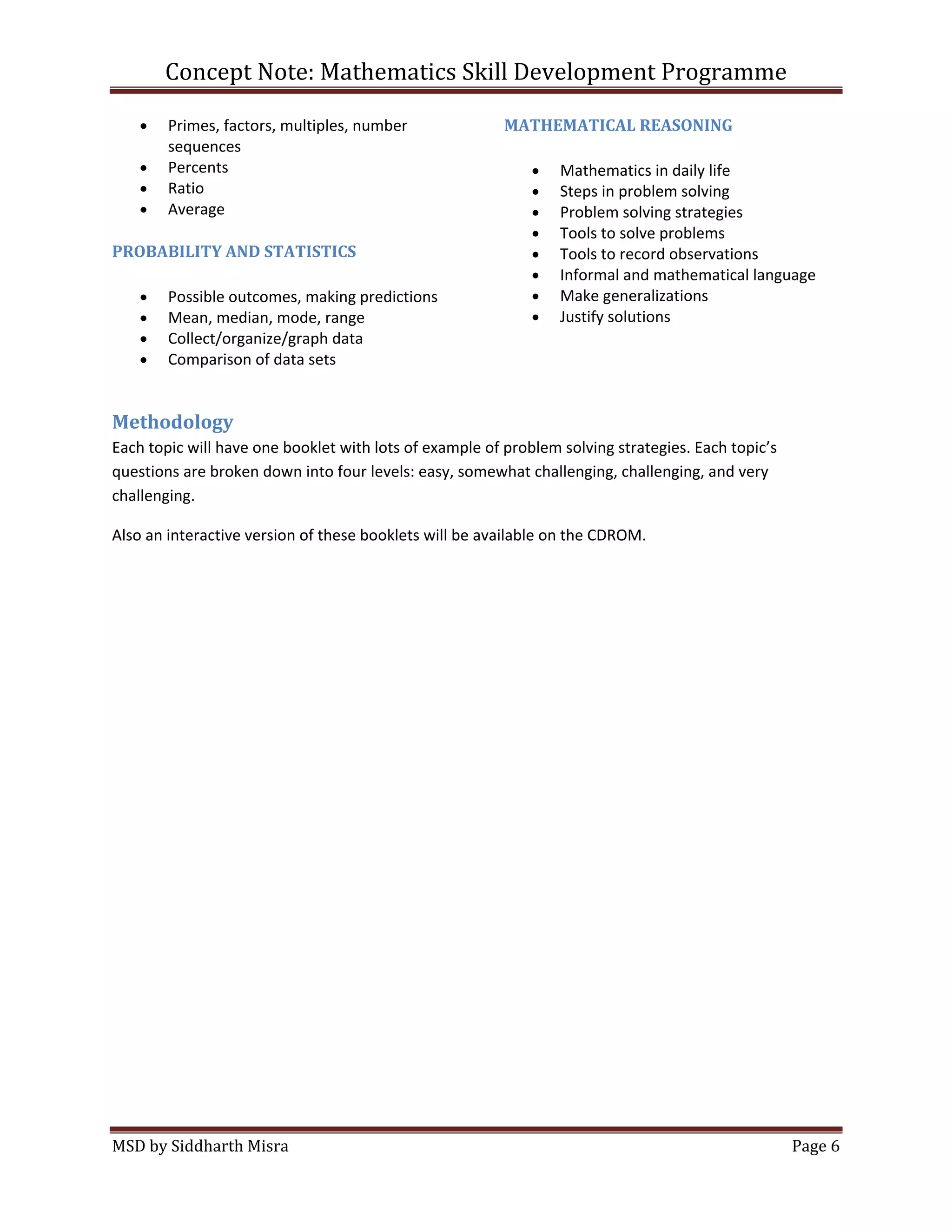
        Primes, factors, multiples, number               MATHEMATICAL REASONING
        sequences
        Percents                                                 Mathematics in daily life
        Ratio                                                    Steps in problem solving
        Average                                                  Problem solving strategies
                                                                 Tools to solve problems
PROBABILITY AND STATISTICS                                       Tools to record observations
                                                                 Informal and mathematical language
        Possible outcomes, making predictions                    Make generalizations
        Mean, median, mode, range                                Justify solutions
        Collect/organize/graph data
        Comparison of data sets


Methodology
Each topic will have one booklet with lots of example of problem solving strategies. Each topic’s
questions are broken down into four levels: easy, somewhat challenging, challenging, and very
challenging.

Also an interactive version of these booklets will be available on the CDROM.


MSD by Siddharth Misra                                                                              Page 6

Mathematics skill development programme

  • 1.
    Concept Note: Mathematics Skill Development Programme Siddharth Misra This program helps children lose the fear of Mathematics (by introducing them the concept of “Joyful Mathematics”) and let them gain confidence in the subject. Saumitra Lucknow 9838073306 5/2/2010
  • 2.
    Concept Note: MathematicsSkill Development Programme Contents Mathematics Skill Development Programme ............................................................................................... 3 What is MatheMatics? .............................................................................................................................. 3 Importance of Mathematics: .................................................................................................................... 3 Problem of teaching mathematics at school level .................................................................................... 3 What is Mathematics Skill Development programme? ............................................................................ 4 Programme content .................................................................................................................................. 5 Topics ........................................................................................................................................................ 5 ALGEBRA ............................................................................................................................................... 5 GEOMETRY ............................................................................................................................................ 5 MEASUREMENT .................................................................................................................................... 5 NUMBER SYSTEM AND ARITHMETIC .................................................................................................... 5 PROBABILITY AND STATISTICS .............................................................................................................. 6 MATHEMATICAL REASONING ............................................................................................................... 6 Methodology ............................................................................................................................................. 6 MSD by Siddharth Misra Page 2
  • 3.
    Concept Note: MathematicsSkill Development Programme Mathematics Skill Development Programme What is MatheMatics? Mathematics is the science of problem-solving, reasoning rather than mugging up the formulae as understood by the students at present. It’s about Questioning Investigating Exploring Thus it is foundation of the ability to reason. Importance of Mathematics: Today, a wide variety of disciplines require their students to have knowledge of certain mathematical tools. Students of not only finance and marketing but also of biological science find that a firm understanding of basic ideas in algebra and calculus is very essential for deriving the ground breaking results in these fields. Furthermore employers of major Information Technology companies use standard mathematics tests as a screen for recruiting undergraduates and graduates regardless of their degree discipline. Problem of teaching mathematics at school level Studies conducted at the schools have revealed that there has been certain gap between school textbook content and the actual learning that happens in the classroom. Further, a lot of teachers as well as the parents have said that most of the children have found mathematics as one of the most feared subjects to learn (and excel). Children on their parts complain that mathematics is boring and too tough to understand. Not only that many of them just get scared by the name of this subject. Now, we must agree to the fact that the goal of education should be to help students in learning the art of ‘How-to-think-more-creatively’ by combining their creative thinking (to generate ideas) and critical thinking (to evaluate ideas). Since, both modes of thinking are essential for a well-rounded productive mind; our programme is all about on this concept only. MSD by Siddharth Misra Page 3
  • 4.
    Concept Note: MathematicsSkill Development Programme What is Mathematics Skill Development programme? MSD Program is aimed at developing the mental mathematics skill of children aged 12 years and above. This program helps children lose the fear of Mathematics (by introducing them the concept of “Joyful Mathematics”) and let them gain confidence in the subject. The focus is on teaching mathematical topics through real-life problem-solving techniques which are characterised by 'helping them constructs a much deeper understanding of mathematical operations and processes by engaging them in doing mathematics: exploring some new ways developin testing g those curiosity ways verifying the success of such ways' This unique programme helps them in their (otherwise tough) academics and encourages the development of their logical capabilities. Thus, it also builds the child’s personality, enhances their IQ, (Intelligence Quotient) and CQ (Creative Quotient), and makes the child more process oriented rather than bookish formulae oriented. more IQ CQ process oriented It clearly targets to change the thought process behind problem solving which is formerly based only on a cheat sheet of formulae rather than understanding of the concepts involved. Class 6 and beyond Age: 12 yrs. and above. MSD by Siddharth Misra Page 4
  • 5.
    Concept Note: MathematicsSkill Development Programme Programme content Problem-solving—the principal reason for studying mathematics: posing questions, analyzing, translating and illustrating results, drawing diagrams, using trial and error, applying rules of logic, recognizing relevant facts, subjecting conclusions to scrutiny. Applying Math to Everyday Situations (real-life puzzles)—interrelated with all computation activities: use everyday situations, translate them into math expressions, solve, interpret results in light of initial situation, for example: Two-player Strategy Games Estimation and Approximation(Vedic Math)—techniques for estimating quantity, length, distance, weight, etc.; know when result is precise enough for purpose at hand. Reading, Interpreting, and Constructing Tables, Charts, and Graphs—condense numerical information into manageable/meaningful terms and use conclusions with simple tables, maps, charts, graphs. Using Mathematics to Predict (probability)—elementary notions of probability to determine likelihood of future events; identify immediate past experience that does not affect the likelihood of future events; use math to help make predictions. Topics Pythagorean Theorem ALGEBRA Geometric concepts, triangle inequality theorem Relationship between data Prime and composite numbers MEASUREMENT Linear functions Solving one-step equations Unit conversions Patterns and relationships Measurement - problems Terms in an arithmetic sequence Temperature, elapsed time - problems Variables, expressions, equations, Direct/indirect, standard/non-standard inequalities units Operations involving monomials and Estimates of measurements polynomials Proportions to convert to equivalent Problems involving quadratic equations measurements GEOMETRY NUMBER SYSTEM AND ARITHMETIC Simple geometric constructions Whole numbers - place value Parallelism, perpendicularity, Decimals - place value congruence Representation on a number line Points on a coordinate grid Equivalent/improper fractions; mixed Perimeter using grids numbers Sketching transformations Compare and simplify fractions Sketching transformations of congruent Decimals, percents and fractions figures Powers, repeated multiplication Problems on sum of angles LCM, GCF, ratios Modeling 2-d and 3-d objects Order of operations Polygons, triangles, quadrilaterals Multiplication/division - inverse Lines of symmetry relationship MSD by Siddharth Misra Page 5
  • 6.
    Concept Note: MathematicsSkill Development Programme Primes, factors, multiples, number MATHEMATICAL REASONING sequences Percents Mathematics in daily life Ratio Steps in problem solving Average Problem solving strategies Tools to solve problems PROBABILITY AND STATISTICS Tools to record observations Informal and mathematical language Possible outcomes, making predictions Make generalizations Mean, median, mode, range Justify solutions Collect/organize/graph data Comparison of data sets Methodology Each topic will have one booklet with lots of example of problem solving strategies. Each topic’s questions are broken down into four levels: easy, somewhat challenging, challenging, and very challenging. Also an interactive version of these booklets will be available on the CDROM. MSD by Siddharth Misra Page 6