MATATAG CURRICULUM
KEY STAGE2 CURRICULUM
Focuses on Grades 4 to 6 learners. At this stage, the
curriculum extends numbers, algebra, measures, geometry,
data and probability. The coverage includes more complex
properties, operations, and problems in different contexts
that demand efficient written and mental methods of
calculation.
3.
use efficient mentaland written mathematical concepts, operations,
procedures, relationships, and tools to solve routine and non-routine real-world
problems.
The learning standards of the Key Stage 2 Mathematics
curriculum aim to ensure that learners:
reason and communicate using precise mathematical language to discuss
ideas, investigate problems, and justify solutions.
exhibit willingness and confidence to explore alternative solutions, and to take
risks necessary to solve real-world problems.
acquire problem-solving and critical thinking skills through real, situated, or
purely mathematical problems; and
enhance appreciation, curiosity, interest, creativity, and other desirable values,
attitudes and dispositions in mathematics.
4.
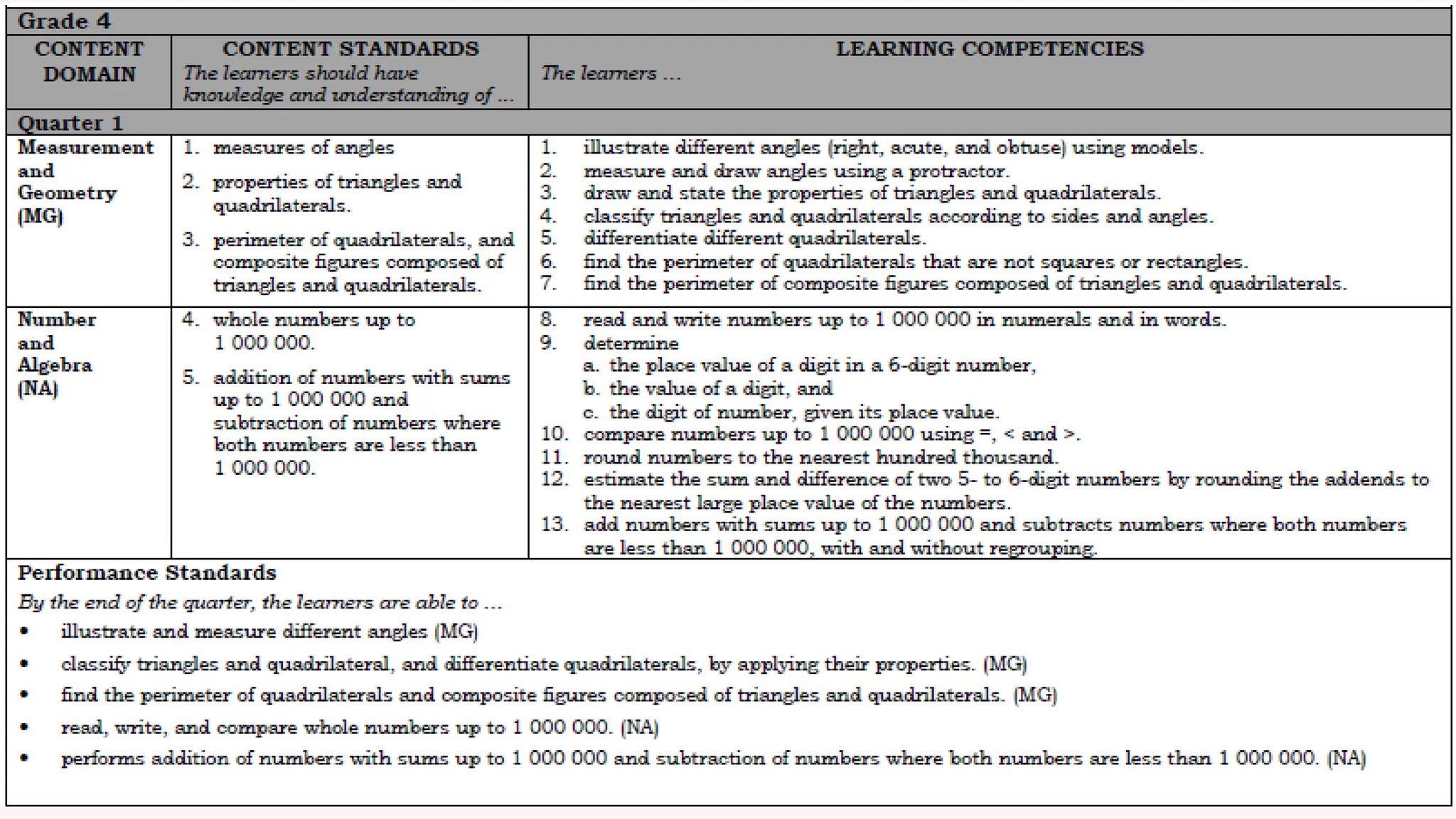
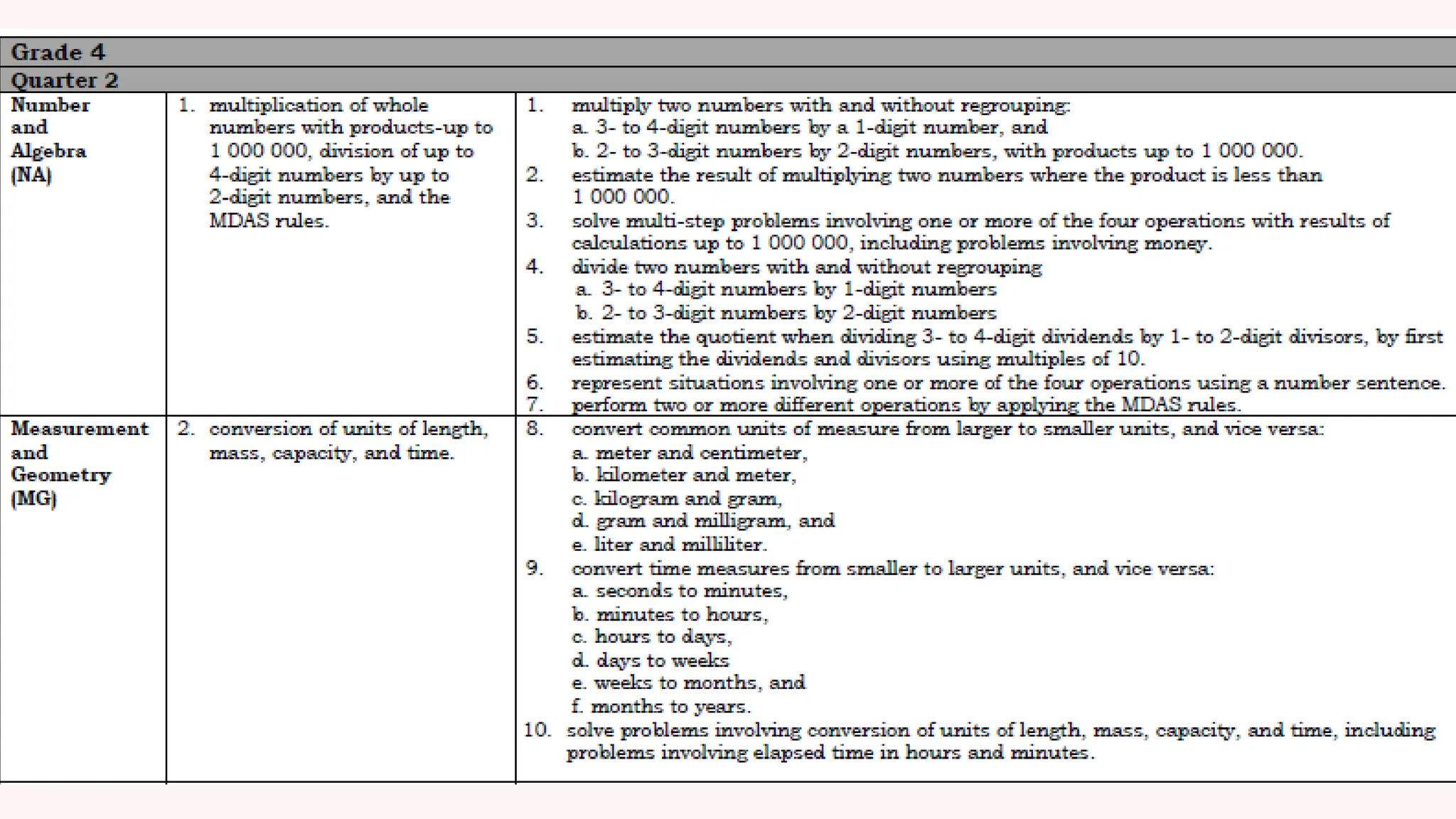
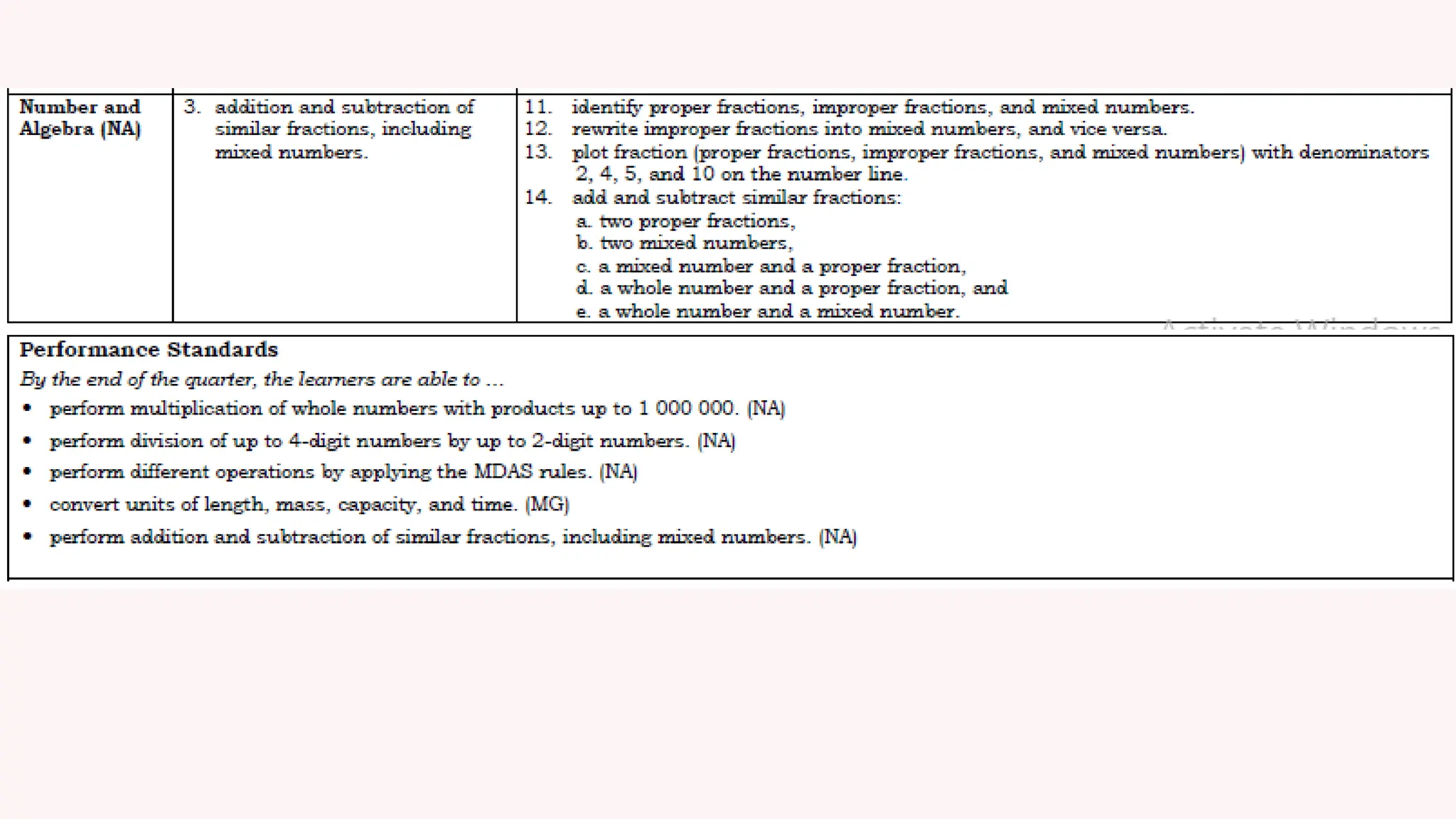
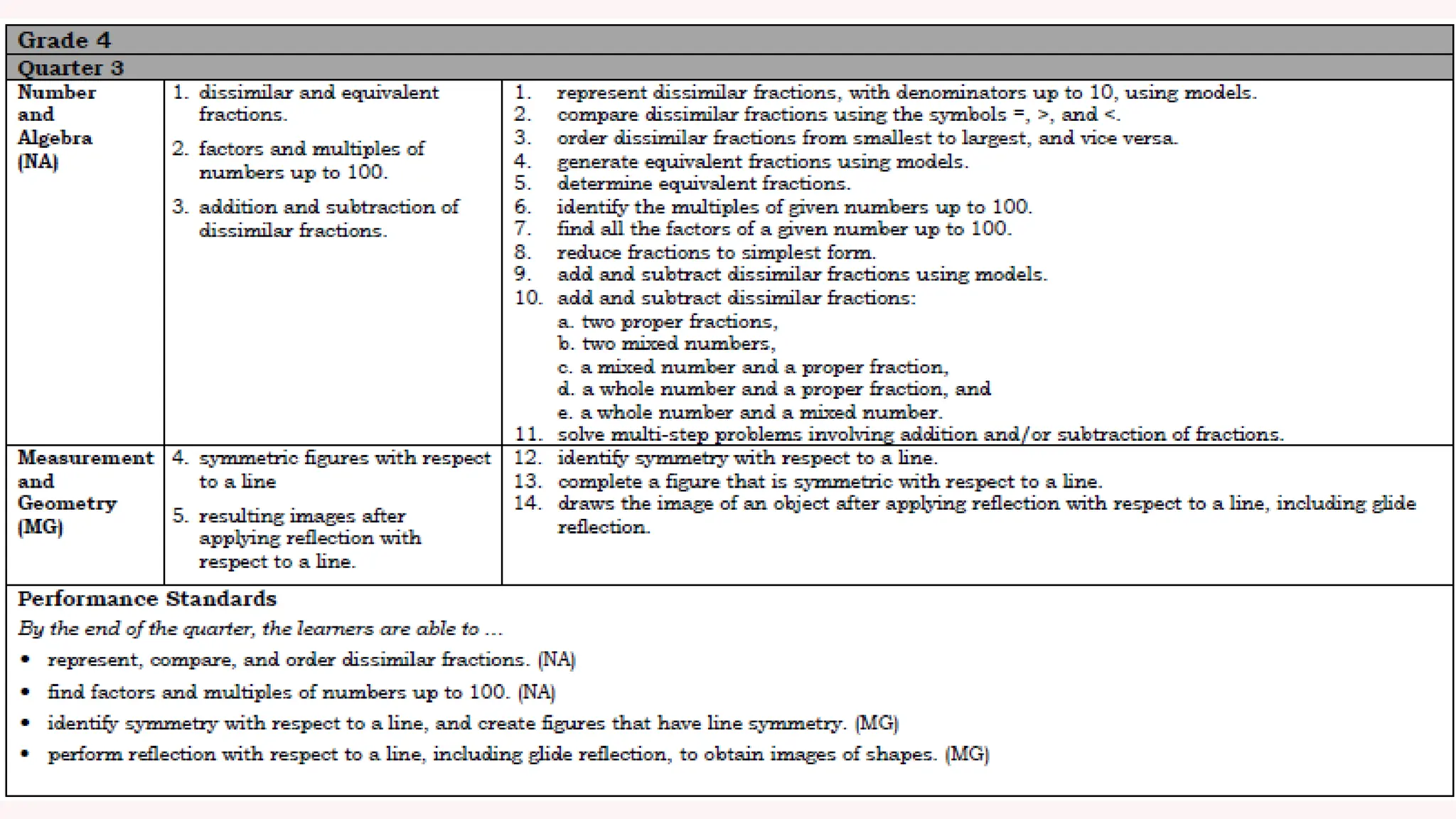
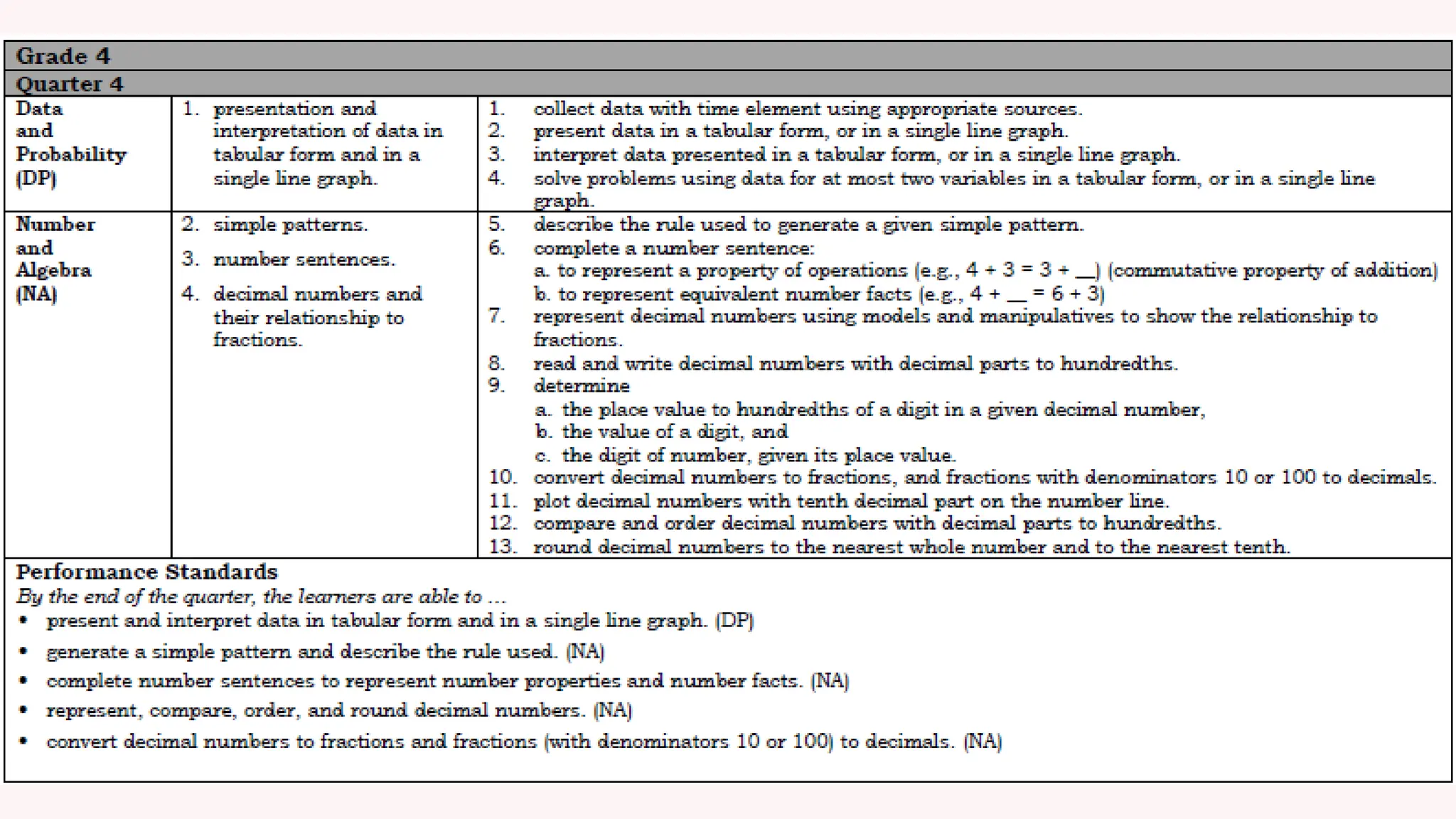
The learner demonstratesknowledge, skills, and understanding in relation to the curriculum content
domains Number and Algebra (whole numbers up to 1 000 000; addition of numbers with sums up
to 1 000 000 and subtraction of numbers where both numbers are less than 1 000 000;
multiplication of whole numbers with products-up to 1 000 000; division of up to 4-digit numbers by
up to 2-digit numbers, and the MDAS rules; addition and subtraction of similar fractions, including
mixed numbers; dissimilar and equivalent fractions; factors and multiples of numbers up to 100;
addition and subtraction of dissimilar fractions; simple patterns; number sentences; decimal
numbers and their relationship to fractions); Measurement and Geometry (right, acute, and obtuse
angles; properties of triangles and quadrilaterals; perimeter of quadrilaterals, and composite
figures composed of triangles and quadrilaterals; conversion of units of length, mass, capacity, and
time; symmetric figures and designs; reflection with shapes); and Data and Probability
(presentation and interpretation of data in tabular form and in a single line graph). This knowledge,
skills, and understanding is applied, with the use of technology, to the processes within
Mathematics of critical thinking, problem solving, communicating, reasoning, and making
connections between topic areas.
GRADE LEVEL STANDARDS (Grade 4)
Things to Considerin Planning
Instruction in TMath 2
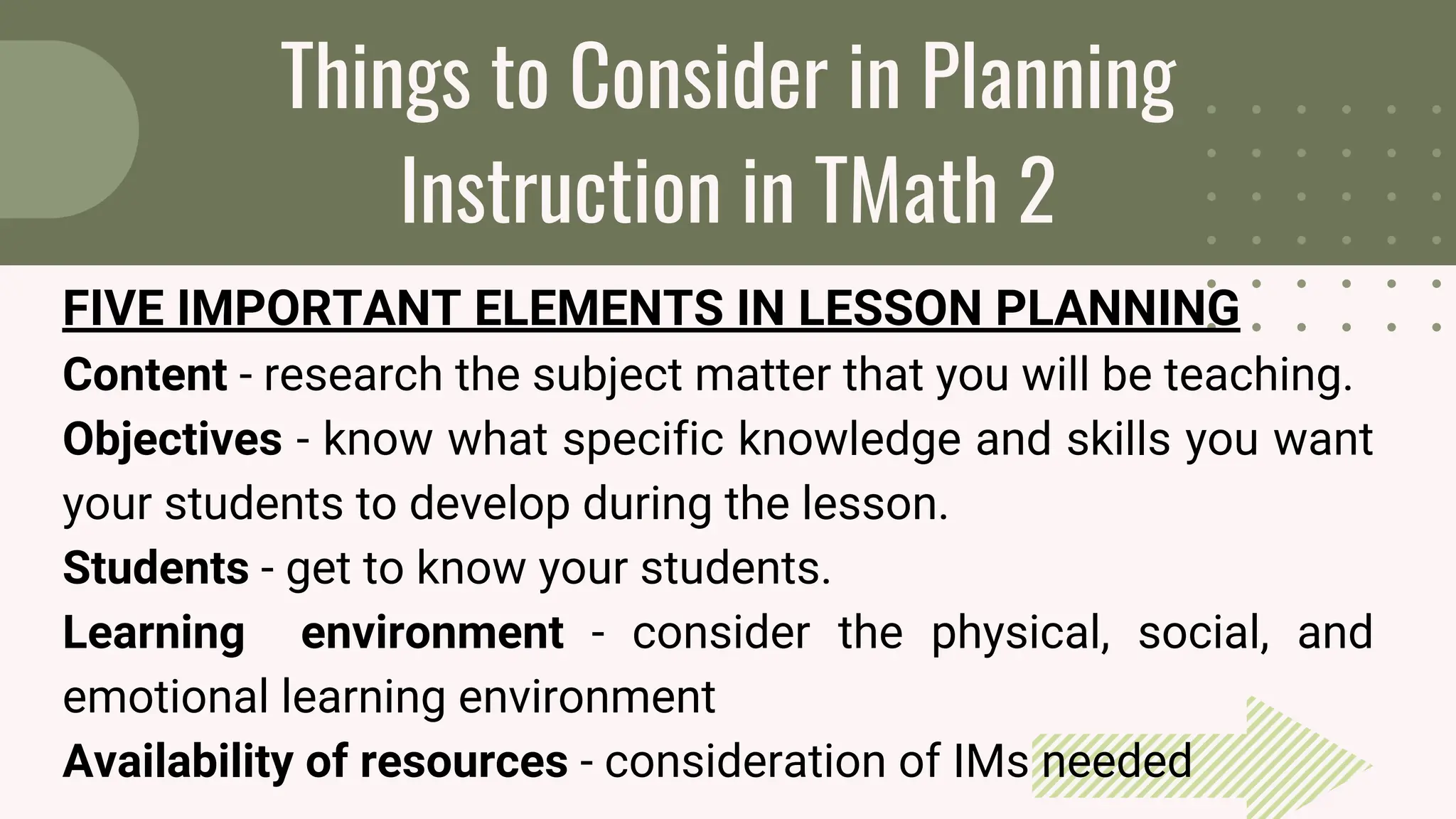
FIVE IMPORTANT ELEMENTS IN LESSON PLANNING
Content - research the subject matter that you will be teaching.
Objectives - know what specific knowledge and skills you want
your students to develop during the lesson.
Students - get to know your students.
Learning environment - consider the physical, social, and
emotional learning environment
Availability of resources - consideration of IMs needed