Reducing Traffic Congestion
A Solution
What traffic congestion does
•
•
•
•
•
•
•
•
•
•

Reduces vehicle speed
Increases travel time
Reducing flow of vehicles
Increases Queue Length
Increase chances of traffic jams
Wastage of fuel
Negative impact on environment
Negative impact on health due to pollution
Increases frustration
Adds avoidable costs to individuals , states and country

Recurring traffic congestion leads to recurring costs as well as raises the demand for fuel
For the same traffic ,wider roads help in reducing traffic congestion
Width of roads within city is influenced by the infrastructure along the roads
Rough Calculation of Costs
An Example
Petrol Price = Rs 80 / ltr ,Running average= 20km/ltr
Therefore Cost/ km = Rs 80/20 = Rs 4
Assuming 10 km travel (both ways)
In Obstruction free Traffic (with traffic signals)
Non productive time of 30 mins will cost Rs 40 (and no income
during travel)
In Traffic congestion (with traffic signals)
Non productive time of 40 mins will cost Rs 40+ ? (extra cost) (and
no income during travel)
Inconveniences : Delay or Missing important meeting/events , avoidable apologies ,
emergency challenges for patients, late start/end of planned events impacting many people,
postponing/cancelling planned events, little time for other activities/work , increased vehicle
maintenance etc.
Rough Calculation of Costs contd..
Assuming a flow of 1000 vehicles/hour on a given stretch
(Unobstructed movement)
Assuming 10 mins of extra time (in Traffic congestion) costs an
additional Rs 5 / vehicle
So 10 mins of extra time for 1000 vehicles to cost – Rs5000 (extra
costs)
Assuming same traffic 14 hours, the total costs per day – 5000*14 – Rs
70,000 (extra costs)
For 365 days – Rs 2,55,50,000 (extra costs)
(i.e. total extra cost of fuel purchased annually by the travelling
community using a particular stretch of road on daily basis)
These extra costs are recurring annually
Note:-Health and environment related costs are not being considered
in this example. Neither is potential loss of income.

Can these additional costs be minimised or eliminated ?
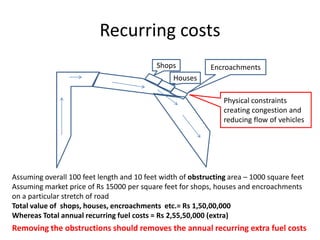
Recurring costs
Shops

Encroachments

Houses
Physical constraints
creating congestion and
reducing flow of vehicles

Assuming overall 100 feet length and 10 feet width of obstructing area – 1000 square feet
Assuming market price of Rs 15000 per square feet for shops, houses and encroachments
on a particular stretch of road
Total value of shops, houses, encroachments etc.= Rs 1,50,00,000
Whereas Total annual recurring fuel costs = Rs 2,55,50,000 (extra)

Removing the obstructions should removes the annual recurring extra fuel costs
A Solution
Buying out and running down the obstructing constructions
and handing over the freed space to city authorities for
road widening
– By Individuals
– By Companies under Corporate Social Responsibility
– By citizen groups ,NGOs etc
– Through crowd sourcing
 Space along the length of roads can be used for putting up
advertisements to recover some or all the costs
 Certain entities can use crowd sourcing to build a fund that can
be utilised for road widening projects
 Even local market associations can come together to fund the
road widening if the accessibility to their shops and offices is
found to improve after doing the same

Overall any time saved makes more time available to do other things
Also reduces the burden on pocket ,health , environment and mind
Nation too benefits

Reducing traffic congestion

  • 1.
  • 2.
    What traffic congestiondoes • • • • • • • • • • Reduces vehicle speed Increases travel time Reducing flow of vehicles Increases Queue Length Increase chances of traffic jams Wastage of fuel Negative impact on environment Negative impact on health due to pollution Increases frustration Adds avoidable costs to individuals , states and country Recurring traffic congestion leads to recurring costs as well as raises the demand for fuel For the same traffic ,wider roads help in reducing traffic congestion Width of roads within city is influenced by the infrastructure along the roads
  • 3.
    Rough Calculation ofCosts An Example Petrol Price = Rs 80 / ltr ,Running average= 20km/ltr Therefore Cost/ km = Rs 80/20 = Rs 4 Assuming 10 km travel (both ways) In Obstruction free Traffic (with traffic signals) Non productive time of 30 mins will cost Rs 40 (and no income during travel) In Traffic congestion (with traffic signals) Non productive time of 40 mins will cost Rs 40+ ? (extra cost) (and no income during travel) Inconveniences : Delay or Missing important meeting/events , avoidable apologies , emergency challenges for patients, late start/end of planned events impacting many people, postponing/cancelling planned events, little time for other activities/work , increased vehicle maintenance etc.
  • 4.
    Rough Calculation ofCosts contd.. Assuming a flow of 1000 vehicles/hour on a given stretch (Unobstructed movement) Assuming 10 mins of extra time (in Traffic congestion) costs an additional Rs 5 / vehicle So 10 mins of extra time for 1000 vehicles to cost – Rs5000 (extra costs) Assuming same traffic 14 hours, the total costs per day – 5000*14 – Rs 70,000 (extra costs) For 365 days – Rs 2,55,50,000 (extra costs) (i.e. total extra cost of fuel purchased annually by the travelling community using a particular stretch of road on daily basis) These extra costs are recurring annually Note:-Health and environment related costs are not being considered in this example. Neither is potential loss of income. Can these additional costs be minimised or eliminated ?
  • 5.
    Recurring costs Shops Encroachments Houses Physical constraints creatingcongestion and reducing flow of vehicles Assuming overall 100 feet length and 10 feet width of obstructing area – 1000 square feet Assuming market price of Rs 15000 per square feet for shops, houses and encroachments on a particular stretch of road Total value of shops, houses, encroachments etc.= Rs 1,50,00,000 Whereas Total annual recurring fuel costs = Rs 2,55,50,000 (extra) Removing the obstructions should removes the annual recurring extra fuel costs
  • 6.
    A Solution Buying outand running down the obstructing constructions and handing over the freed space to city authorities for road widening – By Individuals – By Companies under Corporate Social Responsibility – By citizen groups ,NGOs etc – Through crowd sourcing  Space along the length of roads can be used for putting up advertisements to recover some or all the costs  Certain entities can use crowd sourcing to build a fund that can be utilised for road widening projects  Even local market associations can come together to fund the road widening if the accessibility to their shops and offices is found to improve after doing the same Overall any time saved makes more time available to do other things Also reduces the burden on pocket ,health , environment and mind Nation too benefits