other discrete
PROBABILITY
DISTRIBUTION
By: Angelo Genovana
1.4-
Discrete Uniform Distribution
A random variable has a discrete
uniform distribution where all the values
of the random variable are equally
likely, that is they have equal
probabilities.
If the random variable x assumes
the values x1, x2, x3... xn, that are
equally likely then it as a discrete
uniform distribution. The probability of
any outcome x, is 1/n.
Example:
When a far die is thrown, the
possible outcomes are 1, 2, 3, 4, 5, and
6. each time the die is thrown, it can roll
on any of these numbers. Since there
are six numbers, the probability of a
given score is 1/6. Therefore, we hav a
discrete uniform distributions.
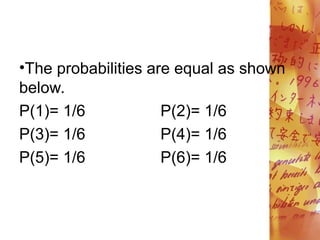
•The probabilities are equal as shown
below.
P(1)= 1/6 P(2)= 1/6
P(3)= 1/6 P(4)= 1/6
P(5)= 1/6 P(6)= 1/6
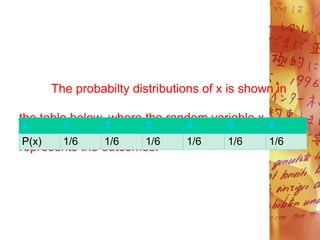
The probabilty distributions of x is shown in
the table below, where the random variable x
represents the outcomes.
x 1 2 3 4 5 6
P(x) 1/6 1/6 1/6 1/6 1/6 1/6
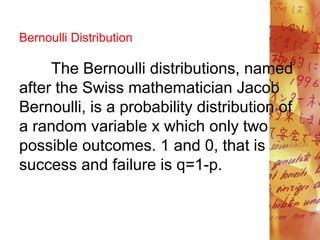
Bernoulli Distribution
The Bernoulli distributions, named
after the Swiss mathematician Jacob
Bernoulli, is a probability distribution of
a random variable x which only two
possible outcomes. 1 and 0, that is
success and failure is q=1-p.
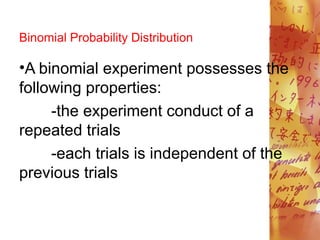
Binomial Probability Distribution
•A binomial experiment possesses the
following properties:
-the experiment conduct of a
repeated trials
-each trials is independent of the
previous trials

Mathematical Equation with solution.pdf

  • 1.
  • 2.
    Discrete Uniform Distribution Arandom variable has a discrete uniform distribution where all the values of the random variable are equally likely, that is they have equal probabilities.
  • 3.
    If the randomvariable x assumes the values x1, x2, x3... xn, that are equally likely then it as a discrete uniform distribution. The probability of any outcome x, is 1/n.
  • 4.
    Example: When a fardie is thrown, the possible outcomes are 1, 2, 3, 4, 5, and 6. each time the die is thrown, it can roll on any of these numbers. Since there are six numbers, the probability of a given score is 1/6. Therefore, we hav a discrete uniform distributions.
  • 5.
    •The probabilities areequal as shown below. P(1)= 1/6 P(2)= 1/6 P(3)= 1/6 P(4)= 1/6 P(5)= 1/6 P(6)= 1/6
  • 6.
    The probabilty distributionsof x is shown in the table below, where the random variable x represents the outcomes. x 1 2 3 4 5 6 P(x) 1/6 1/6 1/6 1/6 1/6 1/6
  • 7.
    Bernoulli Distribution The Bernoullidistributions, named after the Swiss mathematician Jacob Bernoulli, is a probability distribution of a random variable x which only two possible outcomes. 1 and 0, that is success and failure is q=1-p.
  • 8.
    Binomial Probability Distribution •Abinomial experiment possesses the following properties: -the experiment conduct of a repeated trials -each trials is independent of the previous trials