To describe random phenomena
Where Only integer values
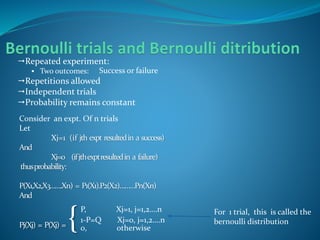
Repeated experiment:
 Two outcomes:
Repetitions allowed
Independent trials
Probability remains constant
Success or failure
Consider an expt. Of n trials
Let
Xj=1 (if jth expt resultedin a success)
And
Xj=0 (ifjthexptresultedin a failure)
thusprobability:
P(X1,X2,X3…….Xn) = P1(X1).P2(X2)………Pn(Xn)
And
Pj(Xj) = P(Xj) = {
P, Xj=1, j=1,2….n
1-P=Q Xj=0, j=1,2….n
0, otherwise
For 1 trial, this is called the
bernoulli distribution
Flipping a coin. In this context, obverse ("heads") conventionally
denotes success and reverse ("tails") denotes failure.
Rolling a die, where a six is "success" and everything else a "failure".
In conducting a political opinion poll, choosing a voter at random to
ascertain whether that voter will vote "yes" in an upcoming
referendum.
Mean and variance:
•Mean:
E(Xj)= 0.q+1.p=P
•Variance:
V(Xj)=[(0.q)+(12.p)]-p2=P(1-P)
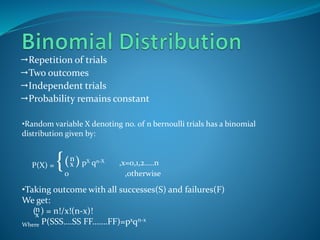
Repetition of trials
Two outcomes
Independent trials
Probability remains constant
•Random variable X denoting no. of n bernoulli trials has a binomial
distribution given by:
P(X) = {
•Taking outcome with all successes(S) and failures(F)
We get:
( ) = n!/x!(n-x)!
Where P(SSS….SS FF…….FF)=pxqn-x
( ) pX qn-X ,x=0,1,2…..n
0 ,otherwise
n
x
n
x
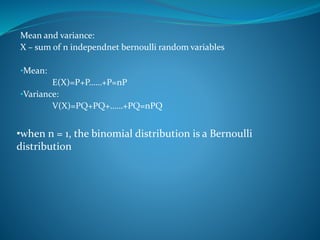
Mean and variance:
X – sum of n independnet bernoulli random variables
•Mean:
E(X)=P+P……+P=nP
•Variance:
V(X)=PQ+PQ+……+PQ=nPQ
•when n = 1, the binomial distribution is a Bernoulli
distribution
P(6)=1/6
P(6’)=5/6
P(6)=1/6
P(6’)=5/6
P(6)=1/6
P(6’)=5/6
P(6)=1/6 P(6)=1/6
P(6’)=5/6
P(6)=1/6
P(6’)=5/6
P(6’)=5/6
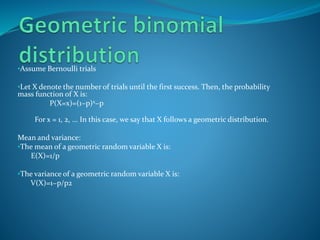
•Assume Bernoulli trials
•Let X denote the number of trials until the first success. Then, the probability
mass function of X is:
P(X=x)=(1−p)x−p
For x = 1, 2, ... In this case, we say that X follows a geometric distribution.
Mean and variance:
•The mean of a geometric random variable X is:
E(X)=1/p
•The variance of a geometric random variable X is:
V(X)=1−p/p2
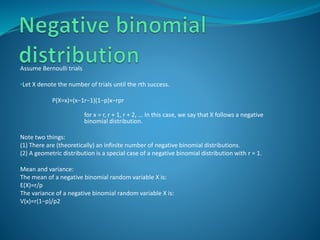
Assume Bernoulli trials
•Let X denote the number of trials until the rth success.
P(X=x)=(x−1r−1)(1−p)x−rpr
for x = r, r + 1, r + 2, ... In this case, we say that X follows a negative
binomial distribution.
Note two things:
(1) There are (theoretically) an infinite number of negative binomial distributions.
(2) A geometric distribution is a special case of a negative binomial distribution with r = 1.
Mean and variance:
The mean of a negative binomial random variable X is:
E(X)=r/p
The variance of a negative binomial random variable X is:
V(x)=r(1−p)/p2
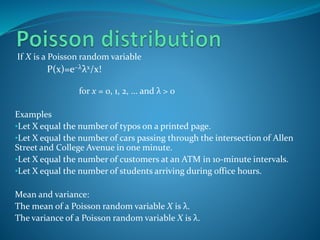
If X is a Poisson random variable
P(x)=e−λλx/x!
for x = 0, 1, 2, ... and λ > 0
Examples
•Let X equal the number of typos on a printed page.
•Let X equal the number of cars passing through the intersection of Allen
Street and College Avenue in one minute.
•Let X equal the number of customers at an ATM in 10-minute intervals.
•Let X equal the number of students arriving during office hours.
Mean and variance:
The mean of a Poisson random variable X is λ.
The variance of a Poisson random variable X is λ.
To describe random phenomena
Where Any value
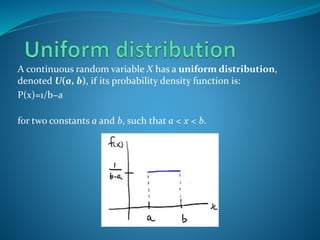
A continuous random variable X has a uniform distribution,
denoted U(a, b), if its probability density function is:
P(x)=1/b−a
for two constants a and b, such that a < x < b.
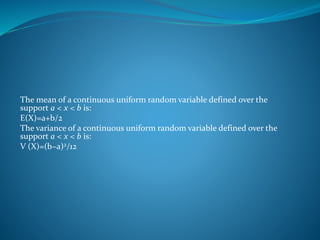
The mean of a continuous uniform random variable defined over the
support a < x < b is:
E(X)=a+b/2
The variance of a continuous uniform random variable defined over the
support a < x < b is:
V (X)=(b−a)2/12
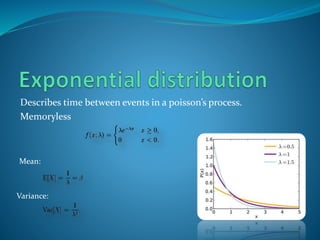
Describes time between events in a poisson’s process.
Memoryless
Mean:
Variance:
To sample exponentional,uniform,triangular dist.
Form empirical dist.
Straight forward
Distribution of random numbers

Distribution of random numbers

  • 2.
    To describe randomphenomena Where Only integer values
  • 3.
    Repeated experiment:  Twooutcomes: Repetitions allowed Independent trials Probability remains constant Success or failure Consider an expt. Of n trials Let Xj=1 (if jth expt resultedin a success) And Xj=0 (ifjthexptresultedin a failure) thusprobability: P(X1,X2,X3…….Xn) = P1(X1).P2(X2)………Pn(Xn) And Pj(Xj) = P(Xj) = { P, Xj=1, j=1,2….n 1-P=Q Xj=0, j=1,2….n 0, otherwise For 1 trial, this is called the bernoulli distribution
  • 4.
    Flipping a coin.In this context, obverse ("heads") conventionally denotes success and reverse ("tails") denotes failure. Rolling a die, where a six is "success" and everything else a "failure". In conducting a political opinion poll, choosing a voter at random to ascertain whether that voter will vote "yes" in an upcoming referendum. Mean and variance: •Mean: E(Xj)= 0.q+1.p=P •Variance: V(Xj)=[(0.q)+(12.p)]-p2=P(1-P)
  • 5.
    Repetition of trials Twooutcomes Independent trials Probability remains constant •Random variable X denoting no. of n bernoulli trials has a binomial distribution given by: P(X) = { •Taking outcome with all successes(S) and failures(F) We get: ( ) = n!/x!(n-x)! Where P(SSS….SS FF…….FF)=pxqn-x ( ) pX qn-X ,x=0,1,2…..n 0 ,otherwise n x n x
  • 6.
    Mean and variance: X– sum of n independnet bernoulli random variables •Mean: E(X)=P+P……+P=nP •Variance: V(X)=PQ+PQ+……+PQ=nPQ •when n = 1, the binomial distribution is a Bernoulli distribution
  • 7.
  • 8.
    •Assume Bernoulli trials •LetX denote the number of trials until the first success. Then, the probability mass function of X is: P(X=x)=(1−p)x−p For x = 1, 2, ... In this case, we say that X follows a geometric distribution. Mean and variance: •The mean of a geometric random variable X is: E(X)=1/p •The variance of a geometric random variable X is: V(X)=1−p/p2
  • 9.
    Assume Bernoulli trials •LetX denote the number of trials until the rth success. P(X=x)=(x−1r−1)(1−p)x−rpr for x = r, r + 1, r + 2, ... In this case, we say that X follows a negative binomial distribution. Note two things: (1) There are (theoretically) an infinite number of negative binomial distributions. (2) A geometric distribution is a special case of a negative binomial distribution with r = 1. Mean and variance: The mean of a negative binomial random variable X is: E(X)=r/p The variance of a negative binomial random variable X is: V(x)=r(1−p)/p2
  • 10.
    If X isa Poisson random variable P(x)=e−λλx/x! for x = 0, 1, 2, ... and λ > 0 Examples •Let X equal the number of typos on a printed page. •Let X equal the number of cars passing through the intersection of Allen Street and College Avenue in one minute. •Let X equal the number of customers at an ATM in 10-minute intervals. •Let X equal the number of students arriving during office hours. Mean and variance: The mean of a Poisson random variable X is λ. The variance of a Poisson random variable X is λ.
  • 11.
    To describe randomphenomena Where Any value
  • 12.
    A continuous randomvariable X has a uniform distribution, denoted U(a, b), if its probability density function is: P(x)=1/b−a for two constants a and b, such that a < x < b.
  • 13.
    The mean ofa continuous uniform random variable defined over the support a < x < b is: E(X)=a+b/2 The variance of a continuous uniform random variable defined over the support a < x < b is: V (X)=(b−a)2/12
  • 14.
    Describes time betweenevents in a poisson’s process. Memoryless Mean: Variance:
  • 15.
    To sample exponentional,uniform,triangulardist. Form empirical dist. Straight forward