edwinxav@hotmail.com 
elapuerta@hotmail.com 
www.twitter.com/mathfor800 
www.facebook.com/mathfor800 
www.pinterest.com/mathfor800
CONTENTS
STATISTICS
Hownumericaldata are distributed. FREQUENCY DISTRIBUTION
CUMULATIVE FREQUENCY 
cumulative 
frequency41319262931
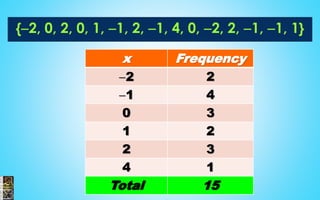
{2, 0, 2, 0, 1, 1, 2, 1, 4, 0, 2, 2, 1, 1, 1} xFrequency 22 1403122341 Total15
MEASURES OF CENTRAL TENDENCY
AritmeticMean
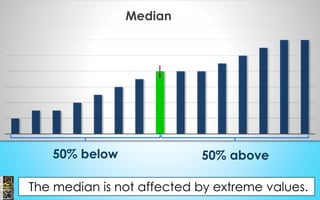
The median of a set of numbers is the value that falls in the middle of the set.
You must first list the values in increasing or decreasing order. MEDIAN
Median 
The median is not affected by extreme values.
ModeThe mode of a set of numbers is the value that appears most often.
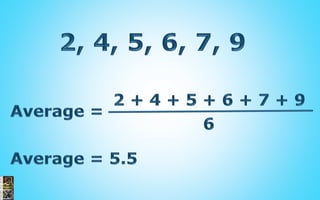
sum of terms 
average 
number of terms 
 
AVERAGE 
(ARITHMETIC MEAN)
EVENLY SPACED TERMS
Just average the smallest and the largest terms. AVERAGE OF EVENLY SPACED TERMS
Arrange the terms in ascending or descending order: 
•the number in the middle of the list, 
•the average (arithmetic mean) of the two numbers in the middle of the list. AVERAGE OF EVENLY SPACED TERMS
4, 5, 6, 7, 8 
4 8 12 
6 
2 2 
 
 
10, 20, 30 , 40 , 50 
10 50 60 
30 
2 2 
 
 
12, 14, 16, 18, 20, 22 
12 22 34 
17 
2 2 
 
 
300, 400, 500, 600, 700, 800 
300 800 1,100 
550 
2 2 
 
 
sum of terms 
average 
number of terms 
 
average number  of terms  sum of terms 
SUM OF TERMS
What is the sum of the integers from 10 to 50, 
inclusive? 
averagenumber of terms  sum of terms 
10 50 
2 
 
 50 10 1  
3041 1,230
WEIGHTED AVERAGE
The girl’s average score is 30. The boy’s 
average score is 24. If there are twice as 
many boys as girls, what is the overall 
average? 
1 30 2 24 
3 
26 
average 
average 
   
 

MEASURES OF CENTRAL TENDENCY
MEASURES OF DISPERSION
Range 
The difference between the highest and the lowest values.
Range
Standard Deviation
RANGE
Variance 
A measure of the average distance between each of a set of data points and their mean value.
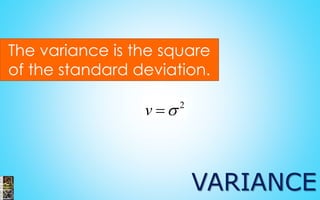
The variance is the square of the standard deviation. VARIANCE 
2v
STEP 1: 
Takethemeasures. 
STEP 2: 
FindtheMean. 
STEP 3: 
CalculatethedifferencesfromtheMean.
NORMAL DISTRIBUTION
Abraham de Moivre(1667-1754). Carl Friedrich Gauss(1777-1855). 
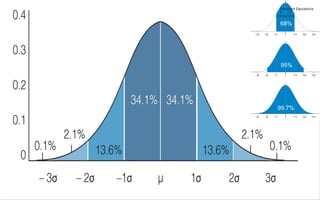
Bell shaped curve.
Symmetry about the center. mean = median = mode
EMPIRICAL RULE68− 95 − 99.7
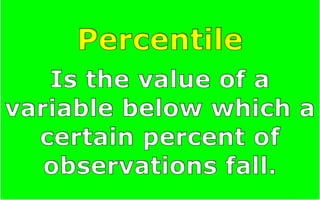
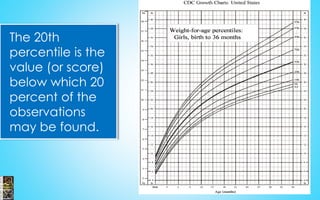
The 20th percentile is the value (or score) below which 20 percent of the observations may be found.
DECILE AND PERCENTILEThe 20th percentile (2nd decile) is the value (or score) below which 20 percent of the observations may be found. D1D2D3D4D5D6D7D8D910%20%30%40%50%60%70%80%90%
QuartilesAre the three points that divide the data set into four equal groups, each representing a fourth of the population being sampled.
QUARTILE
FIRST QUARTILE 
Designated Q1= lower quartile = cuts off lowest 25% of data = 25th percentileQ1Q2Q3
SECOND QUARTILE 
Designated Q2= median = cuts data set in half = 
50th percentileQ1Q2Q3
THIRD QUARTILEQ1Q2Q3
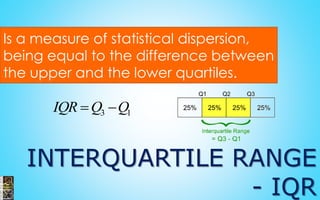
INTERQUARTILE RANGE 
- IQR 
Is a measure of statistical dispersion, 
being equal to the difference between 
the upper and the lower quartiles. 
3 1 IQR Q Q
BOX AND WHISKER PLOTMin:smallest observation (sample minimum), Q1:lower quartile, Q2:median, Q3:upper quartile, andMax:largest observation (sample maximum).
MAX: Q3+ 1.5 IQR (thehighestvalue) 
MIN:Q1–1.5 IQR (thelowestvalue)
A boxplot may also indicate which observations, if any, might be considered outliers.
Hoursof excerciseper week 
2 
4 
6 
8 
10 
12 
0 
Q1 
25% 
Q3 
75% 
Q2 (median) 
50% 
MAX 
MIN 
IRQ = Q3 –Q1 = 6 –2 = 4
PoliticalBent 
(0 = mostconservative, 100 = mostliberal) 
10 
20 
30 
40 
50 
60 
0 
Q1 
Q3 
Q2 
MAX 
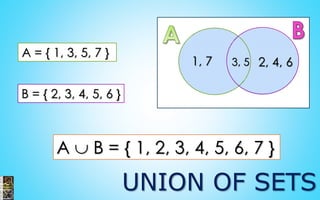
MIN 
70 
80 
90 
100 
Outliers 
Outliers
Correlationcoefficients measure the strength of association between two variables.
PEARSON CORRELATIONCOEFFICIENT
CORRELATION
LINEAR REGRESSION 
Linear regression attempts to model the relationship between two variables by fitting a linear equation to observed data.
STATISTICS
COUNTING METHODS
COUNTING POSSIBILITIES
Fundamental Counting Principle
COUNTING POSSIBILITIES REPETITION
n! (nfactorial) 
means the product of all the integers from 1 to n inclusive.
!  1  2  3 ... 1 
5! 5 4 3 2 1 120 
7! 7 6 5 4 3 2 1 5,040 
7! 7 6! 
7! 7 6 5! 
n  n n   n   n    
      
        
  
   
1! 1 
0! 1 
 

Permutation 
An arrangement of items in some specific order.
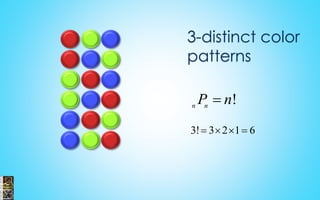
! n n P  n 
3-distinct color 
patterns 
3! 321 6
4! 4321 24 
! n n P  n 
4-distinct color patterns 
1 
2 
3 
4 
5 
6 
7 
8 
9 
10 
11 
12 
13 
14 
15 
16 
17 
18 
19 
20 
21 
22 
23 
24
21 21 P  21! 
! n n P  n 
51,090,942,171,709,440,000
How many different 4-letter arrangements can be formed with all the letters A, B, C, and D? 
ABCD 
ABDC 
ACBD 
ACDB 
ADBC 
ADCB 
BACD 
BADC 
BCAD 
BCDA 
BDAC 
BDCA 
CABD 
CADB 
CBAD 
CBDA 
CDAB 
CDBA 
DABC 
DACB 
DBAC 
DBCA 
DCAB 
DCBA444! 432124P  
There are three marbles: 1 blue, 1 red 
and 1 green. In how many ways is it 
possible to arrange marbles in a row? 
3 3 3! 
3 2 1 
6 
P  
   

There are three marbles: 1 blue, 1 red and 1 green. In how many ways is it possible to arrange marbles in a row if red marble have to be left to blue marble?
Permutationof nthings taken rat a time. 
 ! !nrnPnr  
  6 4 
6! 
6 4 ! 
P  
 
6P4  360
  8 3 
8! 
8 3 ! 
P  
 
8P3  336
  7 3 
7! 
7 3 ! 
P  
 
7P3  210
How many different 3-letter arrangements 
can be formed with all the letters A, B, C, 
D, E, F, and G? 
  7 3 
7! 7! 
210 
7 3 ! 4! 
P    
 
  
! 
! n r 
n 
P 
n r 
 

Circular Permutation
Circular Permutation of 
n things taken at a time. 
  
! 
1 ! 
n 
n 
n 
  
  
5! 
5 1 ! 
5 
  
4! 24
  
14! 
14 1 ! 
14 
  
14! 
13! 
14 

Permutation With Repetition 
Is an arrangement of nitems, of which pare alike and qare alike, in some specific order. 
! !! npq
4! 
2!
8! 
2!
10! 
3!
11! 
2!3!
How many nine-letter patterns can be 
formed using all the letters of the word 
Tennessee? 
9! 
3,780 
4! 2! 2! 
e n s 
 
 
A Combination
  52 5 
52! 
5! 52 5 ! 
C  
  
  
! 
! ! n r 
n 
C 
r n r 
 
  
2,598,960
How many different 3-letter combinations 
can be formed with all the letters A, B, C, 
D, E, F, and G? 
  7 3 
7! 
3! 7 3 ! 
C  
  
  
! 
! ! n r 
n 
C 
r n r 
 
  
7 3 
7! 
35 
3! 4! 
C   

COUNTING METHODS
PROBABILITY
Probability
A variable whose value results from a measurement on some type of random process.
Is a numerical description of the outcome of an experiment. RANDOM VARIABLE
PROBABILITYFor situations in which the possible outcomes are all equally likely, the probability that an event E occurs, represented by “P(E)”, can be defined as: 
FavorableoutcomesofEPETotalnumberofpossibleoutcomes 
COMMON PROBABILITIES
Picking a card in a standard deck 
1 
52
Throwing a die 
1 
6
Flipping a coin12
SUM OF PROBABILITIESIf two or more events constitute all the outcomes, the sum of their probabilities is 1.
2010701001100100100100 
NON-OCCURRENCE PROBABILITY
  
  
20 
100 
80 
100 
p red 
p not red 
 

Independent Events 
Two events are said to be independent if the occurrence or nonoccurrence of either one in no way affects the occurrence of the other.
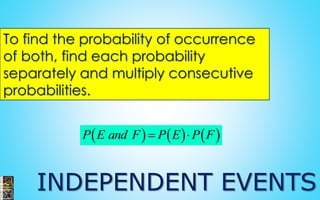
INDEPENDENT EVENTSTo find the probability of occurrence of both, find each probability separately and multiply consecutive probabilities. 
PEandFPEPF
A dresser drawer contains one pair of socks with each 
of the following colors: blue, brown, red, white and 
black. Each pair is folded together in a matching set. 
You reach into the sock drawer and choose a pair of 
socks without looking. You replace this pair and then 
choose another pair of socks. What is the probability 
that you will choose the red pair of socks both times? 
      1 2 p red and red  p red  p red 
1 1 
5 5 
  
1 
25 

DEPENDENT EVENTSTo find the probability of occurrence of both, find each probability separately and multiply consecutive probabilities. 
PEandFPEPF
A card is chosen at random from a standard 
deck of 52 playing cards. Without replacing it, a 
second card is chosen. What is the probability 
that the first card chosen is a queen and the 
second card chosen is a jack? 
      1 2 p queen and jack  p queen  p jack 
4 4 
52 51 
  
4 
663 

PE or F  PE PFPE and F 
PE or F 
PE and F 
Probability that at least one 
of the two events occurs. 
Probability that events E 
and F both occur. 
ADDITION LAW OF 
PROBABILITIES
A 
A 
A 
A 
2 
2 
2 
2 
3 
3 
3 
3 
4 
4 
4 
4 
5 
5 
5 
5 
6 
6 
6 
6 
7 
7 
7 
7 
8 
8 
8 
8 
9 
9 
9 
10 
10 
10 
10 
J 
J 
J 
J 
Q 
Q 
Q 
Q 
K 
K 
K 
K 
What is the probability of picking a 9 or a club in an standard deck of cards? 
DiamondsHeartsClubsSpades 
P (9 or ) = P(9)+P() –P(9 and ) 
= 4/52 + 13/52 –1/52 
= 16/52 
= 4/13 
9
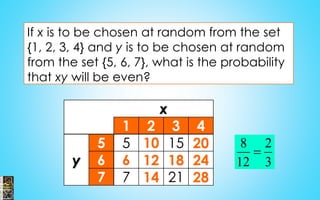
If xis to be chosen at random from the set {1, 2, 3, 4} and yis to be chosen at random from the set {5, 6, 7}, what is the probability that xywill be even? x 
1 
2 
3 
4y 
5 
5 
10 
15 
20 
6 
6 
12 
18 
24 
7 
7 
14 
21 
28 
82123 
If a person rolls two dice, what is the 
probability of getting a prime number as 
the sum of the two dice? 
15 5 
36 12 
2, 3, 5, 7, 11 
If a person rolls two dice, what is the 
probability of getting an even number as 
the sum of the two dice? 
18 1 
36 2 

PROBABILITY
SETS
SETS 
{1, 2, 3} = {2, 3, 1} The objects are called elements of the set.
The order in which the elements are listed in a set does not matter.
UNION OF TWO SETSThe union of two sets is a new set, each of whose elements are in either one or both of the original sets.
A = { 1, 3, 5, 7 } B = { 2, 3, 4, 5, 6 } A B = { 1, 2, 3, 4, 5, 6, 7 } 3, 5 1, 72, 4, 6 UNIONOF SETS
INTERSECTION OF TWO SETSThe intersection of two sets is a new set, whose elements are only those elements shared by the original sets.
A = { 1, 3, 5, 7 } B = { 2, 3, 4, 5, 6 } 3, 5 1, 72, 4, 6 A B = { 3, 5 }
Neitherset A onlyset B onlyboth sets A and Bneither A nor BSet ASet BVENN DIAGRAMSABabcdBoth
ADDITION RULE FOR TWO SETS 
ABABAB
ADDITION RULE FOR TWO SETS 
A 
A 
A 
A 
2 
2 
2 
2 
3 
3 
3 
3 
4 
4 
4 
4 
5 
5 
5 
5 
6 
6 
6 
6 
7 
7 
7 
7 
8 
8 
8 
8 
9 
9 
9 
10 
10 
10 
10 
J 
J 
J 
J 
Q 
Q 
Q 
Q 
K 
K 
K 
K 
How many 9s or clubs are there in an standard deck of cards? |9 or |= |9| + ||–|9 and | = 4 + 13 –1= 16 
DiamondsHearts 
ClubsSpades 
9
3 SETSVENN DIAGRAMS
UNIONA = { 1, 3, 5, 7 } B = { 2, 3, 4, 5, 6 }5 3A B C= { 1, 2, 3, 4, 5, 6, 7, 8, 9 } c = { 5, 6, 7, 8, 9 } 172, 468, 9
INTERSECTIONA = { 1, 3, 5, 7 } B = { 2, 3, 4, 5, 6 }5 3A B C= { 5 } c = { 5, 6, 7, 8, 9 } 172, 468, 9
SET AA = { 1, 3, 5, 7 } B = { 2, 3, 4, 5, 6 } c = { 5, 6, 7, 8, 9 } 172, 468, 935
ONLY AA = { 1, 3, 5, 7 } B = { 2, 3, 4, 5, 6 } c = { 5, 6, 7, 8, 9 } 172, 468, 935 A B C= { 1 }
A OR B, NOT CA = { 1, 3, 5, 7 } B = { 2, 3, 4, 5, 6 } c = { 5, 6, 7, 8, 9 } 172, 468, 935 B C A= { 2, 4, 6, 8, 9 }
A AND CA = { 1, 3, 5, 7 } B = { 2, 3, 4, 5, 6 } c = { 5, 6, 7, 8, 9 } 172, 468, 935 A C = { 5, 7 }
A AND CB BUT NOT BA = { 1, 3, 5, 7 } B = { 2, 3, 4, 5, 6 } c = { 5, 6, 7, 8, 9 } 172, 468, 935 A C B = { 7 }
SETS
GRAPHS
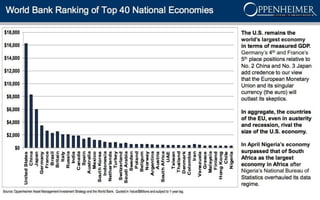
DEALING WITH GRAPHS & CHARTSBefore even reading the questions based on a graph or table, take 10 or 15 seconds to look it over.
Make sure you understand the information that is being displayed, the scales and the units of the quantities involved. DEALING WITH GRAPHS & CHARTS
GRAPHS
SUMMARY
edwinxav@hotmail.com 
elapuerta@hotmail.com 
www.twitter.com/mathfor800 
www.facebook.com/mathfor800 
www.pinterest.com/mathfor800
Math for 800   06 statistics, probability, sets, and graphs-charts

Math for 800 06 statistics, probability, sets, and graphs-charts

  • 2.
    edwinxav@hotmail.com elapuerta@hotmail.com www.twitter.com/mathfor800 www.facebook.com/mathfor800 www.pinterest.com/mathfor800
  • 3.
  • 4.
  • 6.
    Hownumericaldata are distributed.FREQUENCY DISTRIBUTION
  • 7.
    CUMULATIVE FREQUENCY cumulative frequency41319262931
  • 8.
    {2, 0, 2,0, 1, 1, 2, 1, 4, 0, 2, 2, 1, 1, 1} xFrequency 22 1403122341 Total15
  • 9.
  • 10.
  • 11.
    The median ofa set of numbers is the value that falls in the middle of the set.
  • 12.
    You must firstlist the values in increasing or decreasing order. MEDIAN
  • 13.
    Median The medianis not affected by extreme values.
  • 14.
    ModeThe mode ofa set of numbers is the value that appears most often.
  • 16.
    sum of terms average number of terms  AVERAGE (ARITHMETIC MEAN)
  • 18.
  • 19.
    Just average thesmallest and the largest terms. AVERAGE OF EVENLY SPACED TERMS
  • 21.
    Arrange the termsin ascending or descending order: •the number in the middle of the list, •the average (arithmetic mean) of the two numbers in the middle of the list. AVERAGE OF EVENLY SPACED TERMS
  • 22.
    4, 5, 6,7, 8 4 8 12 6 2 2   
  • 23.
    10, 20, 30, 40 , 50 10 50 60 30 2 2   
  • 24.
    12, 14, 16,18, 20, 22 12 22 34 17 2 2   
  • 25.
    300, 400, 500,600, 700, 800 300 800 1,100 550 2 2   
  • 26.
    sum of terms average number of terms  average number  of terms  sum of terms SUM OF TERMS
  • 28.
    What is thesum of the integers from 10 to 50, inclusive? averagenumber of terms  sum of terms 10 50 2   50 10 1  3041 1,230
  • 29.
  • 30.
    The girl’s averagescore is 30. The boy’s average score is 24. If there are twice as many boys as girls, what is the overall average? 1 30 2 24 3 26 average average     
  • 31.
  • 32.
  • 33.
    Range The differencebetween the highest and the lowest values.
  • 34.
  • 35.
  • 36.
  • 37.
    Variance A measureof the average distance between each of a set of data points and their mean value.
  • 38.
    The variance isthe square of the standard deviation. VARIANCE 2v
  • 39.
    STEP 1: Takethemeasures. STEP 2: FindtheMean. STEP 3: CalculatethedifferencesfromtheMean.
  • 45.
  • 46.
    Abraham de Moivre(1667-1754).Carl Friedrich Gauss(1777-1855). Bell shaped curve.
  • 47.
    Symmetry about thecenter. mean = median = mode
  • 48.
  • 57.
    The 20th percentileis the value (or score) below which 20 percent of the observations may be found.
  • 59.
    DECILE AND PERCENTILEThe20th percentile (2nd decile) is the value (or score) below which 20 percent of the observations may be found. D1D2D3D4D5D6D7D8D910%20%30%40%50%60%70%80%90%
  • 60.
    QuartilesAre the threepoints that divide the data set into four equal groups, each representing a fourth of the population being sampled.
  • 61.
  • 62.
    FIRST QUARTILE DesignatedQ1= lower quartile = cuts off lowest 25% of data = 25th percentileQ1Q2Q3
  • 63.
    SECOND QUARTILE DesignatedQ2= median = cuts data set in half = 50th percentileQ1Q2Q3
  • 64.
  • 65.
    INTERQUARTILE RANGE -IQR Is a measure of statistical dispersion, being equal to the difference between the upper and the lower quartiles. 3 1 IQR Q Q
  • 66.
    BOX AND WHISKERPLOTMin:smallest observation (sample minimum), Q1:lower quartile, Q2:median, Q3:upper quartile, andMax:largest observation (sample maximum).
  • 68.
    MAX: Q3+ 1.5IQR (thehighestvalue) MIN:Q1–1.5 IQR (thelowestvalue)
  • 69.
    A boxplot mayalso indicate which observations, if any, might be considered outliers.
  • 70.
    Hoursof excerciseper week 2 4 6 8 10 12 0 Q1 25% Q3 75% Q2 (median) 50% MAX MIN IRQ = Q3 –Q1 = 6 –2 = 4
  • 71.
    PoliticalBent (0 =mostconservative, 100 = mostliberal) 10 20 30 40 50 60 0 Q1 Q3 Q2 MAX MIN 70 80 90 100 Outliers Outliers
  • 73.
    Correlationcoefficients measure thestrength of association between two variables.
  • 75.
  • 76.
  • 77.
    LINEAR REGRESSION Linearregression attempts to model the relationship between two variables by fitting a linear equation to observed data.
  • 78.
  • 79.
  • 80.
  • 81.
  • 82.
  • 83.
  • 84.
  • 87.
  • 90.
    n! (nfactorial) meansthe product of all the integers from 1 to n inclusive.
  • 91.
    !  1 2  3 ... 1 5! 5 4 3 2 1 120 7! 7 6 5 4 3 2 1 5,040 7! 7 6! 7! 7 6 5! n  n n   n   n                       1! 1 0! 1  
  • 92.
    Permutation An arrangementof items in some specific order.
  • 93.
    ! n nP  n 3-distinct color patterns 3! 321 6
  • 94.
    4! 4321 24 ! n n P  n 4-distinct color patterns 1 2 3 4 5 6 7 8 9 10 11 12 13 14 15 16 17 18 19 20 21 22 23 24
  • 95.
    21 21 P 21! ! n n P  n 51,090,942,171,709,440,000
  • 96.
    How many different4-letter arrangements can be formed with all the letters A, B, C, and D? ABCD ABDC ACBD ACDB ADBC ADCB BACD BADC BCAD BCDA BDAC BDCA CABD CADB CBAD CBDA CDAB CDBA DABC DACB DBAC DBCA DCAB DCBA444! 432124P  
  • 97.
    There are threemarbles: 1 blue, 1 red and 1 green. In how many ways is it possible to arrange marbles in a row? 3 3 3! 3 2 1 6 P     
  • 98.
    There are threemarbles: 1 blue, 1 red and 1 green. In how many ways is it possible to arrange marbles in a row if red marble have to be left to blue marble?
  • 99.
    Permutationof nthings takenrat a time.  ! !nrnPnr  
  • 101.
      64 6! 6 4 ! P   6P4  360
  • 102.
      83 8! 8 3 ! P   8P3  336
  • 103.
      73 7! 7 3 ! P   7P3  210
  • 104.
    How many different3-letter arrangements can be formed with all the letters A, B, C, D, E, F, and G?   7 3 7! 7! 210 7 3 ! 4! P       ! ! n r n P n r  
  • 105.
  • 106.
    Circular Permutation of n things taken at a time.   ! 1 ! n n n     5! 5 1 ! 5   4! 24
  • 107.
      14! 14 1 ! 14   14! 13! 14 
  • 108.
    Permutation With Repetition Is an arrangement of nitems, of which pare alike and qare alike, in some specific order. ! !! npq
  • 110.
  • 111.
  • 112.
  • 113.
  • 114.
    How many nine-letterpatterns can be formed using all the letters of the word Tennessee? 9! 3,780 4! 2! 2! e n s   
  • 115.
  • 116.
      525 52! 5! 52 5 ! C      ! ! ! n r n C r n r    2,598,960
  • 117.
    How many different3-letter combinations can be formed with all the letters A, B, C, D, E, F, and G?   7 3 7! 3! 7 3 ! C      ! ! ! n r n C r n r    7 3 7! 35 3! 4! C   
  • 118.
  • 119.
  • 120.
  • 121.
    A variable whosevalue results from a measurement on some type of random process.
  • 122.
    Is a numericaldescription of the outcome of an experiment. RANDOM VARIABLE
  • 123.
    PROBABILITYFor situations inwhich the possible outcomes are all equally likely, the probability that an event E occurs, represented by “P(E)”, can be defined as: FavorableoutcomesofEPETotalnumberofpossibleoutcomes 
  • 124.
  • 125.
    Picking a cardin a standard deck 1 52
  • 126.
  • 127.
  • 133.
    SUM OF PROBABILITIESIftwo or more events constitute all the outcomes, the sum of their probabilities is 1.
  • 134.
  • 135.
  • 136.
       20 100 80 100 p red p not red  
  • 137.
    Independent Events Twoevents are said to be independent if the occurrence or nonoccurrence of either one in no way affects the occurrence of the other.
  • 138.
    INDEPENDENT EVENTSTo findthe probability of occurrence of both, find each probability separately and multiply consecutive probabilities. PEandFPEPF
  • 139.
    A dresser drawercontains one pair of socks with each of the following colors: blue, brown, red, white and black. Each pair is folded together in a matching set. You reach into the sock drawer and choose a pair of socks without looking. You replace this pair and then choose another pair of socks. What is the probability that you will choose the red pair of socks both times?       1 2 p red and red  p red  p red 1 1 5 5   1 25 
  • 141.
    DEPENDENT EVENTSTo findthe probability of occurrence of both, find each probability separately and multiply consecutive probabilities. PEandFPEPF
  • 142.
    A card ischosen at random from a standard deck of 52 playing cards. Without replacing it, a second card is chosen. What is the probability that the first card chosen is a queen and the second card chosen is a jack?       1 2 p queen and jack  p queen  p jack 4 4 52 51   4 663 
  • 143.
    PE or F PE PFPE and F PE or F PE and F Probability that at least one of the two events occurs. Probability that events E and F both occur. ADDITION LAW OF PROBABILITIES
  • 144.
    A A A A 2 2 2 2 3 3 3 3 4 4 4 4 5 5 5 5 6 6 6 6 7 7 7 7 8 8 8 8 9 9 9 10 10 10 10 J J J J Q Q Q Q K K K K What is the probability of picking a 9 or a club in an standard deck of cards? DiamondsHeartsClubsSpades P (9 or ) = P(9)+P() –P(9 and ) = 4/52 + 13/52 –1/52 = 16/52 = 4/13 9
  • 145.
    If xis tobe chosen at random from the set {1, 2, 3, 4} and yis to be chosen at random from the set {5, 6, 7}, what is the probability that xywill be even? x 1 2 3 4y 5 5 10 15 20 6 6 12 18 24 7 7 14 21 28 82123 
  • 146.
    If a personrolls two dice, what is the probability of getting a prime number as the sum of the two dice? 15 5 36 12 2, 3, 5, 7, 11 
  • 147.
    If a personrolls two dice, what is the probability of getting an even number as the sum of the two dice? 18 1 36 2 
  • 148.
  • 149.
  • 151.
    SETS {1, 2,3} = {2, 3, 1} The objects are called elements of the set.
  • 152.
    The order inwhich the elements are listed in a set does not matter.
  • 153.
    UNION OF TWOSETSThe union of two sets is a new set, each of whose elements are in either one or both of the original sets.
  • 154.
    A = {1, 3, 5, 7 } B = { 2, 3, 4, 5, 6 } A B = { 1, 2, 3, 4, 5, 6, 7 } 3, 5 1, 72, 4, 6 UNIONOF SETS
  • 155.
    INTERSECTION OF TWOSETSThe intersection of two sets is a new set, whose elements are only those elements shared by the original sets.
  • 156.
    A = {1, 3, 5, 7 } B = { 2, 3, 4, 5, 6 } 3, 5 1, 72, 4, 6 A B = { 3, 5 }
  • 157.
    Neitherset A onlysetB onlyboth sets A and Bneither A nor BSet ASet BVENN DIAGRAMSABabcdBoth
  • 158.
    ADDITION RULE FORTWO SETS ABABAB
  • 159.
    ADDITION RULE FORTWO SETS A A A A 2 2 2 2 3 3 3 3 4 4 4 4 5 5 5 5 6 6 6 6 7 7 7 7 8 8 8 8 9 9 9 10 10 10 10 J J J J Q Q Q Q K K K K How many 9s or clubs are there in an standard deck of cards? |9 or |= |9| + ||–|9 and | = 4 + 13 –1= 16 DiamondsHearts ClubsSpades 9
  • 160.
  • 161.
    UNIONA = {1, 3, 5, 7 } B = { 2, 3, 4, 5, 6 }5 3A B C= { 1, 2, 3, 4, 5, 6, 7, 8, 9 } c = { 5, 6, 7, 8, 9 } 172, 468, 9
  • 162.
    INTERSECTIONA = {1, 3, 5, 7 } B = { 2, 3, 4, 5, 6 }5 3A B C= { 5 } c = { 5, 6, 7, 8, 9 } 172, 468, 9
  • 163.
    SET AA ={ 1, 3, 5, 7 } B = { 2, 3, 4, 5, 6 } c = { 5, 6, 7, 8, 9 } 172, 468, 935
  • 164.
    ONLY AA ={ 1, 3, 5, 7 } B = { 2, 3, 4, 5, 6 } c = { 5, 6, 7, 8, 9 } 172, 468, 935 A B C= { 1 }
  • 165.
    A OR B,NOT CA = { 1, 3, 5, 7 } B = { 2, 3, 4, 5, 6 } c = { 5, 6, 7, 8, 9 } 172, 468, 935 B C A= { 2, 4, 6, 8, 9 }
  • 166.
    A AND CA= { 1, 3, 5, 7 } B = { 2, 3, 4, 5, 6 } c = { 5, 6, 7, 8, 9 } 172, 468, 935 A C = { 5, 7 }
  • 167.
    A AND CBBUT NOT BA = { 1, 3, 5, 7 } B = { 2, 3, 4, 5, 6 } c = { 5, 6, 7, 8, 9 } 172, 468, 935 A C B = { 7 }
  • 168.
  • 169.
  • 170.
    DEALING WITH GRAPHS& CHARTSBefore even reading the questions based on a graph or table, take 10 or 15 seconds to look it over.
  • 171.
    Make sure youunderstand the information that is being displayed, the scales and the units of the quantities involved. DEALING WITH GRAPHS & CHARTS
  • 174.
  • 175.
  • 176.
    edwinxav@hotmail.com elapuerta@hotmail.com www.twitter.com/mathfor800 www.facebook.com/mathfor800 www.pinterest.com/mathfor800