Dr KAMESHVELL MBBS, MD,
DNB[psy]
Associate Professor, MGMC & RI
MATERNAL & CHILD HEALTH
Maternal and child Health care
• Maternal - Mothers (15-45 yrs)
• Child – Less than 15 years
• Health- Physical, Mental &Social
well being.
Mothers (15-45)
• Roughly 20 % of population.
• Special Risk group because of
repeated pregnancies,childbirths and
related morbidity and Mortality.
• MMR – 3to 5 / 1000LB.
Child (< 15 years)
• Comprise of nearly 40 % of population.
• Vulnerable group because of growth, and
development.
• Increased demand and deficient supply and
related morbidity and Mortality.
• IMR-75/1000LB
• PMR for under 5 is High.
Health
• The physical ,Mental, and social well being
of the various groups.
• The causes leading to mortality of mothers
and children are largely preventable
• Hence,special health care service was
conceived.
• It is a comprehensive health care with
emphasis on Primary Health Care
approach.
Mother & child as ‘one unit’
• Foetus forms part of mother for 280days.
• Child’s health depends on mother’s health.
• Mother’s diseases may be transmitted to
foetus.
• Certain drugs taken by mother may have
effect on child.
• Mental and social development of child
depend on mother’s proximity.
• Post natal and Neo natal periods are closely
linked.
Terms related to MCH
• Obstetrics:
getting healthy mother and healthy
baby at the end of each pregnancy.
• Social obstetrics:
study of relationship between the social
factors of environment and Human
reproduction like:
• Age at marriage
• Child bearing pattern
• Spacing
• Family size
• Customs and habits
• Female literacy
• Status of women
• Factors like Organization, Delivery & Utilization
patterns
• Exists in developed countries also.
Preventive Paediatrics:
Ante natal paediatrics: starts from
conception onwards to take care of :
• Nutrition of mother
• Prevention of infections of mother
• Preparing mother for delivery,breast
feeding,child rearing,child nutrition etc.
Post natal Paediatrics :
• Growth monitoring
• Periodical examination
• Care in Illness
• Child Nutrition,
• Immunization etc.
• Social Paediatrics:
application of social medicine to
paediatrics for complete understanding of
the problems of children in order to
intervene & improve.
Study the social factors which influence the
child health.
Maternity Cycle:
• Fertilization
• Antenatal or prenatal period
• Intranatal period
• Postnatal period
• Inter- conceptional period.
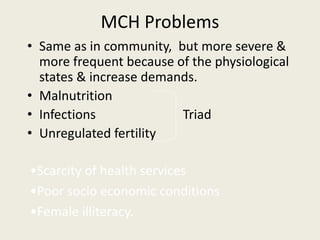
MCH Problems
• Same as in community, but more severe &
more frequent because of the physiological
states & increase demands.
• Malnutrition
• Infections Triad
• Unregulated fertility
•Scarcity of health services
•Poor socio economic conditions
•Female illiteracy.
Malnutrition
• Iceberg. Pregnant & Nursing mothers &
Children.
• In pregnant mother leads to LBW,abortion,
premature delivery & increased morbility &
mortality.
• Remedy: Direct :
Nutrition supplementation
Therapeutic supplementation
Food fortification
Nutrition education
Indirect:
• Control of infections
• Environmental Sanitation
• Safe Water Supply
• Family Planning
• Surveillance to identify MN early &
intervene.
Infections
• Maternal infections leads to Abortion ,
IUGR, LBW etc
• Viral infections & UTI are common
• For the child – from day one.
• 1/3 of baby’s first year is spent in
morbidity.The common ones are
Oph.Neo.,Neonatal tetanus,
• GI infections,ARI,Skin infections,
• Chronic infections like TB.
Remedy:
• Complete immunization
• Care during illness-like ORT,correct
nutrition,timely intervention etc.
• TT immunization for pregnant mothers.
Unregulated fertility
• Leads to Abortion, LBW, Anemia etc.
• High birth rate is always associated
with low standard of child’s health.
Remedy:
• contraceptive practices.
• Small family norm.
Antenatal care
Objectives:
1. To promote, protect & maintain health of all
mothers during pregnancy.
2. To detect high risk mothers & give them
special attention.
3. To forsee complications &intervene.
4. To remove anxiety associated with delivery.
5. To teach mothers child care
6. To sensitise mothers to family planning.
7. To attend to underfives accompanying
mothers.
Components of A.N. care
1. Antenatal visits.
2. Antenatal examination.
3. Risk approach.
4. Prenatal advices.
5. Specific health protection measures.
6. Mental preparation.
7. Family planning.
8. Paediatric component.
Antenatal visits
• Ideal will be:
• 1 visit a month for first 7 months.
• Twice a month for next 2 months
• Once a week after wards
• But practically not possible for HWs or mothers.
• So ,atleast 4 visits 1st visit - within 12 weeks
2nd ,, - 14 – 26 weeks
3rd ,, - 28 – 34 weeks
4th ,, - 36 weeks - term
At least 1 house visit by HW(F), and 1 visit after 36 wks.
Antenatal Examination
History, Examination, Investigation, Registration,
Immunization, Supplementation,Education.
First visit
• History taking
• Confirm pregnancy
• General examination
• Systematic systemic examination
• Investigations
• Registration.
Subsequent visits:
1. obstetric examination
2. TT immunization of mothers.
3. Iron folic acid supplementation
4. Complaints looked into
5. Danger signals asked for
6. Lie, position, presenting part,
engagement.
7. Enquire for place of delivery
Risk Approach
Identify all pregnant mothers to find out
mothers at risk & give them needed care.
1. Elderly primi(<20->30)
2. Short statured mother(<140cms)
3. Malpresentation
4. Ante partum haemorrhage
5. Preeclampsia
6. Anemia
7. Multiple pregnancies, hydramnios.
8. Previous bad Obst. History
9. Elderly grand multi para
10. Prolonged pregnancy
11. H/o previous caesarean
12. Other systemic diseases
13. Treatment for infertility
14. > 3 consecutive abortions
Prenatal Advices
• Pregnant mothers are more receptive to
advices about mother & Child.
1. Diet
2. Personal Hygiene
3. Drugs
4. Radiation
5. Warning signs
6. Child care
Diet: Normal weight gain during pregnancy
must be 12kgs. But in India, 6-8kgs only. So,
additional 300kcal & 14gms of protein
perday in atleast II & III trimester.(Beliefs to
be kept in mind).
Personal Hygiene: Cleanliness, Rest, Bowels,
Exercise,etc..
Drugs: To be taken under supervision
(Thalidomide,LSD,Iodide
preparation,anaesthetic
agents,tetracyclines)
Radiation: Whenever indicated only.
Warning Signs:
-Head ache,
-Blurring of vision,
-Fits,
-Bleeding PV,
-Swelling of feet
Child care:
Specific Health Protection Measures
These measures are incorporated into regulare antenatal
care.
• Anaemia – Prophylaxis Programme
• Other Nutritional deficiencies (Nutrition Progm.)
• Toxemia (Examination & investigation)
• Tetanus (Immunization)
• Syphilis (Investigation)
• Rubella (RA 27/3 Vaccine to all children 1-14yrs).
• Rh status (History & Investigation)
Mental Preparation
Family Planning
Paediatric component
Intra Natal Care
• Child birth is physiological but
complications can occur like septicemia &
Neonatal tetanus.
Objectives:
1. Thorough Asepsis
2. Minimum injury to mother & Infant
3. Readiness to deal with Complications
4. Care of the newborn baby
Types: Domiciliary & Institutional
Domiciliary: Environment must be safe &
mother’s health & pregnancy normal.
Deliveries conducted at home by trained
dais & HW (f)- “domiciliary Midwifery”
Advantages:
1. Familiar surroundings for mother, removes fear
& anxiety associated with delivery in hospital
2. Less chance for cross infection
3. Mother can keep an eye on home
affairs,children & Husband.

Maternal &amp; child health

  • 1.
    Dr KAMESHVELL MBBS,MD, DNB[psy] Associate Professor, MGMC & RI MATERNAL & CHILD HEALTH
  • 2.
    Maternal and childHealth care • Maternal - Mothers (15-45 yrs) • Child – Less than 15 years • Health- Physical, Mental &Social well being.
  • 3.
    Mothers (15-45) • Roughly20 % of population. • Special Risk group because of repeated pregnancies,childbirths and related morbidity and Mortality. • MMR – 3to 5 / 1000LB.
  • 4.
    Child (< 15years) • Comprise of nearly 40 % of population. • Vulnerable group because of growth, and development. • Increased demand and deficient supply and related morbidity and Mortality. • IMR-75/1000LB • PMR for under 5 is High.
  • 5.
    Health • The physical,Mental, and social well being of the various groups. • The causes leading to mortality of mothers and children are largely preventable • Hence,special health care service was conceived. • It is a comprehensive health care with emphasis on Primary Health Care approach.
  • 6.
    Mother & childas ‘one unit’ • Foetus forms part of mother for 280days. • Child’s health depends on mother’s health. • Mother’s diseases may be transmitted to foetus. • Certain drugs taken by mother may have effect on child. • Mental and social development of child depend on mother’s proximity. • Post natal and Neo natal periods are closely linked.
  • 7.
    Terms related toMCH • Obstetrics: getting healthy mother and healthy baby at the end of each pregnancy. • Social obstetrics: study of relationship between the social factors of environment and Human reproduction like:
  • 8.
    • Age atmarriage • Child bearing pattern • Spacing • Family size • Customs and habits • Female literacy • Status of women • Factors like Organization, Delivery & Utilization patterns • Exists in developed countries also.
  • 9.
    Preventive Paediatrics: Ante natalpaediatrics: starts from conception onwards to take care of : • Nutrition of mother • Prevention of infections of mother • Preparing mother for delivery,breast feeding,child rearing,child nutrition etc. Post natal Paediatrics : • Growth monitoring • Periodical examination • Care in Illness • Child Nutrition, • Immunization etc.
  • 10.
    • Social Paediatrics: applicationof social medicine to paediatrics for complete understanding of the problems of children in order to intervene & improve. Study the social factors which influence the child health.
  • 11.
    Maternity Cycle: • Fertilization •Antenatal or prenatal period • Intranatal period • Postnatal period • Inter- conceptional period.
  • 12.
    MCH Problems • Sameas in community, but more severe & more frequent because of the physiological states & increase demands. • Malnutrition • Infections Triad • Unregulated fertility •Scarcity of health services •Poor socio economic conditions •Female illiteracy.
  • 13.
    Malnutrition • Iceberg. Pregnant& Nursing mothers & Children. • In pregnant mother leads to LBW,abortion, premature delivery & increased morbility & mortality. • Remedy: Direct : Nutrition supplementation Therapeutic supplementation Food fortification Nutrition education
  • 14.
    Indirect: • Control ofinfections • Environmental Sanitation • Safe Water Supply • Family Planning • Surveillance to identify MN early & intervene.
  • 15.
    Infections • Maternal infectionsleads to Abortion , IUGR, LBW etc • Viral infections & UTI are common • For the child – from day one. • 1/3 of baby’s first year is spent in morbidity.The common ones are Oph.Neo.,Neonatal tetanus, • GI infections,ARI,Skin infections, • Chronic infections like TB.
  • 16.
    Remedy: • Complete immunization •Care during illness-like ORT,correct nutrition,timely intervention etc. • TT immunization for pregnant mothers.
  • 17.
    Unregulated fertility • Leadsto Abortion, LBW, Anemia etc. • High birth rate is always associated with low standard of child’s health. Remedy: • contraceptive practices. • Small family norm.
  • 18.
    Antenatal care Objectives: 1. Topromote, protect & maintain health of all mothers during pregnancy. 2. To detect high risk mothers & give them special attention. 3. To forsee complications &intervene. 4. To remove anxiety associated with delivery. 5. To teach mothers child care 6. To sensitise mothers to family planning. 7. To attend to underfives accompanying mothers.
  • 19.
    Components of A.N.care 1. Antenatal visits. 2. Antenatal examination. 3. Risk approach. 4. Prenatal advices. 5. Specific health protection measures. 6. Mental preparation. 7. Family planning. 8. Paediatric component.
  • 20.
    Antenatal visits • Idealwill be: • 1 visit a month for first 7 months. • Twice a month for next 2 months • Once a week after wards • But practically not possible for HWs or mothers. • So ,atleast 4 visits 1st visit - within 12 weeks 2nd ,, - 14 – 26 weeks 3rd ,, - 28 – 34 weeks 4th ,, - 36 weeks - term At least 1 house visit by HW(F), and 1 visit after 36 wks.
  • 21.
    Antenatal Examination History, Examination,Investigation, Registration, Immunization, Supplementation,Education. First visit • History taking • Confirm pregnancy • General examination • Systematic systemic examination • Investigations • Registration.
  • 22.
    Subsequent visits: 1. obstetricexamination 2. TT immunization of mothers. 3. Iron folic acid supplementation 4. Complaints looked into 5. Danger signals asked for 6. Lie, position, presenting part, engagement. 7. Enquire for place of delivery
  • 23.
    Risk Approach Identify allpregnant mothers to find out mothers at risk & give them needed care. 1. Elderly primi(<20->30) 2. Short statured mother(<140cms) 3. Malpresentation 4. Ante partum haemorrhage 5. Preeclampsia 6. Anemia 7. Multiple pregnancies, hydramnios.
  • 24.
    8. Previous badObst. History 9. Elderly grand multi para 10. Prolonged pregnancy 11. H/o previous caesarean 12. Other systemic diseases 13. Treatment for infertility 14. > 3 consecutive abortions
  • 25.
    Prenatal Advices • Pregnantmothers are more receptive to advices about mother & Child. 1. Diet 2. Personal Hygiene 3. Drugs 4. Radiation 5. Warning signs 6. Child care
  • 26.
    Diet: Normal weightgain during pregnancy must be 12kgs. But in India, 6-8kgs only. So, additional 300kcal & 14gms of protein perday in atleast II & III trimester.(Beliefs to be kept in mind). Personal Hygiene: Cleanliness, Rest, Bowels, Exercise,etc.. Drugs: To be taken under supervision (Thalidomide,LSD,Iodide preparation,anaesthetic agents,tetracyclines)
  • 27.
    Radiation: Whenever indicatedonly. Warning Signs: -Head ache, -Blurring of vision, -Fits, -Bleeding PV, -Swelling of feet Child care:
  • 28.
    Specific Health ProtectionMeasures These measures are incorporated into regulare antenatal care. • Anaemia – Prophylaxis Programme • Other Nutritional deficiencies (Nutrition Progm.) • Toxemia (Examination & investigation) • Tetanus (Immunization) • Syphilis (Investigation) • Rubella (RA 27/3 Vaccine to all children 1-14yrs). • Rh status (History & Investigation) Mental Preparation Family Planning Paediatric component
  • 29.
    Intra Natal Care •Child birth is physiological but complications can occur like septicemia & Neonatal tetanus. Objectives: 1. Thorough Asepsis 2. Minimum injury to mother & Infant 3. Readiness to deal with Complications 4. Care of the newborn baby
  • 30.
    Types: Domiciliary &Institutional Domiciliary: Environment must be safe & mother’s health & pregnancy normal. Deliveries conducted at home by trained dais & HW (f)- “domiciliary Midwifery” Advantages: 1. Familiar surroundings for mother, removes fear & anxiety associated with delivery in hospital 2. Less chance for cross infection 3. Mother can keep an eye on home affairs,children & Husband.