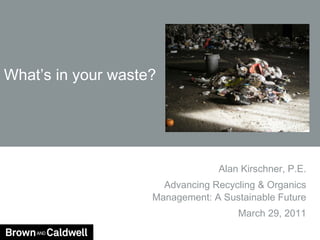
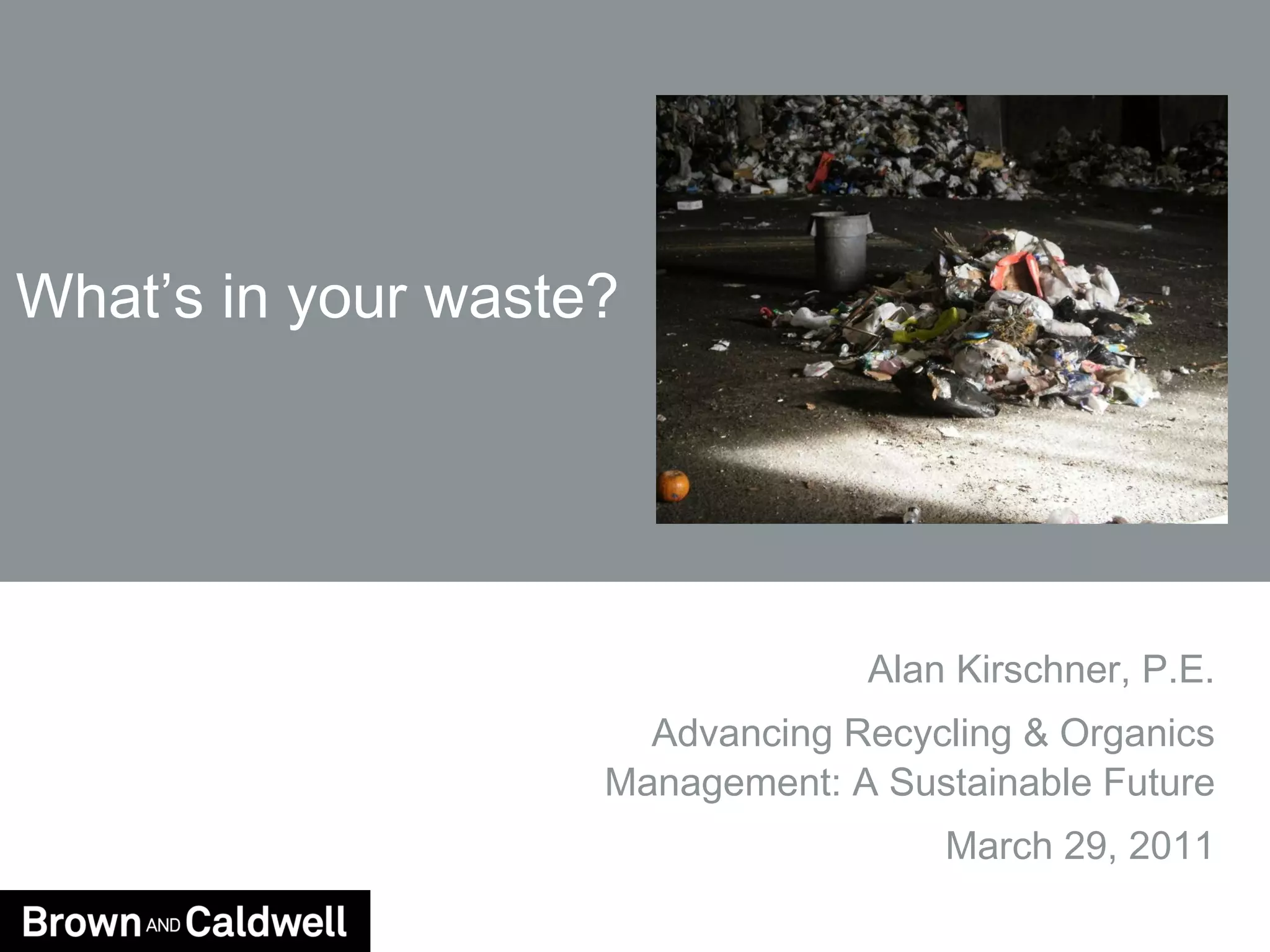
What’s in your waste? Alan Kirschner, P.E. Advancing Recycling & Organics Management: A Sustainable Future March 29, 2011
Introduction … MassDEP’s New Class II Recycling Program Regulations Present the preliminary results of the Waste Characterization Study performed at three waste-to-energy (WTE) plants.
Background … the drivers The MA Green Communities Act (2008) allows existing WTE plants to be considered Class II renewable energy generating sources if: 1.  the facility began commercial operation before December 31, 1997 2.  and the facility operates or contracts for recycling programs approved by the (DEP).  
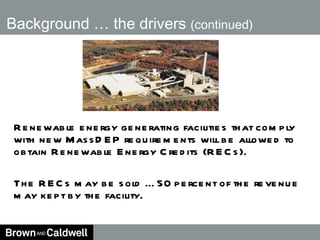
Background … the drivers  (continued) Renewable energy generating facilities that comply with new MassDEP requirements will be allowed to obtain Renewable Energy Credits (RECs). The RECs may be sold … 50 percent of the revenue may kept by the facility.
Revenue from RECs … The remaining 50% of revenue from RECs is allocated to the Sustainable Materials Recovery Program, from where facilities may deposit it in either: Expendable Trust that will be established and administered by MADEP, or  A dedicated account that the facility has established to hold the funds until projects are awarded.
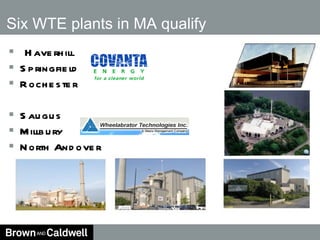
  Haverhill Springfield Rochester Saugus Millbury  North Andover Six WTE plants in MA qualify
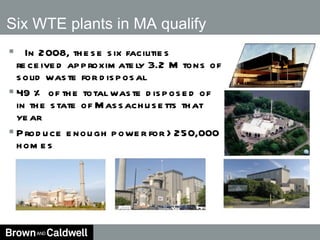
  In 2008, these six facilities received approximately 3.2 M tons of solid waste for disposal 49 % of the total waste disposed of in the state of Massachusetts that year Produce enough power for >250,000 homes Six WTE plants in MA qualify
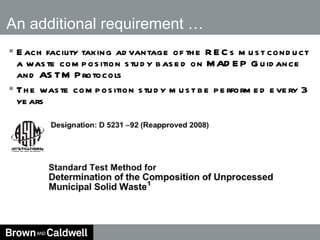
An additional requirement … Each facility taking advantage of the RECs must conduct a waste composition study based on MADEP Guidance and ASTM Protocols The waste composition study must be performed every 3 years
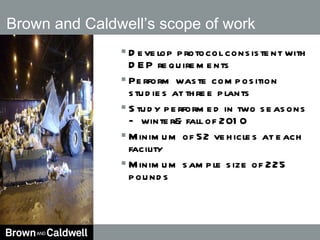
Brown and Caldwell’s scope of work  Develop protocol consistent with DEP requirements Perform waste composition studies at three plants Study performed in two seasons – winter& fall of 2010 Minimum of 52 vehicles at each facility Minimum sample size of 225 pounds
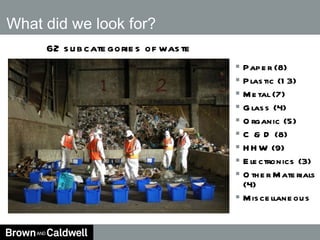
What did we look for? Paper (8) Plastic (13) Metal (7) Glass (4) Organic (5) C & D (8) HHW (9) Electronics (3) Other Materials (4) Miscellaneous 62 subcategories of waste
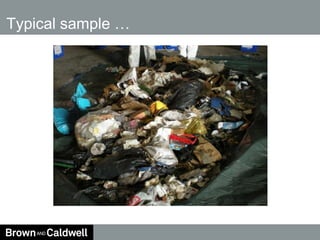
Typical sample …
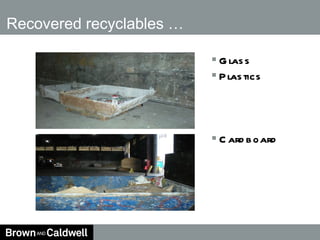
Recovered recyclables … Glass Plastics Cardboard
Findings …
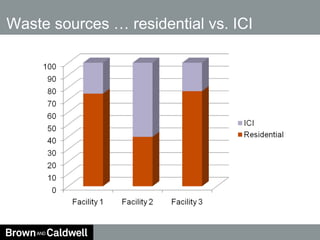
Waste sources … residential vs. ICI
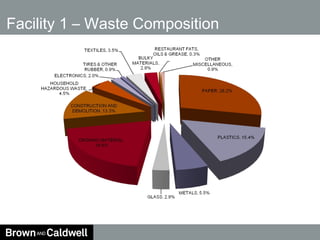
Facility 1 – Waste Composition
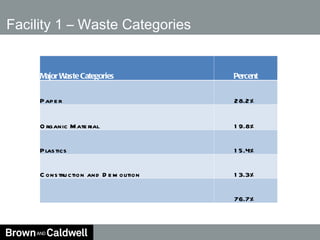
Facility 1 – Waste Categories Major Waste Categories Percent Paper 28.2% Organic Material 19.8% Plastics 15.4% Construction and Demolition 13.3% 76.7%
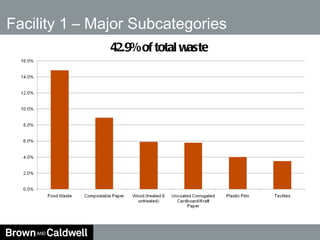
Facility 1 – Major Subcategories 42.9% of total waste
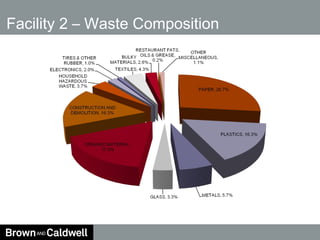
Facility 2 – Waste Composition
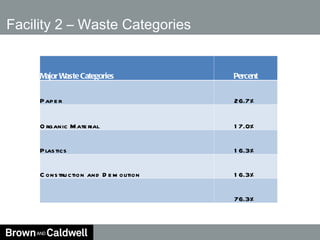
Facility 2 – Waste Categories Major Waste Categories Percent Paper 26.7% Organic Material 17.0% Plastics 16.3% Construction and Demolition 16.3% 76.3%
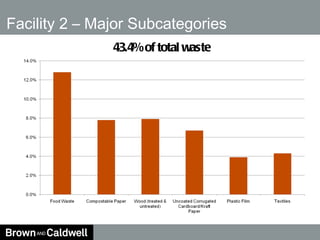
Facility 2 – Major Subcategories 43.4% of total waste
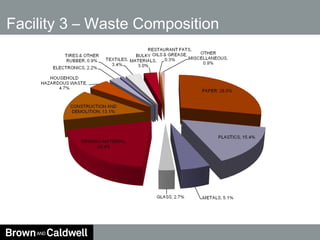
Facility 3 – Waste Composition
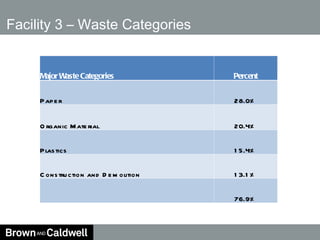
Facility 3 – Waste Categories Major Waste Categories Percent Paper 28.0% Organic Material 20.4% Plastics 15.4% Construction and Demolition 13.1% 76.9%
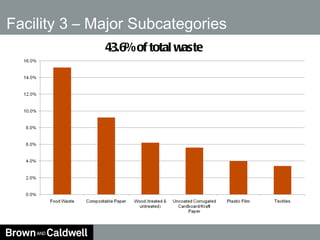
Facility 3 – Major Subcategories 43.6% of total waste
Compostable Paper  means low grade paper that is not capable of being recycled, as well as food contaminated paper. Examples include paper towels, paper plates, waxed papers, egg cartons, pizza boxes, and tissues. Other Film means plastic film  Examples include garbage bags and other types of plastic bags (sandwich bags, zipper-recloseable bags, produce bags, frozen vegetable bags, newspaper bags), painting tarps, food wrappers such as candy-bar wrappers, mailing pouches, bank bags, X-ray film, metalized film (wine containers and balloons), and plastic food wrap. A few definitions …
Observations …
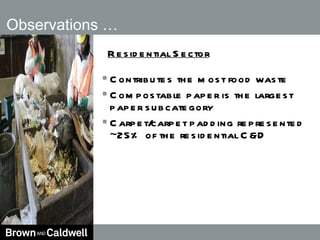
Contributes the most food waste Compostable paper is the largest paper subcategory Carpet/carpet padding represented ~25% of the residential C&D Observations …  Residential Sector
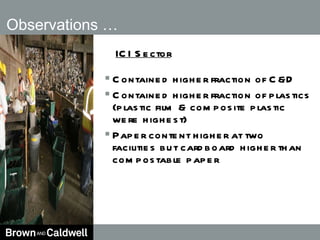
Contained higher fraction of C&D Contained higher fraction of plastics (plastic film & composite plastic were highest) Paper content higher at two facilities but cardboard higher than compostable paper Observations …  ICI Sector
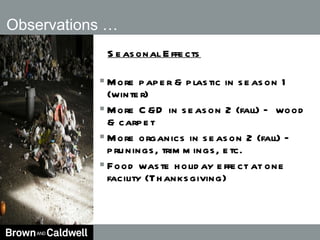
More paper & plastic in season 1 (winter) More C&D in season 2 (fall) – wood & carpet More organics in season 2 (fall) – prunings, trimmings, etc. Food waste holiday effect at one facility (Thanksgiving) Observations …  Seasonal Effects
Acknowledgements Matt Hughes – Wheelabrator Technologies Hala Sfeir – Brown and Caldwell Phil Jagoda – Brown and Caldwell
Questions? Slides are available at www.slideshare.net/MassRecycle2011

Materials #1 A Closer Look at Our Garbage(Alan Kirschner)

  • 1.
    What’s in yourwaste? Alan Kirschner, P.E. Advancing Recycling & Organics Management: A Sustainable Future March 29, 2011
  • 2.
    Introduction … MassDEP’sNew Class II Recycling Program Regulations Present the preliminary results of the Waste Characterization Study performed at three waste-to-energy (WTE) plants.
  • 3.
    Background … thedrivers The MA Green Communities Act (2008) allows existing WTE plants to be considered Class II renewable energy generating sources if: 1. the facility began commercial operation before December 31, 1997 2. and the facility operates or contracts for recycling programs approved by the (DEP).  
  • 4.
    Background … thedrivers (continued) Renewable energy generating facilities that comply with new MassDEP requirements will be allowed to obtain Renewable Energy Credits (RECs). The RECs may be sold … 50 percent of the revenue may kept by the facility.
  • 5.
    Revenue from RECs… The remaining 50% of revenue from RECs is allocated to the Sustainable Materials Recovery Program, from where facilities may deposit it in either: Expendable Trust that will be established and administered by MADEP, or A dedicated account that the facility has established to hold the funds until projects are awarded.
  • 6.
      Haverhill SpringfieldRochester Saugus Millbury North Andover Six WTE plants in MA qualify
  • 7.
      In 2008,these six facilities received approximately 3.2 M tons of solid waste for disposal 49 % of the total waste disposed of in the state of Massachusetts that year Produce enough power for >250,000 homes Six WTE plants in MA qualify
  • 8.
    An additional requirement… Each facility taking advantage of the RECs must conduct a waste composition study based on MADEP Guidance and ASTM Protocols The waste composition study must be performed every 3 years
  • 9.
    Brown and Caldwell’sscope of work Develop protocol consistent with DEP requirements Perform waste composition studies at three plants Study performed in two seasons – winter& fall of 2010 Minimum of 52 vehicles at each facility Minimum sample size of 225 pounds
  • 10.
    What did welook for? Paper (8) Plastic (13) Metal (7) Glass (4) Organic (5) C & D (8) HHW (9) Electronics (3) Other Materials (4) Miscellaneous 62 subcategories of waste
  • 11.
  • 12.
    Recovered recyclables …Glass Plastics Cardboard
  • 13.
  • 14.
    Waste sources …residential vs. ICI
  • 15.
    Facility 1 –Waste Composition
  • 16.
    Facility 1 –Waste Categories Major Waste Categories Percent Paper 28.2% Organic Material 19.8% Plastics 15.4% Construction and Demolition 13.3% 76.7%
  • 17.
    Facility 1 –Major Subcategories 42.9% of total waste
  • 18.
    Facility 2 –Waste Composition
  • 19.
    Facility 2 –Waste Categories Major Waste Categories Percent Paper 26.7% Organic Material 17.0% Plastics 16.3% Construction and Demolition 16.3% 76.3%
  • 20.
    Facility 2 –Major Subcategories 43.4% of total waste
  • 21.
    Facility 3 –Waste Composition
  • 22.
    Facility 3 –Waste Categories Major Waste Categories Percent Paper 28.0% Organic Material 20.4% Plastics 15.4% Construction and Demolition 13.1% 76.9%
  • 23.
    Facility 3 –Major Subcategories 43.6% of total waste
  • 24.
    Compostable Paper means low grade paper that is not capable of being recycled, as well as food contaminated paper. Examples include paper towels, paper plates, waxed papers, egg cartons, pizza boxes, and tissues. Other Film means plastic film Examples include garbage bags and other types of plastic bags (sandwich bags, zipper-recloseable bags, produce bags, frozen vegetable bags, newspaper bags), painting tarps, food wrappers such as candy-bar wrappers, mailing pouches, bank bags, X-ray film, metalized film (wine containers and balloons), and plastic food wrap. A few definitions …
  • 25.
  • 26.
    Contributes the mostfood waste Compostable paper is the largest paper subcategory Carpet/carpet padding represented ~25% of the residential C&D Observations … Residential Sector
  • 27.
    Contained higher fractionof C&D Contained higher fraction of plastics (plastic film & composite plastic were highest) Paper content higher at two facilities but cardboard higher than compostable paper Observations … ICI Sector
  • 28.
    More paper &plastic in season 1 (winter) More C&D in season 2 (fall) – wood & carpet More organics in season 2 (fall) – prunings, trimmings, etc. Food waste holiday effect at one facility (Thanksgiving) Observations … Seasonal Effects
  • 29.
    Acknowledgements Matt Hughes– Wheelabrator Technologies Hala Sfeir – Brown and Caldwell Phil Jagoda – Brown and Caldwell
  • 30.
    Questions? Slides areavailable at www.slideshare.net/MassRecycle2011

Editor's Notes

  • #4 Footer is optional
  • #5 Footer is optional
  • #6 Footer is optional
  • #11 Footer is optional
  • #12 Footer is optional
  • #13 Footer is optional
  • #17 Footer is optional
  • #20 Footer is optional
  • #23 Footer is optional