Difficult to Manage Wastes: Mattresses  Kate Hagemann , Product Stewardship Institute Advancing Recycling & Organics Management: A Sustainable Future  March 29, 2010
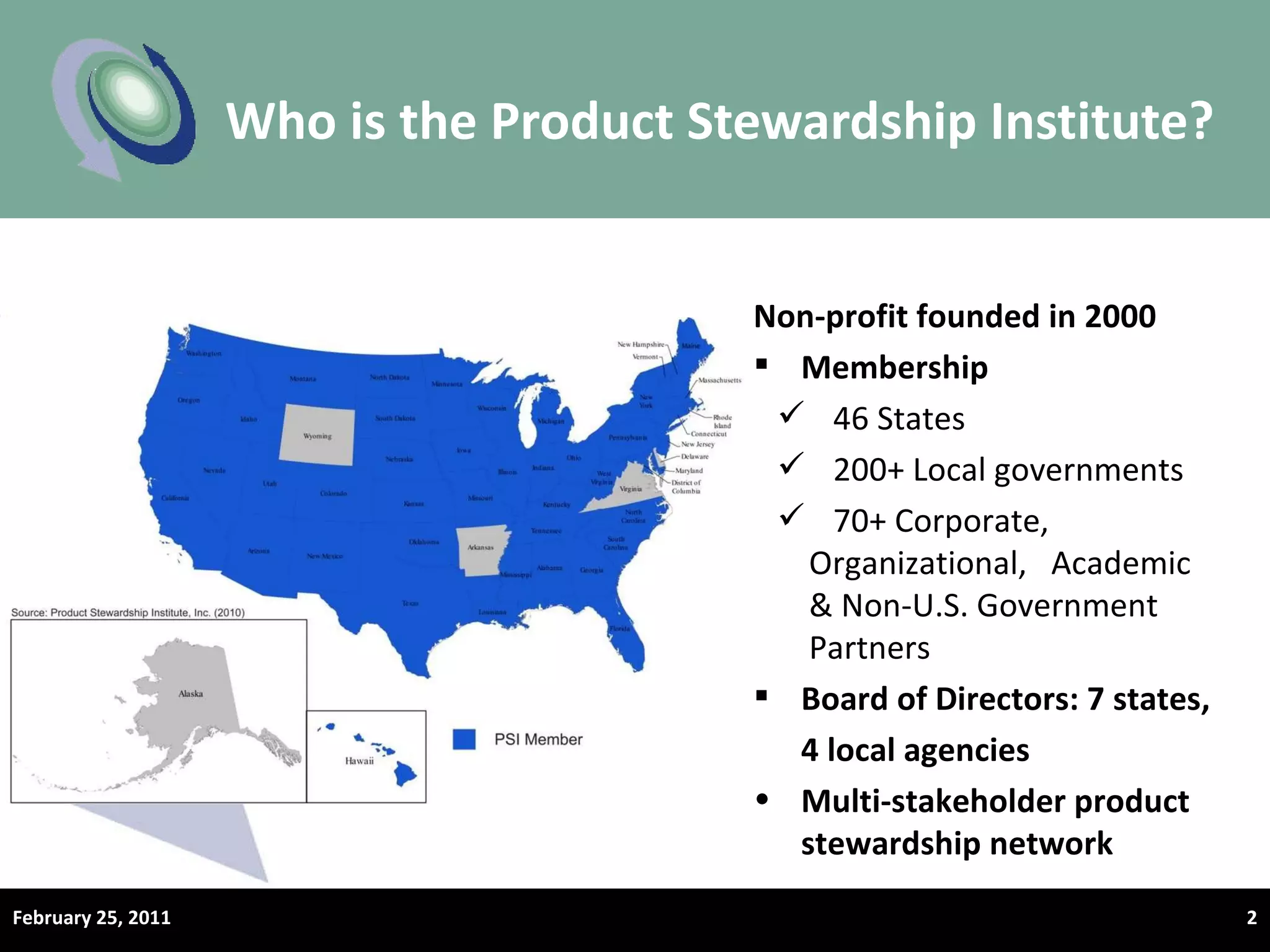
Who is the Product Stewardship Institute? February 25, 2011 Non-profit founded in 2000 Membership 46 States 200+ Local governments 70+ Corporate,  Organizational,  Academic & Non-U.S. Government Partners Board of Directors: 7 states,  4 local agencies  Multi-stakeholder product stewardship network
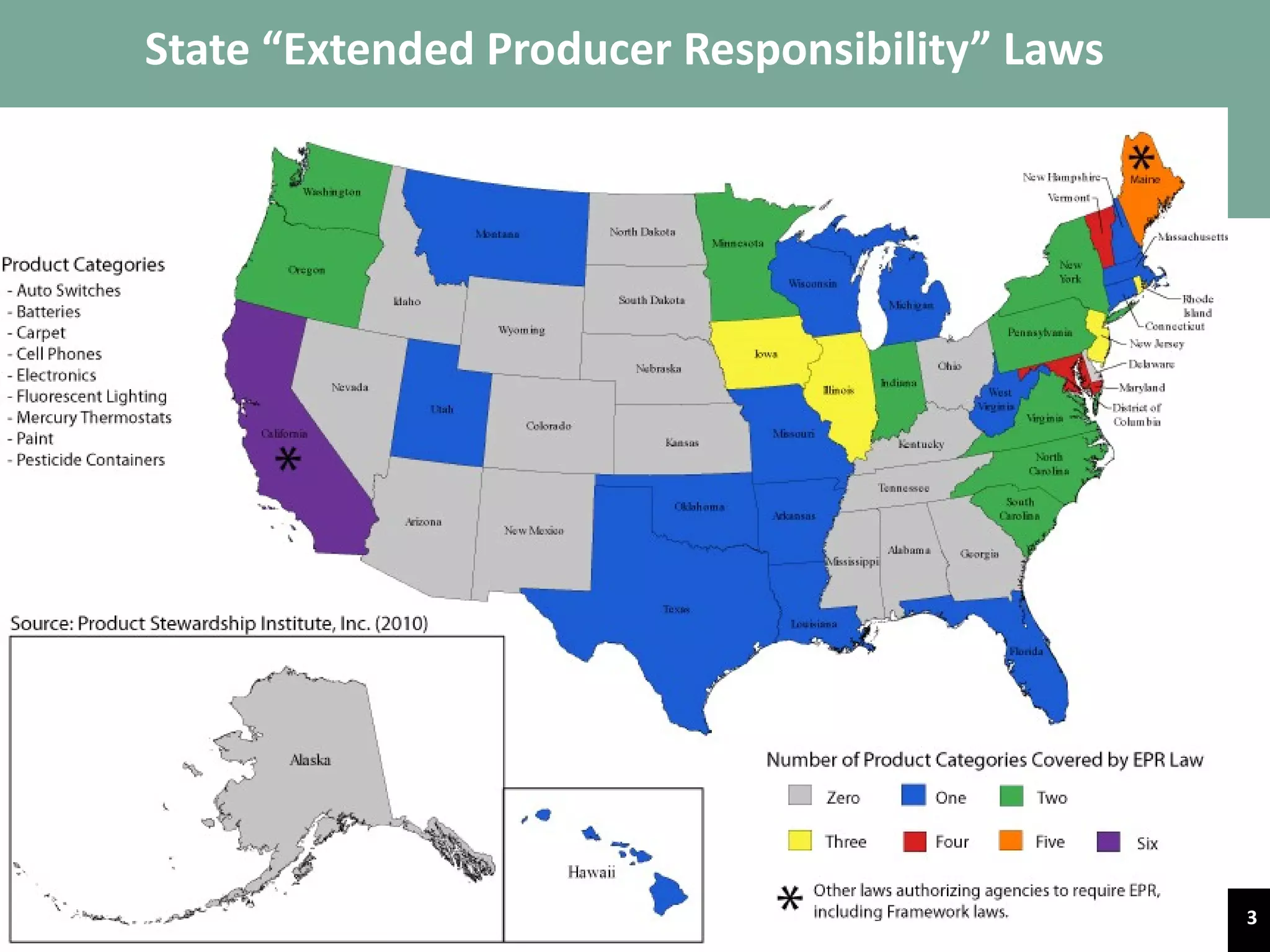
State  “Extended Producer Responsibility” Laws February 25th 2011 8
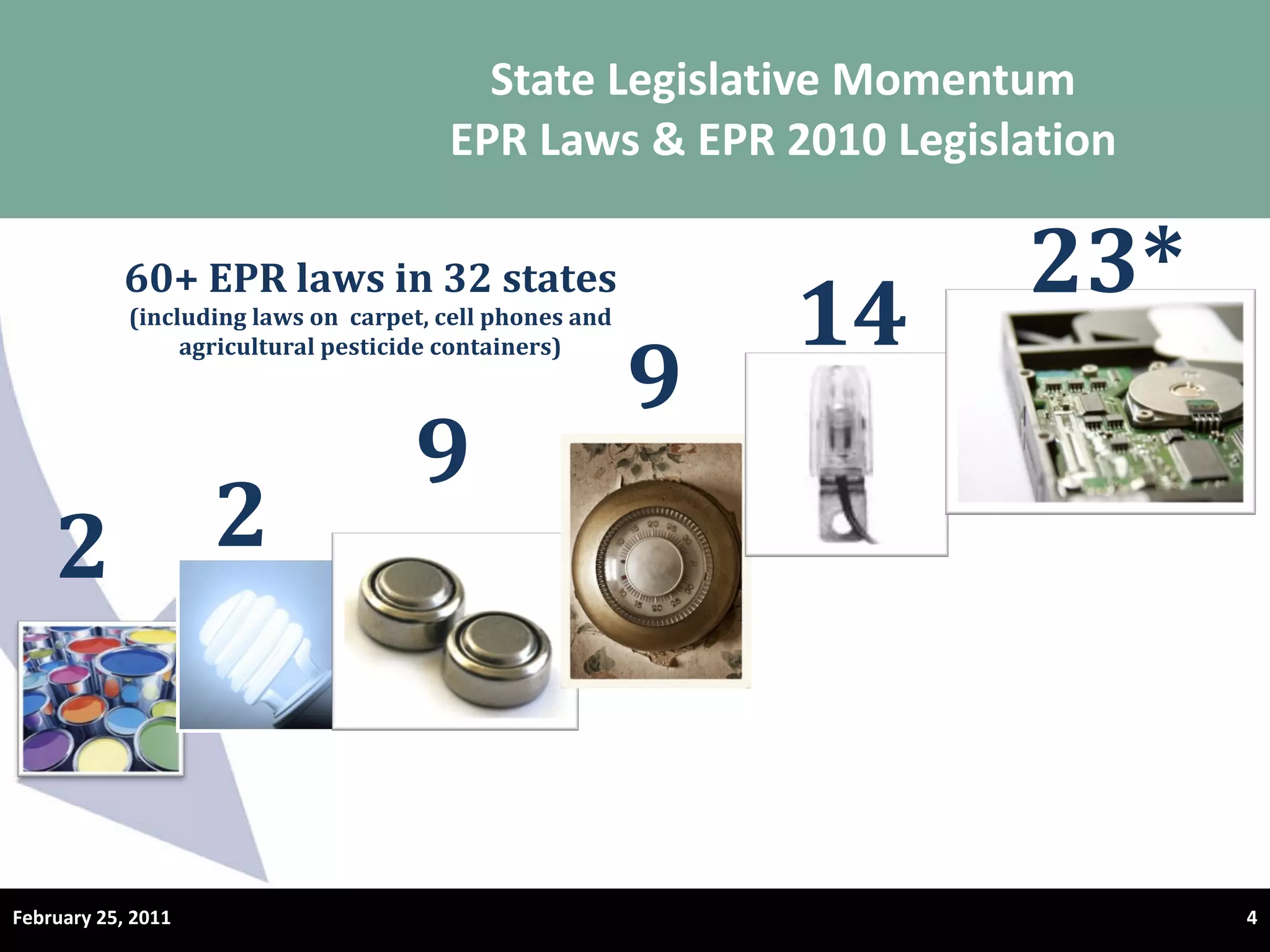
State Legislative Momentum EPR Laws & EPR 2010 Legislation February 25, 2011 60+ EPR laws in 32 states (including laws on  carpet, cell phones and agricultural pesticide containers) 2 2 9 9 14 23*
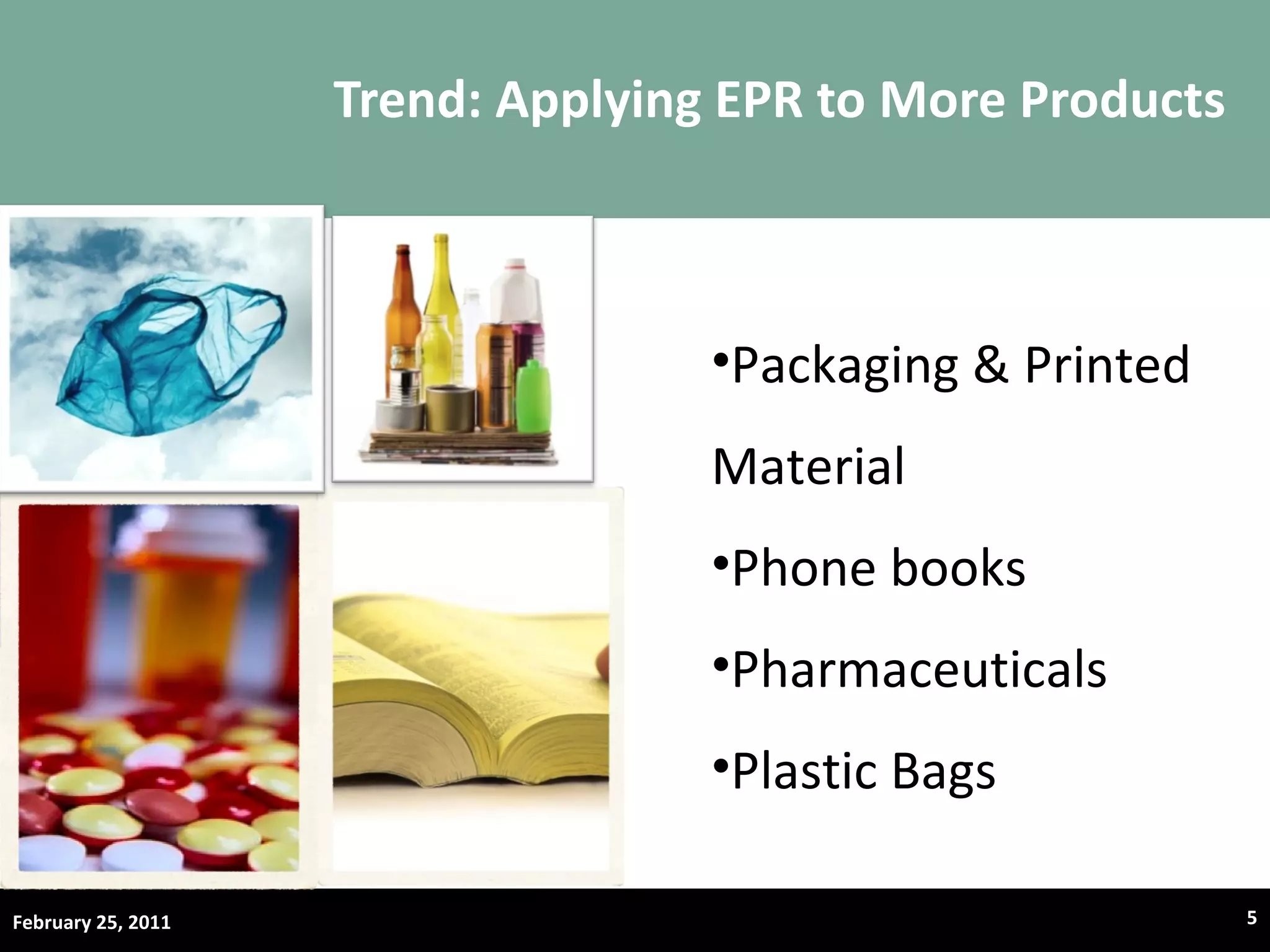
Trend: Applying EPR to More Products Packaging & Printed Material Phone books Pharmaceuticals Plastic Bags February 25, 2011
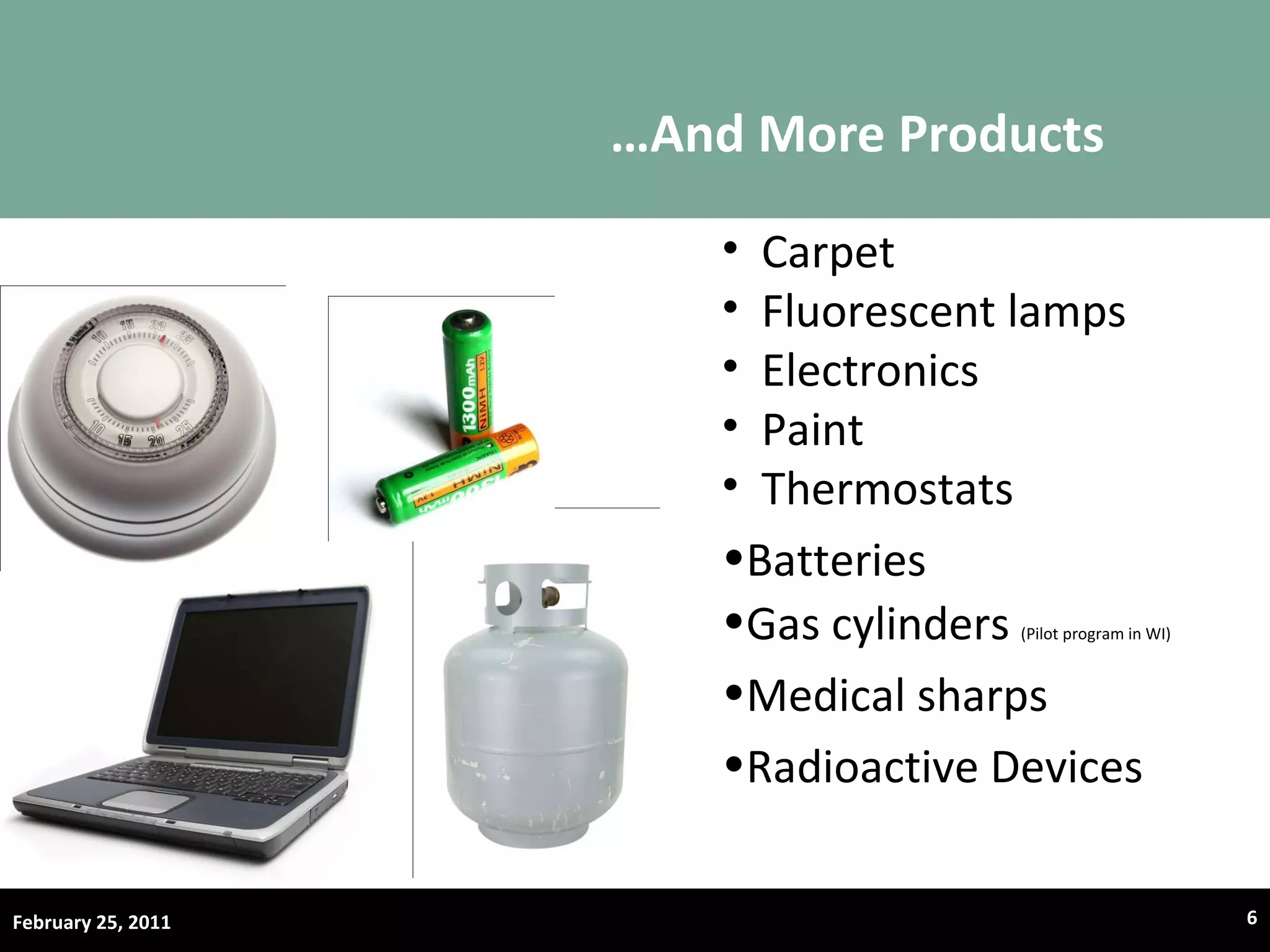
… And More Products February 25, 2011 Carpet Fluorescent lamps Electronics Paint Thermostats Batteries Gas cylinders  (Pilot program in WI) Medical sharps Radioactive Devices
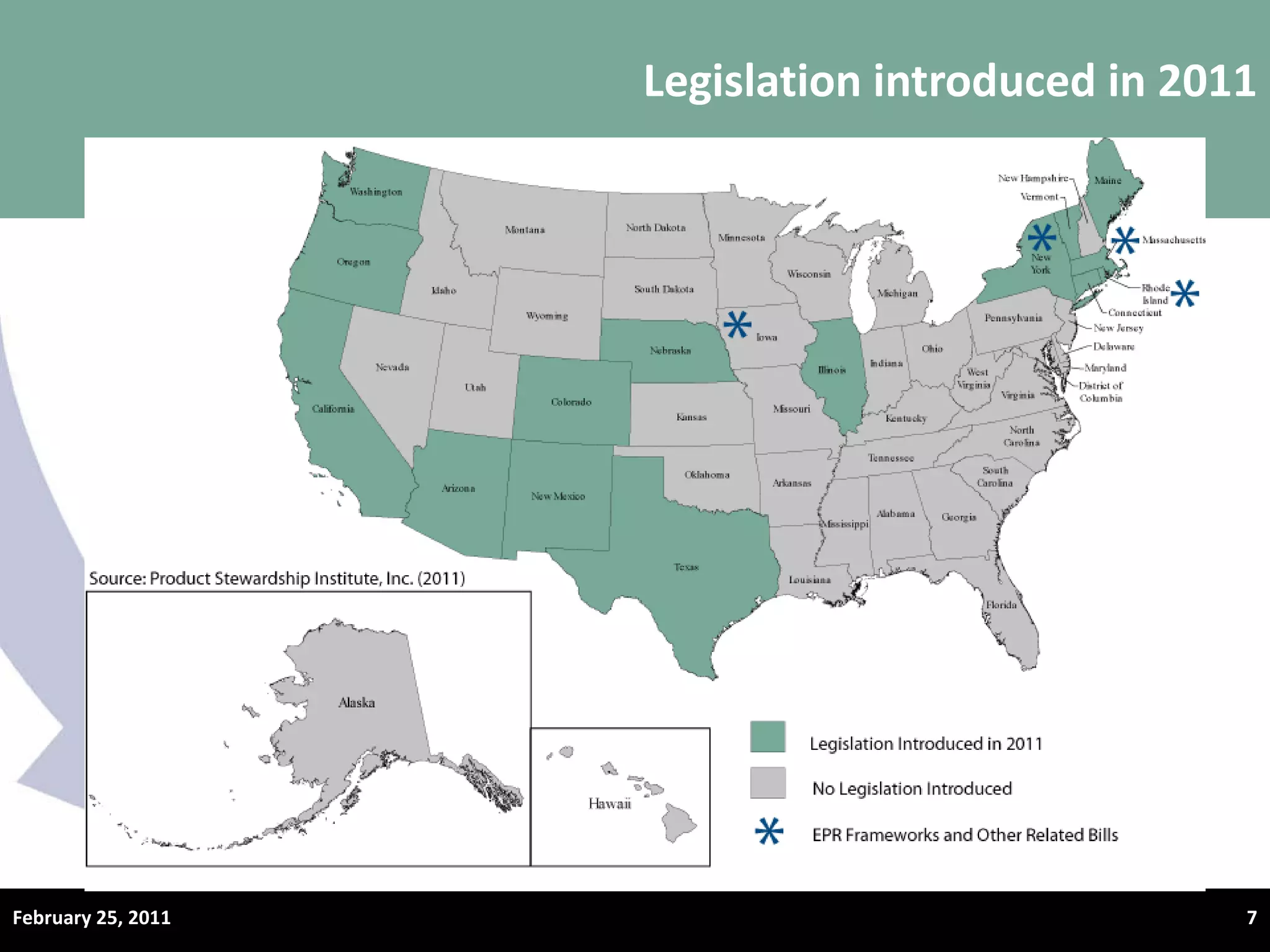
Legislation introduced in 2011 February 25, 2011
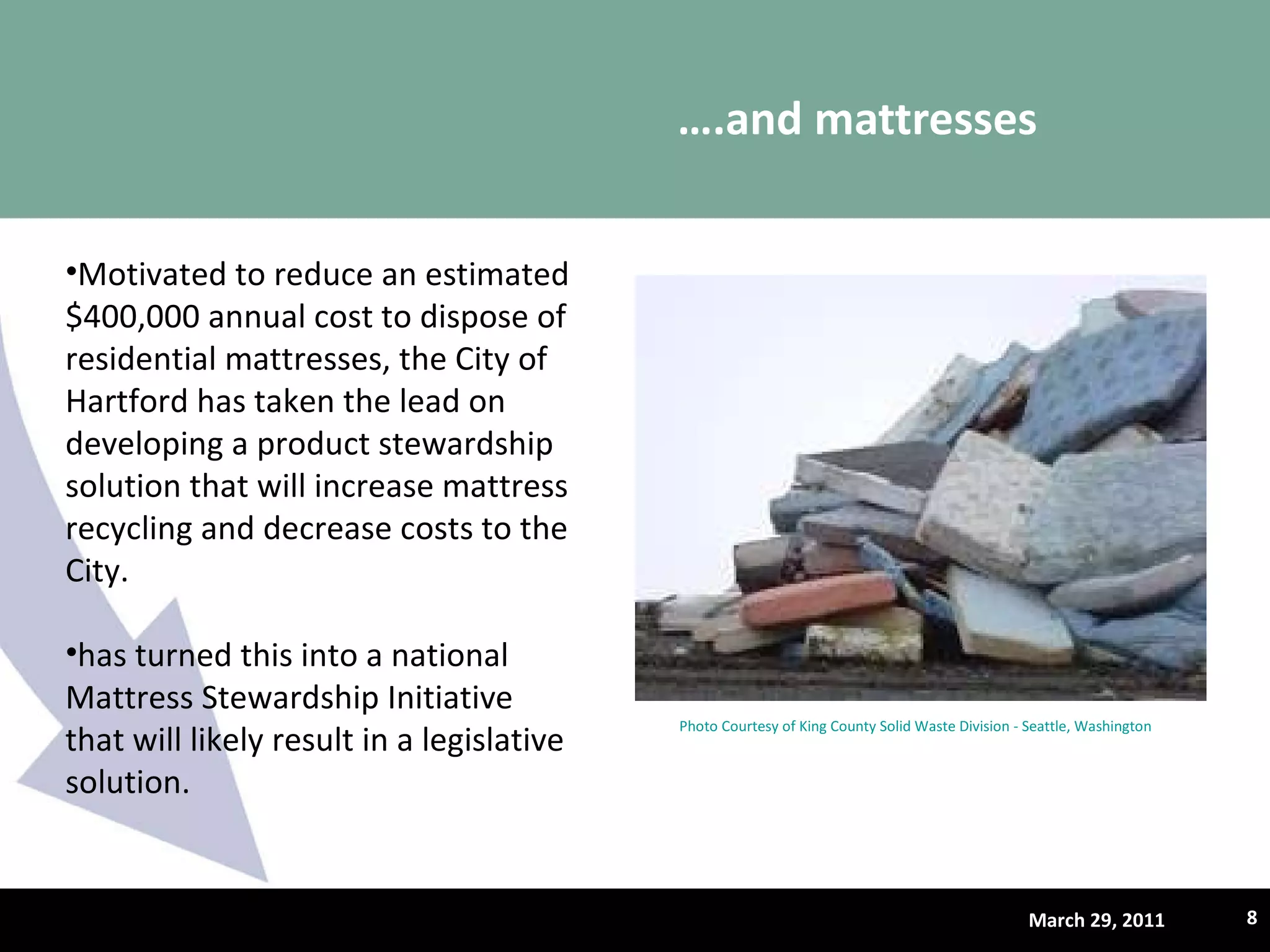
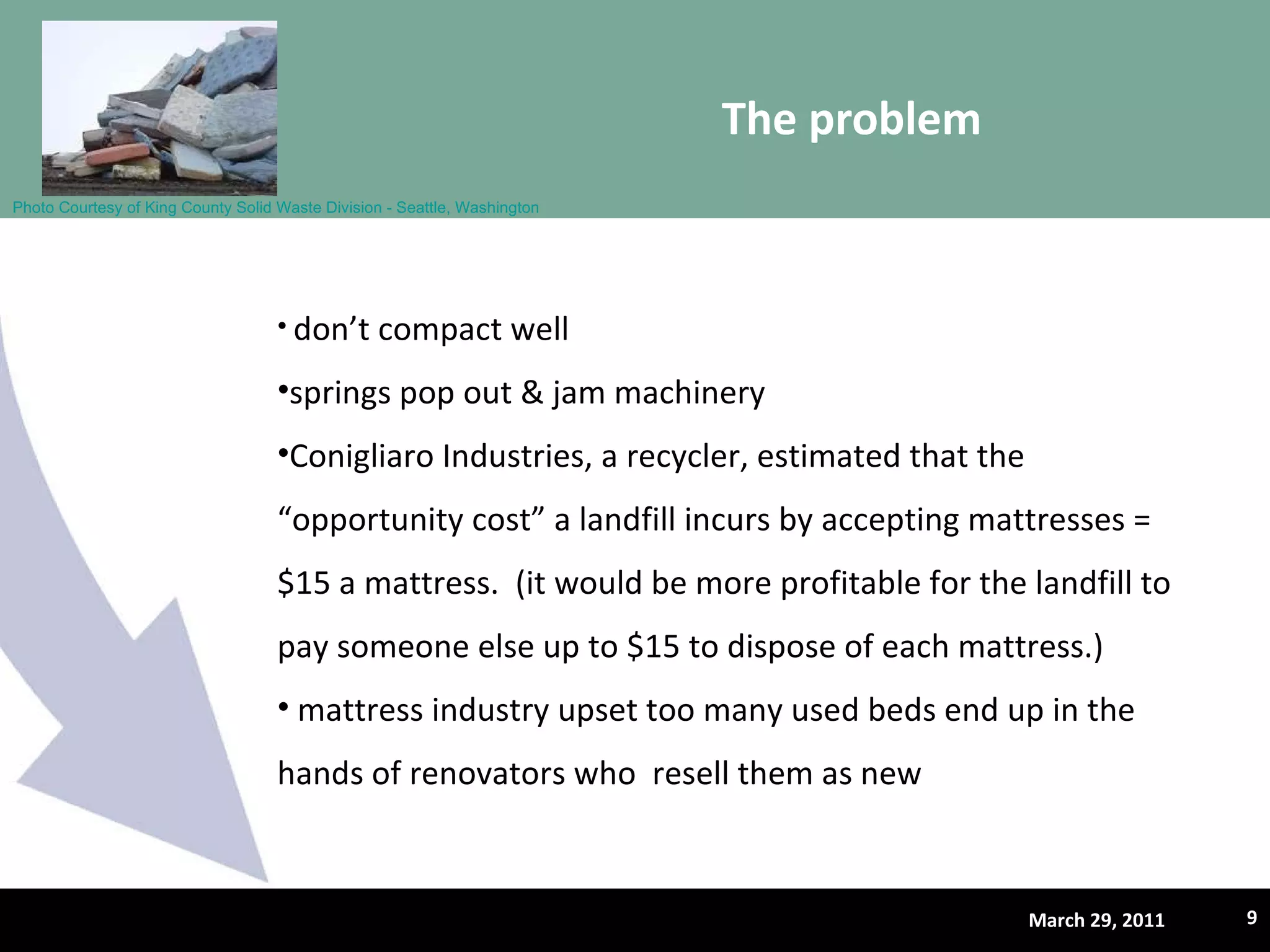
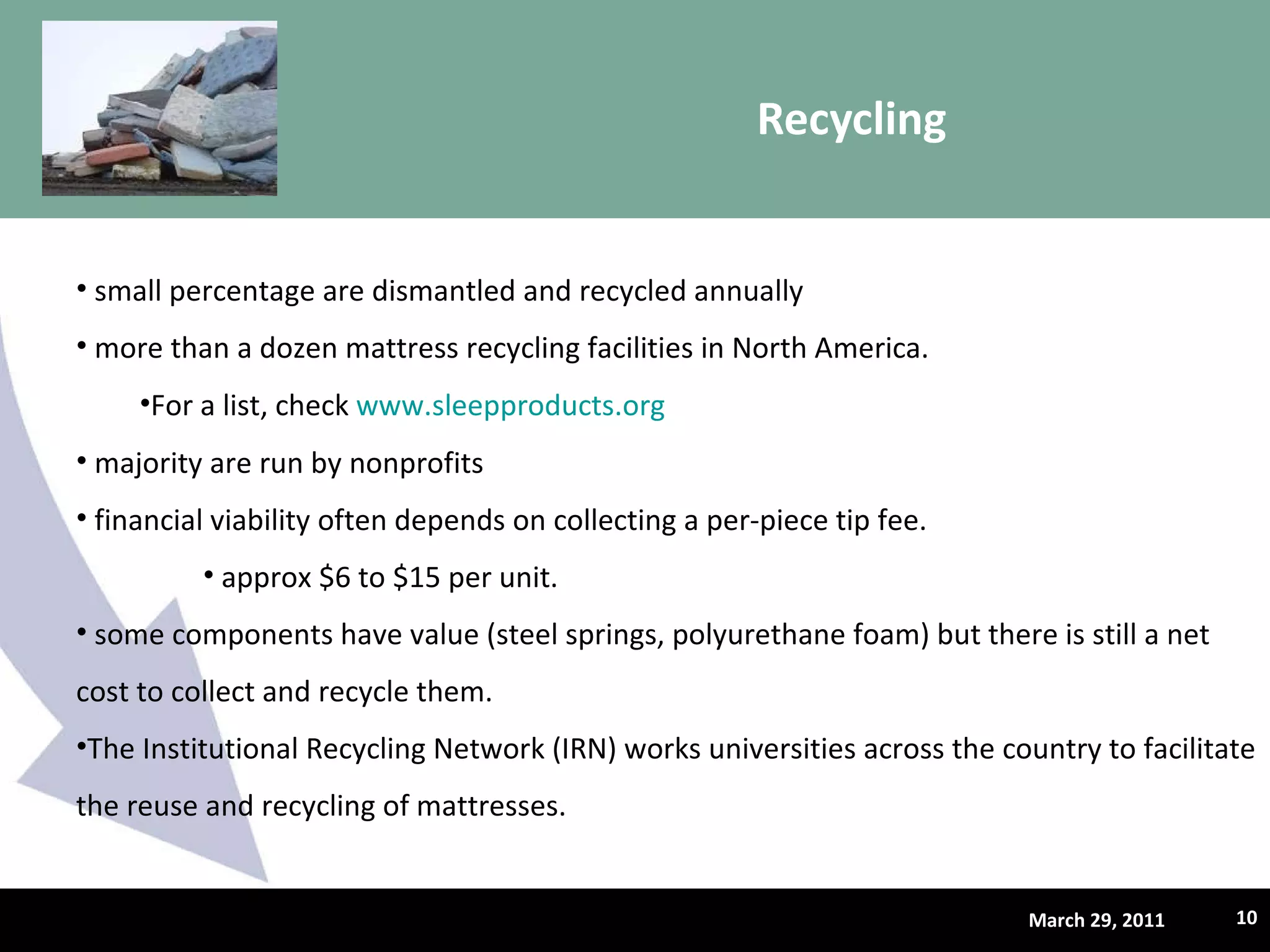
… .and mattresses March 29, 2011 Photo Courtesy of King County Solid Waste Division - Seattle, Washington Motivated to reduce an estimated $400,000 annual cost to dispose of residential mattresses, the City of Hartford has taken the lead on developing a product stewardship solution that will increase mattress recycling and decrease costs to the City.  has turned this into a national Mattress Stewardship Initiative that will likely result in a legislative solution.
The problem  March 29, 2011 Photo Courtesy of King County Solid Waste Division - Seattle, Washington don ’t compact well  springs pop out & jam machinery Conigliaro Industries, a recycler, estimated that the  “opportunity cost” a landfill incurs by accepting mattresses = $15 a mattress.  (it would be more profitable for the landfill to pay someone else up to $15 to dispose of each mattress.) mattress industry upset too many used beds end up in the hands of renovators who  resell them as new
Recycling  March 29, 2011 small percentage are dismantled and recycled annually more than a dozen mattress recycling facilities in North America. For a list, check  www.sleepproducts.org   majority are run by nonprofits  financial viability often depends on collecting a per-piece tip fee.  approx $6 to $15 per unit.  some components have value (steel springs, polyurethane foam) but there is still a net cost to collect and recycle them. The Institutional Recycling Network (IRN) works universities across the country to facilitate the reuse and recycling of mattresses.
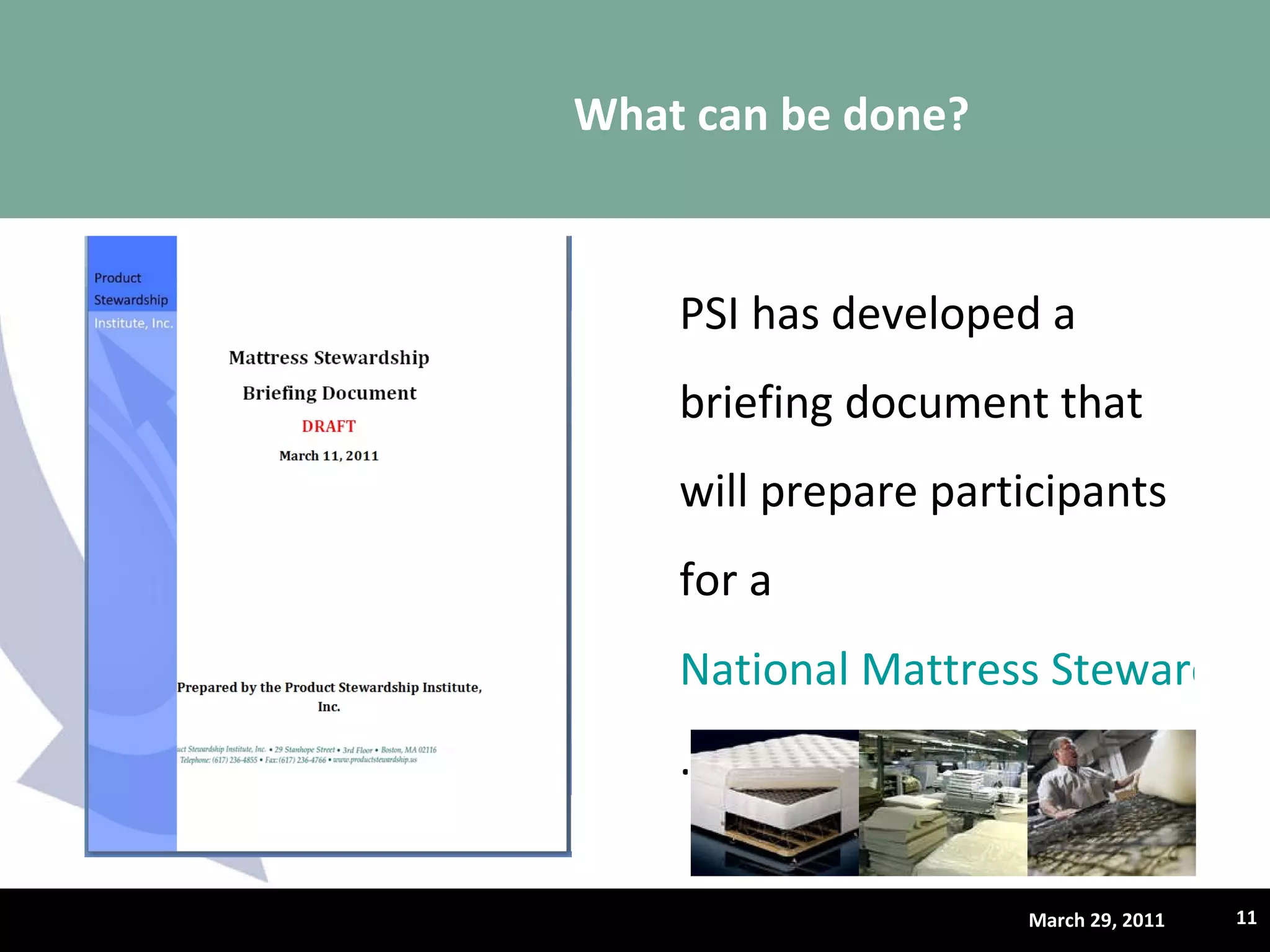
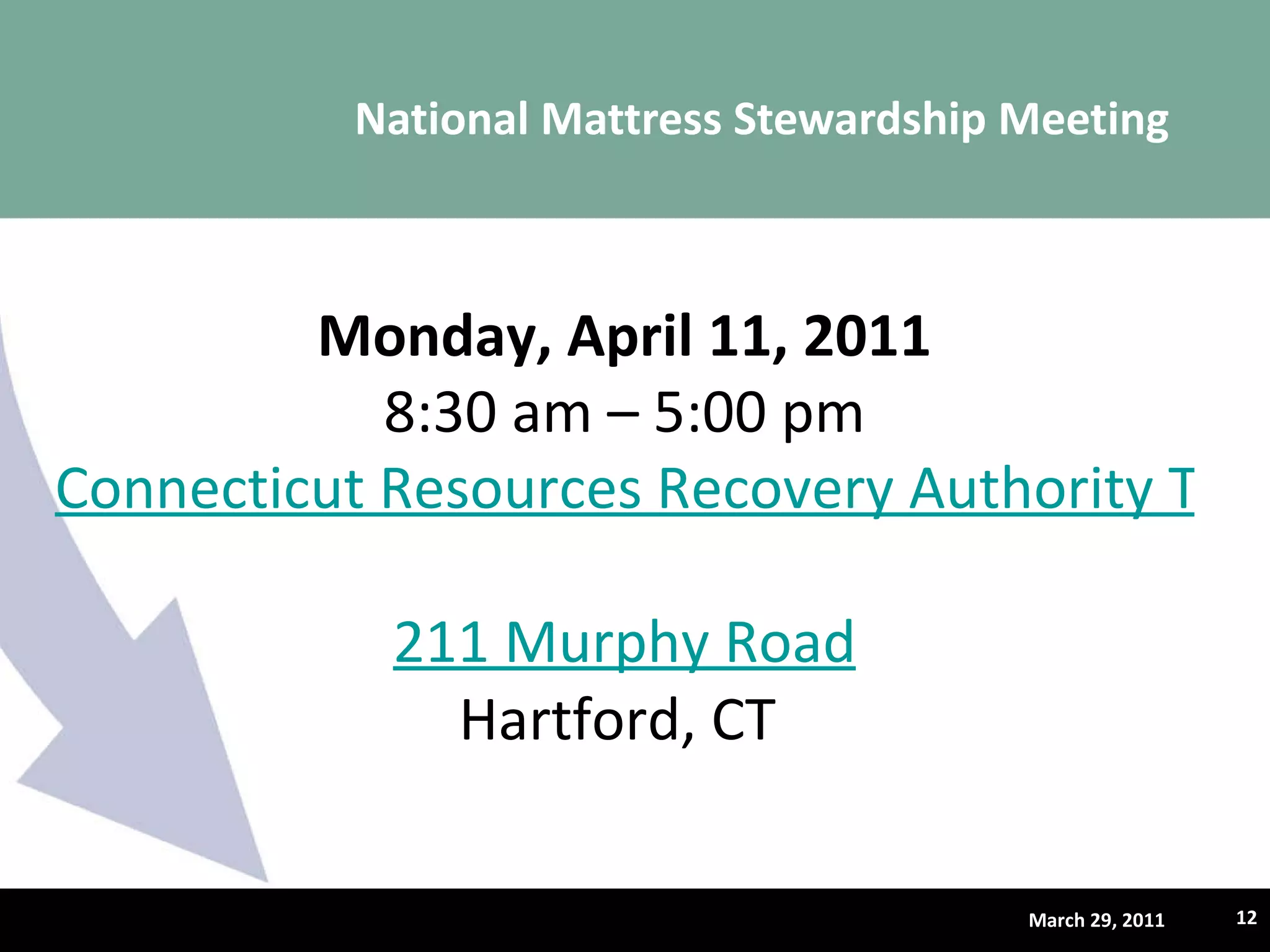
March 29, 2011 PSI has developed a briefing document that will prepare participants for a  National Mattress Stewardship Meeting .  What can be done?
National Mattress Stewardship Meeting  March 29, 2011 Monday, April 11, 2011 8:30 am – 5:00 pm Connecticut Resources Recovery Authority Trash Museum 211 Murphy Road Hartford, CT
Proposed Project Goals March 29, 2011 Develop a long-term financing system to manage mattresses and box springs in a manner that alleviates the financial burden faced by governments . Options:  Extended Producer Responsibility Legislation  Advanced Recycling Fee
Registration March 29, 2011 www.productstewardship.us/mattresses   To register visit:  * dial-in participation also available
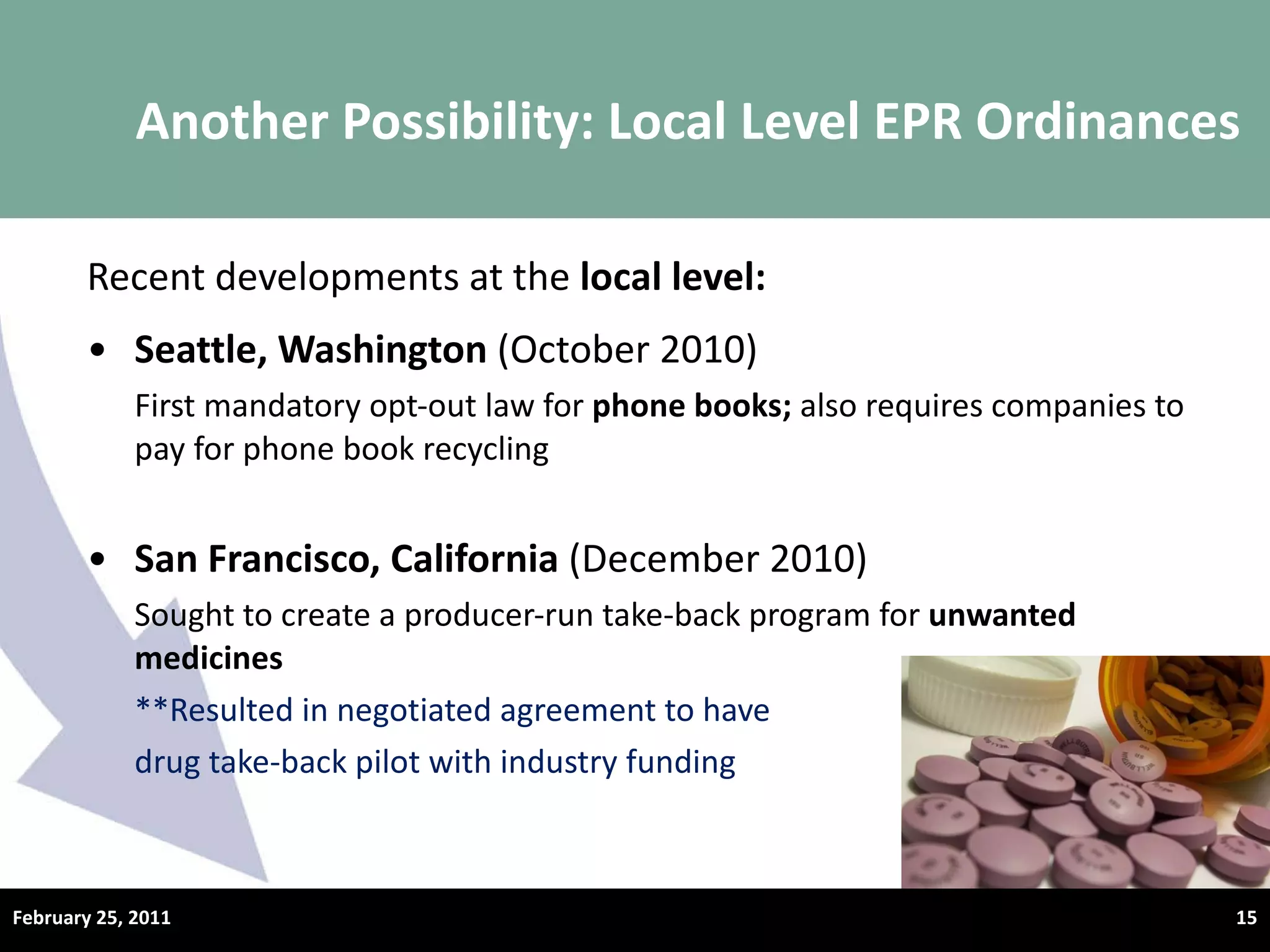
Recent developments at the  local level: Seattle, Washington  (October 2010) First mandatory opt-out law for  phone books;  also requires companies to pay for phone book recycling San Francisco, California  (December 2010) Sought to create a producer-run take-back program for  unwanted medicines **Resulted in negotiated agreement to have  drug take-back pilot with industry funding Another Possibility: Local Level EPR Ordinances February 25, 2011
More Information Kate Hagemann Associate of Policy & Programs [email_address] © Product Stewardship Institute –February 25, 2010 March 29, 2011

Municipal #3 Difficult to Manage Wastes: Mattresses (Kate Hagemann)

  • 1.
    Difficult to ManageWastes: Mattresses Kate Hagemann , Product Stewardship Institute Advancing Recycling & Organics Management: A Sustainable Future  March 29, 2010
  • 2.
    Who is theProduct Stewardship Institute? February 25, 2011 Non-profit founded in 2000 Membership 46 States 200+ Local governments 70+ Corporate, Organizational, Academic & Non-U.S. Government Partners Board of Directors: 7 states, 4 local agencies Multi-stakeholder product stewardship network
  • 3.
    State “ExtendedProducer Responsibility” Laws February 25th 2011 8
  • 4.
    State Legislative MomentumEPR Laws & EPR 2010 Legislation February 25, 2011 60+ EPR laws in 32 states (including laws on carpet, cell phones and agricultural pesticide containers) 2 2 9 9 14 23*
  • 5.
    Trend: Applying EPRto More Products Packaging & Printed Material Phone books Pharmaceuticals Plastic Bags February 25, 2011
  • 6.
    … And MoreProducts February 25, 2011 Carpet Fluorescent lamps Electronics Paint Thermostats Batteries Gas cylinders (Pilot program in WI) Medical sharps Radioactive Devices
  • 7.
    Legislation introduced in2011 February 25, 2011
  • 8.
    … .and mattressesMarch 29, 2011 Photo Courtesy of King County Solid Waste Division - Seattle, Washington Motivated to reduce an estimated $400,000 annual cost to dispose of residential mattresses, the City of Hartford has taken the lead on developing a product stewardship solution that will increase mattress recycling and decrease costs to the City. has turned this into a national Mattress Stewardship Initiative that will likely result in a legislative solution.
  • 9.
    The problem March 29, 2011 Photo Courtesy of King County Solid Waste Division - Seattle, Washington don ’t compact well springs pop out & jam machinery Conigliaro Industries, a recycler, estimated that the “opportunity cost” a landfill incurs by accepting mattresses = $15 a mattress. (it would be more profitable for the landfill to pay someone else up to $15 to dispose of each mattress.) mattress industry upset too many used beds end up in the hands of renovators who resell them as new
  • 10.
    Recycling March29, 2011 small percentage are dismantled and recycled annually more than a dozen mattress recycling facilities in North America. For a list, check www.sleepproducts.org majority are run by nonprofits financial viability often depends on collecting a per-piece tip fee. approx $6 to $15 per unit. some components have value (steel springs, polyurethane foam) but there is still a net cost to collect and recycle them. The Institutional Recycling Network (IRN) works universities across the country to facilitate the reuse and recycling of mattresses.
  • 11.
    March 29, 2011PSI has developed a briefing document that will prepare participants for a National Mattress Stewardship Meeting . What can be done?
  • 12.
    National Mattress StewardshipMeeting March 29, 2011 Monday, April 11, 2011 8:30 am – 5:00 pm Connecticut Resources Recovery Authority Trash Museum 211 Murphy Road Hartford, CT
  • 13.
    Proposed Project GoalsMarch 29, 2011 Develop a long-term financing system to manage mattresses and box springs in a manner that alleviates the financial burden faced by governments . Options: Extended Producer Responsibility Legislation Advanced Recycling Fee
  • 14.
    Registration March 29,2011 www.productstewardship.us/mattresses To register visit: * dial-in participation also available
  • 15.
    Recent developments atthe local level: Seattle, Washington (October 2010) First mandatory opt-out law for phone books; also requires companies to pay for phone book recycling San Francisco, California (December 2010) Sought to create a producer-run take-back program for unwanted medicines **Resulted in negotiated agreement to have drug take-back pilot with industry funding Another Possibility: Local Level EPR Ordinances February 25, 2011
  • 16.
    More Information KateHagemann Associate of Policy & Programs [email_address] © Product Stewardship Institute –February 25, 2010 March 29, 2011

Editor's Notes

  • #5 Electronics: AZ, CO, MA, NE Batteries: CA Paint: CT, ME Thermostats: CT, MA Plastic Bags: IL Study Bill: IA Lamps: ME, MA Phams: ME Sharps: ME Framework: MA Autoswitches: NY
  • #9 Mattresses and box springs are new to the realm of product stewardship. About 40 million mattresses and box springs are sold in the United States each year. Whether they are recycled or disposed, used mattresses represent a significant cost for many local governments and institutions to manage. Currently, most mattresses and box springs are disposed of in landfills or incinerators, where their bulk makes them difficult to handle and expensive to manage. Only a small percentage is recycled annually. Motivated to reduce an estimated $400,000 annual cost to dispose of residential mattresses, the City of Hartford has taken the lead on developing a product stewardship solution that will increase mattress recycling and decrease costs to the City. Assisted by the Connecticut Department of Environmental Protection, Hartford and other local governments in Connecticut and around the country sought help from the Product Stewardship Institute, which has turned this into a national Mattress Stewardship Initiative that will likely result in a legislative solution. This initiative includes representatives from the mattress industry, state and local government agencies, recyclers, and other key stakeholders. PSI has developed a briefing document that will prepare participants for a National Mattress Stewardship Meeting to be held on April 11 in Hartford, Connecticut. Following the meeting, PSI will convene stakeholders on workgroup calls to begin implementation of selected strategies.
  • #10 Using a tipping fee of $75 per ton, and estimating that mattresses would at most weigh 250/lbs/cubic yard, tipping revenues would only amount to $9.38/cubic yard from mattress disposal. Efficient landfills compact garbage at a rate of 1500 lbs/cubic yard which would generate $56.25 in tipping fee revenues. The landfill incurs an opportunity cost of $46.87 to accept lighter mattresses. Assuming 125 mattresses of various sizes with about 10,000 lbs, and can be compacted at a rate of 250lbs/cubic yard, 125 mattresses would take up 40 cubic yards, and each compressed mattress would contain 3.123 mattresses. Taken from “Used Mattress Disposal and Component Recycling: Opportunities and Challenges,” International Sleep Products Association, Mattress Disposal Task Force, available at http://www.sleepproducts.org/Sustainability/docs/UsedMattressesDisposalReport.pdf. “ Used Mattress Disposal and Component Recycling: Opportunities and Challenges,” International Sleep Products Association, Mattress Disposal Task Force, available at http://www.sleepproducts.org/Sustainability/docs/UsedMattressesDisposalReport.pdf. . In a 2004 report released by ISPA,
  • #12 Mattresses and box springs are new to the realm of product stewardship. About 40 million mattresses and box springs are sold in the United States each year. Whether they are recycled or disposed, used mattresses represent a significant cost for many local governments and institutions to manage. Currently, most mattresses and box springs are disposed of in landfills or incinerators, where their bulk makes them difficult to handle and expensive to manage. Only a small percentage is recycled annually. Motivated to reduce an estimated $400,000 annual cost to dispose of residential mattresses, the City of Hartford has taken the lead on developing a product stewardship solution that will increase mattress recycling and decrease costs to the City. Assisted by the Connecticut Department of Environmental Protection, Hartford and other local governments in Connecticut and around the country sought help from the Product Stewardship Institute, which has turned this into a national Mattress Stewardship Initiative that will likely result in a legislative solution. This initiative includes representatives from the mattress industry, state and local government agencies, recyclers, and other key stakeholders. PSI has developed a briefing document that will prepare participants for a National Mattress Stewardship Meeting to be held on April 11 in Hartford, Connecticut. Following the meeting, PSI will convene stakeholders on workgroup calls to begin implementation of selected strategies.
  • #13 In April 2010, PSI conducted an email survey of its state and local government members to better understand the extent of the problems with mattress disposal. The survey generated more than 80 responses, with many respondents indicating that mattress disposal is a significant problem. Thirty stakeholders echoed these concerns, outlined in the proposed issue statement, at a September 1, 2010 meeting in Middletown, Connecticut. Based on the survey responses and September 2010 meeting, PSI has developed this Briefing Document and will hold a multi-stakeholder meeting in Hartford, Connecticut, on April 11, 2011. PSI will also conduct follow-up workgroup conference calls to begin implementation of selected strategies.
  • #14 - The first goal will be of most interest to the group
  • #15 - Very important to show interest ! Bring the manufacturers to the table