BOMO project  as a best practice of C2C V. Castellani , S. Sala,  GRISS – Research Unit on Sustainable Development University of Milano Bicocca Department of Environmental Science Department of  Environmental Science University of Milano Bicocca
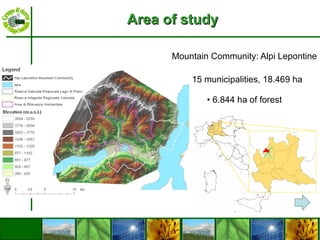
Area of study Mountain Community: Alpi Lepontine 15  municipalities , 18.469 ha 6.844 ha of forest
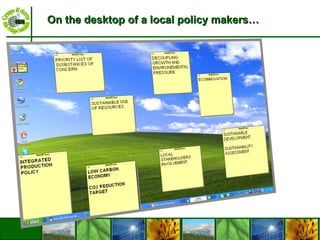
On the desktop of a local policy makers…
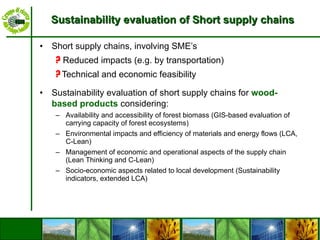
Sustainability evaluation of Short supply chains Short supply chains, involving SME’s ?   Reduced impacts (e.g. by transportation) ?  Technical and economic feasibility Sustainability evaluation of short supply chains for  wood-based products  considering: Availability and accessibility of forest biomass (GIS-based evaluation of carrying capacity of forest ecosystems) Environmental impacts and efficiency of materials and energy flows (LCA, C-Lean) Management of economic and operational aspects of the supply chain (Lean Thinking and C-Lean) Socio-economic aspects related to local development (Sustainability indicators, extended LCA)
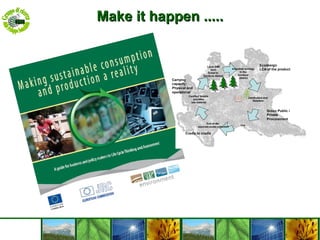
Make it happen .....
BOMO project two researching groups ( forest sector and sustainability) two consortia of SME’s (more then 250 SME’s) 1 province and several local authorities two partners devoted to communication a multidisciplinary multistakeholder project
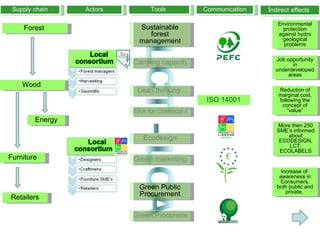
Supply chain Forest  Actors Tools  Communication I ndirect   effects   Carrying capacity Sustainable forest management Environmental protection against hydro geological problems Wood  Energy Furniture Retailers Lean thinking  Ecodesign ISO 14001 ERA for Chemical Assessment More then 250 SME’s informed about ECODESIGN, LCT, ECOLABELS Green Public Procurement Job opportunity in underdeveloped areas Increase of  awareness in Consumers, both public and private,  Green Procurement  Reduction of marginal cost, following the concept of “value” Green marketing
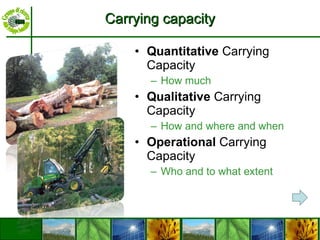
Quantitative  Carrying Capacity How much Qualitative  Carrying Capacity How and where and when Operational  Carrying Capacity Who and to what extent  Carrying capacity
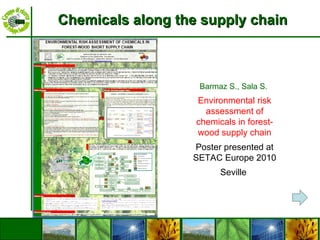
Chemicals along the supply chain Barmaz S., Sala S.  Environmental risk assessment of chemicals in forest-wood supply chain Poster presented at SETAC Europe 2010 Seville
Lean Thinking To make a local system competitive, it is necessary to reframe the entire production process, promoting efficiency and reducing wastes.  Lean Thinking is a management model developed in the context of methods for quality improvement and processes engineering; it is aimed to promote efficiency and reduce wastes It identifies 5 principles which should lead any reengineering and reorganization process effort ( Value mapping,  Value stream, Flow,  Pull, Perfection ) “ C-Lean”   enlarges the principles perspective to include environmental waste in the evaluation Logistic optimisation Sala S, Castellani V. (2009).  Integration of LCA and C-Lean for sustainability assessment of short supply chain related to forest products. Proceedings of 16 th  SETAC LCA Case Study Symposium, Poznan.  Tim P. Mitchell, ( 2004). Principles of Lean Thinking. National Resource Council Canada,
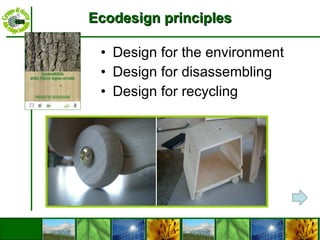
Ecodesign principles Design for the environment  Design for disassembling Design for recycling
Progetto Lissone  www.progettolissone.it
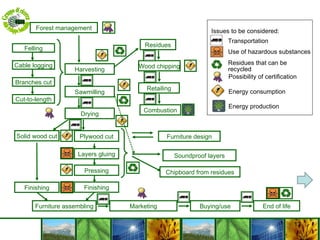
Solid wood cut Furniture design Furniture assembling Marketing End of life Combustion Residues Wood chipping Buying/use Plywood cut Layers gluing Pressing Finishing Finishing Chipboard from residues Soundproof layers Forest management Felling Cut-to-length Cable logging Branches cut Harvesting Sawmilling Drying Retailing Issues to be considered: Transportation Use of hazardous substances Residues that can be recycled Possibility of certification Energy consumption Energy production
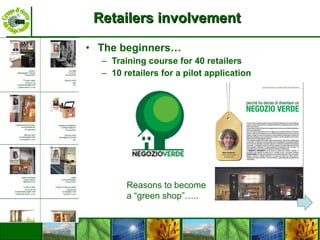
Retailers involvement The  beginners … Training course for 40 retailers 10 retailers for a pilot application Reasons to become a “green shop”…..
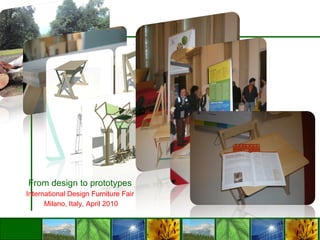
From design to prototypes International Design Furniture Fair Milano, Italy, April 2010
Some conclusion… to make sustainability operational Limits and rate of consumption  have to be integrated in scenario development  Importance of a  widen involvement of whole supply  chain and  stakeholders Need for a strategy to  simplify access to existing methodologies and tools Strenghten relationship with  Public Authorities (local planning, strategic projects etc)  Need of  translation of the results of research  into a usable format for the users, both policy maker. Local stakeholders Indirect effect and indirect indicators have to be taken into account Improvement of knowledge management to capitalize the  existing knowledge  as a key factor for improving capacity building of Local Communities.
v [email_address] www.griss.it GRISS – Research Unit on Sustainable Development University of Milano Bicocca Department of Environmental Science www.boscomobile.it Thank you  for your kind attention Gruppo di ricerca sullo Sviluppo Sostenibile GRISS

C2 cn practices_bomo

  • 1.
    BOMO project as a best practice of C2C V. Castellani , S. Sala, GRISS – Research Unit on Sustainable Development University of Milano Bicocca Department of Environmental Science Department of Environmental Science University of Milano Bicocca
  • 2.
    Area of studyMountain Community: Alpi Lepontine 15 municipalities , 18.469 ha 6.844 ha of forest
  • 3.
    On the desktopof a local policy makers…
  • 4.
    Sustainability evaluation ofShort supply chains Short supply chains, involving SME’s ? Reduced impacts (e.g. by transportation) ? Technical and economic feasibility Sustainability evaluation of short supply chains for wood-based products considering: Availability and accessibility of forest biomass (GIS-based evaluation of carrying capacity of forest ecosystems) Environmental impacts and efficiency of materials and energy flows (LCA, C-Lean) Management of economic and operational aspects of the supply chain (Lean Thinking and C-Lean) Socio-economic aspects related to local development (Sustainability indicators, extended LCA)
  • 5.
  • 6.
    BOMO project tworesearching groups ( forest sector and sustainability) two consortia of SME’s (more then 250 SME’s) 1 province and several local authorities two partners devoted to communication a multidisciplinary multistakeholder project
  • 7.
    Supply chain Forest Actors Tools Communication I ndirect effects Carrying capacity Sustainable forest management Environmental protection against hydro geological problems Wood Energy Furniture Retailers Lean thinking Ecodesign ISO 14001 ERA for Chemical Assessment More then 250 SME’s informed about ECODESIGN, LCT, ECOLABELS Green Public Procurement Job opportunity in underdeveloped areas Increase of awareness in Consumers, both public and private, Green Procurement Reduction of marginal cost, following the concept of “value” Green marketing
  • 8.
    Quantitative CarryingCapacity How much Qualitative Carrying Capacity How and where and when Operational Carrying Capacity Who and to what extent Carrying capacity
  • 9.
    Chemicals along thesupply chain Barmaz S., Sala S. Environmental risk assessment of chemicals in forest-wood supply chain Poster presented at SETAC Europe 2010 Seville
  • 10.
    Lean Thinking Tomake a local system competitive, it is necessary to reframe the entire production process, promoting efficiency and reducing wastes. Lean Thinking is a management model developed in the context of methods for quality improvement and processes engineering; it is aimed to promote efficiency and reduce wastes It identifies 5 principles which should lead any reengineering and reorganization process effort ( Value mapping, Value stream, Flow, Pull, Perfection ) “ C-Lean” enlarges the principles perspective to include environmental waste in the evaluation Logistic optimisation Sala S, Castellani V. (2009). Integration of LCA and C-Lean for sustainability assessment of short supply chain related to forest products. Proceedings of 16 th SETAC LCA Case Study Symposium, Poznan. Tim P. Mitchell, ( 2004). Principles of Lean Thinking. National Resource Council Canada,
  • 11.
    Ecodesign principles Designfor the environment Design for disassembling Design for recycling
  • 12.
    Progetto Lissone www.progettolissone.it
  • 13.
    Solid wood cutFurniture design Furniture assembling Marketing End of life Combustion Residues Wood chipping Buying/use Plywood cut Layers gluing Pressing Finishing Finishing Chipboard from residues Soundproof layers Forest management Felling Cut-to-length Cable logging Branches cut Harvesting Sawmilling Drying Retailing Issues to be considered: Transportation Use of hazardous substances Residues that can be recycled Possibility of certification Energy consumption Energy production
  • 14.
    Retailers involvement The beginners … Training course for 40 retailers 10 retailers for a pilot application Reasons to become a “green shop”…..
  • 15.
    From design toprototypes International Design Furniture Fair Milano, Italy, April 2010
  • 16.
    Some conclusion… tomake sustainability operational Limits and rate of consumption have to be integrated in scenario development Importance of a widen involvement of whole supply chain and stakeholders Need for a strategy to simplify access to existing methodologies and tools Strenghten relationship with Public Authorities (local planning, strategic projects etc) Need of translation of the results of research into a usable format for the users, both policy maker. Local stakeholders Indirect effect and indirect indicators have to be taken into account Improvement of knowledge management to capitalize the existing knowledge as a key factor for improving capacity building of Local Communities.
  • 17.
    v [email_address] www.griss.itGRISS – Research Unit on Sustainable Development University of Milano Bicocca Department of Environmental Science www.boscomobile.it Thank you for your kind attention Gruppo di ricerca sullo Sviluppo Sostenibile GRISS

Editor's Notes

  • #2 Good morning ladies and gentlemen.
  • #3 Mountain community in Alps, near Como and Lugano lake. Many constraints related to logistic of biomasses Local authorities received a number of proposal by private entities to enlarge use of biomass both for heat and electricity generation. At the moment, woody biomass is used mainly in domestic biomass heating systems, with a very low efficiency and a lot of fine particulate emissions. But, local authorities want to prevent area form resource depletion and wish to develop a decision support system to identificy and sizing biomass plants. Biomass can be used locally for both power and heat (CHP) generation but a specific attention has to be paid to : resource availability, biodiversity damage, global co2 and energy balance of the implemented technology Some relevant topics are identified as main threats for local development: low socio-economic development of mountain areas, low entrepreneurship, especially among young people, high level of urbanization in plain areas (related especially to tourism sector). For this reason, it was considered an interesting area for testing the methodology presented in this study.
  • #8 Green marketing: two actors devoted to communication
  • #11 Total quality managemnet ideas Pull : Design and provide what the customer wants only when the customer wants
  • #17 guidelines for designers and producers, with schematic approach to overcome main categories of impacts and to use existing user-friendly tools and methodologies