Product Stewardship: National Trends  Kate Hagemann  Product Stewardship Institute Advancing Recycling & Organics Management: A Sustainable Future   March 29, 2010
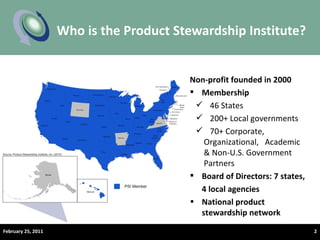
Who is the Product Stewardship Institute? February 25, 2011 Non-profit founded in 2000 Membership 46 States 200+ Local governments 70+ Corporate,  Organizational,  Academic & Non-U.S. Government Partners Board of Directors: 7 states,  4 local agencies  National product stewardship network
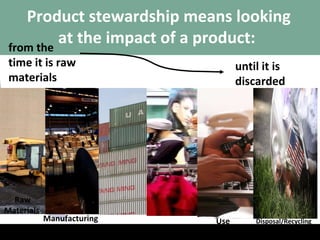
Product stewardship means looking at the impact of a product:  from the time it is raw materials until it is discarded Raw Materials   Manufacturing   Transportation   Retail  Use  Disposal/Recycling
PSI Principles of Product Stewardship © Product Stewardship Institute – February 25, 2011 Shared Responsibility Cost internalization Incentives for Cleaner Products 4.  Performance goals 5.  Flexible Management Strategies  * Endorsements : National League of Cities, Environmental Council of States, Solid Waste Association of North America, and many other organizations February 25, 2011
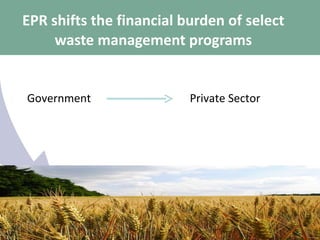
EPR shifts the financial burden of select waste management programs Government Private Sector
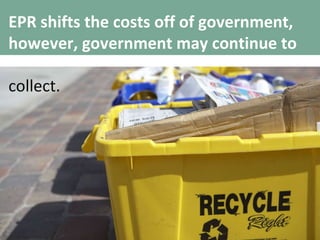
EPR shifts the costs off of government, however, government may continue to  collect.
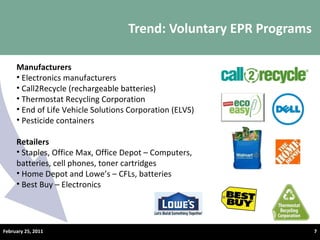
Trend: Voluntary EPR Programs © Product Stewardship Institute – February 25, 2011 Manufacturers Electronics manufacturers Call2Recycle (rechargeable batteries) Thermostat Recycling Corporation End of Life Vehicle Solutions Corporation (ELVS) Pesticide containers Retailers Staples, Office Max, Office Depot – Computers, batteries, cell phones, toner cartridges Home Depot and Lowe ’s – CFLs, batteries Best Buy – Electronics  February 25, 2011
Role of Voluntary Systems Interim steps prior to legislation Increase visibility of take-back programs Allows progress on products of low government priority Provides collection options today © Product Stewardship Institute – November 3, 2010 February 25, 2011
Trend: Regulated Systems Level the playing field (fair) Gives authority to agency to enforce against non-compliant parties Gives authority to agency to enhance program © Product Stewardship Institute – November 3, 2010 February 25, 2011


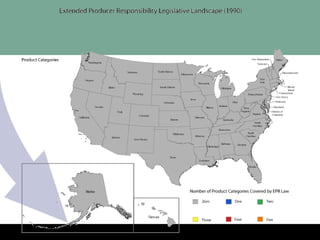
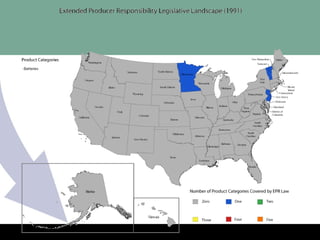
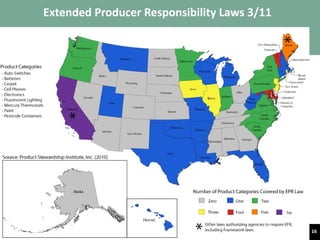
Extended Producer Responsibility Laws 3/11 February 25th 2011 8
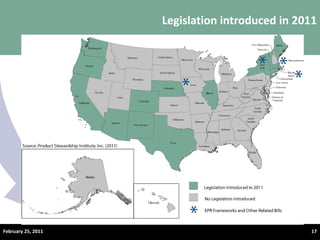
Legislation introduced in 2011 February 25, 2011
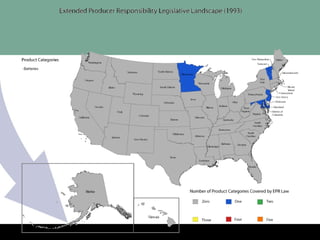
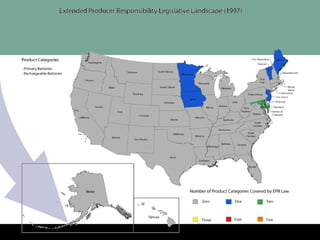
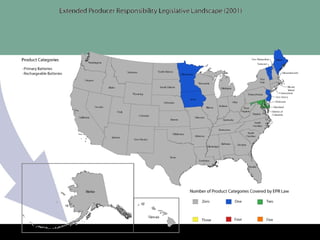
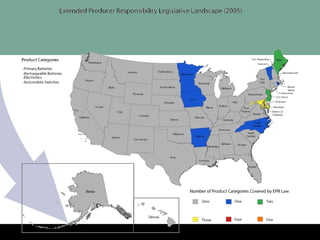
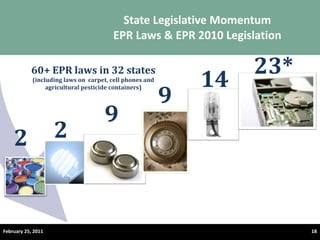
State Legislative Momentum EPR Laws & EPR 2010 Legislation February 25, 2011 60+ EPR laws in 32 states (including laws on  carpet, cell phones and agricultural pesticide containers) 2 2 9 9 14 23*
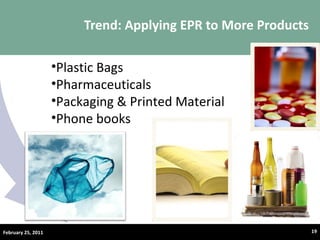
Trend: Applying EPR to More Products Plastic Bags Pharmaceuticals Packaging & Printed Material Phone books February 25, 2011
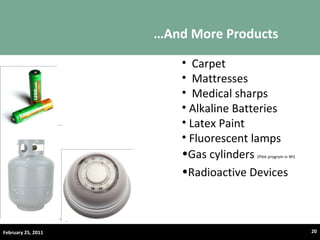
… And More Products February 25, 2011 Carpet Mattresses Medical sharps Alkaline Batteries Latex Paint Fluorescent lamps Gas cylinders  (Pilot program in WI) Radioactive Devices
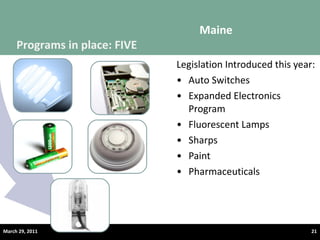
Legislation Introduced this year: Auto Switches Expanded Electronics Program  Fluorescent Lamps Sharps Paint  Pharmaceuticals Maine March 29, 2011 Programs in place: FIVE
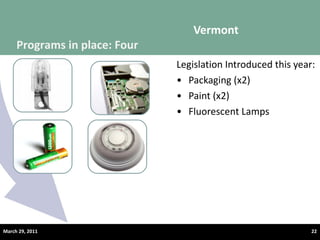
Legislation Introduced this year: Packaging (x2) Paint (x2) Fluorescent Lamps Vermont March 29, 2011 Programs in place: Four
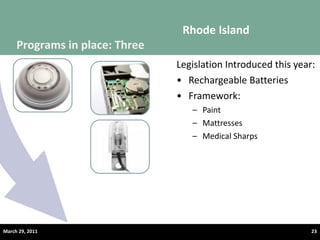
Legislation Introduced this year: Rechargeable Batteries Framework: Paint Mattresses Medical Sharps Rhode Island March 29, 2011 Programs in place: Three
Legislation Introduced this year: Paint Thermostats Connecticut March 29, 2011 Programs in place: One
Legislation Introduced this year: - non-EPR bills  New Hampshire March 29, 2011 Programs in place: One
Legislation Introduced this year: Auto Switches Framework  Thermostats Paint Pharmaceuticals Fluorescent Lighting New York March 29, 2011 Programs in place: TWO
New Jersey  March 29, 2011 Programs in place: three
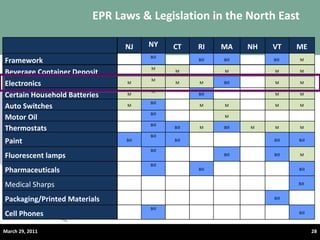
EPR Laws & Legislation in the North East March 29, 2011 NJ NY CT RI MA NH VT ME Framework  Bill Bill Bill Bill  M Beverage Container Deposit  M M M M M Electronics M M M M Bill M M Certain Household Batteries M M Bill M M Auto Switches M Bill M M M M Motor Oil Bill M Thermostats Bill Bill M Bill M M M Paint Bill Bill Bill Bill Bill Fluorescent lamps Bill Bill Bill M Pharmaceuticals Bill Bill Bill Medical Sharps Bill  Packaging/Printed Materials Bill Cell Phones Bill Bill
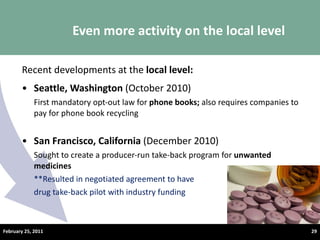
Recent developments at the  local level: Seattle, Washington  (October 2010) First mandatory opt-out law for  phone books;  also requires companies to pay for phone book recycling San Francisco, California  (December 2010) Sought to create a producer-run take-back program for  unwanted medicines **Resulted in negotiated agreement to have  drug take-back pilot with industry funding Even more activity on the local level February 25, 2011
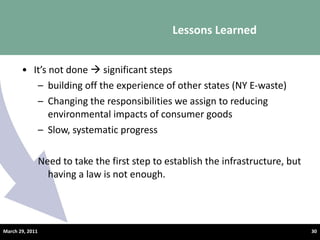
It ’s not done    significant steps building off the experience of other states (NY E-waste) Changing the responsibilities we assign to reducing environmental impacts of consumer goods  Slow, systematic progress  Need to take the first step to establish the infrastructure, but having a law is not enough. Lessons Learned  March 29, 2011
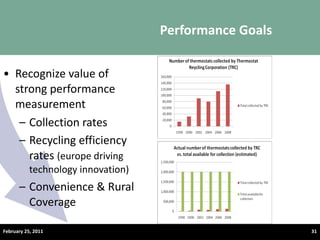
Recognize value of strong performance measurement Collection rates Recycling efficiency rates  (europe driving technology innovation) Convenience & Rural Coverage Performance Goals February 25, 2011
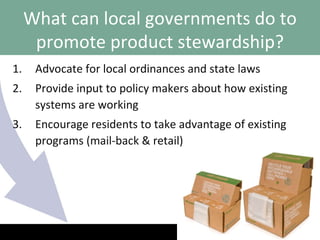
Advocate for local ordinances and state laws Provide input to policy makers about how existing systems are working Encourage residents to take advantage of existing programs (mail-back & retail) What can local governments do to promote product stewardship?
What can local governments do to promote product stewardship? 4. Raise awareness / educate your management 5. Reach out to retailers to build support, encourage them to collect 6. Reach out to manufacturers to ensure they implement their national programs in your community
Full Membership for local governments  Educational opportunities  Paper Source Reduction Pilot Program (Catalogues & phonebooks)  Maximizing the use of existing programs  Regional Meetings (May/June) Massachusetts Product Stewardship Project  March 29, 2011
More Information Kate Hagemann Associate of Policy & Programs [email_address] © Product Stewardship Institute –February 25, 2010 February 25, 2011

Materials #2 Product Stewardship Session (Kate Hagemann)

  • 1.
    Product Stewardship: NationalTrends Kate Hagemann Product Stewardship Institute Advancing Recycling & Organics Management: A Sustainable Future  March 29, 2010
  • 2.
    Who is theProduct Stewardship Institute? February 25, 2011 Non-profit founded in 2000 Membership 46 States 200+ Local governments 70+ Corporate, Organizational, Academic & Non-U.S. Government Partners Board of Directors: 7 states, 4 local agencies National product stewardship network
  • 3.
    Product stewardship meanslooking at the impact of a product: from the time it is raw materials until it is discarded Raw Materials Manufacturing Transportation Retail Use Disposal/Recycling
  • 4.
    PSI Principles ofProduct Stewardship © Product Stewardship Institute – February 25, 2011 Shared Responsibility Cost internalization Incentives for Cleaner Products 4. Performance goals 5. Flexible Management Strategies * Endorsements : National League of Cities, Environmental Council of States, Solid Waste Association of North America, and many other organizations February 25, 2011
  • 5.
    EPR shifts thefinancial burden of select waste management programs Government Private Sector
  • 6.
    EPR shifts thecosts off of government, however, government may continue to collect.
  • 7.
    Trend: Voluntary EPRPrograms © Product Stewardship Institute – February 25, 2011 Manufacturers Electronics manufacturers Call2Recycle (rechargeable batteries) Thermostat Recycling Corporation End of Life Vehicle Solutions Corporation (ELVS) Pesticide containers Retailers Staples, Office Max, Office Depot – Computers, batteries, cell phones, toner cartridges Home Depot and Lowe ’s – CFLs, batteries Best Buy – Electronics February 25, 2011
  • 8.
    Role of VoluntarySystems Interim steps prior to legislation Increase visibility of take-back programs Allows progress on products of low government priority Provides collection options today © Product Stewardship Institute – November 3, 2010 February 25, 2011
  • 9.
    Trend: Regulated SystemsLevel the playing field (fair) Gives authority to agency to enforce against non-compliant parties Gives authority to agency to enhance program © Product Stewardship Institute – November 3, 2010 February 25, 2011
  • 10.
  • 11.
  • 12.
  • 13.
  • 14.
  • 15.
  • 16.
    Extended Producer ResponsibilityLaws 3/11 February 25th 2011 8
  • 17.
    Legislation introduced in2011 February 25, 2011
  • 18.
    State Legislative MomentumEPR Laws & EPR 2010 Legislation February 25, 2011 60+ EPR laws in 32 states (including laws on carpet, cell phones and agricultural pesticide containers) 2 2 9 9 14 23*
  • 19.
    Trend: Applying EPRto More Products Plastic Bags Pharmaceuticals Packaging & Printed Material Phone books February 25, 2011
  • 20.
    … And MoreProducts February 25, 2011 Carpet Mattresses Medical sharps Alkaline Batteries Latex Paint Fluorescent lamps Gas cylinders (Pilot program in WI) Radioactive Devices
  • 21.
    Legislation Introduced thisyear: Auto Switches Expanded Electronics Program Fluorescent Lamps Sharps Paint Pharmaceuticals Maine March 29, 2011 Programs in place: FIVE
  • 22.
    Legislation Introduced thisyear: Packaging (x2) Paint (x2) Fluorescent Lamps Vermont March 29, 2011 Programs in place: Four
  • 23.
    Legislation Introduced thisyear: Rechargeable Batteries Framework: Paint Mattresses Medical Sharps Rhode Island March 29, 2011 Programs in place: Three
  • 24.
    Legislation Introduced thisyear: Paint Thermostats Connecticut March 29, 2011 Programs in place: One
  • 25.
    Legislation Introduced thisyear: - non-EPR bills New Hampshire March 29, 2011 Programs in place: One
  • 26.
    Legislation Introduced thisyear: Auto Switches Framework Thermostats Paint Pharmaceuticals Fluorescent Lighting New York March 29, 2011 Programs in place: TWO
  • 27.
    New Jersey March 29, 2011 Programs in place: three
  • 28.
    EPR Laws &Legislation in the North East March 29, 2011 NJ NY CT RI MA NH VT ME Framework Bill Bill Bill Bill M Beverage Container Deposit M M M M M Electronics M M M M Bill M M Certain Household Batteries M M Bill M M Auto Switches M Bill M M M M Motor Oil Bill M Thermostats Bill Bill M Bill M M M Paint Bill Bill Bill Bill Bill Fluorescent lamps Bill Bill Bill M Pharmaceuticals Bill Bill Bill Medical Sharps Bill Packaging/Printed Materials Bill Cell Phones Bill Bill
  • 29.
    Recent developments atthe local level: Seattle, Washington (October 2010) First mandatory opt-out law for phone books; also requires companies to pay for phone book recycling San Francisco, California (December 2010) Sought to create a producer-run take-back program for unwanted medicines **Resulted in negotiated agreement to have drug take-back pilot with industry funding Even more activity on the local level February 25, 2011
  • 30.
    It ’s notdone  significant steps building off the experience of other states (NY E-waste) Changing the responsibilities we assign to reducing environmental impacts of consumer goods Slow, systematic progress Need to take the first step to establish the infrastructure, but having a law is not enough. Lessons Learned March 29, 2011
  • 31.
    Recognize value ofstrong performance measurement Collection rates Recycling efficiency rates (europe driving technology innovation) Convenience & Rural Coverage Performance Goals February 25, 2011
  • 32.
    Advocate for localordinances and state laws Provide input to policy makers about how existing systems are working Encourage residents to take advantage of existing programs (mail-back & retail) What can local governments do to promote product stewardship?
  • 33.
    What can localgovernments do to promote product stewardship? 4. Raise awareness / educate your management 5. Reach out to retailers to build support, encourage them to collect 6. Reach out to manufacturers to ensure they implement their national programs in your community
  • 34.
    Full Membership forlocal governments Educational opportunities Paper Source Reduction Pilot Program (Catalogues & phonebooks) Maximizing the use of existing programs Regional Meetings (May/June) Massachusetts Product Stewardship Project March 29, 2011
  • 35.
    More Information KateHagemann Associate of Policy & Programs [email_address] © Product Stewardship Institute –February 25, 2010 February 25, 2011

Editor's Notes

  • #5 Each program & roles and responsibilities varies tremendously by product – but there are certain unifying principles Will talk about performance goals later
  • #8 Principles: Cost internalization Shared responsibility manufacturers have greatest role to play Lifecycle costs Performance goals Flexibility for producers
  • #10 - While leaders can emerge in voluntary programs – we need regulated programs to have high performing programs – example texas
  • #17 California has taken the lead with 6 laws Maine close behind - all states on the east coast with at least one
  • #18 - With legislation map – we see this is in blue and red states alike w/ Nebraska introducing electronics legislation
  • #19 Most momentum behind electronics Lots of momentum behind mercury products But growing interest in non-toxic wastes such as paint & batteries
  • #20 This year we saw legislation introduced on plastic bags – applying the EPR model to a familiar problem - Packaging & printed materials (will discuss later) Phone books mandatory opt out And pharms – lots of activity establishing take back programs but a number of them are state-run due to regulations regarding who can handle cerain durgs such as narcotics which can be absued.
  • #22 Leader with a number of groundbreaking laws – not afraid to go first - first to pass framework – went thru review of existing programs & nomination for new programs Number of programs introduced this year – their legislative prospects under the new administration are uncertain -Governor – Reform platform @ the moment he ’s taken out of it the pieces pertaining to PS legislation nothing ’s happened in terms of killing or repealing existing programs
  • #23 Taken important first step of introducing packaing and printed materials (including books, newpapers, etc) These programs have been in place in Europe for quite a while Likely coming on the horizion shortly EPA hosting a dialogue now with industry Many industry leaders are expecting this not as a if but a when Two year session – but due to this history of the bill, future uncertain First included a repeal of the bottle bill – but this has since been removed
  • #24 Following Maine’s example (and a study bill last year) – has introduced framework Includes three products Framework is the direction that we would like to see these programs go, but there is the risk when introducing framework of getting the attention of every industry -
  • #25 Roll out state/ (as is vermont) and is part of a national agreement with the Paint Industry Provides an alternate arrangement – where the paint industry is actually lobby in favor of the paint legislation – of course only the legislation that was proposed Preferred to see a systematic implementation rather than what we’ve seen with electronics
  • #27 Good game of catch up ewaste and battery laws - pharms for healthcare facilities – not mandated EPR
  • #29 Just want to demonstrate that Mass and NH are the only states in the region without e-waste laws