Moving Anne Arundel County
   towards Zero Waste

                     Greg Smith
               Suchitra Balachandran
                Community Research
                  January 26, 2013
Community Research is a Prince George’s County-based
nonprofit that conducts public-interest research,
education and advocacy on the environment, public
health, sustainability, and other issues.
We are working with Clean Water Action, the Energy
Justice Network, and the Institute for Local Self-
Reliance to build a statewide campaign and alliance for
zero waste.

communityresearch@igc.org
What is “Zero Waste”?
"Zero Waste is a goal that is ethical, economical, efficient and
visionary, to guide people in changing their lifestyles and practices
to emulate sustainable natural cycles, where all discarded materials
are designed to become resources for others to use.

Zero Waste means designing and managing products and processes
to systematically avoid and eliminate the volume and toxicity of
waste and materials, conserve and recover all resources, and not
burn or bury them.

Implementing Zero Waste will eliminate all discharges to land,
water or air that are a threat to planetary, human, animal or plant
health."

 -- Zero Waste International Alliance, November 2004.
Nuts and Bolts Definition
                  of Zero Waste
Zero waste means that:
ď‚§ For many jurisdictions, the final goal is to reduce landfilling
  and incineration to less than 10% of the waste produced.
ď‚§ The amount of waste generated is systematically reduced.
ď‚§ Nothing that can be recycled, reused or composted goes into
  a landfill or an incinerator.
ď‚§ Green businesses are encouraged to mine resources from
  what would otherwise be wasted and destroyed through
  landfilling or incineration.
Alameda County Waste Management Authority &
Alameda County Source Reduction and Recycling Board
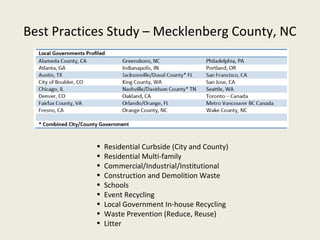
Best Practices Study – Mecklenberg County, NC


            •   Residential Curbside (City and County)
            •   Residential Multi-family
            •   Commercial/Industrial/Institutional
            •   Construction and Demolition Waste
            •   Schools
            •   Event Recycling
            •   Local Government In-house Recycling
            •   Waste Prevention (Reduce, Reuse)
            •   Litter
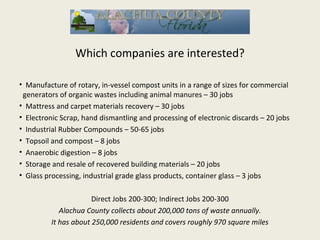
Which companies are interested?

• Manufacture of rotary, in-vessel compost units in a range of sizes for commercial
 generators of organic wastes including animal manures – 30 jobs
• Mattress and carpet materials recovery – 30 jobs
• Electronic Scrap, hand dismantling and processing of electronic discards – 20 jobs
• Industrial Rubber Compounds – 50-65 jobs
• Topsoil and compost – 8 jobs
• Anaerobic digestion – 8 jobs
• Storage and resale of recovered building materials – 20 jobs
• Glass processing, industrial grade glass products, container glass – 3 jobs

                      Direct Jobs 200-300; Indirect Jobs 200-300
            Alachua County collects about 200,000 tons of waste annually.
         It has about 250,000 residents and covers roughly 970 square miles
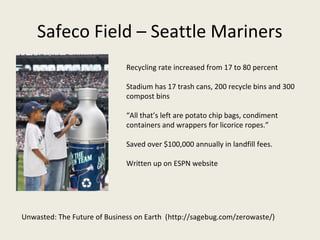
Safeco Field – Seattle Mariners
                              Recycling rate increased from 17 to 80 percent

                              Stadium has 17 trash cans, 200 recycle bins and 300
                              compost bins

                              “All that’s left are potato chip bags, condiment
                              containers and wrappers for licorice ropes.”

                              Saved over $100,000 annually in landfill fees.

                              Written up on ESPN website


Unwasted: The Future of Business on Earth (http://sagebug.com/zerowaste/)
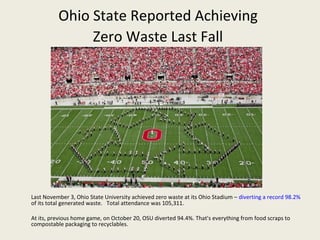
Ohio State Reported Achieving
               Zero Waste Last Fall


Last November 3, Ohio State University achieved zero waste at its Ohio Stadium – diverting a record 98.2%
of its total generated waste. Total attendance was 105,311.

At its, previous home game, on October 20, OSU diverted 94.4%. That's everything from food scraps to
compostable packaging to recyclables.
Local Initiatives
    Not everything innovative and inspirational is
            happening somewhere else

•   Cheverly - household composting
•   University Park - food scrap collection
•   College Park - bulk waste pickup for reuse
•   Laurel – mandates residential recycling
•   University of Maryland - Sustainability Initiative
•   Community Forklift, Eco City Farms
CB 87 - 2012
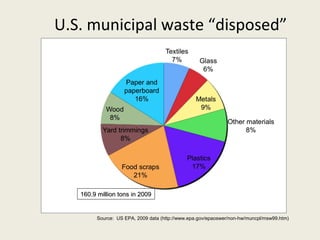
U.S. municipal waste “disposed”


   160.9 million tons in 2009


         Source: US EPA, 2009 data (http://www.epa.gov/epaoswer/non-hw/muncpl/msw99.htm)
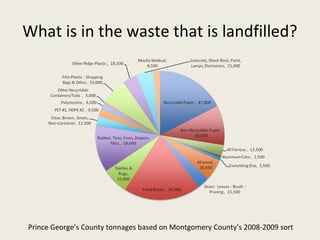
What is in the waste that is landfilled?


Prince George’s County tonnages based on Montgomery County’s 2008-2009 sort
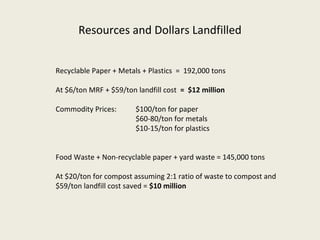
Resources and Dollars Landfilled


Recyclable Paper + Metals + Plastics = 192,000 tons

At $6/ton MRF + $59/ton landfill cost = $12 million

Commodity Prices:       $100/ton for paper
                        $60-80/ton for metals
                        $10-15/ton for plastics


Food Waste + Non-recyclable paper + yard waste = 145,000 tons

At $20/ton for compost assuming 2:1 ratio of waste to compost and
$59/ton landfill cost saved = $10 million
Problems with Burning and Burying

• Both destroy valuable resources.

• Both pollute air, land, water, people and other living things….
  upstream and downstream.

• Both destroy jobs and often export money from communities

• Both increase emissions of greenhouse gases.

• Both are subsidized at the expense of recycling, composting and
  clean renewable energy.

• Both tend to be sited in communities with lower incomes, higher
  percentages of minorities or rural areas.
Even More Problems with Burning

• Ton for ton, incineration is the most expensive waste
  “disposal” option.

• Watt for watt, incineration is the most expensive way to
  generate electricity.

• Watt for watt, burning trash emits more greenhouse gases
  and more of certain toxic air pollutants than burning coal.
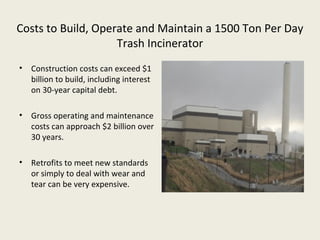
Costs to Build, Operate and Maintain a 1500 Ton Per Day
                    Trash Incinerator
• Construction costs can exceed $1
  billion to build, including interest
  on 30-year capital debt.

• Gross operating and maintenance
  costs can approach $2 billion over
  30 years.

• Retrofits to meet new standards
  or simply to deal with wear and
  tear can be very expensive.
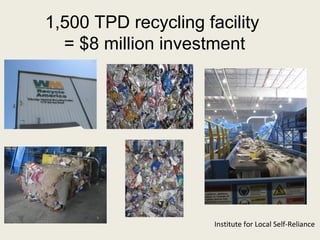
1,500 TPD recycling facility
  = $8 million investment


                      Institute for Local Self-Reliance
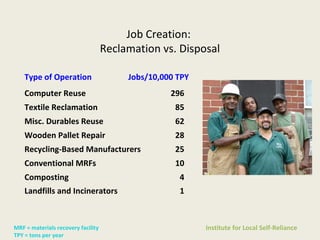
Job Creation:
                                    Reclamation vs. Disposal

    Type of Operation                    Jobs/10,000 TPY
    Computer Reuse                                 296
    Textile Reclamation                             85
    Misc. Durables Reuse                            62
    Wooden Pallet Repair                            28
    Recycling-Based Manufacturers                   25
    Conventional MRFs                               10
    Composting                                       4
    Landfills and Incinerators                       1


MRF = materials recovery facility                          Institute for Local Self-Reliance
TPY = tons per year
So How Does
Zero Waste Happen?
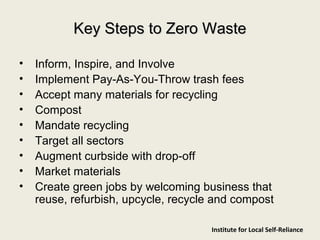
Key Steps to Zero Waste

•   Inform, Inspire, and Involve
•   Implement Pay-As-You-Throw trash fees
•   Accept many materials for recycling
•   Compost
•   Mandate recycling
•   Target all sectors
•   Augment curbside with drop-off
•   Market materials
•   Create green jobs by welcoming business that
    reuse, refurbish, upcycle, recycle and compost

                                      Institute for Local Self-Reliance
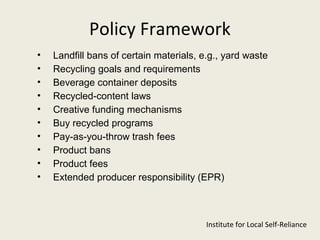
Policy Framework
•   Landfill bans of certain materials, e.g., yard waste
•   Recycling goals and requirements
•   Beverage container deposits
•   Recycled-content laws
•   Creative funding mechanisms
•   Buy recycled programs
•   Pay-as-you-throw trash fees
•   Product bans
•   Product fees
•   Extended producer responsibility (EPR)


                                         Institute for Local Self-Reliance
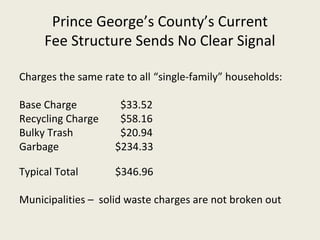
Prince George’s County’s Current
     Fee Structure Sends No Clear Signal

Charges the same rate to all “single-family” households:

Base Charge          $33.52
Recycling Charge     $58.16
Bulky Trash          $20.94
Garbage             $234.33

Typical Total       $346.96

Municipalities – solid waste charges are not broken out
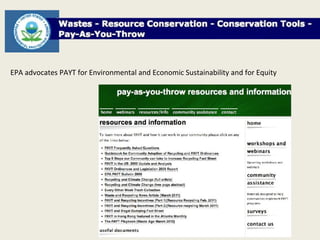
EPA advocates PAYT for Environmental and Economic Sustainability and for Equity
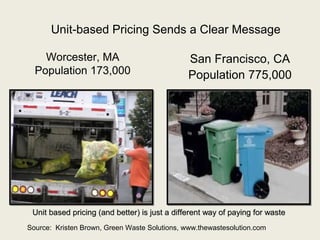
Unit-based Pricing Sends a Clear Message

    Worcester, MA                              San Francisco, CA
  Population 173,000                           Population 775,000


 Unit based pricing (and better) is just a different way of paying for waste
Source: Kristen Brown, Green Waste Solutions, www.thewastesolution.com
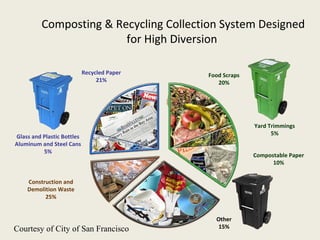
Composting & Recycling Collection System Designed
                         for High Diversion

                            Recycled Paper   Food Scraps
                                 21%            20%


                                                           Yard Trimmings
                                                                 5%
Glass and Plastic Bottles
Aluminum and Steel Cans
          5%
                                                           Compostable Paper
                                                                 10%


    Construction and
    Demolition Waste
          25%


                                               Other
Courtesy of City of San Francisco               15%
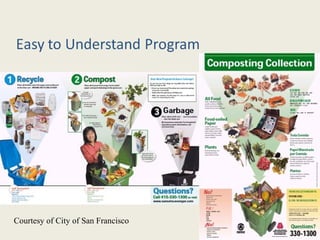
Courtesy of City of San Francisco
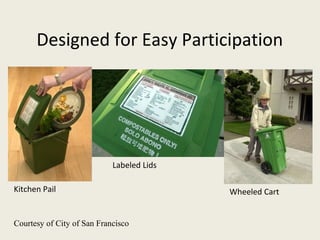
Designed for Easy Participation


                            Labeled Lids

Kitchen Pail                               Wheeled Cart


Courtesy of City of San Francisco
Food Scrap Composting

PAYT

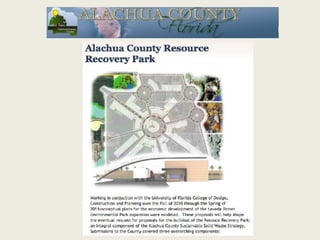
Resource Recovery Park

Waste Audit

ZW Strategic Plan

Post Reports on landfilled, recycled
"If it can't be reduced, reused, repaired, rebuilt,
refurbished, refinished, resold, recycled or
composted, then it should be restricted,
redesigned or removed from production."

                       -- Berkeley Ecology Center

Presentation for gan ltf 20130126

  • 1.
    Moving Anne ArundelCounty towards Zero Waste Greg Smith Suchitra Balachandran Community Research January 26, 2013
  • 2.
    Community Research isa Prince George’s County-based nonprofit that conducts public-interest research, education and advocacy on the environment, public health, sustainability, and other issues. We are working with Clean Water Action, the Energy Justice Network, and the Institute for Local Self- Reliance to build a statewide campaign and alliance for zero waste. communityresearch@igc.org
  • 3.
    What is “ZeroWaste”? "Zero Waste is a goal that is ethical, economical, efficient and visionary, to guide people in changing their lifestyles and practices to emulate sustainable natural cycles, where all discarded materials are designed to become resources for others to use. Zero Waste means designing and managing products and processes to systematically avoid and eliminate the volume and toxicity of waste and materials, conserve and recover all resources, and not burn or bury them. Implementing Zero Waste will eliminate all discharges to land, water or air that are a threat to planetary, human, animal or plant health." -- Zero Waste International Alliance, November 2004.
  • 4.
    Nuts and BoltsDefinition of Zero Waste Zero waste means that: ď‚§ For many jurisdictions, the final goal is to reduce landfilling and incineration to less than 10% of the waste produced. ď‚§ The amount of waste generated is systematically reduced. ď‚§ Nothing that can be recycled, reused or composted goes into a landfill or an incinerator. ď‚§ Green businesses are encouraged to mine resources from what would otherwise be wasted and destroyed through landfilling or incineration.
  • 10.
    Alameda County WasteManagement Authority & Alameda County Source Reduction and Recycling Board
  • 11.
    Best Practices Study– Mecklenberg County, NC • Residential Curbside (City and County) • Residential Multi-family • Commercial/Industrial/Institutional • Construction and Demolition Waste • Schools • Event Recycling • Local Government In-house Recycling • Waste Prevention (Reduce, Reuse) • Litter
  • 13.
    Which companies areinterested? • Manufacture of rotary, in-vessel compost units in a range of sizes for commercial generators of organic wastes including animal manures – 30 jobs • Mattress and carpet materials recovery – 30 jobs • Electronic Scrap, hand dismantling and processing of electronic discards – 20 jobs • Industrial Rubber Compounds – 50-65 jobs • Topsoil and compost – 8 jobs • Anaerobic digestion – 8 jobs • Storage and resale of recovered building materials – 20 jobs • Glass processing, industrial grade glass products, container glass – 3 jobs Direct Jobs 200-300; Indirect Jobs 200-300 Alachua County collects about 200,000 tons of waste annually. It has about 250,000 residents and covers roughly 970 square miles
  • 14.
    Safeco Field –Seattle Mariners Recycling rate increased from 17 to 80 percent Stadium has 17 trash cans, 200 recycle bins and 300 compost bins “All that’s left are potato chip bags, condiment containers and wrappers for licorice ropes.” Saved over $100,000 annually in landfill fees. Written up on ESPN website Unwasted: The Future of Business on Earth (http://sagebug.com/zerowaste/)
  • 15.
    Ohio State ReportedAchieving Zero Waste Last Fall Last November 3, Ohio State University achieved zero waste at its Ohio Stadium – diverting a record 98.2% of its total generated waste. Total attendance was 105,311. At its, previous home game, on October 20, OSU diverted 94.4%. That's everything from food scraps to compostable packaging to recyclables.
  • 16.
    Local Initiatives Not everything innovative and inspirational is happening somewhere else • Cheverly - household composting • University Park - food scrap collection • College Park - bulk waste pickup for reuse • Laurel – mandates residential recycling • University of Maryland - Sustainability Initiative • Community Forklift, Eco City Farms
  • 18.
    CB 87 -2012
  • 19.
    U.S. municipal waste“disposed” 160.9 million tons in 2009 Source: US EPA, 2009 data (http://www.epa.gov/epaoswer/non-hw/muncpl/msw99.htm)
  • 20.
    What is inthe waste that is landfilled? Prince George’s County tonnages based on Montgomery County’s 2008-2009 sort
  • 21.
    Resources and DollarsLandfilled Recyclable Paper + Metals + Plastics = 192,000 tons At $6/ton MRF + $59/ton landfill cost = $12 million Commodity Prices: $100/ton for paper $60-80/ton for metals $10-15/ton for plastics Food Waste + Non-recyclable paper + yard waste = 145,000 tons At $20/ton for compost assuming 2:1 ratio of waste to compost and $59/ton landfill cost saved = $10 million
  • 22.
    Problems with Burningand Burying • Both destroy valuable resources. • Both pollute air, land, water, people and other living things…. upstream and downstream. • Both destroy jobs and often export money from communities • Both increase emissions of greenhouse gases. • Both are subsidized at the expense of recycling, composting and clean renewable energy. • Both tend to be sited in communities with lower incomes, higher percentages of minorities or rural areas.
  • 23.
    Even More Problemswith Burning • Ton for ton, incineration is the most expensive waste “disposal” option. • Watt for watt, incineration is the most expensive way to generate electricity. • Watt for watt, burning trash emits more greenhouse gases and more of certain toxic air pollutants than burning coal.
  • 24.
    Costs to Build,Operate and Maintain a 1500 Ton Per Day Trash Incinerator • Construction costs can exceed $1 billion to build, including interest on 30-year capital debt. • Gross operating and maintenance costs can approach $2 billion over 30 years. • Retrofits to meet new standards or simply to deal with wear and tear can be very expensive.
  • 25.
    1,500 TPD recyclingfacility = $8 million investment Institute for Local Self-Reliance
  • 26.
    Job Creation: Reclamation vs. Disposal Type of Operation Jobs/10,000 TPY Computer Reuse 296 Textile Reclamation 85 Misc. Durables Reuse 62 Wooden Pallet Repair 28 Recycling-Based Manufacturers 25 Conventional MRFs 10 Composting 4 Landfills and Incinerators 1 MRF = materials recovery facility Institute for Local Self-Reliance TPY = tons per year
  • 27.
    So How Does ZeroWaste Happen?
  • 28.
    Key Steps toZero Waste • Inform, Inspire, and Involve • Implement Pay-As-You-Throw trash fees • Accept many materials for recycling • Compost • Mandate recycling • Target all sectors • Augment curbside with drop-off • Market materials • Create green jobs by welcoming business that reuse, refurbish, upcycle, recycle and compost Institute for Local Self-Reliance
  • 29.
    Policy Framework • Landfill bans of certain materials, e.g., yard waste • Recycling goals and requirements • Beverage container deposits • Recycled-content laws • Creative funding mechanisms • Buy recycled programs • Pay-as-you-throw trash fees • Product bans • Product fees • Extended producer responsibility (EPR) Institute for Local Self-Reliance
  • 30.
    Prince George’s County’sCurrent Fee Structure Sends No Clear Signal Charges the same rate to all “single-family” households: Base Charge $33.52 Recycling Charge $58.16 Bulky Trash $20.94 Garbage $234.33 Typical Total $346.96 Municipalities – solid waste charges are not broken out
  • 31.
    EPA advocates PAYTfor Environmental and Economic Sustainability and for Equity
  • 32.
    Unit-based Pricing Sendsa Clear Message Worcester, MA San Francisco, CA Population 173,000 Population 775,000 Unit based pricing (and better) is just a different way of paying for waste Source: Kristen Brown, Green Waste Solutions, www.thewastesolution.com
  • 33.
    Composting & RecyclingCollection System Designed for High Diversion Recycled Paper Food Scraps 21% 20% Yard Trimmings 5% Glass and Plastic Bottles Aluminum and Steel Cans 5% Compostable Paper 10% Construction and Demolition Waste 25% Other Courtesy of City of San Francisco 15%
  • 34.
    Courtesy of Cityof San Francisco
  • 35.
    Designed for EasyParticipation Labeled Lids Kitchen Pail Wheeled Cart Courtesy of City of San Francisco
  • 36.
    Food Scrap Composting PAYT ResourceRecovery Park Waste Audit ZW Strategic Plan Post Reports on landfilled, recycled
  • 37.
    "If it can'tbe reduced, reused, repaired, rebuilt, refurbished, refinished, resold, recycled or composted, then it should be restricted, redesigned or removed from production." -- Berkeley Ecology Center

Editor's Notes

  • #5 Add other points from your definition.
  • #20 Food scraps = 33 million tons Plastics = 28 million tons 2.1 million tons of plates, cups, glasses, hinged containers were landfilled and burned in the US of this, 900,000 tons were plastic, primarily polstyrene by moving toward reusable and compostable food service ware, we can help capture that 33 million tons of food scraps for composting.
  • #23 Greg will draft
  • #24 Greg will draft
  • #29 No one model program. Here are common threads.
  • #31 PAYT is the most effective way to reduce trash and increase recycling
  • #33 Close to 70% diversion Special yellow trash bag 15 gal 75 cents 30 gal 1.50 cents In SF, 90% chose 32 gal trash, $23/month 64 gal is $46/month