Premises
Any building used in manufacturing, processing, packaging or holding of
drugs products will take place
 Principle works:-
Premises must be located ,designed, constructed adapted and maintained for
the operation
Aim /objective
 Minimise risk of error
 Avoid cross-contamination build-up of the dirt and dust
 Avoid any adverse effect on the quality of the products
 Permit effective cleaning
 Permit effective maintenance
Premises
 Location & layout
 Sanitation
 Maintenance
 Contamination control
 Environmental control
 Utilities
 Design & construction
Following Factors are considered
• General requirements
• Ancillary areas
• Storage areas
• Weighing areas
• Production areas
• Quality control areas
 Clean room & strategy
 Sanitation of SterileAreas
 Sanitation
 Maintenance Maintenance of SterileAreas
 Cleanliness of air
 Heating, Ventilation, & Air Conditioning (HVAC) systems
 T
emperature and RH
 cleaned & disinfected
 When cleaned or disinfected
 Air
 Clean room & strategy  Water
 Chemical Processing
 Cross – Contamination
 Location & plant layout
Premises must be located in a site that is of suitable size to house all the different departments
The followingfactors are to be considered while selecting the location:-
• Nature of manufacturing and testing performed
•Magnitude of the operation in terms of daily production levels
• Number of products that will be processed
•Storage space required for raw material, in-process and finished goods
•Availability of power, water, labour workforce and closeness to transport hubs.
• Climatic condition and hygiene levels in surrounding
According to Schedule M of the D & C Act,
•The building used for the factory shall be so situated and shall have such measures as to avoid the risk of
contamination from external environment including open sewage, drains, public lavatories or which produces
disagreeable or obnoxious odours, fumes, dust, smoke, chemical or biological emissions.
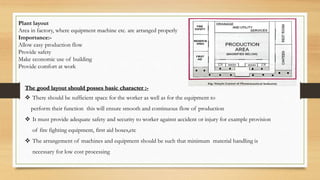
Plant layout
Area in factory, where equipment machine etc. are arranged properly
Importance:-
Allow easy production flow
Provide safety
Make economic use of building
Provide comfort at work
The good layout should posses basic character :-
 There should be sufficient space for the worker as well as for the equipment to
perform their function this will ensure smooth and continuous flow of production
 It must provide adequate safety and security to worker against accident or injury for example provision
of fire fighting equipment, first aid boxes,etc
 The arrangement of machines and equipment should be such that minimum material handling is
necessary for low cost processing
 Design & construction
1. Premises should be designed & constructed properly to maintain in a manner that permit drug production under
hygienic conditions
2. Construction and layout of the building must allow for a sequential and logical flow of the production process
and movement of the personnel and materials.
The following guidelines should be followed:-
1. GENERALREQUIREMENTS
•LIGHTING – lighting levels should be adequate to permit operators to do their work properly, accurately and
attentively. Lighting of production and packing areas should enable good vision.
•ELECTRICITY - Continuity of electrical supply is essential for different purposes and backup systems should be
available in the event of failure.
•SEWAGE – Sewage, and trash shall be disposed in a sanitary manner
•TOILETS & WASHING – adequate facilities should be provided and equipped with hot and cold water, soap,
detergents, air driers etc.
•UTILITIES – adequate ventilation, air filtration, and exhaust systems should be provided
ANCILLARYAREAS:- provides necessary support
 Rest and Refreshment Rooms should be separate from other areas.
 Facilities for Toilets should not communicate directly with production or storage areas.
 Facilities for changing clothes and for washing and toilet purposes should be easily accessible and appropriate for the
number of users.
 Animal houses should be well isolated from other areas, with separate entrance (animal access) and air handling
facilities.
 Maintenance workshop should be separated from production areas.
 Whenever parts and tools are stored in the production area, they should be kept in rooms or lockers reserved for that
use.
STORAGEAREAS:- something stored in this area
 Storage areas should be of sufficient capacity to allow orderly storage of the various categories of materials and
products: starting and packaging materials, intermediate, bulk and finished products, products in quarantine, released,
rejected, returned or recalled.
 Storage areas should be designed or adapted to ensure good storage conditions.
 In particular, they should be clean and dry and maintained within acceptable temperature limits. Where special storage
conditions are required (e.g. temperature, humidity) these should be provided, checked andmonitored.
 Where quarantine status is ensured by storage in separate areas, these areas must be clearly marked and their access
restricted to authorized personnel.
 There should normally be a separate sampling area for starting materials. If sampling is performed in the storage area,
it should be conducted in such a way as to prevent contamination or cross-contamination.
 Segregated areas should be provided for the storage of rejected, recalled or returned materials or products.
 Printed packaging materials are considered critical to the conformity of the medicinal products to its labelling and
special attention should be paid to the sampling and safe storage of these materials.
WEIGHINGAREAS
•Weighing of the starting materials and of the final yield should be done in separate areas.
•Weigh room design depends on the type of processing that will take place in the processarea.
•Weight room is viewed as the entry point to manufacturing and the transition point for materials coming from the
warehouse and entering process areas, so specific criteria will determine the bestlocation.
•Weighing of hazardous materials and sterile materials should also be done in separateareas
PRODUCTIONAREAS
 Production areas should be effectively ventilated with suitable designed HVAC (Heating, ventilation, and air
conditioning) system appropriate to products being handled; to the operations undertaken and to the external
environment.
 Drains should be of adequate size, and designed and equipped to prevent back flow
 Depending on the volumes of materials being handled, adequate space should be provided to avoid mix-ups
 General category products (other than antibiotics, cytotoxic and hormones,) should be manufactured in separate
manufacturing facilities
 Premises should be designed to have logical flow of materials, well organized layout of plant and machinery and
ease of cleaning, both equipment and facility.
 Production areas should be regularly monitored during production and non-production periods to ensure
compliance with their design specifications.
QUALITY CONTROL AREAS
 QC labs should be separate from production areas.
 Areas where biological, microbiological, test methods are employees should be separated from each other.
 Should avoid cross contamination or mix-ups.
 Adequate storage space for samples, reference standards, solvents, reagents and records.
 Separate air supply to laboratory areas.
 Separate room for the instruments used in the laboratory to prevent electrical interferences or contact with moisture.
 Q.C. laboratories should be designed to provide facilities for:
i. chemical analysis
ii. Instrumental analysis.
iii. Microbiological and biological analysis etc. iv.
iv. Storage for control samples, glassware's, chemicals, microbiological media books, documents etc.
SANITATION
 All areas must be cleaned regularly and cleaning records must be maintained.
 Wastes from manufacturing areas must be disposed in keeping with regulations of Environmental Pollution Control
Board. Wastes should be disposed in a safe manner.
 Any waste that are inflammable, or toxic must be stored in a segregated area while awaiting disposal.
Sanitation of SterileAreas
 Must be cleaned and sanitized often
 Regular monitoring to detect presence of contaminating microorganisms.
 Cleaning procedures should be validated and the cleaning agents used should be sterilized before use.
 For spaces that are inaccessible, fumigation should be used.
 Occasional cleaning with a sporicidal agents to clean any microbial spores present.

Premises Design Construction And Plant

  • 1.
    Premises Any building usedin manufacturing, processing, packaging or holding of drugs products will take place  Principle works:- Premises must be located ,designed, constructed adapted and maintained for the operation
  • 2.
    Aim /objective  Minimiserisk of error  Avoid cross-contamination build-up of the dirt and dust  Avoid any adverse effect on the quality of the products  Permit effective cleaning  Permit effective maintenance Premises  Location & layout  Sanitation  Maintenance  Contamination control  Environmental control  Utilities  Design & construction Following Factors are considered • General requirements • Ancillary areas • Storage areas • Weighing areas • Production areas • Quality control areas  Clean room & strategy
  • 3.
     Sanitation ofSterileAreas  Sanitation  Maintenance Maintenance of SterileAreas  Cleanliness of air  Heating, Ventilation, & Air Conditioning (HVAC) systems  T emperature and RH  cleaned & disinfected  When cleaned or disinfected  Air  Clean room & strategy  Water  Chemical Processing  Cross – Contamination
  • 4.
     Location &plant layout Premises must be located in a site that is of suitable size to house all the different departments The followingfactors are to be considered while selecting the location:- • Nature of manufacturing and testing performed •Magnitude of the operation in terms of daily production levels • Number of products that will be processed •Storage space required for raw material, in-process and finished goods •Availability of power, water, labour workforce and closeness to transport hubs. • Climatic condition and hygiene levels in surrounding According to Schedule M of the D & C Act, •The building used for the factory shall be so situated and shall have such measures as to avoid the risk of contamination from external environment including open sewage, drains, public lavatories or which produces disagreeable or obnoxious odours, fumes, dust, smoke, chemical or biological emissions.
  • 5.
    Plant layout Area infactory, where equipment machine etc. are arranged properly Importance:- Allow easy production flow Provide safety Make economic use of building Provide comfort at work The good layout should posses basic character :-  There should be sufficient space for the worker as well as for the equipment to perform their function this will ensure smooth and continuous flow of production  It must provide adequate safety and security to worker against accident or injury for example provision of fire fighting equipment, first aid boxes,etc  The arrangement of machines and equipment should be such that minimum material handling is necessary for low cost processing
  • 6.
     Design &construction 1. Premises should be designed & constructed properly to maintain in a manner that permit drug production under hygienic conditions 2. Construction and layout of the building must allow for a sequential and logical flow of the production process and movement of the personnel and materials. The following guidelines should be followed:- 1. GENERALREQUIREMENTS •LIGHTING – lighting levels should be adequate to permit operators to do their work properly, accurately and attentively. Lighting of production and packing areas should enable good vision. •ELECTRICITY - Continuity of electrical supply is essential for different purposes and backup systems should be available in the event of failure. •SEWAGE – Sewage, and trash shall be disposed in a sanitary manner •TOILETS & WASHING – adequate facilities should be provided and equipped with hot and cold water, soap, detergents, air driers etc. •UTILITIES – adequate ventilation, air filtration, and exhaust systems should be provided
  • 7.
    ANCILLARYAREAS:- provides necessarysupport  Rest and Refreshment Rooms should be separate from other areas.  Facilities for Toilets should not communicate directly with production or storage areas.  Facilities for changing clothes and for washing and toilet purposes should be easily accessible and appropriate for the number of users.  Animal houses should be well isolated from other areas, with separate entrance (animal access) and air handling facilities.  Maintenance workshop should be separated from production areas.  Whenever parts and tools are stored in the production area, they should be kept in rooms or lockers reserved for that use.
  • 8.
    STORAGEAREAS:- something storedin this area  Storage areas should be of sufficient capacity to allow orderly storage of the various categories of materials and products: starting and packaging materials, intermediate, bulk and finished products, products in quarantine, released, rejected, returned or recalled.  Storage areas should be designed or adapted to ensure good storage conditions.  In particular, they should be clean and dry and maintained within acceptable temperature limits. Where special storage conditions are required (e.g. temperature, humidity) these should be provided, checked andmonitored.  Where quarantine status is ensured by storage in separate areas, these areas must be clearly marked and their access restricted to authorized personnel.  There should normally be a separate sampling area for starting materials. If sampling is performed in the storage area, it should be conducted in such a way as to prevent contamination or cross-contamination.  Segregated areas should be provided for the storage of rejected, recalled or returned materials or products.  Printed packaging materials are considered critical to the conformity of the medicinal products to its labelling and special attention should be paid to the sampling and safe storage of these materials.
  • 9.
    WEIGHINGAREAS •Weighing of thestarting materials and of the final yield should be done in separate areas. •Weigh room design depends on the type of processing that will take place in the processarea. •Weight room is viewed as the entry point to manufacturing and the transition point for materials coming from the warehouse and entering process areas, so specific criteria will determine the bestlocation. •Weighing of hazardous materials and sterile materials should also be done in separateareas PRODUCTIONAREAS  Production areas should be effectively ventilated with suitable designed HVAC (Heating, ventilation, and air conditioning) system appropriate to products being handled; to the operations undertaken and to the external environment.  Drains should be of adequate size, and designed and equipped to prevent back flow  Depending on the volumes of materials being handled, adequate space should be provided to avoid mix-ups  General category products (other than antibiotics, cytotoxic and hormones,) should be manufactured in separate manufacturing facilities  Premises should be designed to have logical flow of materials, well organized layout of plant and machinery and ease of cleaning, both equipment and facility.  Production areas should be regularly monitored during production and non-production periods to ensure compliance with their design specifications.
  • 10.
    QUALITY CONTROL AREAS QC labs should be separate from production areas.  Areas where biological, microbiological, test methods are employees should be separated from each other.  Should avoid cross contamination or mix-ups.  Adequate storage space for samples, reference standards, solvents, reagents and records.  Separate air supply to laboratory areas.  Separate room for the instruments used in the laboratory to prevent electrical interferences or contact with moisture.  Q.C. laboratories should be designed to provide facilities for: i. chemical analysis ii. Instrumental analysis. iii. Microbiological and biological analysis etc. iv. iv. Storage for control samples, glassware's, chemicals, microbiological media books, documents etc.
  • 11.
    SANITATION  All areasmust be cleaned regularly and cleaning records must be maintained.  Wastes from manufacturing areas must be disposed in keeping with regulations of Environmental Pollution Control Board. Wastes should be disposed in a safe manner.  Any waste that are inflammable, or toxic must be stored in a segregated area while awaiting disposal. Sanitation of SterileAreas  Must be cleaned and sanitized often  Regular monitoring to detect presence of contaminating microorganisms.  Cleaning procedures should be validated and the cleaning agents used should be sterilized before use.  For spaces that are inaccessible, fumigation should be used.  Occasional cleaning with a sporicidal agents to clean any microbial spores present.