MATERIAL MANAGEMENT
IN SUPPLY CHAIN
MATERIAL MANAGEMENT
• Materials management is a core function of
supply chain management, involving the planning
and execution of supply chains to meet the
material requirements of a company or
organisation.
• These requirements include controlling and
regulating the flow of material while
simultaneously assessing variables like demand,
price, availability, quality, and delivery schedules.
• Material managers determine the amount of
material required and held in stock, plan for the
replenishment of these stocks, create inventory
levels for each type of item (raw material, work in
progress or finished goods), and communicate
information and requirements to procurement
operations and the extended supply chain.
• Materials management also involves assessing
material quality to make sure it meets customer
demands in line with a production schedule and at
the lowest cost.
OBJECTIVES OF MATERIAL MANAGEMENT
The objectives of material management are
sometimes referred to as the ‘Five Rs of Materials
Management:’
1. The right material
2. At the right time
3. In the right amount
4. At the right price
5. From the right sources
OBJECTIVES OF MATERIAL MANAGEMENT
The objectives can be broadly categorized into
primary objectives and secondary objectives
PRIMARY OBJECTIVES
• Low prices
• High inventory turnover
• Low cost acquisition and possession
• Continuity of supply
OBJECTIVES OF MATERIAL MANAGEMENT
• 5. Consistency of quality
• 6.Low payroll costs
• 7.Favorable supplier relationship
• 8. Development of personnel
• 9.Good records
OBJECTIVES OF MATERIAL MANAGEMENT
SECONDARY OBJECTIVES
• 1. Reciprocal relationship
• 2. New materials and products
• 3. Economic make or buy
• 4. Standardization
• 5. Product improvement
• 6. Interdepartmental harmony
• 7. Forecasts
IMPORTANCE OF MATERIALS
MANAGEMENT
• Lower prices for materials and equipments
• Faster inventory turnover
• Continuity of supply
• Reduced lead time
• Reduced transportation costs
• Less duplication of efforts
• Elimination of buck-passing
• Reduced materials obsolescence
IMPORTANCE OF MATERIALS
MANAGEMENT
• Improve supplier relationship and better
records and information
• Better inter-departmental cooperation
• Personnel development
MATERIALS MANAGEMENT
INFORMATION SYSTEM
• A materials management information system
(MMIS) is software with relatively narrow use.
Specifically, an MMIS is used for human
resource and materials management
purposes. This can increase the efficiency of a
business—such as a hospital or health care
system—by helping it integrate its staffing and
material needs. An appropriately programmed
and configured MMIS interacts easily with
other programs.
MATERIALS MANAGEMENT
INFORMATION SYSTEM (MMIS)
• MMIS provide information about stock levels
for raw materials, work in progress, finished
goods and stores and spares.
• But the MMIS should be an intelligent system
• It should provide the right information in right
time
• It should also help to rapid access of
information, detect errors and help in prompt
decisions.
PURCHASING FUNCTION
PURCHASING
• Meaning It refers to the activity of
acquiring goods or services to accomplish the
goals of an organization. It is the procurement
of materials and other requirements from
certain external agencies. It includes activities
like deciding what to buy, where to buy, when
to buy, how much to buy and at what prices to
buy.
Definition
According to Westing, Fine and Zenz
“Purchasing is a managerial activity that goes
beyond the simple act of buying. It includes
research and development for the proper
selection of materials and sources, follow-up to
ensure timely delivery; inspection to ensure both
quantity and quality; to control traffic, receiving,
storekeeping and accounting operations related
to purchases.”
MATERIAL PURCHASING
• Purchasing is the first phase of Materials
Management.
• Purchasing means procurement of goods and
services from some external agencies.
• It was experienced that by giving the purchase
responsibility to a specialist, the firm can
obtain greater economies in purchasing.
• It is the act of buying materials for the factory
at a given price.
SCIENTIFIC PURCHASING
It is the procurement by purchase of the
proper materials, machinery, equipment
and supplier or store used to manufacture
of a product and market it at the proper
quantity and quality and at proper time.
PURCHASING FUNCTION
1: Need Recognition
• The business must know it needs a new
product, whether from internal or
external sources. The product may be
one that needs to be reordered, or it
may be a new item for the company.
2: Specific Need
• The right product is critical for the company.
• Some industries have standards to help
determine specifications. Part numbers help
identify these for some businesses.
• Other industries have no point of reference.
The company may have ordered the product
in the past. If not, then the business must
specify the necessary product by using
identifiers such as color or weight.
3: Source Options
• The business needs to determine where to
obtain the product. The company might have
an approved vendor list. If not, the business
will need to search for a supplier using
purchase orders or research a variety of other
sources such as magazines, the Internet or
sales representatives.
• The company will qualify the suppliers to
determine the best product for the business.
4: Price and Terms
• The business will investigate all relevant
information to determine the best price and
terms for the product. This will depend on if
the company needs commodities (readily
available products) or specialized materials.
• Usually the business will look into three
suppliers before it makes a final decision.
5: Purchase Order
• The purchase order is used to buy materials
between a buyer and seller. It specifically defines
the price, specifications and terms and conditions
of the product or service and any additional
obligations.
6: Delivery
• The purchase order must be delivered, usually by
fax, mail, personally, email or other electronic
means. Sometimes the specific delivery method is
specified in the purchasing documents. The
recipient then acknowledges receipt of the
purchase order. Both parties keep a copy on file.
7: Expediting
• Expedition of the purchase order addresses the
timeliness of the service or materials delivered. It
becomes especially important if there are any
delays. The issues most often noted include
payment dates, delivery times and work
completion.
8: Receipt and Inspection of Purchases
• Once the sending company delivers the product,
the recipient accepts or rejects the items.
Acceptance of the items obligates the company to
pay for them.
9: Invoice Approval and Payment
• Three documents must match when an invoice
requests payment - the invoice itself, the receiving
document and the original purchase order.
• The agreement of these documents provides
confirmation from both the receiver and supplier.
Any discrepancies must be resolved before the
recipient pays the bill.
• Usually, payment is made in the form of cash,
check, bank transfers, credit letters or other types
of electronic transfers.
10: Record Maintenance
• In the case of audits, the company must
maintain proper records.
• These include purchase records to verify any
tax information and purchase orders to
confirm warranty information.
• Purchase records reference future purchases
as well.
RECEIVING
• The principal function of receiving include deliveries
of inbound freight, inspection, and transfer to and
from storage.
• Receiving takes delivery of inbound shipments and
releases and materials to inventory.
• The major responsibilities include:
1. Control and scheduling of deliveries.
2. Accurate checking and recording of shipments
received.
3. Preparation for handling and storage.
INSPECTION
• It is necessary to thoroughly inspect any
materials purchased either at the supplier’s
warehouse (or godown) or at the time goods are
received by the receiving department.
• The main aim of the inspection is to prevent the
production of non-standard items.
• As such, an inspection of materials is of the
utmost importance; both quality and quantity
must be checked and inspected systematically.
OBJECTIVES OF INSPECTION
• The main objectives of inspecting materials are
the following:
1. To maintain product quality.
2. To receive only the correct quantity of materials.
3. To ensure that suppliers are careful and efficient.
4. To utilize the money invested optimally.
5. To increase the watchfulness of the purchase
and store staff.
ADVANTAGES OF INSPECTION
• The main advantages of inspecting materials are
listed as follows:
1. Ensures the quality of materials, thus helping to
maintain steady development.
2. Improves goodwill due to high-quality production,
thereby lowering costs because the inspection of
materials assures effective production.
3. Enables low-cost procurement of statement items or
branded products, which favorably influences the cost
curve due to less wear and tear, wastage, and so on
4. Often increases profitability.
STORAGE OF MATERIALS
• Materials are received in an organization’s
storage department where they are stored
until issued to the using department.
Materials are preserved to protect them from
different types of damages, which maintains
their original value and quality.
STORAGE OF MATERIALS (Cont.)
• Maintaining the original value and quality of
materials can improve production quality
while reducing storage and production costs.
Storage of materials, therefore, is a critical
function. Receiving is important, but storage is
still more important because it aims at:
• Keeping materials safe.
STORAGE OF MATERIALS (Cont.)
• Protecting materials from damage.
• Protecting materials from loss of value or
quality.
• Ensuring the availability of materials in a
perfect and serviceable condition.
• Ensuring the smooth and efficient functioning
of the production department.
Efficient storage requires careful consideration
of the following:
• Checking of materials
• Classification of materials
• Codification of materials
• Arranging of materials
• Systematic storage of materials in bins, racks,
and other places
• Keeping watch on different heights and levels
of the storage
RECEIVING BIDS BEFORE PURCHASE
• BIDDING: It refers to the act of soliciting and
receiving proposals from suppliers for products or
services. And it’s a vital part of
any purchasing/procurement process.
• It has ability to help organizations make
informed decisions while selecting
vendors, negotiate better deals, ensure
transparency, and ultimately drive value for
money.
WHAT BIDDING IS AND HOW IT WORKS
• Bidding is the process of submitting a bid on a
procurement, which can be done by either the
government or private sector entities.
• A bidder must electronic submit their bid and
receive an electronic acknowledgement from the
government; otherwise, their bid cannot be
considered.
• Once all bids are received, the government will
review them and select the winning bidder.
IMPORTANCE OF BIDDING
• The bidding process is an essential part of any
procurement process. It helps ensure that the best
vendor is selected for a project, and it provides
transparency into the bidding process. Bidder
participation also allows companies to interact with
potential suppliers in a more informal setting, which
can lead to better valued proposals.
• Bidding can be used to obtain lower prices on goods
or services, as well as better quality products or
services. Bidder competition can lead to lower pricing,
as well as improved quality and innovation.
DIFFERENT TYPES OF BIDDING PROCESSES
• 1. A sealed bid is a type of procurement in which all bids are
submitted in advance, without any opportunity for discussion or
negotiation. This type of bidding is used when there is a clear
winner and the government does not want to let anyone else
submit a lower bid.
• 2. An open bid is a type of procurement in which the government
allows bidders to discuss their bids with each other. This type of
bidding is used when the government wants to get multiple bids
and see what the best options are.
• 3. A negotiated bid is a type of procurement in which the
government tries to find the best option by negotiating with the
bidders. This type of bidding is used when there are multiple good
options and the government doesn’t know which one to choose.
• Hybrid bidding where some elements of a RFP process are used,
such as issuing requests for qualifications (RFQs).
Benefits of using a bidding process
• Benefits of using a bidding process include
increased competition, better quality
products/services, and reduced costs because
more bids will be submitted.
• Additionally, since it is public information what
companies have stated they would offer to do a
job, it provides transparency into the market and
allows potential taxpayers to make an informed
decision about who they should hire.
DIFFERENT TYPES OF BIDS
• The different types of bids are as follows:
1. Fixed-price bid – This bid is a sealed offer to pay a
fixed price for an item or service. If the bidder wins
the bid, they will be required to pay the stated price
regardless of how much work is necessary to
complete the project.
2. Cost-plus-a-percentage-of-cost bid – This bid
specifies that the bidder will be paid a fixed price plus
a percentage of the cost of the project, which may or
may not include any additional expenses.
DIFFERENT TYPES OF BIDS
3. Time and material contract bid – This type of bid
asks the contractor to provide specific time and
materials needed to complete the project at specified
prices. If awarded, the contractor would then be
responsible for completing all aspects of the project,
including costs associated with labor, materials, and
overhead.
4. Bid rigging – This term refers to manipulating bids
in order to win an auction or contractually gain an
advantage over other bidders. It can involve any
number of tactics, including bidding below one’s true
cost or deliberately underbidding on an item in order
to gain an advantage in negotiations.
MM OF CRITICAL PARTS
• Successful inventory management involves a lot of
careful balance, especially when it comes to critical
parts.
• On the one hand, keeping too many component
parts on hand can be expensive, both in terms of
money and part.
• On the other hand, if you don’t have critical parts
in stock, you’ll experience unplanned downtime or
safety hazards. You can’t afford to stop production
every time a key part wears out, especially
considering the reality of today’s supply chain
issues.
What Are Critical Spares?
• Critical spares are the components that your
operation needs in order to stay up and running.
Without these parts, your production line will
break down and you won’t be able to meet
deadlines or deliver products.
• Most of the time, that means the components
that keep your key production equipment
running. But your maintenance tools are also
critical, in many cases. Critical spares also include
any important parts that are custom-made or
that take a long time to ship.
What Are Critical Spares?
• You may also want to think about how often you
use a particular asset. If you rely on some of your
equipment every day, then it’s probably critical,
even if it isn’t part of your production line.
• Talk to your teams and get their views on which
equipment is most important. That’s the first step
to carrying out an asset criticality assessment.
Performing an Asset Criticality
Assessment
• Typically, your teams will all have different ideas of
which parts are most critical. If you haven’t already
done an asset criticality assessment, you should run one
now.
• Talk to everyone involved and get detailed reporting on
the assets which they identify as critical.
• A Computerized Maintenance Management System
(CMMS) software is also a valuable tool in assessing
asset criticality.
• Once you’ve determined which assets are most
important to your operation, it’s a matter of making
sure that you keep critical parts in stock.
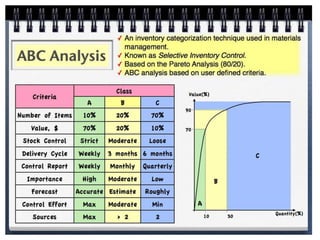
ABC ANALYSIS
• ABC analysis is an inventory management
technique that determines the value of inventory
items based on their importance to the business.
• ABC ranks items on demand, cost and risk data,
and inventory mangers group items into classes
based on those criteria. This helps business leaders
understand which products or services are most
critical to the financial success of their
organization.
How ABC Analysis Relates to the
Pareto Principle
• The Pareto Principle says that most results come
from only 20% of efforts or causes in any system.
Based on Pareto’s 80/20 rule, ABC analysis
identifies the 20% of goods that deliver about
80% of the value.
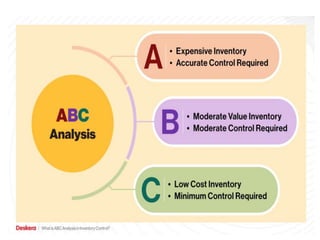
• Therefore, most businesses have a small number
of “A” items, a slightly larger group of B products
and a big group of C goods, a category that that
defines the majority of items.
• The Pareto Principle may not always be
completely accurate. However, analysis shows
that valuable things do tend to bend toward
an 80/20 distribution. ABC analysis identifies
the “sweet spot” where most of a business’s
revenue comes from with relatively little
effort.
CERTIFICATION OF SUPPLIERS
Certification of Suppliers
• Part of a larger strategy of suppliers quality
management.
• Process of managing the relationship between
your organization and its suppliers to
coordinate as on is creating value for all
stakeholders
• A minimum requirement to be considered for
work.
• Main goal: continuous improvement.
Why Certify?
• Way to determine which suppliers meet the company’s
needs.
• Aware of what suppliers can and can not do before everyone
invests time and money.
• May not have to do some processes, such as inspection.
• Consistent methods for managing suppliers.
• Develop supplier capabilities.
• Build stronger and open relationships.
• Better communication and sharing of information.
• Better serve our customers.
• Meet corporate improvement objectives through
collaboration
FACTORS IN CERTIFICATION
• Quality
• Delivery, cost, and technology
• Environmental standards
• Financial status
• Communication capabilities
• Business practices/processes
• Importance of factors vary across industry
and companies
TYPES OF CERTIFICATION
• ISO 9000 – (International Standards
Organization) quality program for certification,
emphasis on documentation as well.
• Industry equivalents (ISO – auto-industry)Self-
designed certification program by company.
• Many companies use the ISO and other
equivalents as a base to then focus on what is
important to them, or to make the requirements
more strict.
INTERNATIONAL ORGANIZATION FOR
STANDARDIZATION (ISO)
• Specifies standard requirements for “state-of-the-
art products, services, processes, materials and
systems, and for good conformity assessment,
managerial and organizational practice.”
• Measures quality, ecology, safety, economy,
reliability, compatibility, interoperability, efficiency,
and effectiveness
• Currently ISO is developing areas to assess
environment, service sectors, security, and good
managerial and organizational practices.
TYPES OF ISO
 ISO 9000
• Primarily concerned with "quality management".
• The customer's quality requirements
• Applicable regulatory requirements
• Enhance customer satisfaction
• Achieve continual improvement of its performance in pursuit of these
objectives.
 ISO 14001
• Primarily concerned with "environmental management".
• Minimize harmful effects on the environment caused by its activities
• Achieve continual improvement of its environmental performance.
 Can be applied in:
• Product Development
• Design Department
• Not a complete list, but these are the two main types. Also, there are updated
versions of each of these, but these are the general families of ISO certifications.

MATERIAL MANAGEMENT IN SUPPLY CHAIN.pptx

  • 1.
  • 2.
    MATERIAL MANAGEMENT • Materialsmanagement is a core function of supply chain management, involving the planning and execution of supply chains to meet the material requirements of a company or organisation. • These requirements include controlling and regulating the flow of material while simultaneously assessing variables like demand, price, availability, quality, and delivery schedules.
  • 3.
    • Material managersdetermine the amount of material required and held in stock, plan for the replenishment of these stocks, create inventory levels for each type of item (raw material, work in progress or finished goods), and communicate information and requirements to procurement operations and the extended supply chain. • Materials management also involves assessing material quality to make sure it meets customer demands in line with a production schedule and at the lowest cost.
  • 4.
    OBJECTIVES OF MATERIALMANAGEMENT The objectives of material management are sometimes referred to as the ‘Five Rs of Materials Management:’ 1. The right material 2. At the right time 3. In the right amount 4. At the right price 5. From the right sources
  • 5.
    OBJECTIVES OF MATERIALMANAGEMENT The objectives can be broadly categorized into primary objectives and secondary objectives PRIMARY OBJECTIVES • Low prices • High inventory turnover • Low cost acquisition and possession • Continuity of supply
  • 6.
    OBJECTIVES OF MATERIALMANAGEMENT • 5. Consistency of quality • 6.Low payroll costs • 7.Favorable supplier relationship • 8. Development of personnel • 9.Good records
  • 7.
    OBJECTIVES OF MATERIALMANAGEMENT SECONDARY OBJECTIVES • 1. Reciprocal relationship • 2. New materials and products • 3. Economic make or buy • 4. Standardization • 5. Product improvement • 6. Interdepartmental harmony • 7. Forecasts
  • 8.
    IMPORTANCE OF MATERIALS MANAGEMENT •Lower prices for materials and equipments • Faster inventory turnover • Continuity of supply • Reduced lead time • Reduced transportation costs • Less duplication of efforts • Elimination of buck-passing • Reduced materials obsolescence
  • 9.
    IMPORTANCE OF MATERIALS MANAGEMENT •Improve supplier relationship and better records and information • Better inter-departmental cooperation • Personnel development
  • 10.
    MATERIALS MANAGEMENT INFORMATION SYSTEM •A materials management information system (MMIS) is software with relatively narrow use. Specifically, an MMIS is used for human resource and materials management purposes. This can increase the efficiency of a business—such as a hospital or health care system—by helping it integrate its staffing and material needs. An appropriately programmed and configured MMIS interacts easily with other programs.
  • 11.
    MATERIALS MANAGEMENT INFORMATION SYSTEM(MMIS) • MMIS provide information about stock levels for raw materials, work in progress, finished goods and stores and spares. • But the MMIS should be an intelligent system • It should provide the right information in right time • It should also help to rapid access of information, detect errors and help in prompt decisions.
  • 12.
  • 13.
    PURCHASING • Meaning Itrefers to the activity of acquiring goods or services to accomplish the goals of an organization. It is the procurement of materials and other requirements from certain external agencies. It includes activities like deciding what to buy, where to buy, when to buy, how much to buy and at what prices to buy.
  • 14.
    Definition According to Westing,Fine and Zenz “Purchasing is a managerial activity that goes beyond the simple act of buying. It includes research and development for the proper selection of materials and sources, follow-up to ensure timely delivery; inspection to ensure both quantity and quality; to control traffic, receiving, storekeeping and accounting operations related to purchases.”
  • 15.
    MATERIAL PURCHASING • Purchasingis the first phase of Materials Management. • Purchasing means procurement of goods and services from some external agencies. • It was experienced that by giving the purchase responsibility to a specialist, the firm can obtain greater economies in purchasing. • It is the act of buying materials for the factory at a given price.
  • 16.
    SCIENTIFIC PURCHASING It isthe procurement by purchase of the proper materials, machinery, equipment and supplier or store used to manufacture of a product and market it at the proper quantity and quality and at proper time.
  • 17.
    PURCHASING FUNCTION 1: NeedRecognition • The business must know it needs a new product, whether from internal or external sources. The product may be one that needs to be reordered, or it may be a new item for the company.
  • 18.
    2: Specific Need •The right product is critical for the company. • Some industries have standards to help determine specifications. Part numbers help identify these for some businesses. • Other industries have no point of reference. The company may have ordered the product in the past. If not, then the business must specify the necessary product by using identifiers such as color or weight.
  • 19.
    3: Source Options •The business needs to determine where to obtain the product. The company might have an approved vendor list. If not, the business will need to search for a supplier using purchase orders or research a variety of other sources such as magazines, the Internet or sales representatives. • The company will qualify the suppliers to determine the best product for the business.
  • 20.
    4: Price andTerms • The business will investigate all relevant information to determine the best price and terms for the product. This will depend on if the company needs commodities (readily available products) or specialized materials. • Usually the business will look into three suppliers before it makes a final decision.
  • 21.
    5: Purchase Order •The purchase order is used to buy materials between a buyer and seller. It specifically defines the price, specifications and terms and conditions of the product or service and any additional obligations. 6: Delivery • The purchase order must be delivered, usually by fax, mail, personally, email or other electronic means. Sometimes the specific delivery method is specified in the purchasing documents. The recipient then acknowledges receipt of the purchase order. Both parties keep a copy on file.
  • 22.
    7: Expediting • Expeditionof the purchase order addresses the timeliness of the service or materials delivered. It becomes especially important if there are any delays. The issues most often noted include payment dates, delivery times and work completion. 8: Receipt and Inspection of Purchases • Once the sending company delivers the product, the recipient accepts or rejects the items. Acceptance of the items obligates the company to pay for them.
  • 23.
    9: Invoice Approvaland Payment • Three documents must match when an invoice requests payment - the invoice itself, the receiving document and the original purchase order. • The agreement of these documents provides confirmation from both the receiver and supplier. Any discrepancies must be resolved before the recipient pays the bill. • Usually, payment is made in the form of cash, check, bank transfers, credit letters or other types of electronic transfers.
  • 24.
    10: Record Maintenance •In the case of audits, the company must maintain proper records. • These include purchase records to verify any tax information and purchase orders to confirm warranty information. • Purchase records reference future purchases as well.
  • 25.
    RECEIVING • The principalfunction of receiving include deliveries of inbound freight, inspection, and transfer to and from storage. • Receiving takes delivery of inbound shipments and releases and materials to inventory. • The major responsibilities include: 1. Control and scheduling of deliveries. 2. Accurate checking and recording of shipments received. 3. Preparation for handling and storage.
  • 26.
    INSPECTION • It isnecessary to thoroughly inspect any materials purchased either at the supplier’s warehouse (or godown) or at the time goods are received by the receiving department. • The main aim of the inspection is to prevent the production of non-standard items. • As such, an inspection of materials is of the utmost importance; both quality and quantity must be checked and inspected systematically.
  • 27.
    OBJECTIVES OF INSPECTION •The main objectives of inspecting materials are the following: 1. To maintain product quality. 2. To receive only the correct quantity of materials. 3. To ensure that suppliers are careful and efficient. 4. To utilize the money invested optimally. 5. To increase the watchfulness of the purchase and store staff.
  • 28.
    ADVANTAGES OF INSPECTION •The main advantages of inspecting materials are listed as follows: 1. Ensures the quality of materials, thus helping to maintain steady development. 2. Improves goodwill due to high-quality production, thereby lowering costs because the inspection of materials assures effective production. 3. Enables low-cost procurement of statement items or branded products, which favorably influences the cost curve due to less wear and tear, wastage, and so on 4. Often increases profitability.
  • 29.
    STORAGE OF MATERIALS •Materials are received in an organization’s storage department where they are stored until issued to the using department. Materials are preserved to protect them from different types of damages, which maintains their original value and quality.
  • 30.
    STORAGE OF MATERIALS(Cont.) • Maintaining the original value and quality of materials can improve production quality while reducing storage and production costs. Storage of materials, therefore, is a critical function. Receiving is important, but storage is still more important because it aims at: • Keeping materials safe.
  • 31.
    STORAGE OF MATERIALS(Cont.) • Protecting materials from damage. • Protecting materials from loss of value or quality. • Ensuring the availability of materials in a perfect and serviceable condition. • Ensuring the smooth and efficient functioning of the production department.
  • 32.
    Efficient storage requirescareful consideration of the following: • Checking of materials • Classification of materials • Codification of materials • Arranging of materials • Systematic storage of materials in bins, racks, and other places • Keeping watch on different heights and levels of the storage
  • 33.
    RECEIVING BIDS BEFOREPURCHASE • BIDDING: It refers to the act of soliciting and receiving proposals from suppliers for products or services. And it’s a vital part of any purchasing/procurement process. • It has ability to help organizations make informed decisions while selecting vendors, negotiate better deals, ensure transparency, and ultimately drive value for money.
  • 34.
    WHAT BIDDING ISAND HOW IT WORKS • Bidding is the process of submitting a bid on a procurement, which can be done by either the government or private sector entities. • A bidder must electronic submit their bid and receive an electronic acknowledgement from the government; otherwise, their bid cannot be considered. • Once all bids are received, the government will review them and select the winning bidder.
  • 35.
    IMPORTANCE OF BIDDING •The bidding process is an essential part of any procurement process. It helps ensure that the best vendor is selected for a project, and it provides transparency into the bidding process. Bidder participation also allows companies to interact with potential suppliers in a more informal setting, which can lead to better valued proposals. • Bidding can be used to obtain lower prices on goods or services, as well as better quality products or services. Bidder competition can lead to lower pricing, as well as improved quality and innovation.
  • 36.
    DIFFERENT TYPES OFBIDDING PROCESSES • 1. A sealed bid is a type of procurement in which all bids are submitted in advance, without any opportunity for discussion or negotiation. This type of bidding is used when there is a clear winner and the government does not want to let anyone else submit a lower bid. • 2. An open bid is a type of procurement in which the government allows bidders to discuss their bids with each other. This type of bidding is used when the government wants to get multiple bids and see what the best options are. • 3. A negotiated bid is a type of procurement in which the government tries to find the best option by negotiating with the bidders. This type of bidding is used when there are multiple good options and the government doesn’t know which one to choose. • Hybrid bidding where some elements of a RFP process are used, such as issuing requests for qualifications (RFQs).
  • 37.
    Benefits of usinga bidding process • Benefits of using a bidding process include increased competition, better quality products/services, and reduced costs because more bids will be submitted. • Additionally, since it is public information what companies have stated they would offer to do a job, it provides transparency into the market and allows potential taxpayers to make an informed decision about who they should hire.
  • 38.
    DIFFERENT TYPES OFBIDS • The different types of bids are as follows: 1. Fixed-price bid – This bid is a sealed offer to pay a fixed price for an item or service. If the bidder wins the bid, they will be required to pay the stated price regardless of how much work is necessary to complete the project. 2. Cost-plus-a-percentage-of-cost bid – This bid specifies that the bidder will be paid a fixed price plus a percentage of the cost of the project, which may or may not include any additional expenses.
  • 39.
    DIFFERENT TYPES OFBIDS 3. Time and material contract bid – This type of bid asks the contractor to provide specific time and materials needed to complete the project at specified prices. If awarded, the contractor would then be responsible for completing all aspects of the project, including costs associated with labor, materials, and overhead. 4. Bid rigging – This term refers to manipulating bids in order to win an auction or contractually gain an advantage over other bidders. It can involve any number of tactics, including bidding below one’s true cost or deliberately underbidding on an item in order to gain an advantage in negotiations.
  • 40.
  • 41.
    MM OF CRITICALPARTS • Successful inventory management involves a lot of careful balance, especially when it comes to critical parts. • On the one hand, keeping too many component parts on hand can be expensive, both in terms of money and part. • On the other hand, if you don’t have critical parts in stock, you’ll experience unplanned downtime or safety hazards. You can’t afford to stop production every time a key part wears out, especially considering the reality of today’s supply chain issues.
  • 42.
    What Are CriticalSpares? • Critical spares are the components that your operation needs in order to stay up and running. Without these parts, your production line will break down and you won’t be able to meet deadlines or deliver products. • Most of the time, that means the components that keep your key production equipment running. But your maintenance tools are also critical, in many cases. Critical spares also include any important parts that are custom-made or that take a long time to ship.
  • 43.
    What Are CriticalSpares? • You may also want to think about how often you use a particular asset. If you rely on some of your equipment every day, then it’s probably critical, even if it isn’t part of your production line. • Talk to your teams and get their views on which equipment is most important. That’s the first step to carrying out an asset criticality assessment.
  • 44.
    Performing an AssetCriticality Assessment • Typically, your teams will all have different ideas of which parts are most critical. If you haven’t already done an asset criticality assessment, you should run one now. • Talk to everyone involved and get detailed reporting on the assets which they identify as critical. • A Computerized Maintenance Management System (CMMS) software is also a valuable tool in assessing asset criticality. • Once you’ve determined which assets are most important to your operation, it’s a matter of making sure that you keep critical parts in stock.
  • 45.
    ABC ANALYSIS • ABCanalysis is an inventory management technique that determines the value of inventory items based on their importance to the business. • ABC ranks items on demand, cost and risk data, and inventory mangers group items into classes based on those criteria. This helps business leaders understand which products or services are most critical to the financial success of their organization.
  • 46.
    How ABC AnalysisRelates to the Pareto Principle • The Pareto Principle says that most results come from only 20% of efforts or causes in any system. Based on Pareto’s 80/20 rule, ABC analysis identifies the 20% of goods that deliver about 80% of the value. • Therefore, most businesses have a small number of “A” items, a slightly larger group of B products and a big group of C goods, a category that that defines the majority of items.
  • 47.
    • The ParetoPrinciple may not always be completely accurate. However, analysis shows that valuable things do tend to bend toward an 80/20 distribution. ABC analysis identifies the “sweet spot” where most of a business’s revenue comes from with relatively little effort.
  • 50.
  • 51.
    Certification of Suppliers •Part of a larger strategy of suppliers quality management. • Process of managing the relationship between your organization and its suppliers to coordinate as on is creating value for all stakeholders • A minimum requirement to be considered for work. • Main goal: continuous improvement.
  • 52.
    Why Certify? • Wayto determine which suppliers meet the company’s needs. • Aware of what suppliers can and can not do before everyone invests time and money. • May not have to do some processes, such as inspection. • Consistent methods for managing suppliers. • Develop supplier capabilities. • Build stronger and open relationships. • Better communication and sharing of information. • Better serve our customers. • Meet corporate improvement objectives through collaboration
  • 53.
    FACTORS IN CERTIFICATION •Quality • Delivery, cost, and technology • Environmental standards • Financial status • Communication capabilities • Business practices/processes • Importance of factors vary across industry and companies
  • 54.
    TYPES OF CERTIFICATION •ISO 9000 – (International Standards Organization) quality program for certification, emphasis on documentation as well. • Industry equivalents (ISO – auto-industry)Self- designed certification program by company. • Many companies use the ISO and other equivalents as a base to then focus on what is important to them, or to make the requirements more strict.
  • 55.
    INTERNATIONAL ORGANIZATION FOR STANDARDIZATION(ISO) • Specifies standard requirements for “state-of-the- art products, services, processes, materials and systems, and for good conformity assessment, managerial and organizational practice.” • Measures quality, ecology, safety, economy, reliability, compatibility, interoperability, efficiency, and effectiveness • Currently ISO is developing areas to assess environment, service sectors, security, and good managerial and organizational practices.
  • 56.
    TYPES OF ISO ISO 9000 • Primarily concerned with "quality management". • The customer's quality requirements • Applicable regulatory requirements • Enhance customer satisfaction • Achieve continual improvement of its performance in pursuit of these objectives.  ISO 14001 • Primarily concerned with "environmental management". • Minimize harmful effects on the environment caused by its activities • Achieve continual improvement of its environmental performance.  Can be applied in: • Product Development • Design Department • Not a complete list, but these are the two main types. Also, there are updated versions of each of these, but these are the general families of ISO certifications.