Chapter One: An overview of
Materials Management
Introduction
Introduction
• Materials Management is simply the process by which an
organization is supplied with the goods and services that it
needs to achieve its objectives of buying, storage and
movement of materials.
• Materials Management is related to planning, obtaining,
storing and providing the appropriate material of right quality,
right quantity at right place in right time so as to co-ordinate
and schedule the production activity in an integrative way for
an industrial undertaking.
• Most industries buy materials, transport them into the plant,
change the materials into parts, assemble parts into finished
products, sell and transport the product to the customer.
• It is only possible by efficient materials management.
Inroduction Con’t…
• All these activities of purchase of materials, flow of materials,
manufacture them into the product, supply and sell the
product at the market requires various types of materials to
manage and control their storage, flow and supply at various
places.
• The materials requirements planning, purchasing, inventory
planning, storage, inventory control, materials supply,
transportation and materials handling are the activities of
materials management.
• Actually before the production begins it is necessary to ensure
availability of all the types of materials needed for production
and its supply at the various production centers.
• Planning, purchasing and scheduling are the main functions of
materials management.
Intro…
. It aims at improved productivity. It is used to reduce the cost,
which increases profitability and streamlines the production.
Apart from management of material cost and its supply it
helps in its proper utilization, transportation, storage,
handling and distribution.
• The market research and forecasting both for sales of
company’s product and purchasing of various materials
required for producing the product are needed at the
planning stage.
• Procurement of materials, transportation, storage, inventory
control, quality control and inspection of materials and goods
supplied at various production centers before production are
also managed as routine work.
Intro…
• Materials handling, packaging, warehouse planning,
accounting, scrap, surplus and obsolete materials disposal,
finished goods safety and care are the activities managed by
the materials management department.
• Selection of personnel for marketing, purchasing, inventory
control, stores management and materials handling and their
training and placement is also to be seen by the materials
management department.
• This indicates that it is very essential to have a materials
management department in any organization to support the
management in the production activities.
Intro…
• It also helps in the marketing, sales promotion and control of
all the types of materials for its quantity, quality and cost.
Definition
 The International Federation of Purchasing and Materials
Management accept the definition of materials management
given below.
 According to it, materials management is a total concept
having its definite organization to plan and control all types of
materials, its supply, and its flow from raw stage to finished
stage so as to deliver the product to customer as per its
requirements in time.
 This involves materials planning, purchasing, receiving,
storing, inventory control, scheduling, production, physical
distribution and marketing.
Intro…
• It also controls the materials handling and its traffic.
• The materials manager has to manage all these functions with
proper authority and responsibility in the materials
management department.
Types of Materials
• The various types of materials to be managed are:
(i) Purchased materials: They are raw materials, components,
spare parts, oils, grease, cotton waste, consumables and tools.
(ii) Work in process (WIP) materials: These are semi-finished and
finished parts and components lying on the shop floor.
(iii) Finished goods: These are the final products either waiting to
be assembled in the assembly lines or in stores which are
stocked for final delivery waiting to sell.
1.2.Importance of Materials Management
• In general material management is important for three
reasons:
1. Customer Service
Materials management (MM) serves other units/departments
of the organization. These services support the goal of fast
process throughout the organization, and include:
• Uninterrupted flow of materials
• Assistance to customers-repair, replants or delivery
• Reduction in parts shortage
• Average transit from warehouse to customer
• Minimum of transportation delays
• Accurate inventory counts
• Good forecast accuracy
Importance Con’t…
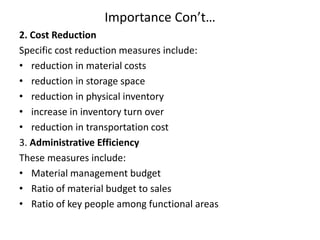
2. Cost Reduction
Specific cost reduction measures include:
• reduction in material costs
• reduction in storage space
• reduction in physical inventory
• increase in inventory turn over
• reduction in transportation cost
3. Administrative Efficiency
These measures include:
• Material management budget
• Ratio of material budget to sales
• Ratio of key people among functional areas
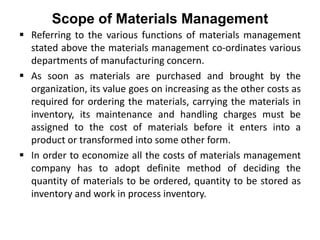
Scope of Materials Management
 Referring to the various functions of materials management
stated above the materials management co-ordinates various
departments of manufacturing concern.
 As soon as materials are purchased and brought by the
organization, its value goes on increasing as the other costs as
required for ordering the materials, carrying the materials in
inventory, its maintenance and handling charges must be
assigned to the cost of materials before it enters into a
product or transformed into some other form.
 In order to economize all the costs of materials management
company has to adopt definite method of deciding the
quantity of materials to be ordered, quantity to be stored as
inventory and work in process inventory.
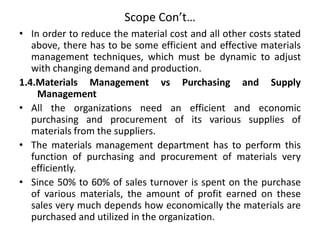
Scope Con’t…
• In order to reduce the material cost and all other costs stated
above, there has to be some efficient and effective materials
management techniques, which must be dynamic to adjust
with changing demand and production.
1.4.Materials Management vs Purchasing and Supply
Management
• All the organizations need an efficient and economic
purchasing and procurement of its various supplies of
materials from the suppliers.
• The materials management department has to perform this
function of purchasing and procurement of materials very
efficiently.
• Since 50% to 60% of sales turnover is spent on the purchase
of various materials, the amount of profit earned on these
sales very much depends how economically the materials are
purchased and utilized in the organization.
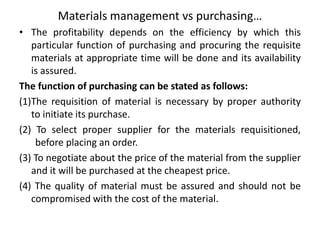
Materials management vs purchasing…
• The profitability depends on the efficiency by which this
particular function of purchasing and procuring the requisite
materials at appropriate time will be done and its availability
is assured.
The function of purchasing can be stated as follows:
(1)The requisition of material is necessary by proper authority
to initiate its purchase.
(2) To select proper supplier for the materials requisitioned,
before placing an order.
(3) To negotiate about the price of the material from the supplier
and it will be purchased at the cheapest price.
(4) The quality of material must be assured and should not be
compromised with the cost of the material.
Materials vs purchasing…
(5)The material should be purchased of right quantity and right
quality at proper time at the cheapest cost.
(6) To set the proper purchase policy and procedure.
Supply management
Specific activities included in supply management are:
conduct of a all purchasing functions
product design and development
material specification
Generally, the major characteristic that differentiates it from
purchasing is that it focuses heavily on the strategic aspects of
the key elements of the firm’s supply system.
Materials Management: an organization concept designed to
enhance coordination and control of the various material
activities.
Materials management vs purchasing…
Differences Among the Three Functional Areas
• Purchasing and supply management are components of
materials management
• Materials management includes other material activities
• Material management is largely a strategic focus
1.5. Materials Management with Other Functional Areas
Materials management has to work in close coordination with
the available departments of an organization. Such as
Operation, Marketing, Finance, HRM
1. Materials Management and Operation
 Materials management department must work with the
operations department and informed about the availability of
raw materials, anticipated delays so that re-scheduling of
production could be done and costly stock outs be avoided.
Materials Management and other…
• The expertise of the materials management could be used by the
operation department in purchasing materials.
• Operation will have to keep materials management department
informed about its plans and schedules so that material
requirements can be planned in advance.
2. Materials Management and Finance
The finance department also has to work in close coordination with materials
management department in:
• anticipating the availability of funds
• accurate record of purchases
• source of accounting documents
3. Materials Management and Marketing
Marketing department will give advance information on sales forecast on which
material forecast is based on and materials management through efficient
operation can keep product prices at a competitive level and thus helps the
marketing department in its operation.
Materials Management and other…
4. Materials Management and HRM
• HRM performs the basic recruitment, selection, promotion
and other employees’ aspects of materials management
department.
Chapter Two: Materials Demand Forecasting
2.1. Meaning, Characteristics and Uses of Forecasting
• Forecasts are estimates of the occurrence, timing or
magnitude of future events. It is all about predicting future
events. Forecasting is the basis of planning ahead even
though the actual demand is quite uncertain.
• Therefore, forecast of future demand is the link between
company’s internal expectations with outside environment
that permits planning function to commence activities.
• Forecast affects decision and activities throughout the
organization in finance, HRM, marketing, operations and
other functions.
Meaning, characteristics…
Characteristics of Forecasts
The following are the characteristics of forecasts:
Forecasting technique generally assumes that the same
underlying causal system that existed in the past will
continue to exist in the future.
Forecasts are rarely perfect, actual results usually differ
from predicted value.
Forecasts for a group of items tends to be more
accurate than forecasts for individual item because
forecasting errors among items in a group usually are
smaller than that of individual items.
Forecast accuracy decreases as the time period covered
by the forecast time horizon increases.
Meaning, characteristics…
Uses of Forecast
• The purpose of forecasting activities is to make the best use of
present information to guide the activity levels that can
minimize short-term fluctuations in production and help
balance workloads.
• This reduces hiring, firing and overtime activities and helps
maintain good labor relationship.
Generally good forecast :
• Could improve employee relation
• Improve materials management
• Helps to have better use of capital and facilitates and
• Improve customer services.
2.2. Techniques of Forecasting
There are two types of forecasting techniques:
• Qualitative forecasting technique
• Quantitative forecasting technique
2.2.1.Qualitative Foretasting Technique
 is used when there is no historical data available about past
performance
 is subjective and judgmental in nature and most of the time it
is based on opinion and expertise judgment.
 rely on analysis of subjective inputs obtained from customers,
sales person, managers and experts.
Common types of qualitative techniques include:
a. Expert Opinion Method
It consists of collecting opinion and judgments of individuals
who are expected to have the best knowledge of current
activities or future plans.
Expert opinion…
Advantages:
• Decision is fast
• Responsibility and accountability is clear
• Brings together the considerable knowledge, experience, skill
and talent of various managers
• Managers (experts) will acquire experience that is obtained in
the discussion.
Disadvantages:
• Probably poor forecast (due to lack of experience)
• Domination by one or few managers
• Diffusing responsibility for the forecast over the entire group
may result in less pressure to produce a good forecast.
2. Sales Force Opinion
• In this method, sales representatives are required to estimate
the demand for each product and the forecast of each sales
representative is consolidated to prepare the overall forecast
for company.
Advantages:
• It can reset in quality forecast
• This pools together knowledge
• Can see from different approaches
Disadvantages:
• Time taking decision
• Avoidance of responsibility
3. Consumer Survey
Is based on the data which is collected from the consumers.
Consumer Survey …
Advantages:
• tap information that may not be available elsewhere
• enhance the quality and accuracy of forecasts
• Disadvantages:
• Experience and knowledge are constraints
• Expensive and time consuming
4. Delphi Method
involves the development, distribution, collection and analysis
of series of questionnaires to get the views of expertise that
are located at different geographic areas to generate the
forecast.
Delphi Method…
Advantages
• The tendency of process loss is avoided/minimized
• No influence of the majority
Disadvantages
• It takes time to reach a consensus
• Coordination and interpretation difficulty
2.2.2. Quantitative Forecasting Techniques
Now let us discuss about the quantitative types of forecasting
techniques.
1. Time Series Analysis
 A time series is a set of some variables (demand) overtime
(e.g. hourly, daily, weekly, quarterly or annually).
Time Series Analysis
 is based on time and does not take specific account of outside
or related factors.
 Forecasting techniques based on time series data are made
on the assumption that history follows a pattern that will
continue.
 Time series analysis is a time-ordered series of values of some
variables.
The variables value in any specific time period is a function of
four factors:
a. Trend- is a general pattern of change overtime. It represents
a long time circular movement, characteristic of many
economic series.
b. Seasonality- refers to any regular pattern recurring with in a
time period of no more than one year. These effects are
often related to seasons of the year.
Time Series Analysis…
c. Cycle – is long-term swings about the trend line and are
usually associated with a business cycle (phases of growth
and decline in a business cycle).
d. Randomness – are irregular effects due to chance and
unusual occurrences.
Types of Time Series Analysis
Chapter Three: Purchasing
3.1. Meaning and Objectives
• Purchasing function comprises the essential activities
associated with the acquisition of materials used in the
operation of an organization.
• Because all organizations require supplies of materials,
purchasing function is common in almost all organizations.
There are two basic types of purchasing in business:
 Purchasing for sale
 Purchasing for consumption/conversion
Objectives of Purchasing
The objectives of purchasing can be viewed from three levels:
1.General Managerial Level
From their perspective, the managements expect the five
rights the purchasing department has to achieve:
– The right quality
– In the right quantity
– From the right supplier
– At the right price
– At the right place
2. Functional (operational) Level
 To support company operations with uninterrupted flow of
materials
Functional Level con’t…
 To buy competitively; buying competitively involves:
• Keeping abreast of the forces of supply and demand that
regulate prices and availability of materials in the market
place.
• Understanding of suppliers cost structure computed with an
ability to help improve the cost structure.
 To buy wisely; buying wisely involves:
• A continued search for better values that yield the best
combination of quality service and price.
• Note: It is the combination of buying competitively and
buying wisely that typically contribute most to the profitability
of the firm.
 To keep inventory investment and inventory losses at a
practical minimum.
Functional Level Con’t…
 To develop effective and reliable source of supply.
 To develop good relationship with supplier community and
good continuing relationship with active suppliers.
 To achieve maximum integration with other departments of
the firm.
3.2. Purchasing Policies and Procedures
Policy
 Policies are general statements, understanding, and guidelines
in making operating decisions that channel actions toward
achievement of the objectives.
 Purchasing polices are aids for purchasing decisions.
Purchasing policy may be written or not.
 It is a policy defining the placement of purchasing authority
Purchasing Policy…
There are two approaches of placing purchasing function
 Centralization
 Decentralization
a. Centralized Purchase
 Centralization exists when the entire purchasing function is
made the responsibility of a single person.
Advantages
 Duplication of effort and haphazard purchasing activities are
minimized by the central coordination of all company
purchasers.
 Quantity discounts are made possible by consolidating all
company orders for the same and similar materials.
 A firm is able to develop and implement a unified purchasing
policy, enabling it to speak with a single voice to its suppliers.
Advantages…
 Transportation savings can be realized by the consolidation of
orders and delivery schedules.
 Develops purchase specialists
 Suppliers are able to offer better prices and better service
 Responsibility for the performance of the purchasing function
is fixed with a single department head, thereby facilitating
management control.
Disadvantages
• Slow decision making
• May not satisfy local interest
• Does not spread risk
Factors Affecting Feasibility and Desirability of Centralization
1. Similarity of the classes of materials used in each of the
departments /plants.
 If a firm’s plants (products) use entirely different materials,
centralization of purchasing offers only minimal benefits.
 But centralization offers benefits because of specialization
when the various plants use similar materials.
2. Size of each individual plant purchasing department
 When a firm’s individual plant purchasing department is not
large in size, centralization would be advantageous.
3. Distance separating individual plants or geographic dispersion of plants
 the closer a firm’s plants are situated geographically, the more
feasible centralization becomes.
b. Decentralized Purchase
 occurs when personnel from other functional areas-operation
marketing, finance, HRM, and so on decide unilaterally on
sources of supply or negotiate with suppliers directly for
major purchases.
Advantages
• Speed of operation: there is a possibility of response more
quickly to user’s needs and time delay can be improved.
• Effective use of local resources/local interests
• Plant/department autonomy
Disadvantages
• Loose control
• Difficulty of obtaining discounts
• Duplication of effort
3.3. Purchasing Procedures
1. Recognition
 The need for purchase typically originates in one of a firm’s
operating department or in its inventory control section.
 The purchasing department is usually notified of the need by
one of the three basic methods:
a) Standard Purchase Requisition
It is an internal document numbered serially for requests
originating in the operating departments.
A purchase requisition is used for materials that have to be
ordered from suppliers
The items included could be:
• Material name/code identification
• The amount needed
• Desired delivery date
Standard Purchase Requisition…
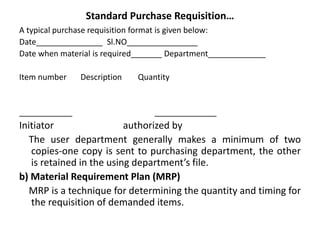
A typical purchase requisition format is given below:
Date_______________ Sl.NO________________
Date when material is required_______ Department_____________
Item number Description Quantity
____________ ______________
Initiator authorized by
The user department generally makes a minimum of two
copies-one copy is sent to purchasing department, the other
is retained in the using department’s file.
b) Material Requirement Plan (MRP)
MRP is a technique for determining the quantity and timing for
the requisition of demanded items.
c) Bill of Materials (BOM)
• It is a complete list of all items incorporated into a finished product
with specifications and quantity required of each item of materials.
2. Verification of Purchase Requisition
It involves:
• Checking the document for accuracy and completeness
• Determining that the need has adequately defined
• Ensuring that the appropriate method of description has been used
to guarantee a satisfactory purchase for the user and at the same
time all possible opportunities in the selection of the supplier.
3. Request for Quotation (bids, price quotation)
A request for quotation is a process of initiating potential
suppliers that are willing to compete to supply the required
material.
Request for Quotation …
Competitive bidding is dictated by five criteria.
 the dollar value of the specific purchase must be large enough
to justify expense to both buyer and seller
 The market must consist of an adequate number of sellers
 The sellers that make up the market must be technically
qualified and willing to compete
 The specification/description is clear to both the buyer and
seller
 The time available must be sufficient for using competitive
bidding
Competitive bidding should not be used:
 For situations in which it is impossible to estimate costs with
a high degree of certainty.
Request for Quotation …
 Situations in which the prices are not the only important
variables. Example, quality, schedule and service may well be
negotiable variables of equal importance.
 Repetitive and routine purchase
 Items of low value
 Single/few suppliers
Invitation for bids (IFB) or request for proposal (RFP) or
request for quotation (REQ) includes:
 Purchase description /specification
 Delivery schedule (timing and mode)
 Special terms/conditions
Request for Quotation …
 Eligibility of suppliers
 Bid security
 Any amendments
 Address for further information
 Purchasing company
 Term of payment
 Last date of submitting bids
 Time, date and place of opening the bid
4. Evaluation and Selection of Suppliers
• There are two primary supply sources: internal and external.
The internal source is the company itself and the external
sources are the outside suppliers and the market place.
Evaluation and Selection of Suppliers…
• When evaluating and selecting a supplier, a buyer should try
to find one who would meet the needs of the quality, quantity
and delivery time (purchase description and specification) at
lower cost.
5. Issuance of Purchase Order (PO)
 Once a supplier has been selected, the purchasing
department prepares and issues a serially numbered purchase
order.
 Purchase order (PO) is the instrument by which goods are
procured to fill a requirement.
 It expresses in specific language the agreement between the
buyer and the vendor. Once accepted, it has the legal force in
a binding contract.
5. Issuance of Purchase Order (PO)…
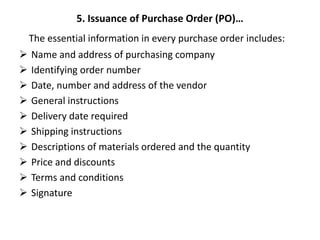
The essential information in every purchase order includes:
 Name and address of purchasing company
 Identifying order number
 Date, number and address of the vendor
 General instructions
 Delivery date required
 Shipping instructions
 Descriptions of materials ordered and the quantity
 Price and discounts
 Terms and conditions
 Signature
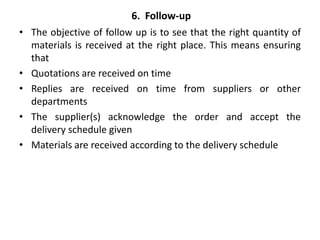
6. Follow-up
• The objective of follow up is to see that the right quantity of
materials is received at the right place. This means ensuring
that
• Quotations are received on time
• Replies are received on time from suppliers or other
departments
• The supplier(s) acknowledge the order and accept the
delivery schedule given
• Materials are received according to the delivery schedule
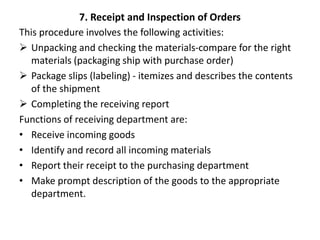
7. Receipt and Inspection of Orders
This procedure involves the following activities:
 Unpacking and checking the materials-compare for the right
materials (packaging ship with purchase order)
 Package slips (labeling) - itemizes and describes the contents
of the shipment
 Completing the receiving report
Functions of receiving department are:
• Receive incoming goods
• Identify and record all incoming materials
• Report their receipt to the purchasing department
• Make prompt description of the goods to the appropriate
department.
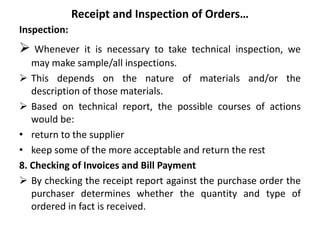
Receipt and Inspection of Orders…
Inspection:
 Whenever it is necessary to take technical inspection, we
may make sample/all inspections.
 This depends on the nature of materials and/or the
description of those materials.
 Based on technical report, the possible courses of actions
would be:
• return to the supplier
• keep some of the more acceptable and return the rest
8. Checking of Invoices and Bill Payment
 By checking the receipt report against the purchase order the
purchaser determines whether the quantity and type of
ordered in fact is received.
Checking of Invoices and Bill Payment…
 Comparing the invoice (proof of purchase) with the purchase
order and receiving report the firm verifies that the supplier’s
bill is correctly priced and that it covers the proper quantity of
acceptable material.
9. Closing the Order
Closing the order simply entails a consolidation of all
documents and correspondence relevant to the order.
The completed order is filled in the close order file.
In most forms, a completed order consists of:
 The purchase requisition (PR)
 Copy of the purchase order (PO)
 Acknowledgment
 Receiving report
Closing the Order…
 Inspection report
 Any notes /correspondence related to the order
The completed order file thus constitutes records of all
activities encompassing the total purchasing cycle.
10. Evaluation of the Purchase Order
The evaluation of purchase process simply constitutes
comparing the standard against the performance to see their
overall purchasing achievements.
CHAPTER 4: INVENTORY MANAGEMENT…
• Inventory constitutes one of the most important elements of
materials management in any organization dealing with
supply, manufacture, and distribution of goods and services.
• It is a major type of control system applied in most
organizations.
• Good inventory management is important for the successful
operation of most businesses and their supply chains.
• Operations, marketing, and finance have interests in good
inventory management.
• Poor inventory management hampers operations, diminishes
customer satisfaction, and increases operating costs.
• Some organizations have excellent inventory management
and many have satisfactory inventory management.
Inventory Management…
• Too many, however, have unsatisfactory inventory
management, which sometimes is a sign that management
does not recognize the importance of inventories.
4.1. Definition of Inventory
• Inventory is the physical stock of items held in any business
for the purpose of future production or sales.
• In a production shop the inventory may be in the form of raw
materials.
• When the items are in production process, we have the
inventory as in-process inventory and at the end of
production cycle inventory is in the form of finished good.
4.2. Significance of Inventories
• There are several reasons why organizations should maintain
inventories of good.
• The fundamental reason for doing so is that it is either
physically impossible or economically unsound to have goods
acquired in a given system precisely only when demands for
them arise.
• Without inventories, customers would have to wait until their
orders are to be filled from another source or until they are to
be manufactured.
• However, customers will not or cannot allow waiting for long
periods of time. For this reason alone, the carrying of
inventories is necessary for almost all organizations that
supply physical goods to customers.
Significance of Inventories…
• There are also other reasons for holding inventories. For
instance, the price of some raw materials used by
manufacturers may exhibit considerable seasonal fluctuation.
• When the price is low, it is profitable for organizations to
procure a sufficient quantity of it to last through the high
price seasons and to keep it in inventory to be used as need
arises in production.
• Another reason for maintaining inventories especially for
retail establishments is that sales and profits can be increased
if one has an inventory of goods to display to customer.
4.3. Inventory Management/Control
Inadequate control of inventories can result in both under and
over stocking of items.
Inventory Management/Control…
• Under-stocking results in missed deliveries, lost sales,
dissatisfied customers, and production bottlenecks;
overstocking unnecessarily ties up funds that might be more
productive elsewhere.
• Inventory management has two main concerns. One is the
level of customer service, that is, to have the right goods, in
sufficient quantities, in the right place, at the right time. The
other is the cost of ordering and carrying inventories.
• The overall objective of inventory management is to achieve
satisfactory levels of customer service while keeping inventory
costs within reasonable bounds. Toward this end, the decision
maker tries to achieve a balance in stocking. He or she must
make two fundamental decisions: the timing and size of
orders (i.e., when to order and how much to order).
Inventory Management/control…
• Before inventory control process starts, inventory planning
should be executed. Inventory planning is the determination
of the type and quantity of inventory items that would be
required at future points for maintaining production
schedules.
• Inventory planning is generally based on information from the
past and also on factors that would arise in future.
• Once this sort of planning is over, the control process begins,
which means that the actual and planned inventory positions
are compared and necessary action taken so that the business
process can function efficiently.
• Inventory control determines the levels of inventories or
parts, materials and products that will most effectively protect
the production, sales and financial requirements of the
business.
Inventory Control…
• In inventory control, we are primarily concerned with the
inventory cost control. The aim is focused to bring down the
total inventory cost per annum as much as possible.
• Two important questions are (1) how much to stock or how
much to buy and (2) how often to buy or when to buy.
• An answer to the above questions is usually given by certain
mathematical models, popularly known as “economic order
quantity models” or “economic lot/batch size models.”
4.4. Inventory Costs
• Because we are interested in optimizing the inventory system,
we must determine an appropriate optimization or
performance criterion.
• There are four major elements of inventory costs that should
be taken for analysis, such as
Inventory Costs…
• Item costs
• Ordering costs
• Holding costs
• Shortage costs
1. Item (Purchased) costs
 This is cost of the item whether it is manufactured or
purchased. If it is manufactured, it includes such items direct
material and labor, indirect materials and labor and over head
expenses.
 When the item is purchased, the item cost is the purchase
price of one unit. Transportation costs also often are included
in the purchase cost of the materials.
2. Ordering (setup) costs
 These are fixed costs usually associated with the production
of a lot internally or the placing of an order externally with a
vendor. In other words, these costs are independent of the
number of units that are requested.
 Setup costs are related to the amount of time needed to
adjust the equipment to perform a specific task. This would
include the alignment of special tooling such as jigs and
fixtures.
 Order costs pertain to the costs involved in placing an order
with a vendor. These may include telephone charges, a
delivery fee, expediting costs, and the time required to
process a purchase order.
Holding (or carrying) costs
• If the item is held in stock, the cost involved is the item
carrying or holding cost. Carrying material in inventory is
expensive.
• A number of studies disclosed that the annual cost of carrying
a production inventory averages approximately 25 percent of
the value of the inventory. Let us briefly examine these
carrying costs (Dobler and Burt; 1996).
i. Opportunity cost of invested funds: when a firm purchases
$50,000 worth of a production material and keeps it in
inventory, it simply has this much less cash to spend for other
purposes. Money invested in productive equipment or in
external securities earns a return for the company.
Conceptually, then, it is logical for the firm to charge all
money invested in inventory an amount equal to that it could
earn if invested elsewhere in the company.
Holding (or carrying) costs…
• This is the “opportunity cost” associated with inventory
investment.
ii. Insurance costs: most firms insure their assets against possible
loss from fire and other forms of damage. An extra $50,000
worth of inventory represents an additional asset on which
insurance premiums must be paid.
iii. Property taxes: as with insurance, property taxes are levied
on the assessed value of a firm’s assets; the greater the
inventory value, the greater the asset value, and consequently
the higher the firm’s tax bill.
iv. Storage costs: the warehouse in which firm stores its
inventory is depreciated a certain number of dollars per year
over the length of its life.
Holding (or carrying) costs…
• One may say, then, that the cost of warehouse space is a
given number of dollars per cubic foot per year. And this cost
conceptually can be charged against inventory occupying the
space.
v. Obsolescence and deterioration: In most inventory
operations, a certain percentage of the stock spoils, is
damaged, is pilfered, or eventually becomes obsolete.
(4) Shortage (penalty or Stock-out) costs
• Shortage costs result when demand exceeds the supply of
inventory on hand. These costs can include the opportunity
cost of not making a sale, loss of customer goodwill, and
similar costs.
4.5. Economic Order Quantity (EOQ) Model
• It is the best known and most fundamental inventory decision
tool. By letting Q= the quantity ordered or produced and To =
the time it takes to deplete an inventory of Q items, we can
illustrate the situation as follows: (from the word)
• When the order arrives from a supplier at time 0, a store will
have its maximum inventory(the order quantity Q). The store
will then supply its customers at a constant rate from stock
until the inventory is depleted at time To.
• In the process, the store will have an average inventory of ½ Q
units for the period. At time To, the store will receive another
supply of Q units and immediately replenish its inventory to
the maximum level.
• The pattern will repeat itself as time goes on. Consequently,
the average inventory level over any time frame will still be
1/2Q units.
Economic order quantity…
• The objective is to find the least costly order quantity. There
are several expenses to consider:
i. Procurement Costs
• It is the cost of the item. If it is manufactured by the firm,
there will be labor, material and overhead expenses. When
the item is purchased, the company pays the purchase price
plus taxes. These purchase and manufacturing expenses are
collectively called procurement costs.
• Procurement expense per period will equal the cost per item
multiplied by the total demand. By letting c= the purchase or
manufacturing cost per item and D= the total demand for the
stated period, we can express the relationship as: cxD =cD.
• In the EOQ model, the purchase or manufacturing cost per
item(c) and total demand (d) are assumed to be known and
constant.
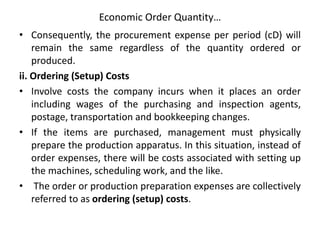
Economic Order Quantity…
• Consequently, the procurement expense per period (cD) will
remain the same regardless of the quantity ordered or
produced.
ii. Ordering (Setup) Costs
• Involve costs the company incurs when it places an order
including wages of the purchasing and inspection agents,
postage, transportation and bookkeeping changes.
• If the items are purchased, management must physically
prepare the production apparatus. In this situation, instead of
order expenses, there will be costs associated with setting up
the machines, scheduling work, and the like.
• The order or production preparation expenses are collectively
referred to as ordering (setup) costs.
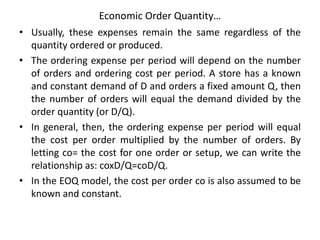
Economic Order Quantity…
• Usually, these expenses remain the same regardless of the
quantity ordered or produced.
• The ordering expense per period will depend on the number
of orders and ordering cost per period. A store has a known
and constant demand of D and orders a fixed amount Q, then
the number of orders will equal the demand divided by the
order quantity (or D/Q).
• In general, then, the ordering expense per period will equal
the cost per order multiplied by the number of orders. By
letting co= the cost for one order or setup, we can write the
relationship as: coxD/Q=coD/Q.
• In the EOQ model, the cost per order co is also assumed to be
known and constant.
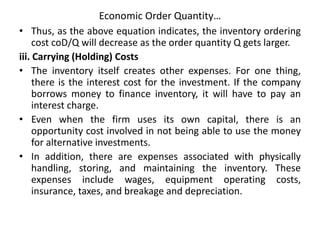
Economic Order Quantity…
• Thus, as the above equation indicates, the inventory ordering
cost coD/Q will decrease as the order quantity Q gets larger.
iii. Carrying (Holding) Costs
• The inventory itself creates other expenses. For one thing,
there is the interest cost for the investment. If the company
borrows money to finance inventory, it will have to pay an
interest charge.
• Even when the firm uses its own capital, there is an
opportunity cost involved in not being able to use the money
for alternative investments.
• In addition, there are expenses associated with physically
handling, storing, and maintaining the inventory. These
expenses include wages, equipment operating costs,
insurance, taxes, and breakage and depreciation.
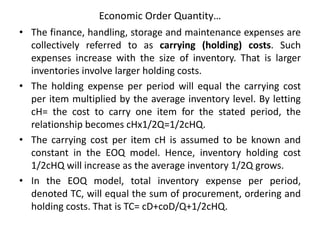
Economic Order Quantity…
• The finance, handling, storage and maintenance expenses are
collectively referred to as carrying (holding) costs. Such
expenses increase with the size of inventory. That is larger
inventories involve larger holding costs.
• The holding expense per period will equal the carrying cost
per item multiplied by the average inventory level. By letting
cH= the cost to carry one item for the stated period, the
relationship becomes cHx1/2Q=1/2cHQ.
• The carrying cost per item cH is assumed to be known and
constant in the EOQ model. Hence, inventory holding cost
1/2cHQ will increase as the average inventory 1/2Q grows.
• In the EOQ model, total inventory expense per period,
denoted TC, will equal the sum of procurement, ordering and
holding costs. That is TC= cD+coD/Q+1/2cHQ.
Economic Order Quantity…
• Even if the relevant time period can be a day, week, month,
year or more, it is usually most convenient to measure
demand and expenses on a yearly basis.
• Figure below shows the annual procurement, ordering,
holding and total costs resulting from an infinite number of
possible order quantities. (from the word…)
• You can see that total expenses are at a minimum when the
decision maker orders Q* units. The figure also indicates that
this quantity balances ordering and holding costs.
• In this model, then, management can determine how much to
order directly from the available cost information. To do so,
the decision maker must find the order quantity Q* that
equates inventory ordering cost (coD/Q) and inventory
holding cost(cHQ/2).
Economic Order Quantity…
From the word..
The value Q* is referred to as the economic order quantity.
Example: A university’s bookstore is in the process of establishing an
inventory policy for notebook filler. Based on past experience,
management knows that demand has been fairly constant at a rate of
6750 package per month. Notebook filler can be purchased from a variety
of suppliers for 50 cents a package. The price remains the same regardless
of the quantity ordered. Jumbo products, the most prompt and reliable
supplier needs 5 days’ notice to ensure prompt service. The university and
Jumbo both work 250 days per year. Each supplier will deliver the entire
order at one point in time. Bookstore staff require 45 minutes to prepare
and process a purchase order and another 15 minutes to set up the sales
display after receiving the shipment. Staff earn $4 per hour. Paper,
postage, telephone, and transportation cost an additional $1 per order.
Annual deterioration, interest, and storage expenses are estimated to be
18% of the value of average inventory. Management policy is to fully
satisfy customer demand. Management must determine the inventory
actions necessary for implementing this policy at least cost.
• Required: i) Find the economic order quantity
• ii) Find the total inventory expense per period
CHAPTER FIVE: STORAGE AND MATERIALS HANDLING
Introduction
• Various types of materials are stored in the warehouse. Each
material has its own characteristics. Some of the materials are
affected by environmental conditions, the method of storage,
and the time of storage.
• For example, rubber materials like belt conveyors, tires, and
vulcanizing materials are affected by temperature; refractory
materials are affected by moisture or humidity; steel items
rust in the presence of moisture and air; some materials
become deformed, if not stored properly and cannot be used
any more, some materials loose their characteristics, if not
used before their expiry date; some materials are of
dangerous nature and special precautions are required in
their storage whereas some of materials evaporate; if left
open.
5.1. Storage Management
• Warehouse/store is an essential limb of an industrial unit. It is
the depository of all materials required by the industrial unit
and supplies materials as and when required.
• Different types of materials are required for different
operations in a production unit.
• The variety of items stored is so large that a planned system is
necessary to keep them safely and in order that the stored
items should be identified and issued with minimum efforts
and minimum time.
5.1.1 Purpose of Stores
• Stores play a vital role in the operations of a company. It is in
direct touch with the user departments in its day-to-day
activities.
Purpose of Stores…
• The most important purpose served by the stores is to
provide uninterrupted service to the manufacturing divisions.
• Further, store is often equated directly with money, as money
is locked up on the stores. The objectives of stores can be
classified as follows:
 To receive raw materials, components, tools, equipments and
other items and account for them.
 To provide adequate and proper storage and preservation to
the various items.
 To meet the demands of the consuming departments by
proper issues and account for the consumption.
 To minimize obsolescence and surplus.
 To highlight stock accumulation, discrepancies and abnormal
consumption and effect control measures.
Purpose of Stores…
 To ensure good housekeeping so that material handling, material
preservation, stocking, receipt and issue can be done adequately.
 To assist in verification and provide supporting information for
effective purchase action.
According to Ahuja (1992), the following are some of the aims of
stores management.
i. Minimization of Cost of Production
The main aim of storekeeping function is to minimize the various
aspects of costs involved, while providing efficient and effective
storekeeping services.
ii. Coordination with Other Departments
• The store department has to establish coordination with the
material control department. But it doesn’t mean that it can ignore
other departments of the organization.
Aims of stores management…
• The following departments are closely linked to the stores
department. The smooth and efficient functioning of the
stores department cannot be thought of without the active
cooperation of each of the following departments:
– Inspection Department
– Design and Engineering Department
– Finance and Accounts Department
– Purchase Department
– Sales Department
– Production Department and
– Transport Department
5.1.2. Storage Systems and Types
Storage Systems
There are two basic systems that can be used in physically
controlling stores materials:
 a closed stores system and
 an open stores system
The application of each depends on the nature and
requirements of a specific production operation. As a general
rule, most firms use one system for certain materials and the
second system for others. These different types of stores
systems are discussed below.
Closed System
• As its name indicates, a closed stores system is one in which
all materials are physically stored in a closed or controlled
area.
Closed System…
• Wherever possible, the general practice is to maintain
physical control by locking the storage area. As a rule, no one
other than stores personnel is permitted in the stores area.
• Material enters and leaves the area only with the
accompaniment of an authorizing document. This system is
designed to afford maximum physical security and to ensure
tight accounting control of inventory material.
Open System
• The open system represents the second major type of stores
system.
• Its widest use is in highly repetitive, mass production types of
operations that exhibit a continuous and predictable demand
for the same materials.
• Most JIT manufacturing systems exemplify this situation.
Closed System…
• In plants using the open system, no storeroom as such exists;
each material is stored as close to its point of use as is
physically possible. Materials are stored in bins, on shelves, in
racks, in boxes, and so on, much as they would be stored in a
storeroom.
• Storage facilities are completely open, and any worker has
access to any storage facility.
• After material is received, stores personnel are usually
responsible for delivering it to the production areas. They are
further responsible for working out satisfactory physical
storage arrangements with the production supervisors.
Random-Access Storage System
The random-access storage system is a unique type of closed
stores system, used by a relatively small number of large
firms.
Random-Access Storage System…
• In this system, no material has a fixed storage location. When
an item enters the storeroom, it is stored in the first available
bin or shelf suitable for its storage requirements.
• When the item is withdrawn from stores, the storage space is
available for any other incoming item having similar physical
storage requirements.
• All materials are thus stored at random locations throughout
the warehouse.
Types of Stores
 Materials held in a store can be typified according to the use
they are put into.
 The advantages of such a classification are that each broad
category of use has its own characteristics and hence needs
its own system for proper control.
Types of Stores…
• In a manufacturing establishment the materials can be
classified as raw materials, work-in-progress, bought-out
components, spares, consumables and packing materials.
• Depending on the number of items in a major class, it can be
split into sub-classes in order to facilitate better control.
Raw Material Stores
• The proper control of raw materials is one of the prime factors
that influence profitability of a company.
• These, being the major input into the organization, form the
bulk that gets converted into output.
• External factors in the supply of such as availability, lead time,
seasonality, and credit conditions all combine to influence the
stocking of raw materials.
Raw Materials…
• Therefore, as the organization grows in size, it will be
advisable to have a separate raw material store.
• Quite expectedly the transactions will be more in these items.
They will form the major contributors to consumption value.
This lays the stress on a tight control of these materials.
• The stock levels and consumption levels should be clearly
fixed and there should be a regular follow up of the items. The
stores should be located as near the consumption centers as
possible in order to reduce handling.
Work-in-Progress
 This class of materials is largely found in engineering industry.
In a process industry, these are in the process line itself and
hence external storage is not required.
Work-in-Progress
• The control system for this class of materials requires a very
efficient information system.
• Co-ordination of various factors such as supply of raw
materials to facilitate job completion, supply of components,
scheduling of production, inspection and testing will be
necessary in order to manage these materials.
• Component Stores
 In engineering industries, the finished products require
complements of the final assembly. These are either
manufactured in feeder shops or procured from sub-
contractors.
 In either of these cases they are stored in a component store
from where the assembly lines are fed.
Component Stores…
• The stock out of a single component can make the entire
assembly line idle. Hence the components should be
monitored closely, and adequate steps must be taken to avoid
stock-outs.
Spares/Maintenance Stores
 The consumption pattern of spares and maintenance items is
usually unpredictable.
 In addition to this, one has to contend with the external
conflict between the maintenance and stores functions
regarding the availability of spare parts and the responsibility
for holding these items.
5.1.3 Storage Functions
Storage Functions…
• The stores is a unit serving or an activity considered as a
temporary location for materials needed for operational
purposes, and should be planned, organized and operated in
such a way that the period for which each stock item kept in
should be as short as possible.
The following are the activities that storage is expected to
perform.
• Receive all incoming materials and check against quantities
and qualities against purchase order, invoices and
specifications.
• Provide adequate and proper storage and preservation.
• Issue materials against authorized requisitions to production
and other departments.
Storage Functions
• See that materials are properly stored against deterioration,
theft etc and that they are ready for issue.
• Minimize obsolescence, surplus, waste and scrap through
proper codification, standardization and preservation.
• Carry out stock verification in accordance with the procedure
laid down by the management.
• Ensure good housekeeping so that material handling, material
preservation, stock receipt and stock issue can be done
accurately.
These activities and responsibility areas can be put into five
functions: receiving, storing, issuing, stock controlling and
store documentation.
Each of these functions is discussed as follows.
5.1.3.1. Receiving Materials
• The receiving section (function) is the central place where all
incoming supplies are received, checked and inspected before
storage or use.
• It is also called goods inward section. Although materials may
be received in store room from many sources (internal and
external), our emphasis here will be on receiving materials
from external sources i.e. from suppliers.
Receiving Procedure
 Unloading and checking the shipment
 Unpacking and inspecting the material
 Completion of the receiving report.
 Delivery of the material.
5.1.3.2. Storing Materials
• In this section of the chapter, the various types of storage
methods are outlined. The type of equipment to be used in
storage depends on the nature of materials to be used, the
size and quantity.
1. Bin- Bin is a storage equipment with partitions for keeping
small items. Each division in a bin is called a pigeon-hole.
Generally, only one item is stored in a pigeonhole.
2. Rack- Rack is an open type of storage equipment for keeping
bulky materials. The number of shelves will depend on the
type of materials to be stored, quantity involved etc.
3. Pallets - are specially designed platforms for the stocking of
materials with a view to the whole load being moved.
4. Block stocking - is another version of storage method in
which boxes or pallets are stocked directly upon each other.
5.1.3.3. Stock Issuance
• Issue of materials, which is supply of materials from stores to
the various users (department) of an organization, is one of
the routine activities of the warehouse.
• The user departments often demand immediate issue of the
materials for attending to urgent repairs of plant and
machinery.
• Stock issuance is executed when the user department comes
or sends to the store section and presents a properly
authorized issue note-usually referred as stores requisition or
issue note or requisition voucher.
5.1.3.4. Stock Controlling: Stocktaking and Stock Verification
• Stocktaking means manual counting of store items and
tallying the physical balance with the quantity as recorded in
the books.
Stocktaking and Stock Verification…
• Stocktaking is a routine and continuous exercise in a
warehouse and is a strong management tool to ensure that
materials procured are accounted for correctly and that the
critical items are physically available as shown in the records.
• Once any discrepancy is noticed, it is essential to establish the
cause of the discrepancy.
Need for stocktaking
• To detect shortage/excess of materials in the stores.
• To detect if the shortage /excess is due to negligence, mistake,
or a willful wrong act on the part of any employee.
• To make sure that important or critical items are physically
available in the store in good condition for use when needed.
• To assess the real value of inventory in the stores, especially in
case of in-process inventory.
Need for stocktaking
• To take immediate action in utilization of the items with limited remaining
shelf-life.
• To develop an appropriate market strategy for a finished product not sold
for long.
5.1.3.5. Store Document
Stores division generates lot of paper work in the process of receipt, issue,
inspection and stock- taking of items.
The major documents to be kept by store functions include.
• Receiving report
• Issuance copy
• Bin card
• Acceptance note
• Rejected note
• Traveling requisition
• Purchase order
• Package slip
• Bill of Materials
• Materials Requirements Planning
5.2. Stores Location and Layout
• More often than not, in the matter of locating the stores,
materials management is rarely consulted. The normal
practice is to locate the stores near the consuming
departments.
• This minimizes handling and ensures timely dispatch.
• In stores layout the governing criteria are :
 easy movement of materials
 good housekeeping, and sufficient space for men and
materials handling equipments
 optimum utilization of storage space
 judicious use of storage equipments, such as shelves, racks,
pallets and proper preservation from rain, light and other
such elements.
Stores Location and Layout…
• Since stores have to be nearest to the user, large organizations
usually have stores attached to each consuming department,
whereas receiving is done centrally.
• Items of common usage are stocked in the central stores so
that inventory is kept at an optimum level. These factors are
considered at the planning level of layout.
• In the case of warehouses stocking finished goods, factors
such as proximity to ports, railway lines, quality of roads,
availability of power, etc., become quite important.
Materials PPT.pptx
Materials PPT.pptx
Materials PPT.pptx
Materials PPT.pptx
Materials PPT.pptx
Materials PPT.pptx
Materials PPT.pptx
Materials PPT.pptx
Materials PPT.pptx
Materials PPT.pptx

Materials PPT.pptx

  • 1.
    Chapter One: Anoverview of Materials Management Introduction
  • 2.
    Introduction • Materials Managementis simply the process by which an organization is supplied with the goods and services that it needs to achieve its objectives of buying, storage and movement of materials. • Materials Management is related to planning, obtaining, storing and providing the appropriate material of right quality, right quantity at right place in right time so as to co-ordinate and schedule the production activity in an integrative way for an industrial undertaking. • Most industries buy materials, transport them into the plant, change the materials into parts, assemble parts into finished products, sell and transport the product to the customer. • It is only possible by efficient materials management.
  • 3.
    Inroduction Con’t… • Allthese activities of purchase of materials, flow of materials, manufacture them into the product, supply and sell the product at the market requires various types of materials to manage and control their storage, flow and supply at various places. • The materials requirements planning, purchasing, inventory planning, storage, inventory control, materials supply, transportation and materials handling are the activities of materials management. • Actually before the production begins it is necessary to ensure availability of all the types of materials needed for production and its supply at the various production centers. • Planning, purchasing and scheduling are the main functions of materials management.
  • 4.
    Intro… . It aimsat improved productivity. It is used to reduce the cost, which increases profitability and streamlines the production. Apart from management of material cost and its supply it helps in its proper utilization, transportation, storage, handling and distribution. • The market research and forecasting both for sales of company’s product and purchasing of various materials required for producing the product are needed at the planning stage. • Procurement of materials, transportation, storage, inventory control, quality control and inspection of materials and goods supplied at various production centers before production are also managed as routine work.
  • 5.
    Intro… • Materials handling,packaging, warehouse planning, accounting, scrap, surplus and obsolete materials disposal, finished goods safety and care are the activities managed by the materials management department. • Selection of personnel for marketing, purchasing, inventory control, stores management and materials handling and their training and placement is also to be seen by the materials management department. • This indicates that it is very essential to have a materials management department in any organization to support the management in the production activities.
  • 6.
    Intro… • It alsohelps in the marketing, sales promotion and control of all the types of materials for its quantity, quality and cost. Definition  The International Federation of Purchasing and Materials Management accept the definition of materials management given below.  According to it, materials management is a total concept having its definite organization to plan and control all types of materials, its supply, and its flow from raw stage to finished stage so as to deliver the product to customer as per its requirements in time.  This involves materials planning, purchasing, receiving, storing, inventory control, scheduling, production, physical distribution and marketing.
  • 7.
    Intro… • It alsocontrols the materials handling and its traffic. • The materials manager has to manage all these functions with proper authority and responsibility in the materials management department. Types of Materials • The various types of materials to be managed are: (i) Purchased materials: They are raw materials, components, spare parts, oils, grease, cotton waste, consumables and tools. (ii) Work in process (WIP) materials: These are semi-finished and finished parts and components lying on the shop floor. (iii) Finished goods: These are the final products either waiting to be assembled in the assembly lines or in stores which are stocked for final delivery waiting to sell.
  • 8.
    1.2.Importance of MaterialsManagement • In general material management is important for three reasons: 1. Customer Service Materials management (MM) serves other units/departments of the organization. These services support the goal of fast process throughout the organization, and include: • Uninterrupted flow of materials • Assistance to customers-repair, replants or delivery • Reduction in parts shortage • Average transit from warehouse to customer • Minimum of transportation delays • Accurate inventory counts • Good forecast accuracy
  • 9.
    Importance Con’t… 2. CostReduction Specific cost reduction measures include: • reduction in material costs • reduction in storage space • reduction in physical inventory • increase in inventory turn over • reduction in transportation cost 3. Administrative Efficiency These measures include: • Material management budget • Ratio of material budget to sales • Ratio of key people among functional areas
  • 10.
    Scope of MaterialsManagement  Referring to the various functions of materials management stated above the materials management co-ordinates various departments of manufacturing concern.  As soon as materials are purchased and brought by the organization, its value goes on increasing as the other costs as required for ordering the materials, carrying the materials in inventory, its maintenance and handling charges must be assigned to the cost of materials before it enters into a product or transformed into some other form.  In order to economize all the costs of materials management company has to adopt definite method of deciding the quantity of materials to be ordered, quantity to be stored as inventory and work in process inventory.
  • 11.
    Scope Con’t… • Inorder to reduce the material cost and all other costs stated above, there has to be some efficient and effective materials management techniques, which must be dynamic to adjust with changing demand and production. 1.4.Materials Management vs Purchasing and Supply Management • All the organizations need an efficient and economic purchasing and procurement of its various supplies of materials from the suppliers. • The materials management department has to perform this function of purchasing and procurement of materials very efficiently. • Since 50% to 60% of sales turnover is spent on the purchase of various materials, the amount of profit earned on these sales very much depends how economically the materials are purchased and utilized in the organization.
  • 12.
    Materials management vspurchasing… • The profitability depends on the efficiency by which this particular function of purchasing and procuring the requisite materials at appropriate time will be done and its availability is assured. The function of purchasing can be stated as follows: (1)The requisition of material is necessary by proper authority to initiate its purchase. (2) To select proper supplier for the materials requisitioned, before placing an order. (3) To negotiate about the price of the material from the supplier and it will be purchased at the cheapest price. (4) The quality of material must be assured and should not be compromised with the cost of the material.
  • 13.
    Materials vs purchasing… (5)Thematerial should be purchased of right quantity and right quality at proper time at the cheapest cost. (6) To set the proper purchase policy and procedure. Supply management Specific activities included in supply management are: conduct of a all purchasing functions product design and development material specification Generally, the major characteristic that differentiates it from purchasing is that it focuses heavily on the strategic aspects of the key elements of the firm’s supply system. Materials Management: an organization concept designed to enhance coordination and control of the various material activities.
  • 14.
    Materials management vspurchasing… Differences Among the Three Functional Areas • Purchasing and supply management are components of materials management • Materials management includes other material activities • Material management is largely a strategic focus 1.5. Materials Management with Other Functional Areas Materials management has to work in close coordination with the available departments of an organization. Such as Operation, Marketing, Finance, HRM 1. Materials Management and Operation  Materials management department must work with the operations department and informed about the availability of raw materials, anticipated delays so that re-scheduling of production could be done and costly stock outs be avoided.
  • 15.
    Materials Management andother… • The expertise of the materials management could be used by the operation department in purchasing materials. • Operation will have to keep materials management department informed about its plans and schedules so that material requirements can be planned in advance. 2. Materials Management and Finance The finance department also has to work in close coordination with materials management department in: • anticipating the availability of funds • accurate record of purchases • source of accounting documents 3. Materials Management and Marketing Marketing department will give advance information on sales forecast on which material forecast is based on and materials management through efficient operation can keep product prices at a competitive level and thus helps the marketing department in its operation.
  • 16.
    Materials Management andother… 4. Materials Management and HRM • HRM performs the basic recruitment, selection, promotion and other employees’ aspects of materials management department.
  • 17.
    Chapter Two: MaterialsDemand Forecasting 2.1. Meaning, Characteristics and Uses of Forecasting • Forecasts are estimates of the occurrence, timing or magnitude of future events. It is all about predicting future events. Forecasting is the basis of planning ahead even though the actual demand is quite uncertain. • Therefore, forecast of future demand is the link between company’s internal expectations with outside environment that permits planning function to commence activities. • Forecast affects decision and activities throughout the organization in finance, HRM, marketing, operations and other functions.
  • 18.
    Meaning, characteristics… Characteristics ofForecasts The following are the characteristics of forecasts: Forecasting technique generally assumes that the same underlying causal system that existed in the past will continue to exist in the future. Forecasts are rarely perfect, actual results usually differ from predicted value. Forecasts for a group of items tends to be more accurate than forecasts for individual item because forecasting errors among items in a group usually are smaller than that of individual items. Forecast accuracy decreases as the time period covered by the forecast time horizon increases.
  • 19.
    Meaning, characteristics… Uses ofForecast • The purpose of forecasting activities is to make the best use of present information to guide the activity levels that can minimize short-term fluctuations in production and help balance workloads. • This reduces hiring, firing and overtime activities and helps maintain good labor relationship. Generally good forecast : • Could improve employee relation • Improve materials management • Helps to have better use of capital and facilitates and • Improve customer services.
  • 20.
    2.2. Techniques ofForecasting There are two types of forecasting techniques: • Qualitative forecasting technique • Quantitative forecasting technique 2.2.1.Qualitative Foretasting Technique  is used when there is no historical data available about past performance  is subjective and judgmental in nature and most of the time it is based on opinion and expertise judgment.  rely on analysis of subjective inputs obtained from customers, sales person, managers and experts. Common types of qualitative techniques include: a. Expert Opinion Method It consists of collecting opinion and judgments of individuals who are expected to have the best knowledge of current activities or future plans.
  • 21.
    Expert opinion… Advantages: • Decisionis fast • Responsibility and accountability is clear • Brings together the considerable knowledge, experience, skill and talent of various managers • Managers (experts) will acquire experience that is obtained in the discussion. Disadvantages: • Probably poor forecast (due to lack of experience) • Domination by one or few managers • Diffusing responsibility for the forecast over the entire group may result in less pressure to produce a good forecast.
  • 22.
    2. Sales ForceOpinion • In this method, sales representatives are required to estimate the demand for each product and the forecast of each sales representative is consolidated to prepare the overall forecast for company. Advantages: • It can reset in quality forecast • This pools together knowledge • Can see from different approaches Disadvantages: • Time taking decision • Avoidance of responsibility 3. Consumer Survey Is based on the data which is collected from the consumers.
  • 23.
    Consumer Survey … Advantages: •tap information that may not be available elsewhere • enhance the quality and accuracy of forecasts • Disadvantages: • Experience and knowledge are constraints • Expensive and time consuming 4. Delphi Method involves the development, distribution, collection and analysis of series of questionnaires to get the views of expertise that are located at different geographic areas to generate the forecast.
  • 24.
    Delphi Method… Advantages • Thetendency of process loss is avoided/minimized • No influence of the majority Disadvantages • It takes time to reach a consensus • Coordination and interpretation difficulty 2.2.2. Quantitative Forecasting Techniques Now let us discuss about the quantitative types of forecasting techniques. 1. Time Series Analysis  A time series is a set of some variables (demand) overtime (e.g. hourly, daily, weekly, quarterly or annually).
  • 25.
    Time Series Analysis is based on time and does not take specific account of outside or related factors.  Forecasting techniques based on time series data are made on the assumption that history follows a pattern that will continue.  Time series analysis is a time-ordered series of values of some variables. The variables value in any specific time period is a function of four factors: a. Trend- is a general pattern of change overtime. It represents a long time circular movement, characteristic of many economic series. b. Seasonality- refers to any regular pattern recurring with in a time period of no more than one year. These effects are often related to seasons of the year.
  • 26.
    Time Series Analysis… c.Cycle – is long-term swings about the trend line and are usually associated with a business cycle (phases of growth and decline in a business cycle). d. Randomness – are irregular effects due to chance and unusual occurrences. Types of Time Series Analysis
  • 27.
    Chapter Three: Purchasing 3.1.Meaning and Objectives • Purchasing function comprises the essential activities associated with the acquisition of materials used in the operation of an organization. • Because all organizations require supplies of materials, purchasing function is common in almost all organizations. There are two basic types of purchasing in business:  Purchasing for sale  Purchasing for consumption/conversion
  • 28.
    Objectives of Purchasing Theobjectives of purchasing can be viewed from three levels: 1.General Managerial Level From their perspective, the managements expect the five rights the purchasing department has to achieve: – The right quality – In the right quantity – From the right supplier – At the right price – At the right place 2. Functional (operational) Level  To support company operations with uninterrupted flow of materials
  • 29.
    Functional Level con’t… To buy competitively; buying competitively involves: • Keeping abreast of the forces of supply and demand that regulate prices and availability of materials in the market place. • Understanding of suppliers cost structure computed with an ability to help improve the cost structure.  To buy wisely; buying wisely involves: • A continued search for better values that yield the best combination of quality service and price. • Note: It is the combination of buying competitively and buying wisely that typically contribute most to the profitability of the firm.  To keep inventory investment and inventory losses at a practical minimum.
  • 30.
    Functional Level Con’t… To develop effective and reliable source of supply.  To develop good relationship with supplier community and good continuing relationship with active suppliers.  To achieve maximum integration with other departments of the firm. 3.2. Purchasing Policies and Procedures Policy  Policies are general statements, understanding, and guidelines in making operating decisions that channel actions toward achievement of the objectives.  Purchasing polices are aids for purchasing decisions. Purchasing policy may be written or not.  It is a policy defining the placement of purchasing authority
  • 31.
    Purchasing Policy… There aretwo approaches of placing purchasing function  Centralization  Decentralization a. Centralized Purchase  Centralization exists when the entire purchasing function is made the responsibility of a single person. Advantages  Duplication of effort and haphazard purchasing activities are minimized by the central coordination of all company purchasers.  Quantity discounts are made possible by consolidating all company orders for the same and similar materials.  A firm is able to develop and implement a unified purchasing policy, enabling it to speak with a single voice to its suppliers.
  • 32.
    Advantages…  Transportation savingscan be realized by the consolidation of orders and delivery schedules.  Develops purchase specialists  Suppliers are able to offer better prices and better service  Responsibility for the performance of the purchasing function is fixed with a single department head, thereby facilitating management control. Disadvantages • Slow decision making • May not satisfy local interest • Does not spread risk
  • 33.
    Factors Affecting Feasibilityand Desirability of Centralization 1. Similarity of the classes of materials used in each of the departments /plants.  If a firm’s plants (products) use entirely different materials, centralization of purchasing offers only minimal benefits.  But centralization offers benefits because of specialization when the various plants use similar materials. 2. Size of each individual plant purchasing department  When a firm’s individual plant purchasing department is not large in size, centralization would be advantageous. 3. Distance separating individual plants or geographic dispersion of plants  the closer a firm’s plants are situated geographically, the more feasible centralization becomes.
  • 34.
    b. Decentralized Purchase occurs when personnel from other functional areas-operation marketing, finance, HRM, and so on decide unilaterally on sources of supply or negotiate with suppliers directly for major purchases. Advantages • Speed of operation: there is a possibility of response more quickly to user’s needs and time delay can be improved. • Effective use of local resources/local interests • Plant/department autonomy Disadvantages • Loose control • Difficulty of obtaining discounts • Duplication of effort
  • 35.
    3.3. Purchasing Procedures 1.Recognition  The need for purchase typically originates in one of a firm’s operating department or in its inventory control section.  The purchasing department is usually notified of the need by one of the three basic methods: a) Standard Purchase Requisition It is an internal document numbered serially for requests originating in the operating departments. A purchase requisition is used for materials that have to be ordered from suppliers The items included could be: • Material name/code identification • The amount needed • Desired delivery date
  • 36.
    Standard Purchase Requisition… Atypical purchase requisition format is given below: Date_______________ Sl.NO________________ Date when material is required_______ Department_____________ Item number Description Quantity ____________ ______________ Initiator authorized by The user department generally makes a minimum of two copies-one copy is sent to purchasing department, the other is retained in the using department’s file. b) Material Requirement Plan (MRP) MRP is a technique for determining the quantity and timing for the requisition of demanded items.
  • 37.
    c) Bill ofMaterials (BOM) • It is a complete list of all items incorporated into a finished product with specifications and quantity required of each item of materials. 2. Verification of Purchase Requisition It involves: • Checking the document for accuracy and completeness • Determining that the need has adequately defined • Ensuring that the appropriate method of description has been used to guarantee a satisfactory purchase for the user and at the same time all possible opportunities in the selection of the supplier. 3. Request for Quotation (bids, price quotation) A request for quotation is a process of initiating potential suppliers that are willing to compete to supply the required material.
  • 38.
    Request for Quotation… Competitive bidding is dictated by five criteria.  the dollar value of the specific purchase must be large enough to justify expense to both buyer and seller  The market must consist of an adequate number of sellers  The sellers that make up the market must be technically qualified and willing to compete  The specification/description is clear to both the buyer and seller  The time available must be sufficient for using competitive bidding Competitive bidding should not be used:  For situations in which it is impossible to estimate costs with a high degree of certainty.
  • 39.
    Request for Quotation…  Situations in which the prices are not the only important variables. Example, quality, schedule and service may well be negotiable variables of equal importance.  Repetitive and routine purchase  Items of low value  Single/few suppliers Invitation for bids (IFB) or request for proposal (RFP) or request for quotation (REQ) includes:  Purchase description /specification  Delivery schedule (timing and mode)  Special terms/conditions
  • 40.
    Request for Quotation…  Eligibility of suppliers  Bid security  Any amendments  Address for further information  Purchasing company  Term of payment  Last date of submitting bids  Time, date and place of opening the bid 4. Evaluation and Selection of Suppliers • There are two primary supply sources: internal and external. The internal source is the company itself and the external sources are the outside suppliers and the market place.
  • 41.
    Evaluation and Selectionof Suppliers… • When evaluating and selecting a supplier, a buyer should try to find one who would meet the needs of the quality, quantity and delivery time (purchase description and specification) at lower cost. 5. Issuance of Purchase Order (PO)  Once a supplier has been selected, the purchasing department prepares and issues a serially numbered purchase order.  Purchase order (PO) is the instrument by which goods are procured to fill a requirement.  It expresses in specific language the agreement between the buyer and the vendor. Once accepted, it has the legal force in a binding contract.
  • 42.
    5. Issuance ofPurchase Order (PO)… The essential information in every purchase order includes:  Name and address of purchasing company  Identifying order number  Date, number and address of the vendor  General instructions  Delivery date required  Shipping instructions  Descriptions of materials ordered and the quantity  Price and discounts  Terms and conditions  Signature
  • 43.
    6. Follow-up • Theobjective of follow up is to see that the right quantity of materials is received at the right place. This means ensuring that • Quotations are received on time • Replies are received on time from suppliers or other departments • The supplier(s) acknowledge the order and accept the delivery schedule given • Materials are received according to the delivery schedule
  • 44.
    7. Receipt andInspection of Orders This procedure involves the following activities:  Unpacking and checking the materials-compare for the right materials (packaging ship with purchase order)  Package slips (labeling) - itemizes and describes the contents of the shipment  Completing the receiving report Functions of receiving department are: • Receive incoming goods • Identify and record all incoming materials • Report their receipt to the purchasing department • Make prompt description of the goods to the appropriate department.
  • 45.
    Receipt and Inspectionof Orders… Inspection:  Whenever it is necessary to take technical inspection, we may make sample/all inspections.  This depends on the nature of materials and/or the description of those materials.  Based on technical report, the possible courses of actions would be: • return to the supplier • keep some of the more acceptable and return the rest 8. Checking of Invoices and Bill Payment  By checking the receipt report against the purchase order the purchaser determines whether the quantity and type of ordered in fact is received.
  • 46.
    Checking of Invoicesand Bill Payment…  Comparing the invoice (proof of purchase) with the purchase order and receiving report the firm verifies that the supplier’s bill is correctly priced and that it covers the proper quantity of acceptable material. 9. Closing the Order Closing the order simply entails a consolidation of all documents and correspondence relevant to the order. The completed order is filled in the close order file. In most forms, a completed order consists of:  The purchase requisition (PR)  Copy of the purchase order (PO)  Acknowledgment  Receiving report
  • 47.
    Closing the Order… Inspection report  Any notes /correspondence related to the order The completed order file thus constitutes records of all activities encompassing the total purchasing cycle. 10. Evaluation of the Purchase Order The evaluation of purchase process simply constitutes comparing the standard against the performance to see their overall purchasing achievements.
  • 48.
    CHAPTER 4: INVENTORYMANAGEMENT… • Inventory constitutes one of the most important elements of materials management in any organization dealing with supply, manufacture, and distribution of goods and services. • It is a major type of control system applied in most organizations. • Good inventory management is important for the successful operation of most businesses and their supply chains. • Operations, marketing, and finance have interests in good inventory management. • Poor inventory management hampers operations, diminishes customer satisfaction, and increases operating costs. • Some organizations have excellent inventory management and many have satisfactory inventory management.
  • 49.
    Inventory Management… • Toomany, however, have unsatisfactory inventory management, which sometimes is a sign that management does not recognize the importance of inventories. 4.1. Definition of Inventory • Inventory is the physical stock of items held in any business for the purpose of future production or sales. • In a production shop the inventory may be in the form of raw materials. • When the items are in production process, we have the inventory as in-process inventory and at the end of production cycle inventory is in the form of finished good.
  • 50.
    4.2. Significance ofInventories • There are several reasons why organizations should maintain inventories of good. • The fundamental reason for doing so is that it is either physically impossible or economically unsound to have goods acquired in a given system precisely only when demands for them arise. • Without inventories, customers would have to wait until their orders are to be filled from another source or until they are to be manufactured. • However, customers will not or cannot allow waiting for long periods of time. For this reason alone, the carrying of inventories is necessary for almost all organizations that supply physical goods to customers.
  • 51.
    Significance of Inventories… •There are also other reasons for holding inventories. For instance, the price of some raw materials used by manufacturers may exhibit considerable seasonal fluctuation. • When the price is low, it is profitable for organizations to procure a sufficient quantity of it to last through the high price seasons and to keep it in inventory to be used as need arises in production. • Another reason for maintaining inventories especially for retail establishments is that sales and profits can be increased if one has an inventory of goods to display to customer. 4.3. Inventory Management/Control Inadequate control of inventories can result in both under and over stocking of items.
  • 52.
    Inventory Management/Control… • Under-stockingresults in missed deliveries, lost sales, dissatisfied customers, and production bottlenecks; overstocking unnecessarily ties up funds that might be more productive elsewhere. • Inventory management has two main concerns. One is the level of customer service, that is, to have the right goods, in sufficient quantities, in the right place, at the right time. The other is the cost of ordering and carrying inventories. • The overall objective of inventory management is to achieve satisfactory levels of customer service while keeping inventory costs within reasonable bounds. Toward this end, the decision maker tries to achieve a balance in stocking. He or she must make two fundamental decisions: the timing and size of orders (i.e., when to order and how much to order).
  • 53.
    Inventory Management/control… • Beforeinventory control process starts, inventory planning should be executed. Inventory planning is the determination of the type and quantity of inventory items that would be required at future points for maintaining production schedules. • Inventory planning is generally based on information from the past and also on factors that would arise in future. • Once this sort of planning is over, the control process begins, which means that the actual and planned inventory positions are compared and necessary action taken so that the business process can function efficiently. • Inventory control determines the levels of inventories or parts, materials and products that will most effectively protect the production, sales and financial requirements of the business.
  • 54.
    Inventory Control… • Ininventory control, we are primarily concerned with the inventory cost control. The aim is focused to bring down the total inventory cost per annum as much as possible. • Two important questions are (1) how much to stock or how much to buy and (2) how often to buy or when to buy. • An answer to the above questions is usually given by certain mathematical models, popularly known as “economic order quantity models” or “economic lot/batch size models.” 4.4. Inventory Costs • Because we are interested in optimizing the inventory system, we must determine an appropriate optimization or performance criterion. • There are four major elements of inventory costs that should be taken for analysis, such as
  • 55.
    Inventory Costs… • Itemcosts • Ordering costs • Holding costs • Shortage costs 1. Item (Purchased) costs  This is cost of the item whether it is manufactured or purchased. If it is manufactured, it includes such items direct material and labor, indirect materials and labor and over head expenses.  When the item is purchased, the item cost is the purchase price of one unit. Transportation costs also often are included in the purchase cost of the materials. 2. Ordering (setup) costs
  • 56.
    2. Ordering (setup)costs  These are fixed costs usually associated with the production of a lot internally or the placing of an order externally with a vendor. In other words, these costs are independent of the number of units that are requested.  Setup costs are related to the amount of time needed to adjust the equipment to perform a specific task. This would include the alignment of special tooling such as jigs and fixtures.  Order costs pertain to the costs involved in placing an order with a vendor. These may include telephone charges, a delivery fee, expediting costs, and the time required to process a purchase order.

  • 57.
    Holding (or carrying)costs • If the item is held in stock, the cost involved is the item carrying or holding cost. Carrying material in inventory is expensive. • A number of studies disclosed that the annual cost of carrying a production inventory averages approximately 25 percent of the value of the inventory. Let us briefly examine these carrying costs (Dobler and Burt; 1996). i. Opportunity cost of invested funds: when a firm purchases $50,000 worth of a production material and keeps it in inventory, it simply has this much less cash to spend for other purposes. Money invested in productive equipment or in external securities earns a return for the company. Conceptually, then, it is logical for the firm to charge all money invested in inventory an amount equal to that it could earn if invested elsewhere in the company.
  • 58.
    Holding (or carrying)costs… • This is the “opportunity cost” associated with inventory investment. ii. Insurance costs: most firms insure their assets against possible loss from fire and other forms of damage. An extra $50,000 worth of inventory represents an additional asset on which insurance premiums must be paid. iii. Property taxes: as with insurance, property taxes are levied on the assessed value of a firm’s assets; the greater the inventory value, the greater the asset value, and consequently the higher the firm’s tax bill. iv. Storage costs: the warehouse in which firm stores its inventory is depreciated a certain number of dollars per year over the length of its life.
  • 59.
    Holding (or carrying)costs… • One may say, then, that the cost of warehouse space is a given number of dollars per cubic foot per year. And this cost conceptually can be charged against inventory occupying the space. v. Obsolescence and deterioration: In most inventory operations, a certain percentage of the stock spoils, is damaged, is pilfered, or eventually becomes obsolete. (4) Shortage (penalty or Stock-out) costs • Shortage costs result when demand exceeds the supply of inventory on hand. These costs can include the opportunity cost of not making a sale, loss of customer goodwill, and similar costs.
  • 60.
    4.5. Economic OrderQuantity (EOQ) Model • It is the best known and most fundamental inventory decision tool. By letting Q= the quantity ordered or produced and To = the time it takes to deplete an inventory of Q items, we can illustrate the situation as follows: (from the word) • When the order arrives from a supplier at time 0, a store will have its maximum inventory(the order quantity Q). The store will then supply its customers at a constant rate from stock until the inventory is depleted at time To. • In the process, the store will have an average inventory of ½ Q units for the period. At time To, the store will receive another supply of Q units and immediately replenish its inventory to the maximum level. • The pattern will repeat itself as time goes on. Consequently, the average inventory level over any time frame will still be 1/2Q units.
  • 61.
    Economic order quantity… •The objective is to find the least costly order quantity. There are several expenses to consider: i. Procurement Costs • It is the cost of the item. If it is manufactured by the firm, there will be labor, material and overhead expenses. When the item is purchased, the company pays the purchase price plus taxes. These purchase and manufacturing expenses are collectively called procurement costs. • Procurement expense per period will equal the cost per item multiplied by the total demand. By letting c= the purchase or manufacturing cost per item and D= the total demand for the stated period, we can express the relationship as: cxD =cD. • In the EOQ model, the purchase or manufacturing cost per item(c) and total demand (d) are assumed to be known and constant.
  • 62.
    Economic Order Quantity… •Consequently, the procurement expense per period (cD) will remain the same regardless of the quantity ordered or produced. ii. Ordering (Setup) Costs • Involve costs the company incurs when it places an order including wages of the purchasing and inspection agents, postage, transportation and bookkeeping changes. • If the items are purchased, management must physically prepare the production apparatus. In this situation, instead of order expenses, there will be costs associated with setting up the machines, scheduling work, and the like. • The order or production preparation expenses are collectively referred to as ordering (setup) costs.
  • 63.
    Economic Order Quantity… •Usually, these expenses remain the same regardless of the quantity ordered or produced. • The ordering expense per period will depend on the number of orders and ordering cost per period. A store has a known and constant demand of D and orders a fixed amount Q, then the number of orders will equal the demand divided by the order quantity (or D/Q). • In general, then, the ordering expense per period will equal the cost per order multiplied by the number of orders. By letting co= the cost for one order or setup, we can write the relationship as: coxD/Q=coD/Q. • In the EOQ model, the cost per order co is also assumed to be known and constant.
  • 64.
    Economic Order Quantity… •Thus, as the above equation indicates, the inventory ordering cost coD/Q will decrease as the order quantity Q gets larger. iii. Carrying (Holding) Costs • The inventory itself creates other expenses. For one thing, there is the interest cost for the investment. If the company borrows money to finance inventory, it will have to pay an interest charge. • Even when the firm uses its own capital, there is an opportunity cost involved in not being able to use the money for alternative investments. • In addition, there are expenses associated with physically handling, storing, and maintaining the inventory. These expenses include wages, equipment operating costs, insurance, taxes, and breakage and depreciation.
  • 65.
    Economic Order Quantity… •The finance, handling, storage and maintenance expenses are collectively referred to as carrying (holding) costs. Such expenses increase with the size of inventory. That is larger inventories involve larger holding costs. • The holding expense per period will equal the carrying cost per item multiplied by the average inventory level. By letting cH= the cost to carry one item for the stated period, the relationship becomes cHx1/2Q=1/2cHQ. • The carrying cost per item cH is assumed to be known and constant in the EOQ model. Hence, inventory holding cost 1/2cHQ will increase as the average inventory 1/2Q grows. • In the EOQ model, total inventory expense per period, denoted TC, will equal the sum of procurement, ordering and holding costs. That is TC= cD+coD/Q+1/2cHQ.
  • 66.
    Economic Order Quantity… •Even if the relevant time period can be a day, week, month, year or more, it is usually most convenient to measure demand and expenses on a yearly basis. • Figure below shows the annual procurement, ordering, holding and total costs resulting from an infinite number of possible order quantities. (from the word…) • You can see that total expenses are at a minimum when the decision maker orders Q* units. The figure also indicates that this quantity balances ordering and holding costs. • In this model, then, management can determine how much to order directly from the available cost information. To do so, the decision maker must find the order quantity Q* that equates inventory ordering cost (coD/Q) and inventory holding cost(cHQ/2).
  • 67.
    Economic Order Quantity… Fromthe word.. The value Q* is referred to as the economic order quantity. Example: A university’s bookstore is in the process of establishing an inventory policy for notebook filler. Based on past experience, management knows that demand has been fairly constant at a rate of 6750 package per month. Notebook filler can be purchased from a variety of suppliers for 50 cents a package. The price remains the same regardless of the quantity ordered. Jumbo products, the most prompt and reliable supplier needs 5 days’ notice to ensure prompt service. The university and Jumbo both work 250 days per year. Each supplier will deliver the entire order at one point in time. Bookstore staff require 45 minutes to prepare and process a purchase order and another 15 minutes to set up the sales display after receiving the shipment. Staff earn $4 per hour. Paper, postage, telephone, and transportation cost an additional $1 per order. Annual deterioration, interest, and storage expenses are estimated to be 18% of the value of average inventory. Management policy is to fully satisfy customer demand. Management must determine the inventory actions necessary for implementing this policy at least cost. • Required: i) Find the economic order quantity • ii) Find the total inventory expense per period
  • 68.
    CHAPTER FIVE: STORAGEAND MATERIALS HANDLING Introduction • Various types of materials are stored in the warehouse. Each material has its own characteristics. Some of the materials are affected by environmental conditions, the method of storage, and the time of storage. • For example, rubber materials like belt conveyors, tires, and vulcanizing materials are affected by temperature; refractory materials are affected by moisture or humidity; steel items rust in the presence of moisture and air; some materials become deformed, if not stored properly and cannot be used any more, some materials loose their characteristics, if not used before their expiry date; some materials are of dangerous nature and special precautions are required in their storage whereas some of materials evaporate; if left open.
  • 69.
    5.1. Storage Management •Warehouse/store is an essential limb of an industrial unit. It is the depository of all materials required by the industrial unit and supplies materials as and when required. • Different types of materials are required for different operations in a production unit. • The variety of items stored is so large that a planned system is necessary to keep them safely and in order that the stored items should be identified and issued with minimum efforts and minimum time. 5.1.1 Purpose of Stores • Stores play a vital role in the operations of a company. It is in direct touch with the user departments in its day-to-day activities.
  • 70.
    Purpose of Stores… •The most important purpose served by the stores is to provide uninterrupted service to the manufacturing divisions. • Further, store is often equated directly with money, as money is locked up on the stores. The objectives of stores can be classified as follows:  To receive raw materials, components, tools, equipments and other items and account for them.  To provide adequate and proper storage and preservation to the various items.  To meet the demands of the consuming departments by proper issues and account for the consumption.  To minimize obsolescence and surplus.  To highlight stock accumulation, discrepancies and abnormal consumption and effect control measures.


  • 71.
    Purpose of Stores… To ensure good housekeeping so that material handling, material preservation, stocking, receipt and issue can be done adequately.  To assist in verification and provide supporting information for effective purchase action. According to Ahuja (1992), the following are some of the aims of stores management. i. Minimization of Cost of Production The main aim of storekeeping function is to minimize the various aspects of costs involved, while providing efficient and effective storekeeping services. ii. Coordination with Other Departments • The store department has to establish coordination with the material control department. But it doesn’t mean that it can ignore other departments of the organization.


  • 72.
    Aims of storesmanagement… • The following departments are closely linked to the stores department. The smooth and efficient functioning of the stores department cannot be thought of without the active cooperation of each of the following departments: – Inspection Department – Design and Engineering Department – Finance and Accounts Department – Purchase Department – Sales Department – Production Department and – Transport Department
  • 73.
    5.1.2. Storage Systemsand Types Storage Systems There are two basic systems that can be used in physically controlling stores materials:  a closed stores system and  an open stores system The application of each depends on the nature and requirements of a specific production operation. As a general rule, most firms use one system for certain materials and the second system for others. These different types of stores systems are discussed below. Closed System • As its name indicates, a closed stores system is one in which all materials are physically stored in a closed or controlled area.
  • 74.
    Closed System… • Whereverpossible, the general practice is to maintain physical control by locking the storage area. As a rule, no one other than stores personnel is permitted in the stores area. • Material enters and leaves the area only with the accompaniment of an authorizing document. This system is designed to afford maximum physical security and to ensure tight accounting control of inventory material. Open System • The open system represents the second major type of stores system. • Its widest use is in highly repetitive, mass production types of operations that exhibit a continuous and predictable demand for the same materials. • Most JIT manufacturing systems exemplify this situation.
  • 75.
    Closed System… • Inplants using the open system, no storeroom as such exists; each material is stored as close to its point of use as is physically possible. Materials are stored in bins, on shelves, in racks, in boxes, and so on, much as they would be stored in a storeroom. • Storage facilities are completely open, and any worker has access to any storage facility. • After material is received, stores personnel are usually responsible for delivering it to the production areas. They are further responsible for working out satisfactory physical storage arrangements with the production supervisors. Random-Access Storage System The random-access storage system is a unique type of closed stores system, used by a relatively small number of large firms.
  • 76.
    Random-Access Storage System… •In this system, no material has a fixed storage location. When an item enters the storeroom, it is stored in the first available bin or shelf suitable for its storage requirements. • When the item is withdrawn from stores, the storage space is available for any other incoming item having similar physical storage requirements. • All materials are thus stored at random locations throughout the warehouse. Types of Stores  Materials held in a store can be typified according to the use they are put into.  The advantages of such a classification are that each broad category of use has its own characteristics and hence needs its own system for proper control.
  • 77.
    Types of Stores… •In a manufacturing establishment the materials can be classified as raw materials, work-in-progress, bought-out components, spares, consumables and packing materials. • Depending on the number of items in a major class, it can be split into sub-classes in order to facilitate better control. Raw Material Stores • The proper control of raw materials is one of the prime factors that influence profitability of a company. • These, being the major input into the organization, form the bulk that gets converted into output. • External factors in the supply of such as availability, lead time, seasonality, and credit conditions all combine to influence the stocking of raw materials.
  • 78.
    Raw Materials… • Therefore,as the organization grows in size, it will be advisable to have a separate raw material store. • Quite expectedly the transactions will be more in these items. They will form the major contributors to consumption value. This lays the stress on a tight control of these materials. • The stock levels and consumption levels should be clearly fixed and there should be a regular follow up of the items. The stores should be located as near the consumption centers as possible in order to reduce handling. Work-in-Progress  This class of materials is largely found in engineering industry. In a process industry, these are in the process line itself and hence external storage is not required.
  • 79.
    Work-in-Progress • The controlsystem for this class of materials requires a very efficient information system. • Co-ordination of various factors such as supply of raw materials to facilitate job completion, supply of components, scheduling of production, inspection and testing will be necessary in order to manage these materials. • Component Stores  In engineering industries, the finished products require complements of the final assembly. These are either manufactured in feeder shops or procured from sub- contractors.  In either of these cases they are stored in a component store from where the assembly lines are fed.
  • 80.
    Component Stores… • Thestock out of a single component can make the entire assembly line idle. Hence the components should be monitored closely, and adequate steps must be taken to avoid stock-outs. Spares/Maintenance Stores  The consumption pattern of spares and maintenance items is usually unpredictable.  In addition to this, one has to contend with the external conflict between the maintenance and stores functions regarding the availability of spare parts and the responsibility for holding these items. 5.1.3 Storage Functions
  • 81.
    Storage Functions… • Thestores is a unit serving or an activity considered as a temporary location for materials needed for operational purposes, and should be planned, organized and operated in such a way that the period for which each stock item kept in should be as short as possible. The following are the activities that storage is expected to perform. • Receive all incoming materials and check against quantities and qualities against purchase order, invoices and specifications. • Provide adequate and proper storage and preservation. • Issue materials against authorized requisitions to production and other departments.
  • 82.
    Storage Functions • Seethat materials are properly stored against deterioration, theft etc and that they are ready for issue. • Minimize obsolescence, surplus, waste and scrap through proper codification, standardization and preservation. • Carry out stock verification in accordance with the procedure laid down by the management. • Ensure good housekeeping so that material handling, material preservation, stock receipt and stock issue can be done accurately. These activities and responsibility areas can be put into five functions: receiving, storing, issuing, stock controlling and store documentation. Each of these functions is discussed as follows.
  • 83.
    5.1.3.1. Receiving Materials •The receiving section (function) is the central place where all incoming supplies are received, checked and inspected before storage or use. • It is also called goods inward section. Although materials may be received in store room from many sources (internal and external), our emphasis here will be on receiving materials from external sources i.e. from suppliers. Receiving Procedure  Unloading and checking the shipment  Unpacking and inspecting the material  Completion of the receiving report.  Delivery of the material.
  • 84.
    5.1.3.2. Storing Materials •In this section of the chapter, the various types of storage methods are outlined. The type of equipment to be used in storage depends on the nature of materials to be used, the size and quantity. 1. Bin- Bin is a storage equipment with partitions for keeping small items. Each division in a bin is called a pigeon-hole. Generally, only one item is stored in a pigeonhole. 2. Rack- Rack is an open type of storage equipment for keeping bulky materials. The number of shelves will depend on the type of materials to be stored, quantity involved etc. 3. Pallets - are specially designed platforms for the stocking of materials with a view to the whole load being moved. 4. Block stocking - is another version of storage method in which boxes or pallets are stocked directly upon each other.
  • 85.
    5.1.3.3. Stock Issuance •Issue of materials, which is supply of materials from stores to the various users (department) of an organization, is one of the routine activities of the warehouse. • The user departments often demand immediate issue of the materials for attending to urgent repairs of plant and machinery. • Stock issuance is executed when the user department comes or sends to the store section and presents a properly authorized issue note-usually referred as stores requisition or issue note or requisition voucher. 5.1.3.4. Stock Controlling: Stocktaking and Stock Verification • Stocktaking means manual counting of store items and tallying the physical balance with the quantity as recorded in the books.
  • 86.
    Stocktaking and StockVerification… • Stocktaking is a routine and continuous exercise in a warehouse and is a strong management tool to ensure that materials procured are accounted for correctly and that the critical items are physically available as shown in the records. • Once any discrepancy is noticed, it is essential to establish the cause of the discrepancy. Need for stocktaking • To detect shortage/excess of materials in the stores. • To detect if the shortage /excess is due to negligence, mistake, or a willful wrong act on the part of any employee. • To make sure that important or critical items are physically available in the store in good condition for use when needed. • To assess the real value of inventory in the stores, especially in case of in-process inventory.
  • 87.
    Need for stocktaking •To take immediate action in utilization of the items with limited remaining shelf-life. • To develop an appropriate market strategy for a finished product not sold for long. 5.1.3.5. Store Document Stores division generates lot of paper work in the process of receipt, issue, inspection and stock- taking of items. The major documents to be kept by store functions include. • Receiving report • Issuance copy • Bin card • Acceptance note • Rejected note • Traveling requisition • Purchase order • Package slip • Bill of Materials • Materials Requirements Planning
  • 88.
    5.2. Stores Locationand Layout • More often than not, in the matter of locating the stores, materials management is rarely consulted. The normal practice is to locate the stores near the consuming departments. • This minimizes handling and ensures timely dispatch. • In stores layout the governing criteria are :  easy movement of materials  good housekeeping, and sufficient space for men and materials handling equipments  optimum utilization of storage space  judicious use of storage equipments, such as shelves, racks, pallets and proper preservation from rain, light and other such elements.
  • 89.
    Stores Location andLayout… • Since stores have to be nearest to the user, large organizations usually have stores attached to each consuming department, whereas receiving is done centrally. • Items of common usage are stocked in the central stores so that inventory is kept at an optimum level. These factors are considered at the planning level of layout. • In the case of warehouses stocking finished goods, factors such as proximity to ports, railway lines, quality of roads, availability of power, etc., become quite important.