

Before MM & After MM
Scope of MM.
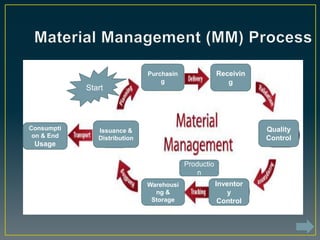
Process of MM.
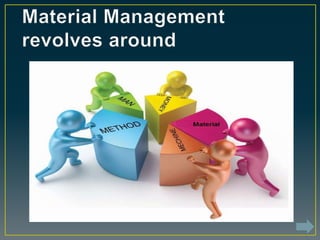
MM Revolves around
5M’s
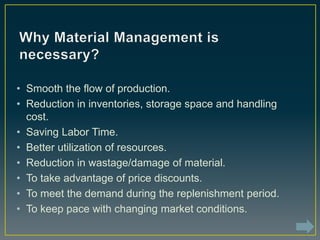
Why MM is Necessary?
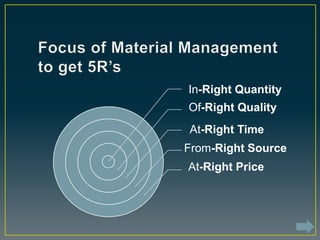
Focus of MM.
Objectives of MM
Main depts. Of MM.
Functions of MM.
a. Production Control
Function (Water Tank
Analogy)
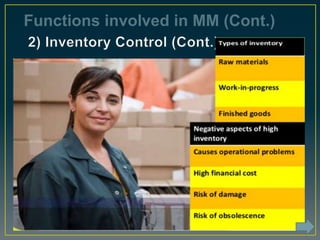
b. Inventory Control
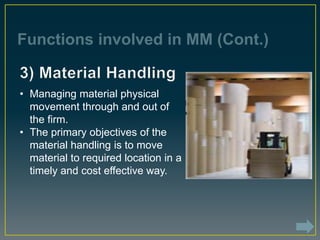
c. Material Handling
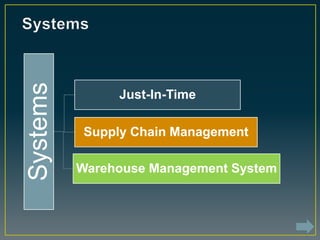
Systems
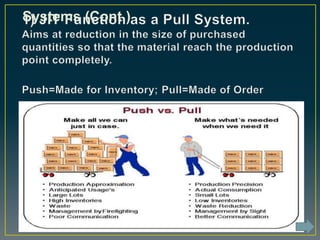
a. JIS
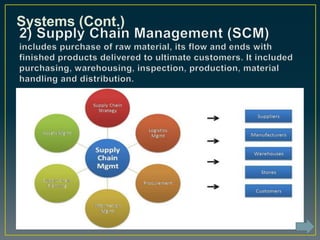
b. SCM
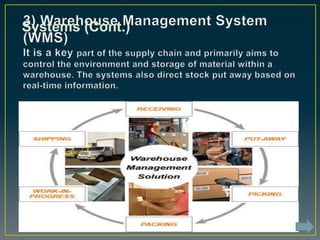
c. WMS
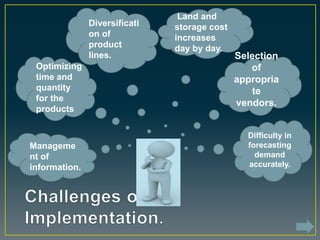
 Challenges for MM
implementation. Q & A Section
 Thank You
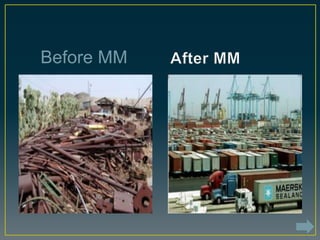
Before MM
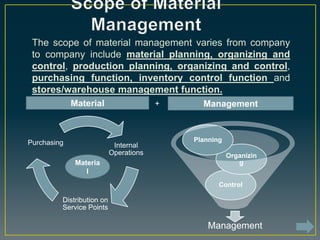
The scope of material management varies from company
to company include material planning, organizing and
control, production planning, organizing and control,
purchasing function, inventory control function and
stores/warehouse management function.
ManagementMaterial +
Internal
Operations
Distribution on
Service Points
Purchasing
Materia
l
Management
Control
Organizin
g
Planning
Consumpti
on & End
Usage
Issuance &
Distribution
Purchasin
g
Receivin
g
Quality
Control
Warehousi
ng &
Storage
Inventor
y
Control
Productio
n
Start
• Smooth the flow of production.
• Reduction in inventories, storage space and handling
cost.
• Saving Labor Time.
• Better utilization of resources.
• Reduction in wastage/damage of material.
• To take advantage of price discounts.
• To meet the demand during the replenishment period.
• To keep pace with changing market conditions.
In-Right Quantity
Of-Right Quality
At-Right Time
From-Right Source
At-Right Price
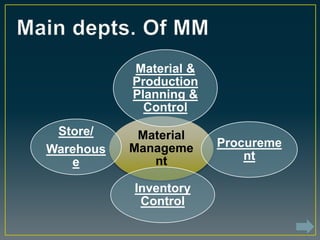
Material
Manageme
nt
Material &
Production
Planning &
Control
Procureme
nt
Inventory
Control
Store/
Warehous
e
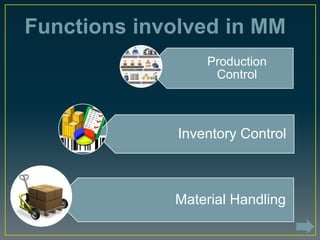
Functions involved in MM
Production
Control
Inventory Control
Material Handling
Functions involved in MM (Cont.)
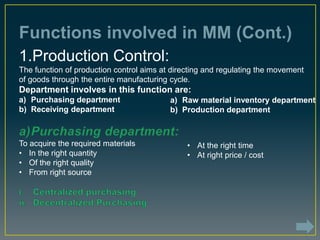
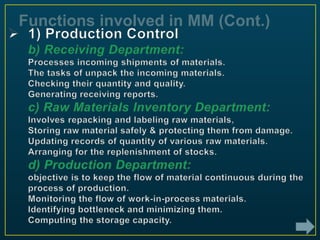
1.Production Control:
The function of production control aims at directing and regulating the movement
of goods through the entire manufacturing cycle.
Department involves in this function are:
a) Purchasing department
b) Receiving department
To acquire the required materials
• In the right quantity
• Of the right quality
• From right source
a) Raw material inventory department
b) Production department
• At the right time
• At right price / cost
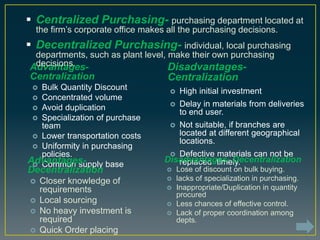
Advantages-
Centralization
 Bulk Quantity Discount
 Concentrated volume
 Avoid duplication
 Specialization of purchase
team
 Lower transportation costs
 Uniformity in purchasing
policies.
 Common supply baseAdvantages-
Decentralization
 Closer knowledge of
requirements
 Local sourcing
 No heavy investment is
required
 Quick Order placing
Disadvantages-
Centralization
 High initial investment
 Delay in materials from deliveries
to end user.
 Not suitable, if branches are
located at different geographical
locations.
 Defective materials can not be
replaced timely.Disadvantages- Decentralization
 Lose of discount on bulk buying.
 lacks of specialization in purchasing.
 Inappropriate/Duplication in quantity
procured
 Less chances of effective control.
 Lack of proper coordination among
depts.
 Centralized Purchasing- purchasing department located at
the firm’s corporate office makes all the purchasing decisions.
 Decentralized Purchasing- individual, local purchasing
departments, such as plant level, make their own purchasing
decisions.
Functions involved in MM (Cont.)
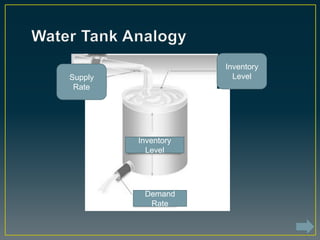
Inventory
LevelSupply
Rate
Inventory
Level
Demand
Rate
Functions involved in MM (Cont.)
• Managing material physical
movement through and out of
the firm.
• The primary objectives of the
material handling is to move
material to required location in a
timely and cost effective way.
Systems
Just-In-Time
Supply Chain Management
Warehouse Management System
Systems (Cont.)
Systems (Cont.)
Systems (Cont.)
Selection
of
appropria
te
vendors.
Difficulty in
forecasting
demand
accurately.
Diversificati
on of
product
lines.
Optimizing
time and
quantity
for the
products
Land and
storage cost
increases
day by day.
Manageme
nt of
information.
Material Management
Material Management

Material Management

  • 2.
    Before MM &After MM Scope of MM. Process of MM. MM Revolves around 5M’s Why MM is Necessary? Focus of MM. Objectives of MM Main depts. Of MM. Functions of MM. a. Production Control Function (Water Tank Analogy) b. Inventory Control c. Material Handling Systems a. JIS b. SCM c. WMS  Challenges for MM implementation. Q & A Section  Thank You
  • 3.
  • 4.
    The scope ofmaterial management varies from company to company include material planning, organizing and control, production planning, organizing and control, purchasing function, inventory control function and stores/warehouse management function. ManagementMaterial + Internal Operations Distribution on Service Points Purchasing Materia l Management Control Organizin g Planning
  • 5.
    Consumpti on & End Usage Issuance& Distribution Purchasin g Receivin g Quality Control Warehousi ng & Storage Inventor y Control Productio n Start
  • 7.
    • Smooth theflow of production. • Reduction in inventories, storage space and handling cost. • Saving Labor Time. • Better utilization of resources. • Reduction in wastage/damage of material. • To take advantage of price discounts. • To meet the demand during the replenishment period. • To keep pace with changing market conditions.
  • 8.
    In-Right Quantity Of-Right Quality At-RightTime From-Right Source At-Right Price
  • 10.
  • 11.
    Functions involved inMM Production Control Inventory Control Material Handling
  • 12.
    Functions involved inMM (Cont.) 1.Production Control: The function of production control aims at directing and regulating the movement of goods through the entire manufacturing cycle. Department involves in this function are: a) Purchasing department b) Receiving department To acquire the required materials • In the right quantity • Of the right quality • From right source a) Raw material inventory department b) Production department • At the right time • At right price / cost
  • 13.
    Advantages- Centralization  Bulk QuantityDiscount  Concentrated volume  Avoid duplication  Specialization of purchase team  Lower transportation costs  Uniformity in purchasing policies.  Common supply baseAdvantages- Decentralization  Closer knowledge of requirements  Local sourcing  No heavy investment is required  Quick Order placing Disadvantages- Centralization  High initial investment  Delay in materials from deliveries to end user.  Not suitable, if branches are located at different geographical locations.  Defective materials can not be replaced timely.Disadvantages- Decentralization  Lose of discount on bulk buying.  lacks of specialization in purchasing.  Inappropriate/Duplication in quantity procured  Less chances of effective control.  Lack of proper coordination among depts.  Centralized Purchasing- purchasing department located at the firm’s corporate office makes all the purchasing decisions.  Decentralized Purchasing- individual, local purchasing departments, such as plant level, make their own purchasing decisions.
  • 14.
  • 15.
  • 16.
  • 17.
  • 18.
    Functions involved inMM (Cont.) • Managing material physical movement through and out of the firm. • The primary objectives of the material handling is to move material to required location in a timely and cost effective way.
  • 19.
  • 20.
  • 21.
  • 22.
  • 23.
    Selection of appropria te vendors. Difficulty in forecasting demand accurately. Diversificati on of product lines. Optimizing timeand quantity for the products Land and storage cost increases day by day. Manageme nt of information.

Editor's Notes

  • #10 In social psychology, reciprocity is a social rule that says we should repay, in kind, what another person has provided us. That is, people give back the kind of treatment they have received from you. By virtue of the rule of reciprocity, we are obligated to repay favors, gifts, invitations, etc. in the future.
  • #16 Analogy means comparison between two things
  • #23 Put away: Internal logistics process from receipt of a load to when it is stocked in its final destination within a warehouse. Picking: order preparation operation is one of a logistics warehousing’ s process
  • #24 Optimized: effective use of resources