AGENDA 
• Material theme 
• Styles 
• Layouts 
• Elevation 
• Widgets 
• Animations
MATERIAL THEME 
The new material theme provides: 
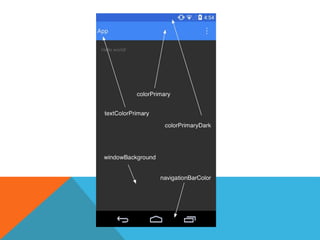
• System widgets that let you set their color palette 
• Touch feedback animations for the system widgets 
• Activity transition animations
The material theme is defined as: 
• @android:style/Theme.Material (dark version) 
• @android:style/Theme.Material.Light (light version) 
• @android:style/Theme.Material.Light.DarkActionBar
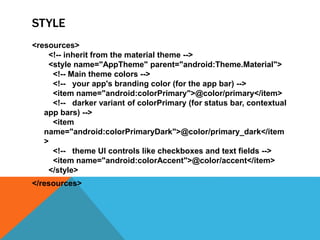
STYLE 
<resources> 
<!-- inherit from the material theme --> 
<style name="AppTheme" parent="android:Theme.Material"> 
<!-- Main theme colors --> 
<!-- your app's branding color (for the app bar) --> 
<item name="android:colorPrimary">@color/primary</item> 
<!-- darker variant of colorPrimary (for status bar, contextual 
app bars) --> 
<item 
name="android:colorPrimaryDark">@color/primary_dark</item 
> 
<!-- theme UI controls like checkboxes and text fields --> 
<item name="android:colorAccent">@color/accent</item> 
</style> 
</resources>
LAYOUTS 
Layouts should conform to the material design guidelines 
• Baseline grids 
• Keylines 
• Spacing 
• Touch target size 
• Layout structure
ELEVATIONS 
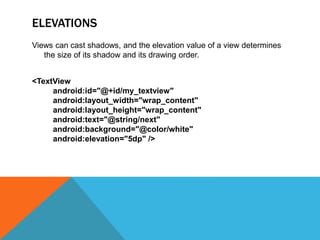
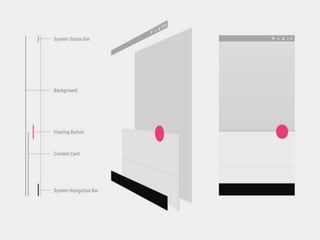
Views can cast shadows, and the elevation value of a view determines 
the size of its shadow and its drawing order. 
<TextView 
android:id="@+id/my_textview" 
android:layout_width="wrap_content" 
android:layout_height="wrap_content" 
android:text="@string/next" 
android:background="@color/white" 
android:elevation="5dp" />
THE Z VALUE 
Z = elevation + translationZ 
To set the elevation of a view: 
In a layout definition, use the android:elevation attribute. 
In the code of an activity, use the View.setElevation method. 
To set the translation of a view, use the View.setTranslationZ method. 
The 
new ViewPropertyAnimator.z and ViewPropertyAnimator.translat 
ionZ 
methods enable you to easily animate the elevation of views.
SHADOWS AND OUTLINES 
The bounds of a view's background drawable determine the default 
shape 
of its shadow 
Outlines represent the outer shape of a graphics object and define the 
ripple area for touch feedback.
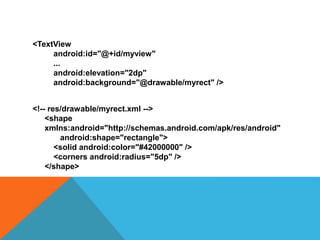
<TextView 
android:id="@+id/myview" 
... 
android:elevation="2dp" 
android:background="@drawable/myrect" /> 
<!-- res/drawable/myrect.xml --> 
<shape 
xmlns:android="http://schemas.android.com/apk/res/android" 
android:shape="rectangle"> 
<solid android:color="#42000000" /> 
<corners android:radius="5dp" /> 
</shape>
You can also create outlines in your code using the methods in 
the Outline class, and you can assign them to views with 
the View.setOutline method. 
To prevent a view from casting a shadow, set its outline to null.
CLIPPING VIEWS 
Clip a view to its outline area using the View.setClipToOutline method. 
Only 
rectangle, circle, and round rectangle outlines support clipping, as 
determined by the Outline.canClip method. 
To clip a view to the shape of a drawable, set the drawable as the 
background of the view (as shown above) and call 
the View.setClipToOutline method. 
Because clipping views is an expensive operation, don't animate the 
shape 
you use to clip a view. To achieve this effect, use a Reveal 
Effect animation.
UI WIDGETS 
Two new widgets 
• RecyclerView 
• CardView 
Available in Android support library
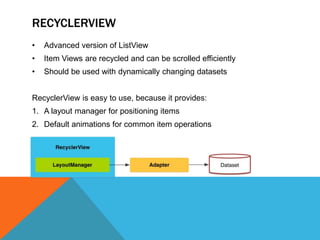
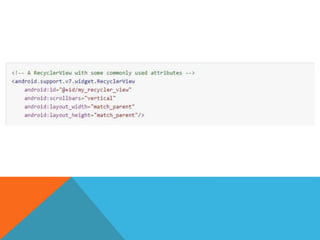
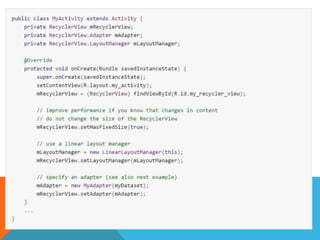
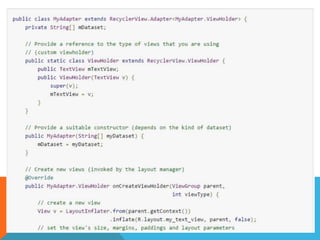
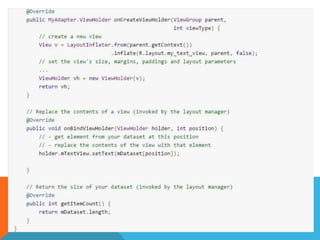
RECYCLERVIEW 
• Advanced version of ListView 
• Item Views are recycled and can be scrolled efficiently 
• Should be used with dynamically changing datasets 
RecyclerView is easy to use, because it provides: 
1. A layout manager for positioning items 
2. Default animations for common item operations
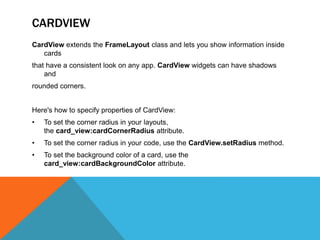
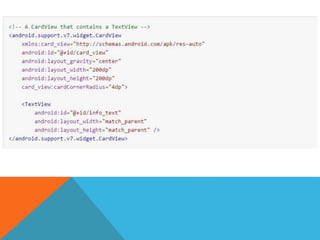
CARDVIEW 
CardView extends the FrameLayout class and lets you show information inside 
cards 
that have a consistent look on any app. CardView widgets can have shadows 
and 
rounded corners. 
Here's how to specify properties of CardView: 
• To set the corner radius in your layouts, 
the card_view:cardCornerRadius attribute. 
• To set the corner radius in your code, use the CardView.setRadius method. 
• To set the background color of a card, use the 
card_view:cardBackgroundColor attribute.
ANIMATIONS 
• Touch feedback 
• Reveal effect 
• Activity transitions 
• Curved motion 
• View state changes
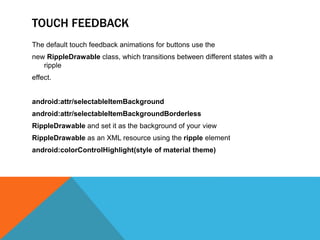
TOUCH FEEDBACK 
The default touch feedback animations for buttons use the 
new RippleDrawable class, which transitions between different states with a 
ripple 
effect. 
android:attr/selectableItemBackground 
android:attr/selectableItemBackgroundBorderless 
RippleDrawable and set it as the background of your view 
RippleDrawable as an XML resource using the ripple element 
android:colorControlHighlight(style of material theme)
REVEAL EFFECT 
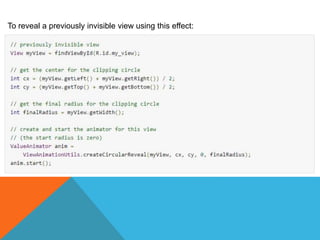
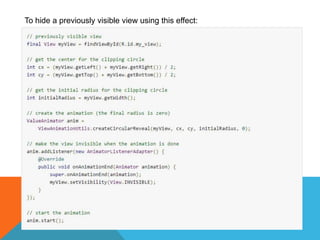
ViewAnimationUtils.createCircularReveal
To reveal a previously invisible view using this effect:
To hide a previously visible view using this effect:
ACTIVITY TRANSITIONS 
• enter transition 
• exit transition 
• shared elements transition 
The Android L Developer Preview supports these enter and exit transitions: 
• explode - Moves views in or out from the center of the scene. 
• slide - Moves views in or out from one of the edges of the scene. 
• fade - Moves views in or out of the scene.
The Android L Developer Preview also supports these shared elements 
transitions: 
• changeBounds - Animates the changes in layout bounds of target views. 
• changeClipBounds - Animates the changes in clip bounds of target views. 
• changeTransform - Animates the changes in scale and rotation of target 
views. 
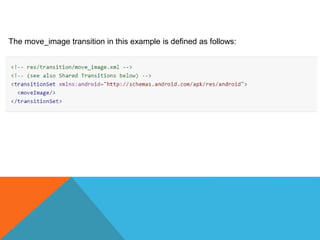
• moveImage - Animates changes in size and scale type for an image view.
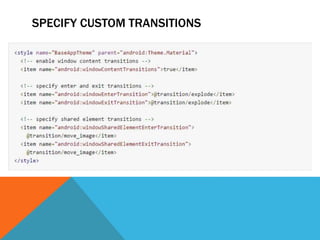
SPECIFY CUSTOM TRANSITIONS
The move_image transition in this example is defined as follows:
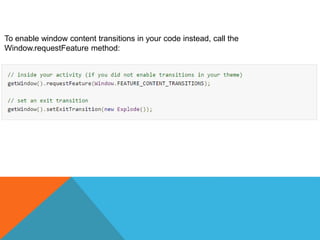
To enable window content transitions in your code instead, call the 
Window.requestFeature method:
To specify transitions in your code, call these methods with a Transition 
object: 
• Window.setEnterTransition 
• Window.setExitTransition 
• Window.setSharedElementEnterTransition 
• Window.setSharedElementExitTransition 
The transition is activated when you launch another activity with 
the startActivity method.
SHARED ELEMENTS TRANSITIONS 
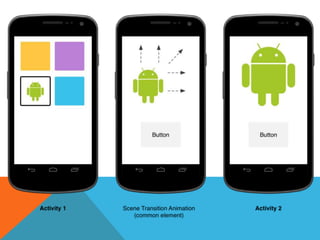
To make a screen transition animation between two activities that have a shared 
element: 
• Enable window content transitions in your style. 
• Specify a shared elements transition in your style. 
• Define your transition as an XML resource. 
• Assign a common name to the shared elements in both layouts with 
the android:viewName attribute. 
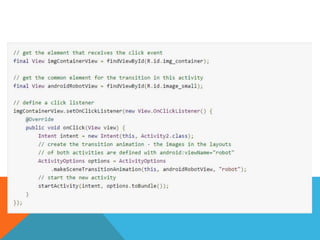
• Use the ActivityOptions.makeSceneTransitionAnimation method.
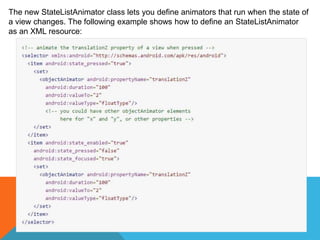
ANIMATING VIEW STATE CHANGES 
The new StateListAnimator class lets you define animators that run when the 
state of 
a view changes. The following example shows how to define an 
StateListAnimator as 
an XML resource
The new StateListAnimator class lets you define animators that run when the state of 
a view changes. The following example shows how to define an StateListAnimator 
as an XML resource:
EXTRACTING PROMINENT COLORS FROM AN IMAGE 
The Android L Developer Preview Support Library includes the Palette 
class 
This class extracts the following prominent colors: 
• Vibrant 
• Vibrant dark 
• Vibrant light 
• Muted 
• Muted dark 
• Muted light 
Palette.generate 
Palette.generateAsync 
Palette.getVibrantColor
REFERENCES 
https://developer.android.com/preview/material/index.html 
http://www.google.com/design/spec/material-design/introduction.html

Material Design Android

  • 2.
    AGENDA • Materialtheme • Styles • Layouts • Elevation • Widgets • Animations
  • 3.
    MATERIAL THEME Thenew material theme provides: • System widgets that let you set their color palette • Touch feedback animations for the system widgets • Activity transition animations
  • 4.
    The material themeis defined as: • @android:style/Theme.Material (dark version) • @android:style/Theme.Material.Light (light version) • @android:style/Theme.Material.Light.DarkActionBar
  • 5.
    STYLE <resources> <!--inherit from the material theme --> <style name="AppTheme" parent="android:Theme.Material"> <!-- Main theme colors --> <!-- your app's branding color (for the app bar) --> <item name="android:colorPrimary">@color/primary</item> <!-- darker variant of colorPrimary (for status bar, contextual app bars) --> <item name="android:colorPrimaryDark">@color/primary_dark</item > <!-- theme UI controls like checkboxes and text fields --> <item name="android:colorAccent">@color/accent</item> </style> </resources>
  • 7.
    LAYOUTS Layouts shouldconform to the material design guidelines • Baseline grids • Keylines • Spacing • Touch target size • Layout structure
  • 8.
    ELEVATIONS Views cancast shadows, and the elevation value of a view determines the size of its shadow and its drawing order. <TextView android:id="@+id/my_textview" android:layout_width="wrap_content" android:layout_height="wrap_content" android:text="@string/next" android:background="@color/white" android:elevation="5dp" />
  • 10.
    THE Z VALUE Z = elevation + translationZ To set the elevation of a view: In a layout definition, use the android:elevation attribute. In the code of an activity, use the View.setElevation method. To set the translation of a view, use the View.setTranslationZ method. The new ViewPropertyAnimator.z and ViewPropertyAnimator.translat ionZ methods enable you to easily animate the elevation of views.
  • 11.
    SHADOWS AND OUTLINES The bounds of a view's background drawable determine the default shape of its shadow Outlines represent the outer shape of a graphics object and define the ripple area for touch feedback.
  • 12.
    <TextView android:id="@+id/myview" ... android:elevation="2dp" android:background="@drawable/myrect" /> <!-- res/drawable/myrect.xml --> <shape xmlns:android="http://schemas.android.com/apk/res/android" android:shape="rectangle"> <solid android:color="#42000000" /> <corners android:radius="5dp" /> </shape>
  • 13.
    You can alsocreate outlines in your code using the methods in the Outline class, and you can assign them to views with the View.setOutline method. To prevent a view from casting a shadow, set its outline to null.
  • 14.
    CLIPPING VIEWS Clipa view to its outline area using the View.setClipToOutline method. Only rectangle, circle, and round rectangle outlines support clipping, as determined by the Outline.canClip method. To clip a view to the shape of a drawable, set the drawable as the background of the view (as shown above) and call the View.setClipToOutline method. Because clipping views is an expensive operation, don't animate the shape you use to clip a view. To achieve this effect, use a Reveal Effect animation.
  • 15.
    UI WIDGETS Twonew widgets • RecyclerView • CardView Available in Android support library
  • 16.
    RECYCLERVIEW • Advancedversion of ListView • Item Views are recycled and can be scrolled efficiently • Should be used with dynamically changing datasets RecyclerView is easy to use, because it provides: 1. A layout manager for positioning items 2. Default animations for common item operations
  • 21.
    CARDVIEW CardView extendsthe FrameLayout class and lets you show information inside cards that have a consistent look on any app. CardView widgets can have shadows and rounded corners. Here's how to specify properties of CardView: • To set the corner radius in your layouts, the card_view:cardCornerRadius attribute. • To set the corner radius in your code, use the CardView.setRadius method. • To set the background color of a card, use the card_view:cardBackgroundColor attribute.
  • 23.
    ANIMATIONS • Touchfeedback • Reveal effect • Activity transitions • Curved motion • View state changes
  • 24.
    TOUCH FEEDBACK Thedefault touch feedback animations for buttons use the new RippleDrawable class, which transitions between different states with a ripple effect. android:attr/selectableItemBackground android:attr/selectableItemBackgroundBorderless RippleDrawable and set it as the background of your view RippleDrawable as an XML resource using the ripple element android:colorControlHighlight(style of material theme)
  • 25.
  • 26.
    To reveal apreviously invisible view using this effect:
  • 27.
    To hide apreviously visible view using this effect:
  • 28.
    ACTIVITY TRANSITIONS •enter transition • exit transition • shared elements transition The Android L Developer Preview supports these enter and exit transitions: • explode - Moves views in or out from the center of the scene. • slide - Moves views in or out from one of the edges of the scene. • fade - Moves views in or out of the scene.
  • 29.
    The Android LDeveloper Preview also supports these shared elements transitions: • changeBounds - Animates the changes in layout bounds of target views. • changeClipBounds - Animates the changes in clip bounds of target views. • changeTransform - Animates the changes in scale and rotation of target views. • moveImage - Animates changes in size and scale type for an image view.
  • 31.
  • 32.
    The move_image transitionin this example is defined as follows:
  • 33.
    To enable windowcontent transitions in your code instead, call the Window.requestFeature method:
  • 34.
    To specify transitionsin your code, call these methods with a Transition object: • Window.setEnterTransition • Window.setExitTransition • Window.setSharedElementEnterTransition • Window.setSharedElementExitTransition The transition is activated when you launch another activity with the startActivity method.
  • 35.
    SHARED ELEMENTS TRANSITIONS To make a screen transition animation between two activities that have a shared element: • Enable window content transitions in your style. • Specify a shared elements transition in your style. • Define your transition as an XML resource. • Assign a common name to the shared elements in both layouts with the android:viewName attribute. • Use the ActivityOptions.makeSceneTransitionAnimation method.
  • 37.
    ANIMATING VIEW STATECHANGES The new StateListAnimator class lets you define animators that run when the state of a view changes. The following example shows how to define an StateListAnimator as an XML resource
  • 38.
    The new StateListAnimatorclass lets you define animators that run when the state of a view changes. The following example shows how to define an StateListAnimator as an XML resource:
  • 39.
    EXTRACTING PROMINENT COLORSFROM AN IMAGE The Android L Developer Preview Support Library includes the Palette class This class extracts the following prominent colors: • Vibrant • Vibrant dark • Vibrant light • Muted • Muted dark • Muted light Palette.generate Palette.generateAsync Palette.getVibrantColor
  • 40.