Instructional Material
Development for Science
Education & Technology in
Elementary Science
Education
Instructional materials play an
important role in the teaching-learning
process. Instruction is improved and
learning is enriched and become more
meaningful with the use of modern
instructional methods and materials..
Instructional materials print and
non-print items that are related to
impact information to students in
the educational process.
(Effiong & Igiri, 2015).
Instructional materials
provide the core
information that
students will experience,
learn, and apply during a
course. They hold the
power to either engage
or demotivate students.
Therefore, such materials
must be carefully planned,
selected, organized, refined,
and used in a course for the
maximum effect. The
planning and selection of
instructional materials should
take into consideration both
the breadth and depth of
content so that student
learning is optimized.
Instructional materials are defined as resources
that organize and support instruction, such as
textbooks, tasks, and supplementary resources
(adapted from Remillard & Heck, 2014).
It refers to the human and non-human materials and
facilities that can be used to ease, encourage,
improve and promote teaching and learning
activities.
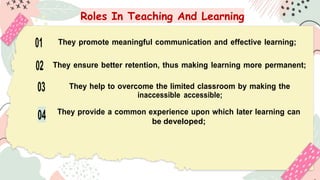
Roles In Teaching And Learning
01 They promote meaningful communication and effective learning;
02 They ensure better retention, thus making learning more permanent;
03 They help to overcome the limited classroom by making the
inaccessible accessible;
They provide a common experience upon which later learning can
be developed;
04
Different Types of
Instructional
Materials for
Science Education
Writing Board
⮚ Can display information written with chalk
(chalkboard or blackboard) or special pens
(whiteboard).
⮚It is a convenient writing area where illustrations can
instantly be drawn even during a discussion. An eraser
can easily keep it clean and ready for continuous use.
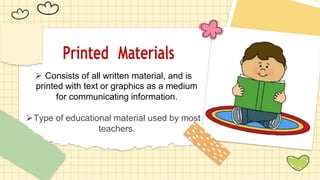
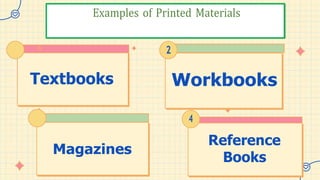
Printed Materials
⮚ Consists of all written material, and is
printed with text or graphics as a medium
for communicating information.
⮚Type of educational material used by most
teachers.
Magazines
Textbooks
Reference
Books
2
Workbooks
4
Examples of Printed Materials
1
3
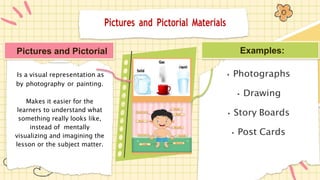
Pictures and Pictorial Materials
Is a visual representation as
by photography or painting.
Makes it easier for the
learners to understand what
something really looks like,
instead of mentally
visualizing and imagining the
lesson or the subject matter.
 Photographs
 Drawing
 Story Boards
 Post Cards
Examples:
Pictures and Pictorial
Realia/Real Object
 Solid, physical objects that can
be brought into a classroom to
be examined.
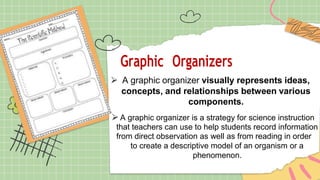
Graphic Organizers
⮚ A graphic organizer visually represents ideas,
concepts, and relationships between various
components.
⮚A graphic organizer is a strategy for science instruction
that teachers can use to help students record information
from direct observation as well as from reading in order
to create a descriptive model of an organism or a
phenomenon.
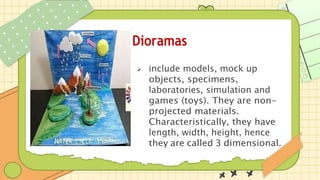
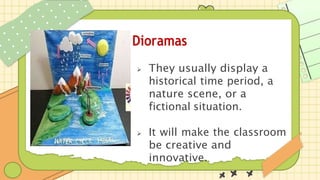
Dioramas
 include models, mock up
objects, specimens,
laboratories, simulation and
games (toys). They are non-
projected materials.
Characteristically, they have
length, width, height, hence
they are called 3 dimensional.
Dioramas
 They usually display a
historical time period, a
nature scene, or a
fictional situation.
 It will make the classroom
be creative and
innovative.
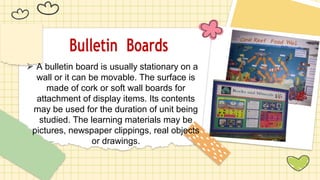
Bulletin Boards
⮚ A bulletin board is usually stationary on a
wall or it can be movable. The surface is
made of cork or soft wall boards for
attachment of display items. Its contents
may be used for the duration of unit being
studied. The learning materials may be
pictures, newspaper clippings, real objects
or drawings.
Using
Technology in
Elementary
Science
Education
 The science classroom provides a perfect environment to help
students develop the technological knowledge and skills they will
need for the rest of their lives. Learning how to operate machines used
for science experiments will help future mechanical engineers in their
pursuits.
 An architect will employ modeling software similar to modeling
programs used to design scientific experiments. And beyond future
employment opportunities, these forms of literacy will help students
make informed decisions as both consumers and global citizens.
01
Teachers can also use technology
to engage and instruct students
with learning or cognitive
disabilities.
02
Science teachers can use many modern technologies
to great effect in the classroom. Computer software
and tablet apps have obvious applications in
classroom activities, but the technologies inherent in
automated cameras, LCDs and experiment monitoring
systems can also aid in science education.
03
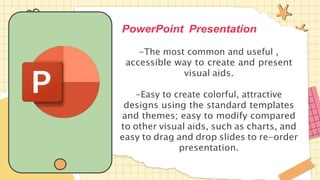
PowerPoint Presentation
-The most common and useful ,
accessible way to create and present
visual aids.
-Easy to create colorful, attractive
designs using the standard templates
and themes; easy to modify compared
to other visual aids, such as charts, and
easy to drag and drop slides to re-order
presentation.
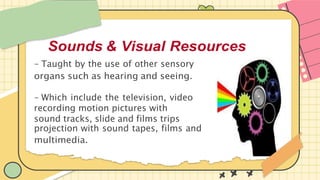
& Visual Resources
- Taught by the use of other sensory
organs such as hearing and seeing.
- Which include the television, video
recording motion pictures with
sound tracks, slide and films trips
projection with sound tapes, films and
multimedia.
Sounds
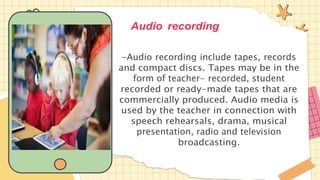
Audio recording
-Audio recording include tapes, records
and compact discs. Tapes may be in the
form of teacher- recorded, student
recorded or ready-made tapes that are
commercially produced. Audio media is
used by the teacher in connection with
speech rehearsals, drama, musical
presentation, radio and television
broadcasting.
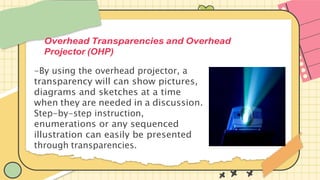
Overhead Transparencies and Overhead
Projector (OHP)
-By using the overhead projector, a
transparency will can show pictures,
diagrams and sketches at a time
when they are needed in a discussion.
Step-by-step instruction,
enumerations or any sequenced
illustration can easily be presented
through transparencies.
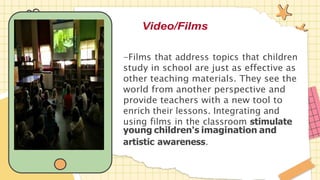
Video/Films
-Films that address topics that children
study in school are just as effective as
other teaching materials. They see the
world from another perspective and
provide teachers with a new tool to
enrich their lessons. Integrating and
using films in the classroom stimulate
young children's imagination and
artistic awareness.
Thank you for
listening! ☺
CREDITS: This presentation template was created by Slidesgo,
including icons by Flaticon, and infographics & images by Freepik

Material

  • 1.
    Instructional Material Development forScience Education & Technology in Elementary Science Education
  • 2.
    Instructional materials playan important role in the teaching-learning process. Instruction is improved and learning is enriched and become more meaningful with the use of modern instructional methods and materials..
  • 3.
    Instructional materials printand non-print items that are related to impact information to students in the educational process. (Effiong & Igiri, 2015).
  • 4.
    Instructional materials provide thecore information that students will experience, learn, and apply during a course. They hold the power to either engage or demotivate students. Therefore, such materials must be carefully planned, selected, organized, refined, and used in a course for the maximum effect. The planning and selection of instructional materials should take into consideration both the breadth and depth of content so that student learning is optimized.
  • 5.
    Instructional materials aredefined as resources that organize and support instruction, such as textbooks, tasks, and supplementary resources (adapted from Remillard & Heck, 2014). It refers to the human and non-human materials and facilities that can be used to ease, encourage, improve and promote teaching and learning activities.
  • 6.
    Roles In TeachingAnd Learning 01 They promote meaningful communication and effective learning; 02 They ensure better retention, thus making learning more permanent; 03 They help to overcome the limited classroom by making the inaccessible accessible; They provide a common experience upon which later learning can be developed; 04
  • 7.
  • 8.
    Writing Board ⮚ Candisplay information written with chalk (chalkboard or blackboard) or special pens (whiteboard). ⮚It is a convenient writing area where illustrations can instantly be drawn even during a discussion. An eraser can easily keep it clean and ready for continuous use.
  • 9.
    Printed Materials ⮚ Consistsof all written material, and is printed with text or graphics as a medium for communicating information. ⮚Type of educational material used by most teachers.
  • 10.
  • 11.
    Pictures and PictorialMaterials Is a visual representation as by photography or painting. Makes it easier for the learners to understand what something really looks like, instead of mentally visualizing and imagining the lesson or the subject matter.  Photographs  Drawing  Story Boards  Post Cards Examples: Pictures and Pictorial
  • 12.
    Realia/Real Object  Solid,physical objects that can be brought into a classroom to be examined.
  • 13.
    Graphic Organizers ⮚ Agraphic organizer visually represents ideas, concepts, and relationships between various components. ⮚A graphic organizer is a strategy for science instruction that teachers can use to help students record information from direct observation as well as from reading in order to create a descriptive model of an organism or a phenomenon.
  • 14.
    Dioramas  include models,mock up objects, specimens, laboratories, simulation and games (toys). They are non- projected materials. Characteristically, they have length, width, height, hence they are called 3 dimensional.
  • 15.
    Dioramas  They usuallydisplay a historical time period, a nature scene, or a fictional situation.  It will make the classroom be creative and innovative.
  • 16.
    Bulletin Boards ⮚ Abulletin board is usually stationary on a wall or it can be movable. The surface is made of cork or soft wall boards for attachment of display items. Its contents may be used for the duration of unit being studied. The learning materials may be pictures, newspaper clippings, real objects or drawings.
  • 17.
  • 18.
     The scienceclassroom provides a perfect environment to help students develop the technological knowledge and skills they will need for the rest of their lives. Learning how to operate machines used for science experiments will help future mechanical engineers in their pursuits.  An architect will employ modeling software similar to modeling programs used to design scientific experiments. And beyond future employment opportunities, these forms of literacy will help students make informed decisions as both consumers and global citizens. 01
  • 19.
    Teachers can alsouse technology to engage and instruct students with learning or cognitive disabilities. 02
  • 20.
    Science teachers canuse many modern technologies to great effect in the classroom. Computer software and tablet apps have obvious applications in classroom activities, but the technologies inherent in automated cameras, LCDs and experiment monitoring systems can also aid in science education. 03
  • 21.
    PowerPoint Presentation -The mostcommon and useful , accessible way to create and present visual aids. -Easy to create colorful, attractive designs using the standard templates and themes; easy to modify compared to other visual aids, such as charts, and easy to drag and drop slides to re-order presentation.
  • 22.
    & Visual Resources -Taught by the use of other sensory organs such as hearing and seeing. - Which include the television, video recording motion pictures with sound tracks, slide and films trips projection with sound tapes, films and multimedia. Sounds
  • 23.
    Audio recording -Audio recordinginclude tapes, records and compact discs. Tapes may be in the form of teacher- recorded, student recorded or ready-made tapes that are commercially produced. Audio media is used by the teacher in connection with speech rehearsals, drama, musical presentation, radio and television broadcasting.
  • 24.
    Overhead Transparencies andOverhead Projector (OHP) -By using the overhead projector, a transparency will can show pictures, diagrams and sketches at a time when they are needed in a discussion. Step-by-step instruction, enumerations or any sequenced illustration can easily be presented through transparencies.
  • 25.
    Video/Films -Films that addresstopics that children study in school are just as effective as other teaching materials. They see the world from another perspective and provide teachers with a new tool to enrich their lessons. Integrating and using films in the classroom stimulate young children's imagination and artistic awareness.
  • 26.
    Thank you for listening!☺ CREDITS: This presentation template was created by Slidesgo, including icons by Flaticon, and infographics & images by Freepik