Types and Characteristics of
Instructional Materials
Prepared by: Marianne C. Beltran
ACTIVITY!
“ I HAVE A
________________,
I HAVE A
_________________.”
= ___________
READINGS
• Written material intended to be
read.
Types of Readings
• Textbooks Magazines
• Comics
• Newspapers
• Play Scripts
• Journals
• Articles
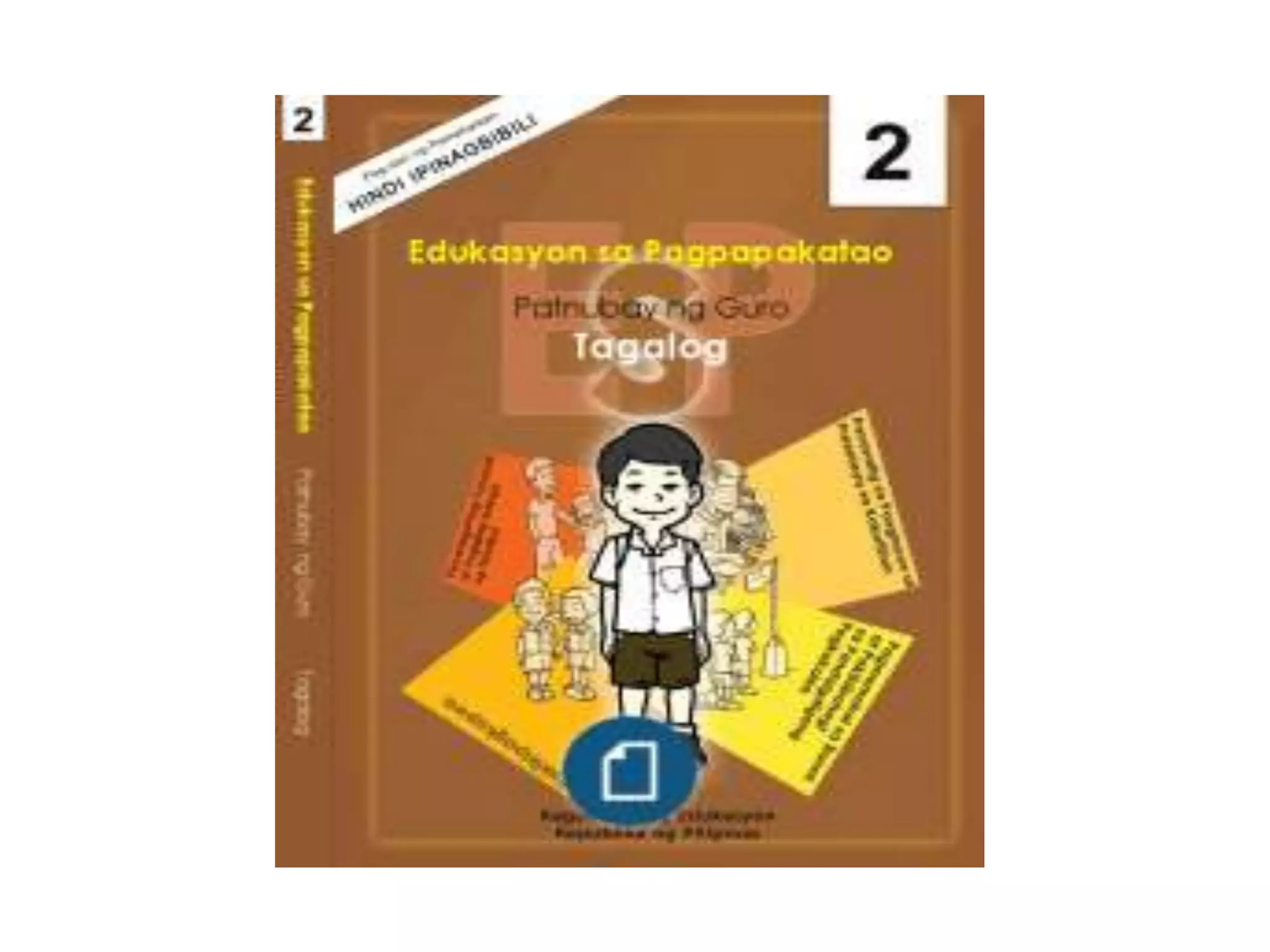
Example of Reading Materials
Importance of Reading
Materials
• It is possible for students to
review and prepare their
lessons. Also, students can
follow the discussion using
reading materials.
Keys on Helping Students Read
Difficult Texts
1. Preview and Build Anticipation
2. Set Purpose
3. Synthesize Along the Way
4. Ask Questions
5. Explain
SYLLABUS
• Outlines the goals and objectives
of a course, prerequisites, the
grading/evaluation scheme,
materials to be used (textbooks,
software), topics to be covered, a
schedule and a bibliography.
Types of Syllabus
• Synthetic Syllabus
• Analytic Syllabus
Importance of Syllabus
• It will help students know what
is expected from them from the
start of the course, and the
syllabus will allow them to plan
their semester efficiently.
Creating an Effective
Syllabus
1. Set the tone for the course.
2. Communicate what, when and how
students will learn.
3. Communicate what students need to
do in order to succeed in the course.
4. Communicate expectations in terms
of the students’ responsibilities.
5. Deter misunderstandings about
course policies.
ASSIGNMENT FILES
• It is an assessment tool that
allows the teacher to specify a
task that requires students to
prepare digital content (any
format) and submit it by
uploading it to the server.
Types of Assignment Files
• Online Text
• Upload a single file
• Advanced uploading of files
• Offline assignment
Importance of Assignment
Files
• It is convenient for the students
and teachers use this assessment
tool in assessing specific tasks
using technology.
Assessing Assignments
• The learning assignment tool
allows the participants to
submit answers individually or
in groups. When assessing, the
teachers can assess individual
participants or several
participants at the same time.
RUBRICS
• A scoring and instructional tool
used to assess student
performance using a task-
specific range or set of criteria.
Types of Rubric
• Analytic
• Holistic
• General
• Task-Specific
Example of Rubrics
Importance of Rubrics
• Rubrics help teachers teach and
coordinate instruction and
assessment, it also help
students learn.
Creating a Rubric
1. Define your assignment or
project.
2. Decide on a scale of
performance.
3. Identify the criteria of the
task.
4. Describe the performance
of each criterion.
HANDOUTS
• A paper based resource used to
support teaching and learning
which can free students from
excessive note taking or
supplement information not
easily available elsewhere.
Types of Handout
• Uncompleted or Gapped
Handout
• Skeletal Notes
• Worksheets
• Assessment Criteria
• Information Sheets
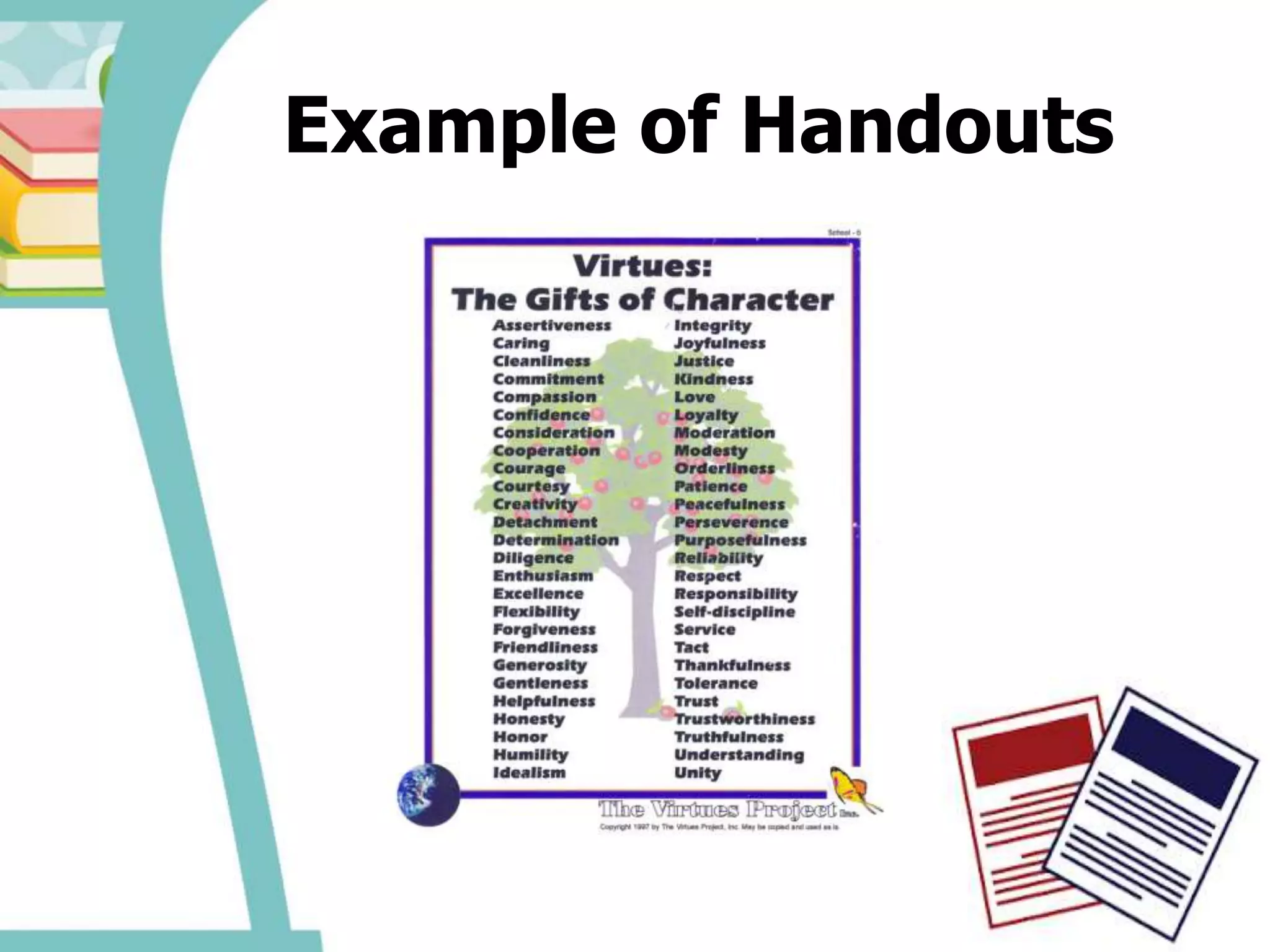
Example of Handouts
Importance of Handouts
• Handout serves as a summary of your key
points. They allow you to provide more
detailed information than you would put
on a slide. It gives your audience
something to take away from your
presentation, to review later and it is one
more way for the listeners to be reminded
of you and your key messages.
General Principles on the
Production of Handouts
• Reading handouts
• Use the what, how, why, when
and where questions as
appropriate.
• Avoid long, dense handouts.
• Make sure the appearance of
the material is up to standard.
• Consult the guidelines which
are displayed by photocopiers.
• Print size.
Thank You!
References:
• http://totalcommunicator.com/vol4_1/handouts.html
• http://www.ladybugsteacherfiles.com/2010/12/important-files-
organization.html
• http://edglossary.org/rubric/
• http://www.ascd.org/publications/books/112001/chapters/What-Are-Rubrics-
and-Why-Are-They-Important%C2%A2.aspx
• https://www.lavc.edu/profdev/library/docs/utilizingrubrics.aspx
• https://prezi.com/pg3t3zwzklch/week-2-types-of-syllabus/
• http://www.cmu.edu/teaching/designteach/design/syllabus/
• http://www.asu.edu/cfa/wwwcourses/art/SOACore/syllabus_definition.htm
• By Allison McDonald. (n.d.). 15 Reading Materials That Aren't Books. Retrieved October 12, 2016, from
http://www.scholastic.com/parents/blogs/scholastic-parents-raise-reader/15-reading-materials-arent-books
• Center for Teaching & Learning. (n.d.). Retrieved October 12, 2016, from http://ctl.byu.edu/tip/five-keys-
helping-students-read-difficult-texts
• COMICS ABOUT values - Google Search. (n.d.). Retrieved October 12, 2016, from
https://www.google.com.ph/search?q=COMICS ABOUT values
• Who Am I? ( Values Education Sample Lesson Plan for All School Levels. (1970). Retrieved October 12,
2016, from http://thefilipinoteacher.blogspot.com/2011/05/who-am-i-values-education-sample-lesson.html
• Lorren Piñera, Professional Teacher at Alcastle Educational School Inc. Follow. (2013). Types of lesson plan.
Retrieved October 12, 2016, from http://www.slideshare.net/lorren0207/types-of-lesson-plan
• Strategies for Effective Lesson Planning. (n.d.). Retrieved October 12, 2016, from
http://www.crlt.umich.edu/gsis/p2_5
• Introduction. (n.d.). Retrieved October 12, 2016, from
http://www2.wmin.ac.uk/mcshand/TEACHING/handouts
• @. (2013). Rubric Definition. Retrieved October 12, 2016, from http://edglossary.org/rubric/
• A. (n.d.). Chapter 1. What Are Rubrics and Why Are They Important? Retrieved October 12, 2016, from
http://www.ascd.org/publications/books/112001/chapters/What-Are-Rubrics-and-Why-Are-They-
Important¢.aspx
• University, C. M. (n.d.). The Syllabus-Teaching Excellence & Educational Innovation -
Carnegie Mellon University. Retrieved October 12, 2016, from
http://www.cmu.edu/teaching/designteach/design/syllabus/
• Syllabus definition. (n.d.). Retrieved October 12, 2016, from
http://www.asu.edu/cfa/wwwcourses/art/SOACore/syllabus_definition.htm
• Writing a Syllabus. (n.d.). Retrieved October 12, 2016, from
https://www.cte.cornell.edu/teaching-ideas/designing-your-course/writing-a-syllabus.html
• Llagas, R. (1970). COURSE SYLLABUS IN Values Education (Personhood Development).
Retrieved October 12, 2016, from http://suhayfilipino.blogspot.com/2014/03/course-
syllabus-in-values-education.html
• VALUES EDUCATION SYLLABUS. (n.d.). Retrieved October 12, 2016, from
https://www.scribd.com/doc/153055024/VALUES-EDUCATION-SYLLABUS
• Centre, J. V. (1970). Syllabus for the Value Education course to be introduced in UPTU
Colleges. Retrieved October 12, 2016, from
http://jeevanvidyastudycentre.blogspot.com/2009/12/syllabus-for-value-education-course-
to.html
• Gibbs G, Habeshaw S et al (1995) 53 Interesting things to do in your lectures (TES)
• McShane, Dalene (1998) Presenting Information Visually (EIC Guide)
• By asking yourself these questions at the onset of your course design process you will be
able to focus more concretely on learning outcomes, which has proven to increase student
learning substantially as opposed to merely shoehorning large quantities of content into a
quarters worth of class meetings. (n.d.). Course and syllabus design. Retrieved October 12,
2016, from http://www.washington.edu/teaching/teaching-resources/preparing-to-
teach/designing-your-course-and-syllabus/
• SAMPLE HANDOUTS ABOUT VALUES EDUCATION - Google Search. (n.d.). Retrieved October
12, 2016, from https://www.google.com.ph/search?q=SAMPLE HANDOUTS ABOUT VALUES
EDUCATION
• DIVERSITY. Talking about values. (n.d.). Retrieved October 12, 2016, from
http://www.eslprintables.com/vocabulary_worksheets/education/social_values/DIVERSITY_
Talking_about_value_646163/

Types and Characteristics of Instructional Materials

  • 1.
    Types and Characteristicsof Instructional Materials Prepared by: Marianne C. Beltran
  • 2.
    ACTIVITY! “ I HAVEA ________________, I HAVE A _________________.” = ___________
  • 3.
    READINGS • Written materialintended to be read.
  • 4.
    Types of Readings •Textbooks Magazines • Comics • Newspapers • Play Scripts • Journals • Articles
  • 5.
  • 7.
    Importance of Reading Materials •It is possible for students to review and prepare their lessons. Also, students can follow the discussion using reading materials.
  • 8.
    Keys on HelpingStudents Read Difficult Texts 1. Preview and Build Anticipation 2. Set Purpose 3. Synthesize Along the Way 4. Ask Questions 5. Explain
  • 9.
    SYLLABUS • Outlines thegoals and objectives of a course, prerequisites, the grading/evaluation scheme, materials to be used (textbooks, software), topics to be covered, a schedule and a bibliography.
  • 10.
    Types of Syllabus •Synthetic Syllabus • Analytic Syllabus
  • 11.
    Importance of Syllabus •It will help students know what is expected from them from the start of the course, and the syllabus will allow them to plan their semester efficiently.
  • 12.
    Creating an Effective Syllabus 1.Set the tone for the course. 2. Communicate what, when and how students will learn. 3. Communicate what students need to do in order to succeed in the course. 4. Communicate expectations in terms of the students’ responsibilities. 5. Deter misunderstandings about course policies.
  • 13.
    ASSIGNMENT FILES • Itis an assessment tool that allows the teacher to specify a task that requires students to prepare digital content (any format) and submit it by uploading it to the server.
  • 14.
    Types of AssignmentFiles • Online Text • Upload a single file • Advanced uploading of files • Offline assignment
  • 15.
    Importance of Assignment Files •It is convenient for the students and teachers use this assessment tool in assessing specific tasks using technology.
  • 16.
    Assessing Assignments • Thelearning assignment tool allows the participants to submit answers individually or in groups. When assessing, the teachers can assess individual participants or several participants at the same time.
  • 17.
    RUBRICS • A scoringand instructional tool used to assess student performance using a task- specific range or set of criteria.
  • 18.
    Types of Rubric •Analytic • Holistic • General • Task-Specific
  • 19.
  • 20.
    Importance of Rubrics •Rubrics help teachers teach and coordinate instruction and assessment, it also help students learn.
  • 21.
    Creating a Rubric 1.Define your assignment or project. 2. Decide on a scale of performance. 3. Identify the criteria of the task. 4. Describe the performance of each criterion.
  • 22.
    HANDOUTS • A paperbased resource used to support teaching and learning which can free students from excessive note taking or supplement information not easily available elsewhere.
  • 23.
    Types of Handout •Uncompleted or Gapped Handout • Skeletal Notes • Worksheets • Assessment Criteria • Information Sheets
  • 24.
  • 25.
    Importance of Handouts •Handout serves as a summary of your key points. They allow you to provide more detailed information than you would put on a slide. It gives your audience something to take away from your presentation, to review later and it is one more way for the listeners to be reminded of you and your key messages.
  • 26.
    General Principles onthe Production of Handouts • Reading handouts • Use the what, how, why, when and where questions as appropriate. • Avoid long, dense handouts. • Make sure the appearance of the material is up to standard. • Consult the guidelines which are displayed by photocopiers. • Print size.
  • 27.
  • 28.
    References: • http://totalcommunicator.com/vol4_1/handouts.html • http://www.ladybugsteacherfiles.com/2010/12/important-files- organization.html •http://edglossary.org/rubric/ • http://www.ascd.org/publications/books/112001/chapters/What-Are-Rubrics- and-Why-Are-They-Important%C2%A2.aspx • https://www.lavc.edu/profdev/library/docs/utilizingrubrics.aspx • https://prezi.com/pg3t3zwzklch/week-2-types-of-syllabus/ • http://www.cmu.edu/teaching/designteach/design/syllabus/ • http://www.asu.edu/cfa/wwwcourses/art/SOACore/syllabus_definition.htm
  • 29.
    • By AllisonMcDonald. (n.d.). 15 Reading Materials That Aren't Books. Retrieved October 12, 2016, from http://www.scholastic.com/parents/blogs/scholastic-parents-raise-reader/15-reading-materials-arent-books • Center for Teaching & Learning. (n.d.). Retrieved October 12, 2016, from http://ctl.byu.edu/tip/five-keys- helping-students-read-difficult-texts • COMICS ABOUT values - Google Search. (n.d.). Retrieved October 12, 2016, from https://www.google.com.ph/search?q=COMICS ABOUT values • Who Am I? ( Values Education Sample Lesson Plan for All School Levels. (1970). Retrieved October 12, 2016, from http://thefilipinoteacher.blogspot.com/2011/05/who-am-i-values-education-sample-lesson.html • Lorren Piñera, Professional Teacher at Alcastle Educational School Inc. Follow. (2013). Types of lesson plan. Retrieved October 12, 2016, from http://www.slideshare.net/lorren0207/types-of-lesson-plan • Strategies for Effective Lesson Planning. (n.d.). Retrieved October 12, 2016, from http://www.crlt.umich.edu/gsis/p2_5 • Introduction. (n.d.). Retrieved October 12, 2016, from http://www2.wmin.ac.uk/mcshand/TEACHING/handouts • @. (2013). Rubric Definition. Retrieved October 12, 2016, from http://edglossary.org/rubric/ • A. (n.d.). Chapter 1. What Are Rubrics and Why Are They Important? Retrieved October 12, 2016, from http://www.ascd.org/publications/books/112001/chapters/What-Are-Rubrics-and-Why-Are-They- Important¢.aspx
  • 30.
    • University, C.M. (n.d.). The Syllabus-Teaching Excellence & Educational Innovation - Carnegie Mellon University. Retrieved October 12, 2016, from http://www.cmu.edu/teaching/designteach/design/syllabus/ • Syllabus definition. (n.d.). Retrieved October 12, 2016, from http://www.asu.edu/cfa/wwwcourses/art/SOACore/syllabus_definition.htm • Writing a Syllabus. (n.d.). Retrieved October 12, 2016, from https://www.cte.cornell.edu/teaching-ideas/designing-your-course/writing-a-syllabus.html • Llagas, R. (1970). COURSE SYLLABUS IN Values Education (Personhood Development). Retrieved October 12, 2016, from http://suhayfilipino.blogspot.com/2014/03/course- syllabus-in-values-education.html • VALUES EDUCATION SYLLABUS. (n.d.). Retrieved October 12, 2016, from https://www.scribd.com/doc/153055024/VALUES-EDUCATION-SYLLABUS • Centre, J. V. (1970). Syllabus for the Value Education course to be introduced in UPTU Colleges. Retrieved October 12, 2016, from http://jeevanvidyastudycentre.blogspot.com/2009/12/syllabus-for-value-education-course- to.html • Gibbs G, Habeshaw S et al (1995) 53 Interesting things to do in your lectures (TES) • McShane, Dalene (1998) Presenting Information Visually (EIC Guide)
  • 31.
    • By askingyourself these questions at the onset of your course design process you will be able to focus more concretely on learning outcomes, which has proven to increase student learning substantially as opposed to merely shoehorning large quantities of content into a quarters worth of class meetings. (n.d.). Course and syllabus design. Retrieved October 12, 2016, from http://www.washington.edu/teaching/teaching-resources/preparing-to- teach/designing-your-course-and-syllabus/ • SAMPLE HANDOUTS ABOUT VALUES EDUCATION - Google Search. (n.d.). Retrieved October 12, 2016, from https://www.google.com.ph/search?q=SAMPLE HANDOUTS ABOUT VALUES EDUCATION • DIVERSITY. Talking about values. (n.d.). Retrieved October 12, 2016, from http://www.eslprintables.com/vocabulary_worksheets/education/social_values/DIVERSITY_ Talking_about_value_646163/