Good Day everyone…
Reporter: Friens-mae Labor
Arnel Medillo
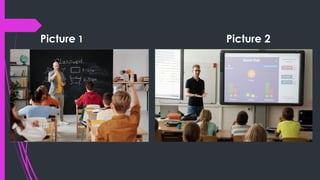
Picture 1 Picture 2
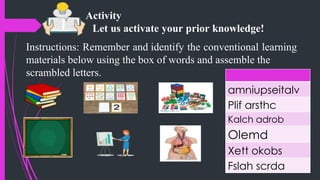
Activity
Let us activate your prior knowledge!
Instructions: Remember and identify the conventional learning
materials below using the box of words and assemble the
scrambled letters.
amniupseitalv
Plif arsthc
Kalch adrob
Olemd
Xett okobs
Fslah scrda
Lesson 4
ICT
Conventional
Materials to
Learning Outcomes
At the end of the lesson, you are expected to:
● Explain what conventional learning and its
implications are.
● Differentiate conventional and non-
conventional learning.
● Identify what the different digital learning
materials and conventional learning resources that
can support the teaching and learning process are.
Conventional or traditional learning
refers to a learning method wherein
teachers and students interact face-to-face
and is limited to the corners of the
classroom. This type of learning is
teacher-centered, meaning the students in
a conventional classroom passively
receive the information being provided by
the teachers.
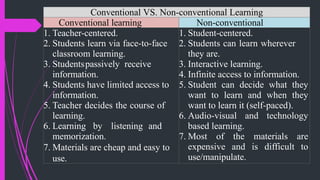
Conventional VS. Non-conventional Learning
Conventional learning Non-conventional
1. Teacher-centered.
2. Students learn via face-to-face
classroom learning.
3. Studentspassively receive
information.
4. Students have limited access to
information.
5. Teacher decides the course of
learning.
6. Learning by listening and
memorization.
7. Materials are cheap and easy to
use.
1. Student-centered.
2. Students can learn wherever
they are.
3. Interactive learning.
4. Infinite access to information.
5. Student can decide what they
want to learn and when they
want to learn it (self-paced).
6. Audio-visual and technology
based learning.
7. Most of the materials are
expensive and is difficult to
use/manipulate.
Learning and teaching are more meaningful,
efficient, and fun if we incorporate the usage of
learning or instructional materials.
These learning or instructional materials may
come in different forms. One of these mentioned
groups is called conventional or non-digital
learning tools.
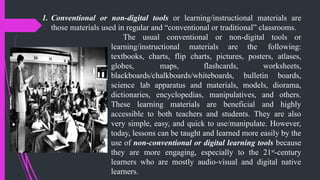
1. Conventional or non-digital tools or learning/instructional materials are
those materials used in regular and “conventional or traditional” classrooms.
The usual conventional or non-digital tools or
learning/instructional materials are the following:
textbooks, charts, flip charts, pictures, posters, atlases,
globes, maps, flashcards, worksheets,
blackboards/chalkboards/whiteboards, bulletin boards,
science lab apparatus and materials, models, diorama,
dictionaries, encyclopedias, manipulatives, and others.
These learning materials are beneficial and highly
accessible to both teachers and students. They are also
very simple, easy, and quick to use/manipulate. However,
today, lessons can be taught and learned more easily by the

use of non-conventional or digital learning tools because
they are more engaging, especially to the 21st
-century
learners who are mostly audio-visual and digital native
learners.
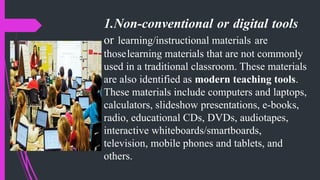
1.Non-conventional or digital tools
or learning/instructional materials are
thoselearning materials that are not commonly
used in a traditional classroom. These materials
are also identified as modern teaching tools.
These materials include computers and laptops,
calculators, slideshow presentations, e-books,
radio, educational CDs, DVDs, audiotapes,
interactive whiteboards/smartboards,
television, mobile phones and tablets, and
others.
I. Conventional or non-digital tools
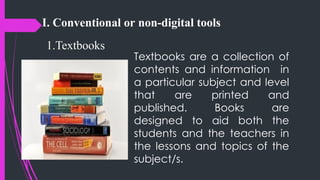
1.Textbooks
Textbooks are a collection of
contents and information in
a particular subject and level
that are printed and
published. Books are
designed to aid both the
students and the teachers in
the lessons and topics of the
subject/s.
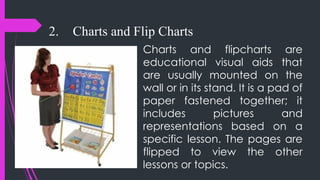
Charts and flipcharts are
educational visual aids that
are usually mounted on the
wall or in its stand. It is a pad of
paper fastened together; it
includes pictures and
representations based on a
specific lesson. The pages are
flipped to view the other
lessons or topics.
2. Charts and Flip Charts
1.Pictures and Posters
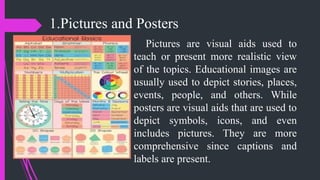
Pictures are visual aids used to
teach or present more realistic view
of the topics. Educational images are
usually used to depict stories, places,
events, people, and others. While
posters are visual aids that are used to
depict symbols, icons, and even
includes pictures. They are more
comprehensive since captions and
labels are present.
4. Atlases, Globes, and Maps
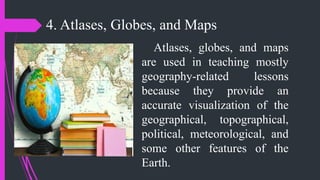
Atlases, globes, and maps
are used in teaching mostly
geography-related lessons
because they provide an
accurate visualization of the
geographical, topographical,
political, meteorological, and
some other features of the
Earth.
5. Flash Cards
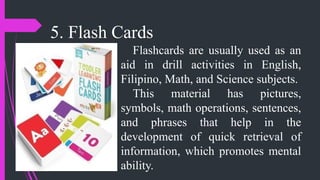
Flashcards are usually used as an
aid in drill activities in English,
Filipino, Math, and Science subjects.
This material has pictures,
symbols, math operations, sentences,
and phrases that help in the
development of quick retrieval of
information, which promotes mental
ability.
6. Worksheets
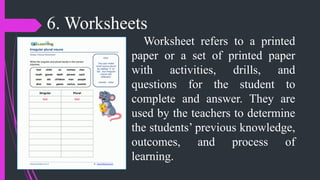
Worksheet refers to a printed
paper or a set of printed paper
with activities, drills, and
questions for the student to
complete and answer. They are
used by the teachers to determine
the students’ previous knowledge,
outcomes, and process of
learning.
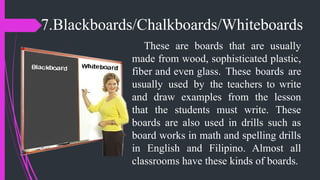
7.Blackboards/Chalkboards/Whiteboards
These are boards that are usually
made from wood, sophisticated plastic,
fiber and even glass. These boards are
usually used by the teachers to write
and draw examples from the lesson
that the students must write. These
boards are also used in drills such as
board works in math and spelling drills
in English and Filipino. Almost all
classrooms have these kinds of boards.
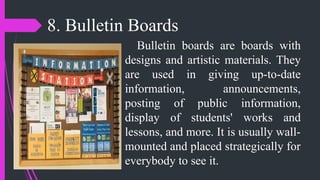
8. Bulletin Boards
Bulletin boards are boards with
designs and artistic materials. They
are used in giving up-to-date
information, announcements,
posting of public information,
display of students' works and
lessons, and more. It is usually wall-
mounted and placed strategically for
everybody to see it.
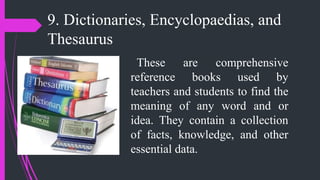
9. Dictionaries, Encyclopaedias, and
Thesaurus
These are comprehensive
reference books used by
teachers and students to find the
meaning of any word and or
idea. They contain a collection
of facts, knowledge, and other
essential data.
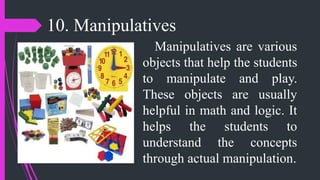
10. Manipulatives
Manipulatives are various
objects that help the students
to manipulate and play.
These objects are usually
helpful in math and logic. It
helps the students to
understand the concepts
through actual manipulation.
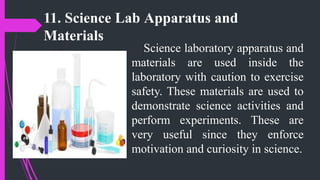
11. Science Lab Apparatus and
Materials
Science laboratory apparatus and
materials are used inside the
laboratory with caution to exercise
safety. These materials are used to
demonstrate science activities and
perform experiments. These are
very useful since they enforce
motivation and curiosity in science.
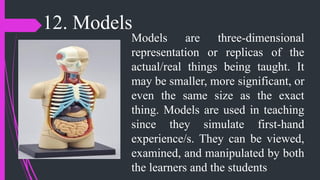
12. Models
Models are three-dimensional
representation or replicas of the
actual/real things being taught. It
may be smaller, more significant, or
even the same size as the exact
thing. Models are used in teaching
since they simulate first-hand
experience/s. They can be viewed,
examined, and manipulated by both
the learners and the students
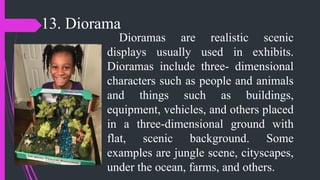
13. Diorama
Dioramas are realistic scenic
displays usually used in exhibits.
Dioramas include three- dimensional
characters such as people and animals
and things such as buildings,
equipment, vehicles, and others placed
in a three-dimensional ground with
flat, scenic background. Some
examples are jungle scene, cityscapes,
under the ocean, farms, and others.
II. Non-conventional or digital tools
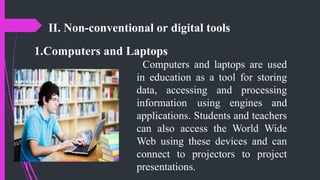
1.Computers and Laptops
Computers and laptops are used
in education as a tool for storing
data, accessing and processing
information using engines and
applications. Students and teachers
can also access the World Wide
Web using these devices and can
connect to projectors to project
presentations.
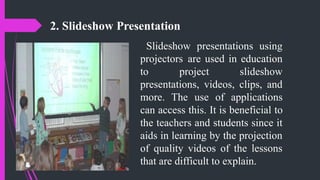
2. Slideshow Presentation
Slideshow presentations using
projectors are used in education
to project slideshow
presentations, videos, clips, and
more. The use of applications
can access this. It is beneficial to
the teachers and students since it
aids in learning by the projection
of quality videos of the lessons
that are difficult to explain.
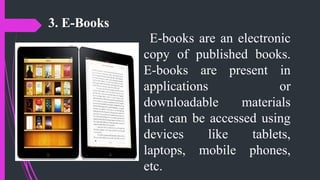
3. E-Books
E-books are an electronic
copy of published books.
E-books are present in
applications or
downloadable materials
that can be accessed using
devices like tablets,
laptops, mobile phones,
etc.
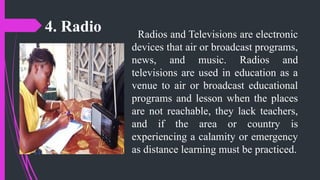
4. Radio Radios and Televisions are electronic
devices that air or broadcast programs,
news, and music. Radios and
televisions are used in education as a
venue to air or broadcast educational
programs and lesson when the places
are not reachable, they lack teachers,
and if the area or country is
experiencing a calamity or emergency
as distance learning must be practiced.
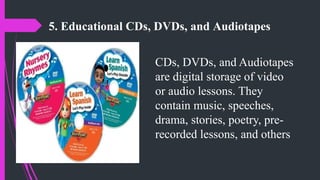
5. Educational CDs, DVDs, and Audiotapes
CDs, DVDs, and Audiotapes
are digital storage of video
or audio lessons. They
contain music, speeches,
drama, stories, poetry, pre-
recorded lessons, and others
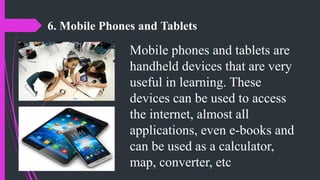
6. Mobile Phones and Tablets
Mobile phones and tablets are
handheld devices that are very
useful in learning. These
devices can be used to access
the internet, almost all
applications, even e-books and
can be used as a calculator,
map, converter, etc
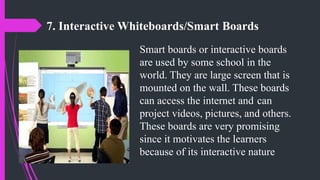
7. Interactive Whiteboards/Smart Boards
Smart boards or interactive boards
are used by some school in the
world. They are large screen that is
mounted on the wall. These boards
can access the internet and can
project videos, pictures, and others.
These boards are very promising
since it motivates the learners
because of its interactive nature
THANK YOU FOR
LISTENING…

technology for teaching and learning ppt

  • 1.
    Good Day everyone… Reporter:Friens-mae Labor Arnel Medillo
  • 3.
  • 4.
    Activity Let us activateyour prior knowledge! Instructions: Remember and identify the conventional learning materials below using the box of words and assemble the scrambled letters. amniupseitalv Plif arsthc Kalch adrob Olemd Xett okobs Fslah scrda
  • 5.
  • 6.
    Learning Outcomes At theend of the lesson, you are expected to: ● Explain what conventional learning and its implications are. ● Differentiate conventional and non- conventional learning. ● Identify what the different digital learning materials and conventional learning resources that can support the teaching and learning process are.
  • 7.
    Conventional or traditionallearning refers to a learning method wherein teachers and students interact face-to-face and is limited to the corners of the classroom. This type of learning is teacher-centered, meaning the students in a conventional classroom passively receive the information being provided by the teachers.
  • 8.
    Conventional VS. Non-conventionalLearning Conventional learning Non-conventional 1. Teacher-centered. 2. Students learn via face-to-face classroom learning. 3. Studentspassively receive information. 4. Students have limited access to information. 5. Teacher decides the course of learning. 6. Learning by listening and memorization. 7. Materials are cheap and easy to use. 1. Student-centered. 2. Students can learn wherever they are. 3. Interactive learning. 4. Infinite access to information. 5. Student can decide what they want to learn and when they want to learn it (self-paced). 6. Audio-visual and technology based learning. 7. Most of the materials are expensive and is difficult to use/manipulate.
  • 9.
    Learning and teachingare more meaningful, efficient, and fun if we incorporate the usage of learning or instructional materials. These learning or instructional materials may come in different forms. One of these mentioned groups is called conventional or non-digital learning tools.
  • 10.
    1. Conventional ornon-digital tools or learning/instructional materials are those materials used in regular and “conventional or traditional” classrooms. The usual conventional or non-digital tools or learning/instructional materials are the following: textbooks, charts, flip charts, pictures, posters, atlases, globes, maps, flashcards, worksheets, blackboards/chalkboards/whiteboards, bulletin boards, science lab apparatus and materials, models, diorama, dictionaries, encyclopedias, manipulatives, and others. These learning materials are beneficial and highly accessible to both teachers and students. They are also very simple, easy, and quick to use/manipulate. However, today, lessons can be taught and learned more easily by the use of non-conventional or digital learning tools because they are more engaging, especially to the 21st -century learners who are mostly audio-visual and digital native learners.
  • 11.
    1.Non-conventional or digitaltools or learning/instructional materials are thoselearning materials that are not commonly used in a traditional classroom. These materials are also identified as modern teaching tools. These materials include computers and laptops, calculators, slideshow presentations, e-books, radio, educational CDs, DVDs, audiotapes, interactive whiteboards/smartboards, television, mobile phones and tablets, and others.
  • 12.
    I. Conventional ornon-digital tools 1.Textbooks Textbooks are a collection of contents and information in a particular subject and level that are printed and published. Books are designed to aid both the students and the teachers in the lessons and topics of the subject/s.
  • 13.
    Charts and flipchartsare educational visual aids that are usually mounted on the wall or in its stand. It is a pad of paper fastened together; it includes pictures and representations based on a specific lesson. The pages are flipped to view the other lessons or topics. 2. Charts and Flip Charts
  • 14.
    1.Pictures and Posters Picturesare visual aids used to teach or present more realistic view of the topics. Educational images are usually used to depict stories, places, events, people, and others. While posters are visual aids that are used to depict symbols, icons, and even includes pictures. They are more comprehensive since captions and labels are present.
  • 15.
    4. Atlases, Globes,and Maps Atlases, globes, and maps are used in teaching mostly geography-related lessons because they provide an accurate visualization of the geographical, topographical, political, meteorological, and some other features of the Earth.
  • 16.
    5. Flash Cards Flashcardsare usually used as an aid in drill activities in English, Filipino, Math, and Science subjects. This material has pictures, symbols, math operations, sentences, and phrases that help in the development of quick retrieval of information, which promotes mental ability.
  • 17.
    6. Worksheets Worksheet refersto a printed paper or a set of printed paper with activities, drills, and questions for the student to complete and answer. They are used by the teachers to determine the students’ previous knowledge, outcomes, and process of learning.
  • 18.
    7.Blackboards/Chalkboards/Whiteboards These are boardsthat are usually made from wood, sophisticated plastic, fiber and even glass. These boards are usually used by the teachers to write and draw examples from the lesson that the students must write. These boards are also used in drills such as board works in math and spelling drills in English and Filipino. Almost all classrooms have these kinds of boards.
  • 19.
    8. Bulletin Boards Bulletinboards are boards with designs and artistic materials. They are used in giving up-to-date information, announcements, posting of public information, display of students' works and lessons, and more. It is usually wall- mounted and placed strategically for everybody to see it.
  • 20.
    9. Dictionaries, Encyclopaedias,and Thesaurus These are comprehensive reference books used by teachers and students to find the meaning of any word and or idea. They contain a collection of facts, knowledge, and other essential data.
  • 21.
    10. Manipulatives Manipulatives arevarious objects that help the students to manipulate and play. These objects are usually helpful in math and logic. It helps the students to understand the concepts through actual manipulation.
  • 22.
    11. Science LabApparatus and Materials Science laboratory apparatus and materials are used inside the laboratory with caution to exercise safety. These materials are used to demonstrate science activities and perform experiments. These are very useful since they enforce motivation and curiosity in science.
  • 23.
    12. Models Models arethree-dimensional representation or replicas of the actual/real things being taught. It may be smaller, more significant, or even the same size as the exact thing. Models are used in teaching since they simulate first-hand experience/s. They can be viewed, examined, and manipulated by both the learners and the students
  • 24.
    13. Diorama Dioramas arerealistic scenic displays usually used in exhibits. Dioramas include three- dimensional characters such as people and animals and things such as buildings, equipment, vehicles, and others placed in a three-dimensional ground with flat, scenic background. Some examples are jungle scene, cityscapes, under the ocean, farms, and others.
  • 25.
    II. Non-conventional ordigital tools 1.Computers and Laptops Computers and laptops are used in education as a tool for storing data, accessing and processing information using engines and applications. Students and teachers can also access the World Wide Web using these devices and can connect to projectors to project presentations.
  • 26.
    2. Slideshow Presentation Slideshowpresentations using projectors are used in education to project slideshow presentations, videos, clips, and more. The use of applications can access this. It is beneficial to the teachers and students since it aids in learning by the projection of quality videos of the lessons that are difficult to explain.
  • 27.
    3. E-Books E-books arean electronic copy of published books. E-books are present in applications or downloadable materials that can be accessed using devices like tablets, laptops, mobile phones, etc.
  • 28.
    4. Radio Radiosand Televisions are electronic devices that air or broadcast programs, news, and music. Radios and televisions are used in education as a venue to air or broadcast educational programs and lesson when the places are not reachable, they lack teachers, and if the area or country is experiencing a calamity or emergency as distance learning must be practiced.
  • 29.
    5. Educational CDs,DVDs, and Audiotapes CDs, DVDs, and Audiotapes are digital storage of video or audio lessons. They contain music, speeches, drama, stories, poetry, pre- recorded lessons, and others
  • 30.
    6. Mobile Phonesand Tablets Mobile phones and tablets are handheld devices that are very useful in learning. These devices can be used to access the internet, almost all applications, even e-books and can be used as a calculator, map, converter, etc
  • 31.
    7. Interactive Whiteboards/SmartBoards Smart boards or interactive boards are used by some school in the world. They are large screen that is mounted on the wall. These boards can access the internet and can project videos, pictures, and others. These boards are very promising since it motivates the learners because of its interactive nature
  • 32.