Implementing AI Solutions
A Comprehensive Guide for Business Leaders
In today's rapidly evolving business landscape, artificial intelligence (AI) has emerged as a game-changing technology
across industries. From construction to finance, healthcare to retail, AI solutions are revolutionizing how organizations
operate, make decisions, and drive growth. This comprehensive guide is designed to help business leaders and
professionals navigate the complex journey of implementing AI solutions in their organizations.
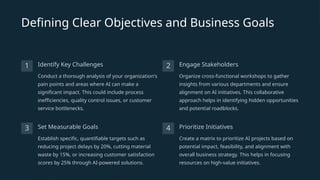
Defining Clear Objectives and Business Goals
1 Identify Key Challenges
Conduct a thorough analysis of your organization's
pain points and areas where AI can make a
significant impact. This could include process
inefficiencies, quality control issues, or customer
service bottlenecks.
2 Engage Stakeholders
Organize cross-functional workshops to gather
insights from various departments and ensure
alignment on AI initiatives. This collaborative
approach helps in identifying hidden opportunities
and potential roadblocks.
3 Set Measurable Goals
Establish specific, quantifiable targets such as
reducing project delays by 20%, cutting material
waste by 15%, or increasing customer satisfaction
scores by 25% through AI-powered solutions.
4 Prioritize Initiatives
Create a matrix to prioritize AI projects based on
potential impact, feasibility, and alignment with
overall business strategy. This helps in focusing
resources on high-value initiatives.
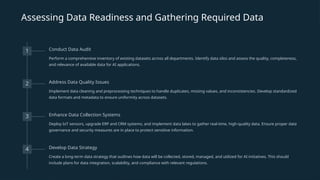
Assessing Data Readiness and Gathering Required Data
1 Conduct Data Audit
Perform a comprehensive inventory of existing datasets across all departments. Identify data silos and assess the quality, completeness,
and relevance of available data for AI applications.
2 Address Data Quality Issues
Implement data cleaning and preprocessing techniques to handle duplicates, missing values, and inconsistencies. Develop standardized
data formats and metadata to ensure uniformity across datasets.
3 Enhance Data Collection Systems
Deploy IoT sensors, upgrade ERP and CRM systems, and implement data lakes to gather real-time, high-quality data. Ensure proper data
governance and security measures are in place to protect sensitive information.
4 Develop Data Strategy
Create a long-term data strategy that outlines how data will be collected, stored, managed, and utilized for AI initiatives. This should
include plans for data integration, scalability, and compliance with relevant regulations.
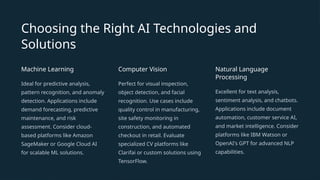
Choosing the Right AI Technologies and
Solutions
Machine Learning
Ideal for predictive analysis,
pattern recognition, and anomaly
detection. Applications include
demand forecasting, predictive
maintenance, and risk
assessment. Consider cloud-
based platforms like Amazon
SageMaker or Google Cloud AI
for scalable ML solutions.
Computer Vision
Perfect for visual inspection,
object detection, and facial
recognition. Use cases include
quality control in manufacturing,
site safety monitoring in
construction, and automated
checkout in retail. Evaluate
specialized CV platforms like
Clarifai or custom solutions using
TensorFlow.
Natural Language
Processing
Excellent for text analysis,
sentiment analysis, and chatbots.
Applications include document
automation, customer service AI,
and market intelligence. Consider
platforms like IBM Watson or
OpenAI's GPT for advanced NLP
capabilities.
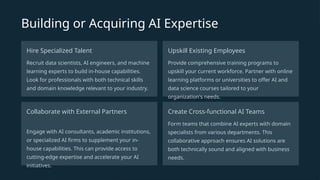
Building or Acquiring AI Expertise
Hire Specialized Talent
Recruit data scientists, AI engineers, and machine
learning experts to build in-house capabilities.
Look for professionals with both technical skills
and domain knowledge relevant to your industry.
Upskill Existing Employees
Provide comprehensive training programs to
upskill your current workforce. Partner with online
learning platforms or universities to offer AI and
data science courses tailored to your
organization's needs.
Collaborate with External Partners
Engage with AI consultants, academic institutions,
or specialized AI firms to supplement your in-
house capabilities. This can provide access to
cutting-edge expertise and accelerate your AI
initiatives.
Create Cross-functional AI Teams
Form teams that combine AI experts with domain
specialists from various departments. This
collaborative approach ensures AI solutions are
both technically sound and aligned with business
needs.
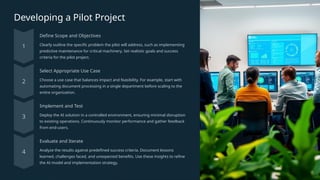
Developing a Pilot Project
Define Scope and Objectives
Clearly outline the specific problem the pilot will address, such as implementing
predictive maintenance for critical machinery. Set realistic goals and success
criteria for the pilot project.
Select Appropriate Use Case
Choose a use case that balances impact and feasibility. For example, start with
automating document processing in a single department before scaling to the
entire organization.
Implement and Test
Deploy the AI solution in a controlled environment, ensuring minimal disruption
to existing operations. Continuously monitor performance and gather feedback
from end-users.
Evaluate and Iterate
Analyze the results against predefined success criteria. Document lessons
learned, challenges faced, and unexpected benefits. Use these insights to refine
the AI model and implementation strategy.
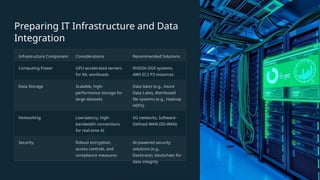
Preparing IT Infrastructure and Data
Integration
Infrastructure Component Considerations Recommended Solutions
Computing Power GPU-accelerated servers
for ML workloads
NVIDIA DGX systems,
AWS EC2 P3 instances
Data Storage Scalable, high-
performance storage for
large datasets
Data lakes (e.g., Azure
Data Lake), distributed
file systems (e.g., Hadoop
HDFS)
Networking Low-latency, high-
bandwidth connections
for real-time AI
5G networks, Software-
Defined WAN (SD-WAN)
Security Robust encryption,
access controls, and
compliance measures
AI-powered security
solutions (e.g.,
Darktrace), blockchain for
data integrity
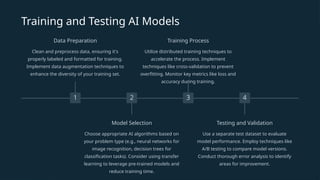
Training and Testing AI Models
1
Data Preparation
Clean and preprocess data, ensuring it's
properly labeled and formatted for training.
Implement data augmentation techniques to
enhance the diversity of your training set.
2
Model Selection
Choose appropriate AI algorithms based on
your problem type (e.g., neural networks for
image recognition, decision trees for
classification tasks). Consider using transfer
learning to leverage pre-trained models and
reduce training time.
3
Training Process
Utilize distributed training techniques to
accelerate the process. Implement
techniques like cross-validation to prevent
overfitting. Monitor key metrics like loss and
accuracy during training.
4
Testing and Validation
Use a separate test dataset to evaluate
model performance. Employ techniques like
A/B testing to compare model versions.
Conduct thorough error analysis to identify
areas for improvement.
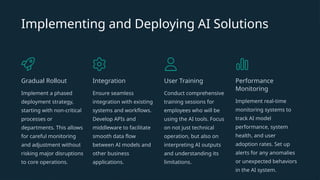
Implementing and Deploying AI Solutions
Gradual Rollout
Implement a phased
deployment strategy,
starting with non-critical
processes or
departments. This allows
for careful monitoring
and adjustment without
risking major disruptions
to core operations.
Integration
Ensure seamless
integration with existing
systems and workflows.
Develop APIs and
middleware to facilitate
smooth data flow
between AI models and
other business
applications.
User Training
Conduct comprehensive
training sessions for
employees who will be
using the AI tools. Focus
on not just technical
operation, but also on
interpreting AI outputs
and understanding its
limitations.
Performance
Monitoring
Implement real-time
monitoring systems to
track AI model
performance, system
health, and user
adoption rates. Set up
alerts for any anomalies
or unexpected behaviors
in the AI system.
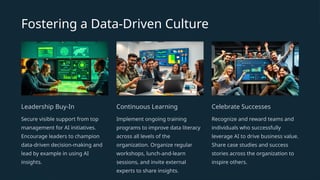
Fostering a Data-Driven Culture
Leadership Buy-In
Secure visible support from top
management for AI initiatives.
Encourage leaders to champion
data-driven decision-making and
lead by example in using AI
insights.
Continuous Learning
Implement ongoing training
programs to improve data literacy
across all levels of the
organization. Organize regular
workshops, lunch-and-learn
sessions, and invite external
experts to share insights.
Celebrate Successes
Recognize and reward teams and
individuals who successfully
leverage AI to drive business value.
Share case studies and success
stories across the organization to
inspire others.
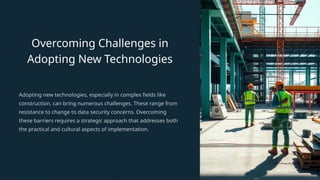
Overcoming Challenges in
Adopting New Technologies
Adopting new technologies, especially in complex fields like
construction, can bring numerous challenges. These range from
resistance to change to data security concerns. Overcoming
these barriers requires a strategic approach that addresses both
the practical and cultural aspects of implementation.
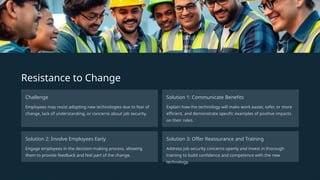
Resistance to Change
Challenge
Employees may resist adopting new technologies due to fear of
change, lack of understanding, or concerns about job security.
Solution 1: Communicate Benefits
Explain how the technology will make work easier, safer, or more
efficient, and demonstrate specific examples of positive impacts
on their roles.
Solution 2: Involve Employees Early
Engage employees in the decision-making process, allowing
them to provide feedback and feel part of the change.
Solution 3: Offer Reassurance and Training
Address job security concerns openly and invest in thorough
training to build confidence and competence with the new
technology.
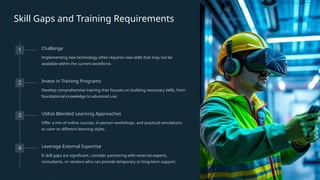
Skill Gaps and Training Requirements
1 Challenge
Implementing new technology often requires new skills that may not be
available within the current workforce.
2 Invest in Training Programs
Develop comprehensive training that focuses on building necessary skills, from
foundational knowledge to advanced use.
3 Utilize Blended Learning Approaches
Offer a mix of online courses, in-person workshops, and practical simulations
to cater to different learning styles.
4 Leverage External Expertise
If skill gaps are significant, consider partnering with external experts,
consultants, or vendors who can provide temporary or long-term support.
High Initial Costs
Challenge
The cost of new technology
(hardware, software, training) can
be substantial, especially for
smaller organizations.
Solutions
• Start with pilot projects to test
effectiveness and justify full-
scale investment
• Explore leasing or
subscription models to lower
upfront costs
• Look for financial assistance
or grants, especially in
construction and
manufacturing industries
Benefits
These approaches can help
organizations manage costs
while still accessing cutting-edge
technology, allowing for a more
gradual and sustainable adoption
process.
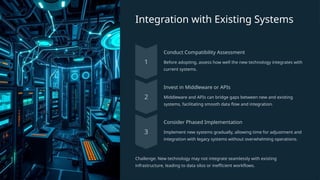
Integration with Existing Systems
Conduct Compatibility Assessment
Before adopting, assess how well the new technology integrates with
current systems.
Invest in Middleware or APIs
Middleware and APIs can bridge gaps between new and existing
systems, facilitating smooth data flow and integration.
Consider Phased Implementation
Implement new systems gradually, allowing time for adjustment and
integration with legacy systems without overwhelming operations.
Challenge: New technology may not integrate seamlessly with existing
infrastructure, leading to data silos or inefficient workflows.
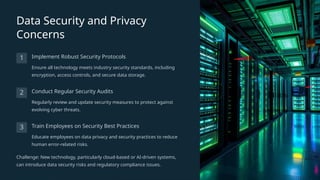
Data Security and Privacy
Concerns
1 Implement Robust Security Protocols
Ensure all technology meets industry security standards, including
encryption, access controls, and secure data storage.
2 Conduct Regular Security Audits
Regularly review and update security measures to protect against
evolving cyber threats.
3 Train Employees on Security Best Practices
Educate employees on data privacy and security practices to reduce
human error-related risks.
Challenge: New technology, particularly cloud-based or AI-driven systems,
can introduce data security risks and regulatory compliance issues.
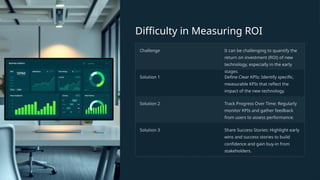
Difficulty in Measuring ROI
Challenge It can be challenging to quantify the
return on investment (ROI) of new
technology, especially in the early
stages.
Solution 1 Define Clear KPIs: Identify specific,
measurable KPIs that reflect the
impact of the new technology.
Solution 2 Track Progress Over Time: Regularly
monitor KPIs and gather feedback
from users to assess performance.
Solution 3 Share Success Stories: Highlight early
wins and success stories to build
confidence and gain buy-in from
stakeholders.
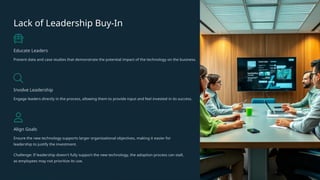
Lack of Leadership Buy-In
Educate Leaders
Present data and case studies that demonstrate the potential impact of the technology on the business.
Involve Leadership
Engage leaders directly in the process, allowing them to provide input and feel invested in its success.
Align Goals
Ensure the new technology supports larger organizational objectives, making it easier for
leadership to justify the investment.
Challenge: If leadership doesn't fully support the new technology, the adoption process can stall,
as employees may not prioritize its use.
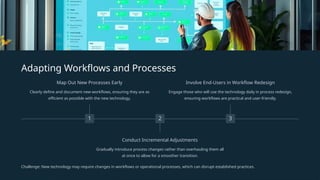
Adapting Workflows and Processes
1
Map Out New Processes Early
Clearly define and document new workflows, ensuring they are as
efficient as possible with the new technology.
2
Conduct Incremental Adjustments
Gradually introduce process changes rather than overhauling them all
at once to allow for a smoother transition.
3
Involve End-Users in Workflow Redesign
Engage those who will use the technology daily in process redesign,
ensuring workflows are practical and user-friendly.
Challenge: New technology may require changes in workflows or operational processes, which can disrupt established practices.
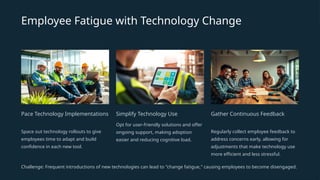
Employee Fatigue with Technology Change
Pace Technology Implementations
Space out technology rollouts to give
employees time to adapt and build
confidence in each new tool.
Simplify Technology Use
Opt for user-friendly solutions and offer
ongoing support, making adoption
easier and reducing cognitive load.
Gather Continuous Feedback
Regularly collect employee feedback to
address concerns early, allowing for
adjustments that make technology use
more efficient and less stressful.
Challenge: Frequent introductions of new technologies can lead to "change fatigue," causing employees to become disengaged.

Presentation1the Security Risk Management in.pptx.

  • 1.
    Implementing AI Solutions AComprehensive Guide for Business Leaders In today's rapidly evolving business landscape, artificial intelligence (AI) has emerged as a game-changing technology across industries. From construction to finance, healthcare to retail, AI solutions are revolutionizing how organizations operate, make decisions, and drive growth. This comprehensive guide is designed to help business leaders and professionals navigate the complex journey of implementing AI solutions in their organizations.
  • 2.
    Defining Clear Objectivesand Business Goals 1 Identify Key Challenges Conduct a thorough analysis of your organization's pain points and areas where AI can make a significant impact. This could include process inefficiencies, quality control issues, or customer service bottlenecks. 2 Engage Stakeholders Organize cross-functional workshops to gather insights from various departments and ensure alignment on AI initiatives. This collaborative approach helps in identifying hidden opportunities and potential roadblocks. 3 Set Measurable Goals Establish specific, quantifiable targets such as reducing project delays by 20%, cutting material waste by 15%, or increasing customer satisfaction scores by 25% through AI-powered solutions. 4 Prioritize Initiatives Create a matrix to prioritize AI projects based on potential impact, feasibility, and alignment with overall business strategy. This helps in focusing resources on high-value initiatives.
  • 3.
    Assessing Data Readinessand Gathering Required Data 1 Conduct Data Audit Perform a comprehensive inventory of existing datasets across all departments. Identify data silos and assess the quality, completeness, and relevance of available data for AI applications. 2 Address Data Quality Issues Implement data cleaning and preprocessing techniques to handle duplicates, missing values, and inconsistencies. Develop standardized data formats and metadata to ensure uniformity across datasets. 3 Enhance Data Collection Systems Deploy IoT sensors, upgrade ERP and CRM systems, and implement data lakes to gather real-time, high-quality data. Ensure proper data governance and security measures are in place to protect sensitive information. 4 Develop Data Strategy Create a long-term data strategy that outlines how data will be collected, stored, managed, and utilized for AI initiatives. This should include plans for data integration, scalability, and compliance with relevant regulations.
  • 4.
    Choosing the RightAI Technologies and Solutions Machine Learning Ideal for predictive analysis, pattern recognition, and anomaly detection. Applications include demand forecasting, predictive maintenance, and risk assessment. Consider cloud- based platforms like Amazon SageMaker or Google Cloud AI for scalable ML solutions. Computer Vision Perfect for visual inspection, object detection, and facial recognition. Use cases include quality control in manufacturing, site safety monitoring in construction, and automated checkout in retail. Evaluate specialized CV platforms like Clarifai or custom solutions using TensorFlow. Natural Language Processing Excellent for text analysis, sentiment analysis, and chatbots. Applications include document automation, customer service AI, and market intelligence. Consider platforms like IBM Watson or OpenAI's GPT for advanced NLP capabilities.
  • 5.
    Building or AcquiringAI Expertise Hire Specialized Talent Recruit data scientists, AI engineers, and machine learning experts to build in-house capabilities. Look for professionals with both technical skills and domain knowledge relevant to your industry. Upskill Existing Employees Provide comprehensive training programs to upskill your current workforce. Partner with online learning platforms or universities to offer AI and data science courses tailored to your organization's needs. Collaborate with External Partners Engage with AI consultants, academic institutions, or specialized AI firms to supplement your in- house capabilities. This can provide access to cutting-edge expertise and accelerate your AI initiatives. Create Cross-functional AI Teams Form teams that combine AI experts with domain specialists from various departments. This collaborative approach ensures AI solutions are both technically sound and aligned with business needs.
  • 6.
    Developing a PilotProject Define Scope and Objectives Clearly outline the specific problem the pilot will address, such as implementing predictive maintenance for critical machinery. Set realistic goals and success criteria for the pilot project. Select Appropriate Use Case Choose a use case that balances impact and feasibility. For example, start with automating document processing in a single department before scaling to the entire organization. Implement and Test Deploy the AI solution in a controlled environment, ensuring minimal disruption to existing operations. Continuously monitor performance and gather feedback from end-users. Evaluate and Iterate Analyze the results against predefined success criteria. Document lessons learned, challenges faced, and unexpected benefits. Use these insights to refine the AI model and implementation strategy.
  • 7.
    Preparing IT Infrastructureand Data Integration Infrastructure Component Considerations Recommended Solutions Computing Power GPU-accelerated servers for ML workloads NVIDIA DGX systems, AWS EC2 P3 instances Data Storage Scalable, high- performance storage for large datasets Data lakes (e.g., Azure Data Lake), distributed file systems (e.g., Hadoop HDFS) Networking Low-latency, high- bandwidth connections for real-time AI 5G networks, Software- Defined WAN (SD-WAN) Security Robust encryption, access controls, and compliance measures AI-powered security solutions (e.g., Darktrace), blockchain for data integrity
  • 8.
    Training and TestingAI Models 1 Data Preparation Clean and preprocess data, ensuring it's properly labeled and formatted for training. Implement data augmentation techniques to enhance the diversity of your training set. 2 Model Selection Choose appropriate AI algorithms based on your problem type (e.g., neural networks for image recognition, decision trees for classification tasks). Consider using transfer learning to leverage pre-trained models and reduce training time. 3 Training Process Utilize distributed training techniques to accelerate the process. Implement techniques like cross-validation to prevent overfitting. Monitor key metrics like loss and accuracy during training. 4 Testing and Validation Use a separate test dataset to evaluate model performance. Employ techniques like A/B testing to compare model versions. Conduct thorough error analysis to identify areas for improvement.
  • 9.
    Implementing and DeployingAI Solutions Gradual Rollout Implement a phased deployment strategy, starting with non-critical processes or departments. This allows for careful monitoring and adjustment without risking major disruptions to core operations. Integration Ensure seamless integration with existing systems and workflows. Develop APIs and middleware to facilitate smooth data flow between AI models and other business applications. User Training Conduct comprehensive training sessions for employees who will be using the AI tools. Focus on not just technical operation, but also on interpreting AI outputs and understanding its limitations. Performance Monitoring Implement real-time monitoring systems to track AI model performance, system health, and user adoption rates. Set up alerts for any anomalies or unexpected behaviors in the AI system.
  • 10.
    Fostering a Data-DrivenCulture Leadership Buy-In Secure visible support from top management for AI initiatives. Encourage leaders to champion data-driven decision-making and lead by example in using AI insights. Continuous Learning Implement ongoing training programs to improve data literacy across all levels of the organization. Organize regular workshops, lunch-and-learn sessions, and invite external experts to share insights. Celebrate Successes Recognize and reward teams and individuals who successfully leverage AI to drive business value. Share case studies and success stories across the organization to inspire others.
  • 11.
    Overcoming Challenges in AdoptingNew Technologies Adopting new technologies, especially in complex fields like construction, can bring numerous challenges. These range from resistance to change to data security concerns. Overcoming these barriers requires a strategic approach that addresses both the practical and cultural aspects of implementation.
  • 12.
    Resistance to Change Challenge Employeesmay resist adopting new technologies due to fear of change, lack of understanding, or concerns about job security. Solution 1: Communicate Benefits Explain how the technology will make work easier, safer, or more efficient, and demonstrate specific examples of positive impacts on their roles. Solution 2: Involve Employees Early Engage employees in the decision-making process, allowing them to provide feedback and feel part of the change. Solution 3: Offer Reassurance and Training Address job security concerns openly and invest in thorough training to build confidence and competence with the new technology.
  • 13.
    Skill Gaps andTraining Requirements 1 Challenge Implementing new technology often requires new skills that may not be available within the current workforce. 2 Invest in Training Programs Develop comprehensive training that focuses on building necessary skills, from foundational knowledge to advanced use. 3 Utilize Blended Learning Approaches Offer a mix of online courses, in-person workshops, and practical simulations to cater to different learning styles. 4 Leverage External Expertise If skill gaps are significant, consider partnering with external experts, consultants, or vendors who can provide temporary or long-term support.
  • 14.
    High Initial Costs Challenge Thecost of new technology (hardware, software, training) can be substantial, especially for smaller organizations. Solutions • Start with pilot projects to test effectiveness and justify full- scale investment • Explore leasing or subscription models to lower upfront costs • Look for financial assistance or grants, especially in construction and manufacturing industries Benefits These approaches can help organizations manage costs while still accessing cutting-edge technology, allowing for a more gradual and sustainable adoption process.
  • 15.
    Integration with ExistingSystems Conduct Compatibility Assessment Before adopting, assess how well the new technology integrates with current systems. Invest in Middleware or APIs Middleware and APIs can bridge gaps between new and existing systems, facilitating smooth data flow and integration. Consider Phased Implementation Implement new systems gradually, allowing time for adjustment and integration with legacy systems without overwhelming operations. Challenge: New technology may not integrate seamlessly with existing infrastructure, leading to data silos or inefficient workflows.
  • 16.
    Data Security andPrivacy Concerns 1 Implement Robust Security Protocols Ensure all technology meets industry security standards, including encryption, access controls, and secure data storage. 2 Conduct Regular Security Audits Regularly review and update security measures to protect against evolving cyber threats. 3 Train Employees on Security Best Practices Educate employees on data privacy and security practices to reduce human error-related risks. Challenge: New technology, particularly cloud-based or AI-driven systems, can introduce data security risks and regulatory compliance issues.
  • 17.
    Difficulty in MeasuringROI Challenge It can be challenging to quantify the return on investment (ROI) of new technology, especially in the early stages. Solution 1 Define Clear KPIs: Identify specific, measurable KPIs that reflect the impact of the new technology. Solution 2 Track Progress Over Time: Regularly monitor KPIs and gather feedback from users to assess performance. Solution 3 Share Success Stories: Highlight early wins and success stories to build confidence and gain buy-in from stakeholders.
  • 18.
    Lack of LeadershipBuy-In Educate Leaders Present data and case studies that demonstrate the potential impact of the technology on the business. Involve Leadership Engage leaders directly in the process, allowing them to provide input and feel invested in its success. Align Goals Ensure the new technology supports larger organizational objectives, making it easier for leadership to justify the investment. Challenge: If leadership doesn't fully support the new technology, the adoption process can stall, as employees may not prioritize its use.
  • 19.
    Adapting Workflows andProcesses 1 Map Out New Processes Early Clearly define and document new workflows, ensuring they are as efficient as possible with the new technology. 2 Conduct Incremental Adjustments Gradually introduce process changes rather than overhauling them all at once to allow for a smoother transition. 3 Involve End-Users in Workflow Redesign Engage those who will use the technology daily in process redesign, ensuring workflows are practical and user-friendly. Challenge: New technology may require changes in workflows or operational processes, which can disrupt established practices.
  • 20.
    Employee Fatigue withTechnology Change Pace Technology Implementations Space out technology rollouts to give employees time to adapt and build confidence in each new tool. Simplify Technology Use Opt for user-friendly solutions and offer ongoing support, making adoption easier and reducing cognitive load. Gather Continuous Feedback Regularly collect employee feedback to address concerns early, allowing for adjustments that make technology use more efficient and less stressful. Challenge: Frequent introductions of new technologies can lead to "change fatigue," causing employees to become disengaged.