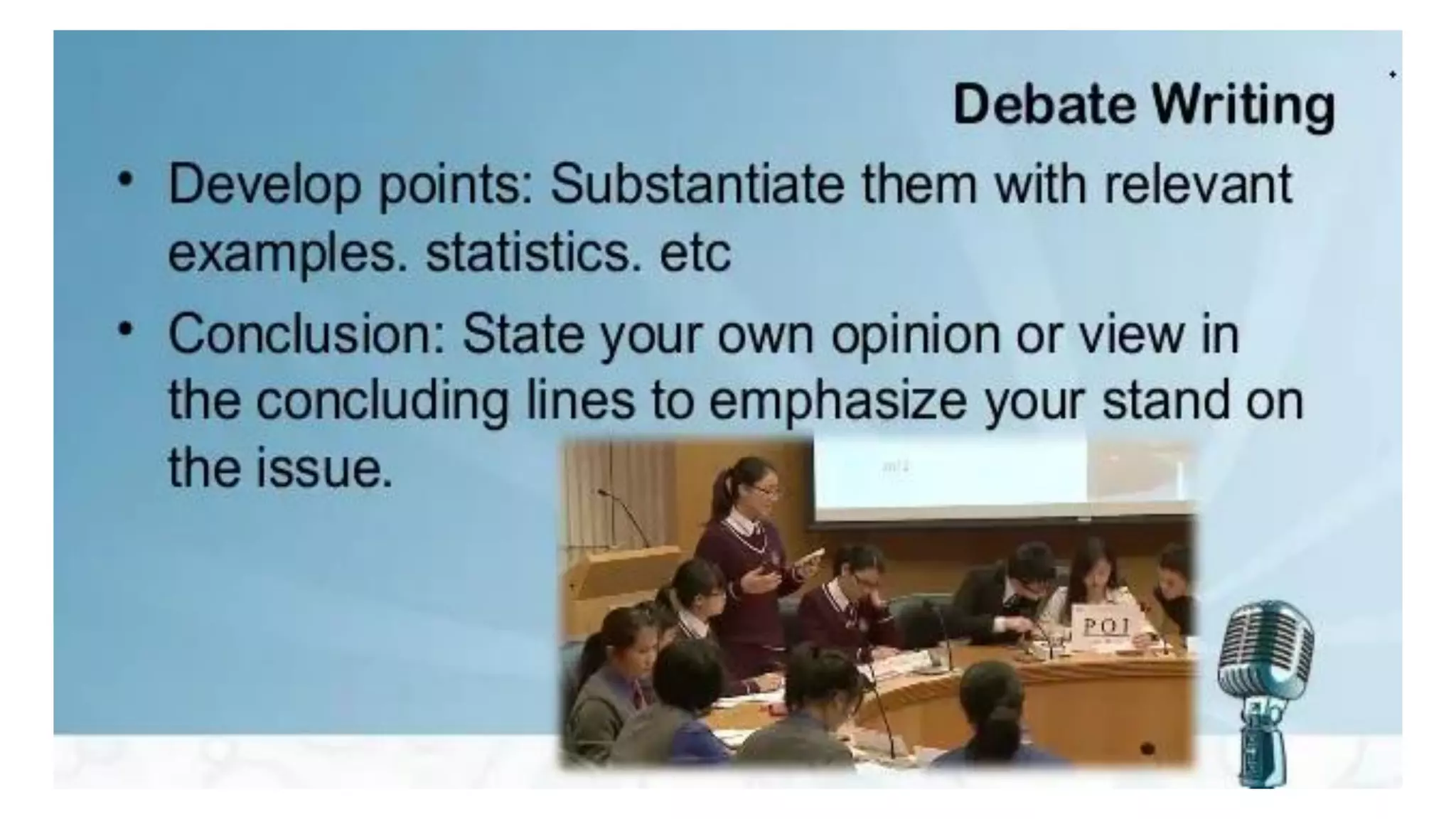
Debate Writing
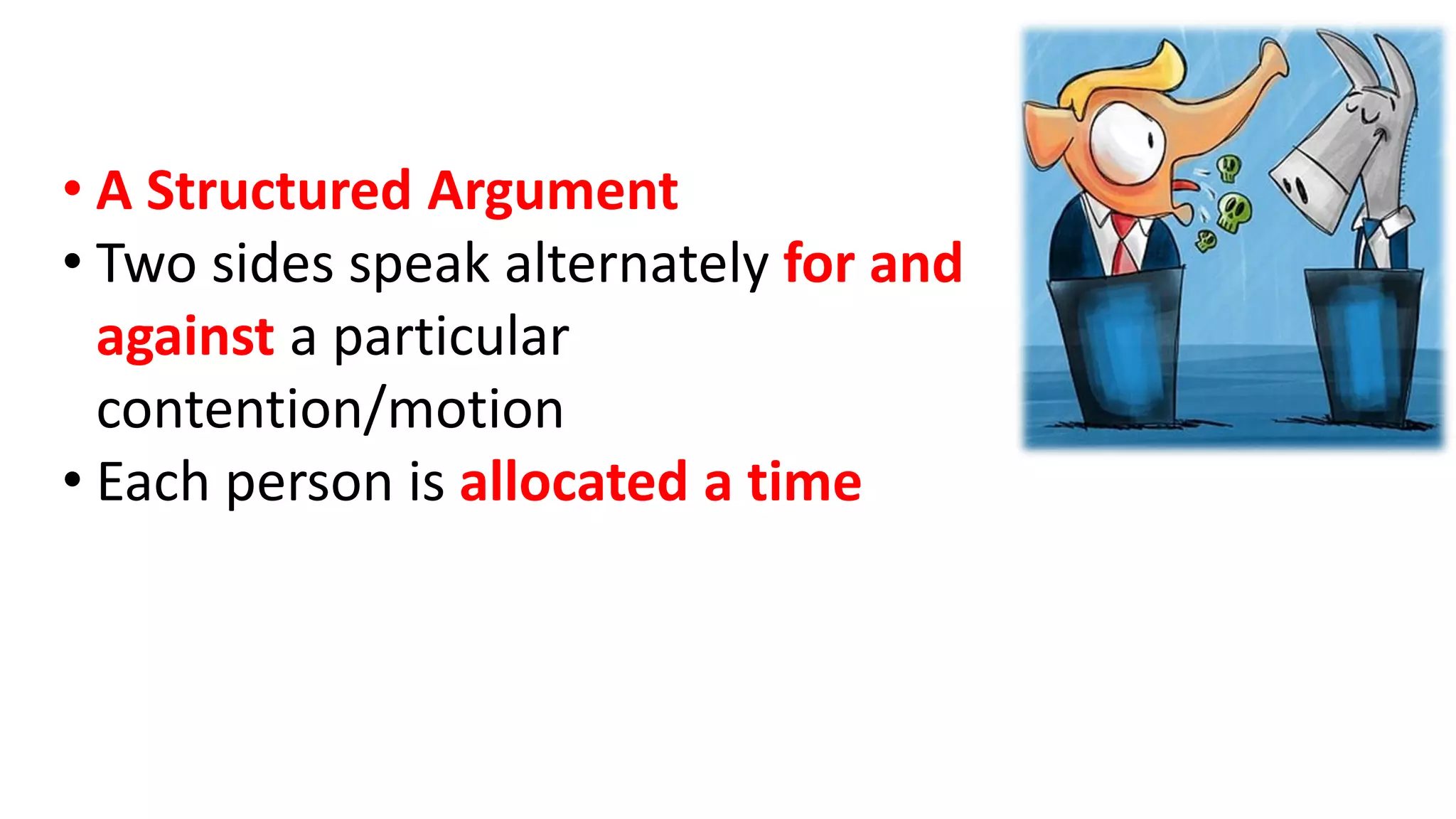
• A Structured Argument
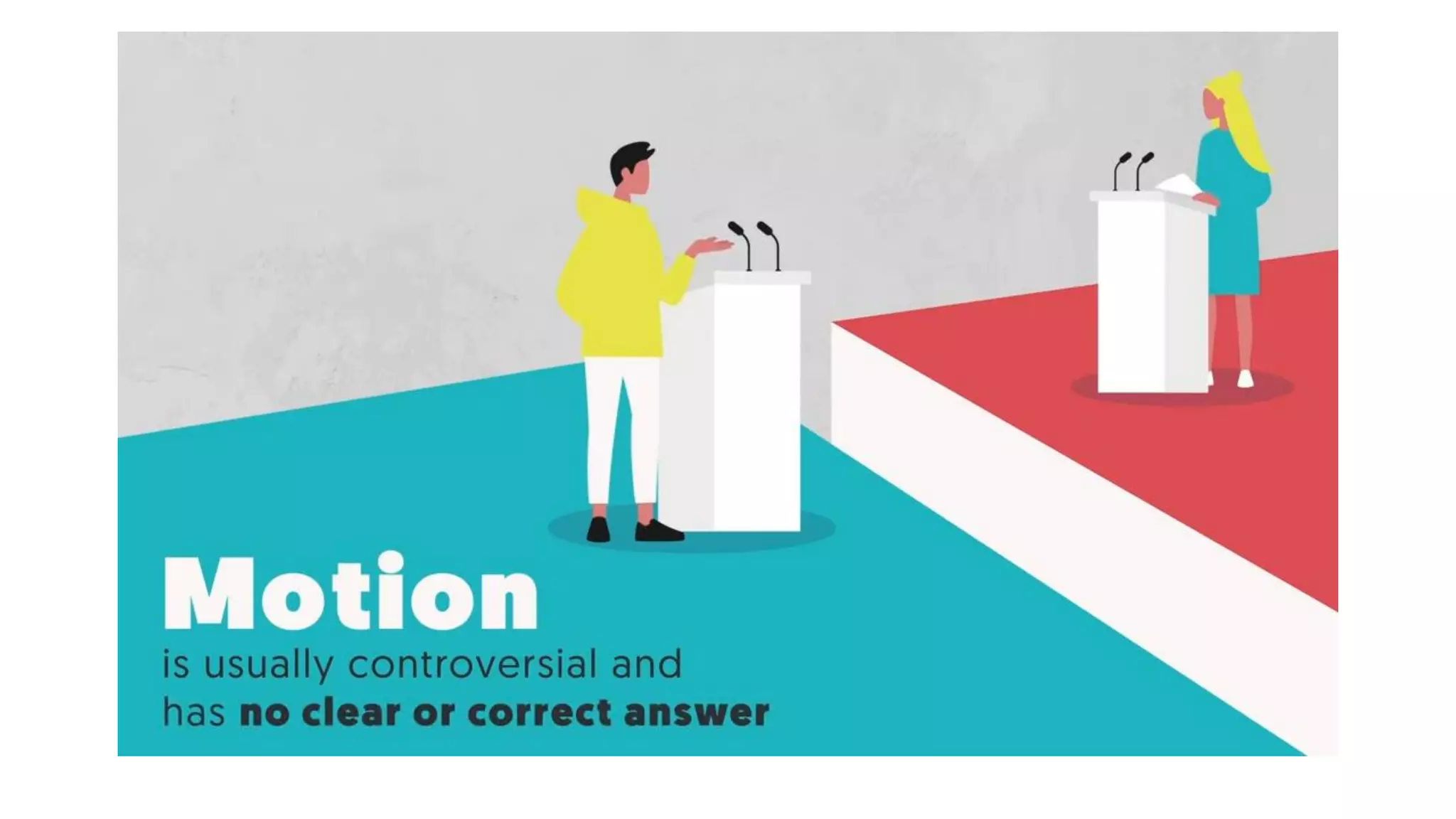
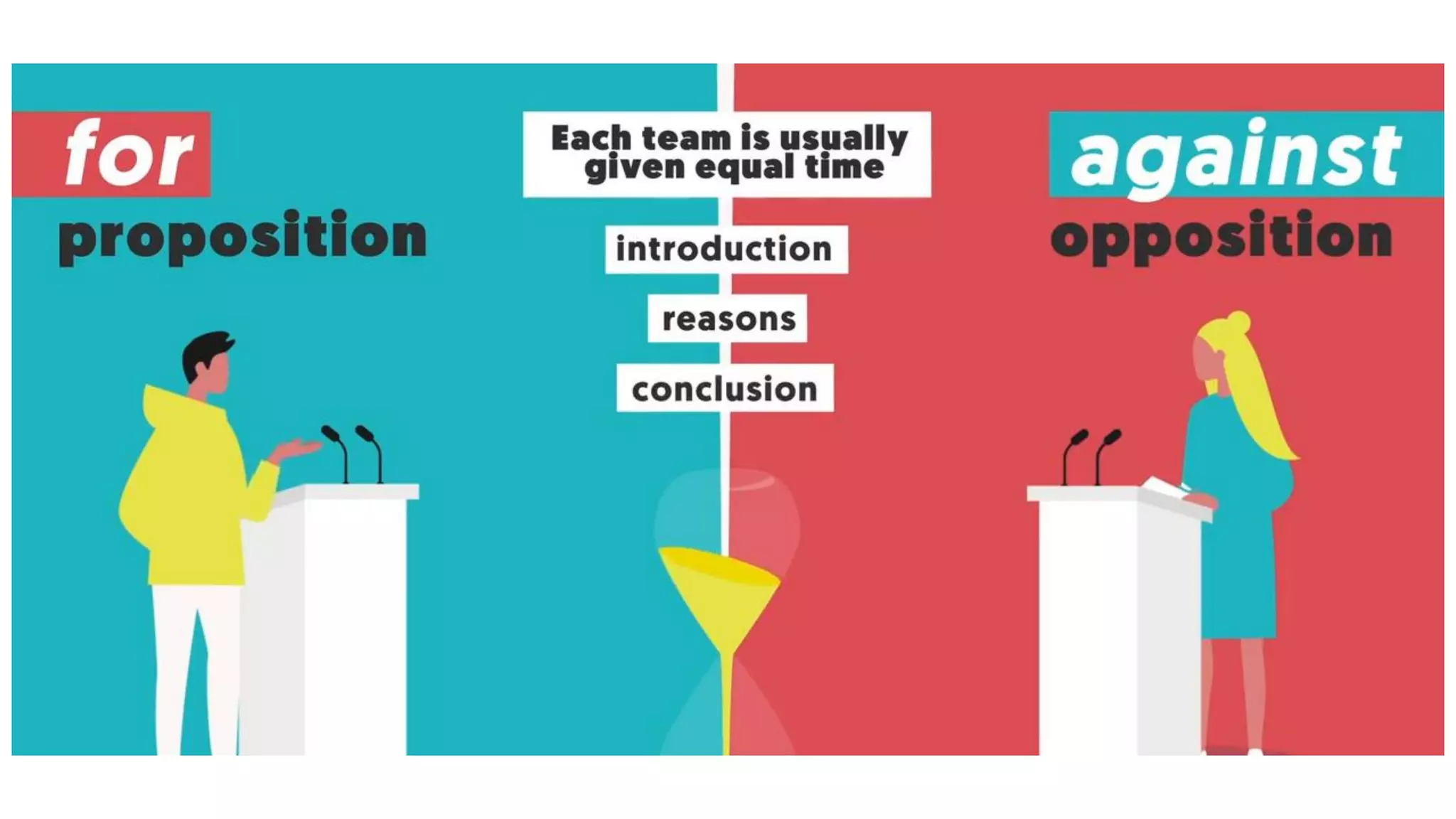
• Two sides speak alternately for and
against a particular
contention/motion
• Each person is allocated a time
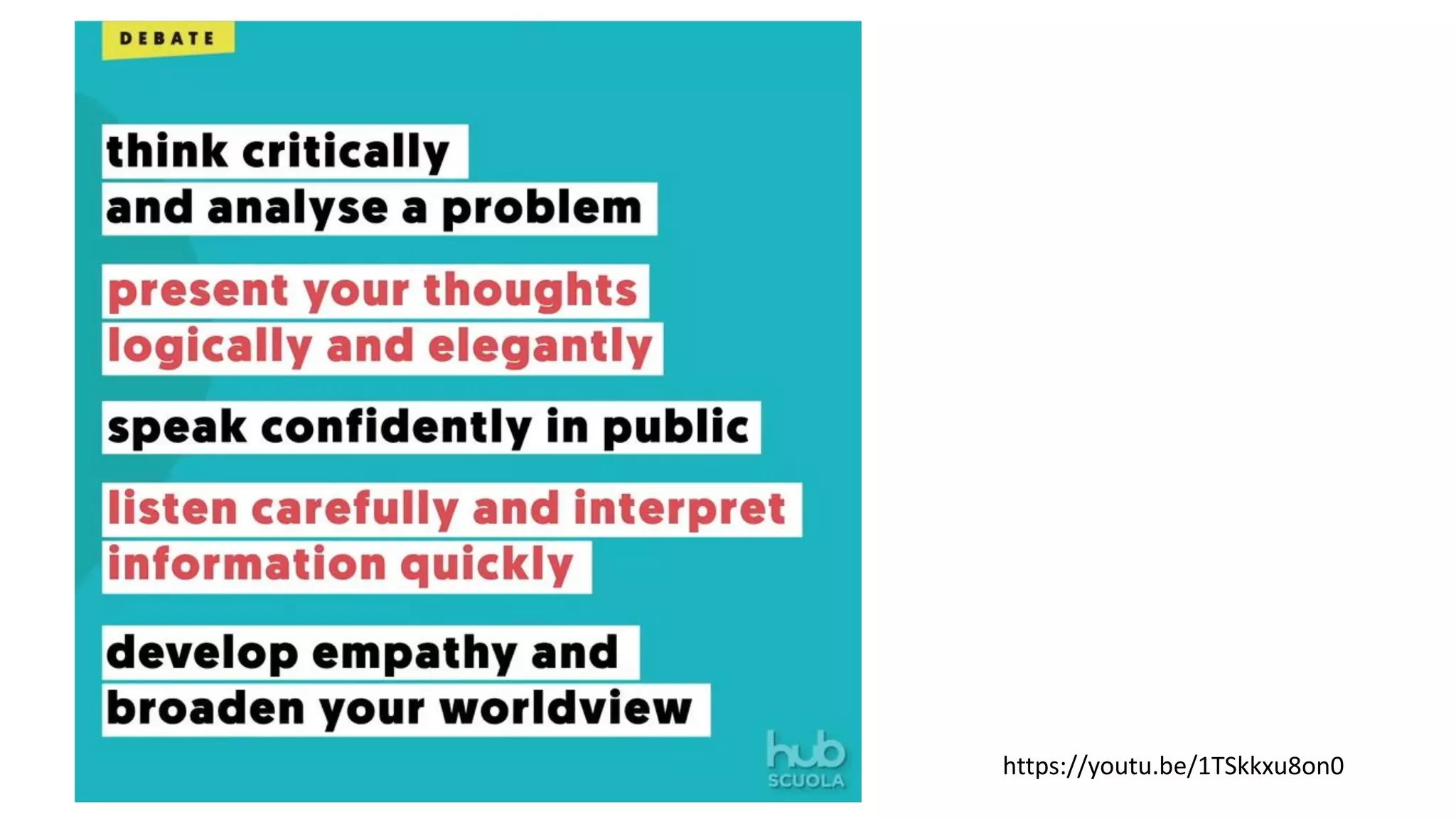
https://youtu.be/1TSkkxu8on0
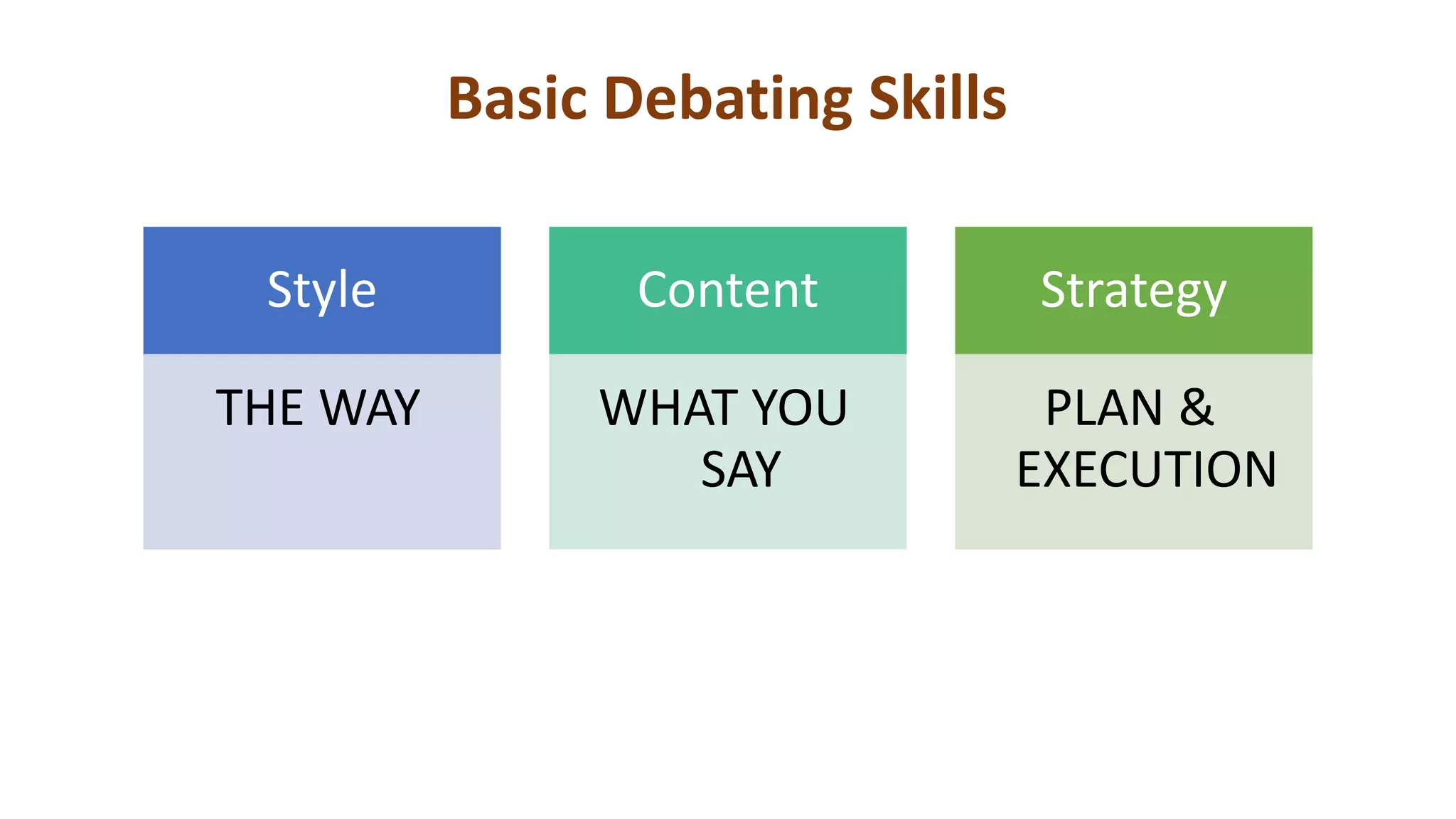
Style
THE WAY
Content
WHAT YOU
SAY
Strategy
PLAN &
EXECUTION
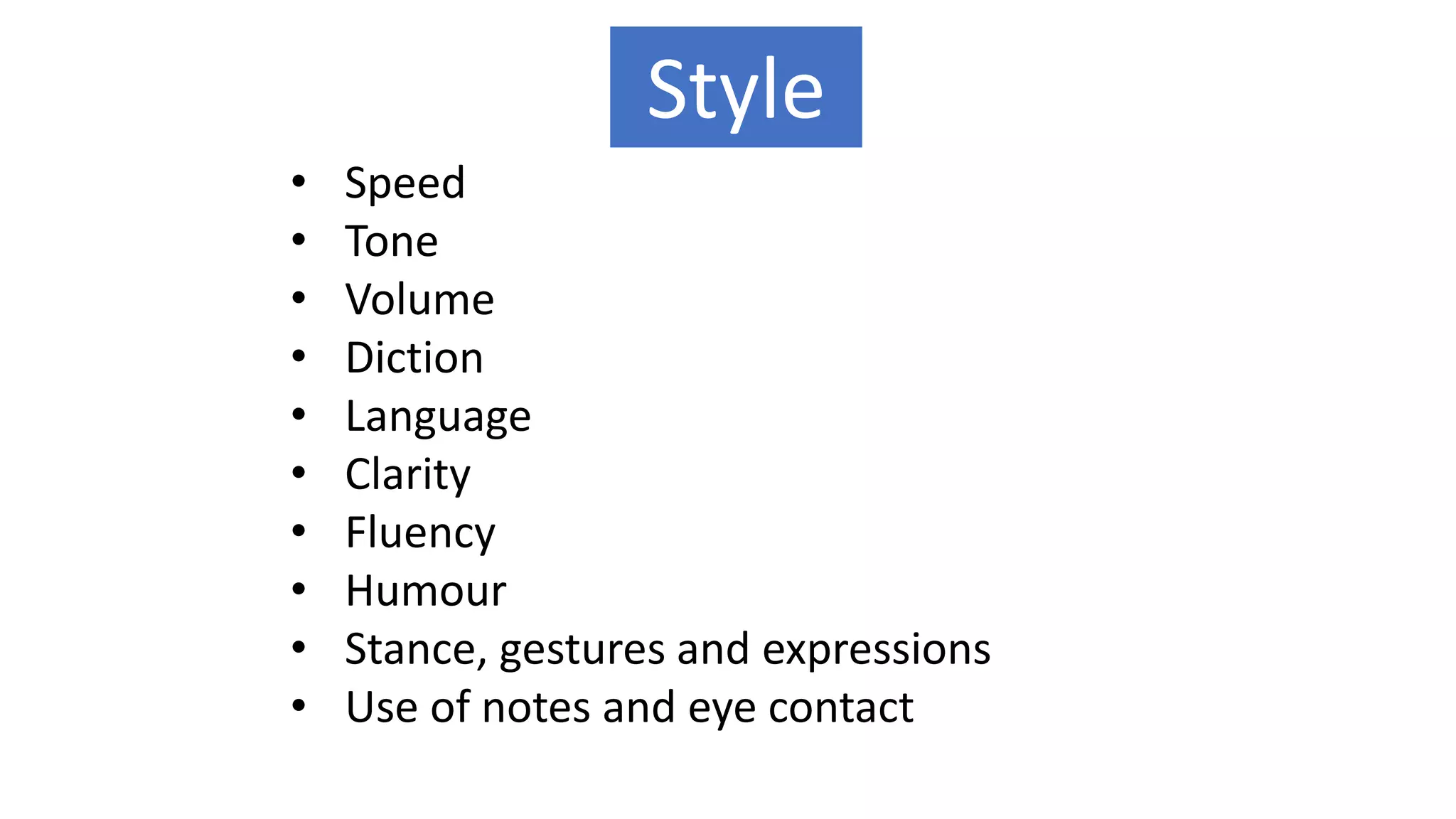
Basic Debating Skills
• Speed
• Tone
• Volume
• Diction
• Language
• Clarity
• Fluency
• Humour
• Stance, gestures and expressions
• Use of notes and eye contact
Style
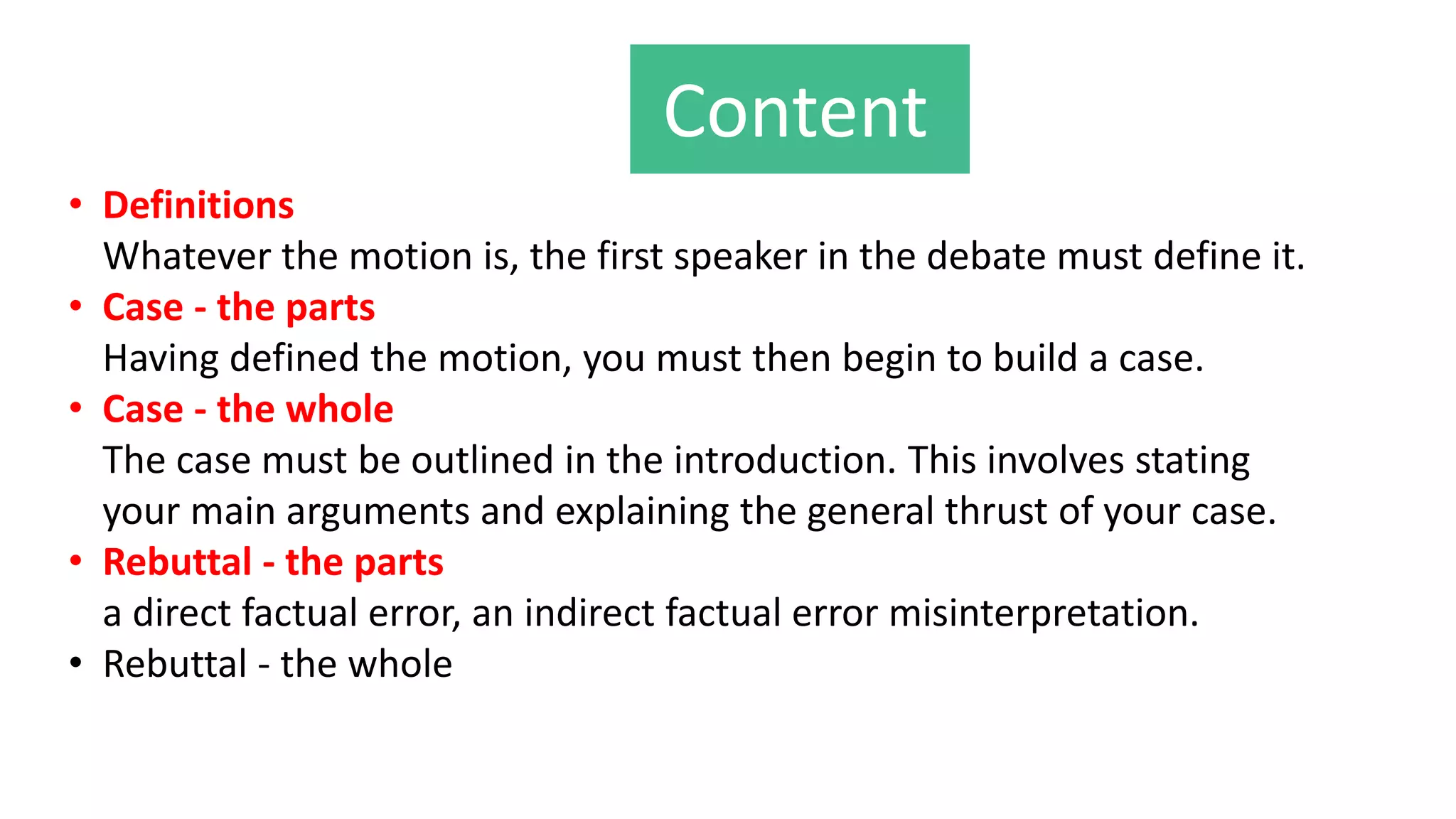
Content
• Definitions
Whatever the motion is, the first speaker in the debate must define it.
• Case - the parts
Having defined the motion, you must then begin to build a case.
• Case - the whole
The case must be outlined in the introduction. This involves stating
your main arguments and explaining the general thrust of your case.
• Rebuttal - the parts
a direct factual error, an indirect factual error misinterpretation.
• Rebuttal - the whole
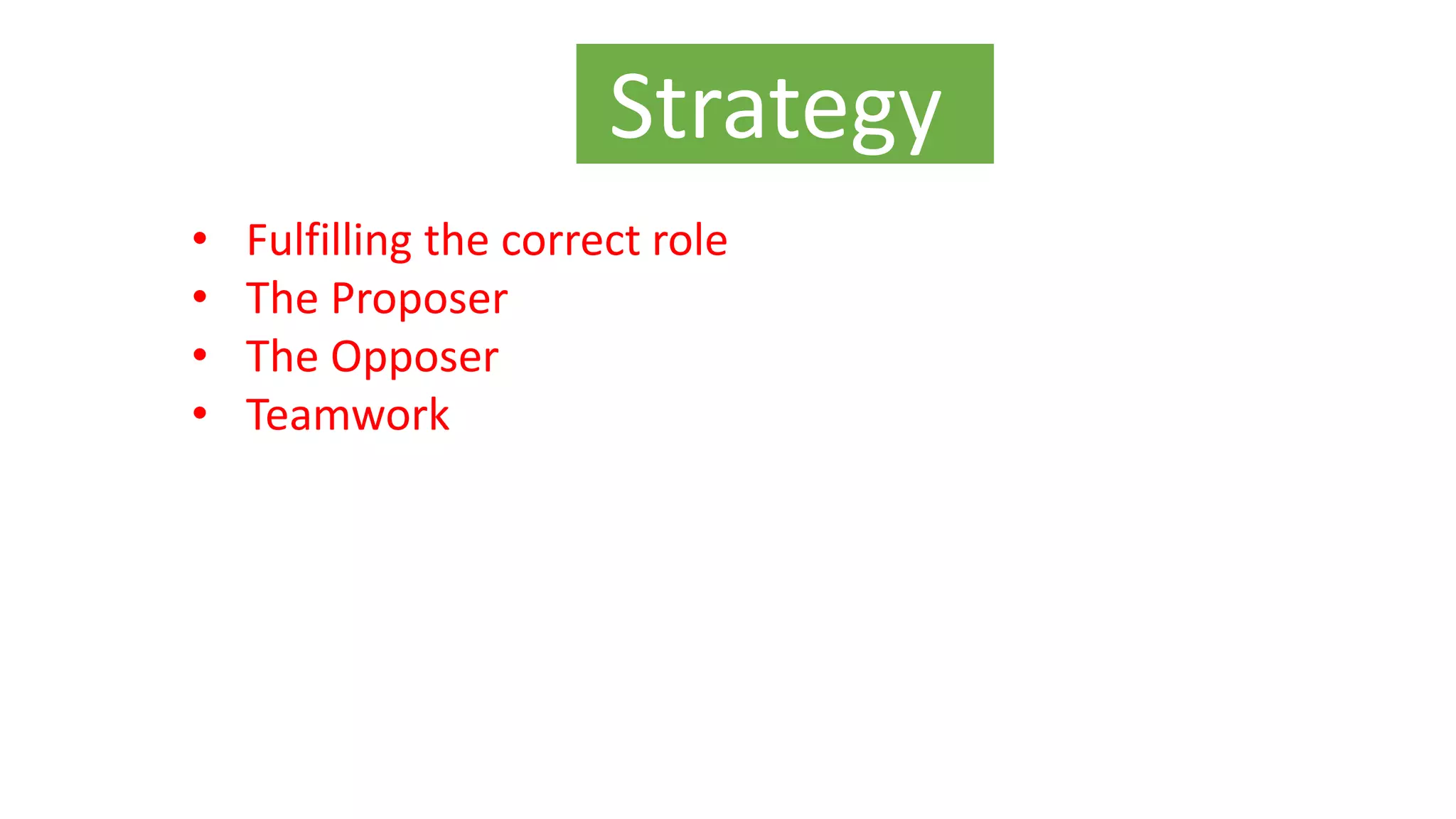
Strategy
• Fulfilling the correct role
• The Proposer
• The Opposer
• Teamwork
USEFUL EXPRESSIONS FOR BEGINNING A DEBATE
• Good morning to all of you present here. I am [name] from----- to
speak on the topic of [title].
• Welcome, ladies and gentlemen, thank you for being here, then pause
a moment, then a quote: "Benjamin Franklin once said ______" or
whatever the quote is.
• Resp. jury and worthy teachers, my fellow mates, honorable guests. A
very GOOD Morning/Noon/Evening…… to one and all present here.
• Then……. Introduce Yourself!
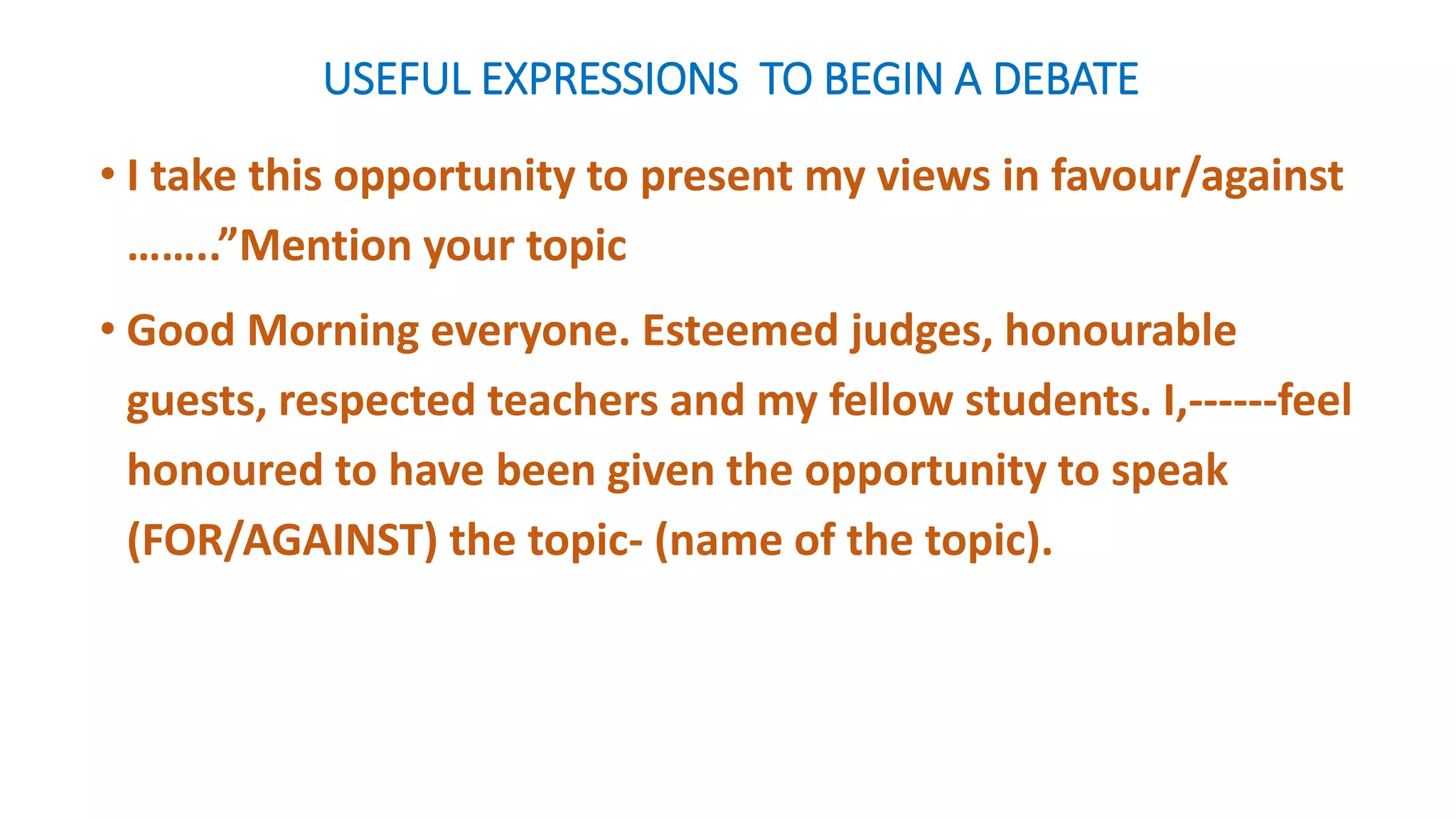
USEFUL EXPRESSIONS TO BEGIN A DEBATE
• I take this opportunity to present my views in favour/against
……..”Mention your topic
• Good Morning everyone. Esteemed judges, honourable
guests, respected teachers and my fellow students. I,------feel
honoured to have been given the opportunity to speak
(FOR/AGAINST) the topic- (name of the topic).
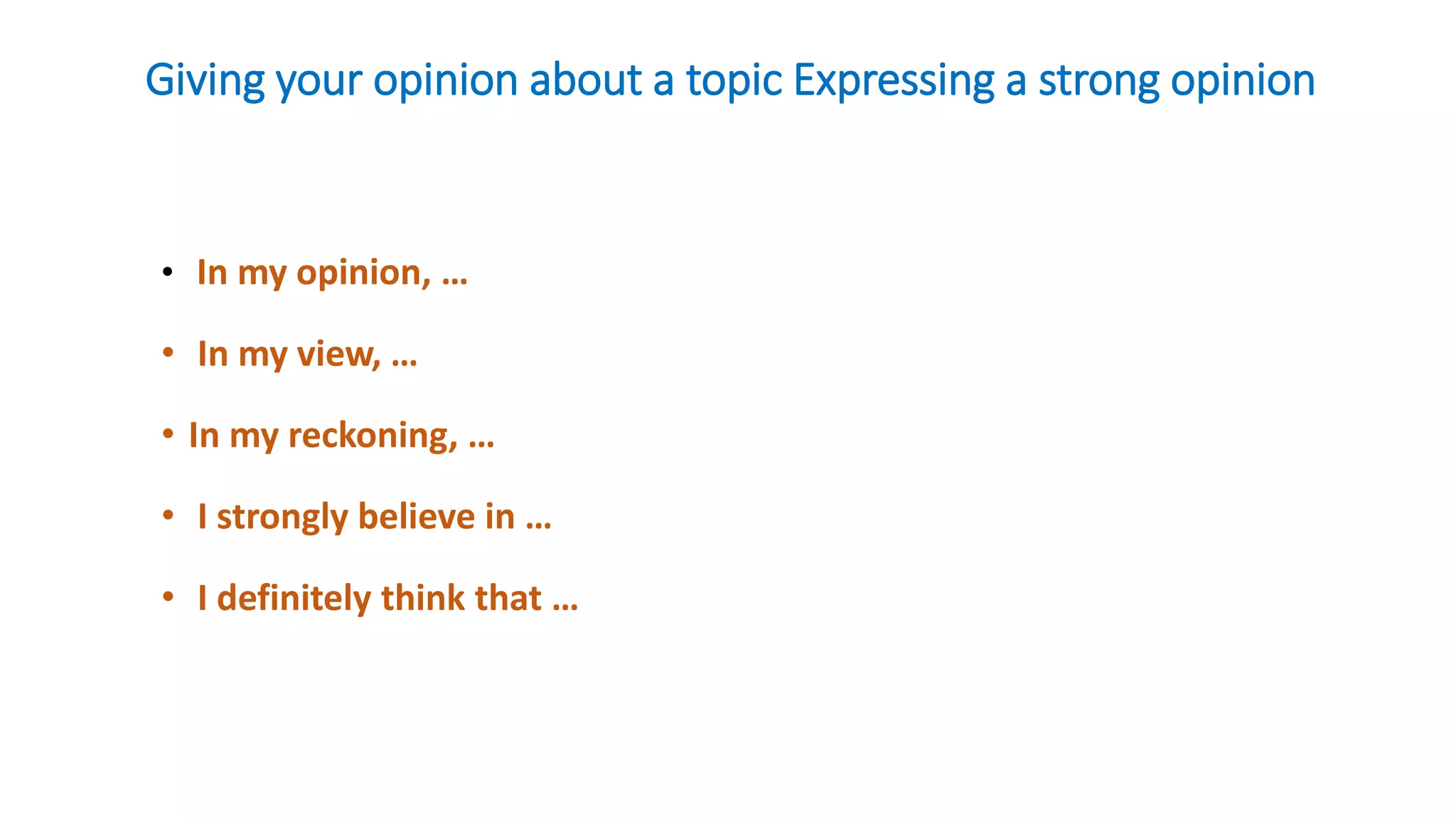
Giving your opinion about a topic Expressing a strong opinion
• In my opinion, …
• In my view, …
• In my reckoning, …
• I strongly believe in …
• I definitely think that …
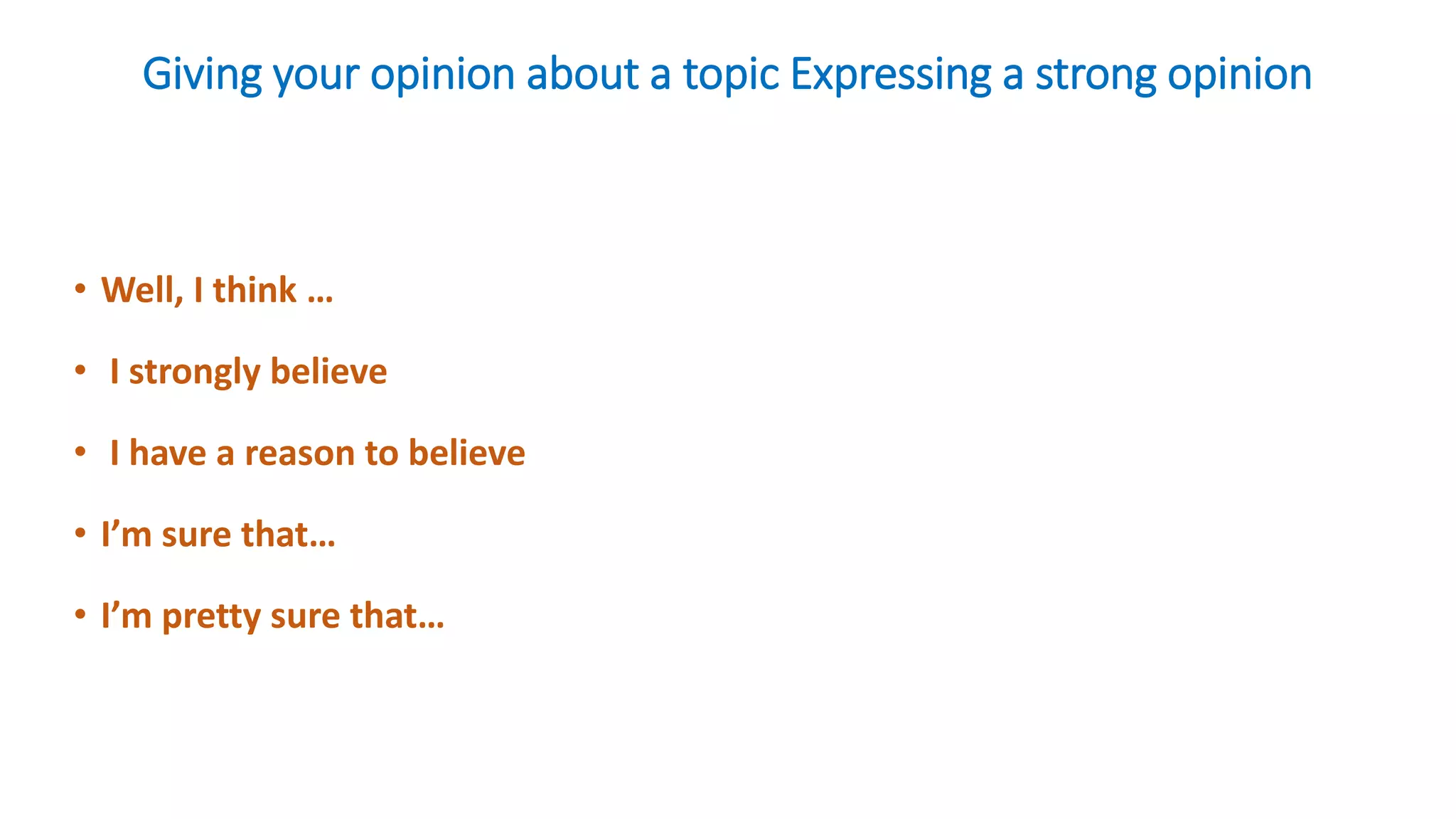
Giving your opinion about a topic Expressing a strong opinion
• Well, I think …
• I strongly believe
• I have a reason to believe
• I’m sure that…
• I’m pretty sure that…
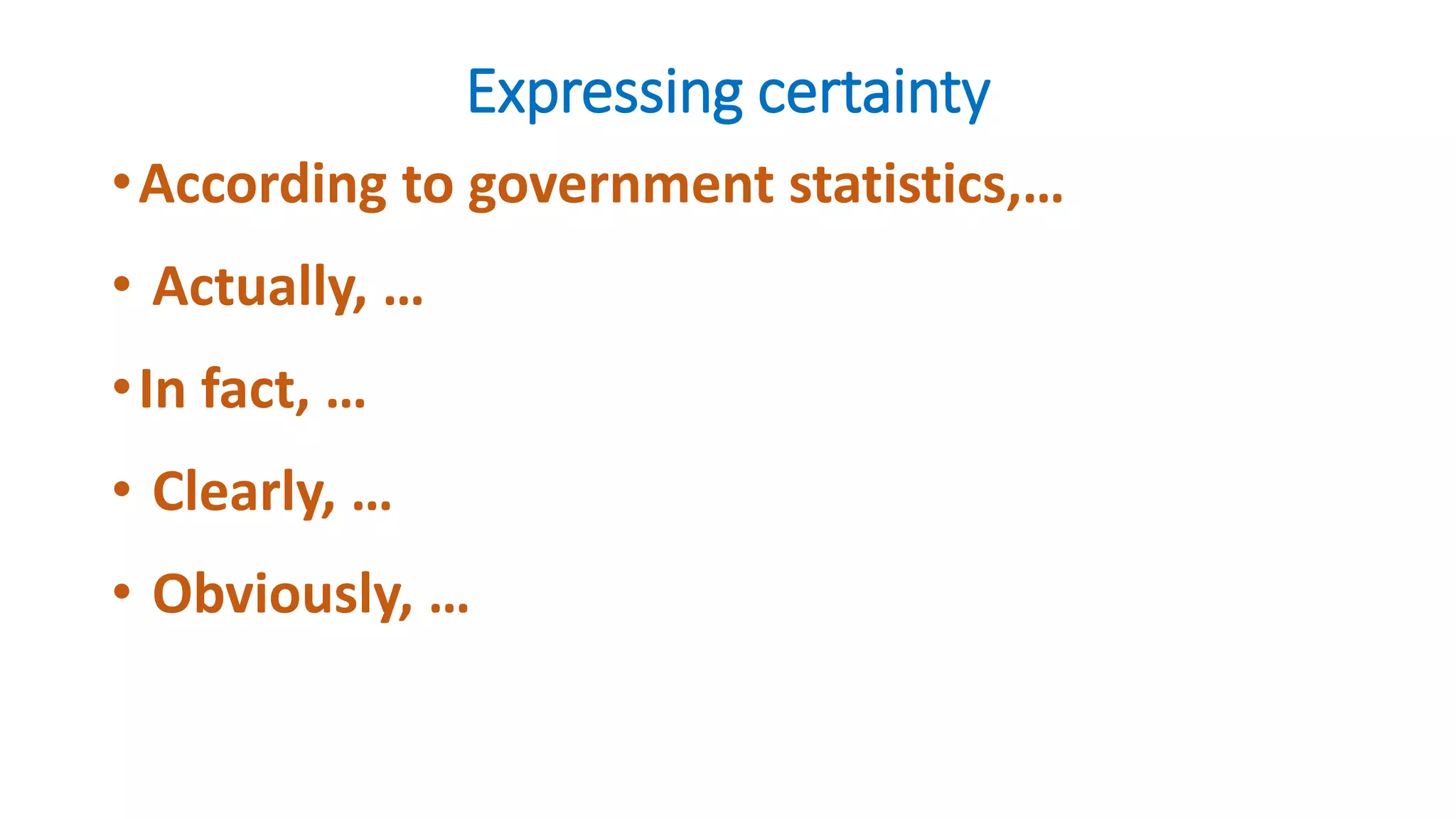
Expressing certainty
•According to government statistics,…
• Actually, …
•In fact, …
• Clearly, …
• Obviously, …
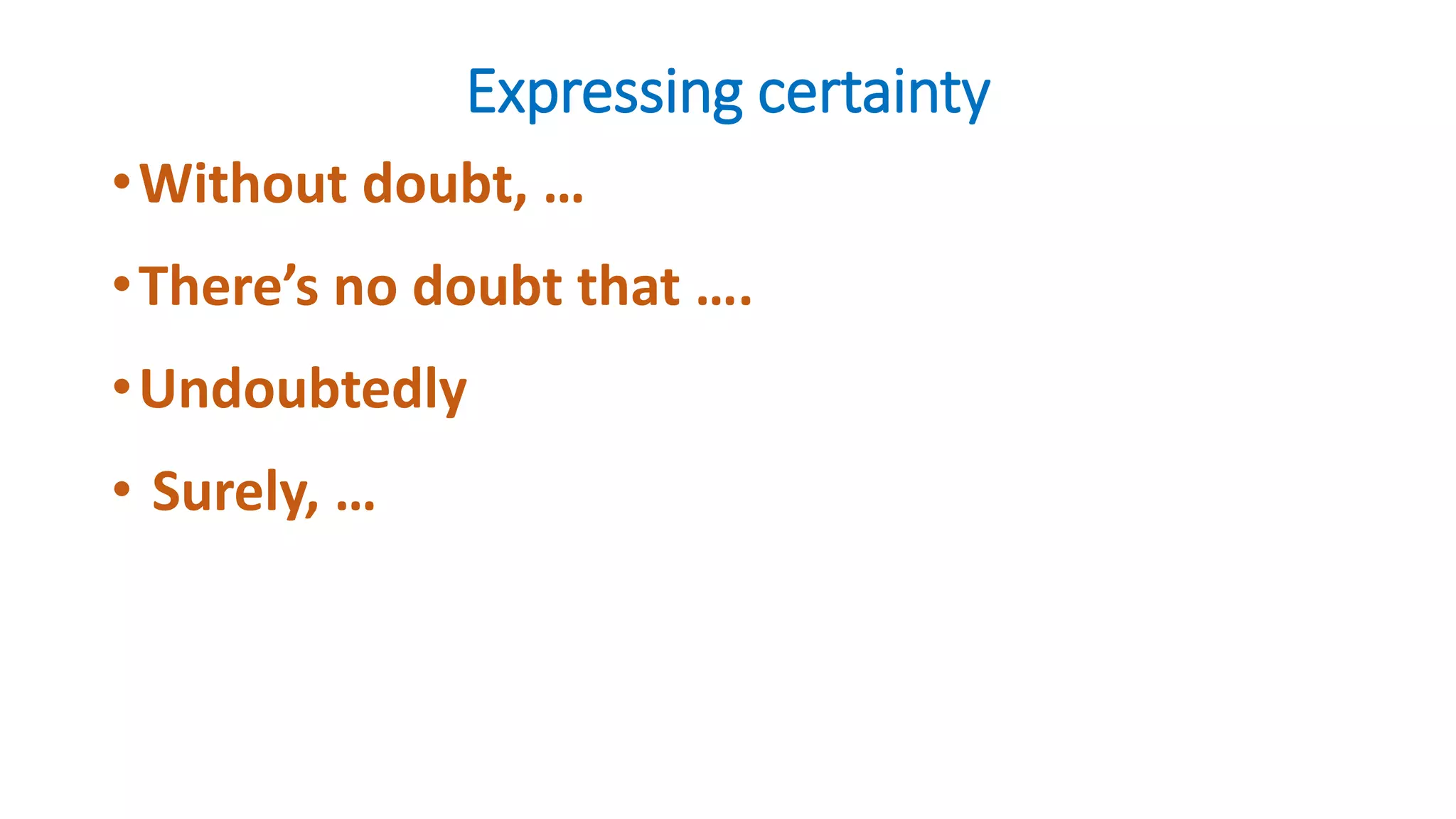
Expressing certainty
•Without doubt, …
•There’s no doubt that ….
•Undoubtedly
• Surely, …
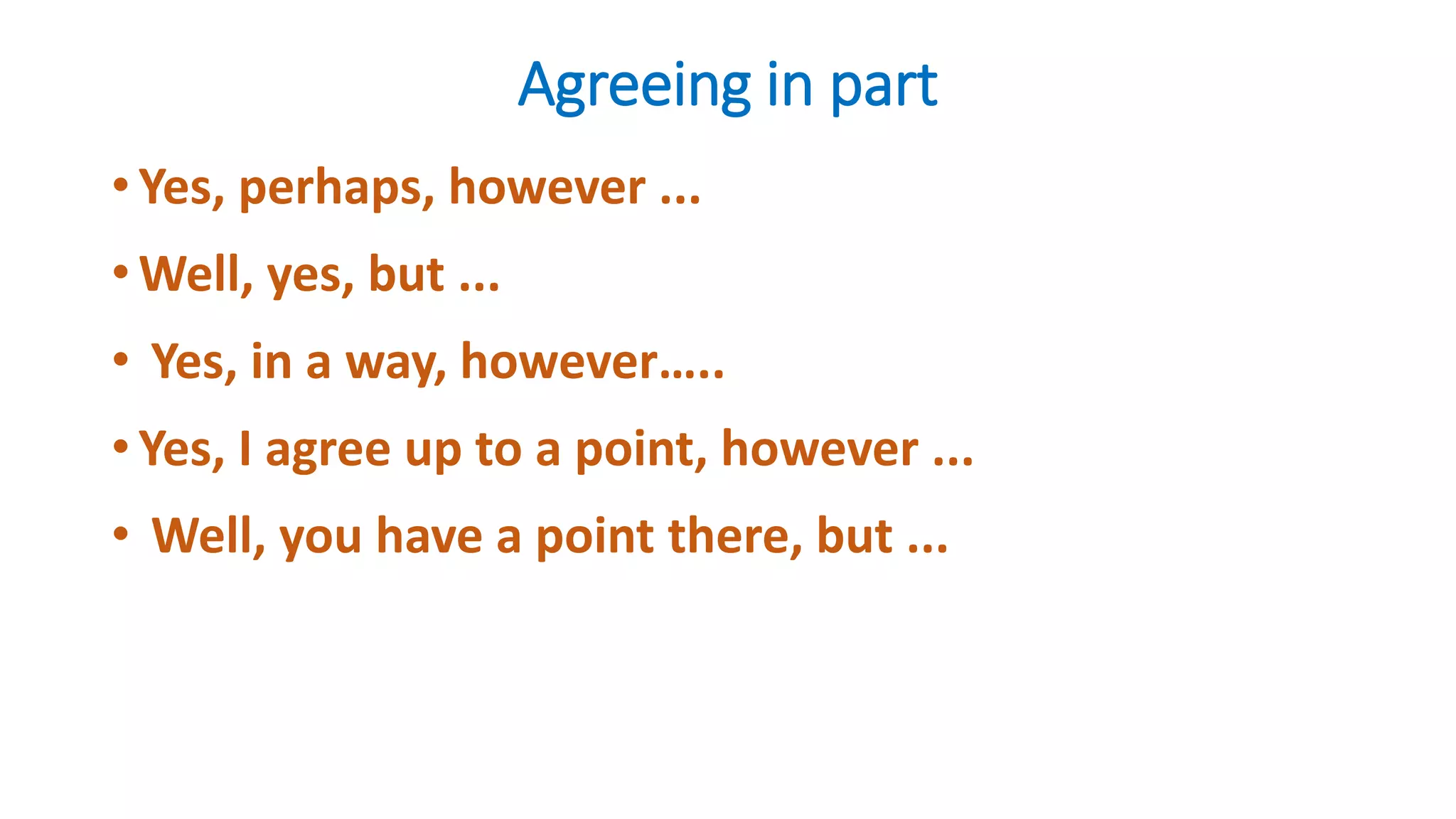
Agreeing in part
• Yes, perhaps, however ...
• Well, yes, but ...
• Yes, in a way, however…..
• Yes, I agree up to a point, however ...
• Well, you have a point there, but ...
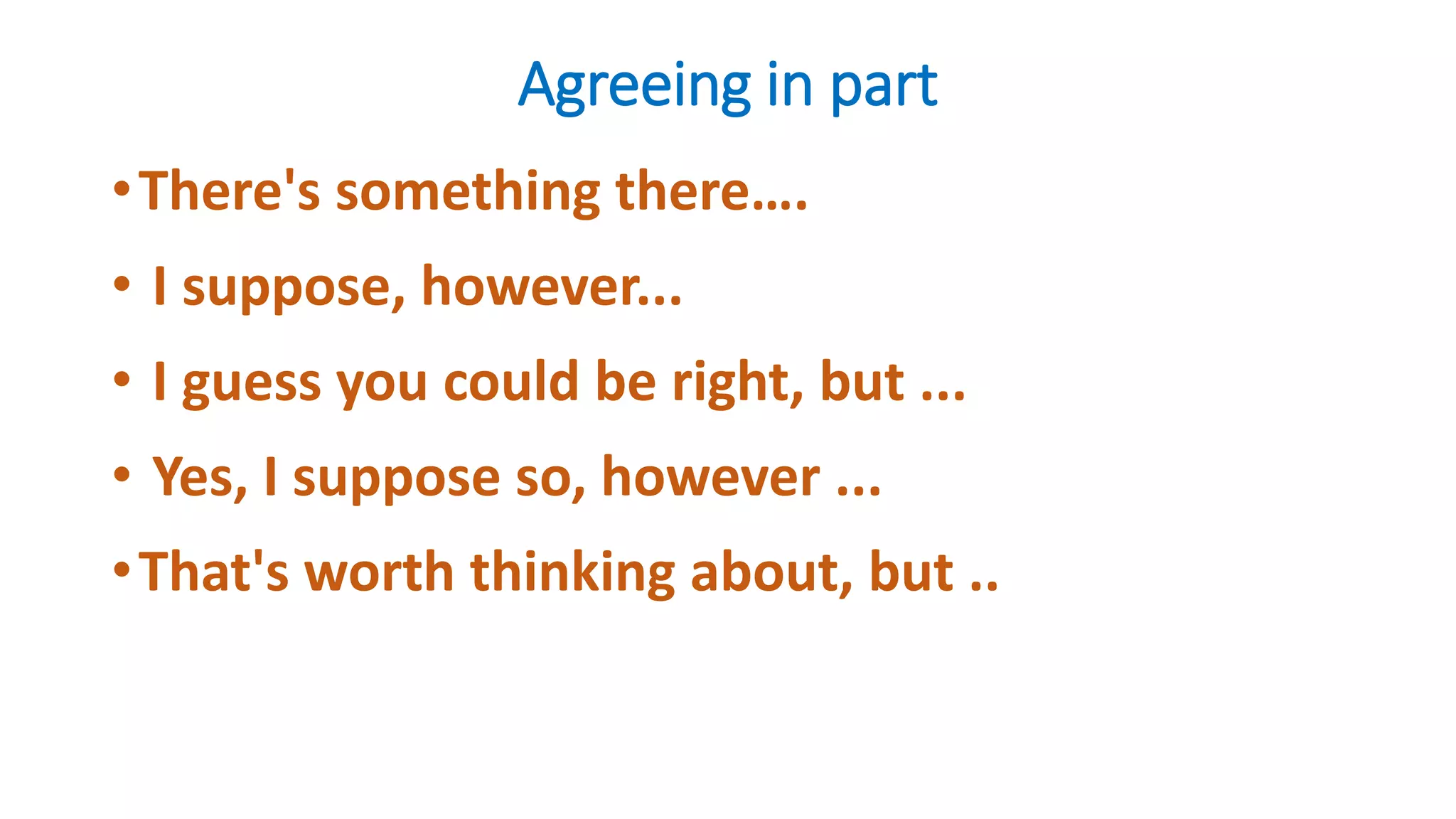
Agreeing in part
•There's something there….
• I suppose, however...
• I guess you could be right, but ...
• Yes, I suppose so, however ...
•That's worth thinking about, but ..
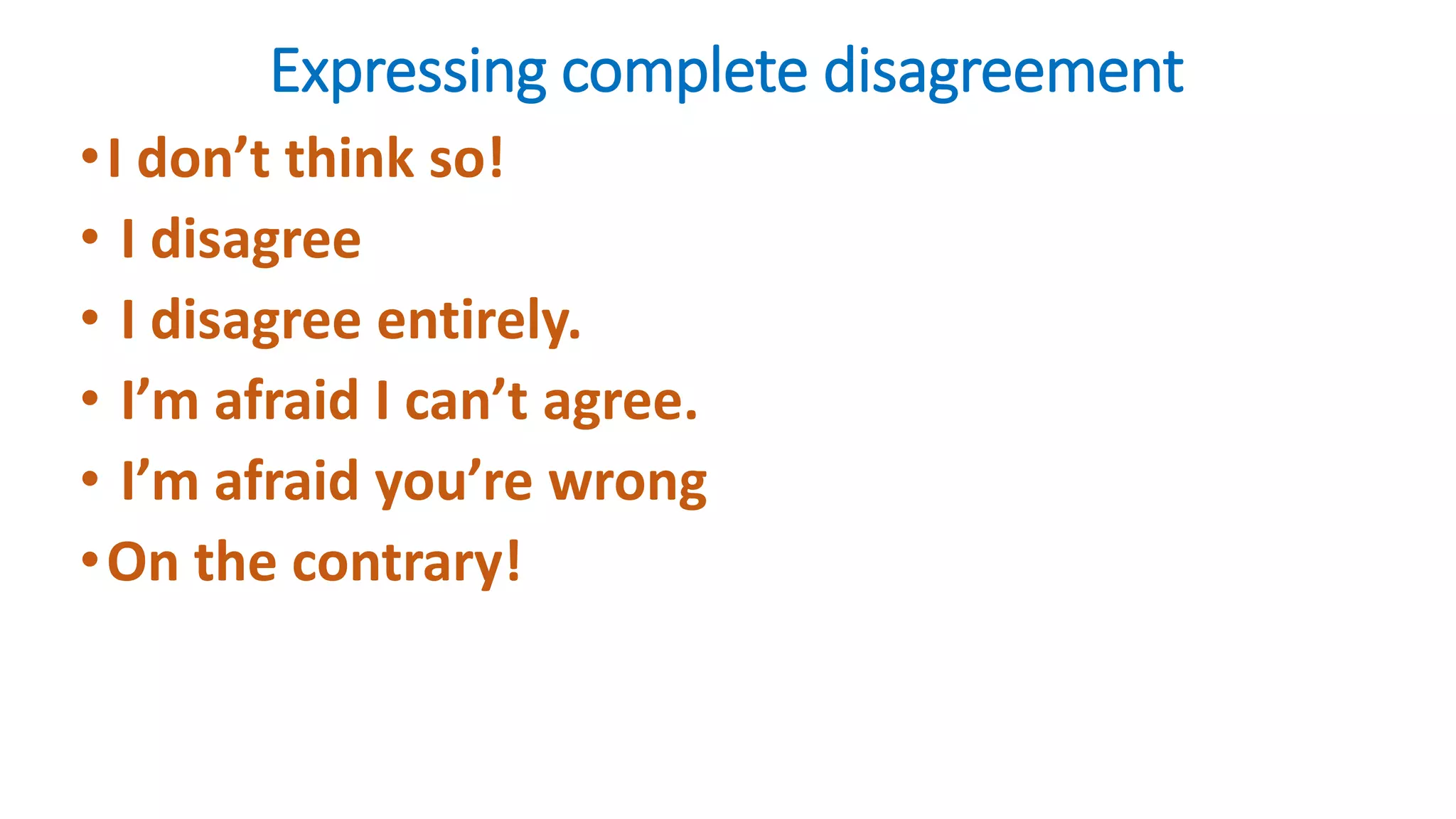
Expressing complete disagreement
•I don’t think so!
• I disagree
• I disagree entirely.
• I’m afraid I can’t agree.
• I’m afraid you’re wrong
•On the contrary!
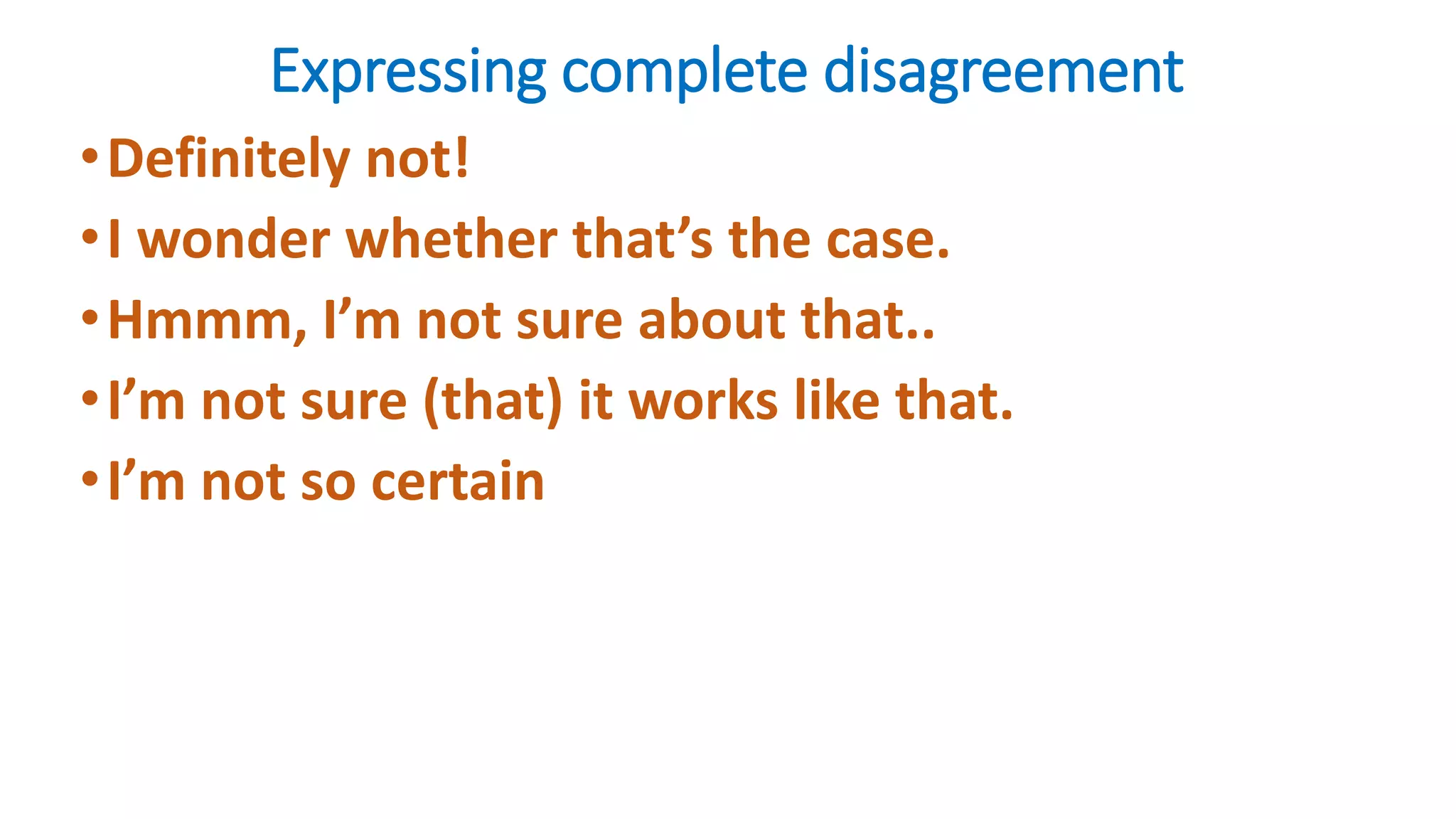
Expressing complete disagreement
•Definitely not!
•I wonder whether that’s the case.
•Hmmm, I’m not sure about that..
•I’m not sure (that) it works like that.
•I’m not so certain
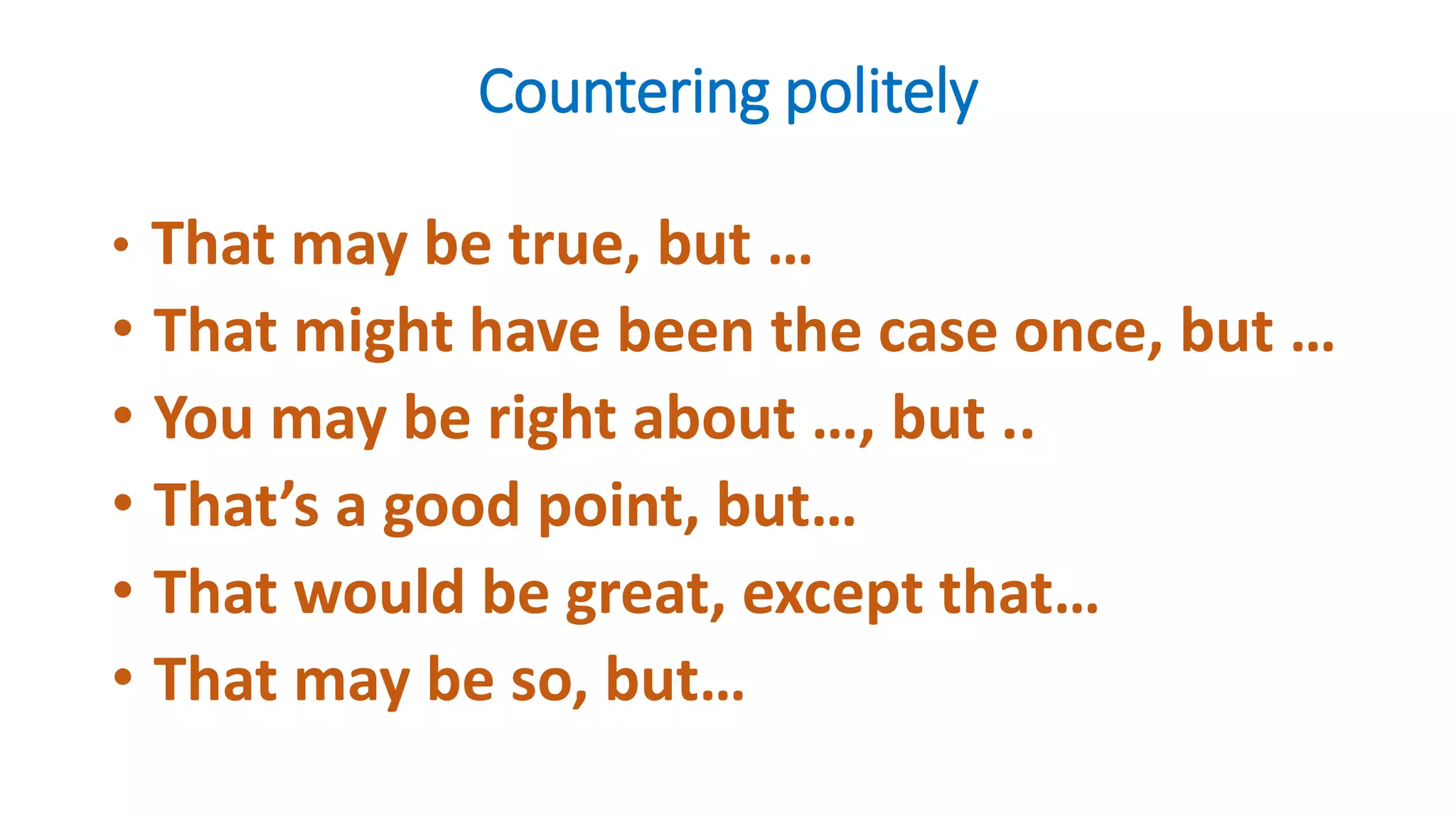
Countering politely
• That may be true, but …
• That might have been the case once, but …
• You may be right about …, but ..
• That’s a good point, but…
• That would be great, except that…
• That may be so, but…
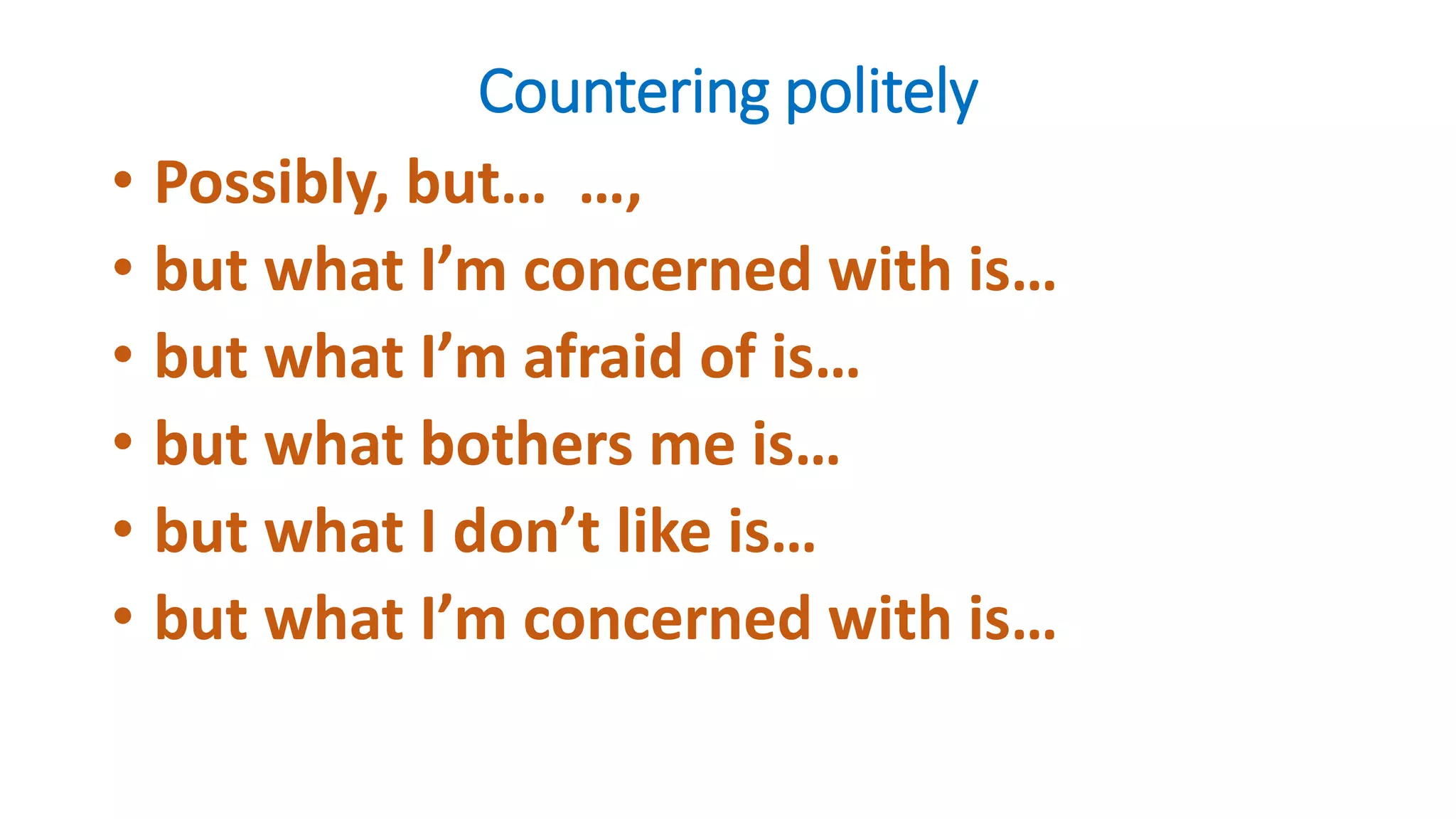
Countering politely
• Possibly, but… …,
• but what I’m concerned with is…
• but what I’m afraid of is…
• but what bothers me is…
• but what I don’t like is…
• but what I’m concerned with is…
DO’S
• Before you begin writing, write down all the points (one/two
words per point) so that you do not forget relevant points
while writing. This also helps you in maintaining a sequence,
which is very important.
• Make sure you double-check for grammatical accuracy and
spellings. They carry marks.
• Leave an adequate number of lines between paragraphs to
make it look clean.
• Underlining the main points is very important
DO’S
• Use a pencil and scale for underlining.
• Always have a few general quotes in handy. They help in
presentation and shows that you’re prepared
• Presentation is very important.
• Have information about all the major environmental, political,
social issues that have taken place during the entire year..
DON’Ts
• Never mention any of your personal details, i.e., name, school name
or address.
• Never write in one go. Make sure you follow the right format and
make paragraphs.
• Don’t use slangs or short forms.
• Don’t write the wrong facts.
• Try not to exceed the prescribed word limit of 150-200 words.
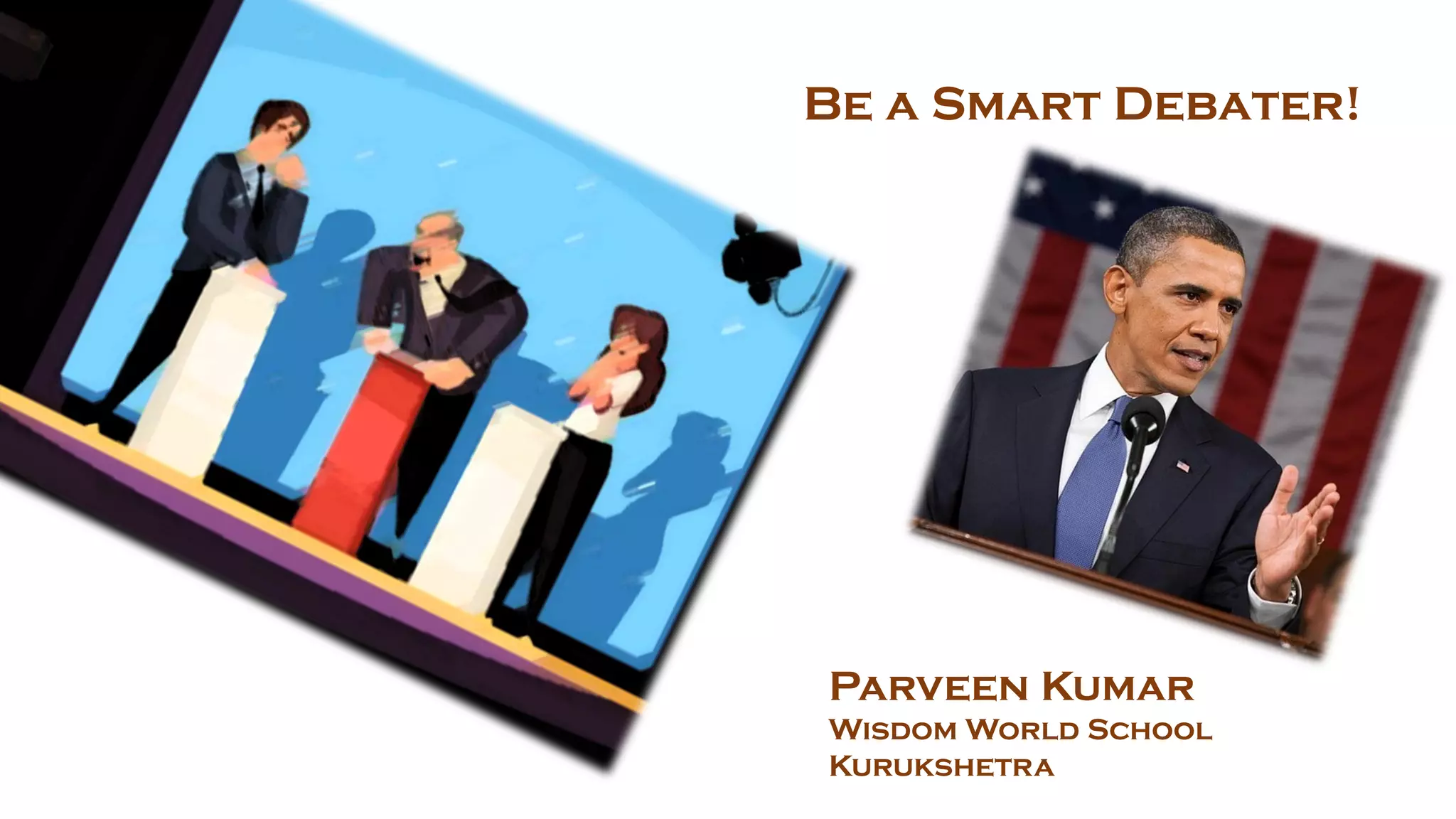
Be a Smart Debater!
Parveen Kumar
Wisdom World School
Kurukshetra

Master the Master Skill - Debate - Debating

  • 1.
  • 3.
    • A StructuredArgument • Two sides speak alternately for and against a particular contention/motion • Each person is allocated a time
  • 8.
  • 9.
    Style THE WAY Content WHAT YOU SAY Strategy PLAN& EXECUTION Basic Debating Skills
  • 10.
    • Speed • Tone •Volume • Diction • Language • Clarity • Fluency • Humour • Stance, gestures and expressions • Use of notes and eye contact Style
  • 11.
    Content • Definitions Whatever themotion is, the first speaker in the debate must define it. • Case - the parts Having defined the motion, you must then begin to build a case. • Case - the whole The case must be outlined in the introduction. This involves stating your main arguments and explaining the general thrust of your case. • Rebuttal - the parts a direct factual error, an indirect factual error misinterpretation. • Rebuttal - the whole
  • 12.
    Strategy • Fulfilling thecorrect role • The Proposer • The Opposer • Teamwork
  • 15.
    USEFUL EXPRESSIONS FORBEGINNING A DEBATE • Good morning to all of you present here. I am [name] from----- to speak on the topic of [title]. • Welcome, ladies and gentlemen, thank you for being here, then pause a moment, then a quote: "Benjamin Franklin once said ______" or whatever the quote is. • Resp. jury and worthy teachers, my fellow mates, honorable guests. A very GOOD Morning/Noon/Evening…… to one and all present here. • Then……. Introduce Yourself!
  • 16.
    USEFUL EXPRESSIONS TOBEGIN A DEBATE • I take this opportunity to present my views in favour/against ……..”Mention your topic • Good Morning everyone. Esteemed judges, honourable guests, respected teachers and my fellow students. I,------feel honoured to have been given the opportunity to speak (FOR/AGAINST) the topic- (name of the topic).
  • 17.
    Giving your opinionabout a topic Expressing a strong opinion • In my opinion, … • In my view, … • In my reckoning, … • I strongly believe in … • I definitely think that …
  • 18.
    Giving your opinionabout a topic Expressing a strong opinion • Well, I think … • I strongly believe • I have a reason to believe • I’m sure that… • I’m pretty sure that…
  • 19.
    Expressing certainty •According togovernment statistics,… • Actually, … •In fact, … • Clearly, … • Obviously, …
  • 20.
    Expressing certainty •Without doubt,… •There’s no doubt that …. •Undoubtedly • Surely, …
  • 21.
    Agreeing in part •Yes, perhaps, however ... • Well, yes, but ... • Yes, in a way, however….. • Yes, I agree up to a point, however ... • Well, you have a point there, but ...
  • 22.
    Agreeing in part •There'ssomething there…. • I suppose, however... • I guess you could be right, but ... • Yes, I suppose so, however ... •That's worth thinking about, but ..
  • 23.
    Expressing complete disagreement •Idon’t think so! • I disagree • I disagree entirely. • I’m afraid I can’t agree. • I’m afraid you’re wrong •On the contrary!
  • 24.
    Expressing complete disagreement •Definitelynot! •I wonder whether that’s the case. •Hmmm, I’m not sure about that.. •I’m not sure (that) it works like that. •I’m not so certain
  • 25.
    Countering politely • Thatmay be true, but … • That might have been the case once, but … • You may be right about …, but .. • That’s a good point, but… • That would be great, except that… • That may be so, but…
  • 26.
    Countering politely • Possibly,but… …, • but what I’m concerned with is… • but what I’m afraid of is… • but what bothers me is… • but what I don’t like is… • but what I’m concerned with is…
  • 27.
    DO’S • Before youbegin writing, write down all the points (one/two words per point) so that you do not forget relevant points while writing. This also helps you in maintaining a sequence, which is very important. • Make sure you double-check for grammatical accuracy and spellings. They carry marks. • Leave an adequate number of lines between paragraphs to make it look clean. • Underlining the main points is very important
  • 28.
    DO’S • Use apencil and scale for underlining. • Always have a few general quotes in handy. They help in presentation and shows that you’re prepared • Presentation is very important. • Have information about all the major environmental, political, social issues that have taken place during the entire year..
  • 29.
    DON’Ts • Never mentionany of your personal details, i.e., name, school name or address. • Never write in one go. Make sure you follow the right format and make paragraphs. • Don’t use slangs or short forms. • Don’t write the wrong facts. • Try not to exceed the prescribed word limit of 150-200 words.
  • 30.
    Be a SmartDebater! Parveen Kumar Wisdom World School Kurukshetra