Do Now
Oxymoron
An oxymoron is a figure of speech containing
words that seem to contradict each other. It's
often referred to as a contradiction in terms.
As with other rhetorical devices, oxymorons
are used for a variety of purposes. Sometimes
they're used to create a little bit of drama for
the reader; sometimes they're used to make a
person stop and think, whether that's to laugh
or to wonder.
Complete the worksheet on oxymoron
• an argument with rules
• two teams present a resolution (sometimes
called a proposition) or topic that they will
debate
• Timed arguments
• One team is for the resolution (PRO or
affirmative) and the other team is
(AGAINST or negative)
• a judge decides at the end of the debate
who is the winner (based on point system)
The 3 major parts of a
debate
1. CONSTRUCTIVE SPEECH
2. CROSS EXAMINATION
3. REBUTTAL
1. CONSTRUCTIVE SPEECH
• Begins with BIRT (Be it resolved that…)
• States 3 or 4 supporting points first
• Then elaborates on each one
• Plan your strategy (for e.g., go from
strongest to weakest)
• Recap at the end
2. CROSS-EXAMINATION
• Most difficult part
• Thinking on your feet
• Question the validity of your
opponents' constructive speech by source,
date, relevance
• Show their weakest points
• Question them aggressively
• Start with general questions then get
really specific
• Undermine the evidence
3. REBUTTAL
• Designed to argue the case made
• It's your time to point out the
inconsistences, absurdities, and illogical
argurments of your opponents.
• Provides the opportunity for speakers to
critique their opponents' arguments
• Absolutely no new evidence may be
presented during this time
• It's time to do some final damage here
•The first speaker in a debate
must make sure that the
resolution is clearly stated and
defined.
What is the Resolution?
• The topic of the debate
• The point on which both parties have
agreed to debate
• Always stated in the positive
• Begins with the phrase (BIRT):
Be it resolved that …
Some examples:
• Be it resolved that Canada is a better
place to live than the U.S.A.
NOT
• Be it resolved that Canada is not a
better place to live than the U.S.A.
And …
• Be it resolved that all public schools
in USA should make uniforms
mandatory for all students.
NOT
• Be it resolved that all public schools
should not make uniforms mandatory
for all students.
Advocate Decision-Making Debate
• Students are placed into groups of three or four
• One or two person is in support of the topic, one or
two is against, and one acts as the judge.
• The judge, or “Decision maker,” will create a list of
questions to ask the advocates, which students will
use as their debate outline.
• Then the judge will decide at the end of the debate
who the winner is.
 Every student should play a musical instrument.
 Homework should be banned.
 All students should do sports throughout middle and high
school.
 All students should be required to volunteer in the
community.
Topics for Debate
Debating Tips and Strategies
• There are many
ways to structure a
debate
• In this class, you
will follow the
handouts carefully
and the time
allotments will not
•DON’T side track your
opponents with irrelevant
points, stay on topic.
•DON’T attack your
opponents.
•DO stick to your planned,
researched arguments.
TIPS
• Cue cards can help a debater to stay
focused, but DON’T read from them,
use them as a guide.
• Speak to the audience or moderator,
not the teacher.
•DO thoroughly research your
topic and position, the best
start to squashing a rebuttal
is a well researched, well
designed presentation.
•DON’T simply state facts:
•This is the path to being a
dull speaker
•Not stating sources or not
backing up statements can
lead to heavy rebuttal from
your opponents
•DO use humor and / or anecdotes in your
speaking:
•Using examples helps illustrate your position, and
uses an argument of precedence
•Make sure your information is appropriate
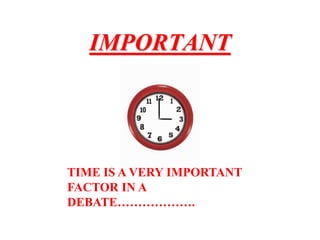
IMPORTANT
TIME IS A VERY IMPORTANT
FACTOR IN A
DEBATE……………….
•DO be aware of time
constraints, if there are
any.
•Practice your initial
speech so you will be “on
top” of the situation.
•Know what it feels like to
speak for the allotted
length of time, speaking
too much or not enough
weakens your position.
•DON’T use inappropriate
language or gestures:
•People will ignore your
information if not presented
in an appropriate manner.
•DON’T try to “juggle” too many points
at once. State your ideas in a logical
order.
•TIP: the more you practice and plan
your speaking, the less nervous you will
be.
Any argument that you do not
address in a rebuttal will be left in
the memory of others as your
opponents stated it.
Likewise, any rebuttal from your
opponents that you do not address
will also be left in the minds of
your audience / judges.
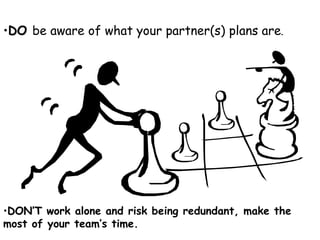
•DO be aware of what your partner(s) plans are.
•DON’T work alone and risk being redundant, make the
most of your team’s time.
•DO recycle
information in your
closing speech.
•Remember:The closing
speaker(s) should sum
up all relevant
arguments and
rebuttals without
introducing any new
information.
Follow these
tips and
suggestions,
and
everything
will come
together for
a successful
debate!!!
5-9-19 Debate.ppt

5-9-19 Debate.ppt

  • 1.
    Do Now Oxymoron An oxymoronis a figure of speech containing words that seem to contradict each other. It's often referred to as a contradiction in terms. As with other rhetorical devices, oxymorons are used for a variety of purposes. Sometimes they're used to create a little bit of drama for the reader; sometimes they're used to make a person stop and think, whether that's to laugh or to wonder. Complete the worksheet on oxymoron
  • 2.
    • an argumentwith rules • two teams present a resolution (sometimes called a proposition) or topic that they will debate • Timed arguments • One team is for the resolution (PRO or affirmative) and the other team is (AGAINST or negative) • a judge decides at the end of the debate who is the winner (based on point system)
  • 3.
    The 3 majorparts of a debate 1. CONSTRUCTIVE SPEECH 2. CROSS EXAMINATION 3. REBUTTAL
  • 4.
    1. CONSTRUCTIVE SPEECH •Begins with BIRT (Be it resolved that…) • States 3 or 4 supporting points first • Then elaborates on each one • Plan your strategy (for e.g., go from strongest to weakest) • Recap at the end
  • 5.
    2. CROSS-EXAMINATION • Mostdifficult part • Thinking on your feet • Question the validity of your opponents' constructive speech by source, date, relevance • Show their weakest points • Question them aggressively • Start with general questions then get really specific • Undermine the evidence
  • 6.
    3. REBUTTAL • Designedto argue the case made • It's your time to point out the inconsistences, absurdities, and illogical argurments of your opponents. • Provides the opportunity for speakers to critique their opponents' arguments • Absolutely no new evidence may be presented during this time • It's time to do some final damage here
  • 7.
    •The first speakerin a debate must make sure that the resolution is clearly stated and defined.
  • 8.
    What is theResolution? • The topic of the debate • The point on which both parties have agreed to debate • Always stated in the positive • Begins with the phrase (BIRT): Be it resolved that …
  • 9.
    Some examples: • Beit resolved that Canada is a better place to live than the U.S.A. NOT • Be it resolved that Canada is not a better place to live than the U.S.A.
  • 10.
    And … • Beit resolved that all public schools in USA should make uniforms mandatory for all students. NOT • Be it resolved that all public schools should not make uniforms mandatory for all students.
  • 11.
    Advocate Decision-Making Debate •Students are placed into groups of three or four • One or two person is in support of the topic, one or two is against, and one acts as the judge. • The judge, or “Decision maker,” will create a list of questions to ask the advocates, which students will use as their debate outline. • Then the judge will decide at the end of the debate who the winner is.
  • 12.
     Every studentshould play a musical instrument.  Homework should be banned.  All students should do sports throughout middle and high school.  All students should be required to volunteer in the community. Topics for Debate
  • 14.
    Debating Tips andStrategies • There are many ways to structure a debate • In this class, you will follow the handouts carefully and the time allotments will not
  • 15.
    •DON’T side trackyour opponents with irrelevant points, stay on topic. •DON’T attack your opponents. •DO stick to your planned, researched arguments.
  • 16.
    TIPS • Cue cardscan help a debater to stay focused, but DON’T read from them, use them as a guide. • Speak to the audience or moderator, not the teacher.
  • 17.
    •DO thoroughly researchyour topic and position, the best start to squashing a rebuttal is a well researched, well designed presentation. •DON’T simply state facts: •This is the path to being a dull speaker •Not stating sources or not backing up statements can lead to heavy rebuttal from your opponents
  • 18.
    •DO use humorand / or anecdotes in your speaking: •Using examples helps illustrate your position, and uses an argument of precedence •Make sure your information is appropriate
  • 19.
    IMPORTANT TIME IS AVERY IMPORTANT FACTOR IN A DEBATE……………….
  • 20.
    •DO be awareof time constraints, if there are any. •Practice your initial speech so you will be “on top” of the situation. •Know what it feels like to speak for the allotted length of time, speaking too much or not enough weakens your position.
  • 21.
    •DON’T use inappropriate languageor gestures: •People will ignore your information if not presented in an appropriate manner. •DON’T try to “juggle” too many points at once. State your ideas in a logical order. •TIP: the more you practice and plan your speaking, the less nervous you will be.
  • 22.
    Any argument thatyou do not address in a rebuttal will be left in the memory of others as your opponents stated it. Likewise, any rebuttal from your opponents that you do not address will also be left in the minds of your audience / judges.
  • 23.
    •DO be awareof what your partner(s) plans are. •DON’T work alone and risk being redundant, make the most of your team’s time.
  • 24.
    •DO recycle information inyour closing speech. •Remember:The closing speaker(s) should sum up all relevant arguments and rebuttals without introducing any new information.
  • 25.
    Follow these tips and suggestions, and everything willcome together for a successful debate!!!