Afternoon Report
Chad Rieck, MD
© 2014 Virginia Mason
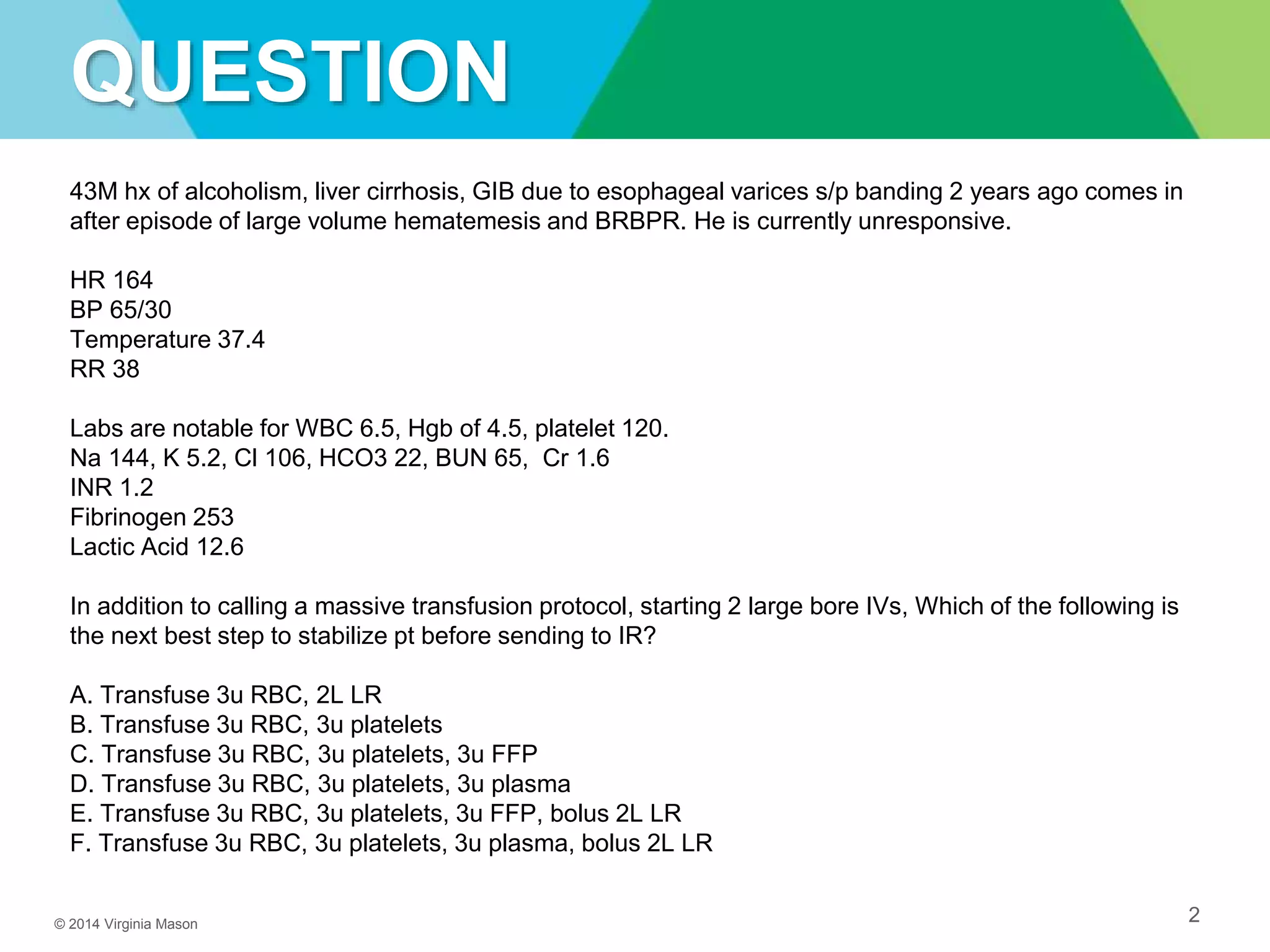
43M hx of alcoholism, liver cirrhosis, GIB due to esophageal varices s/p banding 2 years ago comes in
after episode of large volume hematemesis and BRBPR. He is currently unresponsive.
HR 164
BP 65/30
Temperature 37.4
RR 38
Labs are notable for WBC 6.5, Hgb of 4.5, platelet 120.
Na 144, K 5.2, Cl 106, HCO3 22, BUN 65, Cr 1.6
INR 1.2
Fibrinogen 253
Lactic Acid 12.6
In addition to calling a massive transfusion protocol, starting 2 large bore IVs, Which of the following is
the next best step to stabilize pt before sending to IR?
A. Transfuse 3u RBC, 2L LR
B. Transfuse 3u RBC, 3u platelets
C. Transfuse 3u RBC, 3u platelets, 3u FFP
D. Transfuse 3u RBC, 3u platelets, 3u plasma
E. Transfuse 3u RBC, 3u platelets, 3u FFP, bolus 2L LR
F. Transfuse 3u RBC, 3u platelets, 3u plasma, bolus 2L LR
2
QUESTION
© 2014 Virginia Mason
• Causes:
– Most common, polytrauma
• Major surgeries
– GI bleeds
– Obstetric hemorrhage
3
Massive Blood Transfusion
© 2014 Virginia Mason
Massive Blood Transfusion
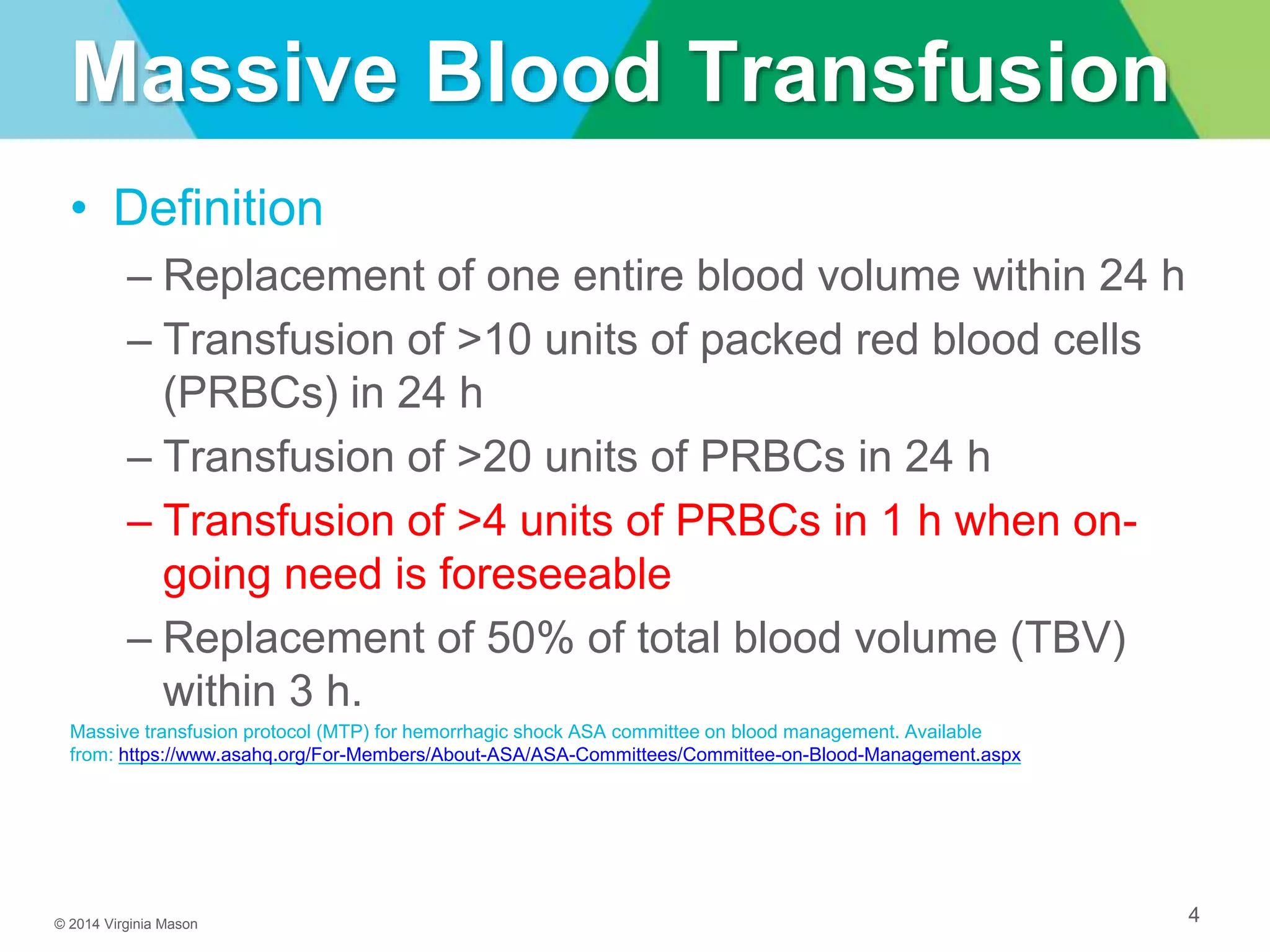
• Definition
– Replacement of one entire blood volume within 24 h
– Transfusion of >10 units of packed red blood cells
(PRBCs) in 24 h
– Transfusion of >20 units of PRBCs in 24 h
– Transfusion of >4 units of PRBCs in 1 h when on-
going need is foreseeable
– Replacement of 50% of total blood volume (TBV)
within 3 h.
Massive transfusion protocol (MTP) for hemorrhagic shock ASA committee on blood management. Available
from: https://www.asahq.org/For-Members/About-ASA/ASA-Committees/Committee-on-Blood-Management.aspx
4
© 2014 Virginia Mason
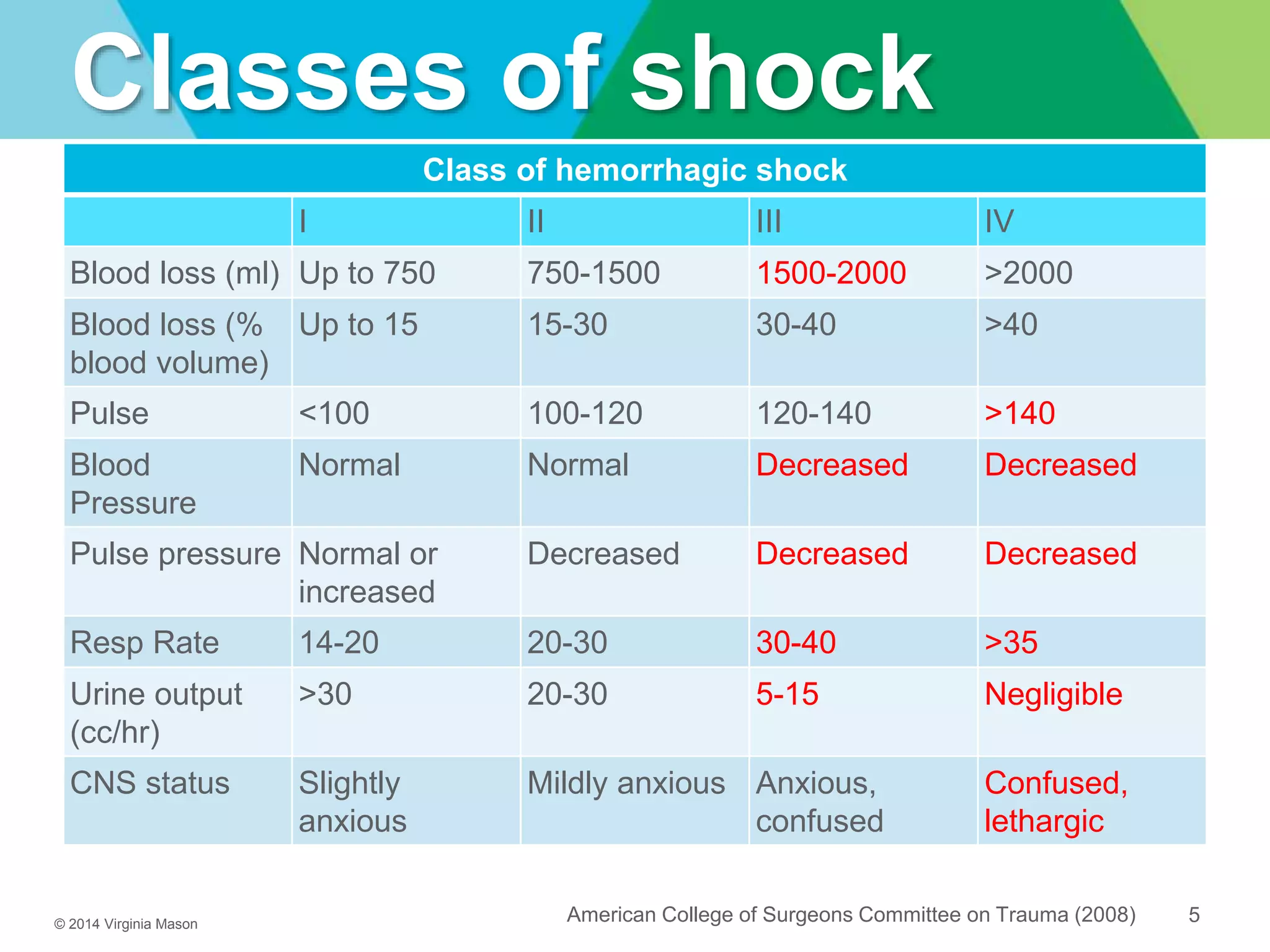
Classes of shock
Class of hemorrhagic shock
I II III IV
Blood loss (ml) Up to 750 750-1500 1500-2000 >2000
Blood loss (%
blood volume)
Up to 15 15-30 30-40 >40
Pulse <100 100-120 120-140 >140
Blood
Pressure
Normal Normal Decreased Decreased
Pulse pressure Normal or
increased
Decreased Decreased Decreased
Resp Rate 14-20 20-30 30-40 >35
Urine output
(cc/hr)
>30 20-30 5-15 Negligible
CNS status Slightly
anxious
Mildly anxious Anxious,
confused
Confused,
lethargic
5American College of Surgeons Committee on Trauma (2008)
© 2014 Virginia Mason
• Intravascular volume loss
– Hemorrhagic shock
– Overzealous resuscitation
• Loss of blood components
– Use
– Lose
– Dilute
6
Management
© 2014 Virginia Mason
Complications from only RBC transfusion
• Coagulation proteins
– 10% decrease in concentration of clotting proteins
for each 500cc of blood loss being replaced
• Bleeding due to dilution occurs when the level of
coagulation proteins fall to 25% of normal (8-10u of
RBC)
• Platelets
– 10-12 u of RBC associated with 50% fall in the
platelet count
• 1 six pack of platelets raise level by 30,000.
7
© 2014 Virginia Mason
Complications from massive transfusion
• Acidosis
– Impaired assembly of coagulation factor complexes
• Increased fibrinolysis
• Delayed fibrin production
• Altered fibrin structure
• Metabolic alkalosis
– 1mmol of Citrate -> 3 mEq of bicarbonate
• Hypothermia
– Platelet function decreased
• Dilution
• Hypocalcemia
– Citrate infusions
• Hyperkalemia
8
© 2014 Virginia Mason 9
Complications from massive transfusion
© 2014 Virginia Mason
Prospective Observational Multicenter
Major Trauma Transfusion (PROMMTT)
10
The bars represent cumulative ratios at the start of each time interval. Most patients received a
plasma:red blood cell (RBC) ratio of 1:2 or higher by 3 hours (A) and a platelet:RBC ratio of 1:2 or
higher by 6 hours (B). In the last time interval (24 hours), the percentage of patients receiving 0 units of
platelets or plasma increases, reflecting the dynamic cohort with newly eligible patients entering and
others exiting owing to death in the previous interval.
© 2014 Virginia Mason
Prospective Observational Multicenter
Major Trauma Transfusion (PROMMTT)
11
Improved mortality with higher blood product
ratios:
First 24 hours for plasma
First 6 hours for platelets
After these times, other high competing risk
for nonhemorrhagic deaths were not
associated with morality
The Prospective Observational Multicenter
Major Trauma Transfusion (PROMMTT)
study demonstrated that clinicians generally
were transfusing patients with a blood
product ratio of 1:1:1 or 1:1:2 and that early
transfusion of plasma (within minutes of
arrival to a trauma center) was associated
with improved 6-hour survival after
admission.
© 2014 Virginia Mason
PROPPR trial
12
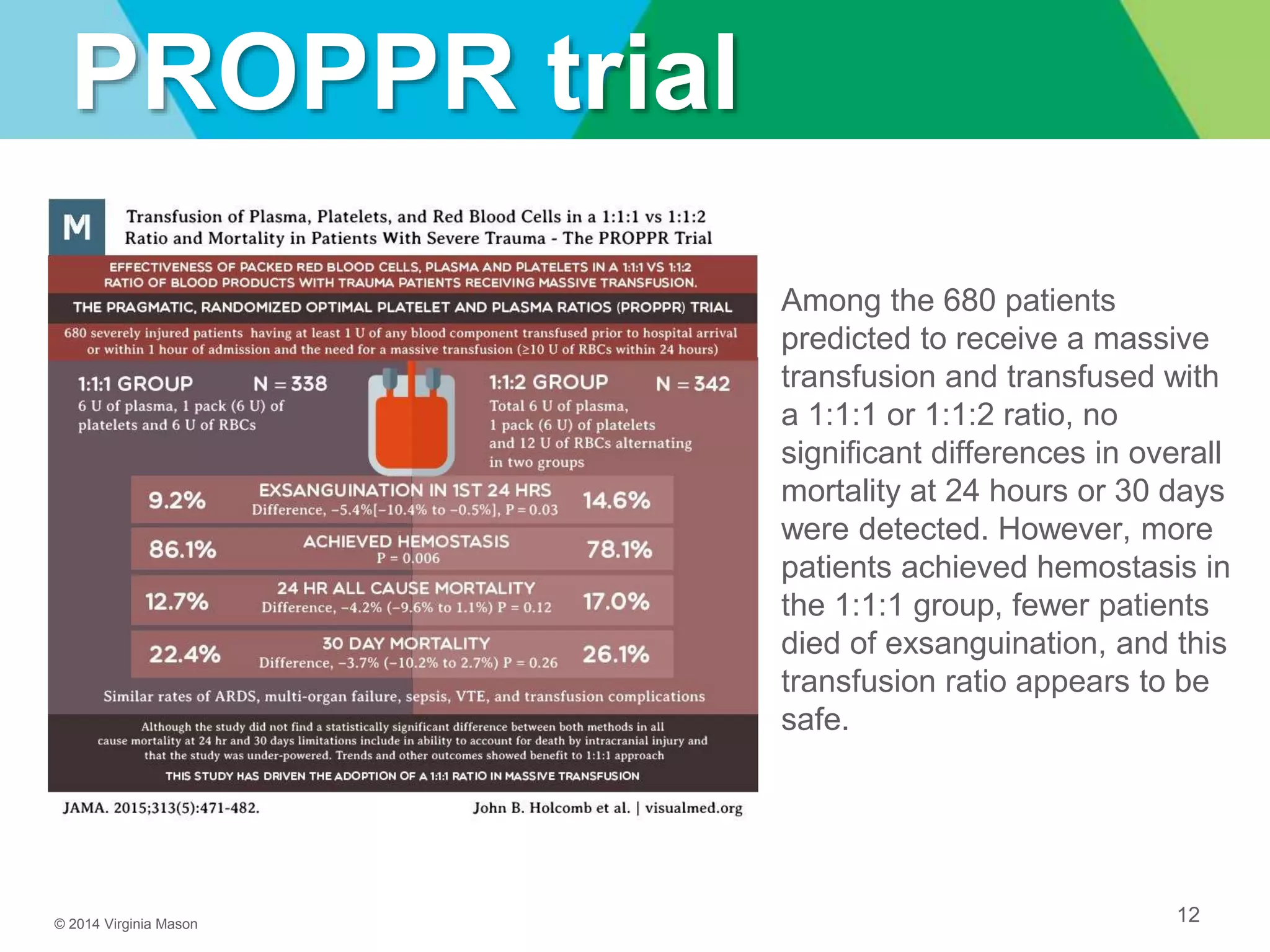
Among the 680 patients
predicted to receive a massive
transfusion and transfused with
a 1:1:1 or 1:1:2 ratio, no
significant differences in overall
mortality at 24 hours or 30 days
were detected. However, more
patients achieved hemostasis in
the 1:1:1 group, fewer patients
died of exsanguination, and this
transfusion ratio appears to be
safe.
© 2014 Virginia Mason
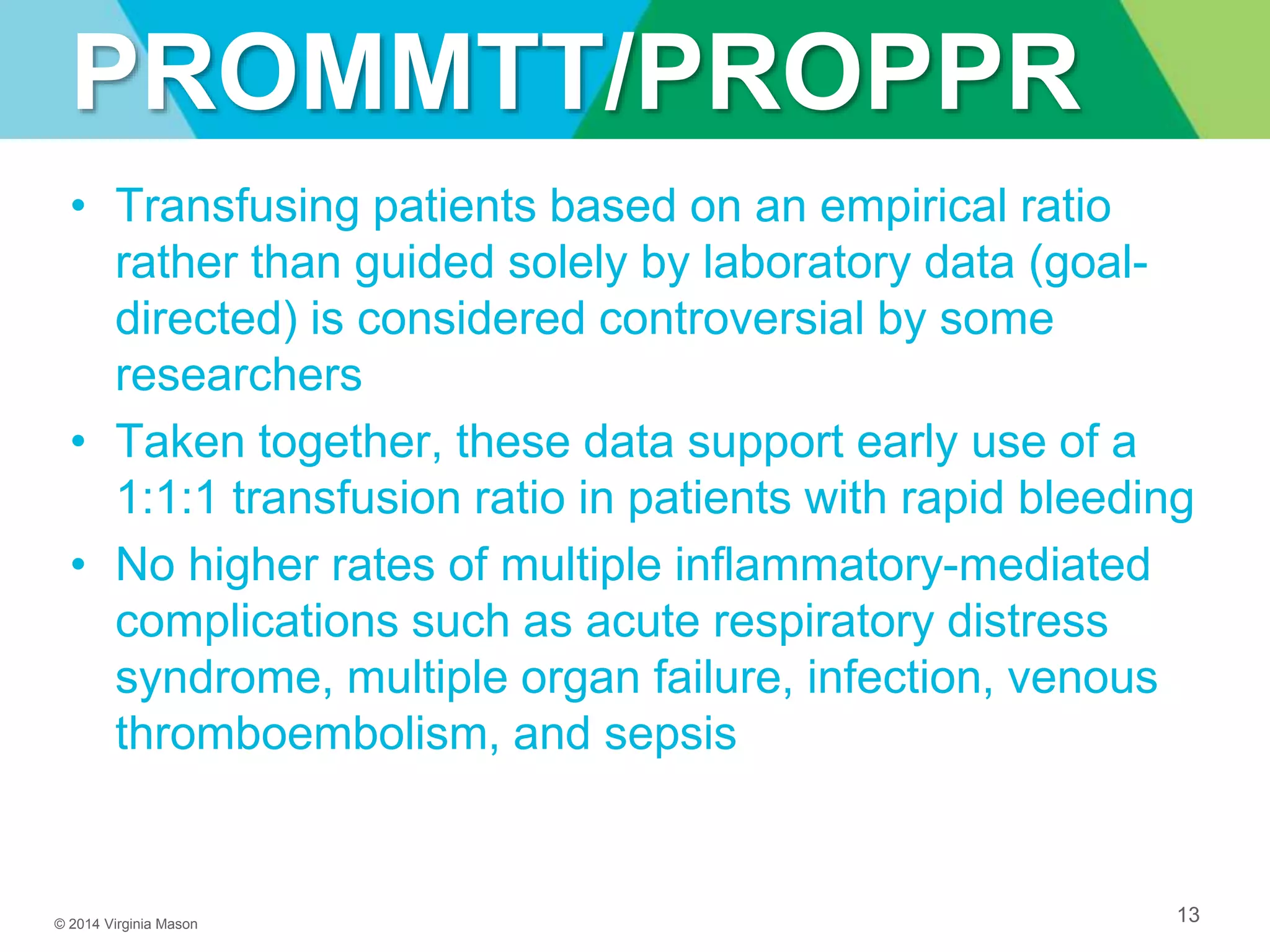
PROMMTT/PROPPR
• Transfusing patients based on an empirical ratio
rather than guided solely by laboratory data (goal-
directed) is considered controversial by some
researchers
• Taken together, these data support early use of a
1:1:1 transfusion ratio in patients with rapid bleeding
• No higher rates of multiple inflammatory-mediated
complications such as acute respiratory distress
syndrome, multiple organ failure, infection, venous
thromboembolism, and sepsis
13
© 2014 Virginia Mason
MTP
• Two options:
– Code blue
• IV therapy/surgery 210/Anesthesia/nursing/RT
– Dial ‘‘ B-L-O-O-D ’’ (x25663)
• A Massive Transfusion Pack contains:
– 6 units red blood cells
– 4 units plasma
– 1 apheresis platelet unit
– 1 cryoprecipitate pooled unit
• RBCs and plasma will be delivered first, with a goal
delivery time of 15 minutes.
14
© 2014 Virginia Mason
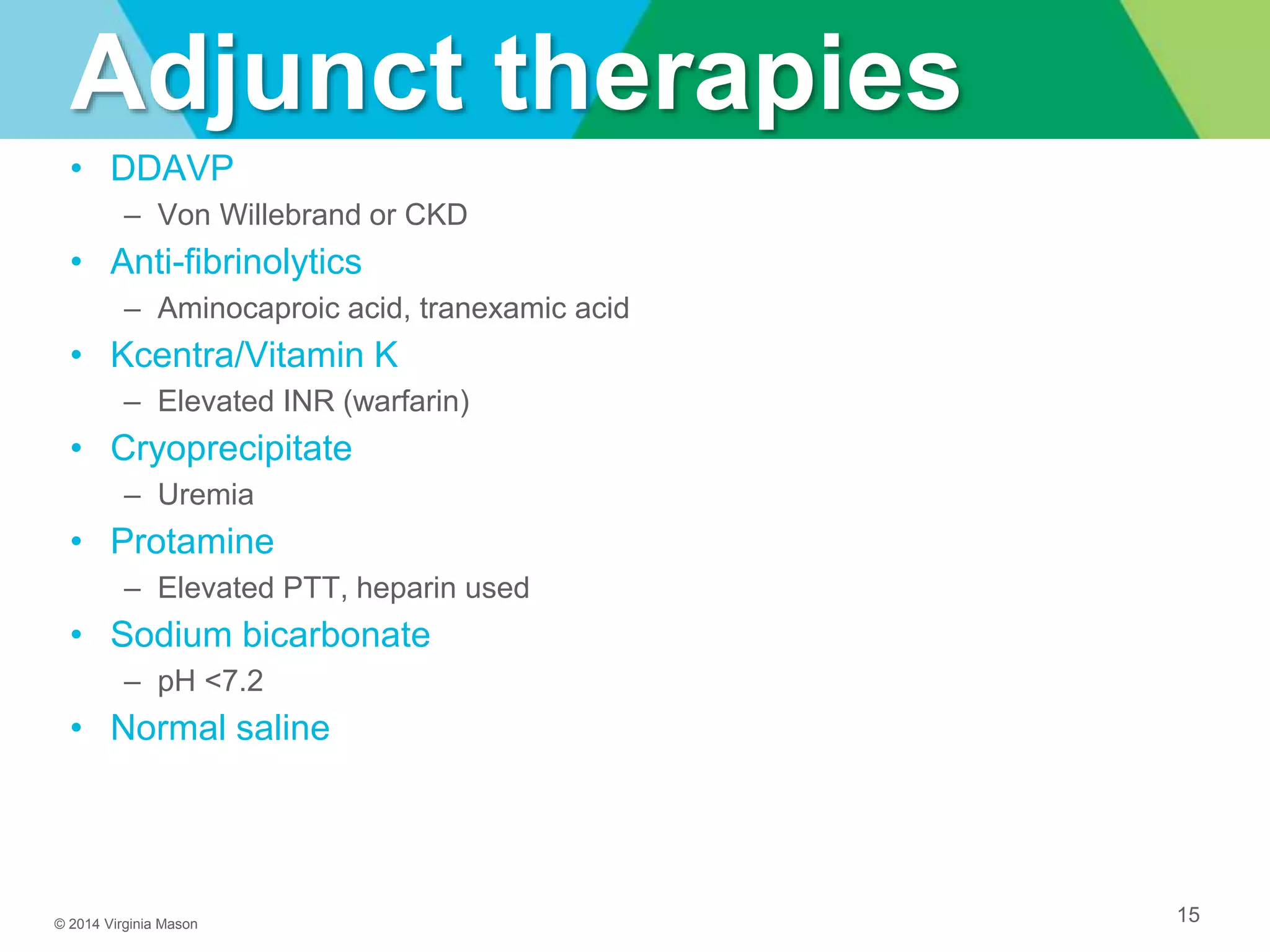
Adjunct therapies
• DDAVP
– Von Willebrand or CKD
• Anti-fibrinolytics
– Aminocaproic acid, tranexamic acid
• Kcentra/Vitamin K
– Elevated INR (warfarin)
• Cryoprecipitate
– Uremia
• Protamine
– Elevated PTT, heparin used
• Sodium bicarbonate
– pH <7.2
• Normal saline
15
© 2014 Virginia Mason
Wellness
16

Massive transfusion

  • 1.
  • 2.
    © 2014 VirginiaMason 43M hx of alcoholism, liver cirrhosis, GIB due to esophageal varices s/p banding 2 years ago comes in after episode of large volume hematemesis and BRBPR. He is currently unresponsive. HR 164 BP 65/30 Temperature 37.4 RR 38 Labs are notable for WBC 6.5, Hgb of 4.5, platelet 120. Na 144, K 5.2, Cl 106, HCO3 22, BUN 65, Cr 1.6 INR 1.2 Fibrinogen 253 Lactic Acid 12.6 In addition to calling a massive transfusion protocol, starting 2 large bore IVs, Which of the following is the next best step to stabilize pt before sending to IR? A. Transfuse 3u RBC, 2L LR B. Transfuse 3u RBC, 3u platelets C. Transfuse 3u RBC, 3u platelets, 3u FFP D. Transfuse 3u RBC, 3u platelets, 3u plasma E. Transfuse 3u RBC, 3u platelets, 3u FFP, bolus 2L LR F. Transfuse 3u RBC, 3u platelets, 3u plasma, bolus 2L LR 2 QUESTION
  • 3.
    © 2014 VirginiaMason • Causes: – Most common, polytrauma • Major surgeries – GI bleeds – Obstetric hemorrhage 3 Massive Blood Transfusion
  • 4.
    © 2014 VirginiaMason Massive Blood Transfusion • Definition – Replacement of one entire blood volume within 24 h – Transfusion of >10 units of packed red blood cells (PRBCs) in 24 h – Transfusion of >20 units of PRBCs in 24 h – Transfusion of >4 units of PRBCs in 1 h when on- going need is foreseeable – Replacement of 50% of total blood volume (TBV) within 3 h. Massive transfusion protocol (MTP) for hemorrhagic shock ASA committee on blood management. Available from: https://www.asahq.org/For-Members/About-ASA/ASA-Committees/Committee-on-Blood-Management.aspx 4
  • 5.
    © 2014 VirginiaMason Classes of shock Class of hemorrhagic shock I II III IV Blood loss (ml) Up to 750 750-1500 1500-2000 >2000 Blood loss (% blood volume) Up to 15 15-30 30-40 >40 Pulse <100 100-120 120-140 >140 Blood Pressure Normal Normal Decreased Decreased Pulse pressure Normal or increased Decreased Decreased Decreased Resp Rate 14-20 20-30 30-40 >35 Urine output (cc/hr) >30 20-30 5-15 Negligible CNS status Slightly anxious Mildly anxious Anxious, confused Confused, lethargic 5American College of Surgeons Committee on Trauma (2008)
  • 6.
    © 2014 VirginiaMason • Intravascular volume loss – Hemorrhagic shock – Overzealous resuscitation • Loss of blood components – Use – Lose – Dilute 6 Management
  • 7.
    © 2014 VirginiaMason Complications from only RBC transfusion • Coagulation proteins – 10% decrease in concentration of clotting proteins for each 500cc of blood loss being replaced • Bleeding due to dilution occurs when the level of coagulation proteins fall to 25% of normal (8-10u of RBC) • Platelets – 10-12 u of RBC associated with 50% fall in the platelet count • 1 six pack of platelets raise level by 30,000. 7
  • 8.
    © 2014 VirginiaMason Complications from massive transfusion • Acidosis – Impaired assembly of coagulation factor complexes • Increased fibrinolysis • Delayed fibrin production • Altered fibrin structure • Metabolic alkalosis – 1mmol of Citrate -> 3 mEq of bicarbonate • Hypothermia – Platelet function decreased • Dilution • Hypocalcemia – Citrate infusions • Hyperkalemia 8
  • 9.
    © 2014 VirginiaMason 9 Complications from massive transfusion
  • 10.
    © 2014 VirginiaMason Prospective Observational Multicenter Major Trauma Transfusion (PROMMTT) 10 The bars represent cumulative ratios at the start of each time interval. Most patients received a plasma:red blood cell (RBC) ratio of 1:2 or higher by 3 hours (A) and a platelet:RBC ratio of 1:2 or higher by 6 hours (B). In the last time interval (24 hours), the percentage of patients receiving 0 units of platelets or plasma increases, reflecting the dynamic cohort with newly eligible patients entering and others exiting owing to death in the previous interval.
  • 11.
    © 2014 VirginiaMason Prospective Observational Multicenter Major Trauma Transfusion (PROMMTT) 11 Improved mortality with higher blood product ratios: First 24 hours for plasma First 6 hours for platelets After these times, other high competing risk for nonhemorrhagic deaths were not associated with morality The Prospective Observational Multicenter Major Trauma Transfusion (PROMMTT) study demonstrated that clinicians generally were transfusing patients with a blood product ratio of 1:1:1 or 1:1:2 and that early transfusion of plasma (within minutes of arrival to a trauma center) was associated with improved 6-hour survival after admission.
  • 12.
    © 2014 VirginiaMason PROPPR trial 12 Among the 680 patients predicted to receive a massive transfusion and transfused with a 1:1:1 or 1:1:2 ratio, no significant differences in overall mortality at 24 hours or 30 days were detected. However, more patients achieved hemostasis in the 1:1:1 group, fewer patients died of exsanguination, and this transfusion ratio appears to be safe.
  • 13.
    © 2014 VirginiaMason PROMMTT/PROPPR • Transfusing patients based on an empirical ratio rather than guided solely by laboratory data (goal- directed) is considered controversial by some researchers • Taken together, these data support early use of a 1:1:1 transfusion ratio in patients with rapid bleeding • No higher rates of multiple inflammatory-mediated complications such as acute respiratory distress syndrome, multiple organ failure, infection, venous thromboembolism, and sepsis 13
  • 14.
    © 2014 VirginiaMason MTP • Two options: – Code blue • IV therapy/surgery 210/Anesthesia/nursing/RT – Dial ‘‘ B-L-O-O-D ’’ (x25663) • A Massive Transfusion Pack contains: – 6 units red blood cells – 4 units plasma – 1 apheresis platelet unit – 1 cryoprecipitate pooled unit • RBCs and plasma will be delivered first, with a goal delivery time of 15 minutes. 14
  • 15.
    © 2014 VirginiaMason Adjunct therapies • DDAVP – Von Willebrand or CKD • Anti-fibrinolytics – Aminocaproic acid, tranexamic acid • Kcentra/Vitamin K – Elevated INR (warfarin) • Cryoprecipitate – Uremia • Protamine – Elevated PTT, heparin used • Sodium bicarbonate – pH <7.2 • Normal saline 15
  • 16.
    © 2014 VirginiaMason Wellness 16

Editor's Notes

  • #11 The significant protective association between higher blood product ratios and mortality that we observed was concentrated in the first 24 hours for plasma and the first 6 hours for platelets. Thereafter, during the later time periods of high competing risks for nonhemorrhagic causes of death among severely injured patients, plasma and platelet ratios were not significantly associated with mortality. The Prospective Observational Multicenter Major Trauma Transfusion (PROMMTT) study demonstrated that clinicians generally were transfusing patients with a blood product ratio of 1:1:1 or 1:1:2 and that early transfusion of plasma (within minutes of arrival to a trauma center) was associated with improved 6-hour survival after admission.
  • #12 The significant protective association between higher blood product ratios and mortality that we observed was concentrated in the first 24 hours for plasma and the first 6 hours for platelets. Thereafter, during the later time periods of high competing risks for nonhemorrhagic causes of death among severely injured patients, plasma and platelet ratios were not significantly associated with mortality.