







Advertising is the
paid, impersonal, oneway
marketing of persuasive
information from an identified
sponsor disseminated through
channels of mass
communication to promote
the adoption of
goods, services or ideas.
Advertisements works largely through
appeal to emotions of
envy, fear, anxiety about one’s
appearance and the lack of status. It is
widely assumed that the attention and
interest of consumers must be gained
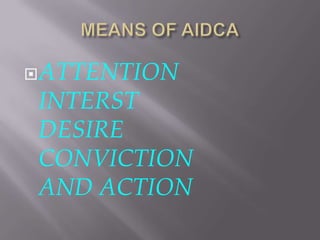
by this formula (AIDCA).
 ATTENTION

INTERST
DESIRE
CONVICTION
AND ACTION


Thomas J. Barratt from London has been called
"the father of modern advertising".Working for
the Pears Soap company, Barratt created an
effective advertising campaign for the company
products, which involved the use of targeted
slogans, images and phrases. One of his
slogans, ""Good morning. Have you used Pears'
soap?" was famous in its day and well into the
20th century.Under Barratt's guidance, Pears
Soap became the world's first legally registered
brand and is therefore the world's oldest
continuously existing brand.
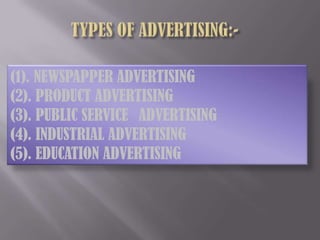
(1). NEWSPAPPER ADVERTISING
(2). PRODUCT ADVERTISING
(3). PUBLIC SERVICE ADVERTISING
(4). INDUSTRIAL ADVERTISING
(5). EDUCATION ADVERTISING


This is the most common type of
advertising. The items advertising
are consumer products and
consumer itself rather than the name
of the company or manufacturer.
The advertising tells a story about
the product, evokes an image or
images of it. Turns into something
unique
The advertising techniques used to promote commercial goods and services
can be used to inform, educate and motivate the public about noncommercial issues, such as HIV/AIDS,political ideology, energy
conservation and deforestation.
Advertising, in its non-commercial guise, is a powerful educational tool
capable of reaching and motivating large audiences. "Advertising justifies
its existence when used in the public interest – it is much too powerful a
tool to use solely for commercial purposes.
Public service advertising, non-commercial advertising, public interest
advertising, cause marketing, and social marketing are different terms for
the use of sophisticated advertising and marketing communications
techniques on behalf of non-commercial, public interest issues and
initiatives.
In the United States, the granting of television and radio licenses by the
FCC is contingent upon the station broadcasting a certain amount of public
service advertising. To meet these requirements, many broadcast stations in
America air the bulk of their required public service announcements during
the late night or early morning when the smallest percentage of viewers are
watching, leaving more day and prime time commercial slots available for
high-paying advertisers………….
Advertising is at the front of delivering the proper
message to customers and prospective customers. The
purpose of advertising is to convince customers that a
company's services or products are the best, enhance
the image of the company, point out and create a need
for products or services, demonstrate new uses for
established products, announce new products and
programs, reinforce the salespeople's individual
messages, draw customers to the business, and to
hold existing customers.
Advertising education has become widely popular
with bachelor, master and doctorate degrees
becoming available in the emphasis. A surge in
advertising interest is typically attributed to the
strong relationship advertising plays in cultural and
technological changes, such as the advance of online
social networking. A unique model for teaching
advertising is the student-run advertising
agency, where advertising students create campaigns
for real companies. Organizations such as American
Advertising Federation and AdU Network partner
established companies with students to create these
campaigns………………..
Advertising has gone through five major stages of
development: domestic, export, international, multinational, and global. For global advertisers, there are
four, potentially competing, business objectives that must
be balanced when developing worldwide advertising:
building a brand while speaking with one
voice, developing economies of scale in the creative
process, maximising local effectiveness of ads, and
increasing the company’s speed of implementation. Born
from the evolutionary stages of global marketing are the
three primary and fundamentally different approaches to
the development of global advertising executions:
exporting executions, producing local executions, and
importing ideas that travel…………….




Egyptians used papyrus to make sales messages and wall
posters. Commercial messages and political campaign
displays have been found in the ruins of Pompeii and
ancient Arabia. Lost and found advertising on papyrus was
common in Ancient Greece and Ancient Rome. Wall or rock
painting for commercial advertising is another
manifestation of an ancient advertising form, which is
present to this day in many parts of Asia, Africa, and South
America. The tradition of wall painting can be traced back to
Indian rock art paintings that date back to 4000 BCE. Out-ofhome advertising and billboards are the oldest forms of
advertising.
As education became an apparent need and reading, as well
as printing, developed advertising expanded to include
handbills.In the 18th century advertisements started to
appear in weekly newspapers in England………………


This practice was carried over to commercial television in the late
1940s and early 1950s. A fierce battle was fought between those
seeking to commercialise the radio and people who argued that the
radio spectrum should be considered a part of the commons – to be
used only non-commercially and for the public good. The United
Kingdom pursued a public funding model for the BBC, originally a
private company, the British Broadcasting Company, but
incorporated as a public body by Royal Charter in 1927. In
Canada, advocates like Graham Spry were likewise able to persuade
the federal government to adopt a public funding model, creating
the Canadian Broadcasting Corporation. However, in the United
States, the capitalist model prevailed with the passage of the
Communications Act of 1934 which created the Federal
Communications Commission (FCC). However, the U.S. Congress
did require commercial broadcasting companies to operate in the
"public interest, convenience, and necessity".Public broadcasting
now exists in the United States due to the 1967 Public Broadcasting
Act which led to the Public Broadcasting Service (PBS) and National
Public Radio (NPR)…………..
Mass media advertisement ppt

Mass media advertisement ppt

  • 3.
     Advertising is the paid,impersonal, oneway marketing of persuasive information from an identified sponsor disseminated through channels of mass communication to promote the adoption of goods, services or ideas.
  • 5.
    Advertisements works largelythrough appeal to emotions of envy, fear, anxiety about one’s appearance and the lack of status. It is widely assumed that the attention and interest of consumers must be gained by this formula (AIDCA).
  • 6.
  • 7.
     Thomas J. Barrattfrom London has been called "the father of modern advertising".Working for the Pears Soap company, Barratt created an effective advertising campaign for the company products, which involved the use of targeted slogans, images and phrases. One of his slogans, ""Good morning. Have you used Pears' soap?" was famous in its day and well into the 20th century.Under Barratt's guidance, Pears Soap became the world's first legally registered brand and is therefore the world's oldest continuously existing brand.
  • 8.
    (1). NEWSPAPPER ADVERTISING (2).PRODUCT ADVERTISING (3). PUBLIC SERVICE ADVERTISING (4). INDUSTRIAL ADVERTISING (5). EDUCATION ADVERTISING
  • 9.
     This is themost common type of advertising. The items advertising are consumer products and consumer itself rather than the name of the company or manufacturer. The advertising tells a story about the product, evokes an image or images of it. Turns into something unique
  • 10.
    The advertising techniquesused to promote commercial goods and services can be used to inform, educate and motivate the public about noncommercial issues, such as HIV/AIDS,political ideology, energy conservation and deforestation. Advertising, in its non-commercial guise, is a powerful educational tool capable of reaching and motivating large audiences. "Advertising justifies its existence when used in the public interest – it is much too powerful a tool to use solely for commercial purposes. Public service advertising, non-commercial advertising, public interest advertising, cause marketing, and social marketing are different terms for the use of sophisticated advertising and marketing communications techniques on behalf of non-commercial, public interest issues and initiatives. In the United States, the granting of television and radio licenses by the FCC is contingent upon the station broadcasting a certain amount of public service advertising. To meet these requirements, many broadcast stations in America air the bulk of their required public service announcements during the late night or early morning when the smallest percentage of viewers are watching, leaving more day and prime time commercial slots available for high-paying advertisers………….
  • 12.
    Advertising is atthe front of delivering the proper message to customers and prospective customers. The purpose of advertising is to convince customers that a company's services or products are the best, enhance the image of the company, point out and create a need for products or services, demonstrate new uses for established products, announce new products and programs, reinforce the salespeople's individual messages, draw customers to the business, and to hold existing customers.
  • 13.
    Advertising education hasbecome widely popular with bachelor, master and doctorate degrees becoming available in the emphasis. A surge in advertising interest is typically attributed to the strong relationship advertising plays in cultural and technological changes, such as the advance of online social networking. A unique model for teaching advertising is the student-run advertising agency, where advertising students create campaigns for real companies. Organizations such as American Advertising Federation and AdU Network partner established companies with students to create these campaigns………………..
  • 14.
    Advertising has gonethrough five major stages of development: domestic, export, international, multinational, and global. For global advertisers, there are four, potentially competing, business objectives that must be balanced when developing worldwide advertising: building a brand while speaking with one voice, developing economies of scale in the creative process, maximising local effectiveness of ads, and increasing the company’s speed of implementation. Born from the evolutionary stages of global marketing are the three primary and fundamentally different approaches to the development of global advertising executions: exporting executions, producing local executions, and importing ideas that travel…………….
  • 15.
      Egyptians used papyrusto make sales messages and wall posters. Commercial messages and political campaign displays have been found in the ruins of Pompeii and ancient Arabia. Lost and found advertising on papyrus was common in Ancient Greece and Ancient Rome. Wall or rock painting for commercial advertising is another manifestation of an ancient advertising form, which is present to this day in many parts of Asia, Africa, and South America. The tradition of wall painting can be traced back to Indian rock art paintings that date back to 4000 BCE. Out-ofhome advertising and billboards are the oldest forms of advertising. As education became an apparent need and reading, as well as printing, developed advertising expanded to include handbills.In the 18th century advertisements started to appear in weekly newspapers in England………………
  • 16.
     This practice wascarried over to commercial television in the late 1940s and early 1950s. A fierce battle was fought between those seeking to commercialise the radio and people who argued that the radio spectrum should be considered a part of the commons – to be used only non-commercially and for the public good. The United Kingdom pursued a public funding model for the BBC, originally a private company, the British Broadcasting Company, but incorporated as a public body by Royal Charter in 1927. In Canada, advocates like Graham Spry were likewise able to persuade the federal government to adopt a public funding model, creating the Canadian Broadcasting Corporation. However, in the United States, the capitalist model prevailed with the passage of the Communications Act of 1934 which created the Federal Communications Commission (FCC). However, the U.S. Congress did require commercial broadcasting companies to operate in the "public interest, convenience, and necessity".Public broadcasting now exists in the United States due to the 1967 Public Broadcasting Act which led to the Public Broadcasting Service (PBS) and National Public Radio (NPR)…………..