AYESHA AFTAB MALIK
AROOJ TAHIR KIAYANI
ZARNAB SHOKAT
ZAHRA HANIF
KHADIJA IJAZ
DEPARTMENT OF BIOINFORMATICS & TECHNOLOGY
FACULTY OF BASIC AND APPLIED SCIENCES
INTERNATIONAL ISLAMIC UNIVERSITY ISLAMABAD
INTRODUCTION
Glassex window cleaner: Magician
Chupa Chup sugar free lollipops: Ants
G
u
i
n
n
e
s
s
:
B
e
e
r
Nikol Baking Tray : Jacuzzi
Bose Noise reduction Headphones: Waterfall
Cemex: Fast Drying Cement
Advertising (mass communication)
In relation to mass communication:
“ It refers to marketing a product or
service in a persuasive manner that
encourages the audience to buy the
product or use the service”.
 From the above we can infer that:
Advertising is promotion, of a product or a service. It is done
by companies to maximize sales. Companies pay a premium
for doing this promotion. Advertising could be done through
billboards, movies etc.
 In Latin, ad vertere means "to turn
toward”
 Advertising seeks to create an image
surrounding a product, so that
customers feel that they need it
 Advertising can promote a new
product and increase sales of existing
products
 Advertising messages are usually paid
for by sponsors and viewed via
various traditional media;
including mass media; or new media
SCOPE OF ADVERTISING
 The Pakistani advertising industry
is upcoming and has a lot of promise.
 Only the hardworking and efficient
companies will survive.
 What matters most in this sector
is knowledge and experience of the
work and the industry. The better
the research and analysis done by
the agency, the better their chances
of success.
WHY WE
NEED
ADVERTISMENTS?
PURPOSE OF ADVERTISING
The purpose of advertising is to conivince the customer:
 Company's services or products are the best
 Enhance the image of the company
 Point out and create a need for products or services
 Demonstrate new uses for established products
 Announce new products and programs
 Draw customers to the business
 To hold existing customers.
ANCIENT FORMS OF ADVERTISING
 History tells us that out-of-home
advertising and billboards are the oldest forms of
advertisement.
 Egyptians used papyrus to make sales messages and
wall posters.
Wall or rock painting
18TH CENTURY
 Advertisements started to appear in weekly newspapers
in England
 Were used mainly to promote books and newspapers
.
19th CENTURY
 Thomas J. Barratt -- “The
father of modern advertising
 the Pears Soap company
 Under Barratt's guidance, Pears
Soap became the world's first
legally registered brand and is
therefore the world's oldest
continuously existing brand!
 Lillie Langtry- income as the
first woman to endorse a com-
mercial product
 In June 1836, French newspaper La Presse was the first
to include paid advertising in its pages
 Volney B. Palmer established the roots of the modern
day advertising agency in Philadelphia.
 The emergence of advertising agency
 In late 19th century advertising agency
of N.W. Ayer & Son was founded
 By 1900, advertising was firmly
established as a profession.
20th CENTURY
 Adoption of the doctrine:
Human instincts could be targeted and harnessed –
"sublimated" into the desire to purchase commodities
 The tobacco industry was one of the firsts to make use of
mass production.
 Late 20s-advertisers recognized the value of women's insight
during the creative process.
On the radio from the 1920s
 In the early 1920s, the first radio
stations were established
 Start of the trend to sponsor
programs
Public service advertising in WW2
“Advertising justifies its existence when used in the
public interest – it is much too powerful a tool to use
solely for commercial purposes."
David Ogilvy
 Public service advertising reached its height
during World Wars I and II under the direction of
more than one government.
Cable television from the 1980s
 The late 1980s and early 1990s saw the
introduction of cable television and
particularly MTV. Pioneering the concept of
the music video
 specialty channels emerged, including channels
entirely devoted to advertising, such
as QVC, Home Shopping Network, and ShopTV
Canada.
On the Internet from the 1990s
 new frontiers for advertisers opened and contributed
to the "dot-com" boom of the 1990s.
 Domain owners allow advertising companies to place
ads on their sites in return for a per-click payment
“Guerrilla marketing"
Includes unusual approaches such as:
 staged encounters in public places
 giveaways of products such as cars that are covered
with brand messages
 interactive advertising where the viewer can respond
to become part of the advertising message.
 having consumers vote through text messages various
innovations utilizing social network services
 With the passage of time, advertising is becoming more
unpredictable and innovative, which causes consumers to
buy the product or idea.
 This reflects an increasing trend of interactive and
"embedded" ads as well as a high competition in the
market.
TYPES OF ADVERTISING
 Traditional Modes of Advertising
 Modern Types of Advertising
 The Future of Advertising
Categories
 Print Advertising
 Outdoor Advertising
 Radio Advertising
 Television
Traditional Modes of Advertising
Print Advertising - Newspapers, Magazines,
Brochures, Fliers
 Print media has always been a
popular advertising option.
 Advertising products via
newspapers or magazines is a
common practice
 It also offers promotional
brochures and fliers
 Newspapers and magazines sell the
advertising space according to the
area occupied by the ad
Print Advertising -
Newspapers, Magazines, Brochures, Fliers
Outdoor Advertising - Billboards,
Kiosks, Trade-shows and Events
Outdoor Advertising - Billboards,
Kiosks, Trade-shows and Events
 Billboard advertising is very
popular.
 Kiosks provide an easy outlet for
the company's products
 Organizing special events or
sponsoring them
Paying people to hold signs is one of the oldest forms of
advertising, as with this human being pictured above.
Radio Advertising
Radio Advertising
 One of the oldest forms of
advertising
 Advertisers can buy airtime from a
radio station to air their ads
 Prices depend upon the duration,
time of the day, and program
Television
Television
 It reaches the maximum number of
target customers
 Expensive type of advertising
 To increase the visibility of
ads, banners are placed in the
background of running programs
 Computer-based graphics are also
used to generate ads
Modern Types of Advertising
 Online Advertising
 Covert Advertising
 Surrogate Advertising
 Public Service Advertising
 Celebrity Advertising
 In-store Advertising
 Coffee Cup Advertising
 Digital Out of Home Advertising
Online Advertising
 Uses the internet and world wide web to attract customers
Covert Advertising - Advertising in Movies
 Unique kind of advertising
 Product or a particular brand is
incorporated in some entertainment
and media channels
 For example, appearance of brand
Nokia which is displayed on tom
cruise's phone in the movie Minority
Report
Covert Advertising - Advertising in Movies
Surrogate Advertising - Advertising
Indirectly
Surrogate Advertising - Advertising Indirectly
 Prominently seen in cases where
advertising a particular product is
banned by law
 Advertisements for products like
cigarettes or alcohol
 Companies come up with products
that have the same brand name to
indirectly remind customers
Public Service Advertising – Advertising
for Social Causes
Public Service Advertising - Advertising for
Social Causes
 Technique used to convey
socially relevant messages about
important matters and social
causes
 These include AIDS, energy
conservation, political integrity,
deforestation, illiteracy, poverty,
and so on.
Celebrity Advertising
 Focuses upon using celebrity
power, fame, money, popularity to
gain recognition for products

In-store Advertising
 Popular advertising method for large
malls and departmental stores
 Also known as ‘point of purchase
advertising’
 Products are usually displayed
prominently at checkout counters and
packaged attractively
 Banners inside the store announcing price
cuts or new launches
Coffee Cup Advertising
 Relatively new form of mass
advertising
 Placement of small ads on
paper cups for coffees or onto
the tabletops of the cafe
Digital Out of Home Advertising
 New type of advertising gaining
popularity and effectiveness
 Essentially a systematic arrangement
of media at different venues
 LCD screens with customized
software can be found in public
locations like parks, subways, and gas
stations
The Future of Advertising
 Digital Signage
 Smartphone Advertising
 Niche Advertising
 User-generated Advertising
Digital Signage
 It is a cheap alternative to the costly
excesses of television commercials
 Done through the installation of LED
or plasma screens in public places
 Railway and subway
stations, cafes, airports, retail
stores, hotels, and many other similar
locations
Smartphone Advertising
 Smartphones offers to consumers a
fertile ground for advertising
 Games downloaded to mobile
platforms display ads when
connected to the internet
 Available across a range of
operating systems such as
Android, iOS and Windows
Niche Advertising
 Deals with targeting the selected
group of customers with tailored ads
 Companies are taking advantage of
online blogs and websites
 Potential customers are exposed to
the ads whenever they search for
related terms or log on to a
particular site
User-generated Advertising
 Radically new form of advertising
 Letting customers create their own
ads for the brand
 One of which is chosen as the
brands official ad for a particular
time period
 User-generated ads are not cost
prohibitive
 Allow the company to generate a lot
of publicity via word-of-mouth
ONLINE
ADVERTISEMENT
Definition
 Internet advertising
 Uses the Internet to deliver promotional marketing
messages to customers
 large business and is growing rapidly.
Types of online
advertisement
Display advertising
 advertising message visually using
text, logos, animations, videos, photographs, or
other graphics
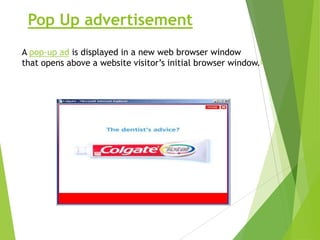
Pop Up advertisement
A pop-up ad is displayed in a new web browser window
that opens above a website visitor’s initial browser window.[
Pop-under Advertisement
 30] A pop-under ad opens a new browser window under a
website visitor’s initial browser window.
Floating Ads
 A floating ad, or overlay ad, is a type of rich media
advertisement that appears superimposed over the
requested website’s content.

Email advertising is ad copy comprising an entire
email or a portion of an email message
Online classified advertising
Adware
 software that, once installed, automatically
displays advertisements on a user’s computer
Social Media Advertisement
• commercial promotion conducted through
social media websites
Compensation method
 CPM > cost per milli
 CPC > cost per click
 CPA or PPP> cost per action or pay per
performance
 Fixed Cost
Advantages of online
advertisement
Cost
 The low costs of electronic communication reduce the cost
of displaying online advertisements
 provides a low-cost means for advertisers
Measurability
 collect data on their ads’ effectiveness
 whether the advertisement resulted in a
sale/visitor view
Coverage
 Online advertising can reach nearly every global
market, and online advertising influences offline
sales
Speed
 online ads can be deployed immediately
 can modify or replace ad copy rapidly
Disadvantages of online
advertisements
Privacy Concern
 The collection of user information by publishers
 Over half of all Google and Facebook users are
concerned about their privacy
Spam
 The Internet’s low cost of disseminating
advertising contributes to spam
 Mobile advertising is a form of advertising
via mobile (wireless) phones or other mobile
devices.
 Subset of mobile marketing.
 Most mobile advertising is targeted at
mobile phones.
 4.6 billion as of 2009.
 Advertisers and media industry will
increasingly take account of a bigger and
fast-growing mobile market
 Mobile phones based on cellular backhaul or
smartphones based on WiFi hot spot or
WiMAX hot zone will also strengthen
 In Japan today, already 44% of mobile
phone owners click on ads they receive on
their phones.
MOBILE AS MEDIA
 “seventh mass media
channel”
 Two-way mobile media
 Ideal for time- and
location-sensitive
advertising,
 Advertising industry
since the mid-2000s
 2007 was worth $2.2 billion.
 Less than 0.5% of the approximately $450 billion global
advertising industry
Viral marketing
 One recipient of an advertisement on mobile,
will forward that to a friend.
 This allows users to become part of the advertising experience.
 At the bare minimum mobile ads with viral abilities can become powerful
interactive campaigns.
 At the extreme, they can become engagement marketing experiences.
 Apha user
Types of mobile ads
 Mobile Web Banner
 Mobile Web Poster
 SMS advertising
 MMS advertising,
 Advertising within mobile games and mobile videos,
during mobile TV receipt
 Audio advertisements
 Audio recording played while interacting with a telephone-based service
such as movie ticketing or directory assistance.
Effectiveness
of
mobile media
ad campaign
 Click-through rates
 Also sold to advertisers by views (Cost Per Impression) or by
click-through (Cost Per Click).
 Conversion rates, such as click-to-call rates
 Other degrees of interactive measurement
 Cost Per Install (CPI)
 Where there the pricing model is based on the user
installing an App on their mobile phone.
 CPI Mobile Advertising Networks work either as incent or
non-incent.
 In the incent model the user is given virtual points or
rewards to install the game or App.
 Impressions (views)
Handsets display and corresponding
ad images
 Screen size and supported technologies
 For color images, formats such as PNG, JPEG, GIF and BMP along
with the monochrome WBMP format.
Handset
Approx Handset Screen Size
(px W x H)
Example Handsets Ad Unit Ad Size (pixels)
X-Large 320 x 320 Palm Treo 700P, Nokia E70 X-Large 300 x 50
Large 240 x 320
Samsung MM-A900, LG VX-
8500 Chocolate, Sony Ericsson
W910i
Large 216 x 36
Medium 176 x 208
Motorola RAZR, LG VX-8000,
Motorola ROKR E1
Medium 168 x 28
Small 128 x 160 Motorola V195 Small 120 x 20
FUNCTIONS OF
ADVERTISEMENTS
Functions of advertising
To differentiate the product from
their competitors
This creates an awareness of the product and
provides a basis for consumers to choose the
advertised product over other products this
creates an awareness of the product and
provides a basis for consumers to choose the
advertised product over other products
Example
 GARNIER FRUTICS (shampoo)
the shampoo bottle have the
different color from all other
shampoo available in the
shelf. The bottle of the
shampoo is unique from all
others.
Example
 Apple laptops make them
different from others as the
WHITE color and logo of
APPLE on back of the screen.
To communicate product
information
 Product information communicated to the customers in manner that
meets their information needs. Most consumers tend to discount the
information in advertising because they understand that the purpose of
the advertising is to persuade.
Example
 Ponds age miracle
To urge product used
 The third function of advertising is to induce
consumers to try new products and to suggest
reuse of the product as well as new uses; this is
the persuasion function.
Example
 Fair and lovely
Example
 Neutrogena acne treatment cream
To expand the product
distribution
 It is basically to provide the product all over
market. It is necessary to make sure that
product should be accessible to everyone.
Availability of product effect the distribution.
Example
 Wateen telecom and Motorola Partner
To increase brand preference
and loyalty
Example
99% girls who are not married
will not look at the ad of
pampers or any milk powder
for children but when they
will get married their
interest will automatically
move towards such ad'
Brand loyalty
 Brand loyalty is a long-term customer preference for a
particular product or service. Brand loyalty can be
produced by factors such as customer satisfaction with
the performance or price of a specific product or
service, or through identifying with a brand image. It can
be encouraged by advertising.
Example
Colgate toothpaste
To reduce overall sales cost
 When a product is selling you have to teach the
people about the product.
 Like if we would advertise through
newspapers, TV, broachers and internet, it would
cater huge sum of masses and if you do individually it
would be more costly and time consuming.
Example
Coke
Creates new demands
 Advertising have to create new demands they should
educate the people about more and more new things
coming up in the market. Each year new
products, including line extensions and new brands
are introduced into groceries and drugstores.
Example
Wateen telecom
DYSFUNCTIONS OF
ADVERTISEMENTS
DYSFUNCTIONS
How accurate is the advertising?
Misrepresentation
Unrealistic Expectations
 Beauty and health
products may also
not live up to their
promises, resulting
in wasted consumer
money.
PARTIAL
DISCLOSURES
VISUAL DISTORTIONS
FALSE COMPARISONS
FALSE TESTIMONIALS
False Images
Does it make us more
materialistic?
Materialism promotion
Advertising Is for the Rich
INCREASING FRAUD RISKS
CHEAP SLOGANS
 O say orient- Pehli Chahat
 Kashmir Premium Gold-Har Pal Mai Basa Pyar
TOO MUCH EXPOSURE OF FEMININE
PRODUCTS
What do you think is the biggest
problem with advertising?
Objectification of Women
 73% of advertisements are presenting
women in a “decorative” manner
Continued…
Continued…
 Focusing on female figures instead of product
Continued..
Effects of objectification on males:
 Changes their views about women’s role in society
Continued…
Effects of objectification on females
 Distorting Women's Self Image
 low self-esteem
 depression
 eating disorders
Result:
 endless demand for new beauty products
 weight-loss, fashion, and cosmetics industries, are among the
largest and most profitable consumer industries
Underlying message
 Important thing about themselves is the way
they look
 Their self-worth is dependent upon attention
from men
THANK YOU!

ADVERTIESMNET

  • 1.
    AYESHA AFTAB MALIK AROOJTAHIR KIAYANI ZARNAB SHOKAT ZAHRA HANIF KHADIJA IJAZ DEPARTMENT OF BIOINFORMATICS & TECHNOLOGY FACULTY OF BASIC AND APPLIED SCIENCES INTERNATIONAL ISLAMIC UNIVERSITY ISLAMABAD
  • 3.
  • 4.
  • 5.
    Chupa Chup sugarfree lollipops: Ants
  • 6.
  • 7.
  • 8.
    Bose Noise reductionHeadphones: Waterfall
  • 9.
  • 11.
    Advertising (mass communication) Inrelation to mass communication: “ It refers to marketing a product or service in a persuasive manner that encourages the audience to buy the product or use the service”.
  • 12.
     From theabove we can infer that: Advertising is promotion, of a product or a service. It is done by companies to maximize sales. Companies pay a premium for doing this promotion. Advertising could be done through billboards, movies etc.
  • 13.
     In Latin,ad vertere means "to turn toward”  Advertising seeks to create an image surrounding a product, so that customers feel that they need it  Advertising can promote a new product and increase sales of existing products  Advertising messages are usually paid for by sponsors and viewed via various traditional media; including mass media; or new media
  • 14.
    SCOPE OF ADVERTISING The Pakistani advertising industry is upcoming and has a lot of promise.  Only the hardworking and efficient companies will survive.  What matters most in this sector is knowledge and experience of the work and the industry. The better the research and analysis done by the agency, the better their chances of success.
  • 15.
  • 16.
    PURPOSE OF ADVERTISING Thepurpose of advertising is to conivince the customer:  Company's services or products are the best  Enhance the image of the company  Point out and create a need for products or services  Demonstrate new uses for established products  Announce new products and programs  Draw customers to the business  To hold existing customers.
  • 18.
    ANCIENT FORMS OFADVERTISING  History tells us that out-of-home advertising and billboards are the oldest forms of advertisement.  Egyptians used papyrus to make sales messages and wall posters.
  • 19.
    Wall or rockpainting
  • 20.
    18TH CENTURY  Advertisementsstarted to appear in weekly newspapers in England  Were used mainly to promote books and newspapers .
  • 21.
    19th CENTURY  ThomasJ. Barratt -- “The father of modern advertising  the Pears Soap company
  • 22.
     Under Barratt'sguidance, Pears Soap became the world's first legally registered brand and is therefore the world's oldest continuously existing brand!  Lillie Langtry- income as the first woman to endorse a com- mercial product
  • 23.
     In June1836, French newspaper La Presse was the first to include paid advertising in its pages  Volney B. Palmer established the roots of the modern day advertising agency in Philadelphia.
  • 24.
     The emergenceof advertising agency  In late 19th century advertising agency of N.W. Ayer & Son was founded  By 1900, advertising was firmly established as a profession.
  • 25.
    20th CENTURY  Adoptionof the doctrine: Human instincts could be targeted and harnessed – "sublimated" into the desire to purchase commodities  The tobacco industry was one of the firsts to make use of mass production.  Late 20s-advertisers recognized the value of women's insight during the creative process.
  • 26.
    On the radiofrom the 1920s  In the early 1920s, the first radio stations were established  Start of the trend to sponsor programs
  • 27.
    Public service advertisingin WW2 “Advertising justifies its existence when used in the public interest – it is much too powerful a tool to use solely for commercial purposes." David Ogilvy
  • 28.
     Public serviceadvertising reached its height during World Wars I and II under the direction of more than one government.
  • 29.
    Cable television fromthe 1980s  The late 1980s and early 1990s saw the introduction of cable television and particularly MTV. Pioneering the concept of the music video  specialty channels emerged, including channels entirely devoted to advertising, such as QVC, Home Shopping Network, and ShopTV Canada.
  • 30.
    On the Internetfrom the 1990s  new frontiers for advertisers opened and contributed to the "dot-com" boom of the 1990s.  Domain owners allow advertising companies to place ads on their sites in return for a per-click payment
  • 31.
    “Guerrilla marketing" Includes unusualapproaches such as:  staged encounters in public places  giveaways of products such as cars that are covered with brand messages  interactive advertising where the viewer can respond to become part of the advertising message.  having consumers vote through text messages various innovations utilizing social network services
  • 32.
     With thepassage of time, advertising is becoming more unpredictable and innovative, which causes consumers to buy the product or idea.  This reflects an increasing trend of interactive and "embedded" ads as well as a high competition in the market.
  • 33.
  • 34.
     Traditional Modesof Advertising  Modern Types of Advertising  The Future of Advertising Categories
  • 35.
     Print Advertising Outdoor Advertising  Radio Advertising  Television Traditional Modes of Advertising
  • 36.
    Print Advertising -Newspapers, Magazines, Brochures, Fliers
  • 37.
     Print mediahas always been a popular advertising option.  Advertising products via newspapers or magazines is a common practice  It also offers promotional brochures and fliers  Newspapers and magazines sell the advertising space according to the area occupied by the ad Print Advertising - Newspapers, Magazines, Brochures, Fliers
  • 38.
    Outdoor Advertising -Billboards, Kiosks, Trade-shows and Events
  • 39.
    Outdoor Advertising -Billboards, Kiosks, Trade-shows and Events  Billboard advertising is very popular.  Kiosks provide an easy outlet for the company's products  Organizing special events or sponsoring them
  • 40.
    Paying people tohold signs is one of the oldest forms of advertising, as with this human being pictured above.
  • 41.
  • 42.
    Radio Advertising  Oneof the oldest forms of advertising  Advertisers can buy airtime from a radio station to air their ads  Prices depend upon the duration, time of the day, and program
  • 43.
  • 44.
    Television  It reachesthe maximum number of target customers  Expensive type of advertising  To increase the visibility of ads, banners are placed in the background of running programs  Computer-based graphics are also used to generate ads
  • 45.
    Modern Types ofAdvertising  Online Advertising  Covert Advertising  Surrogate Advertising  Public Service Advertising  Celebrity Advertising  In-store Advertising  Coffee Cup Advertising  Digital Out of Home Advertising
  • 46.
    Online Advertising  Usesthe internet and world wide web to attract customers
  • 47.
    Covert Advertising -Advertising in Movies
  • 48.
     Unique kindof advertising  Product or a particular brand is incorporated in some entertainment and media channels  For example, appearance of brand Nokia which is displayed on tom cruise's phone in the movie Minority Report Covert Advertising - Advertising in Movies
  • 49.
    Surrogate Advertising -Advertising Indirectly
  • 50.
    Surrogate Advertising -Advertising Indirectly  Prominently seen in cases where advertising a particular product is banned by law  Advertisements for products like cigarettes or alcohol  Companies come up with products that have the same brand name to indirectly remind customers
  • 51.
    Public Service Advertising– Advertising for Social Causes
  • 52.
    Public Service Advertising- Advertising for Social Causes  Technique used to convey socially relevant messages about important matters and social causes  These include AIDS, energy conservation, political integrity, deforestation, illiteracy, poverty, and so on.
  • 53.
    Celebrity Advertising  Focusesupon using celebrity power, fame, money, popularity to gain recognition for products 
  • 54.
    In-store Advertising  Popularadvertising method for large malls and departmental stores  Also known as ‘point of purchase advertising’  Products are usually displayed prominently at checkout counters and packaged attractively  Banners inside the store announcing price cuts or new launches
  • 55.
    Coffee Cup Advertising Relatively new form of mass advertising  Placement of small ads on paper cups for coffees or onto the tabletops of the cafe
  • 56.
    Digital Out ofHome Advertising  New type of advertising gaining popularity and effectiveness  Essentially a systematic arrangement of media at different venues  LCD screens with customized software can be found in public locations like parks, subways, and gas stations
  • 57.
    The Future ofAdvertising  Digital Signage  Smartphone Advertising  Niche Advertising  User-generated Advertising
  • 58.
    Digital Signage  Itis a cheap alternative to the costly excesses of television commercials  Done through the installation of LED or plasma screens in public places  Railway and subway stations, cafes, airports, retail stores, hotels, and many other similar locations
  • 59.
    Smartphone Advertising  Smartphonesoffers to consumers a fertile ground for advertising  Games downloaded to mobile platforms display ads when connected to the internet  Available across a range of operating systems such as Android, iOS and Windows
  • 60.
    Niche Advertising  Dealswith targeting the selected group of customers with tailored ads  Companies are taking advantage of online blogs and websites  Potential customers are exposed to the ads whenever they search for related terms or log on to a particular site
  • 61.
  • 62.
    User-generated Advertising  Radicallynew form of advertising  Letting customers create their own ads for the brand  One of which is chosen as the brands official ad for a particular time period  User-generated ads are not cost prohibitive  Allow the company to generate a lot of publicity via word-of-mouth
  • 63.
  • 64.
    Definition  Internet advertising Uses the Internet to deliver promotional marketing messages to customers  large business and is growing rapidly.
  • 65.
  • 66.
    Display advertising  advertisingmessage visually using text, logos, animations, videos, photographs, or other graphics
  • 68.
    Pop Up advertisement Apop-up ad is displayed in a new web browser window that opens above a website visitor’s initial browser window.[
  • 69.
    Pop-under Advertisement  30]A pop-under ad opens a new browser window under a website visitor’s initial browser window.
  • 70.
    Floating Ads  Afloating ad, or overlay ad, is a type of rich media advertisement that appears superimposed over the requested website’s content.
  • 71.
     Email advertising isad copy comprising an entire email or a portion of an email message
  • 72.
  • 73.
    Adware  software that,once installed, automatically displays advertisements on a user’s computer
  • 74.
    Social Media Advertisement •commercial promotion conducted through social media websites
  • 75.
    Compensation method  CPM> cost per milli  CPC > cost per click  CPA or PPP> cost per action or pay per performance  Fixed Cost
  • 76.
  • 77.
    Cost  The lowcosts of electronic communication reduce the cost of displaying online advertisements  provides a low-cost means for advertisers
  • 78.
    Measurability  collect dataon their ads’ effectiveness  whether the advertisement resulted in a sale/visitor view
  • 79.
    Coverage  Online advertisingcan reach nearly every global market, and online advertising influences offline sales
  • 80.
    Speed  online adscan be deployed immediately  can modify or replace ad copy rapidly
  • 81.
  • 82.
    Privacy Concern  Thecollection of user information by publishers  Over half of all Google and Facebook users are concerned about their privacy
  • 83.
    Spam  The Internet’slow cost of disseminating advertising contributes to spam
  • 85.
     Mobile advertisingis a form of advertising via mobile (wireless) phones or other mobile devices.  Subset of mobile marketing.  Most mobile advertising is targeted at mobile phones.  4.6 billion as of 2009.  Advertisers and media industry will increasingly take account of a bigger and fast-growing mobile market  Mobile phones based on cellular backhaul or smartphones based on WiFi hot spot or WiMAX hot zone will also strengthen  In Japan today, already 44% of mobile phone owners click on ads they receive on their phones.
  • 86.
  • 87.
     “seventh massmedia channel”  Two-way mobile media  Ideal for time- and location-sensitive advertising,  Advertising industry since the mid-2000s
  • 88.
     2007 wasworth $2.2 billion.  Less than 0.5% of the approximately $450 billion global advertising industry
  • 89.
  • 91.
     One recipientof an advertisement on mobile, will forward that to a friend.  This allows users to become part of the advertising experience.  At the bare minimum mobile ads with viral abilities can become powerful interactive campaigns.  At the extreme, they can become engagement marketing experiences.  Apha user
  • 92.
  • 93.
     Mobile WebBanner  Mobile Web Poster  SMS advertising  MMS advertising,
  • 94.
     Advertising withinmobile games and mobile videos, during mobile TV receipt  Audio advertisements  Audio recording played while interacting with a telephone-based service such as movie ticketing or directory assistance.
  • 95.
  • 96.
     Click-through rates Also sold to advertisers by views (Cost Per Impression) or by click-through (Cost Per Click).  Conversion rates, such as click-to-call rates  Other degrees of interactive measurement  Cost Per Install (CPI)  Where there the pricing model is based on the user installing an App on their mobile phone.  CPI Mobile Advertising Networks work either as incent or non-incent.  In the incent model the user is given virtual points or rewards to install the game or App.  Impressions (views)
  • 97.
    Handsets display andcorresponding ad images
  • 98.
     Screen sizeand supported technologies  For color images, formats such as PNG, JPEG, GIF and BMP along with the monochrome WBMP format.
  • 99.
    Handset Approx Handset ScreenSize (px W x H) Example Handsets Ad Unit Ad Size (pixels) X-Large 320 x 320 Palm Treo 700P, Nokia E70 X-Large 300 x 50 Large 240 x 320 Samsung MM-A900, LG VX- 8500 Chocolate, Sony Ericsson W910i Large 216 x 36 Medium 176 x 208 Motorola RAZR, LG VX-8000, Motorola ROKR E1 Medium 168 x 28 Small 128 x 160 Motorola V195 Small 120 x 20
  • 100.
  • 101.
  • 102.
    To differentiate theproduct from their competitors
  • 103.
    This creates anawareness of the product and provides a basis for consumers to choose the advertised product over other products this creates an awareness of the product and provides a basis for consumers to choose the advertised product over other products
  • 104.
    Example  GARNIER FRUTICS(shampoo) the shampoo bottle have the different color from all other shampoo available in the shelf. The bottle of the shampoo is unique from all others.
  • 105.
    Example  Apple laptopsmake them different from others as the WHITE color and logo of APPLE on back of the screen.
  • 106.
  • 107.
     Product informationcommunicated to the customers in manner that meets their information needs. Most consumers tend to discount the information in advertising because they understand that the purpose of the advertising is to persuade.
  • 108.
  • 109.
  • 110.
     The thirdfunction of advertising is to induce consumers to try new products and to suggest reuse of the product as well as new uses; this is the persuasion function.
  • 111.
  • 112.
  • 113.
    To expand theproduct distribution
  • 114.
     It isbasically to provide the product all over market. It is necessary to make sure that product should be accessible to everyone. Availability of product effect the distribution.
  • 115.
    Example  Wateen telecomand Motorola Partner
  • 116.
    To increase brandpreference and loyalty
  • 117.
    Example 99% girls whoare not married will not look at the ad of pampers or any milk powder for children but when they will get married their interest will automatically move towards such ad'
  • 118.
  • 119.
     Brand loyaltyis a long-term customer preference for a particular product or service. Brand loyalty can be produced by factors such as customer satisfaction with the performance or price of a specific product or service, or through identifying with a brand image. It can be encouraged by advertising.
  • 120.
  • 121.
  • 122.
     When aproduct is selling you have to teach the people about the product.  Like if we would advertise through newspapers, TV, broachers and internet, it would cater huge sum of masses and if you do individually it would be more costly and time consuming.
  • 123.
  • 124.
  • 125.
     Advertising haveto create new demands they should educate the people about more and more new things coming up in the market. Each year new products, including line extensions and new brands are introduced into groceries and drugstores.
  • 126.
  • 127.
  • 128.
  • 129.
    How accurate isthe advertising?
  • 130.
  • 131.
    Unrealistic Expectations  Beautyand health products may also not live up to their promises, resulting in wasted consumer money.
  • 132.
  • 133.
  • 134.
  • 135.
  • 136.
  • 137.
    Does it makeus more materialistic?
  • 138.
  • 139.
  • 140.
  • 141.
    CHEAP SLOGANS  Osay orient- Pehli Chahat  Kashmir Premium Gold-Har Pal Mai Basa Pyar
  • 142.
    TOO MUCH EXPOSUREOF FEMININE PRODUCTS
  • 143.
    What do youthink is the biggest problem with advertising?
  • 144.
    Objectification of Women 73% of advertisements are presenting women in a “decorative” manner
  • 145.
  • 146.
    Continued…  Focusing onfemale figures instead of product
  • 147.
    Continued.. Effects of objectificationon males:  Changes their views about women’s role in society
  • 148.
    Continued… Effects of objectificationon females  Distorting Women's Self Image  low self-esteem  depression  eating disorders
  • 149.
    Result:  endless demandfor new beauty products  weight-loss, fashion, and cosmetics industries, are among the largest and most profitable consumer industries
  • 150.
    Underlying message  Importantthing about themselves is the way they look  Their self-worth is dependent upon attention from men
  • 151.