
The Evolution of Advertising


                    Chapter 01
ABOUT THE RESOURCE PERSON
                       Mohammad is a self taught Graphic artist, Brand expert and ad campaign designer.

                       He has been living and breathing design from very early age. At the age of 17 he joined the production
                       team of first 3d animation in south Asian sub continent. in 2001 he started a BD-UK joint venture
                       interactive presentation design company named 'Digital Show reel Solutions‘.
                       He has worked with numerous European celebrities which includes John Mark sorum, Murtz, Adrienne
                       Bailon and many more.

                       Gradually he ventured out in advertising design
                       He has designed advertising campaigns for Xbox, Kellogg's, SAFA, DAE (GOB) and many more.
                       He designed all the ad campaigns in GCC countries for 'Project Natal' AKA 'Kinect'. While working with X
                       Box during his stay in U.A.E, he designed promotional campaign for Department of Economic
                       Development (Government of Dubai) and also worked as a part time curator at Basta Art Café.

                       He has also Designed many brand Identities including D.net, Future Leaders, University of central
MOHAMMAD BAHARU ALAM   California.

                       He has also made two documentary films for Channel-i.
                       His street photography of middle eastern cities was published in National Geographic Magazine in 2010.

                       In last ten years he has delivered lectures at NSU, AIUB, NIMCO, South Asian Institute of Photo graphy,
                       IRM & BIBM.

                       Presently he is working With Themever and a regular resource person at DevsTeam Institute.
                                                                                                                       2
Learning Objectives

• LO1: Define advertising; distinguish it from other
  forms of marketing communications
• LO2: Explain the role advertising plays in business
  and marketing
• LO3: Illustrate the functions of advertising in a free
  market economy
• LO4: Discuss how advertising evolved
• LO5: Describe the impact of advertising on society

                                                      1-3
Obama 2008

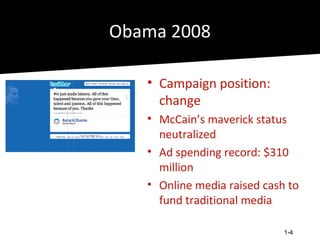
   • Campaign position:
     change
   • McCain’s maverick status
     neutralized
   • Ad spending record: $310
     million
   • Online media raised cash to
     fund traditional media

                             1-4
What is Advertising?

• Advertising
  – A type of marketing communication
  – The structured, composed, nonpersonal
    communication of information, usually paid
    for and persuasive in nature, about
    products by identified sponsors through
    various media


                                                 1-5
Role of Advertising in Business

• Business typically organize along 3 broad
  divisions
  – Operations (production/manufacturing)
  – Finance/administration
  – Marketing
• Marketing alone has a primary role of bringing
  in revenue

                                              1-6
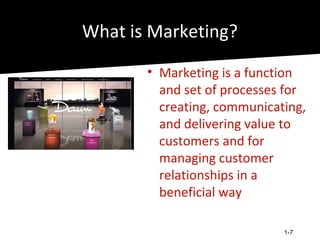
What is Marketing?
       • Marketing is a function
         and set of processes for
         creating, communicating,
         and delivering value to
         customers and for
         managing customer
         relationships in a
         beneficial way

                             1-7
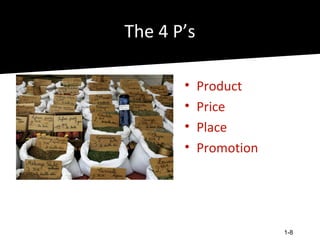
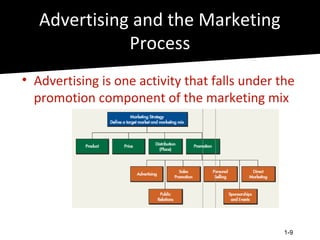
The 4 P’s

       •    Product
       •    Price
       •    Place
       •    Promotion


                        1-8
Advertising and the Marketing
              Process
• Advertising is one activity that falls under the
  promotion component of the marketing mix


                                                1-9
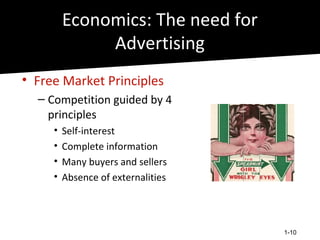
Economics: The need for
              Advertising
• Free Market Principles
  – Competition guided by 4
    principles
     •   Self-interest
     •   Complete information
     •   Many buyers and sellers
     •   Absence of externalities


                                    1-10
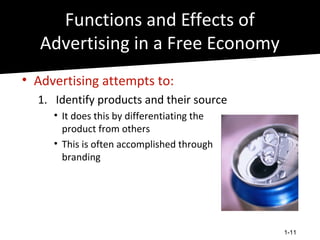
Functions and Effects of
   Advertising in a Free Economy
• Advertising attempts to:
  1. Identify products and their source
     • It does this by differentiating the
       product from others
     • This is often accomplished through
       branding


                                             1-11
Functions and Effects of
   Advertising in a Free Economy
• For a given brand, advertising also strives to:
  2.   Communicate information it
  3.   Induce consumers to try or reuse it
  4.   Stimulate distribution
  5.   Increase its use
  6.   Build value, preference, and loyalty
  7.   Lower the overall cost of sales


                                               1-12
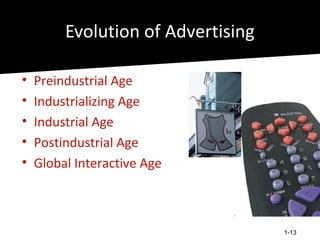
Evolution of Advertising

•   Preindustrial Age
•   Industrializing Age
•   Industrial Age
•   Postindustrial Age
•   Global Interactive Age


                                    1-13
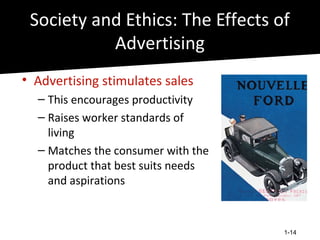
Society and Ethics: The Effects of
           Advertising
• Advertising stimulates sales
  – This encourages productivity
  – Raises worker standards of
    living
  – Matches the consumer with the
    product that best suits needs
    and aspirations


                                    1-14
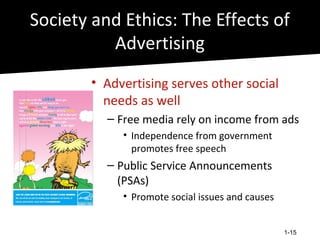
Society and Ethics: The Effects of
          Advertising
        • Advertising serves other social
          needs as well
          – Free media rely on income from ads
             • Independence from government
               promotes free speech
          – Public Service Announcements
            (PSAs)
             • Promote social issues and causes


                                                  1-15
Society and Ethics: The Effects of
           Advertising
• But critics note that:
  – Truthfulness and ethics are a concern
  – Responses to misleading and deceptive
    practices:
     • Government action
         – Pure Food and Drug Act
         – Federal Trade Commission Act
     • Industry action
         – Association of National Advertisers
         – American Advertising Federation


                                                 1-16
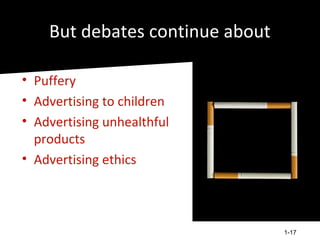
But debates continue about

• Puffery
• Advertising to children
• Advertising unhealthful
  products
• Advertising ethics


                                 1-17
The Economic, Social, and
    Regulatory Aspects of
              Advertising


                 Chapter 02
Learning Objectives

• LO1: Describe advertising’s impact on the economy.
• LO2: Examine the validity of various social criticisms of
  advertising.
• LO3: Explain differences between social responsibility & ethics
  in advertising.
• LO4: Describe how government agencies regulate advertising to
  protect both consumers & competitors.
• LO5: Discuss the activities of nongovernment organizations in
  fighting fraudulent & deceptive advertising.


                                                           2-19
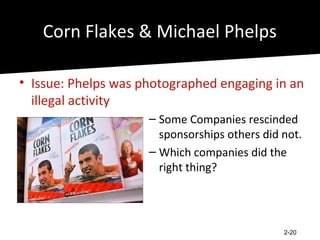
Corn Flakes & Michael Phelps

• Issue: Phelps was photographed engaging in an
  illegal activity
                     – Some Companies rescinded
                       sponsorships others did not.
                     – Which companies did the
                       right thing?


                                               2-20
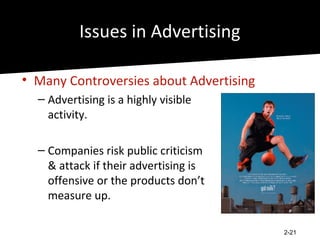
Issues in Advertising

• Many Controversies about Advertising
  – Advertising is a highly visible
    activity.

  – Companies risk public criticism
    & attack if their advertising is
    offensive or the products don’t
    measure up.

                                         2-21
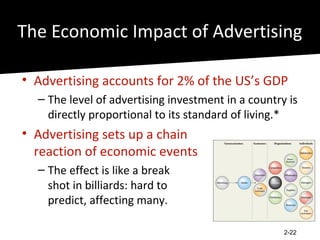
The Economic Impact of Advertising

• Advertising accounts for 2% of the US’s GDP
  – The level of advertising investment in a country is
    directly proportional to its standard of living.*
• Advertising sets up a chain
  reaction of economic events
  – The effect is like a break
    shot in billiards: hard to
    predict, affecting many.

                                                    2-22
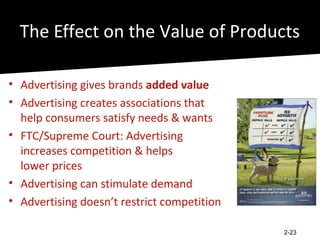
The Effect on the Value of Products

• Advertising gives brands added value
• Advertising creates associations that
  help consumers satisfy needs & wants
• FTC/Supreme Court: Advertising
  increases competition & helps
  lower prices
• Advertising can stimulate demand
• Advertising doesn’t restrict competition

                                             2-23
The Effect on Prices

• Important points on advertising costs & pricing
  – Advertising is a small part of a product’s cost.
  – Advertising enables mass-production, which lowers the cost
    per unit of products.
  – Regulated industries see no price increase associated with
    advertising. When deregulated, advertising often causes lower
    prices.
  – In retail, advertising contributes to both higher & lower prices.


                                                               2-24
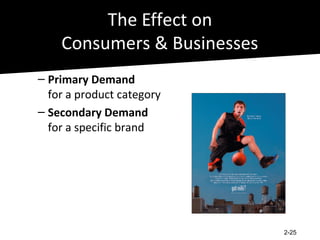
The Effect on
    Consumers & Businesses
– Primary Demand
  for a product category
– Secondary Demand
  for a specific brand


                             2-25
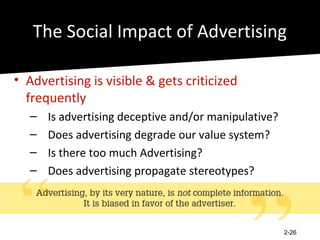
The Social Impact of Advertising

• Advertising is visible & gets criticized
  frequently
   –   Is advertising deceptive and/or manipulative?
   –   Does advertising degrade our value system?
   –   Is there too much Advertising?
   –   Does advertising propagate stereotypes?
   –   Is some advertising unnecessarily offensive?


                                                       2-26
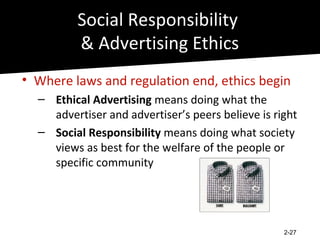
Social Responsibility
         & Advertising Ethics
• Where laws and regulation end, ethics begin
  – Ethical Advertising means doing what the
    advertiser and advertiser’s peers believe is right
  – Social Responsibility means doing what society
    views as best for the welfare of the people or
    specific community


                                                   2-27
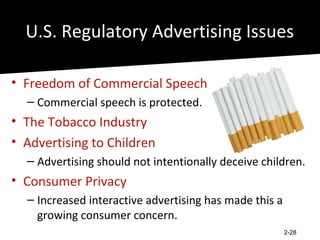
U.S. Regulatory Advertising Issues

• Freedom of Commercial Speech
  – Commercial speech is protected.
• The Tobacco Industry
• Advertising to Children
  – Advertising should not intentionally deceive children.
• Consumer Privacy
  – Increased interactive advertising has made this a
    growing consumer concern.
                                                        2-28
Federal Regulation
        of the Advertising Industry
• Many government agencies protect consumers
  –   FTC (Federal Trade Commission)
  –   FCC (Federal Communications Commission)
  –   ATF (Bureau of Alcohol, Tobacco, and Firearms)
  –   USPS (US Postal Service)
  –   FDA (Food & Drug Administration)
  –   LOC (Library of Congress)
  –   US Patent and Trademark Office
• Many state & local governments also regulate
                                                       2-29
State & Local Regulation
         of the Advertising Industry
• All states have “little FTC acts”
 – State legislation for advertising is often based on the
   truth-in-advertising statute developed by Printer’s Ink.
    – Any maker of an ad found to contain “untrue, deceptive, or misleading”
      material is guilty of a misdemeanor.
 – Often states work together to investigate & prosecute
   violations
 – Many localities also have consumer protection agencies.


                                                                       2-30
Nongovernment Regulation

•   The Better Business Bureau (BBB)
•   Media Regulation
•   The National Advertising Review Council (NARC)
•   Consumer Advocate Groups
•   Self-Regulation


                                              2-31
International Advertising
             Regulation

– Foreign Governments often regulate differently than
  the United States

– Most countries are more restrictive

– Different countries have different legal environments


                                                  2-32
CATCH YOU
IN NEXT CLASS
                33

Advertising

  • 1.
    The Evolution ofAdvertising Chapter 01
  • 2.
    ABOUT THE RESOURCEPERSON Mohammad is a self taught Graphic artist, Brand expert and ad campaign designer. He has been living and breathing design from very early age. At the age of 17 he joined the production team of first 3d animation in south Asian sub continent. in 2001 he started a BD-UK joint venture interactive presentation design company named 'Digital Show reel Solutions‘. He has worked with numerous European celebrities which includes John Mark sorum, Murtz, Adrienne Bailon and many more. Gradually he ventured out in advertising design He has designed advertising campaigns for Xbox, Kellogg's, SAFA, DAE (GOB) and many more. He designed all the ad campaigns in GCC countries for 'Project Natal' AKA 'Kinect'. While working with X Box during his stay in U.A.E, he designed promotional campaign for Department of Economic Development (Government of Dubai) and also worked as a part time curator at Basta Art Café. He has also Designed many brand Identities including D.net, Future Leaders, University of central MOHAMMAD BAHARU ALAM California. He has also made two documentary films for Channel-i. His street photography of middle eastern cities was published in National Geographic Magazine in 2010. In last ten years he has delivered lectures at NSU, AIUB, NIMCO, South Asian Institute of Photo graphy, IRM & BIBM. Presently he is working With Themever and a regular resource person at DevsTeam Institute. 2
  • 3.
    Learning Objectives • LO1:Define advertising; distinguish it from other forms of marketing communications • LO2: Explain the role advertising plays in business and marketing • LO3: Illustrate the functions of advertising in a free market economy • LO4: Discuss how advertising evolved • LO5: Describe the impact of advertising on society 1-3
  • 4.
    Obama 2008 • Campaign position: change • McCain’s maverick status neutralized • Ad spending record: $310 million • Online media raised cash to fund traditional media 1-4
  • 5.
    What is Advertising? •Advertising – A type of marketing communication – The structured, composed, nonpersonal communication of information, usually paid for and persuasive in nature, about products by identified sponsors through various media 1-5
  • 6.
    Role of Advertisingin Business • Business typically organize along 3 broad divisions – Operations (production/manufacturing) – Finance/administration – Marketing • Marketing alone has a primary role of bringing in revenue 1-6
  • 7.
    What is Marketing? • Marketing is a function and set of processes for creating, communicating, and delivering value to customers and for managing customer relationships in a beneficial way 1-7
  • 8.
    The 4 P’s • Product • Price • Place • Promotion 1-8
  • 9.
    Advertising and theMarketing Process • Advertising is one activity that falls under the promotion component of the marketing mix 1-9
  • 10.
    Economics: The needfor Advertising • Free Market Principles – Competition guided by 4 principles • Self-interest • Complete information • Many buyers and sellers • Absence of externalities 1-10
  • 11.
    Functions and Effectsof Advertising in a Free Economy • Advertising attempts to: 1. Identify products and their source • It does this by differentiating the product from others • This is often accomplished through branding 1-11
  • 12.
    Functions and Effectsof Advertising in a Free Economy • For a given brand, advertising also strives to: 2. Communicate information it 3. Induce consumers to try or reuse it 4. Stimulate distribution 5. Increase its use 6. Build value, preference, and loyalty 7. Lower the overall cost of sales 1-12
  • 13.
    Evolution of Advertising • Preindustrial Age • Industrializing Age • Industrial Age • Postindustrial Age • Global Interactive Age 1-13
  • 14.
    Society and Ethics:The Effects of Advertising • Advertising stimulates sales – This encourages productivity – Raises worker standards of living – Matches the consumer with the product that best suits needs and aspirations 1-14
  • 15.
    Society and Ethics:The Effects of Advertising • Advertising serves other social needs as well – Free media rely on income from ads • Independence from government promotes free speech – Public Service Announcements (PSAs) • Promote social issues and causes 1-15
  • 16.
    Society and Ethics:The Effects of Advertising • But critics note that: – Truthfulness and ethics are a concern – Responses to misleading and deceptive practices: • Government action – Pure Food and Drug Act – Federal Trade Commission Act • Industry action – Association of National Advertisers – American Advertising Federation 1-16
  • 17.
    But debates continueabout • Puffery • Advertising to children • Advertising unhealthful products • Advertising ethics 1-17
  • 18.
    The Economic, Social,and Regulatory Aspects of Advertising Chapter 02
  • 19.
    Learning Objectives • LO1:Describe advertising’s impact on the economy. • LO2: Examine the validity of various social criticisms of advertising. • LO3: Explain differences between social responsibility & ethics in advertising. • LO4: Describe how government agencies regulate advertising to protect both consumers & competitors. • LO5: Discuss the activities of nongovernment organizations in fighting fraudulent & deceptive advertising. 2-19
  • 20.
    Corn Flakes &Michael Phelps • Issue: Phelps was photographed engaging in an illegal activity – Some Companies rescinded sponsorships others did not. – Which companies did the right thing? 2-20
  • 21.
    Issues in Advertising •Many Controversies about Advertising – Advertising is a highly visible activity. – Companies risk public criticism & attack if their advertising is offensive or the products don’t measure up. 2-21
  • 22.
    The Economic Impactof Advertising • Advertising accounts for 2% of the US’s GDP – The level of advertising investment in a country is directly proportional to its standard of living.* • Advertising sets up a chain reaction of economic events – The effect is like a break shot in billiards: hard to predict, affecting many. 2-22
  • 23.
    The Effect onthe Value of Products • Advertising gives brands added value • Advertising creates associations that help consumers satisfy needs & wants • FTC/Supreme Court: Advertising increases competition & helps lower prices • Advertising can stimulate demand • Advertising doesn’t restrict competition 2-23
  • 24.
    The Effect onPrices • Important points on advertising costs & pricing – Advertising is a small part of a product’s cost. – Advertising enables mass-production, which lowers the cost per unit of products. – Regulated industries see no price increase associated with advertising. When deregulated, advertising often causes lower prices. – In retail, advertising contributes to both higher & lower prices. 2-24
  • 25.
    The Effect on Consumers & Businesses – Primary Demand for a product category – Secondary Demand for a specific brand 2-25
  • 26.
    The Social Impactof Advertising • Advertising is visible & gets criticized frequently – Is advertising deceptive and/or manipulative? – Does advertising degrade our value system? – Is there too much Advertising? – Does advertising propagate stereotypes? – Is some advertising unnecessarily offensive? 2-26
  • 27.
    Social Responsibility & Advertising Ethics • Where laws and regulation end, ethics begin – Ethical Advertising means doing what the advertiser and advertiser’s peers believe is right – Social Responsibility means doing what society views as best for the welfare of the people or specific community 2-27
  • 28.
    U.S. Regulatory AdvertisingIssues • Freedom of Commercial Speech – Commercial speech is protected. • The Tobacco Industry • Advertising to Children – Advertising should not intentionally deceive children. • Consumer Privacy – Increased interactive advertising has made this a growing consumer concern. 2-28
  • 29.
    Federal Regulation of the Advertising Industry • Many government agencies protect consumers – FTC (Federal Trade Commission) – FCC (Federal Communications Commission) – ATF (Bureau of Alcohol, Tobacco, and Firearms) – USPS (US Postal Service) – FDA (Food & Drug Administration) – LOC (Library of Congress) – US Patent and Trademark Office • Many state & local governments also regulate 2-29
  • 30.
    State & LocalRegulation of the Advertising Industry • All states have “little FTC acts” – State legislation for advertising is often based on the truth-in-advertising statute developed by Printer’s Ink. – Any maker of an ad found to contain “untrue, deceptive, or misleading” material is guilty of a misdemeanor. – Often states work together to investigate & prosecute violations – Many localities also have consumer protection agencies. 2-30
  • 31.
    Nongovernment Regulation • The Better Business Bureau (BBB) • Media Regulation • The National Advertising Review Council (NARC) • Consumer Advocate Groups • Self-Regulation 2-31
  • 32.
    International Advertising Regulation – Foreign Governments often regulate differently than the United States – Most countries are more restrictive – Different countries have different legal environments 2-32
  • 33.