Module 1:
Unreinforced Masonry
Building Assessment
Session 11: Boundary conditions and end wall separation
Boundary Conditions
 Boundary conditions control out-of-plane failure modes
 Typically, the 1-way bending assumption is a lower bound estimate of
actual strength
 But, it may be excessively conservative
 Therefore 2-way bending needs to be considered
 But first – why so many boundary condition cases in Section 10
appendices?
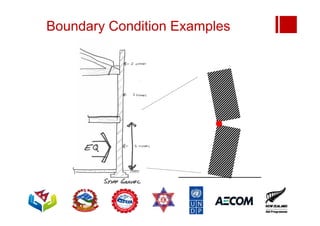
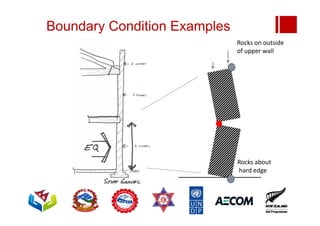
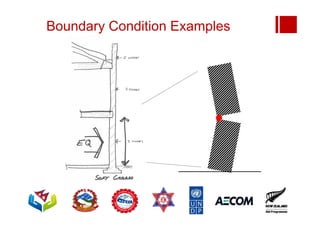
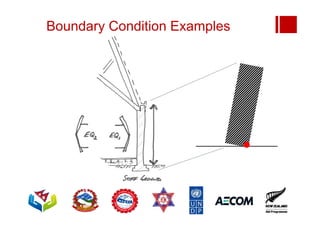
Boundary Condition Examples
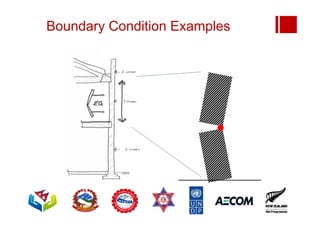
Rocks about
hard edge
Rocks on outside
of upper wall
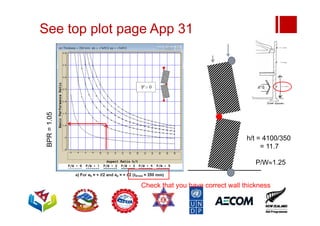
See top plot page App 31
Check that you have correct wall thickness
h/t = 4100/350
= 11.7
P/W≈1.25
h/t = 4100/350
= 11.7
BPR
=
1.05
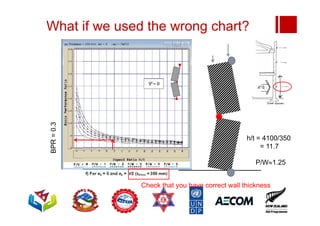
What if we used the wrong chart?
Check that you have correct wall thickness
h/t = 4100/350
= 11.7
P/W≈1.25
h/t = 4100/350
= 11.7
BPR
=
0.3
What is the effect of the correct
vertical boundary conditions?
 The correct boundary conditions are:
 eb = +t/2 and ep = +t/2, giving BPR = 1.05 (Top of page App-31)
 The worst possible mistake gives:
 eb = 0 and ep = -t/2, giving BPR = 0.3 (Top of page App-31)
 If you used the wrong boundary conditions you could mistakenly
assume the wall is weaker than it is:
0.3/1.05 = 30% or in reverse, 1.05/0.3 = 350% stronger than it is
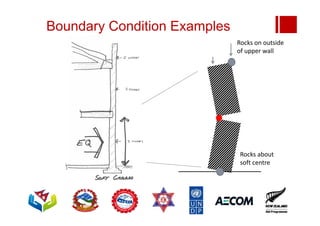
Boundary Condition Examples
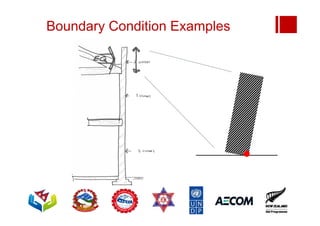
Rocks about
soft centre
Rocks on outside
of upper wall
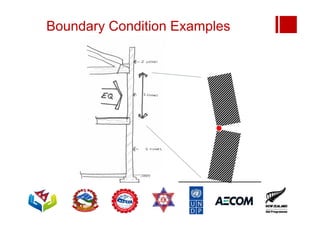
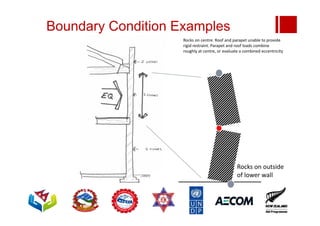
Boundary Condition Examples
Rocks on outside
of lower wall
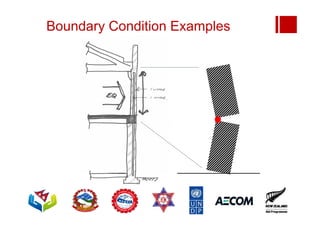
Rocks on centre. Roof and parapet unable to provide
rigid restraint. Parapet and roof loads combine
roughly at centre, or evaluate a combined eccentricity
Boundary Condition Examples
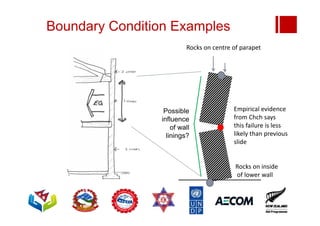
Rocks on inside
of lower wall
Rocks on centre of parapet
Empirical evidence
from Chch says
this failure is less
likely than previous
slide
Possible
influence
of wall
linings?
Boundary Condition Examples
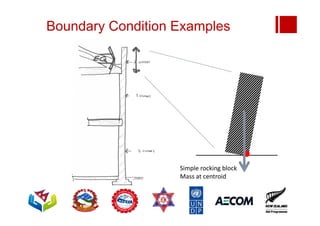
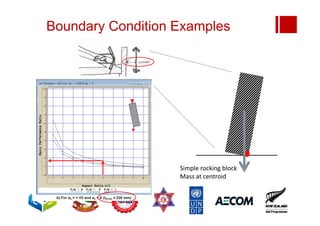
Simple rocking block
Mass at centroid
Boundary Condition Examples
Simple rocking block
Mass at centroid
Boundary Condition Examples
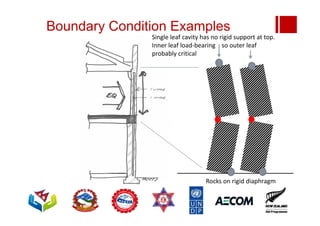
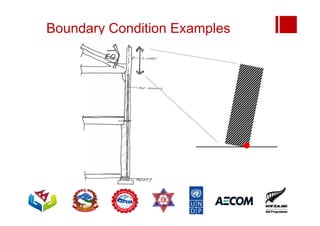
Single leaf cavity has no rigid support at top.
Inner leaf load‐bearing so outer leaf
probably critical
Rocks on rigid diaphragm
Boundary Condition Examples
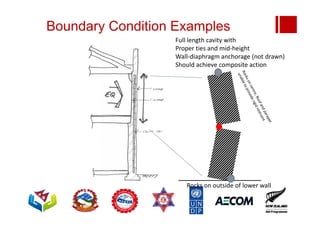
Full length cavity with
Proper ties and mid‐height
Wall‐diaphragm anchorage (not drawn)
Should achieve composite action
Rocks on outside of lower wall
Boundary Condition Examples
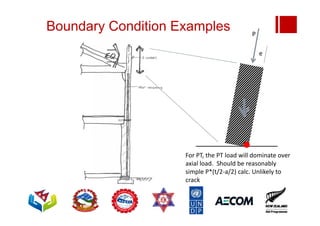
For PT, the PT load will dominate over
axial load. Should be reasonably
simple P*(t/2‐a/2) calc. Unlikely to
crack
e
P
Boundary Condition Examples
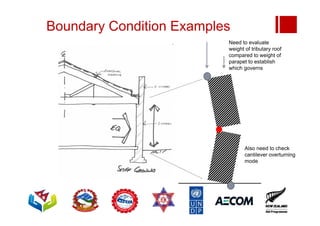
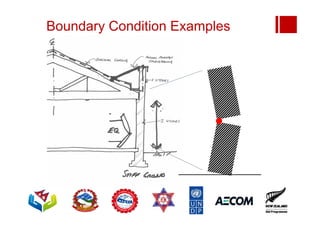
Need to evaluate
weight of tributary roof
compared to weight of
parapet to establish
which governs
Also need to check
cantilever overturning
mode
Boundary Condition Examples
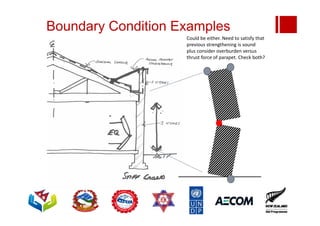
Could be either. Need to satisfy that
previous strengthening is sound
plus consider overburden versus
thrust force of parapet. Check both?
Boundary Condition Examples
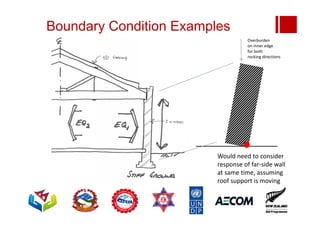
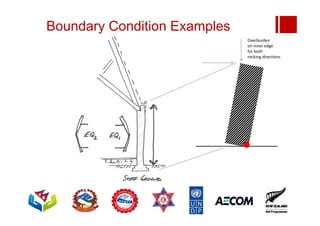
Overburden
on inner edge
for both
rocking directions
Would need to consider
response of far‐side wall
at same time, assuming
roof support is moving
Boundary Condition Examples
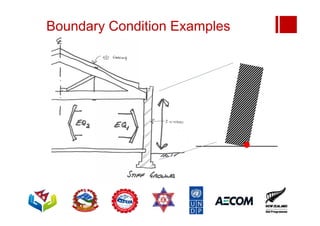
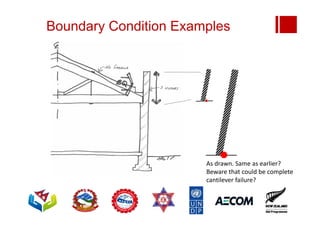
As drawn. Same as earlier?
Beware that could be complete
cantilever failure?
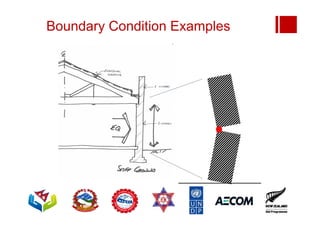
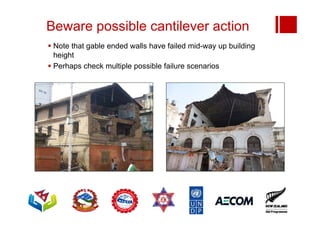
Beware possible cantilever action
 Note that gable ended walls have failed mid-way up building
height
 Perhaps check multiple possible failure scenarios
Boundary Condition Examples
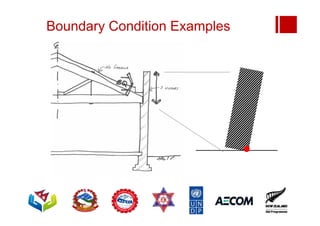
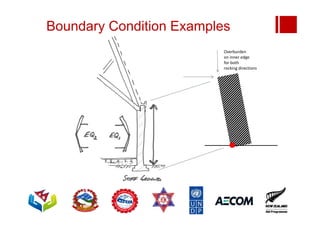
Overburden
on inner edge
for both
rocking directions
Boundary Condition Examples
Overburden
on inner edge
for both
rocking directions
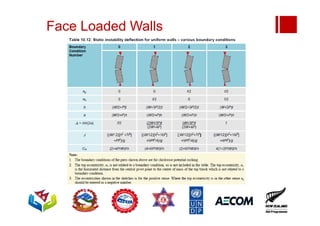
Face Loaded Walls
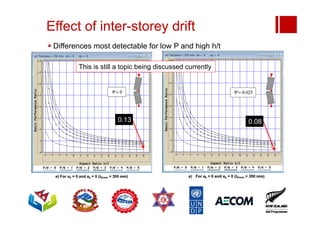
Effect of inter-storey drift
 Differences most detectable for low P and high h/t
0.08
0.13
This is still a topic being discussed currently
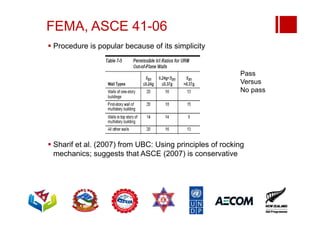
FEMA, ASCE 41-06
 Procedure is popular because of its simplicity
 Sharif et al. (2007) from UBC: Using principles of rocking
mechanics; suggests that ASCE (2007) is conservative
Pass
Versus
No pass
End wall separation
(or Return wall separation)
What is wrong with our vertical one-
way bending assumption?
1. We don’t actually have diaphragm anchorages in most cases
2. We have overlooked the end walls
 Are these end walls reliable to stabilise the face loaded wall?
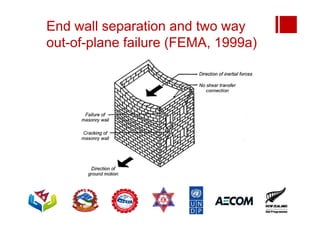
End wall separation and two way
out-of-plane failure (FEMA, 1999a)
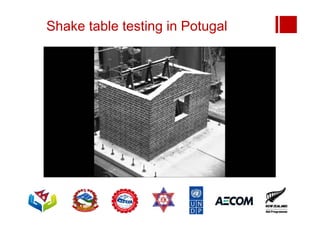
Shake table testing in Potugal
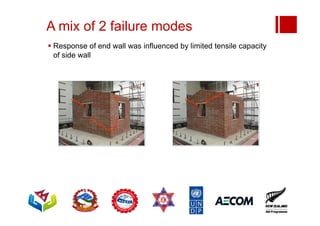
A mix of 2 failure modes
 Response of end wall was influenced by limited tensile capacity
of side wall
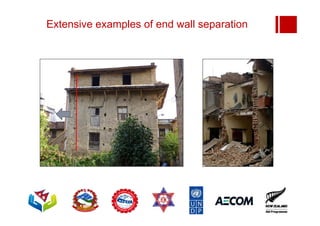
Extensive examples of end wall separation
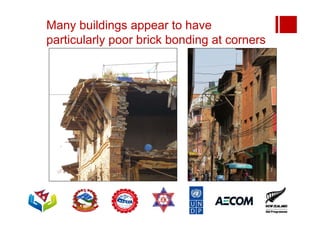
Many buildings appear to have
particularly poor brick bonding at corners
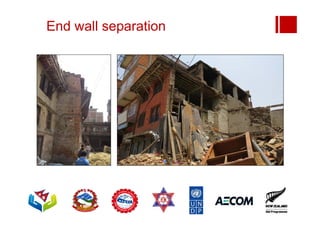
End wall separation
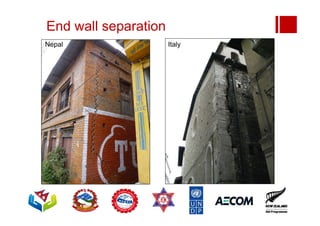
End wall separation
Italy
Nepal
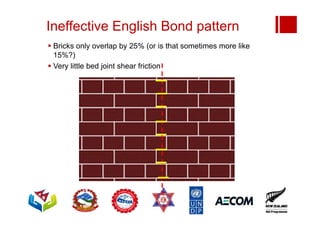
Ineffective English Bond pattern
 Bricks only overlap by 25% (or is that sometimes more like
15%?)
 Very little bed joint shear friction
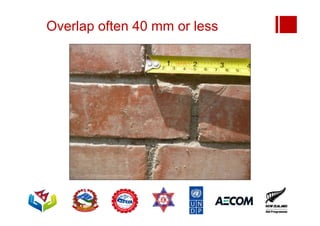
Overlap often 40 mm or less
Should this wall have failed?
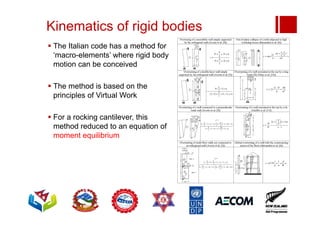
Kinematics of rigid bodies
 The Italian code has a method for
‘macro-elements’ where rigid body
motion can be conceived
 The method is based on the
principles of Virtual Work
 For a rocking cantilever, this
method reduced to an equation of
moment equilibrium
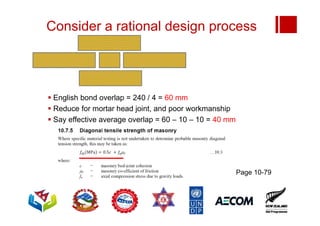
Consider a rational design process
 English bond overlap = 240 / 4 = 60 mm
 Reduce for mortar head joint, and poor workmanship
 Say effective average overlap = 60 – 10 – 10 = 40 mm
Page 10-79
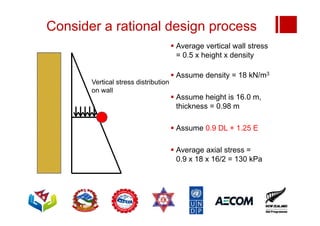
Consider a rational design process
 Average vertical wall stress
= 0.5 x height x density
 Assume density = 18 kN/m3
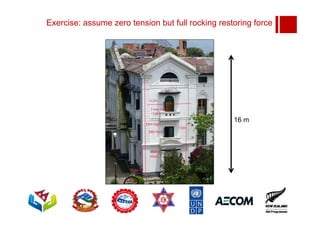
 Assume height is 16.0 m,
thickness = 0.98 m
 Assume 0.9 DL + 1.25 E
 Average axial stress =
0.9 x 18 x 16/2 = 130 kPa
Vertical stress distribution
on wall
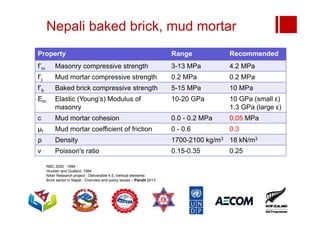
Nepali baked brick, mud mortar
Property Range Recommended
f’m Masonry compressive strength 3-13 MPa 4.2 MPa
f’j Mud mortar compressive strength 0.2 MPa 0.2 MPa
f’b Baked brick compressive strength 5-15 MPa 10 MPa
Em Elastic (Young’s) Modulus of
masonry
10-20 GPa 10 GPa (small ε)
1.3 GPa (large ε)
c Mud mortar cohesion 0.0 - 0.2 MPa 0.05 MPa
μf Mud mortar coefficient of friction 0 - 0.6 0.3
ρ Density 1700-2100 kg/m3 18 kN/m3
ν Poisson's ratio 0.15-0.35 0.25
NBC 2002 : 1994
Houben and Guillard, 1994
Niker Research project - Deliverable 4.5, Vertical elements
Brick sector in Nepal - Overview and policy issues – Pandit 2013
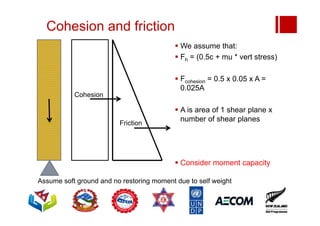
Cohesion and friction
 We assume that:
 Fh = (0.5c + mu * vert stress)
 Fcohesion = 0.5 x 0.05 x A =
0.025A
 A is area of 1 shear plane x
number of shear planes
 Consider moment capacity
Cohesion
Friction
Assume soft ground and no restoring moment due to self weight
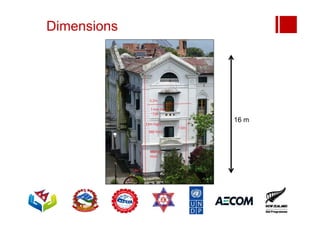
Dimensions
16 m
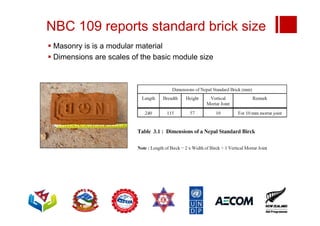
NBC 109 reports standard brick size
 Masonry is is a modular material
 Dimensions are scales of the basic module size
Moment due to cohesion
 Height = 16,000 mm
 Height of brick approx 70 mm (including joint)
 Shear plane = 0.98 m x 0.04 m = 0.039 m2 ( = 393 cm2)
 Number of shear planes = 16000 / 70 (brick height) = 229 planes
 Total cohesion force = 0.025 x 0.039 x 229 = 224 kN
 Moment due to cohesion F = 224 x (16/2) m = 1796 kNm
Moment due to friction
 Average axial stress = 0.9 x 18 x 16/2 = 130 kPa
 Shear plane = 0.98 m x 0.04 m = 0.039 m2 ( = 393 cm2)
 Number of shear planes = 16000 / 70 (brick height) = 229 planes
 Total friction force = (0.3 x 130) x 0.039 x 229 = 349 kN
 Moment due to friction F = 349 x (16/3) m = 1862 kNm
 Total moment capacity = 1796 + 1862 = 3657 kNm
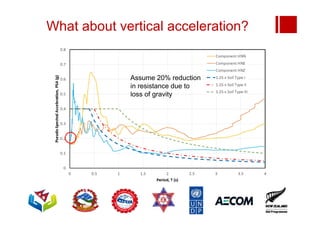
What about vertical acceleration?
Assume 20% reduction
in resistance due to
loss of gravity
Moment due to friction
 Average axial stress = 0.9 x 18 x 6/2 = 48.6 kPa
 Shear plane = 0.98 m x 0.04 m = 0.039 m2 ( = 393 cm2)
 Number of shear planes = 16000 / 70 (brick height) = 229 planes
 Total friction force = (0.3 x 130) x 0.039 x 229 = 349 kN
 Moment due to friction F = 349 x (16/3) m = 1862 kNm
 Total moment capacity = 1796 + 1862 = 3657 kNm
 Reduced moment capacity = 80% x (1796 + 1862) = 2926 kNm
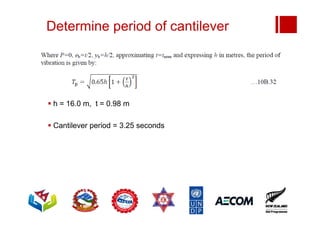
Determine period of cantilever
 h = 16.0 m, t = 0.98 m
 Cantilever period = 3.25 seconds
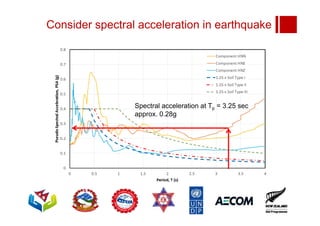
Consider spectral acceleration in earthquake
Spectral acceleration at Tp = 3.25 sec
approx. 0.28g
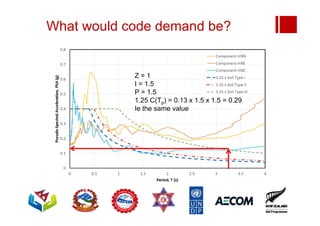
What would code demand be?
Z = 1
I = 1.5
P = 1.5
1.25 C(Tp) = 0.13 x 1.5 x 1.5 = 0.29
Ie the same value
Earthquake demand
 Tributary weight for half wall:
 (0.9 x 18) x [(5.2 +1)/2 x 1.0 x 16]
= 787 kN
 Spectral accel = 0.28g
 Horiz demand = 0.28 x 787
= 220 kN
 Overturning moment =
220 x 2/3 x 16 = 2352 kNm
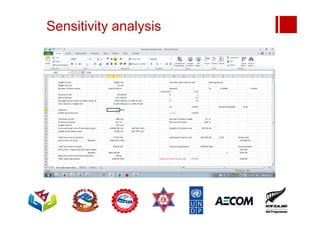
Sensitivity analysis
Capacity / demand
 Capacity = 2926 kNm
 Demand = 2352 kNm
 Ratio is that wall has 119% of required strength.
 So this explains why most did not fail
 But consider:
 20% drop in cohesion: Ratio drops to 107%
 20% drop in cohesion (poor mud mortar), 20% drop in friction, 25%
increase in shaking at site
 Ratio drops to only 76% of code
Capacity / demand
 Capacity = 2926 kNm
 Demand = 2352 kNm
 Ratio is that wall has 119% of required strength.
 So this explains why most did not fail
 But consider:
 20% drop in cohesion: Ratio drops to 107%
 20% drop in cohesion (poor mud mortar), 20% drop in friction, 25%
increase in shaking at site
 Ratio drops to only 76% of code
However, do recall that I also ignored
selfweight as a restoring force.
If rocking about an edge then the wall
would have a much greater restoring force
Capacity / demand
 Capacity = 2926 kNm
 Demand = 2352 kNm
 Ratio is that wall has 119% of required strength.
 So this explains why most did not fail
 But consider:
 20% drop in cohesion: Ratio drops to 107%
 20% drop in cohesion (poor mud mortar), 20% drop in friction, 25%
increase in shaking at site
 Ratio drops to only 76% of code
However, do recall that I also ignored
selfweight as a restoring force.
If rocking about an edge then the wall
would have a much greater restoring force
Note that the Italian method typically assumes zero tensile
strength of masonry, so self weight restoring is a factor
that is important to consider, even if then discounted
Exercise: assume zero tension but full rocking restoring force
16 m
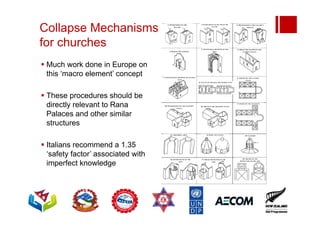
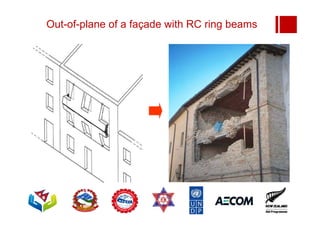
Collapse Mechanisms
for churches
 Much work done in Europe on
this ‘macro element’ concept
 These procedures should be
directly relevant to Rana
Palaces and other similar
structures
 Italians recommend a 1.35
‘safety factor’ associated with
imperfect knowledge
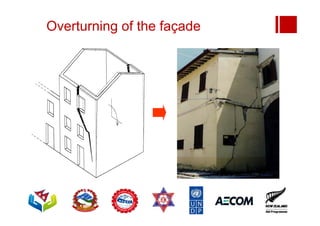
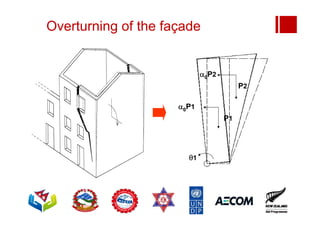
Overturning of the façade
0P1
P1
1
0P2
P2
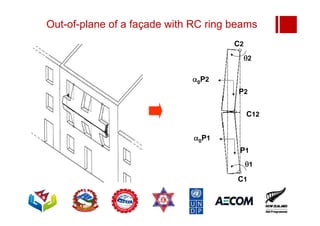
Out-of-plane of a façade with RC ring beams
0P2
P2
1
2
0P1
P1
C1
C12
C2
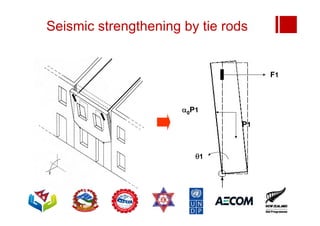
Seismic strengthening by tie rods
0P1
P1
1
F1
Learning lessons
 Boundary conditions significantly influence results
 If needed, you may need to revisit the site to check assumptions
 1-way bending is a lower bound value, but only applies when
diaphragm anchorages exist
 2-way bending generates demand on end walls
 Macro-element analysis is widely used in Italy for modelling
palaces and other monumental buildings
 English bond particularly vulnerable to end wall separation
 Sensitivity study is an very useful exercise

Module 1, session 11 Boundary conditions and end wall seperation.pdf

  • 1.
    Module 1: Unreinforced Masonry BuildingAssessment Session 11: Boundary conditions and end wall separation
  • 2.
    Boundary Conditions  Boundaryconditions control out-of-plane failure modes  Typically, the 1-way bending assumption is a lower bound estimate of actual strength  But, it may be excessively conservative  Therefore 2-way bending needs to be considered  But first – why so many boundary condition cases in Section 10 appendices?
  • 3.
  • 4.
    Boundary Condition Examples Rocksabout hard edge Rocks on outside of upper wall
  • 5.
    See top plotpage App 31 Check that you have correct wall thickness h/t = 4100/350 = 11.7 P/W≈1.25 h/t = 4100/350 = 11.7 BPR = 1.05
  • 6.
    What if weused the wrong chart? Check that you have correct wall thickness h/t = 4100/350 = 11.7 P/W≈1.25 h/t = 4100/350 = 11.7 BPR = 0.3
  • 7.
    What is theeffect of the correct vertical boundary conditions?  The correct boundary conditions are:  eb = +t/2 and ep = +t/2, giving BPR = 1.05 (Top of page App-31)  The worst possible mistake gives:  eb = 0 and ep = -t/2, giving BPR = 0.3 (Top of page App-31)  If you used the wrong boundary conditions you could mistakenly assume the wall is weaker than it is: 0.3/1.05 = 30% or in reverse, 1.05/0.3 = 350% stronger than it is
  • 8.
  • 9.
    Boundary Condition Examples Rocksabout soft centre Rocks on outside of upper wall
  • 10.
  • 11.
    Boundary Condition Examples Rockson outside of lower wall Rocks on centre. Roof and parapet unable to provide rigid restraint. Parapet and roof loads combine roughly at centre, or evaluate a combined eccentricity
  • 12.
  • 13.
    Boundary Condition Examples Rockson inside of lower wall Rocks on centre of parapet Empirical evidence from Chch says this failure is less likely than previous slide Possible influence of wall linings?
  • 14.
  • 15.
    Boundary Condition Examples Simplerocking block Mass at centroid
  • 16.
    Boundary Condition Examples Simplerocking block Mass at centroid
  • 17.
  • 18.
    Boundary Condition Examples Singleleaf cavity has no rigid support at top. Inner leaf load‐bearing so outer leaf probably critical Rocks on rigid diaphragm
  • 19.
  • 20.
    Boundary Condition Examples Fulllength cavity with Proper ties and mid‐height Wall‐diaphragm anchorage (not drawn) Should achieve composite action Rocks on outside of lower wall
  • 21.
  • 22.
    Boundary Condition Examples ForPT, the PT load will dominate over axial load. Should be reasonably simple P*(t/2‐a/2) calc. Unlikely to crack e P
  • 23.
  • 24.
    Boundary Condition Examples Needto evaluate weight of tributary roof compared to weight of parapet to establish which governs Also need to check cantilever overturning mode
  • 25.
  • 26.
    Boundary Condition Examples Couldbe either. Need to satisfy that previous strengthening is sound plus consider overburden versus thrust force of parapet. Check both?
  • 27.
  • 28.
    Boundary Condition Examples Overburden oninner edge for both rocking directions Would need to consider response of far‐side wall at same time, assuming roof support is moving
  • 29.
  • 30.
    Boundary Condition Examples Asdrawn. Same as earlier? Beware that could be complete cantilever failure?
  • 31.
    Beware possible cantileveraction  Note that gable ended walls have failed mid-way up building height  Perhaps check multiple possible failure scenarios
  • 32.
  • 33.
    Boundary Condition Examples Overburden oninner edge for both rocking directions
  • 34.
    Boundary Condition Examples Overburden oninner edge for both rocking directions
  • 35.
  • 36.
    Effect of inter-storeydrift  Differences most detectable for low P and high h/t 0.08 0.13 This is still a topic being discussed currently
  • 37.
    FEMA, ASCE 41-06 Procedure is popular because of its simplicity  Sharif et al. (2007) from UBC: Using principles of rocking mechanics; suggests that ASCE (2007) is conservative Pass Versus No pass
  • 38.
    End wall separation (orReturn wall separation)
  • 39.
    What is wrongwith our vertical one- way bending assumption? 1. We don’t actually have diaphragm anchorages in most cases 2. We have overlooked the end walls  Are these end walls reliable to stabilise the face loaded wall?
  • 40.
    End wall separationand two way out-of-plane failure (FEMA, 1999a)
  • 41.
  • 42.
    A mix of2 failure modes  Response of end wall was influenced by limited tensile capacity of side wall
  • 43.
    Extensive examples ofend wall separation
  • 44.
    Many buildings appearto have particularly poor brick bonding at corners
  • 45.
  • 46.
  • 47.
    Ineffective English Bondpattern  Bricks only overlap by 25% (or is that sometimes more like 15%?)  Very little bed joint shear friction
  • 48.
    Overlap often 40mm or less
  • 49.
    Should this wallhave failed?
  • 50.
    Kinematics of rigidbodies  The Italian code has a method for ‘macro-elements’ where rigid body motion can be conceived  The method is based on the principles of Virtual Work  For a rocking cantilever, this method reduced to an equation of moment equilibrium
  • 51.
    Consider a rationaldesign process  English bond overlap = 240 / 4 = 60 mm  Reduce for mortar head joint, and poor workmanship  Say effective average overlap = 60 – 10 – 10 = 40 mm Page 10-79
  • 52.
    Consider a rationaldesign process  Average vertical wall stress = 0.5 x height x density  Assume density = 18 kN/m3  Assume height is 16.0 m, thickness = 0.98 m  Assume 0.9 DL + 1.25 E  Average axial stress = 0.9 x 18 x 16/2 = 130 kPa Vertical stress distribution on wall
  • 53.
    Nepali baked brick,mud mortar Property Range Recommended f’m Masonry compressive strength 3-13 MPa 4.2 MPa f’j Mud mortar compressive strength 0.2 MPa 0.2 MPa f’b Baked brick compressive strength 5-15 MPa 10 MPa Em Elastic (Young’s) Modulus of masonry 10-20 GPa 10 GPa (small ε) 1.3 GPa (large ε) c Mud mortar cohesion 0.0 - 0.2 MPa 0.05 MPa μf Mud mortar coefficient of friction 0 - 0.6 0.3 ρ Density 1700-2100 kg/m3 18 kN/m3 ν Poisson's ratio 0.15-0.35 0.25 NBC 2002 : 1994 Houben and Guillard, 1994 Niker Research project - Deliverable 4.5, Vertical elements Brick sector in Nepal - Overview and policy issues – Pandit 2013
  • 54.
    Cohesion and friction We assume that:  Fh = (0.5c + mu * vert stress)  Fcohesion = 0.5 x 0.05 x A = 0.025A  A is area of 1 shear plane x number of shear planes  Consider moment capacity Cohesion Friction Assume soft ground and no restoring moment due to self weight
  • 55.
  • 56.
    NBC 109 reportsstandard brick size  Masonry is is a modular material  Dimensions are scales of the basic module size
  • 57.
    Moment due tocohesion  Height = 16,000 mm  Height of brick approx 70 mm (including joint)  Shear plane = 0.98 m x 0.04 m = 0.039 m2 ( = 393 cm2)  Number of shear planes = 16000 / 70 (brick height) = 229 planes  Total cohesion force = 0.025 x 0.039 x 229 = 224 kN  Moment due to cohesion F = 224 x (16/2) m = 1796 kNm
  • 58.
    Moment due tofriction  Average axial stress = 0.9 x 18 x 16/2 = 130 kPa  Shear plane = 0.98 m x 0.04 m = 0.039 m2 ( = 393 cm2)  Number of shear planes = 16000 / 70 (brick height) = 229 planes  Total friction force = (0.3 x 130) x 0.039 x 229 = 349 kN  Moment due to friction F = 349 x (16/3) m = 1862 kNm  Total moment capacity = 1796 + 1862 = 3657 kNm
  • 59.
    What about verticalacceleration? Assume 20% reduction in resistance due to loss of gravity
  • 60.
    Moment due tofriction  Average axial stress = 0.9 x 18 x 6/2 = 48.6 kPa  Shear plane = 0.98 m x 0.04 m = 0.039 m2 ( = 393 cm2)  Number of shear planes = 16000 / 70 (brick height) = 229 planes  Total friction force = (0.3 x 130) x 0.039 x 229 = 349 kN  Moment due to friction F = 349 x (16/3) m = 1862 kNm  Total moment capacity = 1796 + 1862 = 3657 kNm  Reduced moment capacity = 80% x (1796 + 1862) = 2926 kNm
  • 61.
    Determine period ofcantilever  h = 16.0 m, t = 0.98 m  Cantilever period = 3.25 seconds
  • 62.
    Consider spectral accelerationin earthquake Spectral acceleration at Tp = 3.25 sec approx. 0.28g
  • 63.
    What would codedemand be? Z = 1 I = 1.5 P = 1.5 1.25 C(Tp) = 0.13 x 1.5 x 1.5 = 0.29 Ie the same value
  • 64.
    Earthquake demand  Tributaryweight for half wall:  (0.9 x 18) x [(5.2 +1)/2 x 1.0 x 16] = 787 kN  Spectral accel = 0.28g  Horiz demand = 0.28 x 787 = 220 kN  Overturning moment = 220 x 2/3 x 16 = 2352 kNm
  • 65.
  • 66.
    Capacity / demand Capacity = 2926 kNm  Demand = 2352 kNm  Ratio is that wall has 119% of required strength.  So this explains why most did not fail  But consider:  20% drop in cohesion: Ratio drops to 107%  20% drop in cohesion (poor mud mortar), 20% drop in friction, 25% increase in shaking at site  Ratio drops to only 76% of code
  • 67.
    Capacity / demand Capacity = 2926 kNm  Demand = 2352 kNm  Ratio is that wall has 119% of required strength.  So this explains why most did not fail  But consider:  20% drop in cohesion: Ratio drops to 107%  20% drop in cohesion (poor mud mortar), 20% drop in friction, 25% increase in shaking at site  Ratio drops to only 76% of code However, do recall that I also ignored selfweight as a restoring force. If rocking about an edge then the wall would have a much greater restoring force
  • 68.
    Capacity / demand Capacity = 2926 kNm  Demand = 2352 kNm  Ratio is that wall has 119% of required strength.  So this explains why most did not fail  But consider:  20% drop in cohesion: Ratio drops to 107%  20% drop in cohesion (poor mud mortar), 20% drop in friction, 25% increase in shaking at site  Ratio drops to only 76% of code However, do recall that I also ignored selfweight as a restoring force. If rocking about an edge then the wall would have a much greater restoring force Note that the Italian method typically assumes zero tensile strength of masonry, so self weight restoring is a factor that is important to consider, even if then discounted
  • 69.
    Exercise: assume zerotension but full rocking restoring force 16 m
  • 70.
    Collapse Mechanisms for churches Much work done in Europe on this ‘macro element’ concept  These procedures should be directly relevant to Rana Palaces and other similar structures  Italians recommend a 1.35 ‘safety factor’ associated with imperfect knowledge
  • 71.
  • 72.
    Overturning of thefaçade 0P1 P1 1 0P2 P2
  • 73.
    Out-of-plane of afaçade with RC ring beams
  • 74.
    Out-of-plane of afaçade with RC ring beams 0P2 P2 1 2 0P1 P1 C1 C12 C2
  • 75.
    Seismic strengthening bytie rods 0P1 P1 1 F1
  • 76.
    Learning lessons  Boundaryconditions significantly influence results  If needed, you may need to revisit the site to check assumptions  1-way bending is a lower bound value, but only applies when diaphragm anchorages exist  2-way bending generates demand on end walls  Macro-element analysis is widely used in Italy for modelling palaces and other monumental buildings  English bond particularly vulnerable to end wall separation  Sensitivity study is an very useful exercise