Marke&ng	
  Your	
  Community	
  
to	
  Drive	
  Economic	
  Development	
  
Southeast Community Development Institute
April 25, 2013
Download this presentation at
www.slideshare.net/ellendid4
What We’ll Cover Today
1.	
  Defining	
  Your	
  Community’s	
  Brand	
  
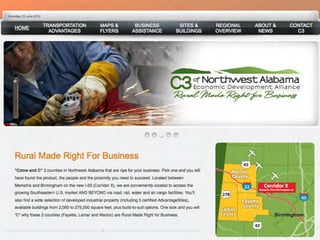
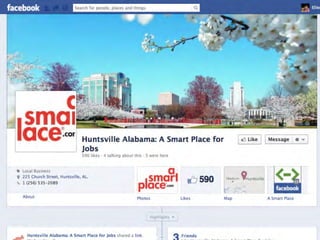
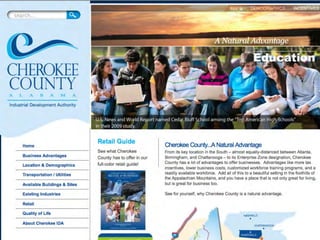
2.	
  Defining	
  Your	
  Audiences	
  and	
  Touchpoints	
  
3.	
  Do	
  the	
  Basics	
  Well:	
  Tools	
  that	
  Reach	
  ALL	
  Audiences	
  
4.	
  Adjust	
  Marke&ng	
  for	
  Each	
  Audience	
  
What We’ll Cover Today
1.	
  Defining	
  Your	
  Community’s	
  Brand	
  
2.	
  Defining	
  Your	
  Audiences	
  and	
  Touchpoints	
  
3.	
  Do	
  the	
  Basics	
  Well:	
  Tools	
  that	
  Reach	
  ALL	
  Audiences	
  
4.	
  Adjust	
  Marke&ng	
  for	
  Each	
  Audience	
  
We’re
Different!
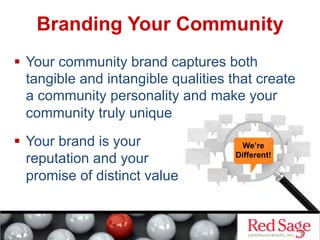
Branding Your Community
  Your community brand captures both
tangible and intangible qualities that create
a community personality and make your
community truly unique
  Your brand is your
reputation and your
promise of distinct value
What We’ll Cover Today
1.	
  Defining	
  Your	
  Community’s	
  Brand	
  
2.	
  Defining	
  Your	
  Audiences	
  and	
  Touchpoints	
  
3.	
  Do	
  the	
  Basics	
  Well:	
  Tools	
  that	
  Reach	
  ALL	
  Audiences	
  
4.	
  Adjust	
  Marke&ng	
  for	
  Each	
  Audience	
  
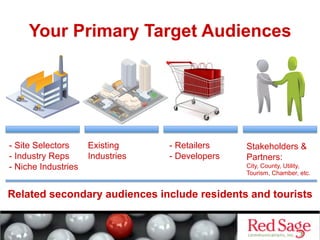
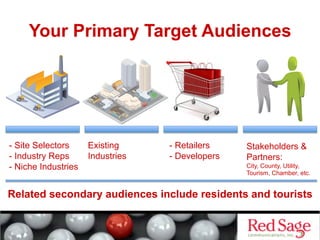
Your Primary Target Audiences
- Site Selectors
- Industry Reps
- Niche Industries
- Retailers
- Developers
Stakeholders &
Partners:
City, County, Utility,
Tourism, Chamber, etc.
Existing
Industries
Related secondary audiences include residents and tourists
Examples of brand touchpoints
inside your community
  Community websites
  Local press
  Social Media
  Wayfinding Signage
  Quality of life features for residents (parks,
road quality, education quality, etc. etc.
  The scope and quality of a visitor’s
experience of a community
Examples of brand touchpoints
outside your community
  Website
  Word of Mouth
  Press
  Social Media
  Travel/Meetings
  Outside paid marketing
  Marketing by local companies
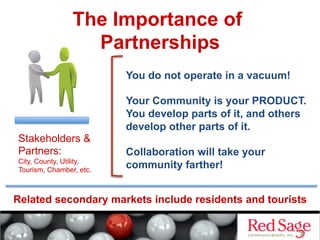
The Importance of
Partnerships
Stakeholders &
Partners:
City, County, Utility,
Tourism, Chamber, etc.
You do not operate in a vacuum!
Your Community is your PRODUCT.
You develop parts of it, and others
develop other parts of it.
Collaboration will take your
community farther!
Related secondary markets include residents and tourists
What We’ll Cover Today
1.	
  Defining	
  Your	
  Community’s	
  Brand	
  
2.	
  Defining	
  Your	
  Audiences	
  and	
  Touchpoints	
  
3.	
  Do	
  the	
  Basics	
  Well:	
  Tools	
  that	
  Reach	
  ALL	
  Audiences	
  
4.	
  Adjust	
  Marke&ng	
  for	
  Each	
  Audience	
  
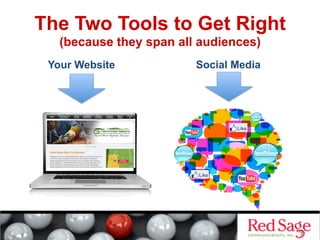
The Two Tools to Get Right
(because they span all audiences)
Your Website Social Media
?
Why is having a strong
online presence for your
community important?
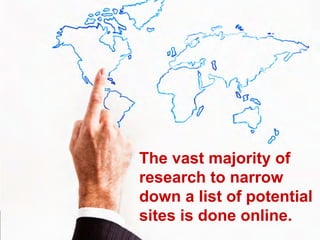
The vast majority of
research to narrow
down a list of potential
sites is done online.
Showcasing your
community with
your economic
development
website
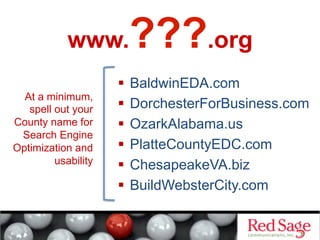
www.???.org
  BaldwinEDA.com
  DorchesterForBusiness.com
  OzarkAlabama.us
  PlatteCountyEDC.com
  ChesapeakeVA.biz
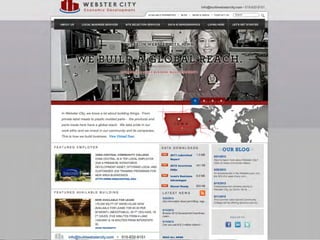
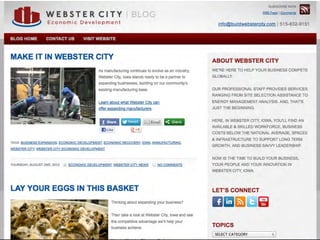
  BuildWebsterCity.com
At a minimum,
spell out your
County name for
Search Engine
Optimization and
usability
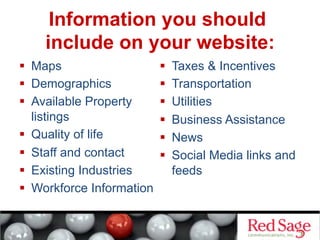
Information you should
include on your website:
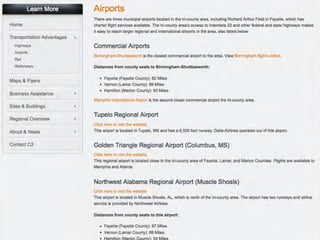
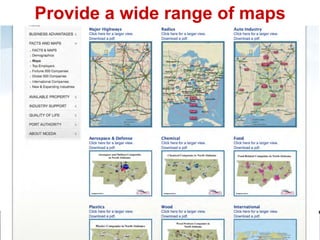
  Maps
  Demographics
  Available Property
listings
  Quality of life
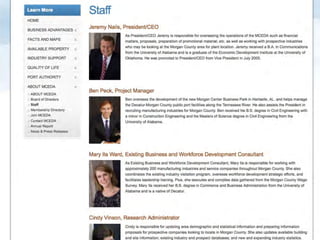
  Staff and contact
  Existing Industries
  Workforce Information
  Taxes & Incentives
  Transportation
  Utilities
  Business Assistance
  News
  Social Media links and
feeds
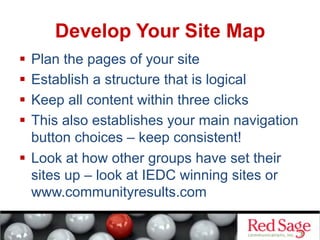
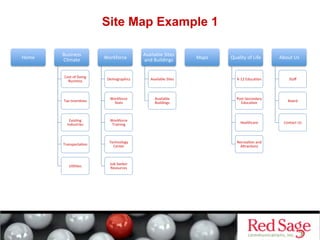
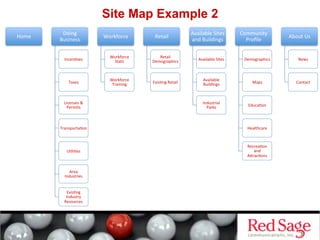
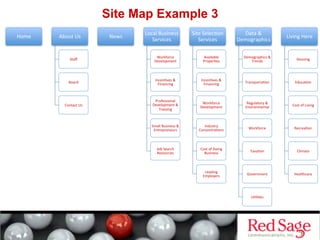
Develop Your Site Map
  Plan the pages of your site
  Establish a structure that is logical
  Keep all content within three clicks
  This also establishes your main navigation
button choices – keep consistent!
  Look at how other groups have set their
sites up – look at IEDC winning sites or
www.communityresults.com
Site Map Example 1
Home	
  
Business	
  
Climate	
  
Cost	
  of	
  Doing	
  
Business	
  
Tax	
  Incen6ves	
  
Exis6ng	
  
Industries	
  
Transporta6on	
  
U6li6es	
  
Workforce	
  
Demographics	
  
Workforce	
  
Stats	
  
Workforce	
  
Training	
  
Technology	
  
Center	
  
Job	
  Seeker	
  
Resources	
  
Available	
  Sites	
  
and	
  Buildings	
  
Available	
  Sites	
  
Available	
  
Buildings	
  
Maps	
   Quality	
  of	
  Life	
  
K-­‐12	
  Educa6on	
  
Post-­‐Secondary	
  
Educa6on	
  
Healthcare	
  
Recrea6on	
  and	
  
ANrac6ons	
  
About	
  Us	
  
Staff	
  
Board	
  
Contact	
  Us	
  
Site Map Example 2
Home	
  
Doing	
  
Business	
  
Incen6ves	
  
Taxes	
  
Licenses	
  &	
  
Permits	
  
Transporta6on	
  
U6li6es	
  
Area	
  
Industries	
  
Exis6ng	
  
Industry	
  
Resources	
  
Workforce	
  
Workforce	
  
Stats	
  
Workforce	
  
Training	
  
Retail	
  
Retail	
  
Demographics	
  
Exis6ng	
  Retail	
  
Available	
  Sites	
  
and	
  Buildings	
  
Available	
  Sites	
  
Available	
  
Buildings	
  
Industrial	
  
Parks	
  
Community	
  
Profile	
  
Demographics	
  
Maps	
  
Educa6on	
  
Healthcare	
  
Recrea6on	
  
and	
  
ANrac6ons	
  
About	
  Us	
  
News	
  
Contact	
  
Site Map Example 3
Home	
   About	
  Us	
  
Staff	
  
Board	
  
Contact	
  Us	
  
News	
  
Local	
  Business	
  
Services	
  
Workforce	
  
Development	
  
Incen6ves	
  &	
  
Financing	
  
Professional	
  
Development	
  &	
  
Training	
  
Small	
  Business	
  &	
  
Entrepreneurs	
  
Job	
  Search	
  
Resources	
  
Site	
  Selec6on	
  
Services	
  
Available	
  
Proper6es	
  
Incen6ves	
  &	
  
Financing	
  
Workforce	
  
Development	
  
Industry	
  
Concentra6ons	
  
Cost	
  of	
  Doing	
  
Business	
  
Leading	
  
Employers	
  
Data	
  &	
  
Demographics	
  
Demographics	
  &	
  
Trends	
  
Transporta6on	
  
Regulatory	
  &	
  
Environmental	
  
Workforce	
  
Taxa6on	
  
Government	
  
U6li6es	
  
Living	
  Here	
  
Housing	
  
Educa6on	
  
Cost	
  of	
  Living	
  
Recrea6on	
  
Climate	
  
Healthcare	
  
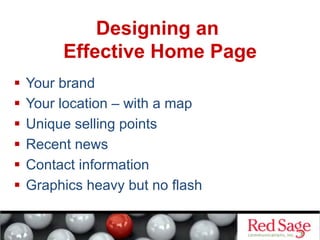
Designing an
Effective Home Page
  Your brand
  Your location – with a map
  Unique selling points
  Recent news
  Contact information
  Graphics heavy but no flash
How to Write and Program
Content
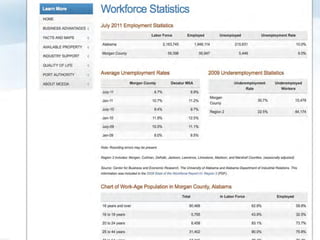
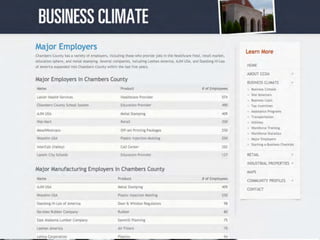
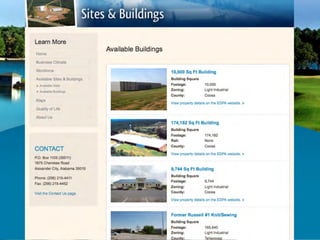
  Economic Development Sites are VERY data
heavy
  People don’t read – avoid paragraphs and use
bullet lists, tables or charts whenever possible
  Break pages up visually with sub-heads,
sections or graphics
What to include in News
  New industry announcements
  Local industry news
  New Hires
  Awards
  Job creation announcements
  Report releases
  Either write your own or link to local coverage
  Ability to share articles on social media
Provide a wide range of maps
GIS Powered Sites
  More robust searching
  More extensive property data fields
  Radius-based demographics
  Exportable reports
  Still pricey for small communities but more
options available
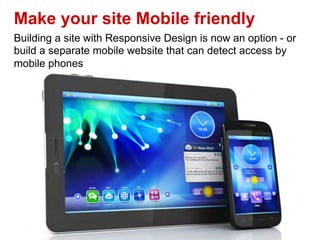
Make your site Mobile friendly
Building a site with Responsive Design is now an option - or
build a separate mobile website that can detect access by
mobile phones
Social Media for Economic Developers
WOW!
DID
YOU
HEAR?
AWESOME!
COOL!
It is about
engagement
and
Top of mind
awareness
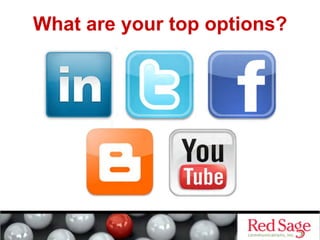
What are your top options?
What can you talk about?
  Industry announcements
  New business startups/entrepreneurship
  Workforce programs and education
  Company profiles
  Local business news
  Unemployment updates and related reports
  Share blogs, videos, photos
  Learn from organizations featured in this
presentation
  If nothing else, participate here
  Broad reach beyond local market
  This is your top business networking
tool, without having to travel to a
conference or other networking
event at a distance
  Participate daily - or weekly at a
minimum
LinkedIn
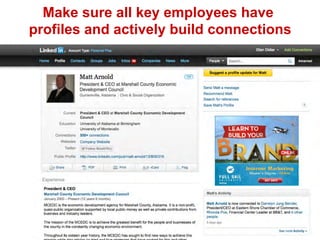
Make sure all key employees have
profiles and actively build connections
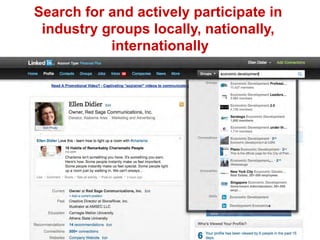
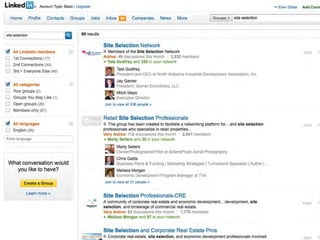
Search for and actively participate in
industry groups locally, nationally,
internationally
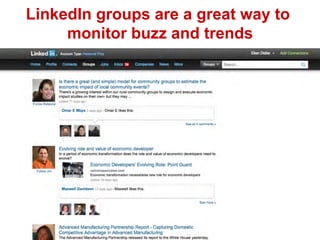
LinkedIn groups are a great way to
monitor buzz and trends
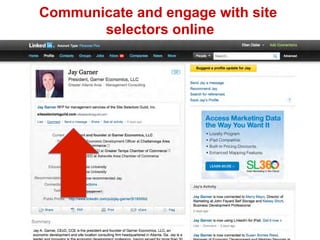
Communicate and engage with site
selectors online
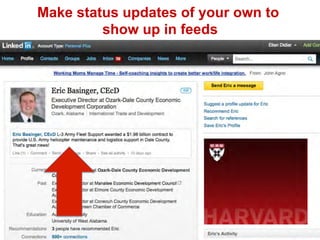
Make status updates of your own to
show up in feeds
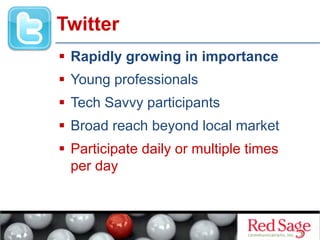
  Rapidly growing in importance
  Young professionals
  Tech Savvy participants
  Broad reach beyond local market
  Participate daily or multiple times
per day
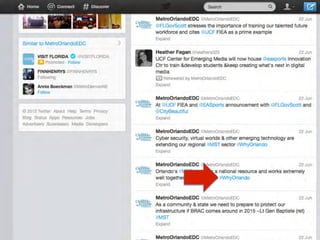
Twitter
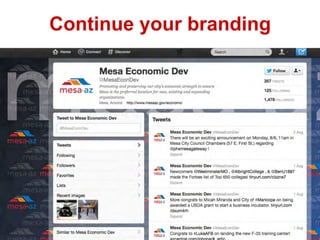
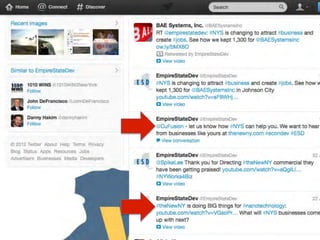
Continue your branding
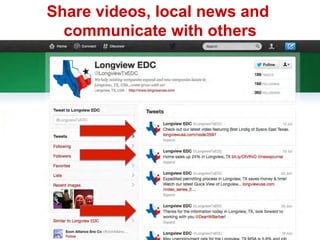
Share videos, local news and
communicate with others
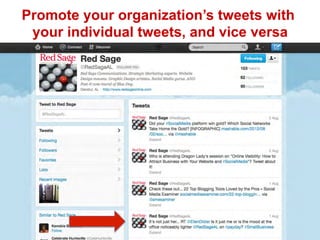
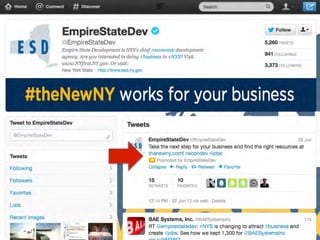
Promote your organization’s tweets with
your individual tweets, and vice versa
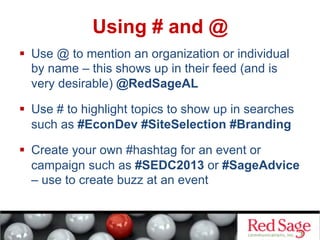
Using # and @
  Use @ to mention an organization or individual
by name – this shows up in their feed (and is
very desirable) @RedSageAL
  Use # to highlight topics to show up in searches
such as #EconDev #SiteSelection #Branding
  Create your own #hashtag for an event or
campaign such as #SEDC2013 or #SageAdvice
– use to create buzz at an event
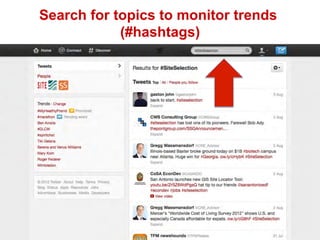
Search for topics to monitor trends
(#hashtags)
  Engagement and relationship building
with your local market primarily
  More personal, informal and friendly
  Know your goals for using this:
  Top of mind in local market
  Sharing local business news, or building
support for a local issue
  Cross sharing/SEO opportunity
Facebook
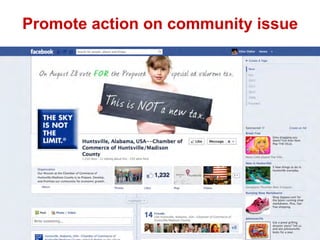
Promote action on community issue
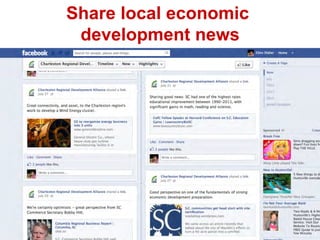
Share local economic
development news
  Terrific opportunity to give your
take on local news and trends –
plus this is the best way to:
  create new personalized content to
share across web and all channels
  Drive traffic to your website
  Increase the odds you will show up in
search engines – awesome SEO tool
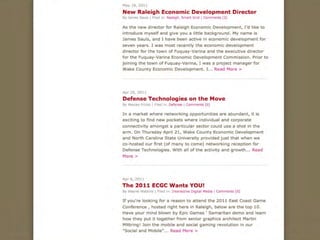
Blogging
  Personal thoughts about current
news or situation
  Keep short – 1 paragraph is fine
  Best is at least once a week, but
even a well maintained once a
month blog is better than most
communities
Blogging
  New business announcements
  Career tech education locally
  Expansions – and why
  Entrepreneurship
  Local business resources
  New regulations
  Top jobs locally
  Etc.
Blog Topics
  Highly recommend starting to
incorporate video into your
efforts, if you are not already
doing this
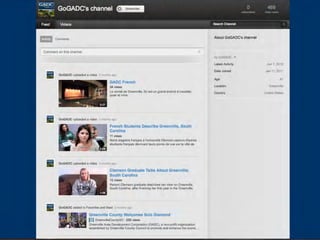
YouTube
Greenville, SC
http://www.youtube.com/gogadc
  About GADC video
  Industry profiles
  Testimonial videos from young
professionals
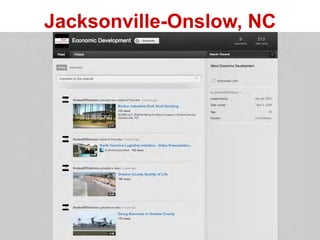
Jacksonville-Onslow, NC
  Follow industry leaders on social media and
on their blogs
  Promote those already championing for you
  Be an active follower by retweeting, sharing,
and commenting
  Actively participate in LinkedIn Groups
  Continuously find and add LinkedIn
connections
Growing your audience:
Follow to be followed
Choosing How to Participate
  Choose how and where to participate:
What do you have time to be consistent
with? (Don’t start a blog if you aren’t
committed to keeping it going)
  Give it time: You won’t see results
overnight, be patient and be consistent
  Devote a realistic amount of time for social
media each week – half hour a day? One
hour a week?
  Make it a priority and be committed to it
  Scale back and focus on one thing if time
is an issue
  Don’t forget to take the time to plan in
advance
Carve out time:
  Add an agenda item to a weekly or
monthly meeting: what should we blog
about this week? What is going on that we
want to talk about in social media?
  Decide what topics you’ll cover: use an
editorial calendar to keep things organized
but make sure you build in flexibility too
Build a process
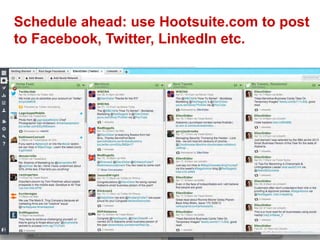
Schedule ahead: use Hootsuite.com to post
to Facebook, Twitter, LinkedIn etc.
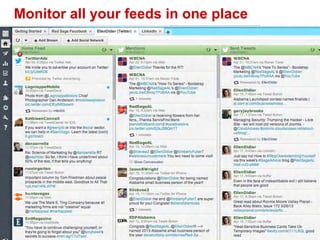
Monitor all your feeds in one place
Know what is being said
  Whether you use social media or not,
people will still be talking about your
organization and your community online
  Monitor all social media platforms for
comments and respond to comments as
quickly as you can
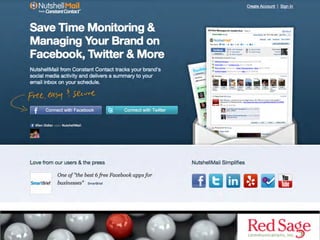
  Offered by Constant Contact
  Monitors mentions and activity:
•  Facebook
•  Twitter
•  LinkedIn
•  Foursquare
  Reports are emailed to you
  FREE!
Easy monitoring:
NutshellMail.com
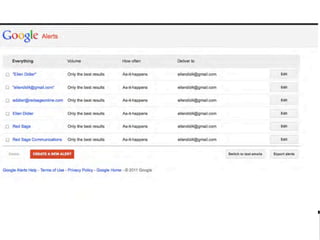
  Set up alerts for your company name,
products, and other identifying keywords
  Set up alerts associated with your
competitors
  Set up alerts for terms associated with
your industry
www.Google.com/Alerts
What We’ll Cover Today
1.	
  Defining	
  Your	
  Community’s	
  Brand	
  
2.	
  Defining	
  Your	
  Audiences	
  and	
  Touchpoints	
  
3.	
  Do	
  the	
  Basics	
  Well:	
  Tools	
  that	
  Reach	
  ALL	
  Audiences	
  
4.	
  Adjust	
  Marke&ng	
  for	
  Each	
  Audience	
  
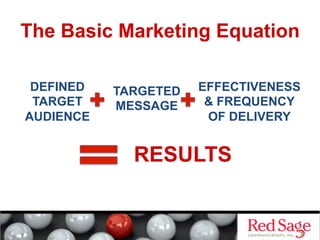
The Basic Marketing Equation
DEFINED
TARGET
AUDIENCE
TARGETED
MESSAGE
EFFECTIVENESS
& FREQUENCY
OF DELIVERY
RESULTS
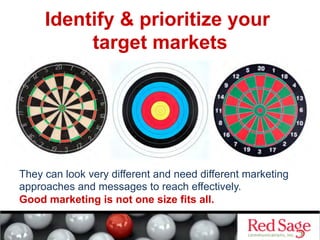
Identify & prioritize your
target markets
They can look very different and need different marketing
approaches and messages to reach effectively.
Good marketing is not one size fits all.
Adjust your message
for each market – AND how
you deliver the message
Your Primary Target Audiences
- Site Selectors
- Industry Reps
- Niche Industries
- Retailers
- Developers
Stakeholders &
Partners:
City, County, Utility,
Tourism, Chamber, etc.
Existing
Industries
Related secondary audiences include residents and tourists
TARGETED MESSAGES
  Why your location is the best choice
•  Located in the middle of a regional industry
cluster of manufacturers and suppliers
(aerospace, automotive, etc.)
•  Available high skilled labor
•  Building or site ready for them immediately
•  History of existing business expansions
and new industry announcements in your
community
•  And any other unique selling propositions
  Letters or quotes of support from key
leaders (Mayor, Governor, head of key
industry, etc.
- Site Selectors
- Industry Reps
- Niche Industries
QUALITY AND FREQUENCY OF
MESSAGE DELIVERY
  Tradeshows, ‘Meet the Consultant’ & other
networking events
  LinkedIn Groups & other social media
participation
  Direct mail, emails, or sales calls to
suppliers or customers of your existing
industries
  YouTube videos of buildings or land
  Direct mail – spec buildings, nearby related
industries, etc.
  Press releases of industry location or
expansion announcements to related print
or online sources
- Site Selectors
- Industry Reps
- Niche Industries
And	
  make	
  sure	
  
your	
  process	
  is	
  
smooth	
  and	
  
materials	
  are	
  
ready!!	
  
TARGETED MESSAGES
  We are here to help you succeed and
grow
  We want to tell you about programs
and resources available for your
business from us, the state, and other
sources
  We want to be your main contact and
advocate for any issue you are facing
that is holding you back from success
and either help you resolve it or point
you to resources that can help
Existing
Industries
QUALITY AND FREQUENCY OF
MESSAGE DELIVERY
  Regular personal meetings, calls or
emails
  Host one or more annual recognition
or social events to build relationships
  E-newsletters to share news and
resources
  Annual survey and report – their
perception of community, your
assistance, local resources such as
education, workforce readiness, etc.
  Responsiveness!!
Existing
Industries
TARGETED MESSAGES
  Population demographics that meet their
targets
  Recent boom of development means they
should look at your community
  Retail Opportunity Gap data
  Outshopping information
  Steady or significant increase in incomes
or population over past 5-10 years
  Factors that don’t show up in
demographics such as nearby college
populations, tourism traffic/spending etc.
Retailers
Developers
QUALITY AND FREQUENCY OF
MESSAGE DELIVERY
  Materials that convey key selling points
  Networking at ICSC and other retail
events
  Work through your developers
  Direct mail, LinkedIn groups, social media
  Ensure your process of responding to
inquiries and supporting all phases of
retail development is responsive and
smooth – this encourages developers to
keep choosing your community for
development because you are easy to
work with (assuming their other
developments are successful).
Retailers
Developers
TARGETED MESSAGES
  What’s new, what are we working on, what
are some recent successes
  We are bringing jobs, money, and new
residents to our community which helps us
all
  We want to work with you to support your
initiatives however we can within our
mission
  We need your help and expertise on a
specific issue to ensure this project’s
success
  We appreciate your partnership with us
Stakeholders &
Partners:
City, County, Utility,
Tourism, Chamber,
Legislators etc.
QUALITY AND FREQUENCY OF
MESSAGE DELIVERY
  Networking
  E-newsletters
  Annual reports
  Show up in support of their key initiatives
  Recognize partnerships and assistance
publicly whenever possible
  Be trustworthy, responsive, and
appreciative
  Regular meetings to update on your
activities and learn about other’s activities
  Host one or more annual recognition or
social events to build relationships
Stakeholders &
Partners:
City, County, Utility,
Tourism, Chamber,
Legislators etc.
Other Marketing Initiatives
and support materials:
  Site or Building Marketing: brochures,
binders, microsites, direct mail, online
listings, etc.
  Industry Recruitment materials – flyers,
rack cards,
  Community Print Ads – Business
Alabama, SKY Magazine, Site Selection
Magazine
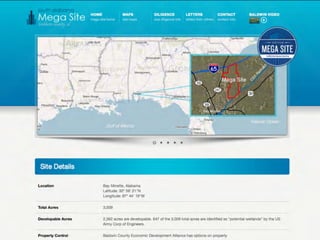
Consider building a separate
microsite for key sites or programs
  Smaller website focused on a single topic
with more in-depth data and information
  Typically associated with other marketing
materials that promote the site
Download this presentation at
www.slideshare.net/ellendid4
Please connect with me!
www.RedSageOnline.com
twitter.com/ellendidier
twitter.com/RedSageAL
facebook.com/redsage linkedin.com/in/
ellendidier

Marketing Your Community for Economic Development

  • 1.
    Marke&ng  Your  Community   to  Drive  Economic  Development   Southeast Community Development Institute April 25, 2013 Download this presentation at www.slideshare.net/ellendid4
  • 2.
    What We’ll CoverToday 1.  Defining  Your  Community’s  Brand   2.  Defining  Your  Audiences  and  Touchpoints   3.  Do  the  Basics  Well:  Tools  that  Reach  ALL  Audiences   4.  Adjust  Marke&ng  for  Each  Audience  
  • 3.
    What We’ll CoverToday 1.  Defining  Your  Community’s  Brand   2.  Defining  Your  Audiences  and  Touchpoints   3.  Do  the  Basics  Well:  Tools  that  Reach  ALL  Audiences   4.  Adjust  Marke&ng  for  Each  Audience  
  • 4.
    We’re Different! Branding Your Community  Your community brand captures both tangible and intangible qualities that create a community personality and make your community truly unique   Your brand is your reputation and your promise of distinct value
  • 8.
    What We’ll CoverToday 1.  Defining  Your  Community’s  Brand   2.  Defining  Your  Audiences  and  Touchpoints   3.  Do  the  Basics  Well:  Tools  that  Reach  ALL  Audiences   4.  Adjust  Marke&ng  for  Each  Audience  
  • 9.
    Your Primary TargetAudiences - Site Selectors - Industry Reps - Niche Industries - Retailers - Developers Stakeholders & Partners: City, County, Utility, Tourism, Chamber, etc. Existing Industries Related secondary audiences include residents and tourists
  • 10.
    Examples of brandtouchpoints inside your community   Community websites   Local press   Social Media   Wayfinding Signage   Quality of life features for residents (parks, road quality, education quality, etc. etc.   The scope and quality of a visitor’s experience of a community
  • 11.
    Examples of brandtouchpoints outside your community   Website   Word of Mouth   Press   Social Media   Travel/Meetings   Outside paid marketing   Marketing by local companies
  • 12.
    The Importance of Partnerships Stakeholders& Partners: City, County, Utility, Tourism, Chamber, etc. You do not operate in a vacuum! Your Community is your PRODUCT. You develop parts of it, and others develop other parts of it. Collaboration will take your community farther! Related secondary markets include residents and tourists
  • 13.
    What We’ll CoverToday 1.  Defining  Your  Community’s  Brand   2.  Defining  Your  Audiences  and  Touchpoints   3.  Do  the  Basics  Well:  Tools  that  Reach  ALL  Audiences   4.  Adjust  Marke&ng  for  Each  Audience  
  • 14.
    The Two Toolsto Get Right (because they span all audiences) Your Website Social Media
  • 15.
    ? Why is havinga strong online presence for your community important?
  • 16.
    The vast majorityof research to narrow down a list of potential sites is done online.
  • 17.
    Showcasing your community with youreconomic development website
  • 18.
    www.???.org   BaldwinEDA.com   DorchesterForBusiness.com  OzarkAlabama.us   PlatteCountyEDC.com   ChesapeakeVA.biz   BuildWebsterCity.com At a minimum, spell out your County name for Search Engine Optimization and usability
  • 19.
    Information you should includeon your website:   Maps   Demographics   Available Property listings   Quality of life   Staff and contact   Existing Industries   Workforce Information   Taxes & Incentives   Transportation   Utilities   Business Assistance   News   Social Media links and feeds
  • 20.
    Develop Your SiteMap   Plan the pages of your site   Establish a structure that is logical   Keep all content within three clicks   This also establishes your main navigation button choices – keep consistent!   Look at how other groups have set their sites up – look at IEDC winning sites or www.communityresults.com
  • 21.
    Site Map Example1 Home   Business   Climate   Cost  of  Doing   Business   Tax  Incen6ves   Exis6ng   Industries   Transporta6on   U6li6es   Workforce   Demographics   Workforce   Stats   Workforce   Training   Technology   Center   Job  Seeker   Resources   Available  Sites   and  Buildings   Available  Sites   Available   Buildings   Maps   Quality  of  Life   K-­‐12  Educa6on   Post-­‐Secondary   Educa6on   Healthcare   Recrea6on  and   ANrac6ons   About  Us   Staff   Board   Contact  Us  
  • 22.
    Site Map Example2 Home   Doing   Business   Incen6ves   Taxes   Licenses  &   Permits   Transporta6on   U6li6es   Area   Industries   Exis6ng   Industry   Resources   Workforce   Workforce   Stats   Workforce   Training   Retail   Retail   Demographics   Exis6ng  Retail   Available  Sites   and  Buildings   Available  Sites   Available   Buildings   Industrial   Parks   Community   Profile   Demographics   Maps   Educa6on   Healthcare   Recrea6on   and   ANrac6ons   About  Us   News   Contact  
  • 23.
    Site Map Example3 Home   About  Us   Staff   Board   Contact  Us   News   Local  Business   Services   Workforce   Development   Incen6ves  &   Financing   Professional   Development  &   Training   Small  Business  &   Entrepreneurs   Job  Search   Resources   Site  Selec6on   Services   Available   Proper6es   Incen6ves  &   Financing   Workforce   Development   Industry   Concentra6ons   Cost  of  Doing   Business   Leading   Employers   Data  &   Demographics   Demographics  &   Trends   Transporta6on   Regulatory  &   Environmental   Workforce   Taxa6on   Government   U6li6es   Living  Here   Housing   Educa6on   Cost  of  Living   Recrea6on   Climate   Healthcare  
  • 24.
    Designing an Effective HomePage   Your brand   Your location – with a map   Unique selling points   Recent news   Contact information   Graphics heavy but no flash
  • 29.
    How to Writeand Program Content   Economic Development Sites are VERY data heavy   People don’t read – avoid paragraphs and use bullet lists, tables or charts whenever possible   Break pages up visually with sub-heads, sections or graphics
  • 35.
    What to includein News   New industry announcements   Local industry news   New Hires   Awards   Job creation announcements   Report releases   Either write your own or link to local coverage   Ability to share articles on social media
  • 36.
    Provide a widerange of maps
  • 37.
    GIS Powered Sites  More robust searching   More extensive property data fields   Radius-based demographics   Exportable reports   Still pricey for small communities but more options available
  • 38.
    Make your siteMobile friendly Building a site with Responsive Design is now an option - or build a separate mobile website that can detect access by mobile phones
  • 39.
    Social Media forEconomic Developers WOW! DID YOU HEAR? AWESOME! COOL! It is about engagement and Top of mind awareness
  • 40.
    What are yourtop options?
  • 41.
    What can youtalk about?   Industry announcements   New business startups/entrepreneurship   Workforce programs and education   Company profiles   Local business news   Unemployment updates and related reports   Share blogs, videos, photos   Learn from organizations featured in this presentation
  • 42.
      If nothingelse, participate here   Broad reach beyond local market   This is your top business networking tool, without having to travel to a conference or other networking event at a distance   Participate daily - or weekly at a minimum LinkedIn
  • 43.
    Make sure allkey employees have profiles and actively build connections
  • 44.
    Search for andactively participate in industry groups locally, nationally, internationally
  • 46.
    LinkedIn groups area great way to monitor buzz and trends
  • 47.
    Communicate and engagewith site selectors online
  • 48.
    Make status updatesof your own to show up in feeds
  • 49.
      Rapidly growingin importance   Young professionals   Tech Savvy participants   Broad reach beyond local market   Participate daily or multiple times per day Twitter
  • 50.
  • 51.
    Share videos, localnews and communicate with others
  • 52.
    Promote your organization’stweets with your individual tweets, and vice versa
  • 53.
    Using # and@   Use @ to mention an organization or individual by name – this shows up in their feed (and is very desirable) @RedSageAL   Use # to highlight topics to show up in searches such as #EconDev #SiteSelection #Branding   Create your own #hashtag for an event or campaign such as #SEDC2013 or #SageAdvice – use to create buzz at an event
  • 54.
    Search for topicsto monitor trends (#hashtags)
  • 58.
      Engagement andrelationship building with your local market primarily   More personal, informal and friendly   Know your goals for using this:   Top of mind in local market   Sharing local business news, or building support for a local issue   Cross sharing/SEO opportunity Facebook
  • 59.
    Promote action oncommunity issue
  • 60.
  • 61.
      Terrific opportunityto give your take on local news and trends – plus this is the best way to:   create new personalized content to share across web and all channels   Drive traffic to your website   Increase the odds you will show up in search engines – awesome SEO tool Blogging
  • 62.
      Personal thoughtsabout current news or situation   Keep short – 1 paragraph is fine   Best is at least once a week, but even a well maintained once a month blog is better than most communities Blogging
  • 63.
      New businessannouncements   Career tech education locally   Expansions – and why   Entrepreneurship   Local business resources   New regulations   Top jobs locally   Etc. Blog Topics
  • 67.
      Highly recommendstarting to incorporate video into your efforts, if you are not already doing this YouTube
  • 68.
    Greenville, SC http://www.youtube.com/gogadc   AboutGADC video   Industry profiles   Testimonial videos from young professionals
  • 70.
  • 71.
      Follow industryleaders on social media and on their blogs   Promote those already championing for you   Be an active follower by retweeting, sharing, and commenting   Actively participate in LinkedIn Groups   Continuously find and add LinkedIn connections Growing your audience: Follow to be followed
  • 72.
    Choosing How toParticipate   Choose how and where to participate: What do you have time to be consistent with? (Don’t start a blog if you aren’t committed to keeping it going)   Give it time: You won’t see results overnight, be patient and be consistent
  • 73.
      Devote arealistic amount of time for social media each week – half hour a day? One hour a week?   Make it a priority and be committed to it   Scale back and focus on one thing if time is an issue   Don’t forget to take the time to plan in advance Carve out time:
  • 74.
      Add anagenda item to a weekly or monthly meeting: what should we blog about this week? What is going on that we want to talk about in social media?   Decide what topics you’ll cover: use an editorial calendar to keep things organized but make sure you build in flexibility too Build a process
  • 75.
    Schedule ahead: useHootsuite.com to post to Facebook, Twitter, LinkedIn etc.
  • 76.
    Monitor all yourfeeds in one place
  • 77.
    Know what isbeing said   Whether you use social media or not, people will still be talking about your organization and your community online   Monitor all social media platforms for comments and respond to comments as quickly as you can
  • 78.
      Offered byConstant Contact   Monitors mentions and activity: •  Facebook •  Twitter •  LinkedIn •  Foursquare   Reports are emailed to you   FREE! Easy monitoring: NutshellMail.com
  • 80.
      Set upalerts for your company name, products, and other identifying keywords   Set up alerts associated with your competitors   Set up alerts for terms associated with your industry www.Google.com/Alerts
  • 82.
    What We’ll CoverToday 1.  Defining  Your  Community’s  Brand   2.  Defining  Your  Audiences  and  Touchpoints   3.  Do  the  Basics  Well:  Tools  that  Reach  ALL  Audiences   4.  Adjust  Marke&ng  for  Each  Audience  
  • 83.
    The Basic MarketingEquation DEFINED TARGET AUDIENCE TARGETED MESSAGE EFFECTIVENESS & FREQUENCY OF DELIVERY RESULTS
  • 84.
    Identify & prioritizeyour target markets They can look very different and need different marketing approaches and messages to reach effectively. Good marketing is not one size fits all.
  • 85.
    Adjust your message foreach market – AND how you deliver the message
  • 86.
    Your Primary TargetAudiences - Site Selectors - Industry Reps - Niche Industries - Retailers - Developers Stakeholders & Partners: City, County, Utility, Tourism, Chamber, etc. Existing Industries Related secondary audiences include residents and tourists
  • 87.
    TARGETED MESSAGES   Whyyour location is the best choice •  Located in the middle of a regional industry cluster of manufacturers and suppliers (aerospace, automotive, etc.) •  Available high skilled labor •  Building or site ready for them immediately •  History of existing business expansions and new industry announcements in your community •  And any other unique selling propositions   Letters or quotes of support from key leaders (Mayor, Governor, head of key industry, etc. - Site Selectors - Industry Reps - Niche Industries
  • 88.
    QUALITY AND FREQUENCYOF MESSAGE DELIVERY   Tradeshows, ‘Meet the Consultant’ & other networking events   LinkedIn Groups & other social media participation   Direct mail, emails, or sales calls to suppliers or customers of your existing industries   YouTube videos of buildings or land   Direct mail – spec buildings, nearby related industries, etc.   Press releases of industry location or expansion announcements to related print or online sources - Site Selectors - Industry Reps - Niche Industries And  make  sure   your  process  is   smooth  and   materials  are   ready!!  
  • 89.
    TARGETED MESSAGES   Weare here to help you succeed and grow   We want to tell you about programs and resources available for your business from us, the state, and other sources   We want to be your main contact and advocate for any issue you are facing that is holding you back from success and either help you resolve it or point you to resources that can help Existing Industries
  • 90.
    QUALITY AND FREQUENCYOF MESSAGE DELIVERY   Regular personal meetings, calls or emails   Host one or more annual recognition or social events to build relationships   E-newsletters to share news and resources   Annual survey and report – their perception of community, your assistance, local resources such as education, workforce readiness, etc.   Responsiveness!! Existing Industries
  • 91.
    TARGETED MESSAGES   Populationdemographics that meet their targets   Recent boom of development means they should look at your community   Retail Opportunity Gap data   Outshopping information   Steady or significant increase in incomes or population over past 5-10 years   Factors that don’t show up in demographics such as nearby college populations, tourism traffic/spending etc. Retailers Developers
  • 92.
    QUALITY AND FREQUENCYOF MESSAGE DELIVERY   Materials that convey key selling points   Networking at ICSC and other retail events   Work through your developers   Direct mail, LinkedIn groups, social media   Ensure your process of responding to inquiries and supporting all phases of retail development is responsive and smooth – this encourages developers to keep choosing your community for development because you are easy to work with (assuming their other developments are successful). Retailers Developers
  • 93.
    TARGETED MESSAGES   What’snew, what are we working on, what are some recent successes   We are bringing jobs, money, and new residents to our community which helps us all   We want to work with you to support your initiatives however we can within our mission   We need your help and expertise on a specific issue to ensure this project’s success   We appreciate your partnership with us Stakeholders & Partners: City, County, Utility, Tourism, Chamber, Legislators etc.
  • 94.
    QUALITY AND FREQUENCYOF MESSAGE DELIVERY   Networking   E-newsletters   Annual reports   Show up in support of their key initiatives   Recognize partnerships and assistance publicly whenever possible   Be trustworthy, responsive, and appreciative   Regular meetings to update on your activities and learn about other’s activities   Host one or more annual recognition or social events to build relationships Stakeholders & Partners: City, County, Utility, Tourism, Chamber, Legislators etc.
  • 95.
    Other Marketing Initiatives andsupport materials:   Site or Building Marketing: brochures, binders, microsites, direct mail, online listings, etc.   Industry Recruitment materials – flyers, rack cards,   Community Print Ads – Business Alabama, SKY Magazine, Site Selection Magazine
  • 96.
    Consider building aseparate microsite for key sites or programs   Smaller website focused on a single topic with more in-depth data and information   Typically associated with other marketing materials that promote the site
  • 99.
    Download this presentationat www.slideshare.net/ellendid4 Please connect with me! www.RedSageOnline.com twitter.com/ellendidier twitter.com/RedSageAL facebook.com/redsage linkedin.com/in/ ellendidier