Learning Hands-on
and by Trial & Error
with Data Curation Profiles
D. Scott Brandt
assoc dean for research
Framing the digital curation curriculum
International Conference
Florence, Italy / 6 - 7 May 2013
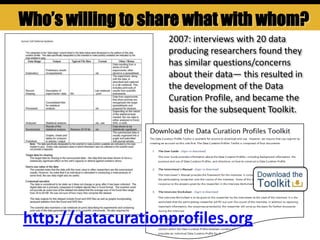
Who’s willing to share what with whom?
2007: interviews with 20 data
producing researchers found they
has similar questions/concerns
about their data— this resulted in
the development of the Data
Curation Profile, and became the
basis for the subsequent Toolkit.
http://datacurationprofiles.org
*D. Scott Brandt. Provost Fellowship, Final Report 2009 (unpublished)
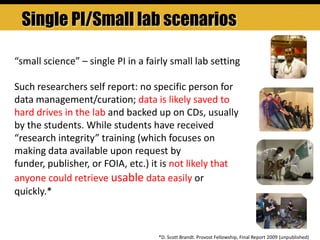
“small science” – single PI in a fairly small lab setting
Such researchers self report: no specific person for
data management/curation; data is likely saved to
hard drives in the lab and backed up on CDs, usually
by the students. While students have received
“research integrity” training (which focuses on
making data available upon request by
funder, publisher, or FOIA, etc.) it is not likely that
anyone could retrieve usable data easily or
quickly.*
Single PI/Small lab scenarios
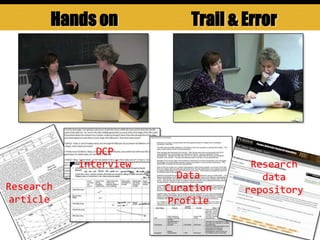
Hands on Trail & Error
Research
article
DCP
interview
Data
Curation
Profile
Research
data
repository
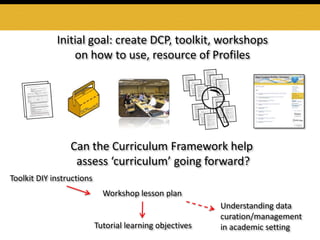
Initial goal: create DCP, toolkit, workshops
on how to use, resource of Profiles
Toolkit DIY instructions
Tutorial learning objectives
Workshop lesson plan
Understanding data
curation/management
in academic setting
Can the Curriculum Framework help
assess ‘curriculum’ going forward?
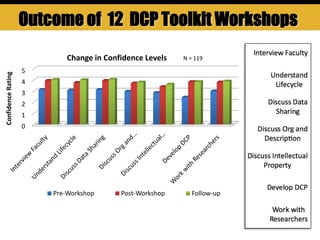
0
1
2
3
4
5
ConfidenceRating
Change in Confidence Levels
Pre-Workshop Post-Workshop Follow-up
N = 119
Outcome of 12 DCP Toolkit Workshops
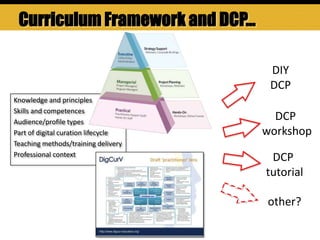
Knowledge and principles
Skills and competences
Audience/profile types
Part of digital curation lifecycle
Teaching methods/training delivery
Professional context
DIY
DCP
DCP
workshop
DCP
tutorial
Curriculum Framework and DCP…
other?
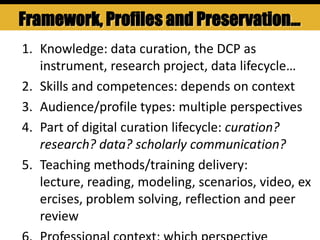
1. Knowledge: data curation, the DCP as
instrument, research project, data lifecycle…
2. Skills and competences: depends on context
3. Audience/profile types: multiple perspectives
4. Part of digital curation lifecycle: curation?
research? data? scholarly communication?
5. Teaching methods/training delivery:
lecture, reading, modeling, scenarios, video, ex
ercises, problem solving, reflection and peer
review
Framework, Profiles and Preservation…
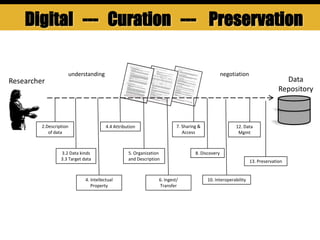
Researcher Data
Repository
3.2 Data kinds
3.3 Target data
2.Description
of data
5. Organization
and Description
6. Ingest/
Transfer
4.4 Attribution
8. Discovery
10. Interoperability
7. Sharing &
Access
13. Preservation
12. Data
Mgmt
understanding negotiation
4. Intellectual
Property
Digital --- Curation --- Preservation
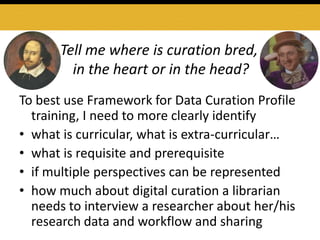
Tell me where is curation bred,
in the heart or in the head?
To best use Framework for Data Curation Profile
training, I need to more clearly identify
• what is curricular, what is extra-curricular…
• what is requisite and prerequisite
• if multiple perspectives can be represented
• how much about digital curation a librarian
needs to interview a researcher about her/his
research data and workflow and sharing
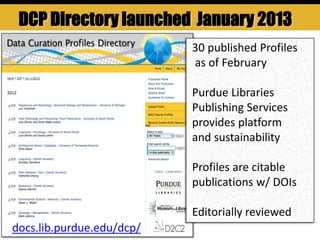
DCP Directory launched January 2013
30 published Profiles
as of February
Purdue Libraries
Publishing Services
provides platform
and sustainability
Profiles are citable
publications w/ DOIs
Editorially reviewed
docs.lib.purdue.edu/dcp/
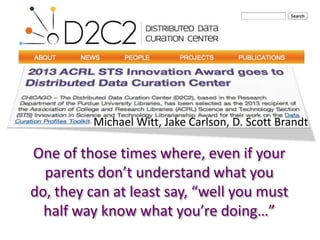
One of those times where, even if your
parents don’t understand what you
do, they can at least say, “well you must
half way know what you’re doing…”
Michael Witt, Jake Carlson, D. Scott Brandt
D. Scott Brandt
techman@purdue.edu
Framing the digital curation curriculum
International Conference
Florence, Italy / 6 - 7 May 2013
grazie mille

Learning Hands-on and by Trial & Error with Data Curation Profiles

  • 1.
    Learning Hands-on and byTrial & Error with Data Curation Profiles D. Scott Brandt assoc dean for research Framing the digital curation curriculum International Conference Florence, Italy / 6 - 7 May 2013
  • 3.
    Who’s willing toshare what with whom? 2007: interviews with 20 data producing researchers found they has similar questions/concerns about their data— this resulted in the development of the Data Curation Profile, and became the basis for the subsequent Toolkit. http://datacurationprofiles.org
  • 4.
    *D. Scott Brandt.Provost Fellowship, Final Report 2009 (unpublished) “small science” – single PI in a fairly small lab setting Such researchers self report: no specific person for data management/curation; data is likely saved to hard drives in the lab and backed up on CDs, usually by the students. While students have received “research integrity” training (which focuses on making data available upon request by funder, publisher, or FOIA, etc.) it is not likely that anyone could retrieve usable data easily or quickly.* Single PI/Small lab scenarios
  • 5.
    Hands on Trail& Error Research article DCP interview Data Curation Profile Research data repository
  • 6.
    Initial goal: createDCP, toolkit, workshops on how to use, resource of Profiles Toolkit DIY instructions Tutorial learning objectives Workshop lesson plan Understanding data curation/management in academic setting Can the Curriculum Framework help assess ‘curriculum’ going forward?
  • 7.
    0 1 2 3 4 5 ConfidenceRating Change in ConfidenceLevels Pre-Workshop Post-Workshop Follow-up N = 119 Outcome of 12 DCP Toolkit Workshops
  • 8.
    Knowledge and principles Skillsand competences Audience/profile types Part of digital curation lifecycle Teaching methods/training delivery Professional context DIY DCP DCP workshop DCP tutorial Curriculum Framework and DCP… other?
  • 9.
    1. Knowledge: datacuration, the DCP as instrument, research project, data lifecycle… 2. Skills and competences: depends on context 3. Audience/profile types: multiple perspectives 4. Part of digital curation lifecycle: curation? research? data? scholarly communication? 5. Teaching methods/training delivery: lecture, reading, modeling, scenarios, video, ex ercises, problem solving, reflection and peer review Framework, Profiles and Preservation…
  • 10.
    Researcher Data Repository 3.2 Datakinds 3.3 Target data 2.Description of data 5. Organization and Description 6. Ingest/ Transfer 4.4 Attribution 8. Discovery 10. Interoperability 7. Sharing & Access 13. Preservation 12. Data Mgmt understanding negotiation 4. Intellectual Property Digital --- Curation --- Preservation
  • 11.
    Tell me whereis curation bred, in the heart or in the head? To best use Framework for Data Curation Profile training, I need to more clearly identify • what is curricular, what is extra-curricular… • what is requisite and prerequisite • if multiple perspectives can be represented • how much about digital curation a librarian needs to interview a researcher about her/his research data and workflow and sharing
  • 12.
    DCP Directory launchedJanuary 2013 30 published Profiles as of February Purdue Libraries Publishing Services provides platform and sustainability Profiles are citable publications w/ DOIs Editorially reviewed docs.lib.purdue.edu/dcp/
  • 13.
    One of thosetimes where, even if your parents don’t understand what you do, they can at least say, “well you must half way know what you’re doing…” Michael Witt, Jake Carlson, D. Scott Brandt
  • 15.
    D. Scott Brandt techman@purdue.edu Framingthe digital curation curriculum International Conference Florence, Italy / 6 - 7 May 2013 grazie mille

Editor's Notes

  • #4 Research revealed that: the definition of what was considered data was quite variable; researchers had varying ideas about sharing data sets at different points in the research lifecycle; and concerns about getting credit for something shared were very similar across a range of research disciplines.
  • #5 Interested in understanding and helping researchers who don’t have a typical pathway for making accessible, let alone preserving, their research outputs
  • #6 As noted in the paper, one of the difficulties of trying to look at this through the perspective of the framework is the hands-on nature of using the DCP, and the trial and error needed to identify a research project to purse, the art of interviewing and then synthesizing information into a Profile, all with the ultimate goal of getting data deposited so that it can be curated, archived and preserved…. Part of this struggle may be directly related to the fact that in many ways we’re talking about art, in a sense, not science… the art of creating a data curation profile
  • #9 There is a lot that the Framework has to offer… I am especially interested in suggestions as to which subjects should be covered in shorter, and how or whether we should provide more specialized courses addressing one particular area of professional digital curation practice. We are very much in need of some kind of a common language as we move forward, especially if we to collaboration with others inbuilding and developing training
  • #10 1) Utilizing the framework helps clarify that there are knowledge and principles related to multiple topics…. data curation, the DCP as instrument, research project, data lifecycle– how deeply can/should each of these be addressed? 2) It became clear that we have muddled out attempts so far in defining skills and competences– there are skills related to using the tool that depend on broader competencies such as interviewing itself (asking probing questions, keeping on track, etc.) and raise the question can we teach what the tool is intended but not all the ins-and-outs of how to interview? 3) While training to use the DCP is aimed at the person doing the interview, there are several perspectives that can be considered– in the cases up to now, the interviewer has been an academic librarian who is a kind of mediator– but could the researcher or data producer use the instrument to essentially interview herself? I was recently asked by a municipal archivist if the tool could be used by him as pre-appraisal tool to understand what and agency is doing with their data… 4) Although I haven’t sorted through it yet, there is a little question of how much of which lifecycle does one need to know? (is there one lifecycle to rule them all?) 5) This is one of the things that is driving me crazy… as noted in the paper, we gave context (lecture), instruction (reading), modeling (videos) and employed problem solving (exercises) but who can find time to recreate online???
  • #11 Part of what I struggle with is where along a continuum of a researcher who does not currently share (or is the gatekeeper for doing so with all the inequality of scale associated with that) and the archive or repository where the person who does preservation is, do I and countless others stand (or sit)? What aspect of curation am I focusing on, and is it in fact curation or something like pre-curation?
  • #12 So as I suggested earlier, I’m not sure how much of working with the Profiles, and teaching others how to, relies on art, which is to say in the heart, or relies more educational on instructional design and education technology, which is to say, the head… I am here to network with others to gain more insight and learn more
  • #13 One reason I want to take advantage of tools like the Framework is that we are starting to see some successes, and we’d like to leverage this further
  • #14 Another reasons we came to the Framework is that we want to carry on to get this right… the DCP have been recognized for innovation in science and technology in librarians